
NIL
Michigan football recruiting: How NIL affected signing day drama

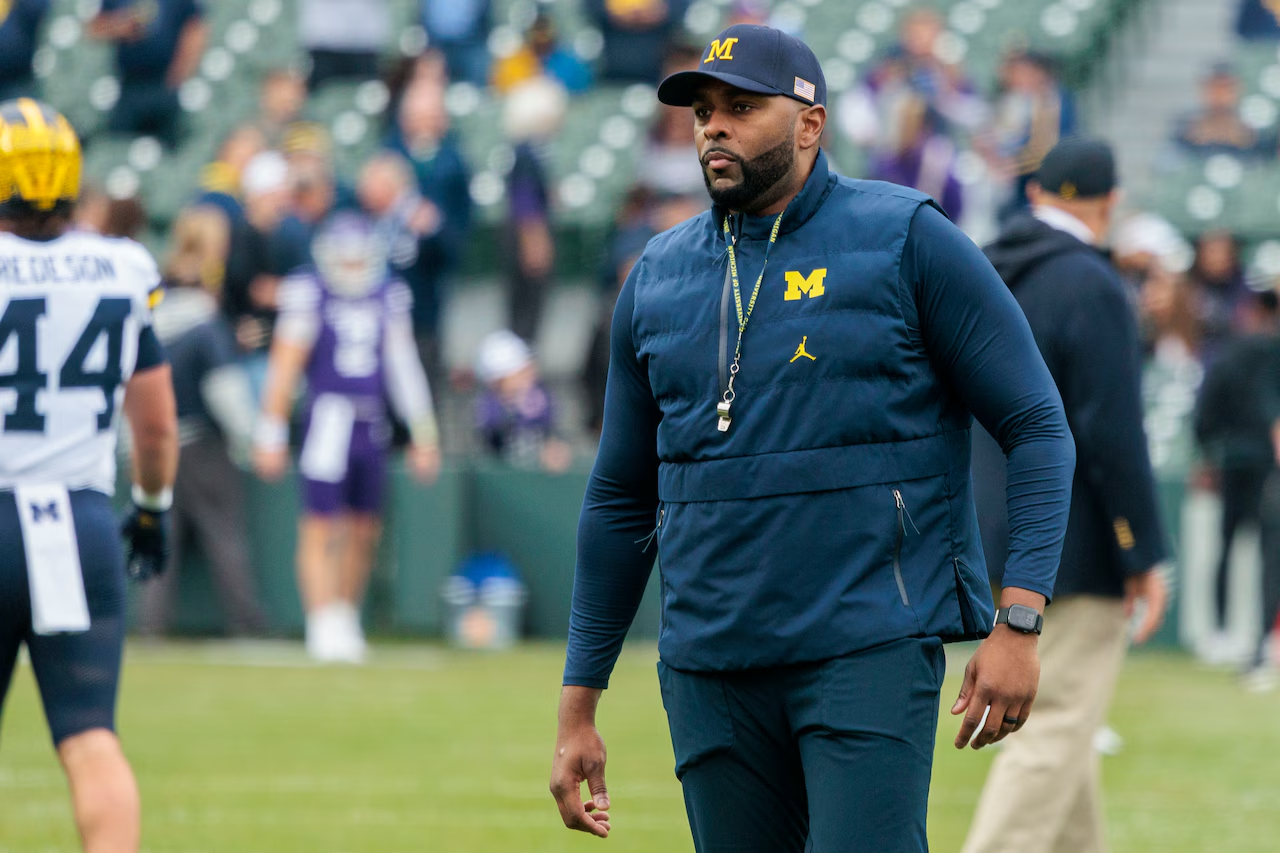
ANN ARBOR – National signing day has always been an opportunity for college coaches to celebrate a new wave of players entering their program.
But in the current name, image and likeness-driven landscape of NCAA football, signing day also is one of the most stressful days of the year for coaches.
This signing day was no different, with dozens of prospects in the 2026 class having a late change of heart about their college choices just before putting pen to paper to make their verbal commitments official.
Michigan and head coach Sherrone Moore weren’t immune to this year’s signing day chaos. The Wolverines had 28 commits entering last Wednesday, the start of the early signing window, but only signed 27 recruits after some late reshuffling in the class.
The drama began Wednesday morning when Mansfield (Texas) four-star receiver pledge Zion Robinson announced he was “postponing signing until further notice.”
According to 247Sports’ Mike Roach, Stanford made an aggressive NIL play for Robinson. The school, which has had five straight losing seasons, successfully flipped the top-200 prospect on Thursday.
Meanwhile, Mineral (Va.) Louisa County five-star running back Savion Hiter, the crown jewel of Michigan’s class, didn’t sign on Wednesday. The delay sparked intense speculation on fan message boards about Hiter’s status, but Michigan was able to seal the deal Thursday morning.
According to Rivals’ Steve Wiltfong, Hiter, the top-ranked running back in the country per the 247Sports Composite, didn’t sign Wednesday because of “minor contractual details.”
The signing period fireworks didn’t end there. Michigan also lost Irmo (S.C.) Dutch Fork four-star edge Julian Walker to South Carolina on Thursday as the top-100 recruit chose to play for his hometown school where his father is on staff, but Moore’s program countered with a major move of its own.
It flipped Cartersville (Ga.) four-star receiver Brady Marchese from Georgia, adding a new top-150 wideout to its 2026 recruiting haul.
Moore was asked during a news conference Monday how much NIL has impacted late flips on signing day.
“It’s definitely out there,” Moore said. “It’s definitely a thing. It’s something you can’t ignore and you have to have a plan for it, and you have to adapt to it, because, yeah, that’s part of it. You think you got somebody signed, and then somebody shoots out something (other schools offering more in the NIL space), or does something, and you’ve got it cemented of what you’ve all agreed to, and all those other things, all those other pieces that are part of college football now, but that’s just college football now. You’ve got to adjust and you’ve got to adapt.”
More than ever before, roster construction in college football is driven by NIL funding. Not only is it prevalent in recruiting high school prospects, but also players in the transfer portal and retaining players on the current roster.
The biggest difference between high school recruiting and the portal is the timelines. Prep prospects can commit to a school at any time, but that verbal pledge doesn’t become binding until the player signs with the school. For example, Robinson and Walker were both committed to Michigan since last summer before flipping. Marchese was pledged to Georgia since March.
The portal is a more condensed timeline. The two-week window opens Jan. 2, and prospects usually try and find a new home quickly so they can enroll at their new schools in time for the start of a fresh semester.
Moore said Michigan is prepared.
“The big thing about the portal is not only getting the right fit, but the relationship,” he said. “Obviously, the right player, but people that fit the program, the people that fit the culture, the people that fit involved in the program. You’ve got to be ready. We’re on it. We’ve been on it. You’ve got to stay on it.
“You’ve got to have lists ready to go. Obviously, you can’t talk to the kids until they get in it. So, we’ve got to do everything we can to be prepared for that. From a financial basis, all that is a piece of it, right? We’ve got to make sure we’ve got a plan for all of it, and we do.”

The eight remaining candidates met with UCLA’s search committee on Zoom, each answering the same set of questions.
When those conversations ended, Martin Jarmond, the athletic director who was presiding over the Bruins’ quest to find their next great football coach, asked everyone on the committee to prioritize which candidates needed to be seen in person.
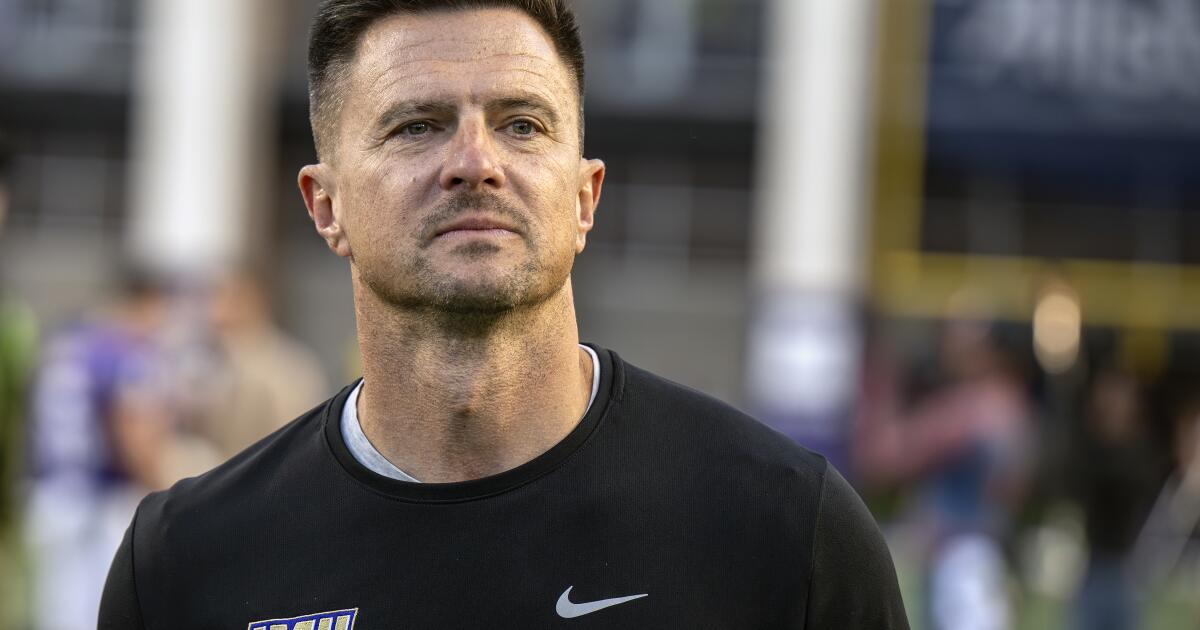
Everyone’s list included the same name: Bob Chesney.
The James Madison coach had already wowed the committee by then, according to multiple people with knowledge of the search who spoke with The Times on condition of anonymity because of the private nature of the process.
Chesney’s experience building programs into winners, established track record of success at multiple levels, ability to develop talent and appreciation for everything UCLA had to offer were all selling points that made him an attractive candidate early in a search lasting 2½ months.
Along the way, Chesney and the six-person committee nurtured a relationship based on shared values and mutual respect, according to those familiar with the process, making him feel prioritized when other potential suitors emerged as part of a coaching carousel that threatened to spin out of control as new openings materialized seemingly by the day.
After Jarmond and Erin Adkins, the executive senior associate athletic director who was also part of the search committee, flew to see Chesney last month in Virginia, the coach and his suitors came to the same conclusion — they were a perfect match. Chesney agreed to become the Bruins’ new coach on Dec. 1, accepting a five-year deal.
On Tuesday morning on campus inside the Luskin Center, UCLA will introduce a coach whose hiring might be the coup of the carousel.
“We owe UCLA students, alumni, supporters and fans a football program built to succeed in the modern age of college sports, and hiring coach Chesney will do just that,” search committee member Bob Myers said. “We not only believe in him as a head coach, but also as a person. His character and values were a huge factor in our decision. Coach Chesney exudes all the qualities you want in someone charged with leading our student-athletes at UCLA.”
The buzz around Chesney only intensified Sunday when James Madison was selected for the College Football Playoff, dramatically increasing his profile. UCLA has agreed to allow Chesney to coach the 12th-seeded Dukes (12-1) through a CFP run that starts Dec. 20 when they face fifth-seeded Oregon (11-1) at Autzen Stadium, the Bruins undoubtedly getting free air time during the TNT broadcast when their new coach is mentioned. The committee was firmly behind Chesney participating in the playoff, celebrating his team’s selection.
The process leading to Chesney’s hiring started as most coaching searches do, with a firing. The dismissal of coach DeShaun Foster on Sept. 14 after an 0-3 start — giving him a 5-10 record over a little more than one season — left the Bruins with a need to recalibrate their approach in picking a successor.

Martin Jarmond
(Wally Skalij/Los Angeles Times)
Jarmond identified three principal guidelines for the search while meeting with UCLA chancellor Julio Frenk. There needed to be alignment among everyone involved in the process about what they wanted in their new coach, ample investment to allow that coach to compete in the Big Ten and nationally, and ultimately the identification of a strong leader who embodied the school’s core values.
Jarmond was open to any candidate, including NFL coaches and college coordinators, but eventually came to prioritize sitting head coaches who had gone through the recent transformative changes in college sports involving the transfer portal, roster management and the name, image and likeness space. There was also a strong preference for someone who had experience turning around a program, building it into a sustained winner.
A search committee that included Jarmond, Adkins, Myers, sports executive Casey Wasserman, Washington Commanders general manager Adam Peters and former Bruins linebacker Eric Kendricks cast a wide net, starting with a list of 40 possible candidates. The committee gathered preliminary background information on those coaches and met regularly via phone calls and in person, with Peters often joining via Zoom because he was based on the East Coast.
Peters offered intelligence based on his extensive network of NFL personnel who regularly visited college campuses and observed coaches. Myers and Wasserman provided insights based on their vast experience as top-level sports executives. Kendricks, who has spent a decade playing in the NFL, queried candidates on playing style, practice habits, accountability measures and coaching philosophy.
As the committee continued to gather information and assess possible fit, it halved the list of candidates to 20, then narrowed it further to 12 and then eight, which included seven sitting college head coaches and one college coordinator. After the round of Zoom calls, the committee identified six candidates it wanted to remain in contention. Jarmond and Adkins flew to see four candidates in person, keeping two others in the running for possible future meetings.
After every interview and in-person meeting, the committee members always asked themselves the same things: Did this candidate possess the qualities they were seeking and could he fulfill their vision for winning?
Chesney, 48, kept checking every box from early in the process. On his Zoom with the committee, Chesney detailed his plan for winning with the Bruins and gave examples of experiences at other schools that revealed his appreciation for what it took to succeed at a highly rigorous academic institution. His resume was just as impressive as his answers.
Chesney’s 132-51 record included success at the Division III, Division II, Football Championship Subdivision and Football Bowl Subdivision levels. Part of that success included dramatic turnarounds. Assumption, which had gone 3-7 under previous coach Corey Bailey in 2012, enjoyed a steady rise under Chesney, going from 6-5 in Year 1 to 7-4 in Year 2 to 11-2 in Year 3.
It was a similar story at Holy Cross, which had gone 4-7 the year before Chesney’s arrival. By Chesney’s second season, the Crusaders started a four-year run of making the FCS playoffs, reaching a quarterfinal in 2022.
While coach Curt Cignetti already had James Madison rolling, the Dukes going 11-2 and reaching the Armed Forces Bowl in 2023, Chesney has now managed in only two years to take the program somewhere his predecessor couldn’t — the CFP.
It’s that sort of sustained success that left UCLA’s search committee with no qualms about Chesney not having won at the Power Four level. Given Chesney’s track record, the committee believed that all he needed to win big at college football’s highest level was an opportunity.
UCLA plans to support its new coach with enhanced resources, making a significant commitment to grow its assistant coach salary pool alongside additional investment in front-office, recruiting and strength and conditioning personnel as well as a restructured NIL operation.
Jarmond and Adkins flew to Virginia on Sunday so that they could accompany Chesney on his flight to Southern California on Monday ahead of his introduction a day later. Chesney will return to James Madison on Wednesday, continuing preparations to take his team somewhere the Bruins hope he can lead them.
Feeling like winners already, the Bruins are about to unveil the coach who seems to have all the answers.
A brand-new NIL
Chesney is going to have some new resources at his disposal.
As part of an aggressive restructuring, UCLA has transitioned its name, image and likeness efforts for football to the same third-party media and branding agency that handles the school’s other teams.
Champion of Westwood will assist Chesney in an effort to elevate his team’s NIL endeavors in the same way it has for men’s basketball — through its Men of Westwood arm — as well as women’s basketball, softball and other teams on campus.
Working with NIL agency Article 41, which has staff on campus to help athletes build their brands through content creation and social media strategies, Champion of Westwood is striving to create new opportunities for football players as part of an all-inclusive approach.
“Everyone is committed to being very symbiotic on this, which I think will lead to success,” said Ken Graiwer, the UCLA alumnus who runs Champion of Westwood. “Supporting NIL is supporting the program.”
As part of a new subscriber model in which payments can be made on a one-time or recurring basis, Champion of Westwood is offering benefits such as exclusive merchandise and player video updates directly from the locker room after a game.
Among its corporate sponsors, Champion of Westwood has partnered with Paige, the same apparel company that outfitted Dodgers stars Freddie Freeman and Mookie Betts.
“They were looking for the next generation of top athletes,” Graiwer said of Paige identifying UCLA as a client. “These are the great kinds of things that we’re doing.”
Champion of Westwood has also assembled a new advisory board that includes former UCLA quarterback Cory Paus, mega donor Michael Price and other heavyweights in the financial and entertainment sectors who can help facilitate introductions between players and individuals or companies interested in engaging them for NIL deals.
Olympic sport of the week: Men’s water polo

The UCLA men’s water polo team after winning the national championship.
(UCLA Athletics)
It was the sort of ending the cross-town rivalry deserved.
In another back-and-forth battle, Frederico Jucá Carsalade made sure the UCLA men’s water polo team came out on top with a goal as time expired Sunday at Stanford’s Avery Aquatic Center, lifting the Bruins to an 11-10 victory over USC in the national championship game.
USC’s Jack Martin had tied the score with 2:03 left before Carsalade’s goal gave UCLA its 125th NCAA title in school history and its second consecutive championship in men’s water polo. Carsalade finished with two goals and Ryder Dodd scored three, including back-to-back goals that pushed the Bruins into a 10-9 lead before the Trojans rallied.
It was payback after USC had won two of the three previous meetings between the teams this season. The victory gave UCLA coach Adam Wright his 10th NCAA title with the Bruins — six as head coach of the men’s water polo team, two as a player for the Bruins, one as head coach of the women’s water polo team and another as an assistant coach with the women’s team.
Opinion time
What is your level of happiness with the Bob Chesney hire?
Ecstatic, couldn’t be happier
Guardedly optimistic
In wait-and-see mode
This is the best they could do?
Click here to vote in our survey.
Poll results
We asked, “How optimistic are you for UCLA football in 2026?”
After 612 votes, the results:
They will qualify for a lower-tier bowl game, 47.1%
They will show some fight, but struggle to a losing record, 23.5%
It’s going to be another long season, 14.6%
They will make a quality bowl game, 10.7%
The Bruins will be in College Football Playoff contention, 4.1%
In case you missed it
Lauren Betts helps No. 3 UCLA pummel Oregon in Big Ten opener
Here are 15 reasons why UCLA should not abandon the Rose Bowl
Eric Dailey Jr. goes from zero to hero, powering UCLA to victory over Oregon
UCLA got its new football coach in Bob Chesney, but who will be coming with him?
‘That’s Bernie Madoff level’: UCLA’s Mick Cronin says agent greed drives player movement
Kroenke Sports and SoFi Stadium are new defendants in Rose Bowl lawsuit against UCLA
UCLA and USC football transfer portal tracker: Who’s in and who’s out?
Mixed results for UCLA on early signing day
How UCLA football salvaged its recruiting class, giving Bob Chesney an early boost
Have something Bruin?
Do you have a comment or something you’d like to see in a future UCLA newsletter? Email me at ben.bolch@latimes.com, and follow me on X @latbbolch. To order an autographed copy of my book, “100 Things UCLA Fans Should Know & Do Before They Die,” send me an email. To get this newsletter in your inbox, click here.

Manning’s name, image and likeness (NIL) valuation has risen to $5.3 million as of Monday, December 8, almost $2 million higher than it was last month. In mid-November, Manning lost his title as the highest paid college athlete, but he now finds himself back on top thanks to a upset victory by the Longhorns to cap off the regular season.
Manning currently leads all athlete on On3’s NIL valuations tracker, followed by BYU basketball player AJ Dybantsa at No. 2 with a $4.3 million value and Ohio State football player Jeremiah State at No. 3 with a value of $4.2 million.
Manning, who is the nephew of Super Bowl-winning quarterbacks Peyton and Eli, saw his NIL value peak at $6.8 million in July, per On3’s past NIL data. However, his value began to slowly take a dip throughout the season after Texas lost to Ohio State, Florida and Georgia. After Texas’ loss to Georgia, Manning’s NIL valuation fell to nearly half of what is was in the preseason, dropping to $3.6 million on November 17.
Texas finished at No. 13 in the final CFP rankings with a 9-3 record, not good enough to earn an at-large bid in the CFP. This marks the first time in three years that Texas will not appear in the playoffs, but Longhorn fans will still get to see their team take on the Michigan Wolverines in the Cheez-It Citrus Bowl on December 31.

The decision by Notre Dame to not play in a bowl game could have sweeping consequences not only for the playoff system, but also regarding the future of the national college football bowl system itself.
That is according to a bowl executive who believes the move could have historic implications for the entire postseason format.
The end of college football bowl season?
After being snubbed from playoff consideration on selection day, Notre Dame stunned the college football world by declining to take part in any postseason competition, and a person involved in the bowl system has suggested that the move could spell its end.
“The bowl system we know now is officially dead,” a college football bowl executive said, via On3 Sports’ Brett McMurphy.
They added: “RIP. It was a nice run while it lasted.”
Playoff or bust?
After news of Notre Dame’s decision went public, a growing consensus has emerged among college football analysts that a precedent has already been established.
By having such a well-known and highly-ranked team that was kept out of the playoff elect to not play in any bowl game, a message of sorts has been communicated to decision makers that the big-time schools are moving towards a playoff-or-bust mentality.
Over time, that could prove to be a mortal blow against a bowl system that was already struggling to stay as relevant as in years past since the emergence of the playoff.
Why Notre Dame did it
Notre Dame looked poised to take the final place in the College Football Playoff after being ranked ahead of Miami in the selection committee’s previous rankings.
That was, until the selectors suddenly swapped them on the last day to put the Hurricanes in and the Irish out.
While most observers agree Miami likely deserved the spot given its head-to-head victory over Notre Dame, the timing of the committee’s decision also drew criticism.
And positively enraged everyone at Notre Dame, enough to withdraw their name from any bowl consideration. Why play in a rinky-dink bowl game when you could have had a playoff spot?
Notre Dame isn’t alone
While it may be the most high-profile program to back out of the bowl season, Notre Dame is not the only one to make that decision.
Kansas State and Iowa State were the two other bowl-eligible teams that announced they will not play in the postseason after the first school’s head coach retired and the latter’s, Matt Campbell, left the program to become the head man at Penn State.
Florida State, Auburn, UCF, Baylor, Kansas, Rutgers, and Temple were the 5-7 schools that also turned down a bowl appearance that was offered to them, according to McMurphy.
Those schools all have very different reasons, but the relatively easy decision they made to not take part in bowl season could itself be enough to send a message to the powers that be that the system itself may not be as important as it once was.
ESPN being the main power in question, given it broadcasts so many of the bowl games and owns more than a dozen of them.
The end of another tradition?
The network could eventually decide that bowl season is an acceptable sacrifice in order to put all of its attention on broadcasting the College Football Playoff.
Which could, in turn, fuel more expansion of the playoff field to ensure as many high-profile schools can take part as possible.
Who knows what the timeline would be, but if the process of eliminating bowl games will turn college football’s operators a profit in place of tradition, you can be sure that’s the course they’ll take.
Read more from College Football HQ
NIL
ACC Commissioner Jim Phillips releases statement on Notre Dame College Football Playoff snub, callout of conference
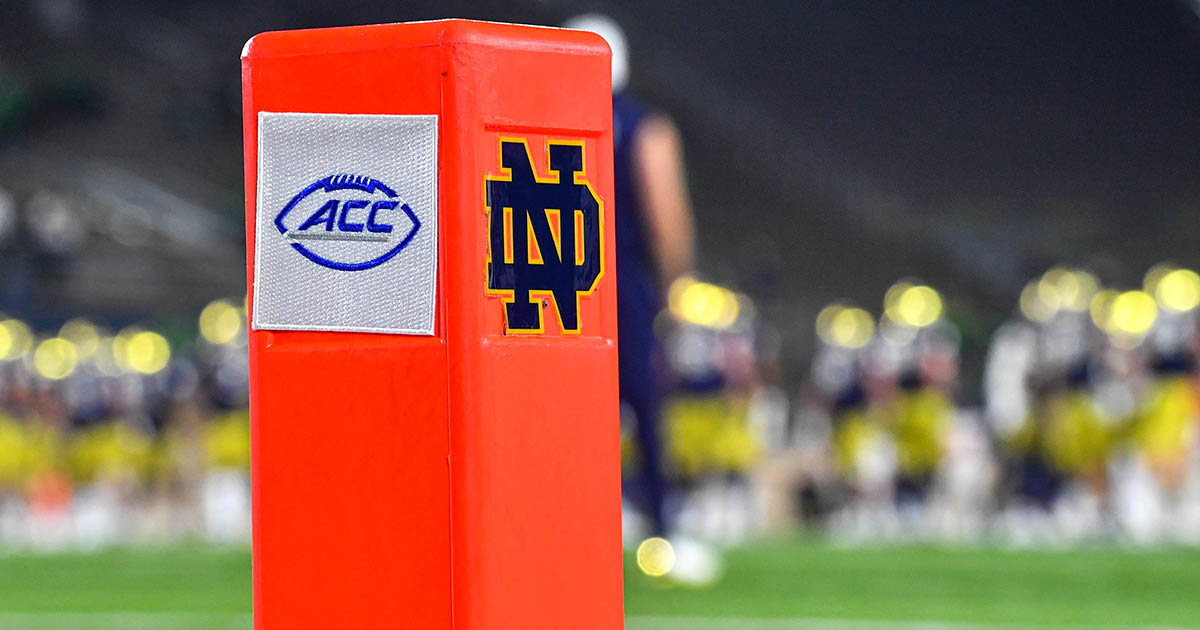
In the aftermath of the College Football Playoff bracket reveal, Notre Dame athletic director Pete Bevacqua has gone after the ACC. He says the ACC has done “permanent damage” to their relationship in an attempt to get Miami into the 12-team field. Notre Dame plays five ACC teams a season in football, while being a member of the conference in other sports.
These comments from Bevacqua came on Monday, only for ACC commissioner Jim Phillips to respond. Phillips released a statement on the matter to On3’s Brett McMurphy.
“The University of Notre Dame is an incredibly valued member of the ACC and there is tremendous respect and appreciation for the entire institution,” Phillips said. “With that said, when it comes to football, we have a responsibility to support and advocate for all 17 of our football-playing member institutions, and I stand behind our conference efforts to do just that leading up to the College Football Playoff Committee selections on Sunday.
“At no time was it suggested by the ACC that Notre Dame was not a worthy candidate for inclusion in the field. We are thrilled for the University of Miami while also understanding and appreciating the significant disappointment of the Notre Dame players, coaches and program.”
Miami will travel to Kyle Field on Dec. 20, facing Texas A&M in the first round. Kickoff is scheduled for noon ET and 11 a.m. local time. Notre Dame’s season is done, declining an opportunity to play in the Pop-Tarts Bowl against BYU.
Pete Bevacqua expresses ‘permanent damage’ done by ACC
Bevacqua made an appearance on The Dan Patrick Show, discussing Notre Dame getting snubbed from the College Football Playoff. The issue for him is not with Miami, the team seemingly replacing the Irish. Instead, Bevacqua believes the ACC attempting to knock down Notre Dame while promoting Miami was a bad look.
“I have tremendous respect for Miami, great team, great school,” Bevacqua said. “Their athletic director, Dan Radakovich, is a good friend. We were mystified by the actions of the conference, to attack their biggest business partner in football and a member of their conference in 24 of our other sports. I wouldn’t be honest with you if I didn’t say that they have certainly done permanent damage to the relationship between the conference and Notre Dame.”
As usual, five ACC opponents are on the 2026 schedule for Notre Dame. Of those, only one will take place outside of South Bend. North Carolina will host the Irish on Oct. 3. Four others, including Miami, will make their way to Notre Dame Stadium throughout the season.

Yes, it’s a bit unorthodox to hire your just-fired head coach as DC. But as you noted Pry had great success with Franklin as his defensive coordinator for many years. And it frees up some money to allocate elsewhere. Pry is already on our payroll, so we might as well get some value for our money. If he flames out as DC in year 1 (doubt it, given the upcoming talent upgrade), no catastrophe. Just fire him (again) and get someone else.

Luffey, Punt Win Events at Season’s First Track Meet

Gophers volleyball sweeps their way to the Sweet 16 – The Minnesota Daily

Kentucky’s $22 Million Basketball Roster Looks Like a Dud

Monks Duo Collects GNAC Track & Field Weekly Accolades

NCAA women’s volleyball: Nebraska and the No. 1 seeds continue their dominance, while some Cinderellas remain

Triple Crown: Monks Men Collect GNAC Track, Field, and Rookie of the Week

After 36-year career, Beth Launiere announces retirement as Utes volleyball coach

Stephen Nasse finally wins Snowball Derby after Ty Majeski penalty

Vanderbilt Football | Lea is Finalist for Another Award

Volleyball ends rocky season with hope for the future — The Panther Newspaper

Coalition files petition to end auto racing at Nashville Fairgrounds Speedway

The backstory on the search that made Bob Chesney a Bruin
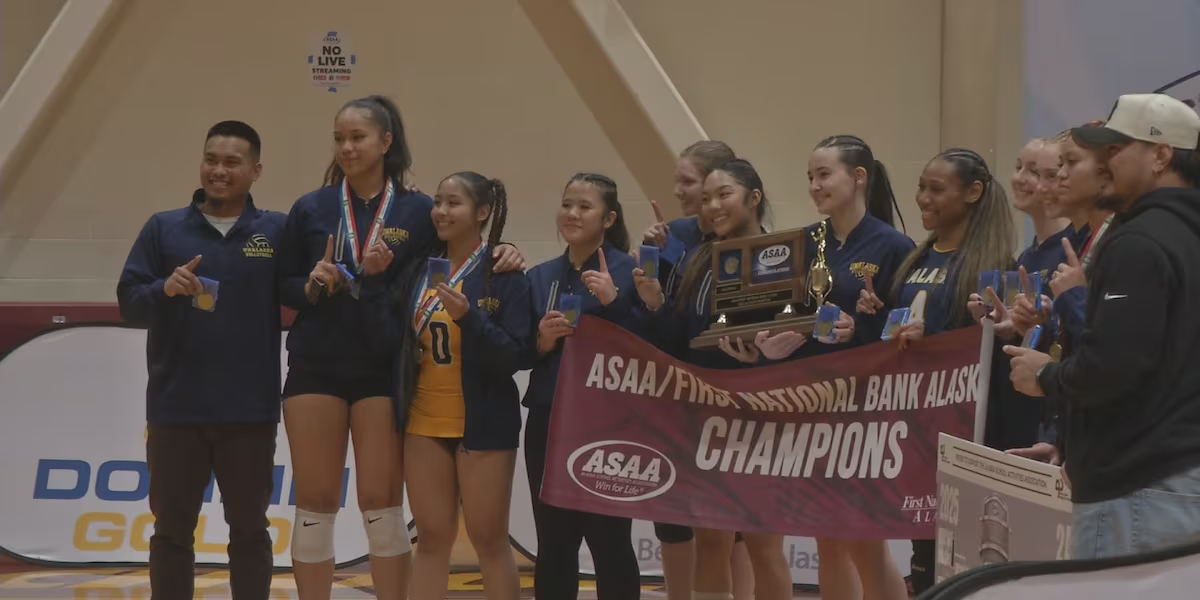
Unalaska, Tanalian both repeat as state volleyball champs

NASCAR owes $364.7M to teams in antitrust case

Lynchburg Announces Joshua Knapp As Head Men’s Volleyball Coach

First Tee Winter Registration is open

Fargo girl, 13, dies after collapsing during school basketball game – Grand Forks Herald

CPG Brands Like Allegra Are Betting on F1 for the First Time

Volleyball Recaps – November 18

F1 Las Vegas: Verstappen win, Norris and Piastri DQ tighten 2025 title fight

Two Pro Volleyball Leagues Serve Up Plans for Minnesota Teams

Utah State Announces 2025-26 Indoor Track & Field Schedule

Sycamores unveil 2026 track and field schedule

Redemption Means First Pro Stock World Championship for Dallas Glenn

Bowl Projections: ESPN predicts 12-team College Football Playoff bracket, full bowl slate after Week 14

Texas volleyball vs Kentucky game score: Live SEC tournament updates

Indiana’s rapid ascent and its impact across college football

How this startup (and a KC sports icon) turned young players into card-carrying legends overnight

Pohlman admits ‘there might be some spats’ as he pushes to get Kyle Busch winning again

Robert “Bobby” Lewis Hardin, 56

 Why a rising mid-major power with an NCAA Tournament team opted out of revenue-sharing — and advertised it
 NBA Legend Michael Jordan to Join NBC Sports as Special Contributor
 Falcons mailbag
 Portal Update – Basketball and Gymnastics Take Hits
 has always dreamed in Mercurial. Now his initials are on the boots.
The new Kyl…
has always dreamed in Mercurial. Now his initials are on the boots.
The new Kyl…
-
 Rec Sports2 weeks ago
First Tee Winter Registration is open
-
 Rec Sports2 weeks ago
Fargo girl, 13, dies after collapsing during school basketball game – Grand Forks Herald
-
 Motorsports2 weeks ago
CPG Brands Like Allegra Are Betting on F1 for the First Time
-
 Sports3 weeks ago
Volleyball Recaps – November 18
-
 Motorsports2 weeks ago
F1 Las Vegas: Verstappen win, Norris and Piastri DQ tighten 2025 title fight
-
 Sports2 weeks ago
Two Pro Volleyball Leagues Serve Up Plans for Minnesota Teams
-
 Sports2 weeks ago
Utah State Announces 2025-26 Indoor Track & Field Schedule
-
 Sports2 weeks ago
Sycamores unveil 2026 track and field schedule
-
 Motorsports2 weeks ago
Redemption Means First Pro Stock World Championship for Dallas Glenn
-
 NIL1 week ago
Bowl Projections: ESPN predicts 12-team College Football Playoff bracket, full bowl slate after Week 14