
Motorsports
All the key moments from the 23XI/FRM vs. NASCAR trial


The 23XI Racing and Front Row Motorsports v NASCAR antitrust trial is raging on as the two sides do battle inside a North Carolina courtroom with the future of the sport likely to be reshaped by the outcome.
Here, you can find a recap of some of the most important and interesting moments from each day of the trial, with links back to more in-depth stories from our Senior NASCAR Editor Matt Weaver, who is inside the room as the trial unfolds.
Day 4 — NASCAR’s Steve O’Donnell and the ‘threat’ of SRX,
The now defunct Superstar Racing Experience Series was at the heart of Day 4’s courtroom battle. In previously unsealed messages, NASCAR leadership made it clear that they saw SRX as a threat and took issue with their drivers/team owners taking part in the weekly series run by NASCAR Hall of Famer Tony Stewart.
Team attorney Jeffrey Kessler tried to drive home the point that NASCAR reacted in a clear way to stifle SRX, which could be critical in how this case goes in the end. It could answer in part if NASCAR is using its position as a monopoly in the premier Stock Car racing space to harm competition or those operating in the space, like the teams.
NASCAR president Steve O’Donell was questioned by Kessler about the previously unsealed messages and NASCAR’s issue with SRX. While the Sanctioning Body was praised for returning beloved short tracks Bowman Gray and North Wilkesboro to the schedule, the trial has revealed that was at least partially motivated by the fact that SRX could beat them there. They also prevented Speedway Motorsports from hosting SRX events.
O’Donnell said NASCAR was in the middle negotiating a new broadcast rights agreement ‘and SRX started to look like NASCAR, so we said no.’ He added that ‘ NASCAR wanted to gain as much TV revenue for the teams and tracks as possible,” and that they were concerned SRX could hinder those efforts. They were frustrated that the drivers and teams didn’t appear to be ‘all in’ on NASCAR by their choice to compete in SRX.
O’Donnell was asked why he wanted NASCAR’s legal team to look at SRX, and he claimed it was simply IP infringement concerns. The existence of LIV Golf and how it challenged the hegemony of the PGA Tour, clearly rattled NASCAR leadership as they saw the possibility of something similar happening in stock car racing.
During one 2022 meeting, Jeff Gordon of Hendrick Motorsports asked Ben Kennedy, the great grandson of NASCAR founder Bill France and nephew to Jim, if “the family was open to a new financial model” to help the teams. Kennedy had told him ‘yes,’ but when Kessler asked O’Donnell if that was actually true, he said ‘no.
In February of 2023, O’Donnell said in an hand-written note: “I was hoping the future board would include the next generation and was hoping to see that change.” Jim France is 81, and O’Donnell believed the ‘legacy mindset’ in the NASCAR Board ‘inhibited growth.’
“Mr. France was the brick wall in the negotiations,” Kessler suggested to O’Donnell, when referring to those 2023 messages.
“Those are your words, not mine,” replied O’Donnell.
On Thursday, O’Donnell also revealed that NASCAR lost $55 million in running the Chicago Street Course for three years. However, NASCAR still says it was worth it, as “it was a strategic investment because if not for that, Amazon would not have become a broadcast partner.” NASCAR also said they lost $6 million by racing in Mexico City this year, but did so because it was important to Amazon, who kicked in an addition $1 million in race purse.
The day also included some more testimony from FRM team owner Bob Jenkins, who was cross-examined. Jenkins testified that it costs $20 million per car to race in the Cup Series, but NASCAR attorney Lawrence Buterman produced discovery documents that showed the most FRM ever spent on a Cup car was actually $14 million.
There was also some discussion about the proposed FRM/23XI merger from a few years back, with NASCAR attorneys trying to draw parallels between those failed negotiations and the ones between the teams and the Sanctioning Body over the 2025 Charter Agreement, where a deadline was imposed.
‘We can’t keep negotiating this forever,” Jenkins wrote in a text and that’s “…why we decided we had to have a deal by 5 p.m.” Jenkins pushed back against what NASCAR’s legal team was trying to do, saying “this is another one of your analogies that doesn’t work.”
There was also some concern at the end of the day that the trial wasn’t moving quick enough, with Judge Bell saying: “I get the impression that this is not moving along the way we all would like it to.” He encouraged both sides to speed it along, and said the jury is being subjected to redundancy ‘and they’re seeing a lot of trees and not a lot of forest.’ Both sides are cutting witnesses to speed it up, but Roger Penske is only available on Monday, and while that timeline is unlikely to work out, Judge Bell said Penske needs to be present whenever he’s needed.
Day 3 — Prime faces more questions, FRM owner Bob Jenkins takes the stand
NASCAR’s Executive Vice President and Chief Strategy Officer Scott Prime was being cross-examined for the second day in a row. The exchanges between prime and team attorney Jeffrey Kessler was sometimes contentious, with the attorney even apologizing to Prime and the court for raising his voice at one point.
Kessler locked in on the goodwill provision in the 2025 Charter Agreement, which is basically a clause that prevents team owners from competing in another series or owning one without NASCAR approval. Kessler called it ‘anti-competitive will,’ which drew an objection from the NASCAR side. He also focused on the Next Gen car, trying to paint its intellectual property restrictions (as the parts are supplied by a third party) as a tool utilized to restrain trade and prevent competition.
Reacting to an email from NASCAR commissioner Steve Phelps where he took a ‘take it or leave it’ attitude, Kessler said: “Only a monopolist has the power to say, ‘Take my offer and if you don’t take it, you will no longer be in this business, and someone else will take your place.’”
He was also questioned about NASCAR’s exclusivity agreement with tracks, but Prime tried to say that a rival series could race at other short tracks or street courses all around the country. Kessler did not accept that, and pushed back.
Kessler also took time to focus on the The Amanda (Oliver) Chart, which reflected a series of 22 asks made by the race teams and showed only a single ‘win’ for the teams as they negotiated with NASCAR. Prime had previously NASCAR’s September 6 a ‘gun to the head’ offer and Kessler seized on that moment in questioning him. One of the asks was for permanent charters, but NASCAR CEO Jim France was unwilling to go that route, despite Prime doing some work behind the scenes to make that happen.
After Prime’s lengthy testimony concluded, Bob Jenkins took the stand. He is the owner of Front Row Motorsports — the only team that stood with 23XI against NASCAR as the other 13 chartered organizations signed the eleventh hour agreement last September.
Jenkins noted that he loses $6.8 million per year and has never turned a profit under the race team banner. He doesn’t take a salary either. He went on to say that he spends $4.7 million per year on car components under the Next Gen model, and that the number was only $1.8 million under the previous generation of car.
When asked why do it then, Jenkins replied: “That sounds like something my wife would say. I just believe in it. It’s why I feel so strongly about changing this system. There are 150 employees at that race shop who believe in me to make this work.”
When asked about the September 6 deadline, Jenkins called it ‘insulting’ and ‘backwards’ as he recalled those critical hours. “There was a lot of passion, a lot of emotion, especially from Joe Gibbs, he felt like he had to sign it,” Jenkins said. “Joe Gibbs felt like he let me down by signing. Not a single owner said, ‘I was happy to sign it.’ Not a single one.”
Jenkins was asked how he could sue NASCAR for placing non-compete clauses in their schedule and charter contracts while placing non-compete clauses in his driver contracts. Hamlin faced the same question from NASCAR attorneys earlier in the trial, and the answer was similar, pointing out that drivers have options on who to sign with.
After court proceedings concluded for the day, Judge Bell took issue with NASCAR attorneys for violating his orders.
Day 2 — Hamlin faces tense cross-examination and NASCAR executive grilled
Hamlin was grilled by NASCAR attorneys in a somewhat contentious back-and-forth. “We’re not a monopoly like you are,” Hamlin said multiple times while on the stand. Hamlin gave insight into his personal frustrations with France, saying it dates back to the 2022 banquet. “He told me directly the problem in NASCAR is that teams spend too much money,” recalled Hamlin, who says he was very ‘discouraged’ by how differently they viewed the financial landscape of the sport.
“Cutting is not growth. I can’t cut my costs in half. It’s not realistic,” asserted Hamlin. He verbally sparred with Lawrence Buterman as the attorney tried to poke holes in the claim that the teams were strapped for cash and struggling to make a profit.
We also learned that Hamlin makes $14 million per year with his current contract as a driver for Joe Gibbs Racing. When asked why he makes more than most drivers, Hamlin simply replied: “I am at the top of my game.”
Scott Prime is not usually front and center, but he was on Tuesday, December 2nd, as NASCAR’s Executive Vice President and Chief Strategy Officer faced uncomfortable questions from Kessler, representing the teams. He was forced to try and explain the internal strife within NASCAR over the charter terms, and the fact that CEO Jim France seemed committed to imposing on teams after shutting down negotiations. There have been numerous unsealed communications that appear to show that France was the roadblock in granting team’s better terms.
Prime was also asked about a possible breakaway series and NASCAR’s efforts to block a potential CART/IRL split in the stock car racing world. He was also questioned about Project Gold Codes, which he described as a ‘contingency plan’ in case multiple charter holding teams boycotted races and/or didn’t sign the charter agreement in time for the 2025 Daytona 500.
Day 1 – Jury selection, opening statements and Hamlin testimony
After jury selection, the trial officially began. Denny Hamlin, the co-owner at 23XI Racing and one of NASCAR’s top drivers, was the first witness to take the stand. However, he was only on the stand for 40 minutes with cross-examination from NASCAR’s legal team yet to commence.
There appeared to be a clear strategy of bringing up the fact that teams frequently compete with NASCAR for sponsorships, as Motorsport.com Senior NASCAR Editor Matt Weaver noted that Hamlin brought it up three times under questioning from his own attorney.
“First, I have to fend off the series,” Hamlin said. “If a new sponsor want to come in, NASCAR will go after them. I have to fight them. I have to fight other teams for them. I have to fight them for employees.”
Both sides also laid out their arguments to the assembled jury and repeated many of the key points that have been repeated throughout the course of this lawsuit. NASCAR attorney John E. Stephenson framed 23XI/FRM as attacking the charter system and that they only brought up claims of antitrust violations after refusing to sign the new agreement.
Kessler, representing the teams, prepared the groundwork to prove that there was a clear anti-competitive strategy orchestrated by NASCAR CEO Jim France. He showed eyebrow-raising text messages from NASCAR leadership to support his claims.
We want your opinion!
What would you like to see on Motorsport.com?
Take our 5 minute survey.
– The Motorsport.com Team


Former NASCAR driver Michael Annett has died. He was 39.
JR Motorsports announced Annett’s death in a social media post Friday evening with no other details. Annett drove for the team in the Xfinity Series for five seasons from 2017-21.
Annett made over 100 starts in NASCAR’s Cup Series and over 300 starts in NASCAR’s second-tier Xfinity Series. Annett’s lone Xfinity Series win came in 2019, when he won the season-opening race at Daytona. He went on to have five more top-five finishes and finished ninth in the points standings that season.
Advertisement
His best season in the Xfinity Series came in 2012 when he drove for Richard Petty Motorsports. Annett had six top-five finishes and 17 top-10 finishes and finished fifth in the points standings.
At JR Motorsports, he never finished outside the top 15 in the points standings.
Annett competed in 106 Cup Series races over the 2014, 2015 and 2016 seasons. He drove for underfunded teams Tommy Baldwin Racing and HScott Racing during his time at NASCAR’s top level and had just six top-20 finishes in his Cup Series career. His best finish came in 2015 when he was 13th at the Daytona 500.
Annett retired after the 2021 season after he dealt with a stress fracture in his right leg for much of the season. He missed seven races that year. He also missed races during the 2013 season after he suffered a fractured and dislocated sternum in a crash at Daytona when his car slammed head-on into the wall.
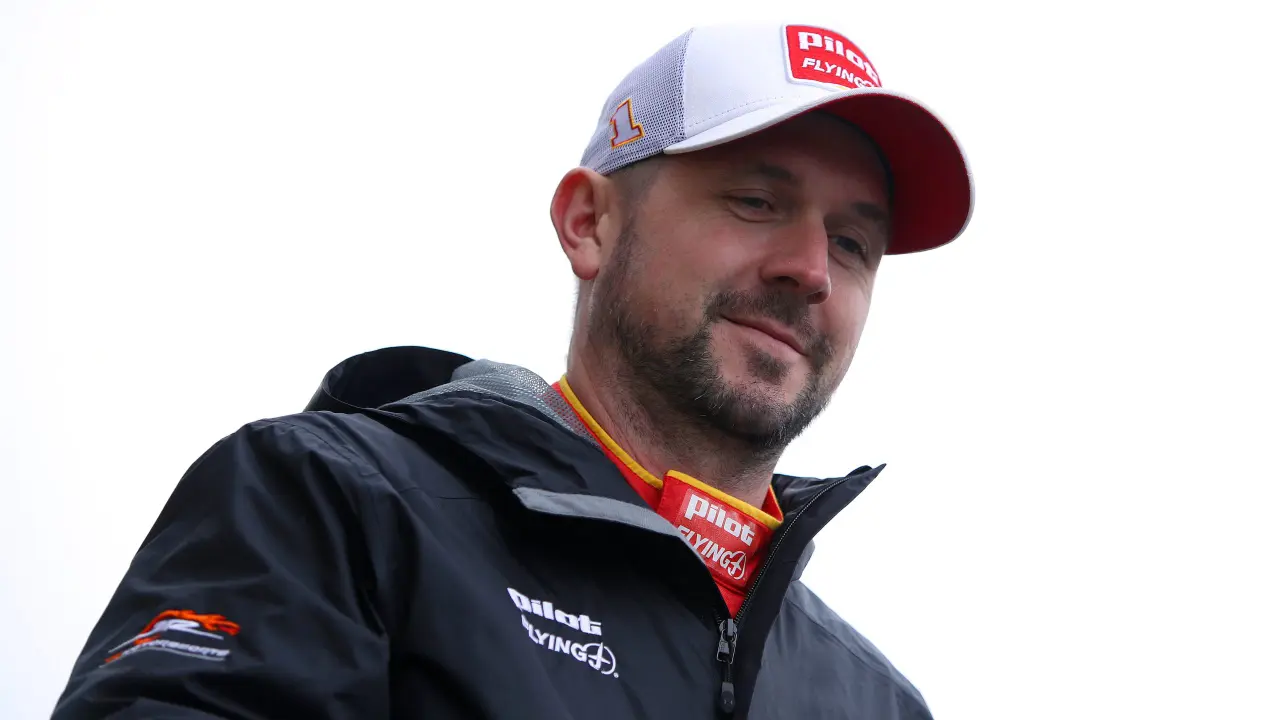

FILE – Michael Annett, driver of the #1 Pilot Flying J Chevrolet, waits on the grid prior to the NASCAR Xfinity Series Kansas Lottery 300 at Kansas Speedway on October 23, 2021 in Kansas City, Kansas. (Photo by Sean Gardner/Getty Images)
Michael Annett, a former NASCAR driver and winner in the Xfinity Series, has died at 39.
JR Motorsports, a team Annett drove for, confirmed his death Friday in a social media post.
Michael Annett cause of death
What we know:
Annett’s death was announced Friday, but no details have been released. Annett was a native of Des Moines, Iowa.
What we don’t know:
It’s unclear when and how he died, though former NASCAR driver Brad Keselowski said he’s “glad he is no longer suffering.”
What they’re saying:
“NASCAR is deeply saddened to learn of the passing of former NASCAR driver Michael Annett,” NASCAR said in a statement. “Michael was a respected competitor whose determination, professionalism, and positive spirit were felt by everyone in the garage. Throughout his career, he represented our sport with integrity and the passion of a true racer. NASCAR extends its condolences to Michael’s family and many friends.”
“Our thoughts and prayers are with the entire Annett family with the passing of our friend Michael Annett,” JR Motorsports shared on social media via X. “Michael was a key member of JRM from 2017 until he retired in 2021 and was an important part in turning us into the four-car organization we remain today.”
Michael Annett’s career
The backstory:
According to NASCAR, Annett made 436 combined starts in NASCAR’s three national touring series. He was most prominent in the Xfinity Series with 321 starts.
In 2019, Annett won the series’ season-opening race at Daytona International Speedway. It was his only national-level win.
Annett was also a two-time winner in the ARCA Menards Series, once in Talladega and once in Daytona.
Annett debuted in the Xfinity Series in 2008, then went full-time in 2009. He drove for Germain Racing, Rusty Wallace Racing, Richard Petty Motorsports, Turner Scott Motorsports and JR Motorsports, which is co-owned by Dale Earnhardt Jr.
He stepped away from racing after the 2021 season due to a stress fracture in his leg.
The Source: This report includes information and comments from NASCAR, JR Motorsports and NASCAR driver Brad Keselowski.

Michael Jordan took the stand on Friday afternoon in the Western District of North Carolina to close out the first week of the 23XI Racing and Front Row Motorsports v NASCAR antitrust lawsuit trial to much fanfare.
Jordan, who co-owns 23XI Racing with Cup Series driver Denny Hamlin and longtime business associate Curtis Polk, are suing NASCAR and CEO Jim France and the 15-month process reached the trial phase this week.
As a refresher, the court has determined that NASCAR is a monopsony, or in layman’s terms, a buyer’s monopoly. The Sanctioning Body is the only purchaser of premier Stock Car racing teams in the market and the question for the jury is whether or not that market power was used to hurt competition and depress the earnings of race teams during the charter extension negotiation period.
Basically, 23XI and Front Row allege that they would have earned more revenue from NASCAR if not for anticompetitive behavior from France that also took on the form of preventing competition from emerging in the marketplace.
Ultimately, 13 of 15 teams in the Cup Series signed the charter extension after over two years of contentious negotiating but the team owned by Hamlin and Jordan did not, alongside FRM owner Bob Jenkins.
“Someone had to step forward to challenge NASCAR,” Jordan said during his time on the stand.
Much of his one hour made the case that NASCAR should be operated more like the National Basketball Association, where he made his claim to fame, in which the league and teams split revenue closer to 50 percent but also share growth responsibilities more evenly.
“If you share responsibility, the healthiness of the sport can grow,” Jordan said. “It needed to be looked at from a whole different perspective. That’s why we’re here.”
The rebuttal from NASCAR, which was made in court on Friday from defense attorney Lawrence Buterman, is that NASCAR is privately-owned by the France family and is not a stick-and-ball league in which the teams effectively own the sport.
Jordan told Buterman that such privately owned sports ventures are ‘rarely successful.’
And yet, Jordan bought into Hamlin’s vision, and even put up the most money to launch what was originally called ‘Michael Jordan Motorsports with Denny Hamlin.’ He is the majority owner and has put $35 to $40 million into the race team.
He did so despite Polk, who has managed many of his affairs for 35 years, telling Jordan that NASCAR was ‘risky to (his) brand and image’ and risked the loss of tens of millions of dollars ‘but you want to do it so I’m doing my best to manage it.’
To wit, Jordan is a professed life long NASCAR fan and was entirely bought-in to Hamlin’s vision that the NASCAR team could at least make a projected $900,000 profit.
Has the team made a reasonable profit?
“Yes.”
Despite the profits, which Jordan claims is a matter of how professionally run the team is while having his star power to lean on, he doesn’t think the charter system’s current construction is equitable. Jordan said he entered NASCAR with optimistic eyes but found the ‘nature of the business to be unfair’ as he spent more time understanding its economic model.
So then, why did Jordan continue to purchase these charters at continually increasing prices? The third charter cost $28 million after the second cost 13.5 and the initial one cost $4.7 million.
“There was a discussion between me and Denny about being successful… people who know me know I like to win and I will pursue anything to win and getting a third charter improves our chance to win the championship.”
Jordan said he was ‘very invested’ in the sport and there were so few charters available and struck while the opportunity persisted itself … even amidst the contentious charter negotiations they ultimately didn’t sign.
Even in this moment, where his party has sued NASCAR, Jordan believes a refined business model that is an equal partnership would benefit all involved.
“The thing I’m hoping for is you create more of a partnership between two entities,” Jordan said. “If that’s the case, it becomes a more valuable business. If you can ever compromise on the things that matter, you can grow your business.”
As part of the trial, and the cross examination with Buterman, NASCAR got opportunities to continue to build their case as well.
Throughout the week, NASCAR has painted Polk as an outsider who came into NASCAR with Jordan and Hamlin with no other interest beyond eventually getting to the point to where 23XI Racing would sue the Sanctioning Body.
It produced discovered documents where Polk expressed that he found races ‘boring as shit’ and painful to watch.’ As Buterman told the jury through his cross-examination, Jordan and Hamlin genuinely love racing but Polk doesn’t.
Therefore, he doesn’t view it in any other way beyond a business opportunity. Buterman asked Jordan if his longtime manager enjoyed racing like the other partners do.
“Obviously not,” Jordan said.
Buterman presented evidence that showed a text where Polk told Jordan ‘our plan is to be a pest and have a mosquito bite every week,’ during charter negotiations with NASCAR. His plan was to leak financial proposals to the media.
Jordan’s response?
(Thumbs up emoji)
At one point in negotiations, Jordan asked Polk ‘how is it going,’ and Polk said 8-9 smaller teams sent a proposal for a permanent charter system to NASCAR that asked for $11 million per chartered car. It’s 23XI and Front Row’s position that teams need $20 million per and only ended up getting $12.5 million in the 2025 agreement.
Polk said he wanted to have a meeting with them to ‘educate them on why that wouldn’t be acceptable to the teams.’
Jordan’s response?
(Thumbs up emoji)
Polk said eventually he was going to send a different letter to NASCAR with ‘alternative evergreen language.’
There was a moment of levity between Jordan and Buterman before the session ended.
Buterman: “Thank you for your time and thank you for making my nine year old think I’m cool.”
Jordan, to Buterman, who normally wears sneakers with his suit: “You’re not wearing your Jordans today.”
Buterman: “I’m not.”
Heather Gibbs

While Jordan was the headline witness, Heather Gibbs was arguably the most impactful of the day. The daughter-in-law of team founder Coach Joe Gibbs preceded ‘Air Jordan’ the hour prior.
While on the stand, she spoke to her history in the sport, one in which she met the son of Joe … Coy … and fell in love with him and their favorite sport. This was also the first time she had spoken publicly about the November 2022 death of Coy, in which ‘my husband didn’t wake up,’ the morning after their son Ty won the Xfinity Series championship at Phoenix Raceway.
Since then, Heather has been more involved with the day-to-day operations of Joe Gibbs Racing and in the charter negotiations. In this time, she said she fully understand now that the financial realities of the Cup Series are “very challenging for the teams,” especially for a family that has no other business to subsidize their losses.
Heather wrote a fiery letter to NASCAR leadership in response to league commissioner Steve Phelps’ assertion that team spending was reckless. She said the comment bothered her, and while she ultimately believed NASCAR needed a different economic model, heaped praise and respect for the France family.
Upon being given the deadline to sign the charters, one that several high-level team people continue to call a ‘gun to the head’ proposition because that’s what NASCAR leadership seemed to agree that it was in their own discovered words, Joe Gibbs told France ‘don’t do this to us.’
Heather said the final draft came in at 5 p.m. on September 6 and they were given until 6 p.m. to sign it, but independent of matters that they disagreed over, the document was also riddled with grammatical and syntax issues. NASCAR said they would fix these issues with side letters. Heather said the agreement didn’t guarantee any broadcast revenue in the seven-year extension period beyond the first seven years.
When Heather called France, she said his response to their concerns was ‘I’m done with the conversation’ and ‘If I wake up and I have 20 charters, I have 20 charters.’
So why did she ultimately sign it?
Heather said that in real time, she only could think of Coy and JD’s legacy, and that JGR not signing the charters and the risk of losing any kind of agreement was too much to bear.
In cross examination, Heather was asked about this continued issue of charter permanency, making the charters permanent rather than something that has to be negotiated every year, closer to a stick-and-ball league franchise.
She said she used ‘auto-renewal with terms’ to NASCAR as opposed to ‘evergreen’ or ‘permanent’ because there was something about the word ‘permanent’ that bothered Jim.
NASCAR team types each say, despite pushback from NASCAR, that permanent charters doesn’t mean permanent terms. The teams just wanted the asset to be permanent because that would increase it respective enterprise values.
O’Donnell wraps up

All told, between the past two days, NASCAR president Steve O’Donnell spent just short of five hours on the stand between examination, cross examination and re-examination, including the first two hours of Friday morning.
After a Thursday that was spent on NASCAR’s reaction to SRX, and the possibility that it or the teams could launch a competitor to the Sanctioning Body, O’Donnell and his team’s lead lawyer (Chris Yates) spent considerable time addressing that topic.
O’Donnell said there are over 1,000 tracks in the United States that a potential competitor could utilize. He says he has visited at least 125 of them. Of all the tracks in the country, only 30 have NASCAR sanctioned exclusivity clauses attached to them.
Examples provided included Hickory Motor Speedway in North Carolina, South Boston Speedway in Virginia, Barber Motorsports Park in Alabama, Road American in Elkhart Lake, Wisconsin, Pikes Peak International in Colorado and Kern County Raceway in Bakersfield California.
O’Donnell said such a series could partner with IndyCar and run on a street course.
O’Donnell said his concerns about SRX’s emergence was a priority because he says he received a phone call from NBC Sports executive Sam Flood that basically questioned the viability of their rights agreement when CBS and then ESPN was getting a NASCAR variant.
O’Donnell said seeing Chase Elliott driving a NAPA sponsored car in a SRX race was alarming.
O’Donnell also claimed, falsely, that SRX is ‘coming back,’ thus NASCAR didn’t ultimately damage it. Instead, GMS Race Cars bought the physical assets from co-founder Ray Evernham for track day purposes but not the series’ intellectual property.
Motorsport confirmed with multiple individuals associated with SRX that there is indeed no comeback in the works.
While the 23XI and Front Row side have spent the week painting the non-compete clauses as anticompetitive, NASCAR and O’Donnell have used their time to say it was just the byproduct of negotiations.
NASCAR got ‘good faith’ commitments from the teams, who in turn received guaranteed revenue and guarantee starting spots.
“It was about being all in together, working towards the best broadcast deal,” O’Donnell said.
A key tenet of NASCAR’s defense is that the Sanctioning Body cannot reasonably be acting anticompetitively because charter payouts have increased from one term to the next, and enterprise value for a charter on the open market has increased from $1 million in 2016 to $45 million this past season.
“It shows that people believe in the sport,” O’Donnell said. “It’s been a challenge with the litigation but despite that, charter value has increased and private equity has increased the value of charters.”
That’s private equity partnership opportunities that were not permitted under the previous agreement but now permitted.
23XI and Front Row say their charters would be worth multiple times more, over $100,000 on the open market, if they were permanent, however.
O’Donnell said ‘in our minds, the charters were not originally put together to be permanent,’ citing schedule and car evolutions.
There was also a lot of talk with O’Donnell about a cost cap and cost floor, which was proposed as part of the 2025 charter negotiations but never came to fruition. NASCAR generally wants a cost cap to reel in the ‘reckless spending’ that is a well-documented part of its bargaining position with the race teams.
O’Donnell said it’s a 50/50 issue when talking to teams about a cost cap. He says that some teams that ‘are dominating’ may ‘not be enthusiastic’ citing Penske, Gibbs and Hendrick but middle teams are ‘more receptive’ to the idea.
He said that Formula 1 team enterprise value increased higher due to a cost cap system.
A cost floor was also proposed, but O’Donnell said a handful of teams reported to him that they are already below the proposed number and it would be a challenge for them to spend more and be efficient.
So much talk this week has focused on what the teams called its ‘four pillars’ proposal, and that can be seen below.


O’Donnell said that asking for $720 million, which is again the $20 million per chartered entry data point, ‘shocked me’ because the previous rights agreement was only $800 million per year. He said giving that amount to the teams would leave nothing for the tracks and inhibit overall industry growth.
He said IndyCar teams get 25 percent of revenue and that’s $2-2.5 million per car.
In re-examination, Kessler says IndyCar’s TV deal is $8 million per entry, which is $20 million or more to teams.
Kessler: “I think that’s 700 percent of 8.”
O’Donnell: “Okay.”
O’Donnell also addressed Polk, the aforementioned business partner of Jordan, and said meeting with the 23XI Racing executive were ‘the most difficult meeting I’ve had with an individual in my 30 years in NASCAR.
Again, NASCAR has painted Polk as someone who intended from the start to intentionally disrupt the status quo with the goal of eventually bringing this lawsuit.
“Mr. Polk stuck to his messages,” O’Donnell said. “He did not have an appreciation for the sport. He was a businessman who said he could leave anytime. He threatened to kick me out of my own meeting … He wasn’t coming from a place of respect.”
Kessler seized on the ‘respect’ line in asking O’Donnell if NASCAR executives like Phelps have always been respectful of team owners, like Richard Childress.
This was, of course, a reference to discovered text messages between Phelps and Scott Prime where the former expressed repeated frustration with the owner of the legendary No. 3 car by calling him ‘a stupid redneck’ who ‘needs to be taken out back and flogged.’
That particular piece of evidence is barred from being used as an exhibit and NASCAR’s attorney’s, specifically Yates, objected to the question because the jury isn’t supposed to know about it an inflammatory reasons.
That is how O’Donnell’s lengthy time on the stand came to a close.
Notes from Judge Bell
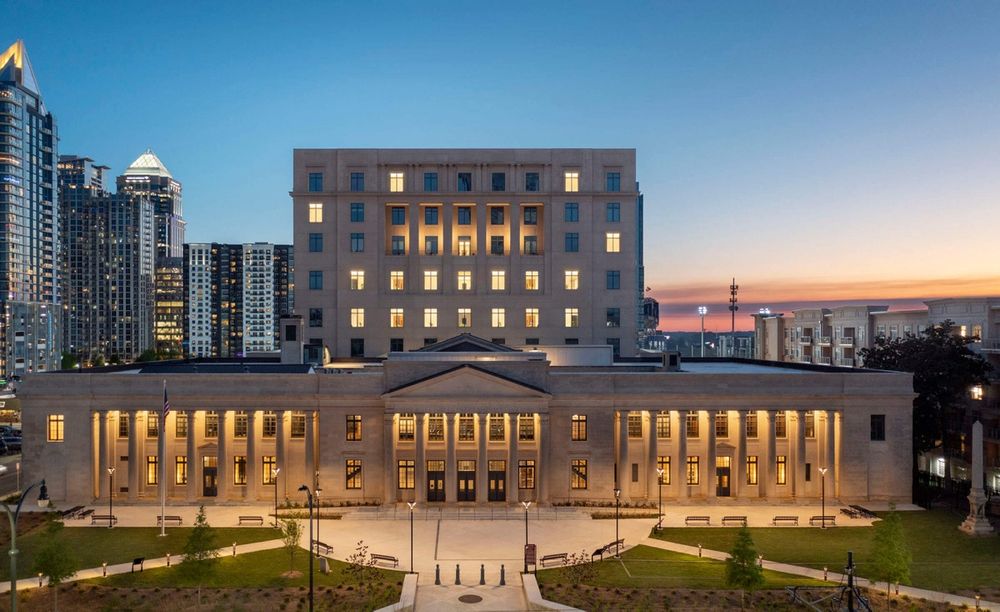
Charles R. Jonas
Kenneth D. Bell, the district court judge overseeing this case since last November warned the NASCAR side that ‘growing the sport’ is not a valid defense. He also said it could be a self-admission.
“Growing the sport is another way of saying increasing the revenues of NASCAR,” Bell said.
He has also finally told the jury about the likelihood that this trial is seemingly going to go beyond its scheduled 10-days over two-weeks timeline.
After dismissing the jury on Thursday, Judge Bell told those in the room that both councils needed to speed things along because the jury was told two weeks and that it’s a burden on them.
“I don’t know that we’re going to finish next Friday,” Judge Bell told the jury. “That remains our goal. I am working to keep things moving.
“Everyone in this court room is paid to be here, some more than others, and while I recognize you all get a stipend, I acknowledge the burden this trial places on you and the court thanks your service.”
Bell thanked the jury for their attentiveness, and that he noticed that everyone locked in, and it was appreciated.
It seems more likely that the trial will end by December 15 or 16 as opposed to December 12.
We want your opinion!
What would you like to see on Motorsport.com?
Take our 5 minute survey.
– The Motorsport.com Team
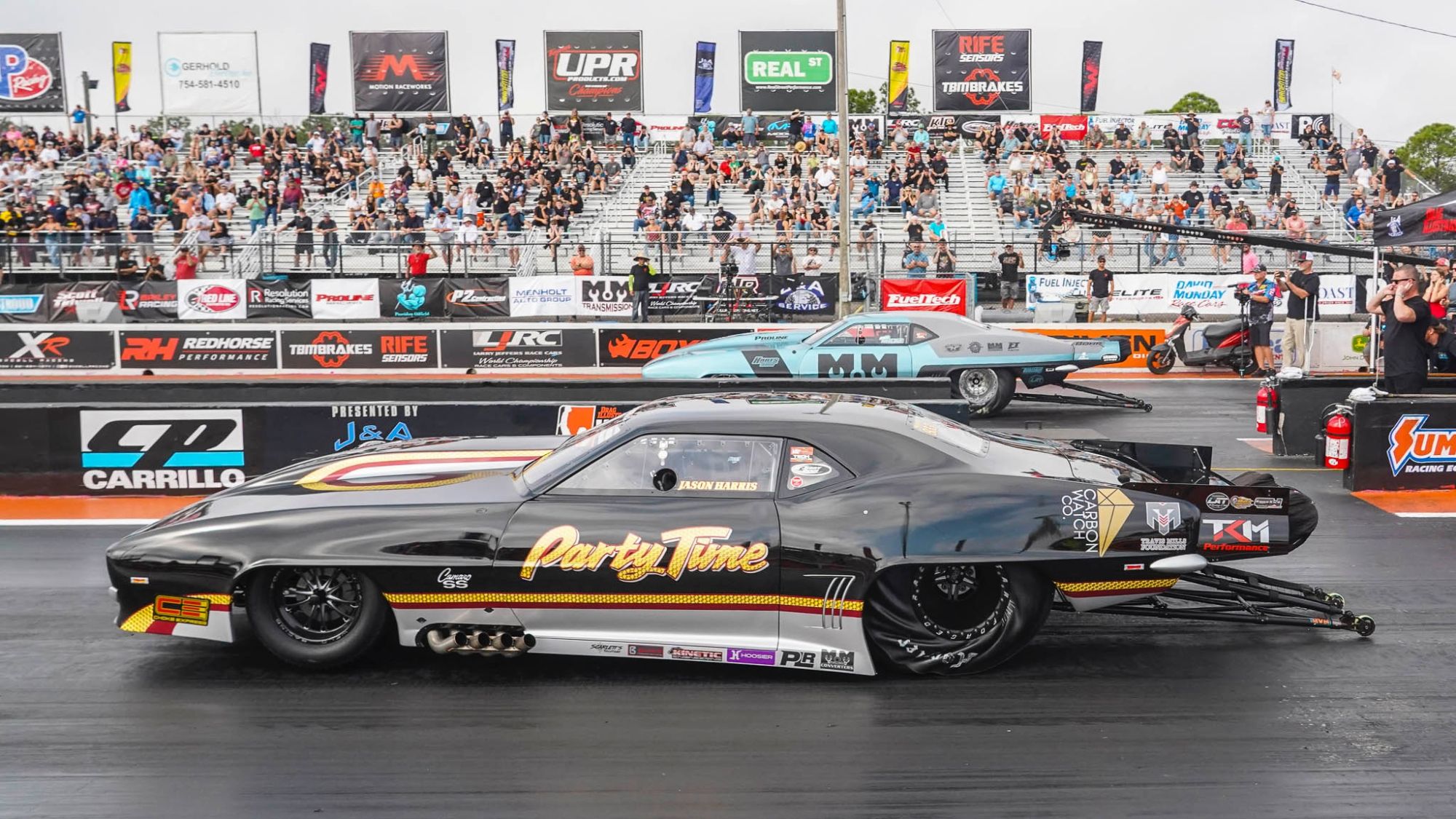
It’s race day at the 2025 Snowbird Outlaw Nationals presented by Motion Raceworks at Bradenton Motorsports Park. The historic event serves as the opening race of the second annual Drag Illustrated Winter Series presented by J&A Service, a three-race Pro Mod series paying out more than $275,000 to race winners and the series champion. The event also includes Pro 10.5, True 10.5 N/T, Lil Gangstas, Limited Drag Radial, Ultra Street and more.
Eliminations results will be posted below when they’re available from race control.
Find Friday qualifying results here.
Tune in to the official event livestream on FloRacing here: https://flosports.link/46edcdu
PRO MOD SEMIFINALS

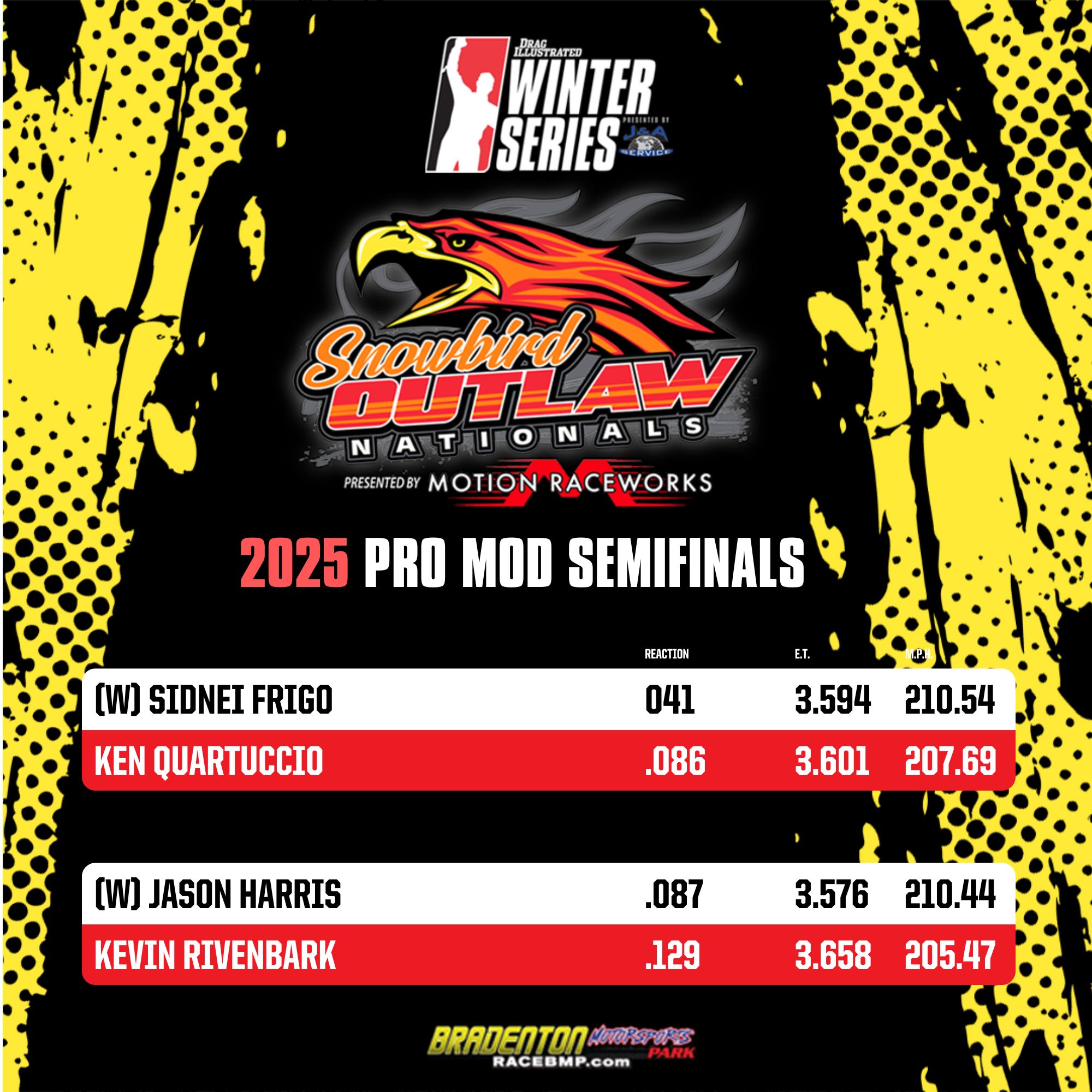
PRO MOD QUARTERFINAL ELIMINATIONS

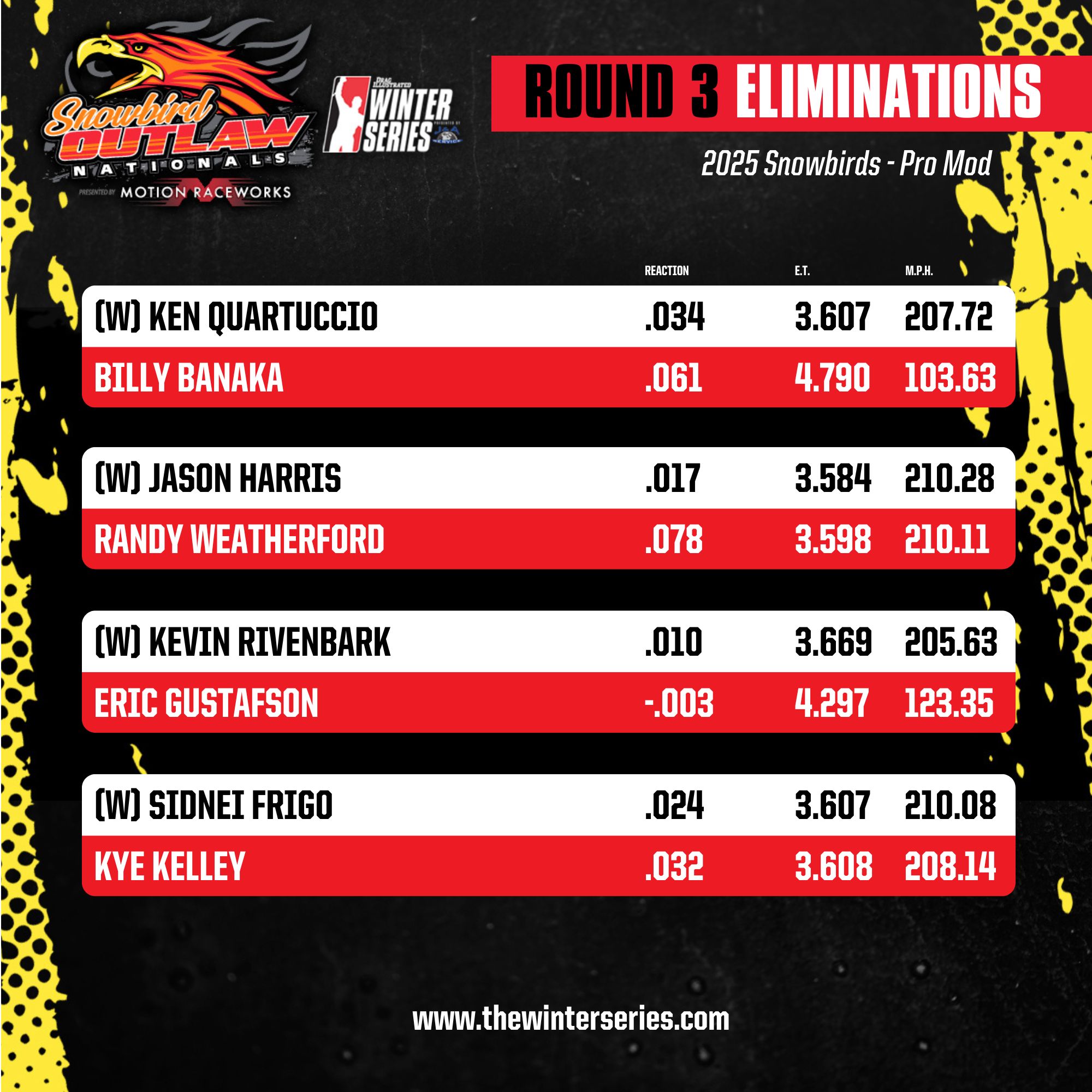
PRO MOD SECOND-ROUND ELIMINATIONS

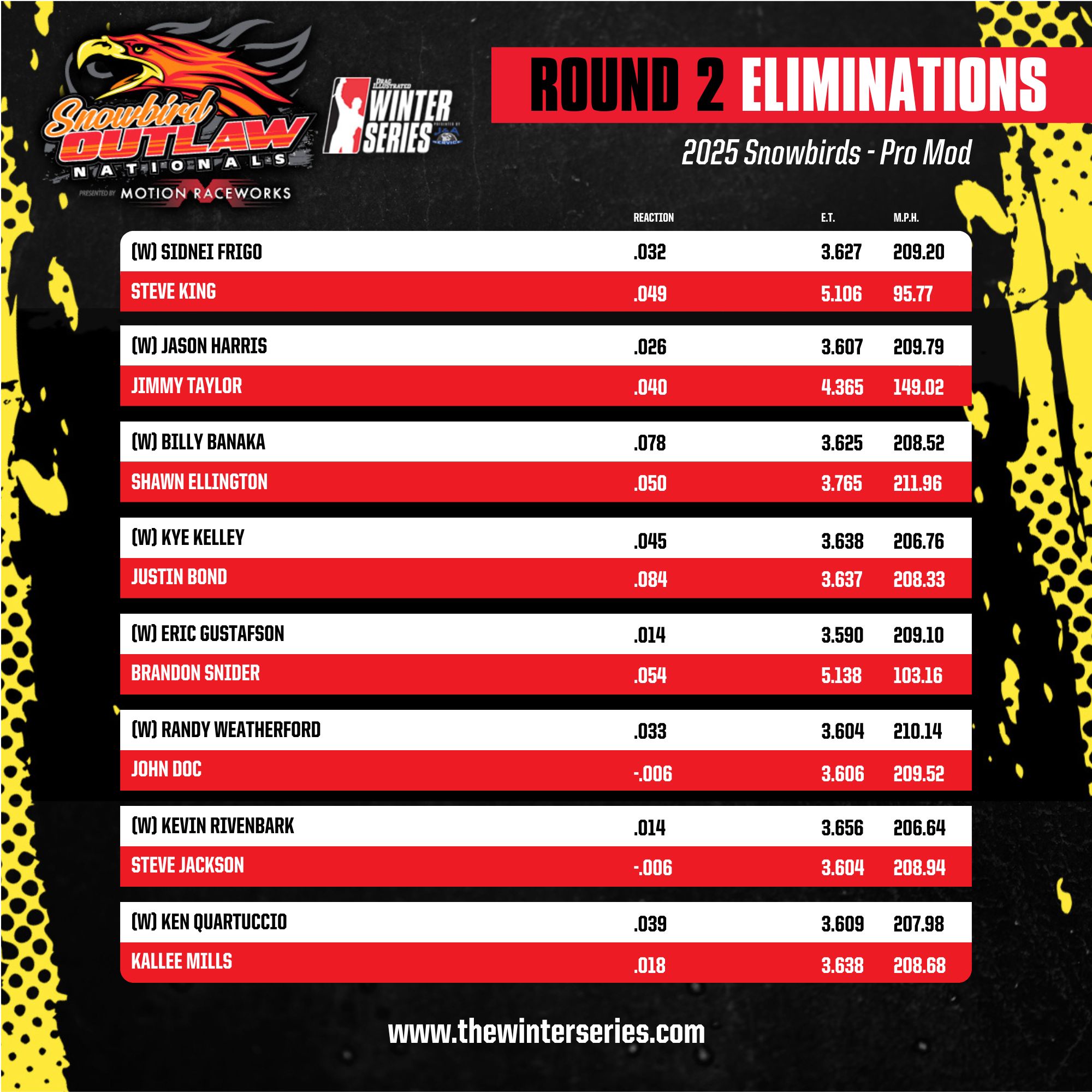
PRO MOD FIRST-ROUND ELIMINATIONS


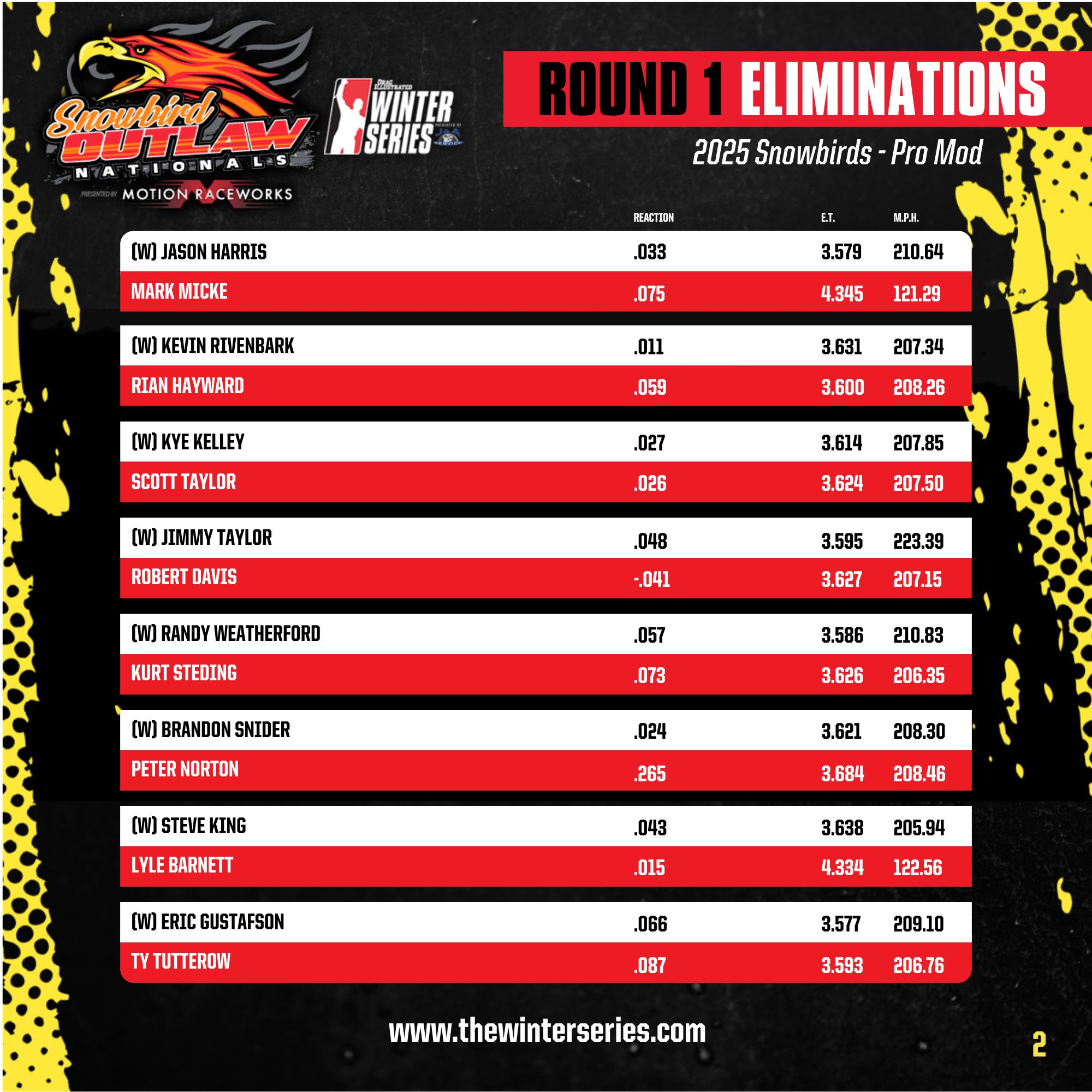
PRO 10.5 SEMIFINALS

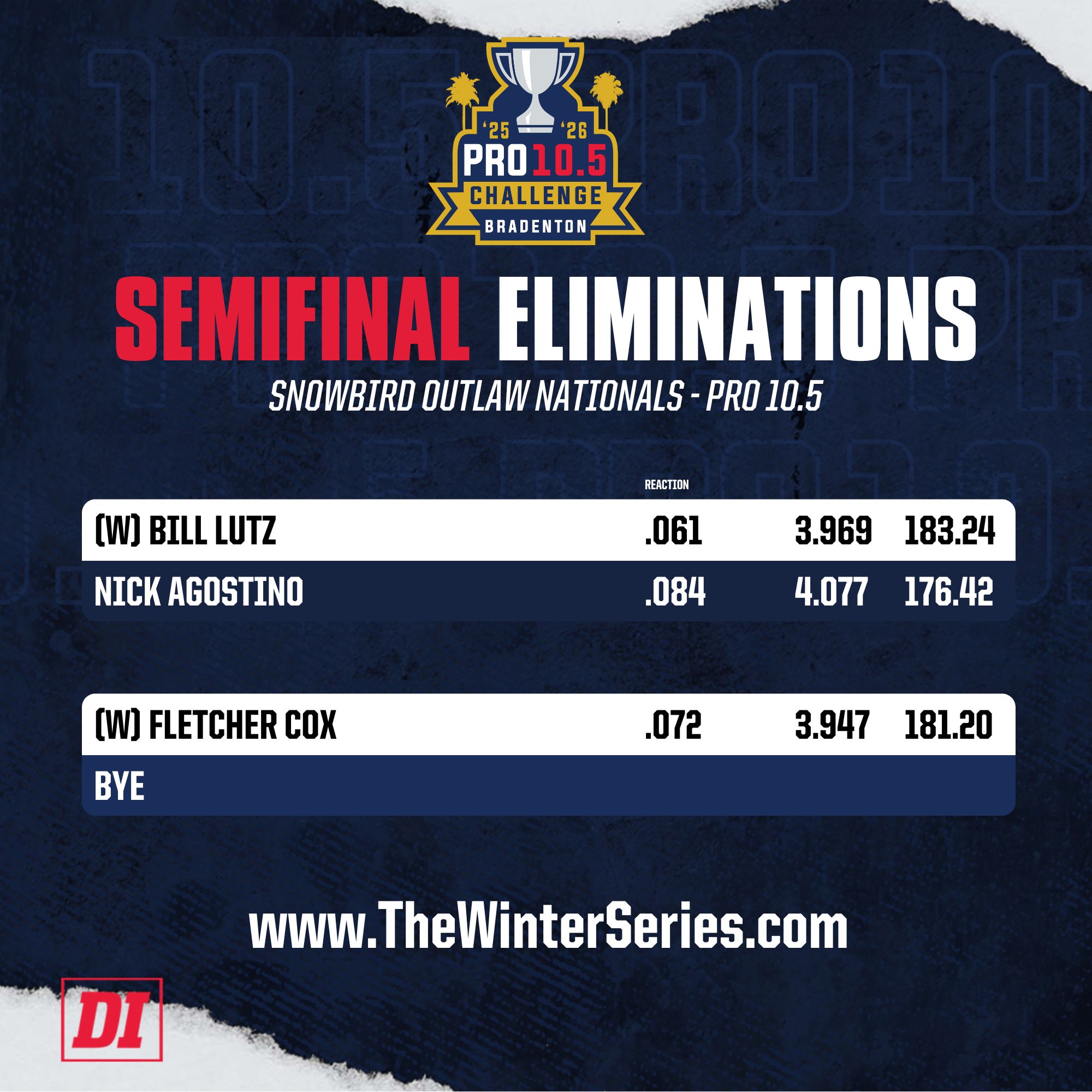
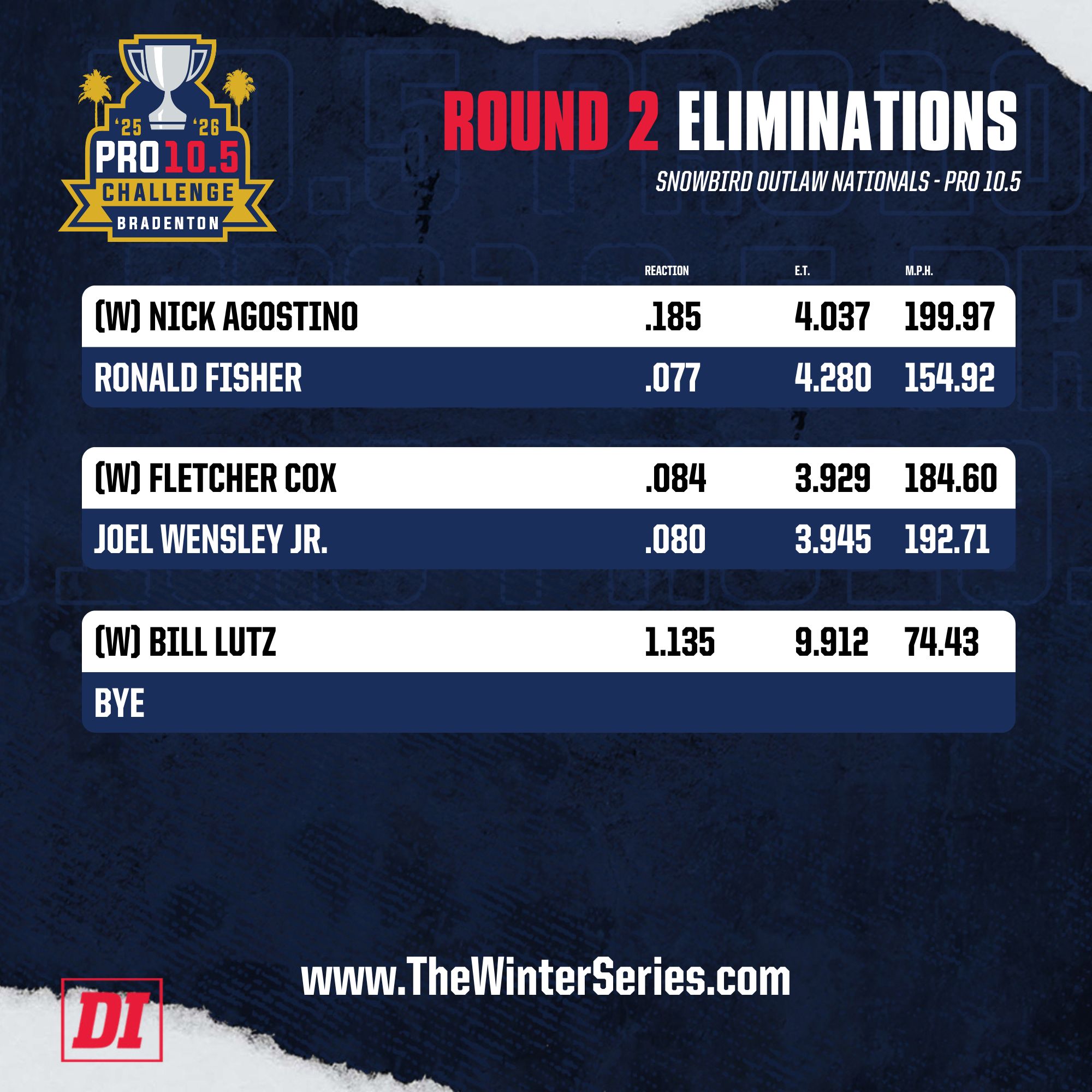
PRO 10.5 SECOND-ROUND ELIMINATIONS

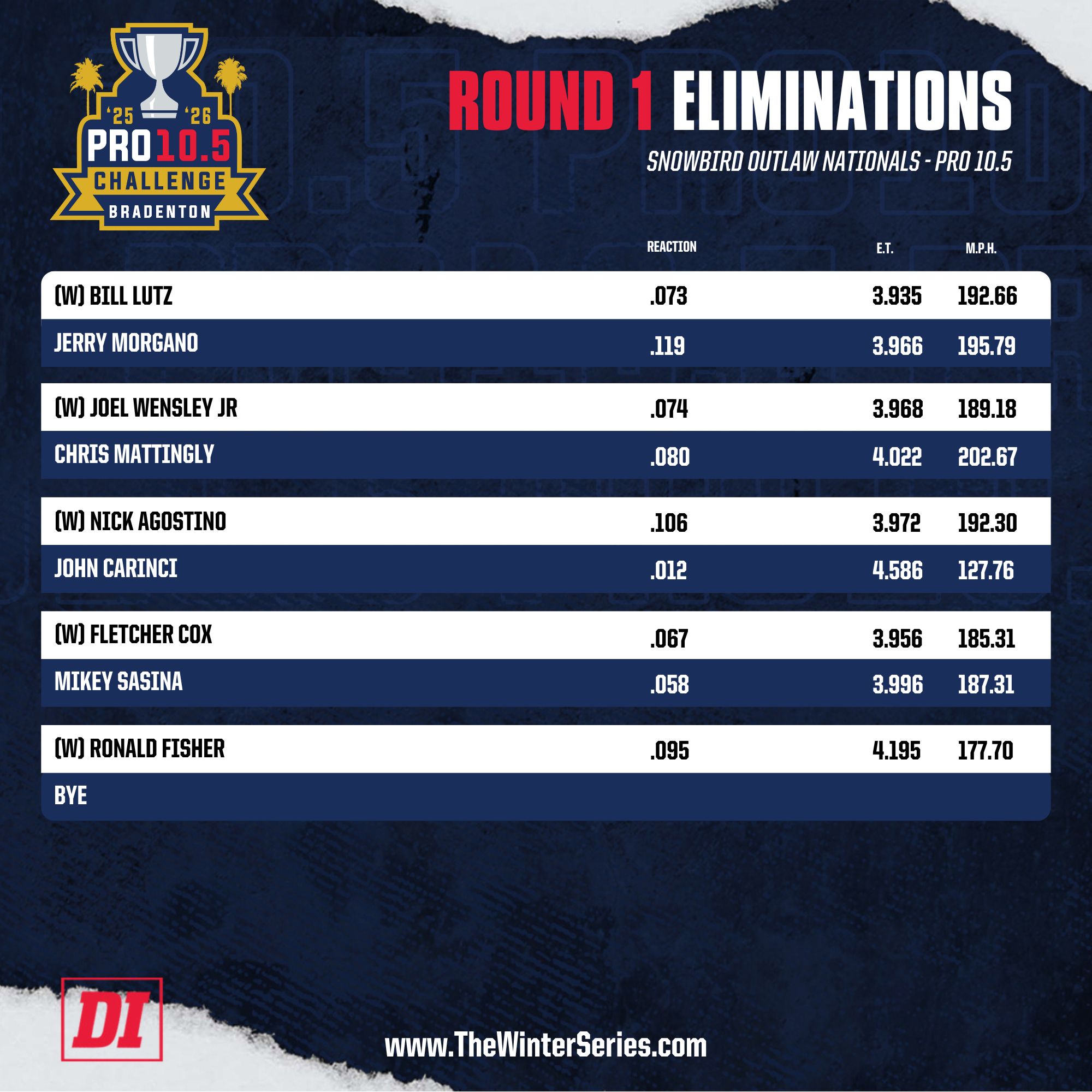
PRO 10.5 FIRST-ROUND ELIMINATIONS

This story was originally published on December 6, 2025. 


Formula 1 arrives at Yas Marina for its most dramatic season finale in over a decade, with three drivers still in contention for the world championship. Lando Norris leads the standings on 408 points, holding a slender 12-point advantage over Max Verstappen and 16 over his McLaren teammate Oscar Piastri. With 25 points available for a race win, the title remains wide open heading into Sunday’s twilight showdown.
Norris enters as the clear favorite. A podium finish will guarantee him his first world championship, regardless of what his rivals achieve. Even if Verstappen wins, third place would be enough for Norris to seal the crown. Anything lower than that, however, could open the door for a late twist.
Verstappen, chasing a fifth consecutive title, must win to have a realistic chance. Victory combined with Norris finishing fourth or worse would hand the Dutchman the championship. A second-place finish could also suffice, but only if Norris slips to eighth or lower and Piastri fails to win. For Verstappen, the permutations are tight, but his recent surge — including back-to-back wins in Las Vegas and Qatar — makes him a formidable threat.
Piastri faces the steepest climb. The Australian needs to win and hope Norris finishes sixth or lower. A second-place finish could keep his hopes alive only if Norris drops to tenth or worse and Verstappen fails to make the podium. Anything less will end his bid for a maiden title.
Qualifying has already set the stage for fireworks. Verstappen starts from pole, with Norris alongside on the front row and Piastri in third. George Russell lines up fourth, ready to play spoiler. Track position is crucial at Yas Marina, where overtaking opportunities are limited and strategy often dictates the outcome. All three contenders have seven wins this season, meaning a tie on points would be decided by second-place finishes — an area where Norris holds the advantage.
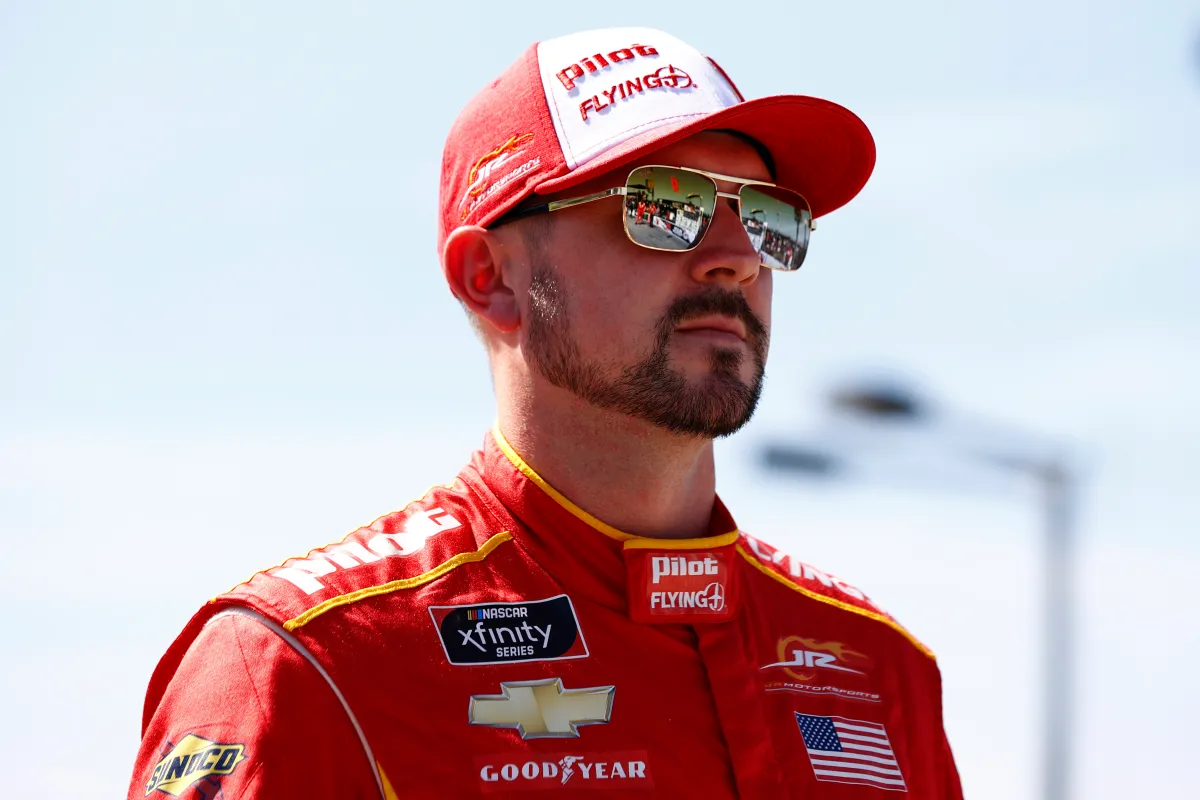
Former NASCAR driver Michael Annett has died at age 39, JR Motorsports (JRM) announced Friday in a social media post and confirmed to NASCAR.com. No cause of death was announced.
Annett, a native of Des Moines, Iowa, made 436 combined starts across NASCAR’s three national touring series during his racing career. He retired from racing in 2021 after a stress fracture in his leg sidelined him for parts of that season.
Who Was Michael Annett?
Annett was a respected NASCAR competitor who made his mark primarily in the Xfinity Series where he recorded 321 starts over his career. His greatest achievement came in 2019 when he won the season-opening race at Daytona International Speedway driving the No. 1 JRM Chevrolet, his only win at NASCAR’s national level.
The victory held special significance for JRM co-owner Dale Earnhardt Jr., who compared it to Michael Waltrip’s 2001 Daytona 500 win after being hired by Dale Earnhardt to drive for Dale Earnhardt, Inc.
Before pursuing stock-car racing, Annett played ice hockey as a defenseman for the United States Hockey League’s Waterloo Black Hawks. His 2004 season earned him a “Most Improved Player” award as his team won the Clark Cup alongside future NHL player Joe Pavelski, who went on to play 18 seasons with the San Jose Sharks and Dallas Stars, per NASCAR.com.

What To Know
Annett made 158 of his Xfinity Series starts with JRM from 2017 through 2021, helping transform the organization into the four-car team it remains today. He also earned two victories in the ARCA Menards Series, winning at Talladega Superspeedway in 2007 and the series opener at Daytona in 2008.
Annett ascended to the Xfinity Series in 2008 before going full-time in 2009, racing with teams including Germain Racing, Rusty Wallace Racing and Richard Petty Motorsports, according to NASCAR.com. He spent three years at NASCAR’s top level in the Cup Series, driving for Turner Scott Motorsports from 2014 through 2016 and making 106 starts.
Annett’s late father, Harrold, previously served as CEO of TMC Transportation, which sponsored much of Annett’s racing efforts. Harrold also co-owned a sprint-car team which fielded cars for famed dirt-tracker Sammy Swindell, collecting 35 wins in their four years together. TMC Transportation and Pilot Flying J remain sponsors of JRM’s Xfinity endeavors through driver Sammy Smith, who pilots the team’s No. 8 Chevrolet.
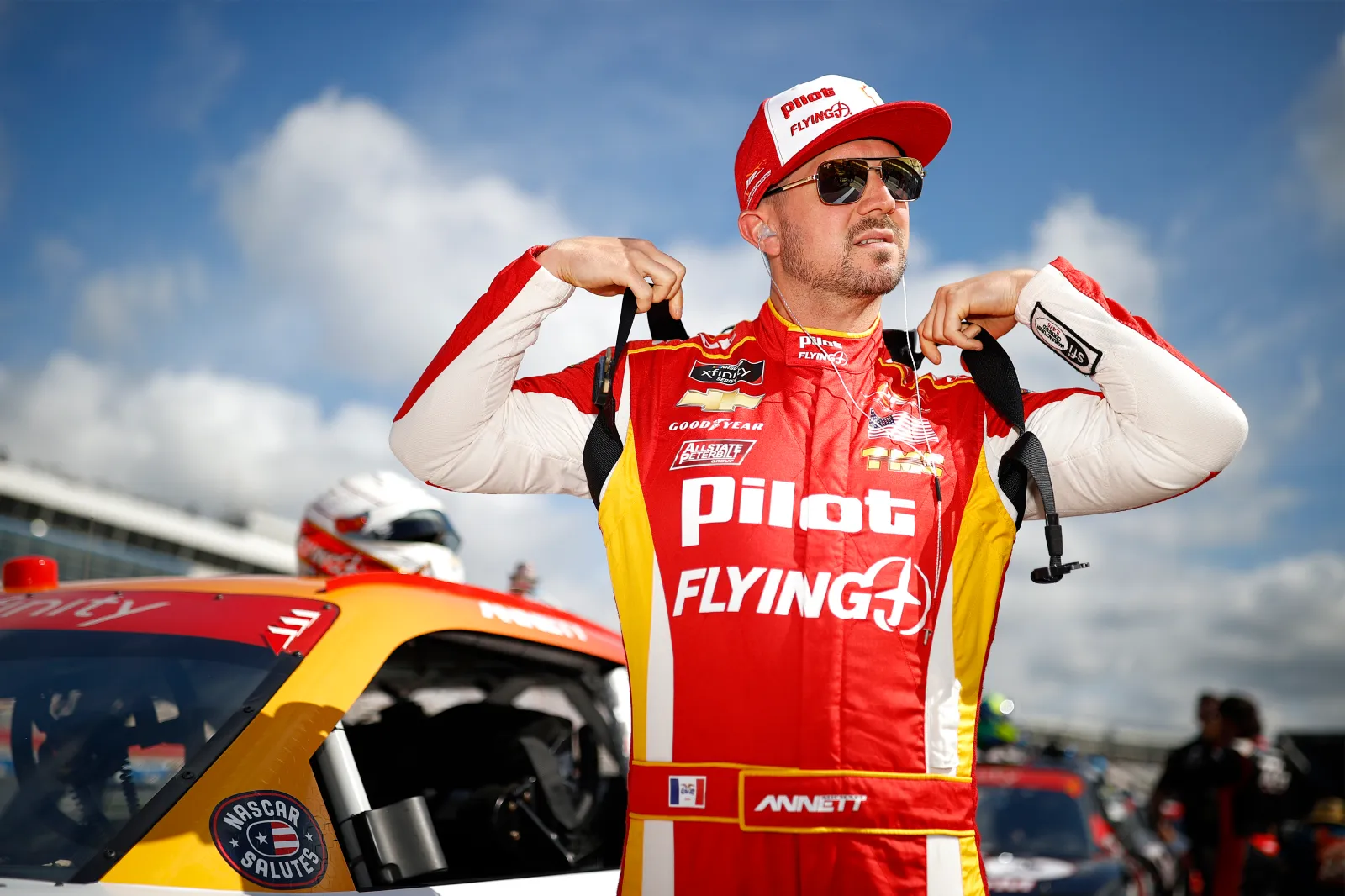
What People Are Saying
NASCAR’s statement: “NASCAR is deeply saddened to learn of the passing of former NASCAR driver Michael Annett. Michael was a respected competitor whose determination, professionalism, and positive spirit were felt by everyone in the garage. Throughout his career, he represented our sport with integrity and the passion of a true racer.”
NASCAR multi-media storyteller Steven Taranto said on X: “Michael Annett led a modest 13 laps in 106 NASCAR Cup Series starts. The most came at Talladega in the fall of 2016, where he led six on an off-strategy during a cycle of green flag stops. Broadcast was in a break for this. Watched the raw feed back. Found it poignant.”
NASCAR driver Jeremy Clements said on X: “RIP Michael Annett. Was a pleasure to go to door to door with you for so many years. You’ll be missed.”
JR Motorsports said on X: “Our thoughts and prayers are with the entire Annett family with the passing of our friend Michael Annett. Michael was a key member of JRM from 2017 until he retired in 2021 and was an important part in turning us into the four-car organization we remain today.”
Sammy Smith, JR Motorsports driver, said on X: “Very sad to lose someone who meant so much to me and my family. Michael was a great person to so many, and we’ll miss him a lot.”
Brad Keselowski, RFK Racing co-owner, said in a statement: “Michael was an up-and-comer at the same time I was and he was looking really good. In the end, life took us different paths and all of us who knew him and the talent he had are sad to see him go.”
Team RSMG on X: “We are sad to have lost a family member. Michael Annett will always be in our hearts. Our thoughts are with the Annett family at this time. Rest in peace MA.”
Motorsport on X: “We’re saddened to learn NASCAR driver Michael Annett has died at the age of 39. Our thoughts are with his family and friends.”

What Happens Next?
The NASCAR and racing community continues to mourn Annett’s passing, with tributes pouring in from former teammates and competitors across the sport.
Details regarding memorial services have not yet been announced.
Reporting from the Associated Press contributed to this article.

Nebraska and Creighton match times, opponents in NCAA Tournament

Giants RB Tyrone Tracy Jr. connects with local Big Blue fans at Limitless Athletics on Staten Island

Oji Leads Record-Breaking Performances at Penn Opener

Governor Kehoe Makes Two More Judicial Appointments – News/ Talk KRMS

Silverfield’s rebuild underway on Hill

No. 1 Nebraska volleyball punches ticket to Sweet 16 with sweep over Kansas State

Salamanca receives $277K state grant for youth center roof project

Sjöberg Becomes Eighth-Fastest 3k Athlete In NCAA History
Iowa youth soccer game was filled with joy; here’s why

Nebraska volleyball sweeps through K-State in a dogfight | Sports

Beckman captures a shoot-out vs. Hillcrest, advances to first CIF state final –

Friar Men’s And Women’s Track Competes at Brown’s Alden Invitational
Louisville volleyball score, UofL vs Marquette NCAA Tournament bracket

Steve Paul Ties 60m School Record in Season Opener

Golden Eagles fall in NCAA Second Round to No. 9 Louisville

First Tee Winter Registration is open

Fargo girl, 13, dies after collapsing during school basketball game – Grand Forks Herald

CPG Brands Like Allegra Are Betting on F1 for the First Time

Volleyball Recaps – November 18

F1 Las Vegas: Verstappen win, Norris and Piastri DQ tighten 2025 title fight

Two Pro Volleyball Leagues Serve Up Plans for Minnesota Teams

Utah State Announces 2025-26 Indoor Track & Field Schedule

Sycamores unveil 2026 track and field schedule

Redemption Means First Pro Stock World Championship for Dallas Glenn

Bowl Projections: ESPN predicts 12-team College Football Playoff bracket, full bowl slate after Week 14

Texas volleyball vs Kentucky game score: Live SEC tournament updates

Pohlman admits ‘there might be some spats’ as he pushes to get Kyle Busch winning again

Indiana’s rapid ascent and its impact across college football

How this startup (and a KC sports icon) turned young players into card-carrying legends overnight

Troy Football Need to Know; Gameday at The Vet — Georgia State Game

 Why a rising mid-major power with an NCAA Tournament team opted out of revenue-sharing — and advertised it
 NBA Legend Michael Jordan to Join NBC Sports as Special Contributor
 Falcons mailbag
 Portal Update – Basketball and Gymnastics Take Hits
 has always dreamed in Mercurial. Now his initials are on the boots.
The new Kyl…
has always dreamed in Mercurial. Now his initials are on the boots.
The new Kyl…
-
 Rec Sports2 weeks ago
First Tee Winter Registration is open
-
 Rec Sports1 week ago
Fargo girl, 13, dies after collapsing during school basketball game – Grand Forks Herald
-
 Motorsports2 weeks ago
CPG Brands Like Allegra Are Betting on F1 for the First Time
-
 Sports3 weeks ago
Volleyball Recaps – November 18
-
 Motorsports2 weeks ago
F1 Las Vegas: Verstappen win, Norris and Piastri DQ tighten 2025 title fight
-
 Sports2 weeks ago
Two Pro Volleyball Leagues Serve Up Plans for Minnesota Teams
-
 Sports2 weeks ago
Utah State Announces 2025-26 Indoor Track & Field Schedule
-
 Sports2 weeks ago
Sycamores unveil 2026 track and field schedule
-
 Motorsports1 week ago
Redemption Means First Pro Stock World Championship for Dallas Glenn
-
 NIL6 days ago
Bowl Projections: ESPN predicts 12-team College Football Playoff bracket, full bowl slate after Week 14