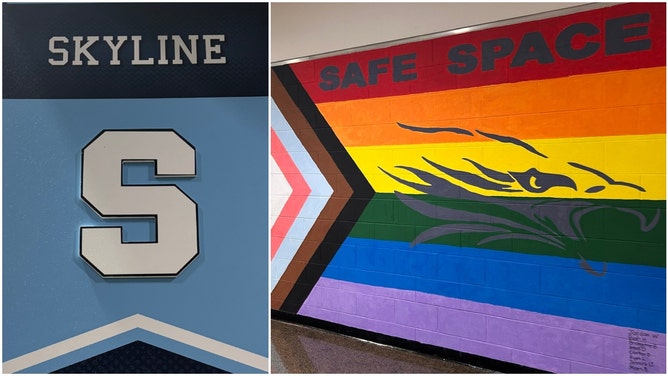
A Monroe family, joined by several Michigan lawmakers, on Monday announced the filing of a Title IX complaint against Monroe Public Schools, Ann Arbor Public Schools and the Michigan High School Athletic Association, challenging a decision to allow a transgender athlete to play on Ann Arbor Skyline’s girls volleyball team and share locker room facilities during a match in the 2025 season.
The complaint, submitted by Sean Lechner alleges “serious administrative failures” by both districts and Monroe athletic director Chet Hesson, including ignoring safety protocols, withholding information, and disregarding student privacy, competitive fairness, MHSAA rules and federal Title IX requirements.
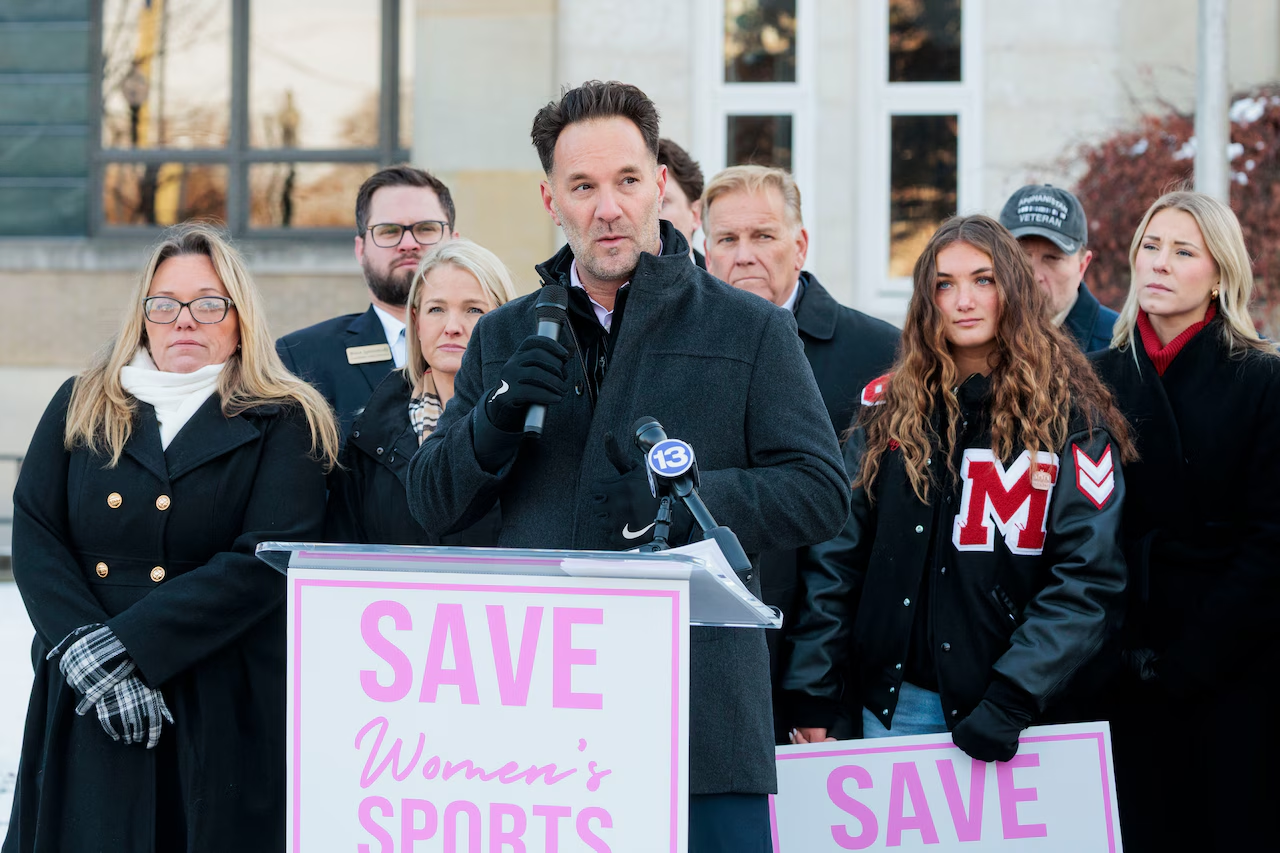
“This is purely about accountability, fairness and justice,” Sean Lechner said. “This is about privacy, safety and dignity of any and all female athletes. Schools do not have the right to hide the biological sex of a male student at the expense of any female student or athlete.”
State representatives James DeSana (R-Carleton), William Bruck (R-Erie Township), Rylee Linting (R-Grosse Ile Township), Jamie Thompson (R-Brownstown) and State Senator Joe Bellino, and Laura Perry, who is running for the Michigan House of Representatives, joined the complaint to discuss the filing and concerns raised.
The complaint has been submitted to the U.S. Department of Education, the Michigan Department of Education, the MHSAA and Monroe Public Schools.
Sean Lechner, whose daughter, Briley, plays on the Monroe team, claims parents were not informed and that privacy and safety protocols were ignored. He said the complaint is also centered around arguments of unfair competition advantages and the violation of female athletes’ privacy.
“I’m speaking out today not just for my daughter, but for every family that was betrayed when the adults responsible failed to do their job,” Sean Lechner said. “This burden must not fall on the shoulders of teenage girls. It is now the responsibility of parents, school officials and lawmakers to step up.”
The complaint also alleges that Skyline allowed the athlete to compete without submitting the required waiver to the MHSAA for a trans female (male to female) to compete, raising concerns about Title IX compliance.
However, the MHSAA and AAPS have stated they do not provide confidential details about students, including eligibility status.
“Title IX was established to separate athletics by biological sex to ensure equal opportunity, competitive fairness and safety of female athletes,” Perry said during the press conference. “…One waiver in Michigan, one displaced female athlete on a varsity roster or starting lineup, one player of the match taken by a biological male, and one team advancing to the Elite Eight in the MHSAA tournament because of a male is one too many.”
Andrew Cluley, AAPS director of communications, said the district does not comment on ongoing litigation.
In a statement regarding the filing, Monroe administration said it has hired a third party to conduct a Title IX investigation to ensure transparency.
“The District has requested a third party to complete the Title IX investigation and provide a recommended determination,” the statement said. “The district has chosen to use a third party so that the investigation can be completed in a manner that allows for complete transparency from beginning to end. Monroe Public Schools has no further comment while the third party is conducting the investigation.”
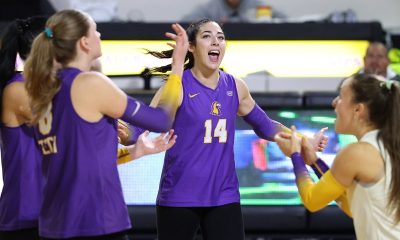
Skyline and Monroe competed on Sept. 9, where Skyline won the match. The complaint alleges that the two teams shared a locker room at Monroe for the match, but parents were not informed of a transgender athlete on Skyline’s team until afterwards.
The two teams also competed in a match during a conference meet on Oct. 25 but did not share a locker room.
“This was definitely very devastating for all of us girls,” Briley Lechner said during the press conference. “This person did disguise themselves to look like a female, so when we found out weeks after that there was another male in the same locker room as us, as we are changing and also playing against us, it caught everyone off guard and it was very changing because nobody would have expected that that would have been the last thought.
“Because as I was looking at this person, admiring how amazing they were, admiring how high they could jump, I was kind of getting down to myself, like, I wonder why I’m not capable of that. So, it’s definitely very like changing to see that.”
Skyline’s team went onto win a Division 1 regional title and advanced to the state quarterfinals for the first time since 2021.
Ahead of the quarterfinal match against Byron Center last month, 14 lawmakers signed a letter asking the MHSAA to provide proof of a transgender athlete’s eligibility to compete on Skyline’s team.
Geoff Kimmerly, MHSAA director of communications, told MLive/The Ann Arbor News that the organization granted one waiver for a transgender athlete to compete this fall but could not provide specifics about which school or sport due to privacy concerns.
The MHSAA granted two waivers for the 2024 fall sports season, Kimmerly said.
Kimmerly added in a statement that the association has been in discussions with lawmakers as it navigates conflicting state and federal guidance on transgender athlete eligibility.
He emphasized that the MHSAA must follow the law and rely on courts or the legislature when conflicts arise.
“The MHSAA has communicated with members of the state legislature throughout the fall about this issue, as the legal landscape in this area – under both federal and state law – remains unsettled, and state and federal guidance have evolved in recent years often in competing ways,” Kimmerly said. “…The MHSAA has consistently emphasized that it must follow the law, and when conflicts in law arise, the MHSAA must rely upon the legislature or the courts to provide clarity.”
The MHSAA has pointed to legal conflicts between Trump’s executive order seeking to ban transgender women from female sports and Michigan’s Elliott-Larsen Civil Rights Act, which protects against gender identity discrimination, as an area needing clarification.
However, Perry said the MHSAA should be following federal law over state law.
“The state of Michigan hides behind the unintended consequences of Elliot Larson and proceeds as though state law trumps federal law,” Perry said. “Federal executive order is being ignored and the buck stops here when the real adults in the room, everybody that showed up here today and everybody behind me, says that this can and will not happen again.”
Linting, who sponsored a two-bill package with Jason Woolford (R-Howell), said the goal is to change policies by banning biological men from competing in women’s sports in Michigan and revising the Elliott-Larsen Act to make such a ban enforceable.
The MHSAA determines eligibility for transgender female athletes on a case-by-case basis, requiring schools to submit documentation at least 30 days before tournament deadlines.
Required materials include school records, medical and psychological information, details on hormone therapy or surgery and a signed waiver allowing disclosure of protected records for eligibility review.
“For more than 50 years, no organization in Michigan has worked harder to expand, support and protect athletic opportunities for girls and young women than the MHSAA – a commitment that has guided our work for decades and remains unchanged today,” Kimmerly said in the MHSAA statement.
The U.S. Supreme Court is scheduled to hear oral arguments on cases involving athletics and transgender participation on Jan. 13, 2026, which could provide more clarification in this ongoing matter.