My son loves playing sports, and I love watching him play. I love seeing how he and his teammates develop their skills and grow into better players each season. A few years back, they learned the basics of how to grip a baseball and dribble a basketball. Now, they can throw a baseball accurately and make a jump shot. God willing, they’ll keep moving forward, building their skills and becoming the best players — and kids — they can be.
That growth cannot happen without coaches. My husband is very active in coaching our son, and he loves it. As I support him in this role, I witness the knowledge, commitment, patience and compassion it takes to do it well.
I bet Mary Blaskiewicz noticed and appreciated those traits in her husband, Anthony “Cooper” Blaskiewicz, as he coached and supported youth sports for more than 50 years in Avoca as a founding member of the Avoca Jolly Boys. By spearheading this program, which provides recreational activities for children from Avoca and the surrounding communities, Cooper certainly gave Mary many reasons to be proud of his efforts. Today, I am confident she will be incredibly proud as the Luzerne County Sports Hall of Fame honors Cooper’s good works at its annual induction banquet.
Please join me in congratulating the Blaskiewicz family as their late father and grandfather posthumously receives the 2025 Sam Falcone Community Service Award from the Luzerne County Sports Hall of Fame. Cooper was selected to receive this award not only for his pivotal role as a youth sports advocate since the Jolly Boys’ founding in 1966 but also for his more than 50 years of dedication to maintaining the program and serving as the organization’s president and athletic director numerous times. He also served as the point man and organizer for the establishment of the Avoca Jolly Boys’ boys and girls basketball leagues.
Through his wonderful example, youth learned to play sports but they, their coaches and everyone who had the opportunity to know Cooper learned something much more important. They learned the value of good sportsmanship, community pride, goal setting, sacrifice and determination. Those are the lessons coaches teach that make you a success on and off the court. Thanks for everything, Cooper. Your efforts are remembered and cherished by many.
Council meeting
Avoca Council will meet Thursday, June 12, at the municipal building, 950 Main St.
The work session begins at 6:30 p.m. followed by the regular monthly meeting.
Queen of the Apostles pro-life fundraiser
Queen of the Apostles Parish’s social concerns/respect life ministry is distributing baby bottles to fill with spare change, cash or checks to support the pro-life work done by the Wilkes-Barre Chapter of Pennsylvanians for Human Life.
Bottles may be placed in the basket in front of the baptismal font during any of the weekend Masses or dropped off at the rectory.
The return deadline is Father’s Day, Sunday, June 15.
Father Phil’s retirement party
Queen of the Apostles Parish will have the final planning meeting for the Rev. Phillip J. Sladicka’s parishioner-sponsored retirement gala at 6 p.m. Tuesday, June 17, in the parish hall, 742 Spring St.
The gala, which will begin with a Mass in thanksgiving of Father Phil’s 49 years of priestly service, will take place at 2 p.m. Sunday, June 29, in the church, 715 Hawthorne St., followed by the gala on the parish hall grounds.
All are welcome to attend to share memories with Father Phil.
Food pantry
Avoca Food Pantry will open at 3 p.m. Thursday, June 19, at Bethel United Methodist Church, 532 Main St. The public can pick up food provided by the Commission on Economic Opportunity’s Weinberg Northeast Regional Food Bank, at the rear entrance of the building. If you can volunteer to unload and distribute food, please arrive at the church at 1:30 p.m. For information, please call Jim at 570-921-9899.
Church cookbook fundraiser
The parishioners of Queen of the Apostles Parish are selling “Father Phil’s Favorites: A Collection of Recipes by the Parishioners and Friends of Queen of the Apostles Parish.” The cookbooks are $10 each and include 255 recipes sorted into appetizers and beverages, soups and salads, vegetables and side dishes, main dishes, breads and rolls, desserts, cookies and candy.
The books will be available after the weekend Masses: 4 p.m. Saturdays and 8 and 10 a.m. Sundays. You can also purchase one by calling the parish office at 570-457-3412.
All proceeds will contribute to covering the expenses for the parish-sponsored retirement gala in honor of Father Phil.
Queen of the Apostles/Sacred Heart linkage
Queen of the Apostles Parish and Sacred Heart of Jesus Parish, 215 Lackawanna Ave., Dupont, will link effective July 1. The Rev. Thomas J. Petro, J.C.L., KCHS, will be the pastor of both parishes. Beginning July 1, the new Mass schedule will be as follows: Monday, Wednesday and Friday, 7:30 a.m., Sacred Heart of Jesus Parish; Tuesday and Thursday, 9 a.m., Queen of the Apostles Parish; Saturdays: 4 p.m., Sacred Heart of Jesus Parish, 5:30 p.m. Queen of the Apostles Parish, and Sundays: 8 a.m. Queen of the Apostles Parish, and 10:30 a.m. Sacred Heart of Jesus Parish.
The Sacrament of Reconciliation will be available at 3 p.m. Saturdays at Sacred Heart of Jesus Parish.
Religious education classes for children in kindergarten through eighth grade will be held from 9:15 to 10:15 a.m. Sundays following the same schedule during the academic year at both parishes.
Bulk collections
Residents are reminded they may dispose of one bulk item on the first Monday of the month with up to three bags of trash. Mattresses and box springs must be wrapped in plastic. Electronics will not be collected. Items should not be placed at the curb until the night before the collection.
Yard waste
Residents are reminded each household may place up to three standard size open containers or paper bags of yard waste curbside for collection every Tuesday. Please do not use plastic bags, oversized containers or containers with attached lids. The containers must not weigh more than 30 pounds each and can only contain leaves, grass clippings, weeds, branches and clippings from bushes and shrubs. Branches must be cut to 3 feet in length and a half-inch in diameter.
Rocks, stone, pet waste and plastic bags will not be collected.
Please place yard waste curbside on Monday night to ensure collection on Tuesday.
Please contact the borough office at 570-457-4947 for information.
That’s about it for this week, my friends.
Thanks for reading and have a great week!
Jackie Borthwick-Galvin writes about Avoca every week. To list an item, email jborthwickgalvin@pittstonprogress.com or call 570-301-2171 two weeks prior to the desired publication date.
Exceptional performers play a major role in driving innovation and tackling some of the world’s most urgent challenges. Because of this, societies have a strong stake in understanding how top-level talent develops. A new review published in the journal Science argues that many long standing approaches to gifted education and talent development rest on flawed assumptions. For the first time, an international and interdisciplinary research team has brought together evidence on how world-class performers emerge in science, classical music, chess, and sports.
For decades, research on giftedness and expertise has followed a familiar model. Outstanding achievement was thought to depend on strong early performance, such as excelling in school subjects, sports, or concerts, combined with specific abilities like intelligence, physical coordination, or musical talent. These traits were believed to need years of intense, discipline-focused training to produce elite results. As a result, many talent programs concentrate on identifying the top young performers early and pushing them to specialize quickly.
According to new findings led by Arne Güllich, professor of sports science at RPTU University Kaiserslautern-Landau, this approach may not be the most effective way to nurture future high achievers.
Why Earlier Research Missed the Full Picture
Until recently, most studies of giftedness focused on young or sub-elite performers. These groups included school and college students, youth athletes, young chess players, and musicians training at conservatories. However, evidence drawn from adult world-class athletes has begun to challenge conclusions based on these earlier samples.
“Traditional research into giftedness and expertise did not sufficiently consider the question of how world-class performers at peak performance age developed in their early years,” Arne Güllich explains. The goal of the new Review was to address this gap by examining how elite performers actually progressed over time.
To do this, Güllich worked with an international research team that included Michael Barth, assistant professor of sports economics at the University of Innsbruck, D. Zach Hambrick, professor of psychology at Michigan State University, and Brooke N. Macnamara, professor of psychology at Purdue University. Their findings are now published in Science.
Pooling Evidence Across Fields
The researchers reexamined large datasets from many previous studies, analyzing the developmental histories of 34,839 top-level performers from around the world. The group included Nobel Prize winners in the sciences, Olympic medalists, elite chess players, and leading classical music composers. This effort made it possible, for the first time, to compare how world-class performers develop across very different disciplines.
Early Stars Are Rarely Future Legends
One of the most striking conclusions is that elite performers follow a developmental path that differs from long-held assumptions. “And a common pattern emerges across the different disciplines,” Güllich notes.
First, individuals who stand out as the best at a young age are usually not the same people who become the best later in life. Second, those who eventually reached the highest levels tended to improve gradually during their early years and were not top performers within their age group. Third, future world-class achievers typically did not focus on a single discipline early on. Instead, they explored a range of activities, such as different academic subjects, musical genres, sports, or professions (e.g., different subjects of study, genres of music, sports, or professions).
How Variety Builds Stronger Performers
The researchers propose three ideas that may help explain these patterns. “We propose three explanatory hypotheses for discussion,” says Güllich.
The search-and-match hypothesis suggests that exposure to multiple disciplines increases the likelihood of eventually finding the best personal fit. The enhanced-learning-capital hypothesis proposes that learning in diverse areas strengthens overall learning capacity, making it easier to continue improving later at the highest level within a chosen field. The limited-risks hypothesis argues that engaging in multiple disciplines reduces the chance of setbacks such as burnout, unhealthy work-rest imbalances, loss of motivation, or physical injury in psychomotor disciplines (sports, music).
Arne Güllich summarizes the combined effect of these factors: “Those who find an optimal discipline for themselves, develop enhanced potential for long-term learning, and have reduced risks of career-hampering factors, have improved chances of developing world-class performance.”
Encouraging Breadth Instead of Early Specialization
Based on these findings, Güllich offers clear guidance on how young talent should be supported. The evidence suggests avoiding early specialization in a single field. Instead, young people should be encouraged and given opportunities to explore several areas of interest and receive support in two or three disciplines.
These areas do not need to be closely related. Combinations like language and mathematics, or geography and philosophy, can be equally valuable. Albert Einstein provides a famous example — one of the most important physicists, who was also deeply engaged with music and played the violin from an early age.
Implications for Policy and Practice
The authors argue that these insights should inform changes in how talent development programs are designed. Policymakers and program leaders can move toward approaches grounded in evidence rather than tradition.
As Güllich concludes, “This may enhance opportunities for the development of world-class performers — in science, sports, music, and other fields.”
When it comes to financial numbers for high school football recruits in this new world of Name, Image and Likeness (NIL), it’s not often their parents or agents, or the player themselves, explicitly say what they are being offered.
However, when it comes to former Mission Viejo High School star and four-star wide receiver Phillip Bell, that isn’t the case after a recent Wall Street Journal feature on the Ohio State freshman revealed what Washington reportedly offered the four-star prospect.
In a story that details the inner-workings of what the Journal labeled as the black market of youth sports and family of the Buckeyes’ receiver, along with other figures in the high school and college recruiting world, that drives at the central problems that NIL—what has effectively turned into the compensation 18 to 23 year olds receive in return to represent colleges while also playing for one of their athletic programs—has become, Bell’s mother texted a friend following an official visit to UW in late May 2024 that the senior-to-be had been offered $350,000 to don purple and gold over the next four years.
The article noted after the quote sent by Bell’s mother, who passed away before his senior year, that the university declined to comment on the matter.
Ultimately, the 6-foot-2, 195-pound four-star recruit in the 2025 class committed to OSU three months after his UW visit, while the newly minted Big Ten program signed five receivers in the cycle, four of which made their verbal commitments before Bell announced his decision on August 31.
Although—despite the story citing his two subsequent official visits to Penn State and OSU went poorly—the Huskies didn’t land the talented California recruit, and whether or not his mother’s claim is true remains unknown, it sheds some light on what the estimated value is of high-caliber prep prospects, which UW football head coach Jedd Fisch has said he wants his program to be built on with the rest of the roster supplemented through “free agency,” the term Fisch and many other coaches use for the transfer portal.
In the case of Bell, who played only 22 snaps and registered just one target this season for the Buckeyes—none of which came in UW’s 24-6 loss to Ryan Day’s team when the two opened Big Ten play against each other at Husky Stadium in late September—Fisch made the right call to take the five receivers the program signed as things turned out, even though Arizona-native Raiden Vines-Bright has already opted to enter the portal after less than one calendar year in Seattle.
During Week 5 of the 1995 NFL season, the Miami Dolphins traveled on the road to face the Cincinnati Bengals at Riverfront Stadium.
Down by four points with just over a minute to play, Dolphins quarterback Dan Marino found wide receiver O.J. McDuffie on a back-shoulder route at the left pylon. McDuffie reeled in the pass for his first touchdown of the season for a Dolphins win.
Rooting for the Dolphins in the 300-level seats was Seth Levit, a soon-to-be University of Florida graduate who was interning for the Cleveland Cavaliers. The Dolphins’ victory against the Bengals was Levit’s first game outside of the then-Miami Orange Bowl. If it had not been for taking the weekend off from his all-encompassing Cavaliers gig, Levit would not have seen the wideout he deeply admired.
Today, Levit shares a microphone with McDuffie on The Fish Tank: Miami Dolphins Tales From The Deep podcast. Thirty years after the Miami legend caught the walk-off touchdown in Cincinnati, the two spend more than an hour multiple times a week discussing “the good ol’ days” of the Dolphins.
But long before stepping into sports media, Levit’s journey into sports ties back to Piper High School in Sunrise. A 1991 graduate, he played tennis for the Piper Bengals and continued his academic journey at UF, where he becadme involved with Gators athletics after overhearing a teammate speaking about a degree in sports administration
With a slight bit of luck and a “rowdy crowd” basketball contest, Levit became a part of Florida Basketball’s backup statistics crew. After meeting with then-sports information director Joel Glass, Levit built his own group behind the stats.
Levit and former Florida Men’s Basketball coach Lon Kruger ahead of Levit’s day as honorary coach. [Photo courtesy of Seth Levit]
At Florida, Levit learned the daily responsibilities of an SID for Gators basketball and football. He spent Saturdays answering phone calls at The Swamp about 1996 Heisman Winner Danny Wuerffel’s stats.
As a senior, Levit reluctantly put his name in the mix for an opportunity with the Cavaliers despite striving to pursue a career in football. Still a college student, he bought a suit and made the trip to Cleveland, where he met with Cavaliers executives and secured himself a gig as a season intern.
After forming a relationship with Harvey Greene, the Dolphins senior vice president of media relations, Levit had the opportunity to watch the Dolphins take on the Bengals in Cincinnati. The 26-23 October win was meaningful in two regards: he watched McDuffie notch the game-winning touchdown, and it helped wrap up an important chapter in Levit’s life in Cleveland.
Greene later connected with then-Cavaliers media relations executive Bob Zink, who spoke highly of his intern. The conversation landed Levit his dream job — working with the Dolphins organization.
“Bob told Harvey, ‘You might look long and hard and find somebody as good. I doubt it, but I know you won’t find anyone better. He’s as good as we’ve ever had here,’” Levit said.
The new UF grad had one thing to do in order to join Miami: enroll in a college course.
While he did not attend graduation, Levit was required to take a class to intern with the Dolphins. After discussions with the late Owen J. Holyoak, the former chair of the department of education in the College of Health and Human Performance, Levit signed up for the professor’s course and began working with Miami.
“Cleveland was an opportunity, but the Dolphins was my dream job,” Levit said.
McDuffie, a Cleveland native, was entering his fourth season with the Dolphins. He was fresh off a 1995 season with eight touchdowns and 819 receiving yards. Once Levit stepped foot on the Miami facility, the two formed a friendship that remains today.
“We hit it off right away,” McDuffie said. “It was almost an instant connection between him and I.”
Levit had the responsibility to handle “whatever was left over” while Greene worked with coach Jimmy Johnson and Marino. He orchestrated training camp interviews, set up media conversations with coaches, answered PR questions — all the duties that were required of Seth during his first few moments with the Dolphins.
“I was heavily involved,” Levit said. “In some ways, not all, I was given more opportunities in Miami early on than in Cleveland.”
Levit quickly formed relationships with Dolphins stars.
Jason Taylor, the Miami Hurricanes defensive ends coach, was drafted by Miami in April 1997. The third-round selection immediately transformed the Dolphins defense. He was named Defensive Player of the Year in 2006 and inducted in the Pro Football Hall of Fame in 2017.
“Seth was very relatable with the players,” Taylor said. “He was always around and we sparked up a friendship, and have been boys ever since.”
Taylor and Levit walking the halls of the Miami Dolphins facility amidst Taylor’s induction into the Hall of Fame. [Miami Dolphins]
Taylor quickly cemented himself as one of the greatest to ever do it. His name remains in history in the Miami Dolphins Ring of Honor. Taylor and Levit grew closer as the defensive cornerstone made his rise to the top.
Levit was with the organization and alongside Taylor through his 18.5-sack 2002 season — which remains as the program’s record — and his various community service initiatives.
While he terrorized the league through his 15-year career, Taylor arguably made his greatest impact off the field. He was honored as the 2007 Walter Payton Man of the Year, given to one player each season who provides a positive influence in the community.
Three years prior to the accolade, Taylor had his eyes set on creating a foundation for the children of South Florida. As a gesture on Levit’s birthday in 2004, Taylor approached him with the idea.
“He gave me a card that said ‘celebrate your birthday today, and turn in your two weeks tomorrow,’” Levit said.
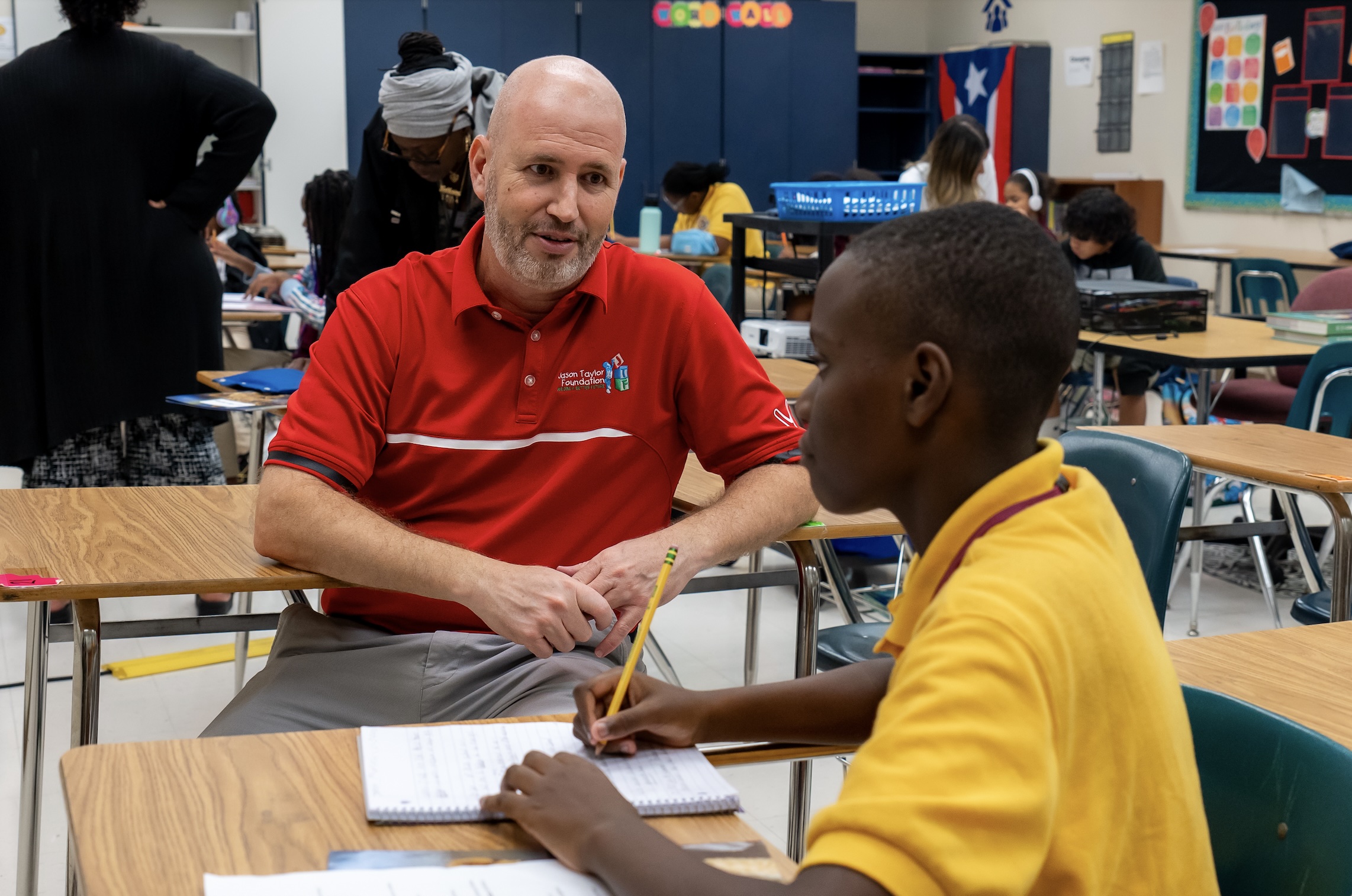
After mulling over the idea, Levit agreed and became the executive director and partners with Taylor in what is now known as the Jason Taylor Foundation.
Levit and Taylor in the parking lot following the annual Ping Pong Smash Kids’ Clinic. [Photo courtesy of Seth Levit]
The non-profit organization based out of Davie, Florida, focuses on aiding the day-to-day of children in South Florida.
“I wanted it to be a children’s-based foundation that focused on improving kids’ lives through education, health care and general well-being,” Taylor said. “We wanted to affect lives in a different way, we wanted to create original programming.”
While it has evolved across its 21 years of functioning, the foundation serves in various capacities. Taylor and Levit worked together to bolster the original idea. Now, JTF carries numerous programs — Bluapple Poetry Network, Careers in Sports Network, Children’s Learning Center, Reading Room and more.
“We wanted to teach kids how to capture opportunities, be prepared for opportunities and to better themselves,” Taylor said. “At some point they have to leave the nest and go out and fend for themselves to become productive citizens and people within our society.”
Troy Drayton, former Miami Dolphins tight end, was brought on to the JTF scene in 2002, 18 years after the foundation’s inception.
Levit worked with Drayton during the latter’s time with the organization. He was traded to Miami from St. Louis early in the 1996 NFL season and became close with Levit. Also, Drayton and Taylor shared the same football agent, bringing the three together.
When the idea for the Careers in Sports Network transpired, Levit looked towards Drayton to run the program.
Drayton said Levit’s drive for the idea and the other aspects of his life enticed him to take the opportunity.
“When you have the kind of passion and are the type of leader Seth is, anything is possible,” he said.
Careers in Sports “focuses on educating the future generation of leaders in the sports business.”
The network works with high schools in South Florida such as Cypress Bay, Piper and Cardinal Gibbons in creating a positive environment for students to become involved with athletics in various facets of the business.
“The foundation was an opportunity to give back and to work with young people in helping them figure out what they want to do for the rest of their lives,” Drayton said. “They are going to be the next generation of sports leaders in the industry and we want to have our hand in being a part of that process.”
Levit wanted to kickstart the Careers in Sports Network off of the idea that there is more to athletics than the product put out on the field. He said everything the foundation has created up to 2022 revolved around education, but there was untapped potential in sports.
“You could build an entire career in sport without ever sacking a quarterback, without ever catching a touchdown pass, without ever dunking a basketball,” Levit said.
Former Dolphins defensive end and linebacker Kim Bokamper has also become immensely involved with Levit, but from behind the microphone.
Bokamper, a nine-year NFL standout, co-hosts the Out to Pasture podcast with ex-teammate Joe Rose. The two introduced the weekly show early in 2024 where they reminisce on the “glory days.”
Rose served as the Dolphins’ tight end from 1980 for 1985, while Bokamper played on the Miami defense tabbed the ‘killer b’s’ in the same time span. Levit produces the show while the two talk about their previous experiences and speak with various guests.
“I don’t think I’ve seen many people like Seth,” Bokamper said. “He’s my first call in the morning and my last call at night, and probably three or four times in between.”
Like Drayton and Taylor, Bokamper first met Levit when he was in the PR department with Miami. The two would cross paths frequently and struck up a friendship. As the years went on and they became increasingly close, producing the podcast entered the conversation.
“I have a real admiration for him,” Bokamper said. “You know you like working with somebody when you’re happy every time you see them.”
Prior to becoming the producer of Out to Pasture, Levit had begun to work on a podcast of his own with McDuffie.
The Fish Tank began as a weekly live chat on a computer in McDuffie’s home with Levit typing behind the screen because he’s “a much better typer” than the former wideout. The public would ask questions about McDuffie’s career and other aspects of the game.
McDuffie and Levit speaking on The Fish Tank with the Miami Dolphins. [Photo courtesy of Seth Levit]
The two had the idea to start the podcast in 2018. The show’s first episode dropped in July of the same year and took off. At first, they relied on “authentic voices of the players” such as former Dolphins linebacker and Pro Football Hall of Fame inductee Zach Thomas.
“The podcast has given me something that I really enjoy doing,” McDuffie said. “I’ve learned so much about some of the guys that I played with. It gets me more inside who the real person is.”
What started as a part of the Five Reasons Sports Network evolved to a piece of the Miami Dolphins organization, and is now its own entity.
“All these stories were buried in the depths of the sea and you have to be ready to swim in the deep end,” Levit said.
Levit’s numerous stops in his professional life has led to building the Jason Taylor Foundation and amusing the public with stories of the Dolphins’ past.
The once-college student sitting in the seats of Riverfront Stadium in Cincinnati admiring as McDuffie caught the game-winning touchdown now bolsters the community through his words and actions, while inspiring those around him.
Category: Feature Sports News, Former Gators, Miami Dolphins, NFL, University of Florida
Rockport native Arthur Barragan is turning hometown pride into purpose through his locally-owned company called Brightview Exterior Cleaning, a business rooted in service quality and community commitment.
Barragan, who grew up in Rockport, says building a business in his hometown was always the goal. After spending nearly a decade as a specialty welder, he launched Brightview during the COVID pandemic, seeking stability and control over his future.
Today, Brightview Exterior Cleaning provides residential and commercial services, including soft house washing, window cleaning, pressure washing, and trash can cleaning, serving waterfront properties, neighborhoods, and local businesses across Rockport.
Now in its fifth year, the company has grown from about 100 customers to more than 700, a success Barragan credits to consistent customer service and strong relationships with other local businesses.
Giving back is central to Brightview’s mission. The company supports Church Unlimited, local youth sports, and community events, reflecting Barragan’s belief that business growth should benefit the entire town.
For Barragan, success is measured not just by numbers but by service to the community that raised him.
Brightview Exterior Cleaning can be found online at brightviewexteriorcleaning.com and on Facebook and Instagram under Brightview Exterior Cleaning, where the company regularly shares photos and updates from recent projects.
“This town gave me everything, Barragan said. Now I get to give back.”
The Tennessee Wildlife Resources Agency (TWRA) is encouraging youth across the state in grades K-12 to submit their original artwork of any Tennessee native fish for the national Art of Conservation: Fish Art Contest. The contest was created by the nonprofit Wildlife Forever to encourage youth to become connected to the outdoors.
The contest is free to enter, and students can submit one 2D piece and one 3D piece. All participants must enter original artwork of a Tennessee fish in a natural habitat and may not replicate another artist’s work. Photos or videos used as a source material for inspiration of the artwork are allowed. Goldfish, guppies, bettas, and koi are not eligible for this contest.
Additionally, TWRA is adding its own specialty award this year, The Bill Dance Signature Lakes Award – in honor of the legacy of fishing legend Bill Dance and the TWRA’s work to develop premier fishing destinations across the state. To be considered for the award, students should enter artwork of largemouth or smallmouth bass or art featuring bass fishing.
All submissions must be entered through an online entry form. More information regarding rules, submission form, and requirements can be found on the Wildlife Forever Art of Conservation website. The last day for submitting artwork is Feb. 28, 2026.
The Tennessee Wildlife Resources Agency is responsible for protecting, managing, and conserving fish and wildlife species for the benefit of Tennesseans and visitors. The Agency also maintains public safety through law enforcement and safety education on waterways.
The Centennial Cougars won their game at Centennial Sports Arena against the Champlin Park Rebels on Saturday, Dec. 20, 2025, ending 7-4.
The Rebels took the lead in the middle of the first period, with a goal from Paul Pazandak. Derek Roehl assisted.
The Cougars tied it up 1-1 with a goal from Nick Carls halfway through the first, assisted by Joey Hemr.
Five goals were scored in the second period, and the Cougars led 4-3 going in to the third period.
The Cougars increased the lead to 5-3, only 43 seconds into the third when Cooper Daikawa netted one, assisted by Keegan Julik.
Kaden Johnson made it 6-3 with a goal three minutes later, assisted by Gavin Cunningham.
Paul Pazandak narrowed the gap to 6-4 with a goal three minutes later, assisted by Gabe Contons and Brody Girard.
Gavin Cunningham also increased the lead to 7-4 with a goal eight minutes later.
The teams will face off once again at Champlin Ice Forum on January 9th.
Coming up:
The Cougars will go up against the Forest Lake Rangers at Centennial Sports Arena on Tuesday, Dec. 23, 2025, while the Rebels will battle Maple Grove on Monday, Dec. 29, 2025, at Maple Grove Community Center.
Read more prep coverage
Scoring:
Minnesota, Centennial Sports Arena
6th December 2025
Champlin Park Rebels at Centennial Cougars
7-4
1st period:
Champlin Park Rebels, 1–0 (9:44) Paul Pazandak
Centennial Cougars, 1–1 (12:20) Nick Carls
2nd period:
1–2 (23:20) Kaden Johnson, 2–2 (23:42) Max Peterson, 3–2 (25:30) Rhys George, 3–3 (30:55) Joey Hemr, 3–4 (32:25) Nick Carls
3rd period:
3–5 (41:43) Cooper Daikawa, 3–6 (44:48) Kaden Johnson, 4–6 (47:13) Paul Pazandak, 4–7 (55:39) Gavin Cunningham
Automated articles produced by United Robots on behalf of The Rink Live.