The first step toward addressing a problem, as the saying goes, is admitting you have one. Good news for concerned SEC football fans: It does seem the conference admits it has a problem.
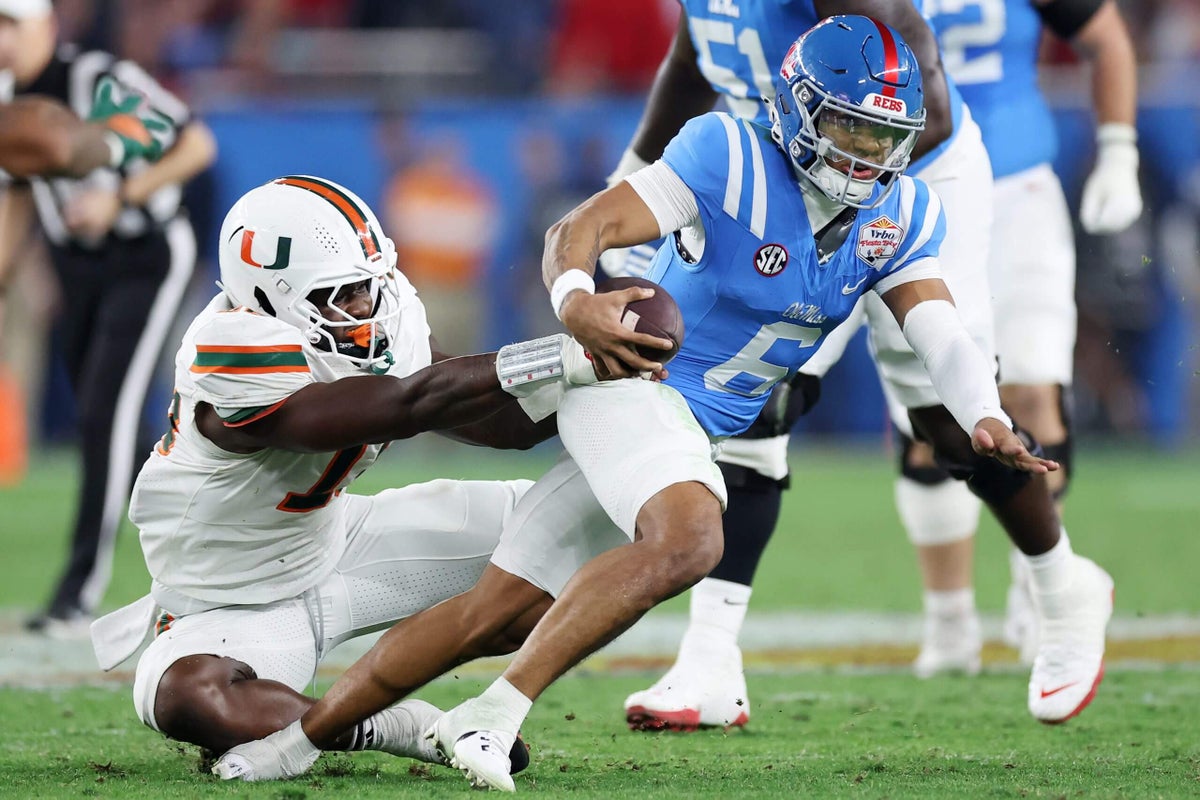
That was true even before Ole Miss lost to Miami on Thursday night, meaning the SEC was shut out of the national championship game for a third straight year. Ole Miss acquitted itself well, played a great game and almost got there. It deserves its flowers.
In fact, Ole Miss being the last SEC team standing was perfect symbolism. The rest of the conference should take heed.
As it is, the reality of the SEC’s situation set in this week among the conference’s defenders and within the league itself.
There was Paul Finebaum, voice of the SEC Network and basically the SEC, saying there was no defense for the conference’s 2-7 bowl record, including Alabama’s loss to Indiana in the College Football Playoff.
“There’s no way to defend the SEC. It’s been terrible,” Finebaum said on ESPN’s “First Take” on Tuesday.
There was Steve Spurrier, legendary former coach of Florida and South Carolina, not quite calling out his conference but also not downplaying things: “We got slapped in the face during the bowl season.”
And in my own conversations with people around the league, granted anonymity in order to be candid, there was none of the “everything is fine” meme.
“There’s no getting around the bowl results,” one conference source said, noting that SEC teams lost games they were favored to win. As elite teams faltered in the CFP, the SEC’s argument has been that it was still a deeper conference; Missouri losing to Virginia, Tennessee losing to Illinois, Vanderbilt losing to Iowa … not good.
Another SEC official maintained that the SEC is still the best league — as the NFL Draft has shown for years — but acknowledged that parity is here.
So will the SEC shrug and accept that? We all know the answer lies in a four-word slogan. The only question now is what the conference collectively will do about it.
To quote another saying: The answer to all your questions is money.
And a humbled SEC may become a desperate but smarter SEC. Because if the conference is going to get its mojo back, it will just need to mean more again. As in more money towards players.
Normally you could say the SEC was just due for a dip, this was cyclical, nothing to waste a column on. But the dip coincides with the other changes in the sport. The world is flat now, and too many SEC teams were slow to react.
Alabama and Georgia have been operating the past few years as if they got a discount because of their status. And that is the case for some recruits. But it isn’t for others, and that’s been enough to knock their talent down a notch.
Kirby Smart spent the early years of his tenure working donors for facility money, and it worked. When collectives became the focus, Smart did some lobbying, but perhaps with some restraint on the assumption they’d get that NFL Draft discount. Now that the difference appears to be third-party NIL deals, Smart may need to ratchet it up: There are big-money people working all around the Southeast who are Georgia fans and can probably arrange deals that will be approved by the authorities.
Or if not … well, anyway.
Georgia actually looks like it should be very good next year. Texas may be too. Alabama, on the other hand, has questions. Other teams are in transition, and then you have Ole Miss, the SEC program that most took advantage of the new rules. (Or lack of rules.) The other was Texas A&M a few years ago, but that was geared around traditional recruiting, not the portal. The programs that otherwise were the face of the era — programs desperate to win and willing to pay big to do it — tended to be outside the conference: Texas Tech, Miami and Ohio State.
That’s not to say SEC programs weren’t spending too; they were, which was part of the problem. SEC teams were picking off each other, whether it was top teams like Texas poaching Georgia and Alabama players or teams in the middle like Missouri. The SEC has been eating itself.
At the high school level, the SEC has still dominated recruiting:
• Last year, SEC teams signed 55 of the top 100 players, per the 247Sports Composite, including a remarkable 16 of the top 25.
• This year, it was only nine of the top 25, but still 53 of the top 100.
But while in the past it was the Georgias, Alabamas and LSUs signing most of those players, it’s now much more widely dispersed:
• Last year, 11 different SEC teams signed at least one top 100 player, and seven signed at least one top 25 player.
• This year, 13 different SEC teams signed at least one top 100 player, and five different teams signed at least one top 25 player. Vanderbilt, of all teams, swooped in and flipped the top-ranked recruit, quarterback Jared Curtis, from Georgia.
In the last year of the pre-NIL era, the 2021 recruiting cycle, teams that are now in the SEC signed a combined 18 of the top 35 players, but Alabama and Georgia signed 11 of them.
And of course, once you get players on campus, it’s harder to hoard the talent. Unlimited transfers provide a way for players to leave for immediate playing time rather than be stowed away on the bench, as Saban and Kirby Smart could do in the old days.
The world is flat. Parity is here. And throw in the CFP, which appears to be college sports joining the rest of the sports world with a postseason that’s a crapshoot. The best team doesn’t always win.
That is, if the SEC has the best team. Which it’s hard to say it has lately.
There can’t be any dismissing of the past: The SEC deserved the accolades it got for more than a decade leading up to 2023. The conference did win 13 national championships in 17 seasons, did have both teams in the national championship game three times in 12 years, did whip the Big Ten and other conferences in head-to-head matchups.
The SEC dominance was not a media creation.
But for the SEC industrial complex — media, administrators, whoever — to ignore the reality of the last three years would be foolish.
LSU is acting like a desperate program, committing the GDP of a small country not only to lure Lane Kiffin but to give him the resources to recruit. Texas, after a disappointing season, is also acting seriously about making amends. Even on the lower rung, Kentucky decided to pay coach Mark Stoops’ buyout, showing it wasn’t resigned to staying on that lower rung.
The signs are indeed there the SEC gets it. There’s a sense of urgency now. That doesn’t mean the old days will return: They’re probably gone, with super teams giving way to parity. That’s the new world.
The SEC isn’t doomed. It just has to adjust.