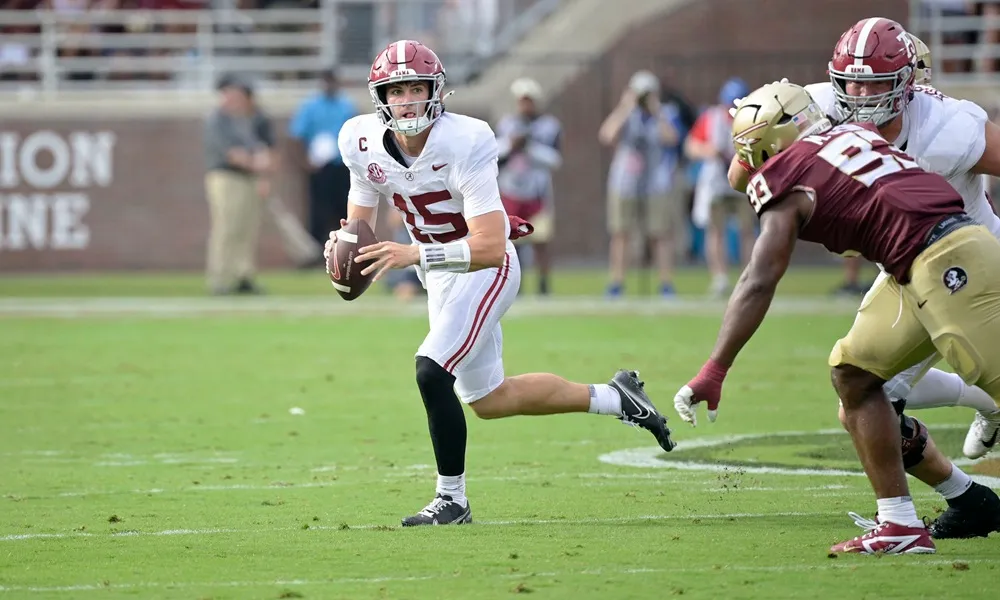
It was quite a week for the Washington Huskies and quarterback Demond Williams Jr.
In the span of a few days, Williams went from signing a new contract to stay with Washington for the 2026 season to announcing his intention to enter the transfer portal. Two days later, he said he will, in fact, remain with the Huskies “after thoughtful reflection.”
A potential standoff between a star quarterback and a Big Ten program lasted 48 hours, but it still raised pertinent questions about the enforceability of revenue-sharing agreements that have become a predominant feature of major college football. Williams’ new contract with Washington will pay him roughly $4 million, a deal Washington made clear it had no intention of releasing Williams from.
It’s the latest saga in this new-ish era of college sports, one reshaped by legal battles and schools directly signing athletes to contracts. Universities are permitted to distribute up to $20.5 million in revenue sharing to athletes across all sports for the 2025-26 school year, a result of the multi-billion-dollar antitrust settlement agreed to by the NCAA and power conferences.
The disturbance at Washington was sorted out before things fully escalated, but it wasn’t the first contract dispute involving a college athlete, and it won’t be the last. Let’s examine the nuances of these revenue-sharing deals — and potential fallout when others inevitably go pear-shaped.
If a player breaches a revenue-sharing agreement… ?
The prevailing question for many in the industry is whether these revenue-sharing deals are actually worth the paper they’re printed on. If an athlete can break a deal and transfer to another school — presumably for more money or better circumstances — what purpose do these contracts actually serve?
“They’re not worthless,” said lawyer Cal Stein, who advises colleges and athletes on revenue sharing, “but they are very difficult to enforce.”
From a legal perspective, that difficulty is due to the blurred shadowland college football operates in, compensating athletes like pay-for-play employees without lawfully designating them as such. Revenue-sharing contracts are not employment contracts because college athletes are not employees — a designation the NCAA and member schools have resisted because of the added costs and responsibilities that would come with it. Think of these deals more like independent contractor agreements, a distinction that might not mean much to the average person, but is significant in terms of how contracts hold up under legal scrutiny.
“If push comes to shove and a judge takes a look at them, I think it will be interesting what that judge’s determination is,” said lawyer Darren Heitner, who specializes in sports law.
Last Thursday, after The Athletic spoke with him for this article, Heitner announced that he had been retained as legal counsel for Williams.
Many universities use a template contract crafted by the conference office, with each one adjusted according to state law and as each school sees fit. Commonly referred to as “licensing agreements” — because they license an athlete’s name, image and likeness rights to a university — it essentially allows a school to market the contracted athlete, often with exclusivity language.
These agreements increasingly feature early termination language as well, also known as buyout clauses, which stipulate dollars an athlete is responsible for redeeming to the university if they breach the contract before the end of the term. It’s usually a specified percentage or amount, such as the amount remaining on the deal once it is broken. This is similar to coaching buyouts, when a coach is hired away and owes money to the previous institution in the form of liquidated damages.
“The biggest difficulty is coming up with damages” — meaning a dollar amount — “that a judge or arbitrator will accept,” Stein said of revenue-sharing buyouts. “How can you quantify the financial harm a university will suffer based on a single player playing somewhere else? I could put on my creative lawyer hat and come up with some ideas, but it would be really hard to prove.”
Regardless, buyouts are becoming more common and can make for more efficient conflict resolution. Multiple power conference general managers tell The Athletic they have either signed players who had buyouts with their previous school or lost players with buyouts to other teams. Most are handled without public incident or additional legal action.
“It’s not prevalent, but it’s happening,” Heitner said. “Typically, there is a negotiation where a school starts at a specific number and then negotiates down, if the player has good counsel.”
One noteworthy wrinkle is that if a player with a buyout transfers to another school, the dollar amount of that buyout counts against the new school’s revenue-sharing cap for that fiscal year. That’s according to enforcement guidelines from the College Sports Commission, which oversees revenue sharing and settlement terms. Typically, a player’s deal with the new school will cover or account for the buyout in some fashion, but the new school is not required to directly pay the buyout fee to the previous school.
The Athletic reported last Friday that Brendan Sorsby, the top transfer quarterback of the current portal window, transferred to Texas Tech with one season remaining on a multi-year revenue-sharing agreement with Cincinnati that includes a $1 million buyout clause. It is not yet clear how Sorsby’s buyout will be resolved.
What happened with Williams and Washington?
We don’t know all the details of Williams’ initial desire to transfer, or of his swift change of heart to return to Washington. The specifics of his deal with the Huskies have not been made public, either. His agent publicly dropped him Thursday for “philosophical differences.” But we can glean that a potential buyout may have factored into the final decision.
Yahoo Sports reported Thursday evening that, if he left Washington, Williams would have owed the Huskies the value of his new contract (roughly $4 million), and if he transferred to a new school, that new school would have to count the $4 million against its own $20.5 million revenue-sharing cap for the 2025-26 fiscal year.
As The Athletic reported, this reflects the buyout language in the Big Ten template contract. Multiple versions of the template, reviewed by The Athletic, state that if a player intends to transfer before the end of an agreement, the athlete would owe the remaining amount left to be paid on the contract, unless the school negotiates a different buyout amount.
It’s possible a legal challenge would have delivered a different verdict or required a lesser buyout figure. But despite Williams retaining a lawyer, this situation is not headed to court. That itself could be a revealing outcome: In the end, the contract may have been strong enough to deter Williams from breaking it. The fact that he signed his deal less than a week prior probably bolstered that sentiment.
“If it’s a clear agreement that was negotiated by both parties, the damages are reasonable, those are generally enforceable,” said lawyer Paia LaPalombara, a former college athletics administrator who advises schools, conferences and athletes on revenue sharing. “A lot of it depends on how things are worded within the agreement.”
Do schools have recourse?
It’s common for revenue-sharing contracts to include language prohibiting a player from entering the transfer portal or another school from using their NIL rights, and there were reports that Williams’ deal with Washington includes similar stipulations. But those only apply if the contract is in good standing. No school will keep paying an athlete who doesn’t play for them, and there’s no contract that can prevent a player from quitting the team.
“You can’t force someone to stay where they are. There is a freedom aspect in an agreement that allows an individual to terminate that agreement,” said LaPalombara. “Can they terminate it for free? No, not necessarily. But you have the right to get out of an agreement. And if there is not language that allows for it, that can be taken to a court.”
If a school believes a contract has been breached and the agreement contains early-termination language, the simplest resolution is to pursue the buyout payment, whether in full or at a negotiated rate.
If a buyout isn’t feasible for whatever reason, a school can take a player to court or arbitration, which is a private form of mediation. Some schools and administrators, however, might be hesitant of how a legal battle with a college athlete will play publicly, even if there is confidence in the legal argument.
“College athletics is a very relational business,” said LaPalombara. “It’s less of a legal challenge and more of an optics challenge for some institutions.”
Though that dynamic could be shifting as well.
How existing disputes were handled
Late last year, the University of Georgia took former defensive end Damon Wilson II to court, with Georgia seeking arbitration and $390,000 in damages, claiming Wilson broke an agreement with Georgia’s NIL collective, a third-party group affiliated with the school, prior to the start of revenue sharing. The arbitration request was filed in the state of Georgia — contract law is traditionally a state matter — and Wilson, who transferred to Missouri for the 2025 season, later filed suit in the state of Missouri against Georgia’s athletic association, seeking his own damages. It’s believed to be the first time a player and school have taken each other to court over an NIL dispute, and both cases are ongoing. Wilson recently re-entered the portal.
Last winter, then-Wisconsin defensive back and South Florida native Xavier Lucas attempted to enter the transfer portal. At the time, Wisconsin claimed that Lucas had a “binding agreement” with the university. The university, with the support of the Big Ten, refused to enter Lucas into the portal as a result, even though it could violate NCAA transfer bylaws.
Lucas later un-enrolled as a student from Wisconsin and enrolled at Miami, where he is playing football for a team that plays for the national title next week. There were no NCAA or eligibility rules preventing Lucas from transferring without utilizing the portal.
“There is nothing improper about a student un-enrolling from one school and enrolling at another,” said Heitner, who represented Lucas. “My inclination is that no judge is going to [prohibit] an athlete from changing schools.”
In June, the University of Wisconsin sued the University of Miami for tortious interference, claiming Miami intentionally interfered with a contract between Wisconsin and Lucas. That case is also ongoing.
The NCAA has its own rules against tampering, but it’s so rampant in college sports that it’s become almost impossible for the NCAA to penalize it. But if a school believes that another school illegally tampered with one of its athletes in an attempt to break a revenue-sharing contract — and the first school believes it can prove that in court — it could attempt the tortious interference route.
What’s next?
Was the potential standoff at Washington a harbinger or an outlier?
It might be the shortest contract dispute we ever see, but the turbulence with Williams could be an indicator of future conflicts. Few would argue that this era of revenue sharing and NIL has done much to stabilize college sports, even if most agree that athletes deserve to be compensated.
But in the meantime, schools and conferences will continue to fortify the language in revenue-sharing contracts, and athletes with the most leverage — or legal horsepower — will continue to test those limits. Until the next saga arrives.