The settlement of a class-action lawsuit against the NCAA and its most powerful conferences this year was supposed to cap the amount of money schools could pay athletes and establish stricter guidelines for name, image and likeness payments.
But the introduction of direct revenue sharing with athletes and new reporting requirements hasn’t stopped increased spending, according to coaches, athletics directors and general managers. Even President Donald Trump noted the high price for college talent recently in the Oval Office, and it’s not clear that anyone — in the pursuit of championships and on-field glory — can help themselves.
“Loopholes have won the day,” NC State football coach Dave Doeren said Wednesday.
The result is a continuing financial race across college athletics, especially football and men’s basketball, with seemingly no end to increasing costs at a time when the NCAA has abandoned or been forced to abandon its amateurism rules under a barrage of legal challenges and moves toward a professional model. Programs and conferences are working with private equity and trying to find new revenue streams amid the financial challenges.
Meanwhile, athletes are in their fifth year of being able to profit from their names, images and likenesses (NIL). And looser transfer rules implemented at the same time have enabled the movement of athletes akin to free agency in professional sports.
“Let’s make no doubt about it: We’re in a professional era,” University of North Carolina football general manager Michael Lombardi told reporters during a press conference this month.
The settlement in House v. NCAA — named for lead plaintiff Grant House, a former Arizona State swimmer — led to direct revenue-sharing between schools and athletes. And it came with a cap: $20.5 million per school to be divided as they see fit among programs and athletes.
The number equaled 22% of average athletic revenue across teams in the four biggest, most powerful conferences and brought total spending on athletes to roughly 50% of revenues, including scholarships, travel, food and other expenses.
House and other athletes sued college sports’ governing body and the NCAA’s major conferences — the ACC, Big Ten, Big 12, Pac-12 and SEC. The athletes argued that they deserved damages for not being allowed to monetize their NIL as the NCAA has allowed since 2021. They also wanted future broadcast revenue to be classified as NIL, opening the door to potential revenue sharing. The major conferences and the NCAA make the majority of their revenue through selling broadcast rights for football and men’s basketball. After several years, the dispute wound up with a proposed settlement.
The NCAA and member schools have pushed for federal legislation to allow them to codify some of the settlement and thwart some legal challenges, but that effort hasn’t produced a bill able to pass either chamber.
NIL spending
In addition to revenue sharing, the settlement allowed for outside compensation for the use of athletes’ names, images or likeness, but any deal above $600 would have to go through a new system, called NIL Go, designed to weed out abuses through the new College Sports Commission.
More than 12,000 deals for a total value of $87.5 million have been cleared by NIL Go as of Nov. 1, according to the College Sports Commission. Almost 400 deals worth $10 million haven’t been cleared since the launch of NIL Go on June 11. In October, more than 3,300 deals were cleared worth about $25 million – an average of $7,418 per deal.
The College Sports Commission initially said that NIL collectives — groups created to raise money to pay players for individual schools — wouldn’t meet the group’s “valid business purpose” criteria, a move designed to stop pay-to-play payments masquerading as contracts requiring nominal work or appearances. Within weeks, the commission reversed course, meaning NIL could continue to function as it has in addition to the new revenue sharing.
Collectives rushed to beat the implementation of the coming revenue-sharing cap by frontloading deals for athletes for the 2025-26 academic year so they wouldn’t count against that figure.
Texas Tech, which will play in this season’s College Football Playoff, is the most public example with billionaire boosters helping spend more than $28 million on its roster, including $7 million on its defensive line. Virginia, which reached the ACC title game, got at least $20 million from an anonymous donor to upgrade its football roster.
“You get what you pay for sometimes – most of the time,” said Doeren, who is completing his 13th season at NC State and is among the longest tenured coaches in major college football. “So that’s what people are doing to rebuild. Some of the schools have more than others. I don’t understand how we can say there’s a cap though, if there’s not.”
UNC paid $4 million over two years for quarterback Gio Lopez, a transfer from South Alabama, ESPN reported. Duke reportedly paid $8 million over two years for quarterback Darian Mensah, a transfer from Tulane who was the top passer in the ACC for Duke, which won its first outright ACC title since 1962. NC State quarterback CJ Bailey will likely have lucrative offers this offseason from teams in need.
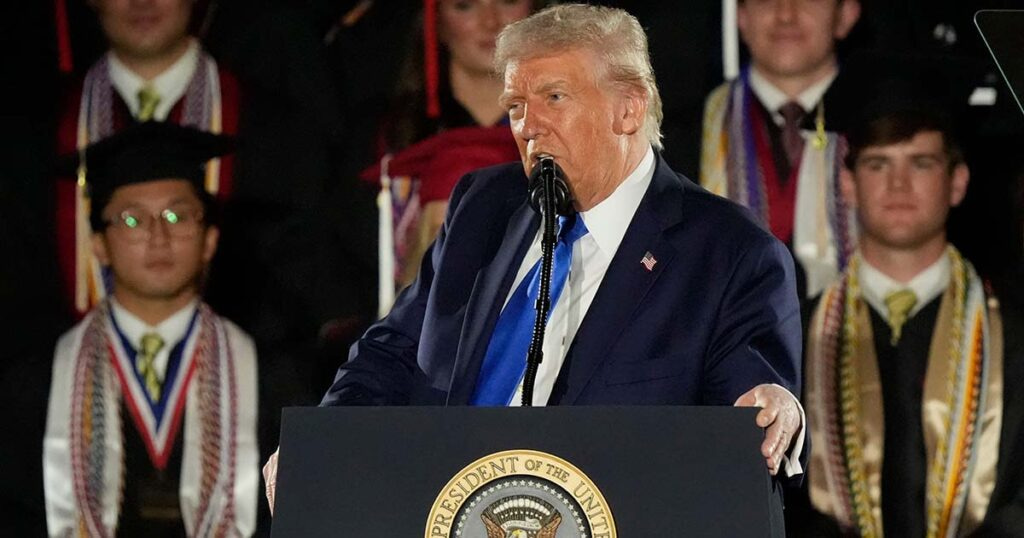
Trump said NIL “is a disaster for sports.”
“You can’t pay a quarterback $14 million to come out of high school,” Trump said. “They don’t even know if he’s going to be a very good player. Colleges cannot afford to pay the kind of salaries you’re hearing out there.”
Salaries, particularly for high school players, haven’t reached that amount yet. But Trump suggested that colleges won’t be able to stop.
“They’re going to get wiped out, including ones that do well in football,” he said.
There is plenty of evidence to suggest schools won’t stop. LSU reportedly guaranteed new coach Lane Kiffin $25 million annually for his roster. Other schools, too, have promised their coaches millions for talent acquisition and retention, above and beyond the revenue-sharing cap.
“Tell me the numbers and the plan for what the money is for the players because that’s everything in that area to me,” Kiffin said at his introductory press conference, claiming he was unaware of his $13-million a year salary. “Not what I make, what they make, to understand how you can build this.”
Arms race
Officials from across the country are paying attention to reports of millions for rosters — and trying to square that with the new rules.
“The numbers you’re hearing and the numbers we know that are out there don’t compute with the cap number,” Notre Dame athletics director Pete Bevacqua said at a press conference last week. “I think we have to be honest and forthright with ourselves and have a set of rules that are realistic and reflect what’s happening, reflect major college football in 2025 and beyond.”
The revenue-sharing cap is $20.5 million, but the first $2.5 million of additional athletic scholarships across the department is supposed to count against the cap, something that could change moving forward. The cap goes up 4% annually.
North Carolina allocated $13 million to football, $7 million to men’s basketball, $250,000 to baseball and $250,000 to women’s basketball, roughly accounting for how the department generates its revenue. Bevacqua said some schools allocate up to $16 million of the cap to football.
“I think the cap’s too low, and I think if we keep operating under this rule of where the cap is, most major programs are going to have a heck of a time going backwards because you read the same news reports that I do,” Bevacqua said. “You read and know about the same roster numbers for NIL and compensation that I do. Instead of making pretend that doesn’t exist, let’s deal with it and come up with a set of rules that can be followed and then hold people’s feet to the fire.”
Before revenue sharing, programs were committing dollars that had been raised — or needed to be raised. Direct revenue sharing brought some certainty as to where the $20.5 million would come from. But the “above the cap” spending comes from outside dollars.
NC State’s OnePack NIL Collective, a group that helps fund NIL payments for Wolfpack, raises money by selling membership packages to fans and supporters, who get access to a variety of perks including newsletters, gear, autograph sessions and personalized tours from athletes.
North Carolina has adopted a corporate model, seeking to partner with companies to funnel more money toward its players. Sponsorship money that comes directly to the athletic department would count toward the revenue-sharing cap, Lombardi explained, while a corporate sponsorship deal with a player wouldn’t.
“Part of this job is still fundraising because the teams that you’re competing against – the Clemsons, the Florida States, the Virginias – they’re operating on a different level,” said Lombardi, who traveled to Saudi Arabia before the football season to meet with a potential donor for the UNC program.
“Everybody has a different level of financial money and you’ve got to be able to be competitive within that environment. Texas, Texas A&M, the Southeastern Conference schools, everybody gets $20.5 million. How it gets divided up is different, but everybody else is out fundraising through corporate dollars, which will then be allowed to go to the players.”
New model
As of 2021, players, at last, could get money to sign autographs, appear in commercials or for the sale of their jerseys. The market, quickly and predictably, expanded into talent acquisition and retention. In 2025, it is an accepted part of recruiting for high school players and college transfers.
Lombardi said every freshman signing with schools is getting a revenue share contract and that each comes with an acquisition cost in a highly competitive environment. UNC brought in 38 freshmen as part of its 39-man early signing day class in December.
“You can argue the order, but what’s your academic curriculum and what’s your NIL situation are two questions that got to get answered,” Lombardi said. “Maybe the second one goes first.”
Lombardi said the Tar Heels under coach Bill Belichick, who won six Super Bowl titles in the NFL but is new to the college game, needed time to get up and running to compete against others who have had a plan for several years.
They’re not alone. Coaches, general managers and programs have to figure out what numbers are real and what they can do within their own budget.
The transfer portal, which Lombardi has equated to NFL free agency, opens Jan. 2, though many players have already announced their intent to transfer and schools, no doubt, have lined up deals with them.
“It’s a mess right now,” Doeren said. “You just got to do the best you can. I know, as a program — [athletics director] Boo [Corrigan] and I’ve met — we’re going to do everything we can to be as aggressive as we can in this space.”