Connect with us
https://yoursportsnation.com/wp-content/uploads/2025/07/call-to-1.png

NIL

Deadline, expedited College Sports Commission roll out, worries non-Power Conferences

Published

on


Dan Butterly sat inside a large conference room inside Orlando’s World Center Marriott Resort and listened as Ohio State athletic director Ross Bjork and select members of the Settlement Implementation Committee explained how the newly-approved House v. NCAA settlement would change college athletics as we know it during the first panel of last week’s National Association of Collegiate Directors of Athletics (NACDA) convention.

Bjork is part of a 10-person working group made up of two ADs from each of the five defendant – known colloquially as the “Power” – conferences that have been developing ways to implement the terms of the House v. NCAA class-action settlement approved late June 6 by California district court judge Claudia Wilken.

And while the NACDA panel was certainly educational, especially for ADs and administrators from the more than 300 Division I schools that weren’t defendants in the groundbreaking House case, which combined three separate lawsuits against the NCAA, it left many in the room with more questions than answers.

“In some ways it felt like they were trying to educate us, but at the same time talking down in some ways,” Butterly, the Big West Conference commissioner, told On3 after emerging from that panel Tuesday morning, “just because of the lack of information that’s available to the rest of us in the room.”

A week after Wilken’s approval, the NCAA and defendant conferences jointly released a 36-page question-and-answer document late Friday that provided some clarity on an array of questions provided to the NCAA over the last year. But there still remain several key issues that have non-defendant Division I conferences and schools raising concerns about the expedited pace at which these groups are being asked to opt-in to the new world order, even after the original June 15 deadline was extended to June 30.

Butterly described it as creating “frustration and confusion” for schools from outside the defendant/Power conferences – i.e. the ACC, Big Ten, Big 12, and SEC.

“Now we know where the goalposts stand, and rather than being in a defensive stance and not know which way the ball is going to go, now we know where the ball is going and you have to adjust to it,” Butterly said. “But we just don’t know the playing rules yet, and it’s really about trying to get clarification beyond the stuff we see posted (in the media).”

NEW WORLD ORDER

The new House settlement formally ends the NCAA’s long-standing “amateurism” model in favor of revenue-sharing that allows Division I schools to provide direct financial payments to student-athletes beginning July 1. At least for the 2025-26 academic year, Division I programs are able to share up to $20.5 million, or 22-percent of the Autonomy/Power conferences’ aggregate revenue from media rights, ticket sales, and sponsorships.

There is also nearly $2.8 billion in back damages to be paid out over a 10-year period to former NCAA student-athletes who competed between 2016-24 that were either fully or partially unable to take advantage of NIL or rev-sharing. A significant portion – more than 85-percent – is expected to go toward athletes who participated in the highest revenue-generating sports: football and men’s basketball. Before Wednesday’s Title IX appeal was filed, putting back damages on pause during the appeal process, the first back payments were set to be paid within 45 days of the settlement’s finalization – July 21.

The House settlement also facilitated the creation of the College Sports Commission, a new enforcement entity that will implement the settlement’s rules around revenue-sharing, NIL and roster limits, as well as Deloitte’s “NIL Go” clearinghouse, which will regulate and approve third-party NIL deals above $600 between athletes and non-institutional entities based on an algorithm that determines an athlete’s fair-market-value within an established “range of compensation” based on similar NIL deals.

As NCAA president Charlie Baker explained at a May 20 panel set up by the Knight Commission, the College Sports Commission and NIL Go will serve as “the vehicle through which most of the so-called ‘money issues’ get addressed.”

But while all those new innovations are generally seen as welcomed changes across what had become an almost unchecked marketplace in college athletics, it’s the general lack of transparency about what the next stage will look like, including yet-to-be-finalized specifics – including legal contract language – about the College Sports Commission and NIL Go.

“It was very alarming and frankly discouraging that institutions that had a choice of whether to opt-in or not felt an urgency to make that decision, and there was a huge vacuum of information about how the terms will be implemented and what the impacts could be,” Knight Commission CEO Amy Perko told On3. “This plane is being built while it’s in the air.”

According to Butterly, the non-defendant conferences have yet to receive any indication whether they’ll be required to sign the same “participation agreements” the Power Five programs must sign with the College Sports Commission that not only codifies the settlement terms but binds all parties against taking legal action to settle disagreements.

Michael Cross, the Southern Conference commissioner, also raised similar concerns about a yet-to-be-revealed financial charge associated with joining the CSC – much like there’s a cost to be a part of the NCAA – or to utilize Deloitte’s NIL Go clearinghouse.

“None of those entities are doing their work for free, but there’s been no suggestion or clarity about where and how the costs and expenses to run these entities are going to be assigned,” Cross told On3.

And given the lack of transparency with those outside the defendant conferences, there is concern those legally-binding agreements could be forced on institutions just prior to the new June 30 deadline, not allowing time for each institution to best evaluate the full legal scope of the agreement.

“That’s the $20.5 million question,” Butterly said. “Once this information is released, … if they require as part of the opting in … that you have to agree to this contract as an opt-in institution, that takes some time. You can’t just as an AD or commissioner sign off on behalf of your membership or institution. That has to go through a legal process.”

Added Cross: “Nobody would run a business this way, nobody would say: ‘Oh yeah, we’ll write you a blank check and send me the bill later.’”

MONEY MATTERS

While most of the defendant/Power conference institutions are expected to take full advantage of the new rev-sharing cap, which allows programs to dish out up to the $20.5 million annually to student-athletes as they see fit, that figure is simply unreasonable for many institutions outside the Power Five conferences.

Not that it’s stopping them from opting in. All 11 Big West programs, which includes Hawaii for all non-football sports until the Rainbow Warriors officially join the Mountain West in 2026, already opted into the House settlement. But that doesn’t mean those Big West programs will be able to take full advantage of all the same financial benefits as their Power conference peers.

“We’re not going to be at the $20.5 million level, I’m just being blunt,” Butterly said of the Big West, a non-football conference. “One of my institution’s athletic directors said, ‘Our budget is $20.5 million and we’re not going to be able to double our budget to pay student athletes.”

Facing similar financial limitations, the Southern Conference (SoCon) is split 50-50, with five of its 10 schools opting in to the House settlement and five opting out for the first year while the dust settles, preferring to take a wait-and-see approach before reevaluating their options prior to the 2026-27 academic year.

“At our level, I don’t have anybody that’s going to go to $20.5 million, and that’s OK,” Cross said. “It doesn’t prevent us from meeting on the playing field, it doesn’t prevent us from meeting on the basketball court.”

Even at a Power program like Alabama, which produced an annual revenue of nearly $235 million but posted a roughly $28 million overall deficit in FY 2023-24, money remains a concern. Especially when, like most other Division I programs, its two revenue-generating sports – football and men’s basketball – often help to subsidize its 19 other non-revenue-generating sports.

“Our smallest net financial losers – from a financial standpoint, they’re all important programs – are men’s and women’s tennis, each lose about $1 million, and everybody else is more than that. … And from a financial standpoint, we’re in a pretty good position compared to most schools out there,” Byrne said on Tuesday’s episode of McElroy and Cubelic in the Morning with Greg McElroy and Cole Cubelic. “But it’s still challenging the new model because now we have a $20.5 million line item from a rev-share standpoint, which I think is the right thing to do, we’re going to fully fund it, but we’ve got to have that money come from somewhere. So, it’s a bit of a tight rope you’re walking right now.”

In addition to rev-sharing restrictions, all 32 Division I conferences are responsible to sharing in the $2.8 billion in back damages paid out over the next decade. The Big West is responsible for approximately $31.5 million – “a significant impact,” Butterly said – with the NCAA expected to withhold more than $3 million annually from the conference’s annual revenue distribution figure.

“That’s a direct impact on what we can do for conference championships and what we can do for our student-athletes at an institutional level,” Butterly said.

While he declined to provide a specific number, Cross indicated the SoCon’s financial responsibility for back damages is “millions of dollars annually, and at our level, those are real dollars.” In an effort to better manage their finances, at least in this first year, the SoCon ruled it will not expand scholarship limits beyond the previous NCAA standards prior to the House settlement ruling, even though the settlement allows for increased scholarship opportunities.

“All of our schools want to be competitive, they want to be competitive at the highest level, and they all operate within budgets,” Cross said, “but the order of magnitude is different and understanding what those costs might be is a real factor in the decision-making.”

And while the Power conferences are pushing to expand the College Football Playoff even further to add additional games – and revenue opportunities – to help offset the cost associated with paying both back damages and future revenue-sharing, the non-defendant conferences don’t currently have that option to generate new revenue.

“Those dynamics haven’t changed (for non-defendant schools), the pie hasn’t grown, and we’re going to spend a lot more money for our slice of pie,” Cross said. “And it isn’t going to look a whole lot different in size.”

WHAT’S NEXT WITH COLLEGE SPORTS COMMISSION, NIL GO

While the College Sports Commission and NIL Go are effectively taking over enforcement and regulation of the monetary side of college athletics, the NCAA will continue to manage other aspects such as academic eligibility and performance, as well as working to continue to govern rules around recruiting, sports betting, and other fraud and safety violations.

Within that vein, the NCAA plans to overhaul its own governance model to better align with the terms and conditions of House settlement and College Sports Commission. That includes deleting more than 150 previous bylaws and rules, many of which restricted direct payment to student-athletes – which is now legal, of course.

But what’s more concerning to the non-defendant conferences is a move to grant the Power conferences as much as 65-percent weighted voting authority in future committees, thus giving the four most powerful leagues even greater influence to reshape collegiate sports as they see fit.

“The CFP (Power) Four will have 59 institutions (between) four conferences with potentially 65-percent of the weighted vote in Division I governance moving forward,” Butterly said, “and many of us may not even have a representative in the room where it’s going to happen.”

Of course, that’s not sitting well with the 28 other conferences and more than 300 Division I institutions that are not a part of the Autonomy/Power Four leagues.

“That’s just not a way we should be governing a 370-member Division I governance group moving forward,” Butterly said.

The Division I Board of Directors will vote on that proposal in their June 23 meeting, which is just a week before the newly extended June 30 opt-in deadline.

In the meantime, as non-Power conference programs continue to weigh their options on whether or not to fully embrace the new post-House world of college athletics, the majority simply want to be included in the conversation and then be afforded the necessary time to make informed decisions at an institutional and conference level.

“There are legitimate questions. Get us some answers, and then give us some time to digest it. Don’t say, hey, you’ve got two weeks,” Cross said. “I’m not saying we need six months, but geez, is 30 days with the Fourth of July intervening and everything else (going on) really that difficult? Is the world going to collapse if July 1 comes and goes and not everybody’s opted in yet? What’s the big deal? Nobody’s playing games until August.”



Link

Continue Reading
Click to comment

Leave a Reply

Your email address will not be published. Required fields are marked *

NIL

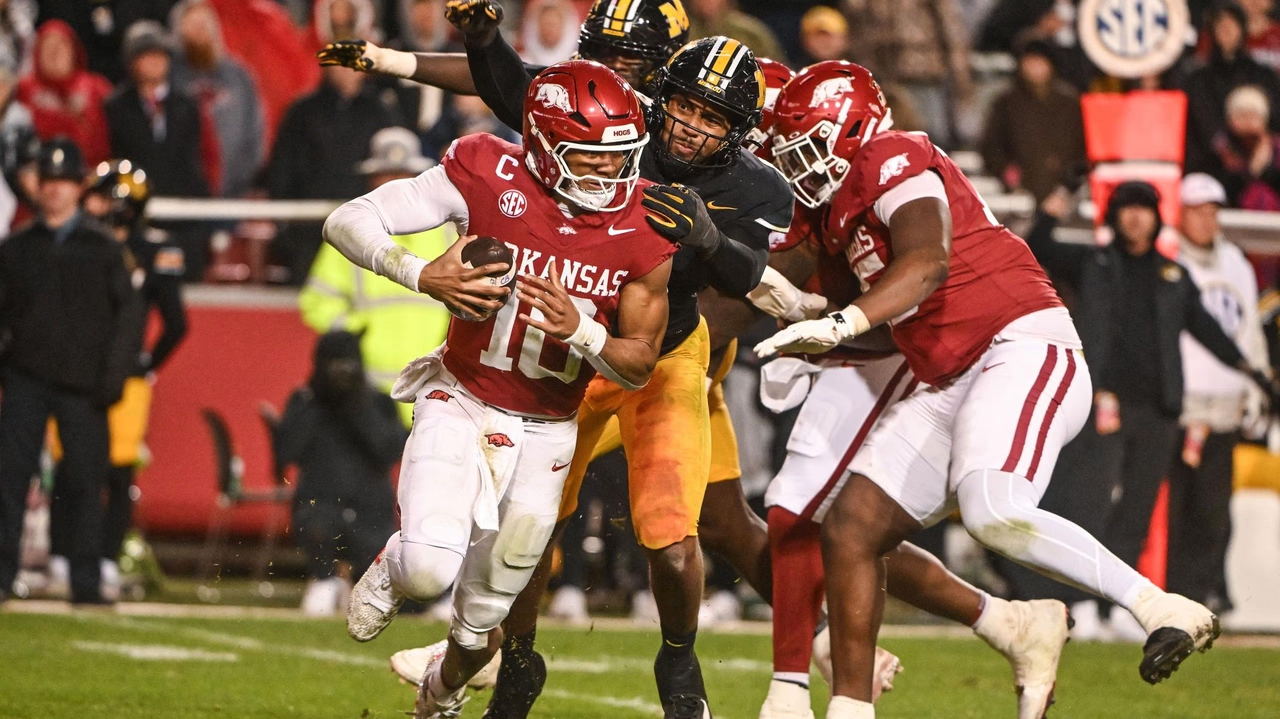
How would I put together a $25 million Arkansas football roster?

Published

on


If I were given $25 million to build the 105-man Arkansas football roster, how would I do it? All schools on the Power Four level have $22.5 million allotted for revenue sharing across all sports. SEC programs have pledged to donate $2.5 million of that to scholarships. For most schools, football is expected to receive approximately 75% of the remaining balance.

That comes out to $13.5 million in revenue sharing for football. That means we need to raise an additional $11.5 million in NIL to get to $25 million, which is probably the amount of money a program would need to be considered to be in the upper-half of NIL among SEC programs. And that’s an educated guess. Arkansas is likely working somewhere between $20 million and $25 million, I would assume.

That’s probably what it takes to bump someone out among programs like Georgia, Alabama, Texas, Texas A&M, Florida, Tennessee, Oklahoma, Auburn and Ole Miss. Let’s suppose the breakdown below is for Arkansas. It has always been said Arkansas must do more with less. I’ve got a formula that should stretch that $25 million in Monopoly Money I’m playing with today…


Link

Continue Reading

NIL

Commute: Wilson Countersues Georgia in Monumental NIL Case

Published

on


Welcome to the Morning Commute

Today we are talking about Mizzou Football!

In case you missed it, Mizzou defensive end Damon Wilson II got sued by Georgia in regards to breached agreement by transferring and owes $390,000, the unpaid portion of the deal, under a liquidated damages clause.

The Missouri defensive end challenges whether or not that agreement was ever legally binding.

Wilson is suing for defamation after spokesman Steven Drummond told ESPN that Georgia “expects student athletes to honor commitments.” The complaint alleges the comment damaged Wilson’s character by falsely implying he breached a contract.

This is definitely an ongoing subject so the best way to stay updated is the Rock M+ forums!

Yesterday at Rock M and Rock M+

Let’s shift our focus to Mizzou Football as Missouri plays in the TaxSlayer Gator Bowl vs Virginia on Saturday night. For the final time this season, it’s game week.

Hey… Missouri Football is playing! Should be an exciting matchup to wrap up Christmas festivities!

MU has seen its three-point field goal percentage drop from 45 percent to 31 percent since Stone, who shot 41.7 percent from beyond the arc in his six games this season, left the rotation. Gates used the analogy of his team as a puzzle in the postgame press conference, pointing to Pierce and Stone as key (missing) pieces.

Key players missing leads to major impact. Mizzou needs to get healthy if it wants a chance to compete in the SEC.

From Rock M Radio: Dive Cuts

In this episode, what turned into a slaughter fest of the Braggin’ Rights matchup is previewed. More to come soon on Rock M Radio!

If you like Rock M Radio drop us a Review and be sure to subscribe on your preferred podcasting platform. Follow @RockMRadio on Twitter and if you haven’t already head over to our YouTube channel and click that subscribe button!

(** RockMNation has affiliate partnerships. These do not influence editorial content, though RockMNation may earn commissions for products purchased via affiliate links.**)


Link

Continue Reading

NIL

Georgia football maintains ‘relationship business’ with roster management

Published

on


ATHENS — Collectively, the Georgia football program is focused on its Sugar Bowl showdown with Ole Miss that’s rapidly approaching.

But behind the scenes next season’s roster is being determined, as Kirby Smart has met with players about their football futures.

Smart — arguably the master of modern-day roster management with the most NFL draft picks (46) and national titles (2) in college football the previous four years — has held private meetings with players about their football futures.

It’s fair to say retention, as much as recruiting, has been key to the Bulldogs’ championship runs going back to Jordan Davis and Devonte Wyatt deciding together to return for the 2021 season.

Georgia, with 54% of its roster made up of first- or second-year players, figures to have several key contributors returning to a team Smart has enjoyed coaching this season.

“A couple of them just told me they want to go back and practice tonight, they said they want to get out there tonight and get on a Bloody Tuesday when we get back home,” Smart said in his postgame on-field interview after the 28-7 SEC title game win over Alabama.

“That’s the kind of mentality this team has — they want to practice some more, they want to practice some more, they love contact, and we love them.”

Settling up

If there is a silver lining to Georgia missing out on 2026 quarterback recruit Jared Curtis — whose signing would have cost in excess of $700,000 — it’s that Smart has more funds to spread around on returning players.

The Bulldogs, like many other programs, front-loaded investing in the 2025 class with the settlement of the landmark House vs. NCAA case pending, as it brought about a $20.5 million cap that schools could directly pay student-athletes for usage of their Name, Image and Likeness.

Smart noted the challenge some of the front-loaded deals would bring when discussing last year’s signing classes.

“ … What’s going to happen when those people expect that same money the next year and it’s not there because you’re in a cap?” Smart said last April. “There’s going to be a correction eventually, and I don’t think any of us know what’s going to happen.”

What has happened is that Georgia, like other schools, is working to help secure NIL deals for student-athletes that meet the standard for approval required by the College Sports Commission’s “NIL Go” platform.

“We can now help our athletes really serve as a marketing agency to go out and source opportunities, whether it’s corporate opportunities, whether it’s local opportunities, whether it’s social media opportunities,” Ohio State athletic director Ross Bjork said on Front Office Sports Today. “That’s going to be the next race.”

Per ESPN, more than 8,300 NIL deals worth approximately $80 million were approved between June 11 and Aug. 31 alone.

Keeping the culture

Name Image and Likeness deals, though not intended to be an incentive for recruiting talent or inducing transfers, certainly have had an effect.

But in a college football world dominated by high-profile transfers — including seven of the 10 Heisman Trophy finalists — Smart’s program continues to feature a culture built from within.

Indeed, the difference between Georgia and Ole Miss — its CFP Sugar Bowl quarterfinal opponent (8 p.m. Jan. 1) — is no less than stunning.

UGA recruits have made 90% of the starts for the Bulldogs this season, while nearly two-thirds (66.3%) of the starts made in the Rebels’ program have been made by transfers.

Perhaps it’s fitting that Lane Kiffin, the architect of the Ole Miss roster, has himself transferred in the sense of leaving his team for what’s perceived to be a better job as LSU’s head coach.

Building blocks

Indiana and Texas Tech — the next two most transfer-heavy teams in the 12-team College Football Playoff — took different approaches to free agency.

Hoosiers coach Curt Cignetti has brought 13 transfers with him from his previous job as James Madison head coach, effectively replanting a team culture in Bloomington, Indiana.

Cignetti, like Kiffin a former Nick Saban assistant, was not like Kiffin when it came to cashing in on his success in pursuit of a better job, even while his name was among the hottest for the most high-profile jobs.

Cignetti, whose most recent portal haul included 23 players (including Heisman Trophy-winner Fernando Mendoza and veteran Notre Dame starting center Pat Coogan), re-signed an 8-year contract with Indiana that will pay him $11.6 million annually — this, after more than doubling his salary at Indiana with an extension worth more than $8 million annually signed the year before.

Texas Tech, meanwhile, has a roster reportedly worth some $25 million reportedly funded by prominent Texas Tech booster and billionaire oilman Cody Campbell, a former Red Raiders offensive lineman (2001-04).

Campbell, who founded the Double Eagle Energy oil and gas company, leads the school’s “Matador Club” NIL collective and he is the school’s Chairman of the Board of Regents.

The Red Raiders brought in seven of the top 75 players in ESPN’s transfer rankings.

It’s worth noting five of the top 10 ESPN transfers helped lead their respective new programs into the 12-team College Football Playoff:

• John Mateer (Oklahoma, ranked No. 1)

• Carson Beck (Miami, ranked No. 2)

• Fernando Mendoza (Indiana, ranked No. 5)

• Makhi Hughes (Oregon, ranked No. 7)

• Zachariah Branch (Georgia, ranked No. 10).

The Red Raiders will next face Oregon in the CFP Orange Bowl quarterfinal at noon on Jan. 1.

The Ducks’ roster is widely believed to benefit from the school’s well-known association with Nike co-founder and billionaire booster Phil Knight.

Smart said at the 2024 SEC Media Days: “(I) wish I could get some of that NIL money (Knight is) sharing with Dan Lanning.”

Campaigning for dollars

Arizona State coach Kenny Dillingham openly campaigned on Saturday for $20 million in NIL money from someone — anyone — in the Phoenix community.

“We need to find one of these really rich people in this city to step up and stroke a check,” said Dillingham, whose Sun Devils missed making this year’s CFP field after winning the Big 12 last season.

“We live in Phoenix, Arizona. You’re telling me there’s not one person who could stroke a $20 million check right now? There is somebody out there who can.”

The funding required to compete for championships doesn’t stop with NIL dollars.

Per a recent story in “The Athletic,” this year’s College Football Playoff field reflected the four schools with the highest football budgets — not all calculated the same, the story notes — each made the field.

Total expenses submitted by the schools for 2023-24:

• Alabama: $112.2 million

• Texas A&M: $82.2 million

• Ohio State: $78.6 million

• Miami: $78.1 million

• Georgia: $68.9 million

• Oklahoma: $65.8 million

• Indiana: $61.3 million

• Ole Miss: $57.1 million

• Oregon: $53.9 million

• Texas Tech: $34.3 million

• James Madison: $15.9 million

• Tulane: $13 million

At Georgia, Smart works closely with athletics director Josh Brooks to stay within the proposed budget, while maintaining the necessary relationships with players, eschewing the trend of hiring a general manager.

“It’s still a relationship business for us,” Smart said last spring. “We find our niche in our culture, which is relational, and trying to have a relationship with somebody.”


Link

Continue Reading

NIL

The NCAA has made a mess of college football. Here’s a remedy.

Published

on


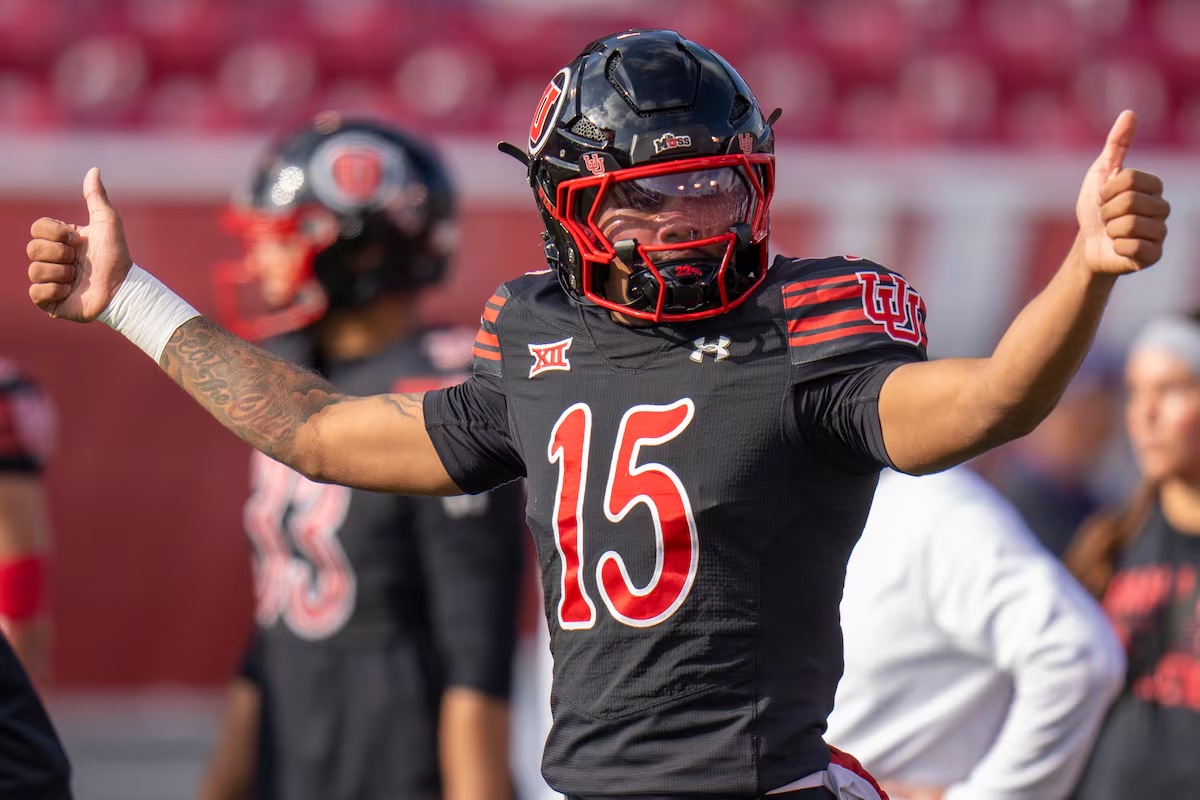
(Rick Egan | The Salt Lake Tribune) Utah Utes quarterback Byrd Ficklin (15) warms up on the field before Big-12 Football action between the Utah Utes and the Kansas State Wildcats at Rice-Eccles Stadium, on Saturday, Nov. 22, 2025.

I enjoy college football, but the College Football Playoff Selection Committee just killed my postseason viewing. I’ll only watch the Utah Utes in the Las Vegas Bowl, but I’m supporting Notre Dame’s bowl boycott after it was cheated out of a spot in the College Football Playoff. The University of Alabama was chosen instead, despite having poorer performance stats and losing big in its conference championship game. The University of Miami was also elevated above Notre Dame despite its less impressive stats — with the exception of having narrowly beaten The Fighting Irish in the season opener.

In recent years, the National Collegiate Athletics Association has made a mess of college football, but if the NCAA wants to redeem itself, it could:

1. Expand the playoff to 16 teams with no byes which would have eliminated this year’s fiasco.

2. Realign conferences to have no more than ten teams. The conference champion would be the team with the best record in nine conference games. No conference championship game needed.

3. Eliminate publishing CFP rankings before the end of the season. The committee embarrasses itself when it reorders those without cause.

4. Put income limits on Name Image Likeness as it grossly enriches some players. NIL has turned college football into the NFL Lite.

5. Fix the transfer portal. Allow players only one transfer and perhaps a second if a coach moves on.

6. Convince the Heisman Trophy Trust to award its statue at the end of the playoffs eliminating the embarrassment when an awardee fizzles in postseason play.

7. Consider eliminating conferences altogether. Create leagues of 60 or so teams in upper and lower divisions like European sports are structured with fluidity between the divisions based on teams’ previous year’s performance.

To do all this would just require some good will.

Jim Catano, Salt Lake City

Submit a letter to the editor


Link

Continue Reading

NIL

Nick Saban’s new role with the Nashville Predators

Published

on


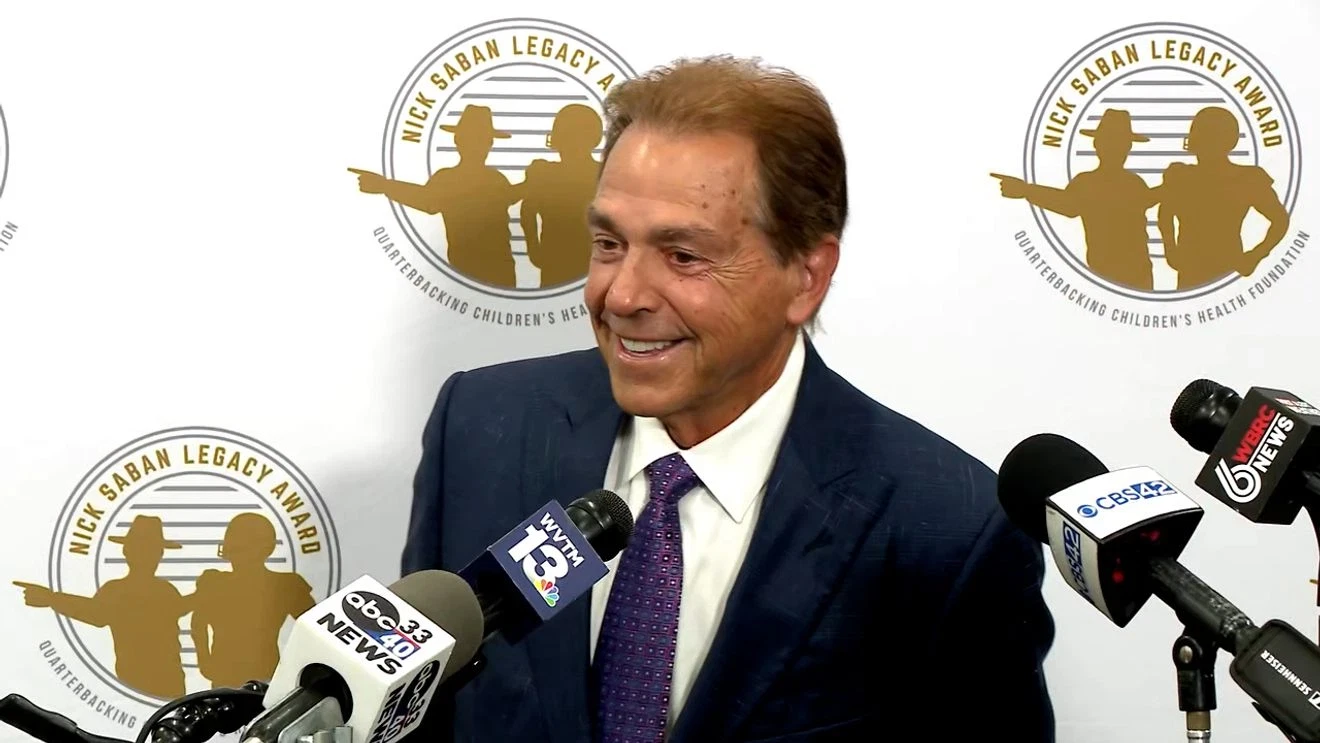
NASHVILLE, Tenn. (AP) — Nick Saban knows his strengths with seven national championships as a college football coach. He also understands how to put coaches and athletes in the best position to succeed.

That’s what he hopes to bring to the NHL’s Nashville Predators after joining the franchise as a minority owner.

“I’m no expert in hockey, so don’t look at me like I’m going to make some huge impact coaching around here because that’s not going to happen,” Saban said Monday. “But I do have a pretty good idea of what it takes to have successful organizations.”

Saban made his first appearance Monday in his new role as a minority owner alongside Predators chairman Bill Haslam.

The Predators announced Saban’s purchase Dec. 16 through Dream Sports Ventures LLC, an entity controlled by Saban and business partner Joe Agresti. That business group features 10 car dealerships, including two in Nashville.

Haslam, a former Tennessee governor, was working on a possible WNBA expansion franchise when Saban told the Predators controlling owner that he also might be interested in hockey.

“I thought, ‘Well, that’s the greatest no brainer of all time,’” Haslam said. “You have somebody who understands building a championship culture, who understands, I think, better than almost anybody in sports the process that’s needed to get to where you can compete as a champion.”

Saban grew up in West Virginia with no hockey around. He became interested in hockey when coaching at Michigan State and became friends and shared ideas with that team’s coach. Saban called this an opportunity to be involved with a team for the first time since he announced his retirement Jan. 10, 2024.

So what will Saban bring to the NHL and the Predators in his newest role?

His experience building programs both in college football and six seasons in the NFL working for Bill Belichick in Cleveland and as head coach of Miami. A “transformational leader” as Saban put it. Once college football season ends, Saban said he will be involved as much as Haslam wants.

Saban already has spoken to coaches and some players during what he called a minicamp. Saban also has met a couple times with general manager Barry Trotz, saying his goal is to support Trotz and everyone else with the Predators.

Nashville won the Western Conference before losing the Stanley Cup Final in 2017 to Pittsburgh in six games. The Predators won the Presidents’ Trophy for the 2017-18 season but ranked 26th out of 32 NHL teams Monday five points back of the second wild-card spot in the West.

“To be a part of the hockey team here is something special, and we’d love to build it into a championship,” Saban said. “We’d love to partner with Mr. Haslam to do anything that we can do to help this organization be successful.”

___

AP NHL: https://apnews.com/hub/nhl


Link

Continue Reading

NIL

Missouri linebacker Damon Wilson II accuses Georgia of illegal punishment in transfer portal lawsuit

Published

on


COLUMBIA, Mo. — Missouri pass rusher Damon Wilson II claims that the athletic department at Georgia is trying to illegally punish him for entering the transfer portal in a lawsuit filed by the linebacker in state court Tuesday in Boone County, Missouri.

Wilson transferred to the Tigers last January after signing a 14-month deal with Georgia’s booster collective to capitalize on his name, image and likeness. He received $30,000 in an initial payment on a $500,000 deal before entering the transfer portal.

Georgia filed a lawsuit last month claiming that Wilson owed its athletic department $390,000 in liquidated damages for leaving the team. Wilson’s countersuit claims that his former school is using such damages to “punish” him for his decision to leave.

Georgia spokesman Steve Drummond said the school had no comment because it involves pending litigation.

“When the University of Georgia Athletic Association enters binding agreements with student-athletes, we honor our commitments and expect student-athletes to do the same,” Drummond said upon the school’s initial lawsuit in early December.

Wilson had nine sacks and an interception this season for the Tigers. They will play Virginia in the Gator Bowl on Saturday.


Link

Continue Reading

Most Viewed Posts

Trending