





Cougars on the air
Pop-Tarts Bowl
No. 12 BYU (11-2) vs. No. 22 Georgia Tech (9-3)
- Saturday, Dec. 27, 1:30 p.m. MST
- Orlando, Florida
- TV: ABC
- Radio: 102.7 FM/1160 AM


Since the earliest days of professionalism, the foundation of the multibillion-dollar sports industry has been its tripartite relationship with media and sponsorship. This so-called ‘golden triangle’ has allowed sport to monetise fandom away from the stadium, bringing in revenue that has raised standards on and off the field of play.
Technology has been a crucial facilitator. Radio and television broadcasting enabled a shift away from localised, ad-hoc commercial activity by offering a national, and later international, platform for brands, athletes, teams and competitions to collaborate.
More recently, the internet, mobile devices and digital platforms have unlocked entirely new forms of engagement, creative possibilities, and more diverse revenue streams. Advances in LED advertising boards, in-stadium WiFi and the Internet of Things (IoT) have transformed on-site activations, allowing marketing campaigns to bridge the digital and physical worlds.
These advances, coupled with effective data analysis, have allowed brands and sports organisations to deliver more impactful, cost-effective and agile campaigns at all levels of sport and have seen sponsorships transform beyond mere transactional arrangements into genuine partnerships.
Now, a new wave of technological innovation is accelerating this trend even further – and inspiring projects like Impact X, SportsPro’s new initiative spotlighting the most creative and effective partnerships in sport. Here are four ways tech-infused activity is not just delivering greater value for rights holders and their sponsors, but also enhancing the fan experience itself.
Official websites, mobile apps and social media channels provided the first opportunity sports organisations had to establish true two-way relationships with their fanbases, strengthening relationships and significantly expanding the data collection possibilities.
Interactive, social digital environments powered by immersive graphics, augmented reality (AR) and virtual reality (VR) are seen by many as the next frontier of digital fan engagement, building on mature social media strategies that facilitate direct fan engagement and sponsor activation.
While visions of a fully-fledged metaverse with data and identity portability, along with blockchain-enabled ownership, have yet to be realised, there are several platforms that are proving hugely effective tools of communication – particularly among younger audiences.
Fifa, the National Hockey League (NHL) and golf’s R&A are among those to have created Roblox experiences, which include games, competitions and digital recreations of real-life sporting action, supported by tech companies and digital agencies. Indeed, Roblox claims sports experiences on its platform attracted more than 500 million hours of activity in 2024 alone, representing US$300 million in potential earned media value.
Many rights holders have recognised the ability to commercialise this engagement.
Last year, the International Olympic Committee (IOC) created an Olympic World on Roblox that was sponsored by TOP partner Visa, while Team USA launched an experience for Paris 2024 where users could buy virtual fashion items produced by the US Olympic and Paralympic Committee’s (USOPC) official outfitter Ralph Lauren. Meanwhile, the United States Tennis Association (USTA) previously created a dedicated space on Roblox that incorporated its airline partner Emirates.
Fortnite has also proved popular. Wimbledon has activated its American Express partnership within the game, inviting players to set a best time across a course that spans multiple London landmarks, including Big Ben, the London Eye and Wimbledon Village in a bid to win tickets, travel and accommodation for the tournament itself.
Traditional video games, meanwhile, are providing a new platform for activations, with several brands appearing in EA Sports FC. One of these companies, Pepsi, has also blurred the lines between the digital and physical worlds by offering in-game items on promotional packs of its soft drinks.
While digital platforms provide ample opportunity to gather data on fans, Cisco went one step further by using a ‘connected scarf’ that tracked the emotions, physiology and movement of Manchester City supporters when they were watching a match, giving the club a better understanding of fan behaviour. Sensors located on the neck were capable of measuring everything from heart rate, respiration, oxygen saturation and hydration levels through to nervous system responses and temperature.
Elsewhere, at the Qatar 2022 Fifa World Cup, brewing giant AB InBev partnered with the Mexican Football Federation (FMF) and Adidas to roll out a limited-edition Mexico jersey pre-loaded with Corona beer. A near-field communication (NFC) chip embedded in the crest gave fans two free beers and other benefits, transforming Mexico’s jersey from a show of national pride into both a convenient payment solution and fan loyalty programme.
One of the reasons that technology companies are so attracted to sport is because they value the ability to showcase their innovations to potential customers in a relatable, meaningful way. Oracle’s relationship with the Premier League and Amazon Web Services’ (AWS) partnership with Formula One are but two examples of big tech using high-profile events to demonstrate the capabilities of their cloud computing and AI innovations.
Other vendors are getting even more creative. As a B2B IT consultancy and services firm, Tata Consultancy Services (TCS) would not appear to be the most organic fit as the title sponsor of the London Marathon. However, it has used the partnership to promote its full suite of services, including AI-powered holographic replicas of runners that conveyed the potential of digital twin technology to improve healthcare and fitness.
The importance of technology and digital innovation to the sports industry is now such that rights holders are seeking more than just financial benefits when identifying commercial partners. In exchange for a high-profile use case for vendors to profit from, teams, leagues and federations want access to powerful tools, services and expert support that might otherwise be beyond their financial means.
As part of Adobe’s three-year deal to become title sponsor of the Women’s FA Cup, the tech firm has made its AI-powered Adobe Express creation tools available to every single team in the competition. This arrangement ensures that clubs at every level can create professional-grade content that attracts and engages fans on digital platforms and provides opportunities to promote and serve commercial partners.
Women’s sport has also been a priority for Google, which has sought to leverage its entire portfolio of products and services, including its eponymous search engine and its Pixel range of smartphones, to help the likes of the Women’s National Basketball Association (WNBA) and several major European soccer clubs.
However, the most famous example of Google’s technology at work may have been the image of Liverpool’s Mo Salah taking a selfie with fans in front of the Kop at Anfield, which was widely shared on social media and published by outlets around the world. The Egyptian took the selfie on a Google Pixel handed to him by a club photographer who was already using the phone to capture pitchside content, making the stunt appear as though it was a totally organic, spontaneous use of technology.
As the hottest topic in technology, it’s no surprise to see brands using AI to power more creative campaigns. Ahead of Uefa Euro 2024, Snickers created an AI-powered clone of notoriously outspoken soccer manager Jose Mourinho in WhatsApp, allowing fans to be roasted in a personalised video.
Euroleague Basketball and its sponsor BKT Tyres used AI to determine which of the competition’s 18 clubs had the most passionate fans by measuring the intensity and volume of their chants. Others are using AI in more practical ways. At the 2023 Ryder Cup, Capgemini rolled out a tool that crunched the available data to produce live outcome probabilities of players winning a particular hole or an entire match. The insights were popular on social media and were used by the competition’s live broadcast partners, including Sky Sports.
But perhaps the best way that sponsorship has transformed the fan experience through technology is by making sport more accessible.
In its role as official connectivity partner of Wimbledon, UK mobile operator Vodafone has deployed connected headsets that help visually impaired fans in the stand experience more of the stadium atmosphere. These headsets use ultrafast, high capacity and ultra-low latency 5G networks to stream footage from local TV cameras and enhance the footage to suit a person’s specific sight profile.
Newcastle United’s main partner Sela looked to do something similar for deaf fans or those suffering from hearing loss. It integrated conductive textiles, haptic modules and integrated antennas into the fabric of a connected jersey that converted sounds from pitchside microphones into vibrations.
Even more remarkable was Michelob Ultra’s campaign to help Cameron Black, a blind basketball fan, fulfill his dream of commentating on a live NBA game. A haptic vest, wearable technology, and spatial audio allowed Black to experience a live New York Knicks game like never before, while an AI-powered system translated complex basketball data into information that was relayed on an 80-cell braille display. Black’s commentary was made available on ESPN and on MSG Network.
Digital transformation has transformed how sport is played, consumed and organised, so it’s only natural that technology has fundamentally altered how it is commercialised, too. The combination of cutting-edge innovation and creative inspiration benefits rights holders, brands and fans, and will be as important as ever as sport enters its next phase of digital disruption.
Produced by SportsPro in collaboration with SportQuake, Impact X is a new annual initiative spotlighting the most impactful, creative and effective partnerships in sport. Click here to find out more.



South Carolina Upstate Spartans (8-6) at Youngstown State Penguins (7-5, 2-1 Horizon League)
Youngstown, Ohio; Saturday, 1 p.m. EST
BOTTOM LINE: Youngstown State hosts South Carolina Upstate after Cris Carroll scored 31 points in Youngstown State’s 80-77 overtime loss to the Robert Morris Colonials.
The Penguins are 4-0 on their home court. Youngstown State scores 80.2 points and has outscored opponents by 10.9 points per game.
The Spartans are 2-5 on the road. South Carolina Upstate is fifth in the Big South scoring 79.6 points per game and is shooting 46.2%.
Youngstown State averages 10.4 made 3-pointers per game, 3.8 more made shots than the 6.6 per game South Carolina Upstate gives up. South Carolina Upstate has shot at a 46.2% rate from the field this season, 3.3 percentage points greater than the 42.9% shooting opponents of Youngstown State have averaged.
TOP PERFORMERS: Carroll averages 3.0 made 3-pointers per game for the Penguins, scoring 16.4 points while shooting 48.6% from beyond the arc. Rich Rolf is averaging 10.8 points over the last 10 games.
Mason Bendinger is scoring 16.1 points per game and averaging 3.1 rebounds for the Spartans. Carmelo Adkins is averaging 1.9 made 3-pointers over the last 10 games.
LAST 10 GAMES: Penguins: 6-4, averaging 81.3 points, 33.6 rebounds, 15.2 assists, 9.1 steals and 3.3 blocks per game while shooting 49.6% from the field. Their opponents have averaged 67.7 points per game.
Spartans: 5-5, averaging 75.4 points, 33.5 rebounds, 14.1 assists, 6.1 steals and 5.0 blocks per game while shooting 43.9% from the field. Their opponents have averaged 73.2 points.
___
The Associated Press created this story using technology provided by Data Skrive and data from Sportradar.
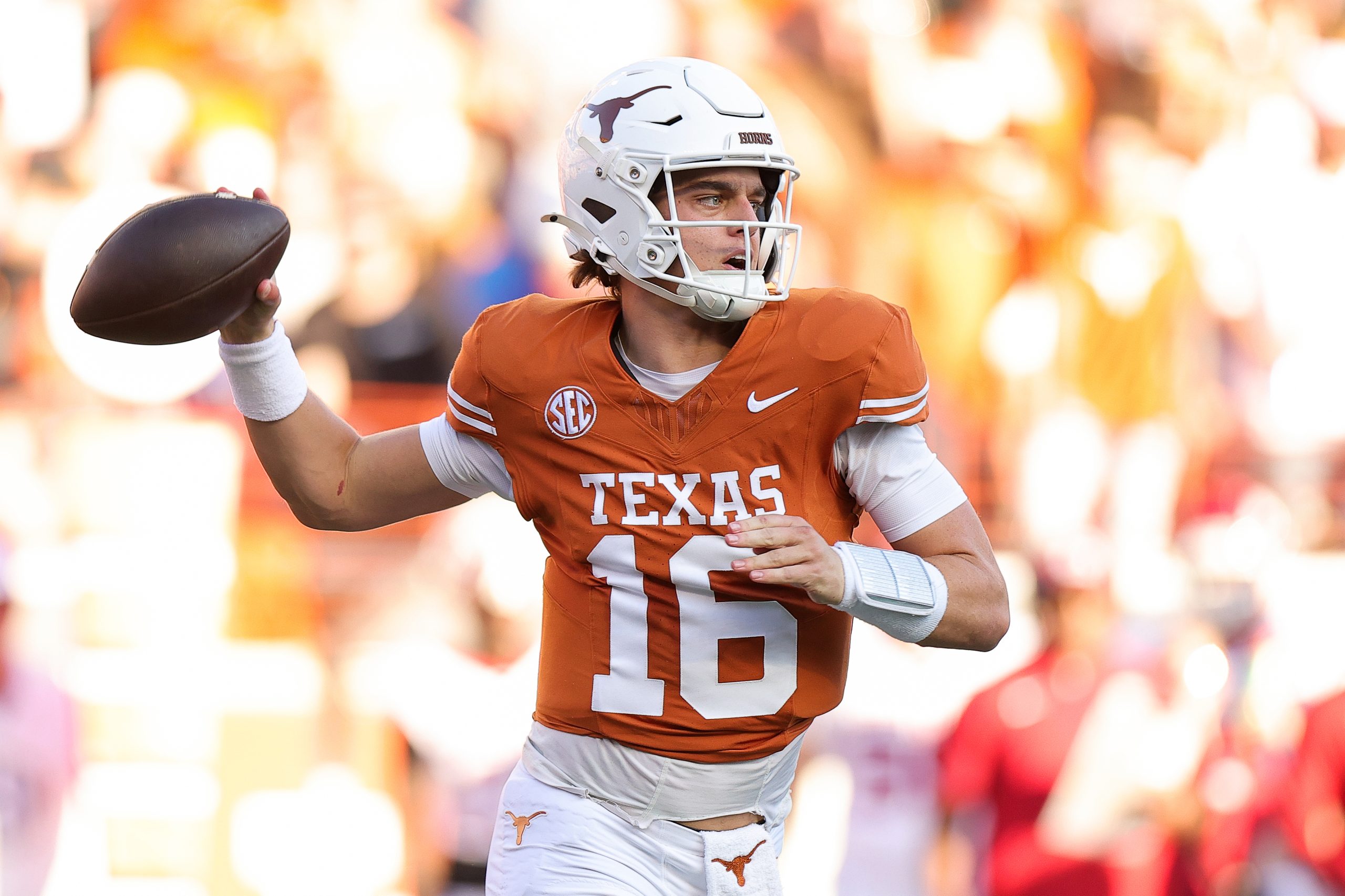
In a college football world where NIL numbers keep climbing, Arch Manning is going the other way.
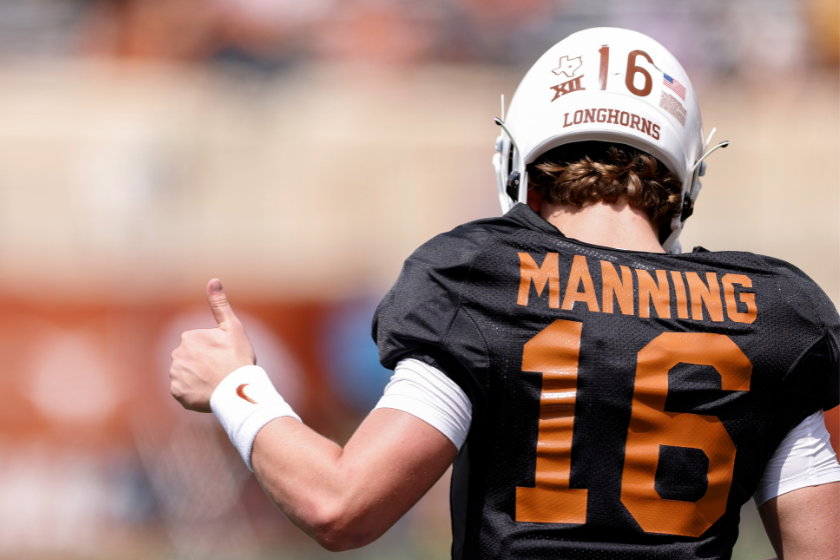
Photo by Tim Warner/Getty Images
The Texas quarterback has agreed to take a reduced share from the Longhorns’ revenue-sharing pool for the 2026 season, according to Justin Wells of Inside Texas. Manning was entitled to a full portion of the program’s revenue cap but opted to scale it back in an effort to give Texas more flexibility to strengthen its roster.
It is a move that stands out in the current landscape. It is also one Manning can afford to make.
Manning remains one of the most marketable players in college football and has a long list of endorsement deals that will continue to pay handsomely. Even with less money coming directly from the school, he is still expected to earn millions in 2026.
This is not the first time he has shown restraint, either. Manning has consistently been selective with his NIL opportunities since arriving in Austin.
The timing matters. The 2026 season is widely expected to be Manning’s last at Texas before he makes the jump to the NFL. From that perspective, the decision is straightforward. He wants the best possible team around him for one more run at a national championship.
Manning has already demonstrated his commitment to the program. He waited his turn behind Quinn Ewers for two seasons without entertaining a transfer and now is willing to sacrifice a portion of his compensation for the good of the roster.
On the field, the growth showed. After a shaky start in 2025, Manning finished with 2,942 passing yards and 24 touchdowns. Texas rebounded from a 3-2 opening to win six of its final seven games, punctuated by a decisive win over Texas A&M.
It is not a common move. It is a very Arch Manning one.

Ahead of the College Football Playoff opener, Malachi Toney added a notable NIL deal. The Miami wide receiver has inked a partnership with apparel company Hellstar.
Toney is Hellstar’s first NIL athlete, the Los Angeles-based brand said in an Instagram post. He became a crucial part of the Hurricanes’ offense during the regular season, helping lead the program to a College Football Playoff appearance as the last team in the field.
SUBSCRIBE to the On3 NIL and Sports Business Newsletter
It was part of a decorated freshman year for Toney, who’s emerging as one of the top young stars in the sport. Repped by NETWORK, he has a $878,000 On3 NIL Valuation.
“We are so proud to announce our first Hellstar Sports College Athlete NIL signing – Malachi Toney,” Hellstar wrote in its announcement. “We had the privilege to coach @malitoney10 while he was apart of our high school 7 on 7 program, so now seeing him shine on the collegiate level we couldn’t be more proud.
“We will continue to do our part to help these young athletes stay on the right path, and shine their light to the rest of the world. From Liberty City to the stars!”
It’s the latest notable NIL deal for Toney amid his freshman season. He also secured a partnership with Leaf Trading Cards in October.
Through his freshman year at Miami, Malachi Toney emerged as a top target for Carson Beck. He led the Hurricanes with 84 receptions for 970 yards, and his seven touchdown catches put him atop the ACC. Toney also added 89 rushing yards this year, as well as a rushing touchdown against Louisville.
Those numbers helped Toney become an On3 True Freshman All-American this year. In addition, he was a central figure in Miami’s run to the College Football Playoff.
“Toney’s quickness and playmaking instincts make him dangerous after the catch. He accounted for 350 yards after the catch with an average depth of target of 6.6, according to Pro Football Focus,” On3 | Rivals’ Charles Power wrote. “Whether working out of the slot or moving around the formation, the South Florida native has proven nearly impossible to contain. His playmaking ability was pivotal to Miami’s playoff push as he became the focal point of the Hurricanes’ passing attack.
“Given his play as a true freshman, it’s safe to say the Fort Lauderdale American Heritage product will enter next season as one of college football’s premier wide receivers. Toney’s performance as a true freshman is even more impressive considering that he should still be in high school, having reclassified into the 2025 cycle late in the recruiting process.”
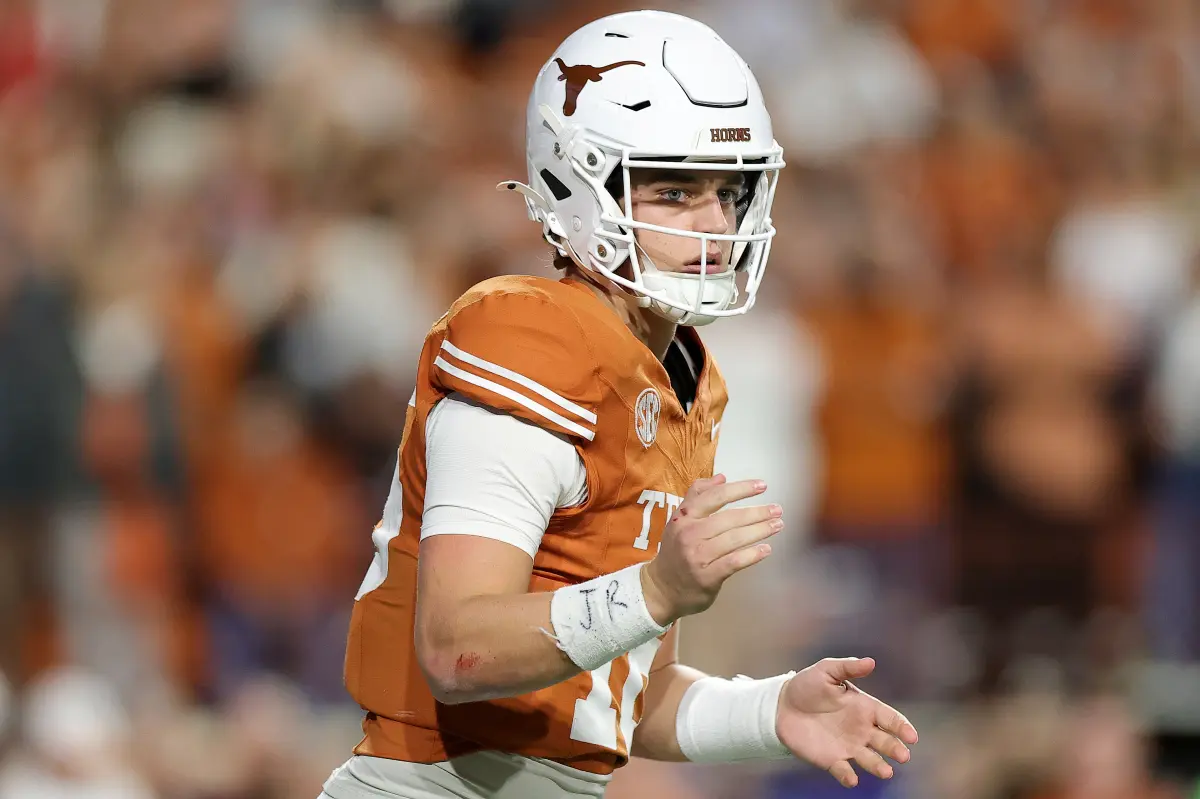
Arch Manning is taking a pay cut.
The Texas quarterback agreed to take a reduced share of the team’s revenue-sharing pool “as part of an effort to help the Longhorn football program do whatever it takes to support a 2026 championship run,” according to On3’s Justin Wells.
The savings “could be used on transfer portal talent or as part of retention efforts” for the Longhorns, per Wells.
This season, athletic programs were capped at $20.5 million in revenue-sharing, although that number is likely to increase next season and beyond.

Manning, the nephew of NFL icons Peyton and Eli Manning and the grandson of legendary quarterback Archie, is one of the most marketable athletes in college sports.
On3 currently gives Manning an NIL valuation of $5.3 million, which leads all student-athletes.
Although he is getting less money from Texas, Manning still holds NIL deals with brands like Red Bull, Uber and EA Sports, among others.
However, Manning sometimes struggled in a season that started with Heisman hype and the Longhorns ranked No. 1 in the nation.
Texas finished the season 9-3 and out of the College Football Playoff, a disappointing midseason loss against a poor Florida team all but ended their chances of being in the 12-team field.
Manning’s season was underwhelming as well, throwing for 2,942 yards with 24 touchdowns and seven interceptions.
The news comes after Manning’s father, Cooper Manning, told ESPN earlier this week that his son would return to the Longhorns in 2026 for his junior season despite previously mulling entering the 2026 NFL Draft.
“Arch is playing football at Texas next year,” Cooper said.
Texas finished No. 13 in the end of season rankings and will be on the sidelines for the College Football Playoff, which kicks off on Friday.

Defensive tackle Keanu Tanuvasa and offensive tackle Andrew Gentry made the biggest splashes in the offseason when they transferred to BYU from Utah and Michigan, respectively, but perhaps the greatest contribution from a transfer not named Bear Bachmeier was made by tight end Carsen Ryan in 2025.
The former American Fork and Timpview star, who began his college career at UCLA before transferring to Utah in 2024 and then BYU in 2025, filled a huge hole at the tight end position and was a big reason why the Cougars’ offense performed so well against all of its opponents except Texas Tech this season.
“Carsen has been everything we expected him to be,” offensive coordinator Aaron Roderick said a few weeks ago. “He’s been great.”
Of course, the 6-foot-4, 250-pound Ryan will get at least one more chance to do his thing when the No. 12 Cougars (11-2) meet No. 22 Georgia Tech (9-3) in the Pop-Tarts Bowl on Dec. 27 at Camping World Stadium in Orlando, Florida. While some seniors and juniors seemingly headed to the NFL are opting out of bowl games, Ryan said the thought has never crossed his mind.
“I am not in the position to do that, but even if I was, I feel like I would still want to play in this game,” he told the Deseret News on Wednesday. “You never know. Any game could be your last game playing football.
“You are never going to experience playing college football again, most likely. … It’s been such a special time for me in my life. I would be upset with myself if I didn’t play in this game and give myself one more chance to have one more game with my brothers and have fun.”
— BYU tight end Carsen Ryan
“You are never going to experience playing college football again, most likely,” he continued. “I’m never gonna experience that again. It’s been such a special time for me in my life. I would be upset with myself if I didn’t play in this game and give myself one more chance to have one more game with my brothers and have fun.”
Ryan is listed as a redshirt senior on BYU’s roster, but the truth is he is just a senior and has played only four years of college football. Because he played in only five games at UCLA his freshman year (2022) before sustaining a season-ending injury, he has applied for a waiver with the NCAA to get that year of eligibility back.
But he’s not holding his breath, having heard through various channels that the waiver is not likely to be granted.
“I have applied, but I am treating this season like I am training to go full-go to the (NFL) right now.
“That’s the goal right now,” he said. “I don’t know what the outcome of that’s going to be. I haven’t heard a lot of good news about it. I am treating everything like I am going to the league next year.”
Ryan has selected agent Carter Chow — Norm Chow’s son — of Red Envelope Sports to represent him in NIL and NFL draft negotiations and would like nothing more than to put up another outstanding game in Orlando next week.
While some college players have language in their NIL contracts with schools that stipulate they must play in bowl games, Ryan said his contract does not include that. Not that it would matter.
“I have been at places where that is in the (NIL) contract,” he said. “I haven’t heard about that being a thing here at BYU. However, I don’t have any negative thoughts about playing in the bowl game, either. I’m really looking forward to it.”
Ryan said that sentiment applies to all of his teammates; as of Friday, it appeared that BYU would have no bowl game opt-outs, aside from the handful of backups who have announced their intentions to enter the transfer portal when it opens on Jan. 2.
“Everyone is excited, still. We still bring the same energy, same intensity to practice,” he said. “It is not a vacation or a week off for us. It is another serious game that we want to go out there and win.”
Ryan said getting a victory against the ACC foe won’t be easy. Georgia Tech is coming off a close loss — 16-9 — to No. 3 Georgia in Atlanta and has the ACC’s Quarterback of the Year, Haynes King.
“They are a good team. They are good defensively. They have a lot of really good players on that team. They all work together. Everyone does their job. So it’s gonna be a tough game,” he said. “They only lost three games this year, and those losses were to really good teams (North Carolina State, Pitt and Georgia).”
Meanwhile, Ryan turned out to be just what the doctor ordered for BYU, after tight ends Keanu Hill (12), Mata’ava Ta’ase (9) and Ryner Swanson (10) combined for just 31 catches in 2024, for 290 yards.
Ryan is BYU’s third-leading pass-catcher, with 37 receptions for 500 yards and three touchdowns. He’s often wondered what might have been if he had considered BYU two years ago when he was leaving UCLA.
“I have loved it here. Every second I have been here has been fun,” he said. “There have been ups and downs. With football, it has been a good year for me, and the relationships I’ve made with the coaches and players will last forever.
“I wish I could have had more time at this place. I wish I got here sooner,” he continued. “But everything happened for a reason, and I’m grateful for my journey and how I’ve gotten here, and that Kalani and his staff found a place for me here.”
Part of that journey included meeting his fiancee, Jayne Basso, at UCLA. She is finishing up her degree at UCLA this winter. The couple plans to wed in June.
“We are excited to start this whole new chapter of our lives together,” Ryan said.

Updated Dec. 19, 2025, 6:24 p.m. CT
The Texas Tech football team will once again try to load up on talent through the transfer portal after the Red Raiders’ highly successful run through the 2025 college football season.
Last year saw the Red Raiders go hard at top-tier players in the portal, which brought in the likes of David Bailey, Lee Hunter, Terrance Carter Jr. and Brice Pollock. The moves made by head coach Joey McGuire and the NIL funds provided by Cody Campbell pushed Texas Tech to the Big 12 Conference championship and an appearance in the College Football Playoff for the first time in program history.
This year’s transfer portal is down to just one window for players to join new teams or leave their current squads. It opens on Jan. 2 and closes again Jan. 16. Players have until Jan. 16 to enter the portal and can pick their new teams at any time after submitting their names.
Keep tabs on all of Texas Tech’s transfer portal activity right here.
This section will be updated when player commitments are announced on social media, by Tech athletics or reported elsewhere.
The final addition of last year’s winter transfer portal cycle was the first to announce his departure on Dec. 11. Upton Bellenfant joined Texas Tech out of Buffalo last year but lost the starting kicker job to Stone Harrington midway through the year. Bellenfant was 6-for-6 on field goals and 14-of-16 on point-after kicks.
On3 reported on Dec. 19 that Dylan Spencer will enter the transfer portal. He is no longer on the Texas Tech roster for the 2025 season after he appeared in just three games, registering a pair of tackles. Showed potential as a true freshman in the 2023 season before he suffered a season-ending knee injury in the first preseason practice ahead of the 2024 season.



SoundGear Named Entitlement Sponsor of Spears CARS Tour Southwest Opener

Bowl Projections: ESPN predicts 12-team College Football Playoff bracket, full bowl slate after Week 14


Donny Schatz finds new home for 2026, inks full-time deal with CJB Motorsports – InForum


How Donald Trump became FIFA’s ‘soccer president’ long before World Cup draw

Men’s and Women’s Track and Field Release 2026 Indoor Schedule with Opener Slated for December 6 at Home

Black Bear Revises Recording Policies After Rulebook Language Surfaces via Lever


Michael Jordan’s fight against NASCAR heads to court, could shake up motorsports
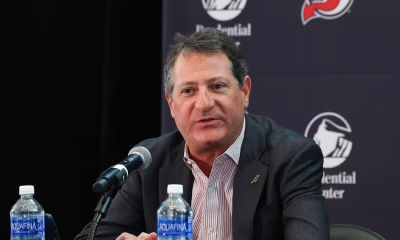

David Blitzer, Harris Blitzer Sports & Entertainment


JR Motorsports Confirms Death Of NASCAR Veteran Michael Annett At Age 39
Second-Screen Golf Experiences : Player Profiles