


NIL
Louisville baseball’s Bayram Hot enters NCAA transfer portal

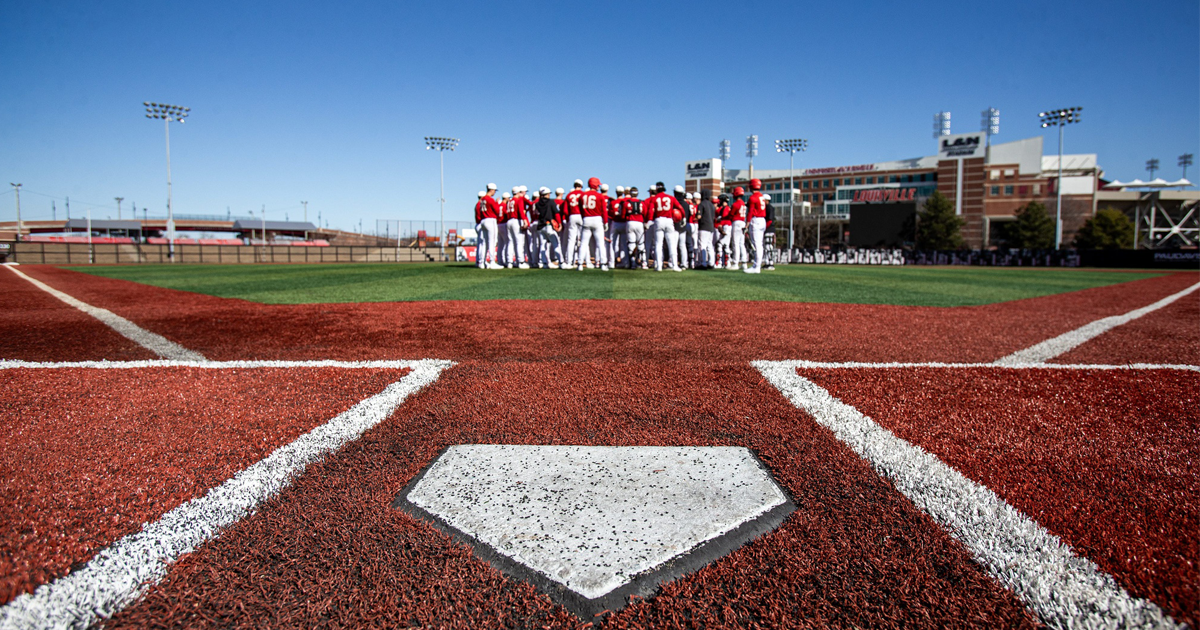
Louisville baseball’s Bayram Hot has entered the NCAA transfer portal, On3’s Pete Nakos confirmed. Hot played one season with the Cardinals.
Hot saw action in 36 games for Louisville in 2025. Across 92 at-bats, Hot averaged a .326 batting average to go with 30 hits, 22 RBIs and three home runs.
2025 was Hot’s third season at the collegiate level, spending his first two years at Marist. There, he earned 2023 MAAC Rookie of the Year honors after finishing his true freshman season with a .382 batting average across 50 games played. Hot wasn’t a home run threat, but logged 73 hits, scoring 47 runs, 37 RBIs and 19 extra base hits.
In 2024, Hot’s batting average regressed to a career-low .278. That doesn’t mean he wasn’t productive, however. As a sophomore, he logged career highs in walks (29) and home runs (7).
Hot then transferred to Louisville, where the Cardinals finished the 2025 season with a 42-24 overall record. They reached College World Series for the sixth time in program history and the first since 2019. Their record allowed the program to surpass the 40-win threshold for the 14th time in program since Dan McDonnell came to the program 19 seasons ago. Before his arrival, Louisville baseball had never reached that win total.
Now, Hot will have one year of eligibility remaining to play for his new college baseball team. Chose Louisville over Kentucky, Mississippi State, East Carolina, Kansas, Michigan and Maryland. It’s unclear if any of these teams will pursue him in the portal this cycle. Whichever program it will be, it’ll be Hot’s third in four seasons.
The transfer portal wire provides a real-time feed of player activity, including basic player profile information, transfer portal ranking and original On3 Industry recruiting ranking, as well as NIL valuation (name, image and likeness).
To keep up with the latest players on the move, check out On3’s Transfer Portal wire. The On3 Transfer Portal Instagram account and Twitter account are excellent resources to stay up to date with the latest moves.
Continue Reading

The college football head coaching carousel concluded one of its most chaotic cycles one month after the conclusion of the 2025 regular season.
No fewer than 18 different Power Four programs will have a new head coach in the 2026 college football season. Some fired coaches for poor performance, some fired coaches for cause, and others had their head coaches hired away by other Power Four programs.
The question for each school that hired a new coach is how quickly its program can succeed under said coach. Some programs take longer to build, while others make people feel better about themselves after their first season under a coach.
Retired three-time national champion head coach Urban Meyer made predictions for which programs will succeed the quickest under their new head coaches. He listed three different programs forecasted to see quick turnarounds on “The Triple Option Podcast.”

Meyer ranked California’s hire of Tosh Lupoi as the third-best hire in the offseason, citing Lupoi’s ability to recruit and the play of his defenses as rationale for a speedy rise for the Golden Bears as a national power. No. 2 was Florida bringing in Jon Sumrall from Tulane because of how quickly he expects the Gators’ style of play to change.
The No. 1 hire in the 2026 coaching carousel, according to Meyer, was Michigan’s hiring of Kyle Whittingham, the very last hiring of the cycle.

“The impactful ones in this order are, No. 1 is Kyle Whittingham,” Meyer said on the podcast. “And not just (Michigan earning) Ws, but just the way they’re going to go about their business.”
Meyer is very familiar with Michigan, having coached opposite the Wolverines in “The Game.” He was Ohio State’s head coach from 2012-2018, a stretch in which the Buckeyes only missed two Big Ten Championship games and never lost to the Wolverines. In addition to Michigan as a program, Meyer is also very familiar with its new head coach.
Following a two-year tenure at Bowling Green, Meyer took the head coaching vacancy at Utah in 2003. Kyle Whittingham was entering his tenth season on the Utes’ staff when Meyer took over. Whittingham succeeded Meyer as head coach after Meyer’s 22-2 record in two seasons catapulted him into the head coaching vacancy left at Florida by Ron Zook in the 2005 offseason.

Michigan was wrapping up its second season under Sherrone Moore when the Wolverines decided to fire him with cause on Dec. 10, 2025. The Wolverines were 17-9 in the two seasons with Moore at the helm.


With the 2026 NFL Draft’s early entry deadline looming, Alabama quarterback Ty Simpson has several lucrative NIL offers related to the 2026 transfer portal, AL.com reports. While the report states Simpson staying in the NFL Draft is “not a done deal,” 247Sports reports that Simpson is “not wavering” on his decision. Simpson’s offers include three from SEC schools “north of $4 million” and one program reportedly offering a $6.5 million package, sources told AL.com.
Wednesday represents the deadline for underclassmen to enter the NFL Draft. Simpson’s father, UT-Martin head coach Jason Simpson, told ESPN his son has received first-round grades from every NFL general manager spoken to since the season ended. He also confirmed to ESPN that several programs expressed transfer interest, including Miami, Oregon and Tennessee.
“There were very, very lucrative opportunities to play another year of college football,” Jason Simpson said.
CBS Sports previously reported that Miami and LSU were two of the programs left on the board expected to sign a top-end quarterback, options that include former Arizona State star Sam Leavitt. Multiple sources close to Miami told CBS Sports over the weekend that the Alabama quarterback could enter the picture for the Hurricanes.
In CBS Sports’ latest mock draft first round from Mike Renner, Simpson is slotted to go 29th overall to the Los Angeles Rams as a possible heir to veteran Matthew Stafford. Simpson is the No. 3 quarterback behind Indiana’s Fernando Mendoza and Oregon’s Dante Moore.
Simpson completed 64.5% of his passes for 3,567 yards with 28 touchdowns and five interceptions during the 2025 season, his first as a starter after sitting the last two years in Tuscaloosa behind Jalen Milroe.
“Yes, they would love for him to come back,” Jason Simpson said of Alabama’s coaching staff. “But if you’ve got an opportunity to go be a first-round pick in the NFL draft, you go. That’s why they pour all that into you, for that individual opportunity, so I really appreciated them.”

Ty Simpson has made his intention to enter the NFL Draft known, but that decision may not be as final as it once appeared.
As the clock winds down toward Wednesday’s official NFL Draft declaration deadline, Simpson’s name is still very much circulating in college football circles. According to sources familiar with the situation, multiple SEC football programs are continuing to push hard behind the scenes, hoping to convince the Alabama quarterback to return to the college game for the 2026 season. Even after announcing his draft intentions, Simpson has reportedly remained the subject of aggressive NIL pursuit through third-party channels
Advertisement
What is clear, however, is the money involved.
One program has reportedly put a package on the table that could reach as high as $6.5 million for Simpson to suit up in 2026. Beyond that, multiple SEC schools, at least three, per AL.com, have floated offers north of $4 million, with incentives that could push those totals even higher.
That level of interest isn’t random. I
t’s a direct reflection of the current quarterback landscape heading into 2026.
Elite quarterbacks are scarce.
The demand is massive.
And the pressure to compete for a College Football Playoff spot has never been higher.
As sports attorney Darren Heitner explained, the market dynamics are doing exactly what markets do when supply runs thin:
Advertisement
“Several teams chasing a shrinking pool of elite quarterbacks, combined with the pressure to field a CFP contender, could drive up the price for certain players who have yet to transfer and/or are considering the NFL Draft and are seen as transformative,” Heitner said. “It’s basic economics where leverage meets scarcity.”
That leverage belongs to Simpson right now, and it’s rare.
It’s the kind of leverage only a handful of quarterbacks ever experience, where every decision reshapes not just their future, but the plans of entire programs and front offices. NFL scouts are evaluating long-term upside and readiness. NIL collectives are weighing risk versus reward. College coaches are staring at their quarterback rooms, knowing one elite decision could define, or derail, their 2026 season.
Everyone is pulling on the same thread, trying to see which direction Simpson will go.
Advertisement
And until that deadline hits, nothing is final.
Nothing is settled.
Every option remains on the table.
Whether Simpson ultimately stays in the NFL Draft or sends shockwaves through college football by choosing to return for another season, one thing is crystal clear: the quarterback market has reached unprecedented territory.
Experience matters.
Leadership matters.
And proven production matters more than ever.
And right now, Alabama Football’s own Ty Simpson sits at the center of it all, a reminder that in today’s game, elite quarterbacks don’t just lead offenses.
They set markets.

Good morning, and thanks for spending part of your day with Extra Points.
I’m headed to Washington, D.C. (okay fiiiine, Maryland), tomorrow for the NCAA convention. Kyle Rowland of NIL Wire and I will be around until Thursday evening, and we’d love to say hello and chat! If you’d like to meet up, shoot me an email. We are also hosting a happy hour with College Sports Solutions at 8 p.m. on Wednesday at the Belvedere Lobby Bar. No RSVP is required, so feel free to join us for some beverages and off-the-record conversations.
Made in Chicago: Custom, licensed luggage tags for your student-athletes
Elevate your team’s travel gear with a partner you can trust. Desert Cactus is an officially licensed licensee for more than 625 colleges and universities, meaning they already know your brand standards. They produce high-quality, durable acrylic luggage tags in the Chicagoland area.
Perfect for student-athlete backpacks and travel bags, their tags are fully customizable with athlete names, jersey numbers and specific sport designations. Get the professional look your program deserves from a proven industry partner.
For more information on bulk-order discounts, please contact Brad Schweitzer.
Since I’m flying Tuesday morning and will be out and about, I figured today would be a good day to open the ol’ mailbag and answer your questions. As always, mailbag questions are accepted on a rolling basis via email, Bluesky, texting, etc.

Some NCAA-sponsored sports adding plenty of new teams at the moment include beach volleyball, STUNT, women’s wrestling and lacrosse. These sports don’t typically require as much in the way of startup costs (you don’t need to build a new facility for a women’s wrestling program, after all), have growing high school and club participation levels and can provide a lower-cost way for schools to comply with Title IX sport sponsorship requirements.
Usually, if a school is adding sports, it’s because it is more focused on enrollment-related goals and/or Title IX/conference sport sponsorship requirements, rather than competitive excellence or ticket revenue generation. So sports that don’t require lots of supporting infrastructure and have access to enough recruits will always be attractive. That’s also why it is generally harder to add sports like hockey or baseball, since those tend to require more expensive infrastructure supports.
Across the country, and especially at the small school level, you also sometimes see growth in sport sponsorship that exists completely outside the NCAA. Examples of those sports include rugby, esports, ultimate frisbee and women’s flag football. Some of these may eventually fall under the purview of the NCAA … and some may not!
Speaking of spending money, reader Domo asks

Well … I think that depends on how you define “cutting back.”
It’s true that in Ye Olden Times (i.e., before 2020), it was common for schools to spend money on gold-plating locker rooms, practice facilities, meeting rooms and stadiums, all in the hope of improving recruiting outcomes. If you couldn’t directly give cash to athletes, the thinking was, you could woo them with sleep pods and podcasting studios and Big Buck Hunter arcade cabinets.
But if you want to play Big Buck Hunter, you don’t need to go to a school with a machine in the locker room. You don’t even need to go to Dave and Busters. You can just buy a machine yourself, thanks to cash. And schools, be it via officially sanctioned House payments or whatever we’re pretending marketing deals are, can now give athletes that cash directly.
I’ve heard of a few Power 4 programs that have either postponed or scaled back previously planned facility investments that would fall under this category so they can spend that money directly paying athletes (as well as other stuff). Personally, I think that’s a better investment anyway.
But not every facility investment is “turning the film room into a go-kart track.” Schools also spend money on facilities to do mundane stuff like “keep stadiums built in 1927 at least kinda up to modern building codes” or “add Wi-Fi” or “replace bleachers with actual chairs.”
In fact, because of this crushing need to grow revenue at every level, many programs are looking at spending more on facilities … to help their stadiums better monetize their audience. That means more luxury boxes, more high-end concessions, more bathrooms (so you can serve more booze), more parking and more experiences. Conspicuously absent from that list, of course, is more seating. Usually, capacity is getting smaller, not larger.
So I wouldn’t look for facility improvements or spending to bottom out in the near future. Schools are just going to spend on different things. The driving question at most programs right now is “how can we drive more revenue from our existing fans, corporate partners and real estate footprint?” … and the answer sometimes requires building more stuff.

Sure, I think that could happen. I’ve talked to some mid-major athletic directors and coaches who would explicitly prefer for that to happen (as a way for their schools to get some sort of long-term benefit for developing high school players who won’t stay), and I understand why lawyers, agents and reporters occasionally propose it.
I think there are two related challenges to implementing this system. One is the College Sports Commission. We’re seven months out from House, and nobody has gotten in trouble for breaking any of the rev-share or “third party NIL” rules. There have been guideline updates, and most everybody is making some sort of effort to at least partially comply, but there haven’t been any actual penalties.
Without some sort of regulatory system that is actually enforced, I don’t think a transfer fee system can ever actually work … since who will be in charge to actually make sure those fees are properly paid? Can state courts be trusted to enforce player contracts with schools? Can they enforce those contracts quickly enough? How will transfer fees be permitted to be used? Will they be taxable income?
Even if the CSC (or something else) gets patched up, I’m not certain a fee system can work at scale without either employment status or some sort of federal exemption that provides clarity.
But those are the same challenges to nearly every other sort of reform effort to player movement and compensation. I don’t think that’s unique to transfer fees.
A better way to trade Nvidia

Nvidia has already delivered a staggering 80% gain year-over-year, building a $4.35 trillion empire. But here’s the million-dollar question: Where does Nvidia go from here?
Our advanced A.I. models are painting a different picture for the immediate future.
Reader Sheep Launcher asks:

Under the pre-2020 rule set, I would typically tell people there were reasons why sleeping giants were sleeping … and it’s uncommon for them to wake up. Institutions that appeared to have favorable demographics or resources, upon further inspection, often didn’t. You will not convince me that Maryland football, for example, is just waiting to finally become an elite program, no matter how many good athletes play at DeMatha.
But in the post-NIL, post-portal and post-rev share world, perhaps previous assumptions are worth revisiting.
If we want to use Sheep Launcher’s definition (a school that is reporting a lot of revenue but not as much elite success), there might be a few candidates.
I pulled up the FY24 top programs in royalties, licensing, advertisement and sponsorships revenue from the Extra Points Library. This might be a more useful proxy for revenue generation than total revenue, since isolating sponsorship money removes stuff like student fees, institutional support and “just having a huge stadium” from the picture.
You can probably predict the top teams: Texas, Michigan, Ohio State, Texas A&M, Florida State, etc. Surprisingly high is Louisville (sixth!), Arizona State (15th) and Nebraska (17th). If you sort by ticket revenue, there are a few other programs surprisingly high, like Arkansas (5th), Colorado (17th), Louisville (20th).
If I had to pick a program that was underachieving relative to total earned athletic revenues over the past few years, my answer would probably be Texas A&M, Nebraska or Washington. If I had to pick a program I think could become a substantially more successful department in the future, just based on revenues right now … I’d go with Arizona State.
I’m open to other suggestions, though. Leave ’em in the comments..
Let’s get out of here on this one:

Boy, this is a tough one, because I don’t think most of the other great college football turnaround stories were that sudden.
Take Northwestern, for example. The football team was absolute garbage from the late 1960s to early 1990s. In 1995, it made the Rose Bowl under Gary Barnett … but that was in his fourth season. The Wildcats went 3-8, 2-9 and 3-7-1 before exploding to a 10-2 record.
The faster Northwestern turnaround story was back in the dang 1930s. When Pappy Waldorf took over for Dick Hanley in 1935, the Wildcats went 4-3-1. The next season? They went 7-1 and held the No. 1 spot in the AP poll for three weeks.
Kansas State stunk for a few years before Bill Snyder broke through in 1993. Frank Beamer was bad or average for several years at Virginia Tech before the Hokies won nine games in 1993. Barry Alvarez had three losing seasons before making the Rose Bowl at Wisconsin.
I guess the closest thing we’ve gotten in the modern era was at UCF. In George O’Leary’s last season in 2015, UCF went 0-12. Scott Frost went 6-7 in his first season, and then won a national title* with a 13-0 season in year two.
But even that isn’t what Indiana did. UCF only really sucked for one season, and it took more than one to turn the ship around. This Indiana football story, as far as I know, is in a class of its own.
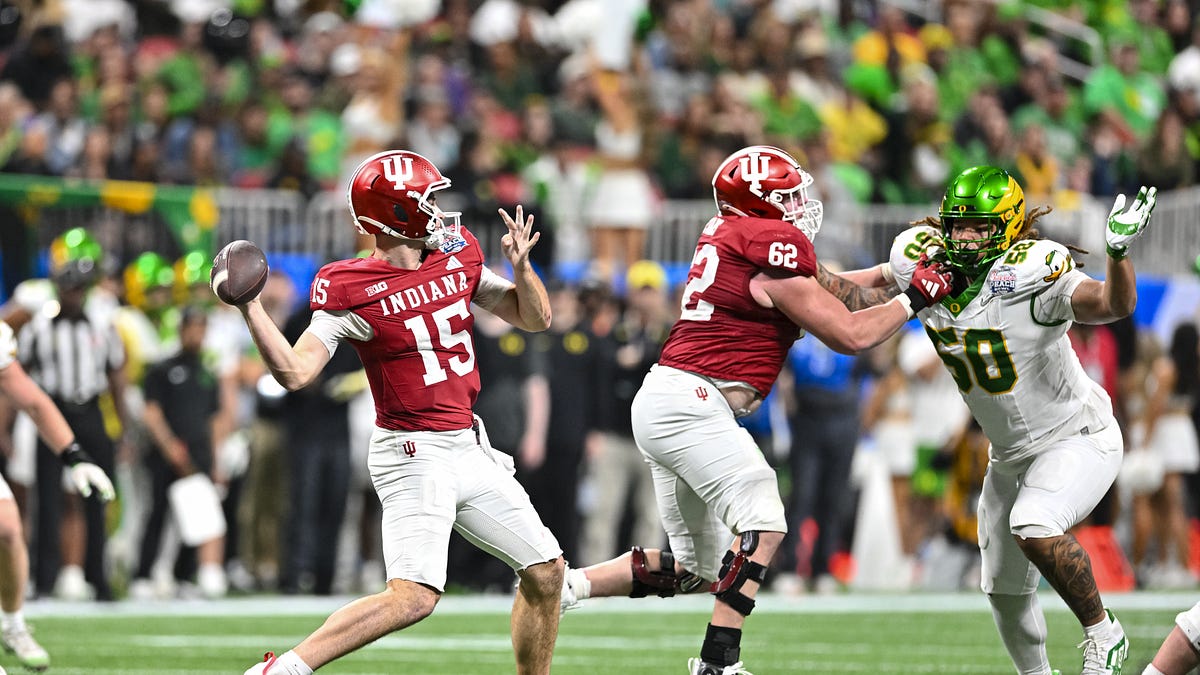

One of the most compelling sales pitches for the new(ish) expanded College Football Playoff, now in its second season of existence, was that it offered more teams chances to prove their worth on the field, rather than in computer formulae or the backrooms of the sport’s halls of power. And with apologies to notable snubs like Notre Dame, that’s mostly been the case. Eighth-seeded Ohio State fought through the strongest opponents of any modern champion last year, while next Monday’s championship game will pit undefeated Indiana — who might have a case as the greatest champ ever — against No. 10 seed Miami, who earned every bit of their way to play the title game at their home stadium.
The price for all of that, however, was adding to the disoriented and discontented feeling that generally pervades the sport right now.
Last week, The Athletic conducted a “vibe-check” poll of college football fans, asking how they felt about the sport. And the results were not exactly pretty. Out of more than 12,000 voters, roughly 56 percent said they did not like the state of college football at the moment because “it’s a mess” — more than two-and-a-half as many respondents who said they liked the sport because “the games are great”:
To be clear, I suspect the majority of that comes from the off-field chaos — from money-chasing coaches like Lane Kiffin to the sense that NIL and the transfer portal have fundamentally turned college football into a completely different sport than it used to be. (A viewpoint with which I sympathize, though the upside has been to allow non-traditional powers inject the sport with much-needed parity.)
But other changes have plunged the sport still deeper into the uncanny valley between its amateur past and an increasingly professionalized future. I wrote last month about the toll the new playoff was taking on the last remaining vestiges of the classic bowl system, and this time a year ago I noted how absurdly long and drawn-out bowl season was in the age of the expanded CFP:
Just like last season, this year’s title game will take place a full 38 days after the beginning of bowl season — and 32 days since the opening game of the playoff itself. For comparison’s sake, pre-playoff bowl season used to span an average of 19.1 days, and the old four-team playoff lasted an average of 10.9 days from beginning to end. Now we will have a gap longer than that simply between Miami and Indiana’s semifinal victories at the end of last week and the title game a week from tonight.
If that (and really the whole thing in general) feels weird and long, it might be because we’re still thinking of things in college terms — when, like everything else in the sport right now, we probably should be putting it in pro terms instead. Here’s a comparison between various different formats (plus March Madness, thrown in for fun) when it comes to their average days until the championship at each round of the playoffs:
The 12-team college playoff has taken slightly longer (31.8 days) to get to the championship than the 14-team NFL playoffs (29.2). But generally, the cadence matches pretty closely, right down to the double-digit day gap between the semifinals and final. (Conversely, it would be a lot to ask football players to turn around within a few days and play the championship, like they do in basketball’s Final Four.)
So, then, what makes the NFL’s postseason rhythm feel so much more normal than college football’s? Well, in addition to the novelty of the college playoff even having this many teams and rounds, the NFL gets to muscle college off of the premium days for playoff scheduling. As Club Sportico’s Eben Novy-Williams notes here, the odd timing of the CFP’s biggest games is mainly a byproduct of the NFL’s dominance of the January calendar.
While college football “owns” Saturdays in the fall, thanks to protections in the 1961 Sports Broadcasting Act, those safeguards expire in mid-December, freeing the NFL to schedule late regular season and playoff games on Saturdays and Sundays. And rather than going head-to-head with the NFL postseason, the College Football Playoff and its TV partners must push marquee games to weekday nights where they can be the biggest event on the schedule. In their current formats, nearly 92 percent of NFL playoff games have been on weekends, while only 9 percent of college playoff games can say the same. (Many more have been on random-feeling days like Tuesday, Wednesday, Thursday and especially Friday.)
That tradeoff reflects a broader paradox for modern college sports: What makes college football special is its tradition and atmosphere — but what makes it valuable is television. And as the NFL continues to broaden its reach across more days of the year and college football continues to expand its playoff bracket, the latter increasingly finds itself chasing whatever visibility it can find, wherever it can be found. As a result, college football is now no longer the biggest thing on the calendar when its games matter the most.
That sensation, as much as any, is what fans can’t quite shake — even as the cream rises to the top more than ever and the football itself can be plenty exciting (when Indiana isn’t blowing the doors off everyone, that is). This no longer feels quite like the sport we used to organize our lives around, and the weirdo cadence of the playoff schedule is one of the most glaring signs of that shift. That doesn’t mean the expanded playoff was a mistake, but it does mean college football is asking us to recalibrate how we experience it: Following a game that looks like a pro league in more and more ways, even as it still demands to be loved like a campus tradition.
Filed under: College Football, Football

It was quite a week for the Washington Huskies and quarterback Demond Williams Jr.
In the span of a few days, Williams went from signing a new contract to stay with Washington for the 2026 season to announcing his intention to enter the transfer portal. Two days later, he said he will, in fact, remain with the Huskies “after thoughtful reflection.”
A potential standoff between a star quarterback and a Big Ten program lasted 48 hours, but it still raised pertinent questions about the enforceability of revenue-sharing agreements that have become a predominant feature of major college football. Williams’ new contract with Washington will pay him roughly $4 million, a deal Washington made clear it had no intention of releasing Williams from.
It’s the latest saga in this new-ish era of college sports, one reshaped by legal battles and schools directly signing athletes to contracts. Universities are permitted to distribute up to $20.5 million in revenue sharing to athletes across all sports for the 2025-26 school year, a result of the multi-billion-dollar antitrust settlement agreed to by the NCAA and power conferences.
The disturbance at Washington was sorted out before things fully escalated, but it wasn’t the first contract dispute involving a college athlete, and it won’t be the last. Let’s examine the nuances of these revenue-sharing deals — and potential fallout when others inevitably go pear-shaped.
If a player breaches a revenue-sharing agreement… ?
The prevailing question for many in the industry is whether these revenue-sharing deals are actually worth the paper they’re printed on. If an athlete can break a deal and transfer to another school — presumably for more money or better circumstances — what purpose do these contracts actually serve?
“They’re not worthless,” said lawyer Cal Stein, who advises colleges and athletes on revenue sharing, “but they are very difficult to enforce.”
From a legal perspective, that difficulty is due to the blurred shadowland college football operates in, compensating athletes like pay-for-play employees without lawfully designating them as such. Revenue-sharing contracts are not employment contracts because college athletes are not employees — a designation the NCAA and member schools have resisted because of the added costs and responsibilities that would come with it. Think of these deals more like independent contractor agreements, a distinction that might not mean much to the average person, but is significant in terms of how contracts hold up under legal scrutiny.
“If push comes to shove and a judge takes a look at them, I think it will be interesting what that judge’s determination is,” said lawyer Darren Heitner, who specializes in sports law.
Last Thursday, after The Athletic spoke with him for this article, Heitner announced that he had been retained as legal counsel for Williams.
I have been retained as legal counsel for Demond Williams Jr. We have no public comment at this time. Updates will be provided as appropriate.
— Darren Heitner (@heitner) January 8, 2026
Many universities use a template contract crafted by the conference office, with each one adjusted according to state law and as each school sees fit. Commonly referred to as “licensing agreements” — because they license an athlete’s name, image and likeness rights to a university — it essentially allows a school to market the contracted athlete, often with exclusivity language.
These agreements increasingly feature early termination language as well, also known as buyout clauses, which stipulate dollars an athlete is responsible for redeeming to the university if they breach the contract before the end of the term. It’s usually a specified percentage or amount, such as the amount remaining on the deal once it is broken. This is similar to coaching buyouts, when a coach is hired away and owes money to the previous institution in the form of liquidated damages.
“The biggest difficulty is coming up with damages” — meaning a dollar amount — “that a judge or arbitrator will accept,” Stein said of revenue-sharing buyouts. “How can you quantify the financial harm a university will suffer based on a single player playing somewhere else? I could put on my creative lawyer hat and come up with some ideas, but it would be really hard to prove.”
Regardless, buyouts are becoming more common and can make for more efficient conflict resolution. Multiple power conference general managers tell The Athletic they have either signed players who had buyouts with their previous school or lost players with buyouts to other teams. Most are handled without public incident or additional legal action.
“It’s not prevalent, but it’s happening,” Heitner said. “Typically, there is a negotiation where a school starts at a specific number and then negotiates down, if the player has good counsel.”
One noteworthy wrinkle is that if a player with a buyout transfers to another school, the dollar amount of that buyout counts against the new school’s revenue-sharing cap for that fiscal year. That’s according to enforcement guidelines from the College Sports Commission, which oversees revenue sharing and settlement terms. Typically, a player’s deal with the new school will cover or account for the buyout in some fashion, but the new school is not required to directly pay the buyout fee to the previous school.
The Athletic reported last Friday that Brendan Sorsby, the top transfer quarterback of the current portal window, transferred to Texas Tech with one season remaining on a multi-year revenue-sharing agreement with Cincinnati that includes a $1 million buyout clause. It is not yet clear how Sorsby’s buyout will be resolved.
What happened with Williams and Washington?
We don’t know all the details of Williams’ initial desire to transfer, or of his swift change of heart to return to Washington. The specifics of his deal with the Huskies have not been made public, either. His agent publicly dropped him Thursday for “philosophical differences.” But we can glean that a potential buyout may have factored into the final decision.
Yahoo Sports reported Thursday evening that, if he left Washington, Williams would have owed the Huskies the value of his new contract (roughly $4 million), and if he transferred to a new school, that new school would have to count the $4 million against its own $20.5 million revenue-sharing cap for the 2025-26 fiscal year.
As The Athletic reported, this reflects the buyout language in the Big Ten template contract. Multiple versions of the template, reviewed by The Athletic, state that if a player intends to transfer before the end of an agreement, the athlete would owe the remaining amount left to be paid on the contract, unless the school negotiates a different buyout amount.
It’s possible a legal challenge would have delivered a different verdict or required a lesser buyout figure. But despite Williams retaining a lawyer, this situation is not headed to court. That itself could be a revealing outcome: In the end, the contract may have been strong enough to deter Williams from breaking it. The fact that he signed his deal less than a week prior probably bolstered that sentiment.
“If it’s a clear agreement that was negotiated by both parties, the damages are reasonable, those are generally enforceable,” said lawyer Paia LaPalombara, a former college athletics administrator who advises schools, conferences and athletes on revenue sharing. “A lot of it depends on how things are worded within the agreement.”
Do schools have recourse?
It’s common for revenue-sharing contracts to include language prohibiting a player from entering the transfer portal or another school from using their NIL rights, and there were reports that Williams’ deal with Washington includes similar stipulations. But those only apply if the contract is in good standing. No school will keep paying an athlete who doesn’t play for them, and there’s no contract that can prevent a player from quitting the team.
“You can’t force someone to stay where they are. There is a freedom aspect in an agreement that allows an individual to terminate that agreement,” said LaPalombara. “Can they terminate it for free? No, not necessarily. But you have the right to get out of an agreement. And if there is not language that allows for it, that can be taken to a court.”
If a school believes a contract has been breached and the agreement contains early-termination language, the simplest resolution is to pursue the buyout payment, whether in full or at a negotiated rate.
If a buyout isn’t feasible for whatever reason, a school can take a player to court or arbitration, which is a private form of mediation. Some schools and administrators, however, might be hesitant of how a legal battle with a college athlete will play publicly, even if there is confidence in the legal argument.
“College athletics is a very relational business,” said LaPalombara. “It’s less of a legal challenge and more of an optics challenge for some institutions.”
Though that dynamic could be shifting as well.
How existing disputes were handled
Late last year, the University of Georgia took former defensive end Damon Wilson II to court, with Georgia seeking arbitration and $390,000 in damages, claiming Wilson broke an agreement with Georgia’s NIL collective, a third-party group affiliated with the school, prior to the start of revenue sharing. The arbitration request was filed in the state of Georgia — contract law is traditionally a state matter — and Wilson, who transferred to Missouri for the 2025 season, later filed suit in the state of Missouri against Georgia’s athletic association, seeking his own damages. It’s believed to be the first time a player and school have taken each other to court over an NIL dispute, and both cases are ongoing. Wilson recently re-entered the portal.
Last winter, then-Wisconsin defensive back and South Florida native Xavier Lucas attempted to enter the transfer portal. At the time, Wisconsin claimed that Lucas had a “binding agreement” with the university. The university, with the support of the Big Ten, refused to enter Lucas into the portal as a result, even though it could violate NCAA transfer bylaws.
Lucas later un-enrolled as a student from Wisconsin and enrolled at Miami, where he is playing football for a team that plays for the national title next week. There were no NCAA or eligibility rules preventing Lucas from transferring without utilizing the portal.
“There is nothing improper about a student un-enrolling from one school and enrolling at another,” said Heitner, who represented Lucas. “My inclination is that no judge is going to [prohibit] an athlete from changing schools.”
In June, the University of Wisconsin sued the University of Miami for tortious interference, claiming Miami intentionally interfered with a contract between Wisconsin and Lucas. That case is also ongoing.
The NCAA has its own rules against tampering, but it’s so rampant in college sports that it’s become almost impossible for the NCAA to penalize it. But if a school believes that another school illegally tampered with one of its athletes in an attempt to break a revenue-sharing contract — and the first school believes it can prove that in court — it could attempt the tortious interference route.
What’s next?
Was the potential standoff at Washington a harbinger or an outlier?
It might be the shortest contract dispute we ever see, but the turbulence with Williams could be an indicator of future conflicts. Few would argue that this era of revenue sharing and NIL has done much to stabilize college sports, even if most agree that athletes deserve to be compensated.
But in the meantime, schools and conferences will continue to fortify the language in revenue-sharing contracts, and athletes with the most leverage — or legal horsepower — will continue to test those limits. Until the next saga arrives.

Motorsports4 minutes ago
Chef Boyardee Joins HYAK for Three-Race Sponsorship
Motorsports5 minutes ago
Tyler Reddick Adds SupplyHouse Sponsorship

Rec Sports10 minutes ago
Eagles fall short against Pioneers on “Bubba’s Youth Day” | UW-La Crosse

Motorsports20 minutes ago
NASCAR Truck: Ross Chastain remains with Niece

Motorsports21 minutes ago
23XI Racing, Reddick Announce Multi-Race Partnership with SupplyHouse

NIL25 minutes ago
Urban Meyer names No. 1 college football head coaching move

Sports28 minutes ago
Tulane Beach Volleyball Announces 2026 Schedule

Rec Sports49 minutes ago
Check out who are the top recruits playing at Flyin’ to the Hoop in 2026

Motorsports52 minutes ago
Razgatlıoğlu’s MotoGP leap begins in Siena with new bike unveiling
Rec Sports56 minutes ago
Israel, Poland clash on alleged attack on Israeli judo team
Rec Sports1 hour ago
Elmira police seek suspect after Centertown Parking Garage shooting

Motorsports1 hour ago
Chef Boyardee Returns to Nascar at the Daytona 500 with Record Fan Giveaway and New NASCAR Cup Series Motorsports Partnership

Motorsports1 hour ago
SupplyHouse Joins 23XI Racing as an Official Partner for 2026 Season

Rec Sports1 hour ago
St. Cloud Celebrates New Little League Fields with 2026 Spring Season Set to Begin in February

Sports1 hour ago
Molinares Joining Mean Green as XC/Distance Coach

Rec Sports4 weeks ago
Stempien to seek opening for Branch County Circuit Court Judge | WTVB | 1590 AM · 95.5 FM

Motorsports4 weeks ago
Ross Brawn to receive Autosport Gold Medal Award at 2026 Autosport Awards, Honouring a Lifetime Shaping Modern F1

Rec Sports3 weeks ago
Princeton Area Community Foundation awards more than $1.3 million to 40 local nonprofits ⋆ Princeton, NJ local news %

NIL4 weeks ago
Downtown Athletic Club of Hawaiʻi gives $300K to Boost the ’Bows NIL fund

Sports3 weeks ago
Badgers news: Wisconsin lands 2nd commitment from transfer portal

Rec Sports1 week ago
Five Youth Sports Trends We’re Watching in 2026

Sports4 weeks ago
Beach Volleyball Unveils 2026 Spring Schedule – University of South Carolina Athletics

NIL4 weeks ago
Nike Signs 10 LSU Athletes to NIL deals

Sports4 weeks ago
Three Clarkson Volleyball Players Named to CSC Academic All-District List

Sports3 weeks ago
Badgers news: Final Four Game Thread vs. No. 1 Kentucky Wildcats

Sports3 weeks ago
Kentucky VB adds an All-American honorable mention, loses Brooke Bultema to portal

NIL4 weeks ago
Kentucky AD explains NIL, JMI partnership and cap rules

Sports4 weeks ago
Central’s Meyer earns weekly USTFCCCA national honor

Motorsports4 weeks ago
PRI Show revs through Indy, sets tone for 2026 racing season

Sports3 weeks ago
Is women’s volleyball the SEC’s next big sport? How Kentucky, Texas A&M broke through

 NBA Legend Michael Jordan to Join NBC Sports as Special Contributor
 Why a rising mid-major power with an NCAA Tournament team opted out of revenue-sharing — and advertised it
 Trackhouse to pair Chastain with McSwain
 Volleyball Falls to SEMO – Tennessee State University
 Kennewick School Board backs changes to gender inclusion in sports | News
-
 Sports3 weeks ago
Badgers news: Wisconsin lands 2nd commitment from transfer portal
-
 Rec Sports1 week ago
Five Youth Sports Trends We’re Watching in 2026
-
 Sports3 weeks ago
Kentucky VB adds an All-American honorable mention, loses Brooke Bultema to portal
-

 Motorsports3 weeks ago
Dr. Patrick Staropoli Lands Full-Time O’Reilly Ride with Big Machine Racing
-

 Motorsports2 weeks ago
BangShift.com IHRA Acquires Historic Memphis Motorsports Park In Millington Tennessee. Big Race Weekend’s Planned For 2026!
-
NIL2 weeks ago
Fifty years after IU’s undefeated champs … a Rose Bowl
-
 Sports2 weeks ago
H.S. INDOOR TRACK & FIELD: GLOW region athletes face off at Nazareth University | Sports
-
 Sports3 weeks ago
Colorado volleyball poised to repeat success
-
 Sports3 weeks ago
2025 Volleyball Player of the Year: Witherow makes big impact on Central program | Nvdaily
-

 Motorsports3 weeks ago
NJ Motorsports Park Announces 2026 Event Schedule