Connect with us
https://yoursportsnation.com/wp-content/uploads/2025/07/call-to-1.png

Technology

Massive Multiplayer Online Games Market Size

Published

on


Report Overview

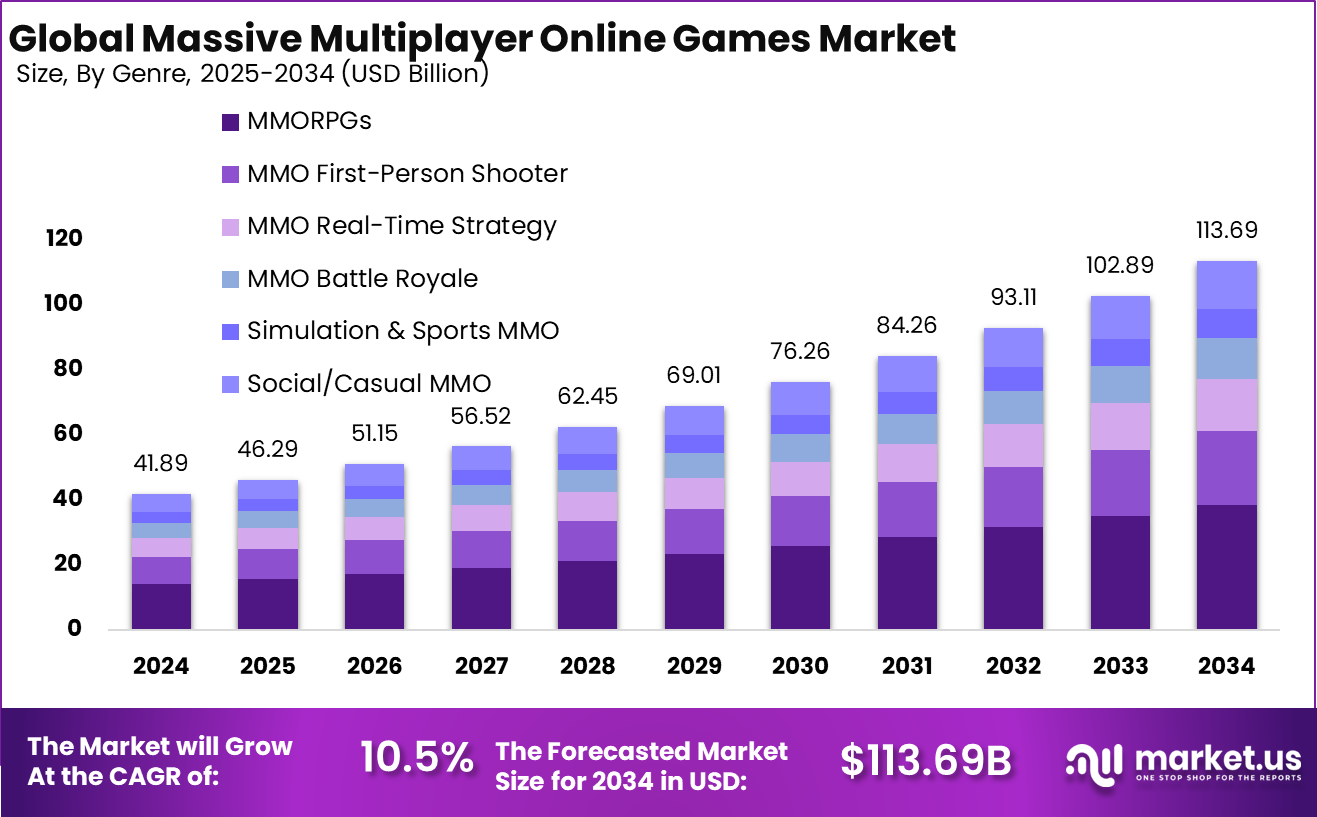
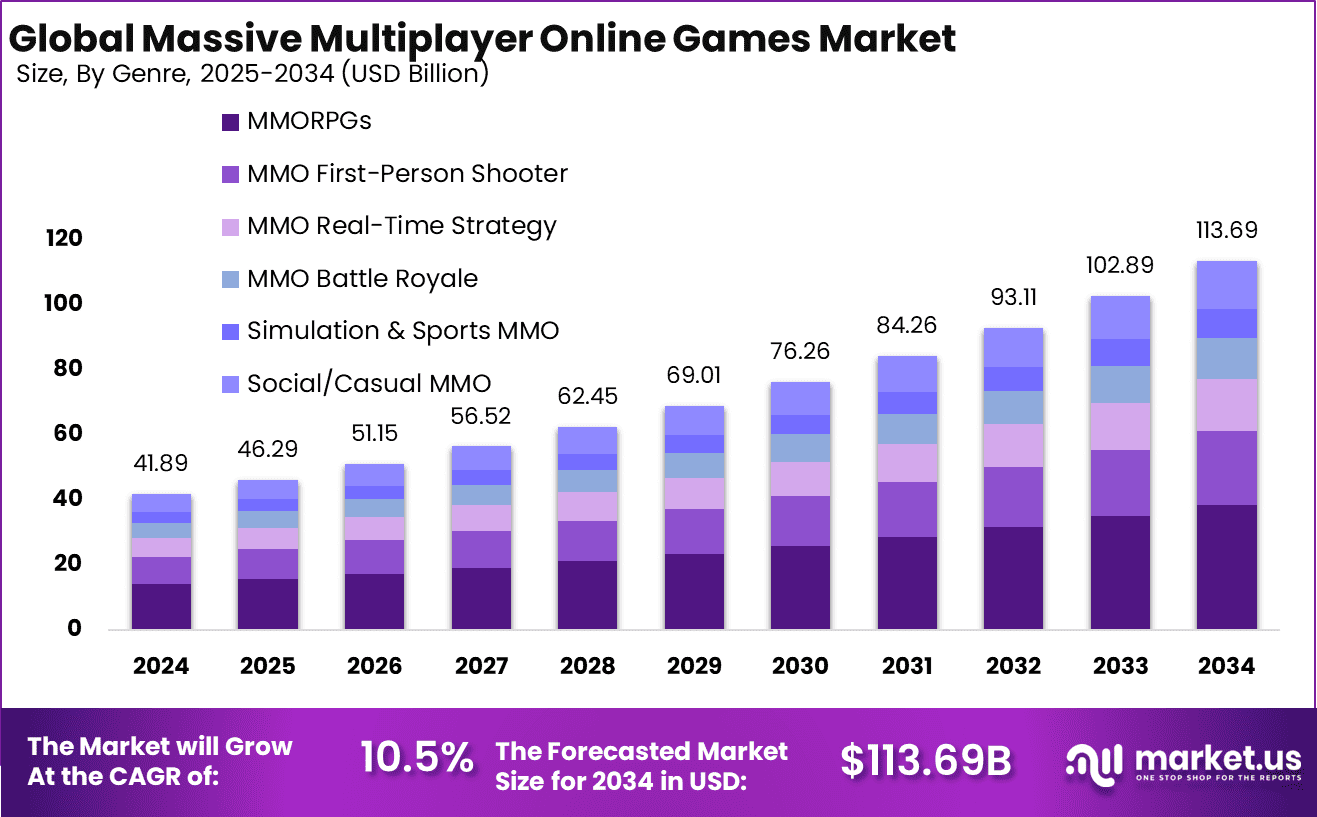
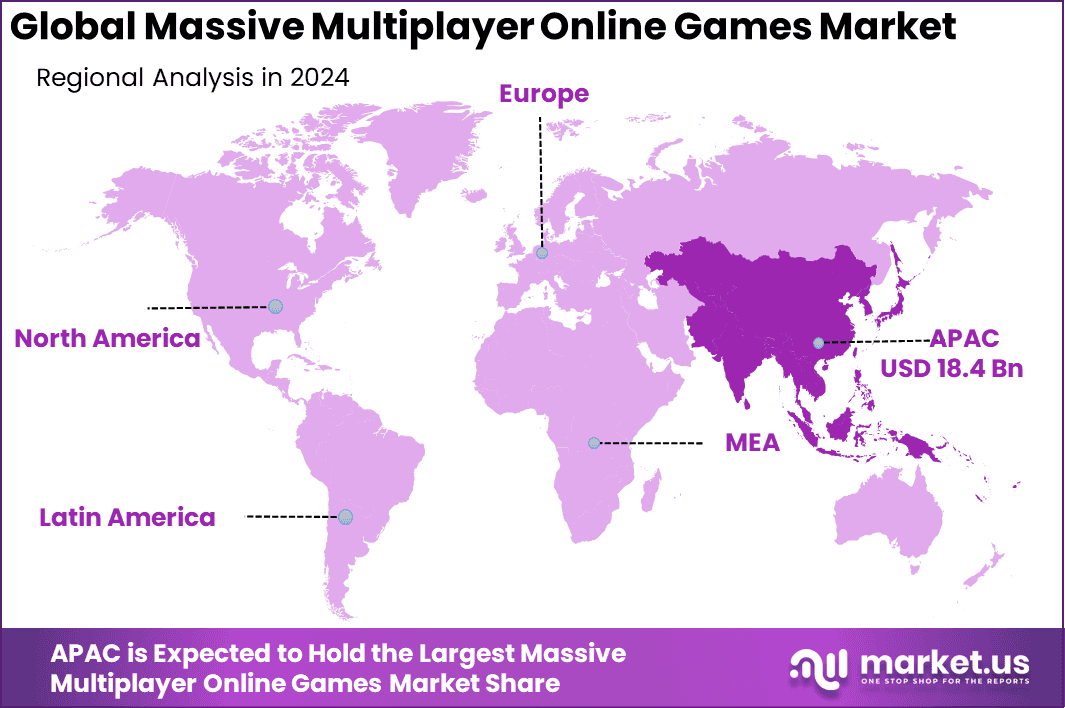
The Global Massive Multiplayer Online (MMO) Games Market size is expected to be worth around USD 113.69 billion by 2034, from USD 41.89 billion in 2024, growing at a CAGR of 10.5% during the forecast period from 2025 to 2034. In 2024, Asia Pacific held a dominant market position, capturing more than a 44% share, holding USD 18.4 billion in revenue.

The market for Massive Multiplayer Online (MMO) games is primarily driven by the increasing demand for immersive, social, and interactive gaming experiences. As internet access and mobile device penetration continue to rise globally, more players are drawn to the dynamic, community-driven environments that MMOs provide.
Massive Multiplayer Online Games Market SizeMassive Multiplayer Online Games Market Size

Consumer demand is being driven by a desire for immersive, persistent experiences and deep social interaction through guilds, events, and collaborative gameplay. The convenience and ubiquity of mobile devices, combined with the cloud and subscription-based access, attract diverse demographics beyond the traditional hardcore gamer segment.

For instance, In January 2025, South Korea’s gaming sector gained momentum as Nexon unveiled a new MMO project integrating advanced AI and cloud gaming features. This move reflects Nexon’s strategic push to enhance immersive gameplay and strengthen its position in both domestic and global MMO markets.

Investment in these technologies is being driven by their ability to lower hardware costs, expand audience reach, and enhance player retention. Cloud adoption enables flexible scaling and global accessibility, while AI integration fosters deeper engagement through intelligent matchmaking and adaptive game environments. Energy efficiency aligns with broader sustainability goals, which can be monetized through consumer goodwill and cost savings.

Business benefits include extended user lifecycles through recurring revenue models, strengthened brand loyalty via community building, and diversified monetization channels (e.g. free‑to‑play with in‑game purchases). Additionally, advancements in sustainability and safety can enhance reputation and comply with social and regulatory expectations.

Key Insights Summary

  • The global MMO games market is projected to grow from USD 41.89 billion (2024) to USD 113.69 billion by 2034, registering a CAGR of 10.5%.
  • In 2024, the Asia Pacific region led the market with over 44% share, generating USD 18.4 billion in revenue.
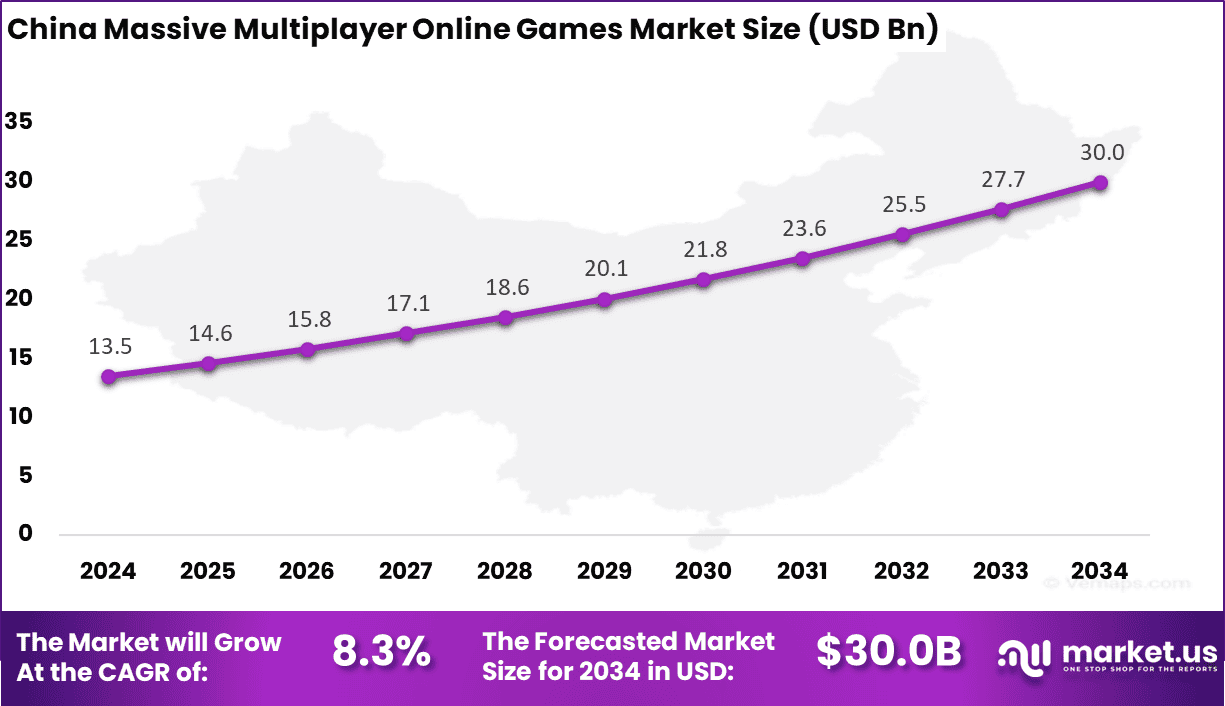
  • China alone contributed USD 13.5 billion, growing at a CAGR of 8.3%.
  • By genre, Massively Multiplayer Online RPGs (MMORPGs) dominated with a 34% share.
  • Mobile platforms led usage, accounting for 41% of total market revenue.
  • The Free-to-Play (F2P) model remained most popular, capturing a 48% share of the revenue model segment.

China MMO Games Market Size

The market for Massive Multiplayer Online (MMO) Games within China is growing tremendously and is currently valued at USD 13.5 billion, the market has a projected CAGR of 8.3%. China’s growing market for Massive Multiplayer Online (MMO) games is largely due to its expanding internet connectivity, tech-savvy youth, and increasing interest in online sports.

The demand for mobile gaming in China is driven by its thriving culture, which is heavily connected to online gaming and competitive gaming. In addition, government support for digital entertainment and the development of high-speed internet and 5G networks are key factors driving the growth of MMOs.

For instance, In June 2025, Tencent was reportedly considering the acquisition of Nexon, a well-known MMO game developer. This strategic move could enhance Tencent’s MMO portfolio and reinforce its global market presence. By tapping into Nexon’s successful franchises, Tencent aims to solidify its leadership in the highly competitive MMO gaming industry.
China Massive Multiplayer Online Games MarketChina Massive Multiplayer Online Games Market

In 2024, Asia Pacific held a dominant market position in the Global Massive Multiplayer Online (MMO) Games Market, capturing more than a 44% share, holding USD 18.4 billion in revenue. This region is in a dominant position due to a rapidly growing gamer population, widespread mobile device adoption, and advanced digital infrastructure.

It benefits from low-cost smartphones, high bandwidth, and the growing popularity of mobile gaming, which makes MMOs accessible to many. In addition, a strong esports culture, continuous innovation in gaming technology, and robust community engagement have reinforced Asia Pacific’s leadership, with China playing a pivotal role in this growth.

For instance, in October 2024, a leak revealed that Nintendo is planning to launch a Minecraft-style MMO for the Switch, which will allow players to build, explore, and interact in an open-world environment. The game, which is expected to be available through Nintendo Switch Online, will feature a blend of sandbox gameplay and multiplayer features, offering a dynamic, collaborative gaming experience.
Massive Multiplayer Online Games Market RegionMassive Multiplayer Online Games Market Region

Genre Analysis

In 2024, the Massively Multiplayer Online RPGs (MMORPGs) segment held a dominant market position, capturing a 34% share of the Global Massive Multiplayer Online (MMO) Games Market. The MMORPG market’s dominance is due to the genre’s unique ability to provide engaging, long-lasting gaming experiences with complex plotlines, detailed character development, and expansive online virtual worlds.

The ability of MMORPGs to create strong player groups is crucial for maintaining a sense of community and participation among players. Through the sustained success of flagship titles, as well as frequent additions to the content and inclusion of advanced social features, this popularity has further enhanced the genre’s appeal and solidified its position as a dominant force in the global MMO gaming market.

For instance, In April 2025, the creators of Axie Infinity announced the shutdown of Project T, their MMO RPG initiative. The closure was attributed to difficulties in aligning the game’s blockchain-based economic model with sustained player engagement. This outcome underscores the ongoing challenges in merging blockchain mechanics with MMORPG design, particularly in maintaining long-term user retention and balanced virtual economies.

Platform Analysis

In 2025, the Mobile segment held a dominant market position, capturing a 41% share of the Global Massive Multiplayer Online (MMO) Games Market. The increase in demand for MMO experiences has been largely driven by the widespread use of smartphones, improved internet connectivity, and mobility for gaming.

This growth has also been supplemented by the introduction of free-to-play models, cross-platform functionality, and ongoing improvements to mobile graphics and performance. Also, due to the popularity of multiplayer and social aspects, as well as regular content updates and active community engagement, mobile has become the preferred platform for many MMO enthusiasts.

For instance, in February 2025, Nexon reported a record annual revenue of ¥446.2 billion (~$3 billion), driven largely by the continued success of Dungeon Fighter Online (DFO), which saw significant growth in both its mobile and PC versions. The strong performance of DFO helped Nexon maintain its position as a leader in the MMO market.

Revenue Model Analysis

In 2024, the Free-to-Play (F2P) segment held a dominant market position, capturing a 48% share of the Global Massive Multiplayer Online (MMO) Games Market. This dominance is due to the widespread appeal of F2P models, which lower the barrier to entry for players, allowing anyone to access the game without upfront costs.

Additionally, the revenue generated through in-game purchases, such as virtual goods, cosmetics, and microtransactions, has proven highly profitable. Regular content updates, seasonal events, and the integration of social features also contribute to strong player retention and continuous monetization opportunities, reinforcing the F2P model’s market leadership.

For Instance, in June 2025, NetEase Games introduced custom servers for Once Human, a popular free-to-play survival crafting game. These custom servers allow players to adjust various game parameters, such as PvE/PvP scenarios and difficulty levels, offering a more tailored experience. This move enhances the game’s accessibility and player engagement by providing a highly customizable gameplay environment.

Key Market Segments

By Genre

  • Massively Multiplayer Online Role-Playing Games (MMORPGs)
  • MMO First-Person Shooter (MMOFPS)
  • MMO Real-Time Strategy (MMORTS)
  • MMO Battle Royale
  • Simulation & Sports MMO
  • Social/Casual MMO

By Platform

  • PC
  • Console
  • Mobile
  • Cloud Gaming Platforms

By Revenue Model

  • Subscription-based
  • Free-to-Play (F2P)
  • Buy-to-Play
  • Hybrid Models
  • NFT/Play-to-Earn (P2E)

Drivers

Growing Popularity of Esports

Esports has become a major player in the MMO industry, sparking heightened interest and involvement. Games such as League of Legends and Dota 2 have shifted from being recreational activities to large-scale arenas with audiences across the globe.

Besides building up loyal fan bases, this trend generates revenue through sponsorships, advertising, and merchandise sales. The esports framework has elevated MMOs’ status as a top entertainment spectacle, attracting sponsorships from major companies and drawing in mainstream media attention.

For instance, in September 2023, the Odin Cup garnered significant attention, showcasing the immense potential of the MMO market in Southeast Asia, particularly within esports. The event highlighted the region’s growing appetite for competitive gaming, with Odin: Valhalla Rising leading the charge in attracting both players and audiences.

Restraint

Security and Privacy Concerns

Security and privacy concerns remain a major challenge for MMO developers. The online gaming industry is a prime target of hackers, fraudsters, and data breaches that expose compromising personal information. The reputation of a game can be severely damaged by these events, which can lead to lowered player confidence and ultimately result in the loss of users.

The implementation of robust cybersecurity measures and data safeguarding practices is essential for developers to ensure that their players are protected by regulations and minimize data risks. For instance, in December 2023, Street Mobster, a popular MMO game, was found to have a significant data breach, exposing the personal information of over 2 million players.

The leaked data included sensitive details such as usernames, passwords, and email addresses, which raised serious concerns about the game’s security protocols. This incident highlights the ongoing risks of data security in online gaming environments and underscores the importance of robust protection measures to safeguard player privacy in the increasingly connected MMO market.

Opportunities

Community and Social Features

As gaming becomes more social, MMOs are leveraging the benefits of community-based features. A stronger connection to social media platforms, collaborations with influencers, and the development of in-game communities create immersive environments that foster player involvement and commitment.

Through word-of-mouth, these characteristics drive organic growth and foster long-term retention as players become socially enticed by the game. MMOs that promote seamless social interactions both within and beyond the game can enhance user relationships, leading to increased engagement and revenue.

For instance, in April 2025, Ronin Games announced a collaboration with Forgotten Runiverse and Pixels to bring influencer-driven content into their MMO ecosystem. This partnership aims to integrate exclusive in-game content, such as limited-edition skins and events, which are promoted through influencer channels.

By leveraging the reach of popular content creators, the collaboration not only enhances player engagement but also taps into new audiences, further highlighting the growing trend of influencer partnerships in the MMO space to drive engagement and monetization.

Challenges

Intense Competition from New Entrants

The MMO arena is a highly competitive field, with both established franchises and emerging developers competing fiercely. The presence of new and exciting competitions can undermine the authority of established games, making it more challenging for any championship to maintain a dominant position.

Classic MMOs face a challenge from new competitors who bring in fresh gameplay mechanics, narratives, and monetization strategies to retain their audience. In this highly competitive atmosphere, it is imperative to constantly adjust and evolve to meet the changing preferences and demands of players.

For instance, in October 2024, Nintendo announced it is developing a new MMO-style game aimed at competing with popular titles like Minecraft and Roblox. The game, which is expected to feature expansive open-world mechanics, user-generated content, and multiplayer interactions, will target a broad audience, including younger players.

This strategic move positions Nintendo to tap into the growing market of social and sandbox gaming, combining its rich history in family-friendly entertainment with the growing demand for immersive, online multiplayer experiences.

Latest Trends

Innovations in Augmented Reality (AR), Virtual Reality (VR), and 5G connectivity are significantly enhancing the MMO gaming experience. AR and VR have created virtual experiences that are so immersive and visually stunning that gamers can experience them in real life without having to go through the physical stuff.

Additionally, 5G and faster internet speeds are reducing lag and improving the responsiveness of multiplayer games, enabling real-time connections between players. Both developers and players are now able to utilize the innovations to unlock more profound, captivating gameplay possibilities in the MMO realm.

For instance, in May 2020, Bublar announced the soft launch of Otherworld Heroes, a location-based augmented reality (AR) MMORPG. This innovative game integrates AR technology to create immersive, real-world environments where players can interact with virtual elements overlaid onto their surroundings. The use of AR in Otherworld Heroes enhances the traditional MMO experience by blending the digital and physical worlds, offering a more engaging and dynamic gameplay experience.

Key Regions and Countries

  • North America
  • Europe
    • Germany
    • France
    • The UK
    • Spain
    • Italy
    • Russia
    • Netherlands
    • Rest of Europe
  • Asia Pacific
    • China
    • Japan
    • South Korea
    • India
    • Australia
    • Singapore
    • Thailand
    • Vietnam
    • Rest of APAC
  • Latin America
    • Brazil
    • Mexico
    • Rest of Latin America
  • Middle East & Africa
    • South Africa
    • Saudi Arabia
    • UAE
    • Rest of MEA

Key Players Analysis

Activision Blizzard Inc., Electronic Arts Inc., and Ubisoft Entertainment SA lead the MMO games market with strong global IPs and recurring content updates. Their focus on live-service models and cross-platform play drives long-term player engagement. NCSOFT Corporation and Giant Interactive Group Inc. maintain a solid presence in Asia, supported by culturally tailored MMORPGs and loyal user bases.

In June 2024, NCSOFT, in collaboration with Amazon Games, launched Throne and Liberty, a free-to-play MMORPG across PC, PlayStation 5, and Xbox Series X|S. Featuring a dynamic open world with changing weather and seasons, the game offers immersive PvP and PvE gameplay. This launch marks a key milestone for NCSOFT, reinforcing its competitive standing in the global MMO gaming market.

Tencent Holdings Limited, Amazon Game Studios, and Nexon Co. Ltd are investing in cloud gaming and cross-device features. Jagex Limited and Bright Star Studios focus on player-centric design, offering deep storytelling and persistent online worlds that appeal to core MMO players.

Daybreak Game Company, CCP Games UK Ltd, and Neteasegames Inc. rely on genre diversity and real-time events to retain users. Aeria Games and Gravity Corporation expand in mobile-friendly and emerging markets. Other players are exploring blockchain, NFTs, and player-owned assets, pushing the MMO market toward decentralized, creator-driven experiences.

Top Key Players in the Market

  • Activision Blizzard Inc.
  • Electronic Arts Inc.
  • Ubisoft Entertainment SA
  • NCSOFT Corporation
  • Giant Interactive Group Inc.
  • Tencent Holdings Limited
  • Amazon Game Studios
  • Nexon Co. Ltd
  • Jagex Limited
  • Bright Star Studios
  • Daybreak Game Company
  • CCP games UK Ltd
  • Netease Games Inc.
  • Aeria Games
  • Gravity Corporation
  • Others

Recent Developments

  • In July 2024, Amazon Game Studios announced significant updates for New World, their MMORPG, introducing new content and gameplay features to enhance the player experience. The update focused on expanding the game’s world with additional zones, quests, and PvP modes.
  • In October 2023, Activision Blizzard plans to introduce several of its popular games to Xbox Game Pass, expanding accessibility for players on Microsoft’s platform in 2024. This move follows the company’s acquisition by Microsoft and aims to enhance the reach of Activision’s game library, which includes highly successful franchises like Call of Duty and World of Warcraft.

Report Scope



Link

Continue Reading
Click to comment

Leave a Reply

Your email address will not be published. Required fields are marked *

Technology

Superbet Group Becomes Super Technologies, Shaping the Future of Digital Entertainment Ecosystems

Published

on


Our website uses cookies, as almost all websites do, to help provide you with the best experience we can.

Cookies are small text files that are placed on your computer or mobile phone when you browse websites.

Our cookies help us:

– Make our website work as you’d expect

– Remember your settings during and between visits

– Offer you free services/content (thanks to advertising)

– Improve the speed/security of the site

– Allow you to share pages with social networks like Facebook

– Continuously improve our website for you

– Make our marketing more efficient (ultimately helping us to offer the service we do at the price we do)

We do not use cookies to:

– Collect any personally identifiable information (without your express permission)

– Collect any sensitive information (without your express permission)

– Pass personally identifiable data to third parties

– Pay sales commissions

{short version}This Privacy Policy discloses the privacy practices for EEGReport Magazine, EEGaming.org, GamblingIndustryB2B.com, iGamingRadio.com, GamblingAffiliateVoice.com and EuropeanGaming.eu, including subdomains, our email newsletters and other applications owned and operated by our company (collectively referred to as the “European Gaming Media and events” – formerly known as “EEGMedia“), and to any services that display this notice. The Privacy Policy also sets out the ways in which we may use your personal data.

{long detailed version} To read this in full, click on the Privacy Policy button found in this window.

{short version} These terms and conditions govern your use of the websites owned and operated by European Gaming Media and Events; by using our websites, you accept these terms and conditions in full and without reservation. If you disagree with these terms and conditions or any part of these terms and conditions, you must not use these websites.

You must be at least 18 [eighteen] years of age to use our websites. By using our websites and by agreeing to these terms and conditions, you warrant and represent that you are at least 18 years of age.

The list of the websites owned and operated by European Gaming Media and Events can be found here.

In other words,
You must be at least 18 years old to use our service and fully agree with everything stated on this page. Otherwise, sorry, guys, ours websites are not for you.

License to use our websites
Unless otherwise stated, European Gaming Media and Events and/or its licensors own the intellectual property rights published on our websites and materials used on the European Gaming Media and Evnts network. Subject to the license below, all these intellectual property rights are reserved.

You may view, download for caching purposes only, and print pages, files or other content from the websites for your own personal use, subject to the restrictions set out below and elsewhere in these terms and conditions.

You must not:

republish material from these websites in neither print nor digital media or documents (including republication on another website);
sell, rent or sub-license material from the websites;
show any material from the websites in public;
reproduce, duplicate, copy or otherwise exploit material from our websites for a commercial purpose;
edit or otherwise modify any material on these websites;
redistribute material from these websites – except for content specifically and expressly made available for redistribution; or
republish or reproduce any part of these websites through the use of iframes or screenscrapers.
Where content is specifically made available for redistribution, it may only be redistributed within your organisation.

In other words,
Everything on our websites belongs to us. You can read it, but you cannot republish it. Sounds fair, doesn’t it?

Acceptable use
You must not use these websites in any way that causes, or may cause, damage to the websites or impairment of the availability or accessibility of the European Gaming Media network or in any way which is unlawful, illegal, fraudulent or harmful, or in connection with any unlawful, illegal, fraudulent or harmful purpose or activity.

{long detailed version} To read this in full, click on the Terms of Service button found in this window.


Link

Continue Reading

Technology

Gaming Headset Market reaching an estimated USD 7 billion by 2034

Published

on


Gaming Headset

Gaming Headset

Pune, India – December 15, 2025 – Exactitude Consultancy, a global leader in market research and intelligence, today announced the publication of its Gaming Headset Market Report, delivering a detailed analysis of industry trends, segmentation, competitive landscape, and growth forecast through 2034. This report equips manufacturers, gaming peripheral brands, distributors, investors, and technology stakeholders with actionable insights into the evolving gaming audio accessory ecosystem.

Download Full PDF Sample Copy of Market Report @ https://exactitudeconsultancy.com/request-sample/70022

Market Overview

The global gaming headset market was valued at approximately USD 3.6 billion in 2024 and is projected to grow at a CAGR of 7.1 % over the forecast period (2025-2034), reaching an estimated USD 7 billion by 2034. Growth is driven by rising eSports participation, immersive gaming demand, and technological advancements in audio features.

Key Growth Drivers & Trends

• eSports & Online Gaming Boom: Global expansion of competitive gaming amplifies demand for high performance headsets that offer superior positional audio and communication clarity.

• Technological Innovation: Enhanced features such as noise cancellation, surround sound, wireless connectivity, and spatial audio are increasingly integrated, improving player immersion and comfort.

• Streaming & Content Creation: Growth in gaming streaming and content production influences headset demand, as creators seek high quality audio capture and playback.

• Casual & Mobile Gamers: A broadening gamer base – especially casual players – continues to drive headset adoption for both competitive play and entertainment.

Market Segmentation

The report segments the gaming headset market by:

• Product Type: Wired and wireless gaming headsets. Wired remains significant due to low latency, while wireless is rising with improved battery tech and convenience.

• Application: Gaming, music, virtual reality (VR), and streaming usage.

• End User: Casual gamers, professional gamers, and eSports athletes.

• Technology: Surround sound, noise cancellation, RGB lighting, built in microphones – key immersive and functional features driving differentiation.

• Distribution Channel: Online retail, offline retail stores, and direct manufacturer sales.

Explore Full Report here: https://exactitudeconsultancy.com/reports/70022/gaming-headset-market

Regional Insights

• North America remains the largest regional market, accounting for about 40 % of global revenue, buoyed by a strong gaming culture and high accessory spend.

• Asia Pacific is a dynamic growth region with an ~10 % CAGR, driven by expanding middle class gaming populations and significant eSports adoption in China, Japan, and SEA.

• Europe shows solid growth supported by widespread console and PC gaming infrastructure.

• Latin America and Middle East & Africa are among the fastest growing emerging regions with projected double digit regional CAGRs by 2034.

Competitive Landscape

The gaming headset market is highly competitive with both established brands and specialized gaming audio companies. Key players include:

• Logitech

• Razer

• Corsair

• SteelSeries

• HyperX

• ASUS

• Turtle Beach

• Sennheiser

• JBL

• Creative Labs

These companies continually innovate with features such as spatial audio, advanced noise suppression, enhanced wireless protocols, and ergonomic design to meet diverse gamer preferences.

Market Challenges

Challenges facing the market include price competition and saturation in certain product tiers, as well as evolving platform compatibility requirements across PC, console, mobile, and VR devices.

Strategic Importance

Gaming headsets have become essential peripherals for modern gaming ecosystems, influencing play experience, communication, and competitive performance. As the gaming sector – including casual, competitive, and VR gaming – continues to expand, high fidelity audio gear remains a key differentiator for brands and consumers alike.

This report is also available in the following languages : Japanese (ゲーミングヘッドセット市場), Korean (게이밍 헤드셋 시장), Chinese (游戏耳机市场), French (marché des casques de jeu), German (Markt für Gaming-Headsets), and Italian (Mercato delle cuffie da gioco), etc.

Request for a sample of this research report at (Use Corporate Mail ID for Quick Response) @ https://exactitudeconsultancy.com/request-sample/70022

Our More Reports:

Standalone Trackpad Market

https://exactitudeconsultancy.com/reports/33610/standalone-trackpad-market

Virtual Reality Devices Market

https://exactitudeconsultancy.com/reports/34652/virtual-reality-devices-market

Professional Monitors Market

https://exactitudeconsultancy.com/reports/35764/professional-monitors-market

About Us

Exactitude Consultancy is a market research & consulting services firm which helps its client to address their most pressing strategic and business challenges. Our market research helps clients to address critical business challenges and also helps make optimized business decisions with our fact-based research insights, market intelligence, and accurate data.

https://bulletin.exactitudeconsultancy.com/

https://www.thehealthanalytics.com/

https://www.analytica.global/

https://www.marketintelligencedata.com/

https://www.marketinsightsreports.com/

https://exactitudeconsultancy.com/

Connect Us:

Irfan Tamboli

PHONE NUMBER +1 (704) 266-3234

EMAIL ADDRESS: sales@exactitudeconsultancy.com

This release was published on openPR.


Link

Continue Reading

Technology

UM-Flint event sees Corunna, Davison win top esports honors | News

Published

on


Games including Rocket League, Marvel Rivals, Super Smash Bros, Mario Kart 8, and others.


FLINT, Mich. (WJRT) – The University of Michigan-Flint’s College of Innovation & Technology joined forces with the Michigan High School Esports Federation to host the fall 2025 state finals event.

More than 120 teams and 350 players from over 70 schools across the state participated in the event on Saturday.

Eleven champions were crowned in games such as Rocket League, Marvel Rivals, Super Smash Bros, and Mario Kart 8.

“It’s amazing. It’s my first time in a tournament or anything,” said Corunna esports player Jackson Donley.

“Especially in person, and the atmosphere is just amazing. You can tell it’s tense, especially when the matches are so close,” Donley said.

Corunna Middle School secured first place in the middle school division of the Team Super Smash Bros competition.

Davison High School claimed first place in the high school division.


Link

Continue Reading

Technology

Retro Cartoon Tech Accessories : Higround x SEGA

Published

on


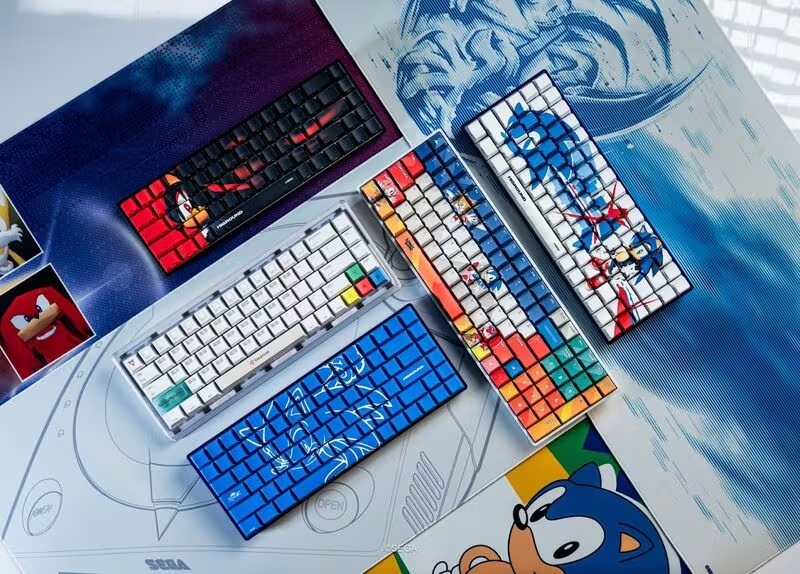
The Sonic the Hedgehog collection, a renewed collaboration between lifestyle gaming peripheral brand Higround and SEGA, highlights a design concept that merges retro nostalgia with modern performance engineering. Drawing from the cultural legacy of Sonic the Hedgehog and the visual language of the Dreamcast era, the collection introduces peripherals that blend archival aesthetics with contemporary functionality. This release also expands Higround’s product range “through updated 75% and 96% keyboard layouts and the introduction of a Hall Effect model, each referencing the theme of Sonic’s characteristic speed.”

The ‘Summit 65+,’ presented in a Dreamcast-inspired design, features a CNC aluminum case, stainless steel back plate, and Higround’s ‘Dampening Plus’ five-layer system for a stable, quiet typing experience. The ‘Basecamp 65HE,’ influenced by the Radical Highway level, debuts Hall Effect technology for increased precision. Additional offerings—including the Classic Sonic–themed ‘Basecamp 96+,’ two ‘Basecamp 75+’ versions inspired by Escape from the City and Sonic CD, a Sonic CD keycap set, and four coordinated XL mousepads—further unify the collection’s nostalgic yet contemporary character.

Image Credit: Higround


Link

Continue Reading

Technology

How Miami’s Sports Culture Reflects the High-Energy Mindset Driving Today’s Tech Innovations – Five Reasons Sports Network

Published

on


The Competitive Spirit That Powers Both Sports and Startups

Miami sports fans know that greatness comes from more than talent alone. Whether it’s the Heat grinding through a tight fourth quarter or the Dolphins executing a perfectly timed offensive scheme, winning requires discipline, fast thinking, and an unshakeable competitive spirit. Interestingly, these same qualities power the tech and startup world, where entrepreneurs make split-second decisions that can define the future of an entire business.

In both arenas, success belongs to those who can read momentum, adapt under pressure, and turn small opportunities into game-changing wins. That overlap is why so many sports-minded individuals naturally thrive in the world of business, innovation, and technology.

Why Analytics in Sports Fuel Smarter Business Thinking

Today’s sports landscape is driven by analytics—shot charts, win probability graphs, EPA metrics, and possession efficiency numbers are all part of modern fan knowledge. This analytical mindset doesn’t stop at the arena. Tech entrepreneurs, founders, and investors rely on the same data-driven thinking to navigate product decisions, market shifts, and competition.

This crossover is why the startup world attracts problem solvers shaped by sports culture. And platforms in the entertainment-tech space—such as Foxy gold casino—reflect this growing connection between digital innovation, predictive thinking, and user engagement.

Understanding Momentum: A Shared Advantage for Founders and Athletes

Momentum is everything. In sports, a single run, turnover, or three-pointer can change the energy in seconds. In business, momentum might be a viral post, a successful beta launch, or hitting a major funding milestone. Leaders in both fields understand how to recognize momentum and capitalize on it.

This parallels perfectly:

  • Athletes ride hot streaks.
  • Founders capitalize on traction.
  • Sports teams adjust mid-play.
  • Startups pivot product strategy just as quickly.

The ability to shift gears on the fly is one of the most important skills in sports and tech alike.

Building a Winning Strategy: What Startups Can Learn From Miami Sports

1. Scouting and Research Matter

Sports teams invest heavily in scouting reports and film studies. They evaluate:

  • Opponent strengths
  • Player tendencies
  • Lineup matchups
  • Efficiency ratings

Startups mirror this with market research, user interviews, competitive analysis, and data modeling. Knowing the landscape allows founders to execute smarter, faster, and with more confidence.

2. Team Culture Determines Long-Term Success

The Miami Heat built the “Heat Culture,” known for discipline, conditioning, and accountability. Startups adopting similar cultural principles see major benefits:

  • Clear leadership and communication
  • Defined expectations
  • Continuous improvement
  • Resilience under pressure

A strong culture is often the difference between a startup that scales—and one that collapses.

3. Adaptability Separates Winners From the Rest

Sports demand constant adjustments: defensive rotations, halftime strategies, and clutch-time decisions. Startups face equally rapid shifts:

  • Market changes
  • New competitors
  • Shifting user demand
  • Technological breakthroughs

Founders who adapt quickly, without losing their vision, stay competitive.

Table: Business Lessons Inspired by Miami’s Sports Playbook

Miami Sports Principle Startup Application Tech/Innovation Impact
Heat Culture Strong internal systems Higher productivity & retention
Film study & analytics Market and user research Better decision-making
In-game adjustments Product pivots Faster adaptation to trends
Team chemistry Cross-functional collaboration Smoother product scaling
Game-winning mentality Resilient leadership Strong long-term growth

How Miami’s Fast-Paced Environment Fuels Innovation

South Florida’s sports scene is known for energy, excitement, and bold plays. Coincidentally, Miami’s startup scene mirrors that same intensity. The city has quickly become a hub for fintech, AI, gaming, and digital entertainment. Entrepreneurs here are used to speed—speed of execution, iteration, and scaling.

A few reasons Miami is thriving in the innovation sector:

  • Diverse global talent
  • High investor interest
  • Strong tech community backing
  • Growing digital entertainment market
  • Crossover influence from sports and media

Miami is one of the few cities where sports culture and startup culture genuinely feed each other.

Technology Is Changing the Game—On the Field and in the Office

Technology has reshaped sports with player-tracking systems, real-time analytics, and dynamic stat models. Meanwhile, tech startups use automation, AI-driven insights, and SaaS platforms to accelerate growth. Both industries depend on innovation to stay ahead.

Today’s fans and founders alike have access to tools such as:

  • Predictive analytics
  • Machine learning insights
  • Automated reporting dashboards
  • Real-time performance tracking
  • Competitive intelligence platforms

This shared tech ecosystem keeps both sports teams and startups laser-focused on performance.

The Role of Mindset: What Makes Sports Fans Natural Innovators

Sports fans understand pressure. They analyze plays, debate strategies, track performance trends, and anticipate outcomes. These instincts make them naturally suited for entrepreneurship and tech leadership.

Key mindset overlaps include:

  • Confidence under pressure
  • Long-term thinking
  • Understanding risk and reward
  • Embracing competition
  • Continuous improvement

Sports create thinkers who thrive in fast-paced, unpredictable environments—the exact conditions startups face daily.

Why the Connection Between Sports and Startups Keeps Growing

Sports influence is everywhere—from data modeling to team culture to leadership strategy. At the same time, tech continues to elevate sports through analytics, digital enhancements, and real-time engagement tools. The crossover strengthens every year, especially in vibrant markets like Miami.

As both industries push forward, one thing remains true: the mindset that wins games is the same mindset that builds the next big company. Athletes, analysts, fans, and founders all share a core advantage—a competitive drive, sharpened by strategy, that fuels consistent growth.


Link

Continue Reading

Technology

Lakeview Academy unveils renovated Innovation and Technology Wing

Published

on


Lakeview Academy in Gainesville recently unveiled its newly renovated Innovation and Technology Wing.

The learning environment is designed to inspire creativity, collaboration, and hands-on problem-solving.

“The expanded robotics and esports facilities give our students room to imagine bigger and build bolder,” Technology Director Mikhail Lovell, said. “With advanced tools like industrial laser cutters and high-performance 3D printers, they can design and create with a level of precision and freedom that we couldn’t offer before. This renovation strengthens the programs our students already love while opening the door to new opportunities for innovation, growth, and achievement.”

School officials said the renovation was made possible through Lakeview donors and community partners who share in the school’s mission to cultivate curiosity, excellence, and forward-thinking leadership.

“This renovation represents more than just new facilities,” John Simpson, Head of School at Lakeview Academy, said. “It is an investment in our students’ future and a reflection of Lakeview’s vision to provide a learning environment that mirrors the innovation and collaboration found in today’s leading industries.”


Link

Continue Reading

Most Viewed Posts

Trending