A new card grading company emerged earlier this month with promises to provide cheap and transparent grading using artificial intelligence and machine-learning technology.
But two weeks after its launch, Zeagley Grading Services has already halted submissions, aired public spats on its website and avoided providing any substantial insight into its grading process or ownership structure.
Less than 40 minutes after ending a call with cllct Tuesday, the company’s website had disappeared. It returned Thursday with only the popular gif of former professional wrestler The Undertaker rising from a coffin, floating against a background image of Freddie Freeman’s walk-off grand slam from Game 1 of the 2024 World Series.
After briefly disappearing, Zeagley’s website returned with a gif of The Undertaker and image of Freddie Freeman.
On Friday, Zeagley’s website had been updated to show a photoshopped variation of the Freeman image with a countdown clock ending July 29. The National Sports Collectors Convention in Chicago takes place July 30 to Aug. 3.
Zeagley made a quiet debut via press release June 13, saying its team of former Amazon, Google and Meta engineers could deliver the “next-generation sports card grading platform powered entirely by artificial intelligence and machine learning.”
Zeagley said it would have a booth at Fanatics Fest 2025 in New York to demonstrate its technology firsthand by grading cards “in less than one second.”
The company has “already attracted early attention from major names, including DraftKings,” the release said.
In the days following its launch, Zeagley faced scrutiny from hobbyists, with many calling for additional transparency into its grading process and the company founders.
The first public hurdle for Zeagley came June 17 when the company said it had received a cease-and-desist letter from Collectors, the parent company of grading giant PSA.
The letter, portions of which were obtained by cllct and also posted to Zeagley’s website, demanded Zeagley halt use of its label, which Collectors claimed violated PSA’s trademark and trade dress. In the letter, Collectors also requested Zeagley destroy any remaining stock of labels.
After this story originally published Friday, PSA confirmed it did send the cease-and-desist letter.
Following the alleged cease-and-desist request, cllct attempted to discover who was behind the launch of Zeagley and learn what makes the company different from the industry’s current offerings.
On June 18, cllct was provided with a Google Voice number to schedule an interview with a member of the company. Rather than speak with a founding member, cllct would be connected with a spokesperson it was told it could refer to as “Ace.”
Cllct spoke with “Ace” on June 19 for 75 minutes.
During the call, “Ace” provided a basic overview of the company’s AI and machine-learning technology that it uses to grade cards.
Zeagley’s website currently features a countdown clock to July 19.
“We don’t want to give too much away, but at a high level, we’re getting thousands of data points on every card,” the spokesperson told cllct. “And from that, our software can do anything. It’s not just cards, we’ve scraped everything from the web.”
According to “Ace,” Zeagley initially began to form roughly two years ago from a group of card collectors with engineering backgrounds. Public records show Zeagley LLC was officially formed March 17, 2025.
“Ace” told cllct the company had analyzed more than 1,000 cards over the last year that had been graded by other companies to test for accuracy and consistency. He said Zeagley believed 80% of those cards were graded incorrectly.
“Over the last year, I would say we’ve graded cards at several different companies and the data we have, if we were to release it — we would be sued into oblivion,” “Ace” said. “So it’s shocking what we found.”
Additional details provided for the grading process were vague.
According to “Ace,” the label was made using AI, and Zeagley was adamant for it to have a QR code on the front. The company would be working with a graphic designer to create a new label. Whether it would be a standard label or have custom designs was still being researched.
The grading process itself is extremely simple, with human hands still being used to place cards before and after scanning. Little insight was given into the holdering process.
“It’s pretty much all automated,” the spokesperson said. “We don’t really have to tell it to start to scan. We don’t really have to tell any of the hardware to turn on. We don’t have to tell the software to run. We pretty much place the card and pick the card back up.”
According to “Ace,” the company doesn’t employ any former graders, but its members do have card backgrounds. When asked what safety nets or processes are in place to correct mistakes or improve the software, “Ace” said Zeagley hadn’t run into any issues.
“That’s kind of all baked into the system’ right? Not to get too technical, but you basically are looking at sort of an ‘if-else,’” they said. “If the condition is ‘true,’ do this, else do that. So that’s all sort of baked into the software. There’s logging, and we get errors if the software has issues, but ultimately our [quality assurance] has been going on for over a year. We haven’t had a problem at all.”
The June 13 press release said Zeagley would disrupt the collectibles market.
“Ace” then explained the proposed software to cllct further.
“Think of the model as a human. The model is continuously learning. The model is not done. The model is always learning,” they said. “The model knows more than any human on this planet ever will.
“The model knows more than just sports cards. The model has crawled all over the web, and we’ve trained it for probably over a year on exactly how we want the model to behave and fine-tuned to the point that we think we’re ready.”
When questioned by cllct about his role with the company a second time, “Ace” said he was acting as Zeagley’s CEO in addition to its spokesperson.
When asked about the company’s use of PSA’s trademark, “Ace” told cllct Zeagley would likely comply with the cease-and-desist. He also denied claims made by individual hobbyists on social media that the entire holder pictured — not just the label — was a visually-altered PSA slab.
During cllct’s call June 19, Zeagley posted an update to its website saying submissions would be paused, and the company would no longer be demonstrating its service at Fanatics Fest. “Ace” said the company had received about 1,000 orders prior to pausing service and those customers would be refunded.
It’s currently unclear if any cards were mailed to Zeagley for grading.
With Zeagley’s technology still largely unclear, cllct made repeated attempts to learn about the company infrastructure, its founders and funding.
The company was largely made up of engineers who were impacted by tech layoffs, “Ace” told cllct. Who these engineers were, exactly, he wouldn’t say. Zeagley was operating “pretty lean” at the moment, but had between 50 and 100 paid employees, he said.
“Ace” wouldn’t offer up additional details on the founders. Cllct agreed not to publish names of individuals if it could independently confirm the engineers had the background Zeagley claimed they did.
Cllct’s requests were repeatedly declined
Zeagley offered little insight into the company’s funding.
“The long and short is it’s a little bit of private and a little bit of public money,” they said, “but I think this weekend will change that.”
On June 18, Zeagley’s website featured a prominent “DraftKings” logo next to an advertisement for additional funding. “Want to invest?” the ad read. “Contact us for our next series of funding and join in with our existing partners.”
The advertisement and DraftKings logo were eventually removed from Zeagley’s website during one of the company updates written directly onto the homepage.
A DraftKings spokesperson later told cllct the company has no official relationship with Zeagley.
Additional requests to independently vet engineers and founders of the company were repeatedly declined by “Ace.”
“We’re not in a typical scenario,” he said. “We’re involved with lawyers, and there’s a lot of money at stake. I’m closing dealers tomorrow, and I don’t need the distraction.”
Instead, “Ace” offered to meet cllct in New York during Fanatics Fest from June 20-22. He clarified Zeagley never had a booth booked at the event, but there was intent to set up a “pop-up” tent outside of the venue to demonstrate the company’s ability to take initial scans in “about a millisecond.”
Cllct set a tentative window to meet midday on Friday, June 20.
Early that day, Zeagley’s website confirmed it would comply with PSA’s cease-and-desist request and had halted submissions.
“We complied with the cease and desist — not because we agree, but because we’d rather innovate than fight in court,” the note read. “Our new label is underway, and we’re committed to doing things the Zeagley way: with innovation, not intimidation. At Zeagley, we’re focused on building a grading system that collectors deserve.”
A text message from cllct to the Google Voice number used by “Ace” at 1:38 p.m. ET on June 20 wasn’t returned.
“Sorry got swamped, update on the site now,” read a text message from the Google Voice number used by “Ace” to cllct on June 22 at 9:49 p.m. ET.
The update on Zeagley’s homepage wrote of a meeting with Fanatics Live CEO Nick Bell on Saturday as well as a “total accident” meeting in an elevator with two employees from Mantel, a popular social media website dedicated to cards, collectibles and memorabilia.
“We gave them a quick, on-the-fly demo, and now we’re scheduled to talk again soon,” Zeagley’s update read.
Fanatics declined cllct’s request for confirmation Bell met with Zeagley representatives in any capacity.
A source for Mantel confirmed to cllct two employees ran into a Zeagley representative in an elevator during the event, but an official meeting was never set, and the reported demo of the company’s services were screenshots rather than video.
The source confirmed to cllct Mantel has no relationship with Zeagley. According to a Mantel source, the Zeagley representative introduced himself as “Kyle,” but didn’t provide a last name.
Two addresses are listed in Zeagley’s filings, including one that directs to Northwest Registered Agent. According to Northwest’s website, registered agent services are a way to “keep your sensitive personal data private and out of your company’s public information.”
The second address listed in Zeagley’s filings is a mailing address that directs to a post office in Seattle. “Ace” told cllct Zeagley planned to use that address to pick up cards that were mailed in for grading.
According to a Mantel source, the Google Voice number given to the team by “Kyle” is the same number cllct has used to communicate with “Ace.”
After a text message by cllct to the number provided for “Kyle” and “Ace” wasn’t returned Monday, the employee cllct had previously spoken to agreed to a second interview Tuesday.
When reached by cllct, “Ace” said he had personally shown Mantel employees a demo of Zeagley’s service at the Bleecker Trading booth during Fanatics Fest.
According to “Ace,” the company had been considering all paths forward. Following concerns about trustworthy suppliers that could provide the plastic holders need to grade cards at scale, the company was considering white-labeling its technology.
“Ace” said the meetings so far had largely involved Zeagley’s AI and machine-learning technology rather than its grading services. Zeagley would also be shifting its focus from accepting investments to partnerships.
Additional requests by cllct to confirm identities and backgrounds of founders at the company were repeatedly denied. The person speaking as “Ace” declined cllct’s request to confirm whether “Ace” and “Kyle” were the same employee working for Zeagley.
After originally taking credit for showing Mantel employees a demo in New York, the person speaking as “Ace” claimed he was never at Fanatics Fest, and “Kyle” was a different employee.
“Ace” then denied multiple cllct requests for any additional transparency.
“The people we want to know who we are, know who we are,” they said. ”We don’t care what the public thinks. The public is not writing checks and not doing deals.”
One of cllct’s final questions to “Ace” was whether Zeagley felt customers should know the backgrounds of the founders before sending cards or money to the company.
“We’re not even a grading company anymore,” he said. “Who knows what we are anymore? Maybe we dissolve tomorrow. Like I said, maybe we’re acquired tomorrow, and Zeagley never even existed. I really don’t even know what’s going to happen.”
The second call between cllct and “Ace” on Tuesday lasted 55 minutes and ended at 4:18 p.m. ET.
An attempt to reach Zeagley’s website by cllct at 4:58 p.m. ET that day was met with an error.
By early Thursday, the website, which has a listed owner of Domains By Proxy, LLC, had returned with the Freeman photograph and spinning GIF of The Undertaker.
An online search for “Zeagley” on Thursday listed the company as an online auction marketplace rather than a grading company.
“This online marketplace facilitates secure local auctions for buyers and sellers,” a preview for the company read. “Sellers list items and set a starting bid, while buyers compete to offer the best price. The platform prioritizes speed and convenience, allowing for quick sales and competitive bidding.”
A text message to the Google Voice number previously used by “Ace” and “Kyle” asking for clarity on a possible company pivot wasn’t immediately returned Thursday afternoon.
Ben Burrows is a reporter and editor for cllct, the premier company for collectible culture. He was previously the Collectibles Editor at Sports Illustrated. You can follow him on X and Instagram @benmburrows.
Games including Rocket League, Marvel Rivals, Super Smash Bros, Mario Kart 8, and others.
FLINT, Mich. (WJRT) – The University of Michigan-Flint’s College of Innovation & Technology joined forces with the Michigan High School Esports Federation to host the fall 2025 state finals event.
More than 120 teams and 350 players from over 70 schools across the state participated in the event on Saturday.
Eleven champions were crowned in games such as Rocket League, Marvel Rivals, Super Smash Bros, and Mario Kart 8.
“It’s amazing. It’s my first time in a tournament or anything,” said Corunna esports player Jackson Donley.
“Especially in person, and the atmosphere is just amazing. You can tell it’s tense, especially when the matches are so close,” Donley said.
Corunna Middle School secured first place in the middle school division of the Team Super Smash Bros competition.
Davison High School claimed first place in the high school division.
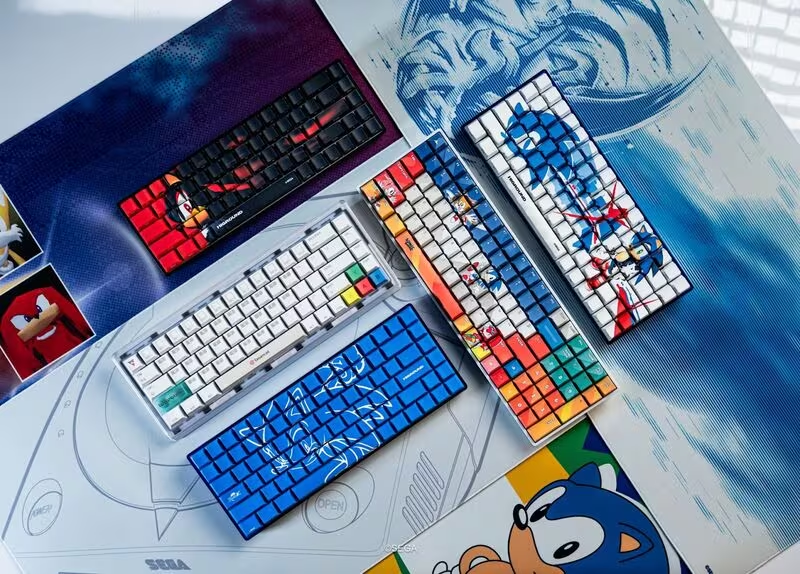
The Sonic the Hedgehog collection, a renewed collaboration between lifestyle gaming peripheral brand Higround and SEGA, highlights a design concept that merges retro nostalgia with modern performance engineering. Drawing from the cultural legacy of Sonic the Hedgehog and the visual language of the Dreamcast era, the collection introduces peripherals that blend archival aesthetics with contemporary functionality. This release also expands Higround’s product range “through updated 75% and 96% keyboard layouts and the introduction of a Hall Effect model, each referencing the theme of Sonic’s characteristic speed.”
The ‘Summit 65+,’ presented in a Dreamcast-inspired design, features a CNC aluminum case, stainless steel back plate, and Higround’s ‘Dampening Plus’ five-layer system for a stable, quiet typing experience. The ‘Basecamp 65HE,’ influenced by the Radical Highway level, debuts Hall Effect technology for increased precision. Additional offerings—including the Classic Sonic–themed ‘Basecamp 96+,’ two ‘Basecamp 75+’ versions inspired by Escape from the City and Sonic CD, a Sonic CD keycap set, and four coordinated XL mousepads—further unify the collection’s nostalgic yet contemporary character.
The Competitive Spirit That Powers Both Sports and Startups
Miami sports fans know that greatness comes from more than talent alone. Whether it’s the Heat grinding through a tight fourth quarter or the Dolphins executing a perfectly timed offensive scheme, winning requires discipline, fast thinking, and an unshakeable competitive spirit. Interestingly, these same qualities power the tech and startup world, where entrepreneurs make split-second decisions that can define the future of an entire business.
In both arenas, success belongs to those who can read momentum, adapt under pressure, and turn small opportunities into game-changing wins. That overlap is why so many sports-minded individuals naturally thrive in the world of business, innovation, and technology.
Why Analytics in Sports Fuel Smarter Business Thinking
Today’s sports landscape is driven by analytics—shot charts, win probability graphs, EPA metrics, and possession efficiency numbers are all part of modern fan knowledge. This analytical mindset doesn’t stop at the arena. Tech entrepreneurs, founders, and investors rely on the same data-driven thinking to navigate product decisions, market shifts, and competition.
This crossover is why the startup world attracts problem solvers shaped by sports culture. And platforms in the entertainment-tech space—such asFoxy gold casino—reflect this growing connection between digital innovation, predictive thinking, and user engagement.
Understanding Momentum: A Shared Advantage for Founders and Athletes
Momentum is everything. In sports, a single run, turnover, or three-pointer can change the energy in seconds. In business, momentum might be a viral post, a successful beta launch, or hitting a major funding milestone. Leaders in both fields understand how to recognize momentum and capitalize on it.
This parallels perfectly:
Athletes ride hot streaks.
Founders capitalize on traction.
Sports teams adjust mid-play.
Startups pivot product strategy just as quickly.
The ability to shift gears on the fly is one of the most important skills in sports and tech alike.
Building a Winning Strategy: What Startups Can Learn From Miami Sports
1. Scouting and Research Matter
Sports teams invest heavily in scouting reports and film studies. They evaluate:
Opponent strengths
Player tendencies
Lineup matchups
Efficiency ratings
Startups mirror this with market research, user interviews, competitive analysis, and data modeling. Knowing the landscape allows founders to execute smarter, faster, and with more confidence.
2. Team Culture Determines Long-Term Success
The Miami Heat built the “Heat Culture,” known for discipline, conditioning, and accountability. Startups adopting similar cultural principles see major benefits:
Clear leadership and communication
Defined expectations
Continuous improvement
Resilience under pressure
A strong culture is often the difference between a startup that scales—and one that collapses.
3. Adaptability Separates Winners From the Rest
Sports demand constant adjustments: defensive rotations, halftime strategies, and clutch-time decisions. Startups face equally rapid shifts:
Market changes
New competitors
Shifting user demand
Technological breakthroughs
Founders who adapt quickly, without losing their vision, stay competitive.
Table: Business Lessons Inspired by Miami’s Sports Playbook
Miami Sports Principle
Startup Application
Tech/Innovation Impact
Heat Culture
Strong internal systems
Higher productivity & retention
Film study & analytics
Market and user research
Better decision-making
In-game adjustments
Product pivots
Faster adaptation to trends
Team chemistry
Cross-functional collaboration
Smoother product scaling
Game-winning mentality
Resilient leadership
Strong long-term growth
How Miami’s Fast-Paced Environment Fuels Innovation
South Florida’s sports scene is known for energy, excitement, and bold plays. Coincidentally, Miami’s startup scene mirrors that same intensity. The city has quickly become a hub for fintech, AI, gaming, and digital entertainment. Entrepreneurs here are used to speed—speed of execution, iteration, and scaling.
A few reasons Miami is thriving in the innovation sector:
Diverse global talent
High investor interest
Strong tech community backing
Growing digital entertainment market
Crossover influence from sports and media
Miami is one of the few cities where sports culture and startup culture genuinely feed each other.
Technology Is Changing the Game—On the Field and in the Office
Technology has reshaped sports with player-tracking systems, real-time analytics, and dynamic stat models. Meanwhile, tech startups use automation, AI-driven insights, and SaaS platforms to accelerate growth. Both industries depend on innovation to stay ahead.
Today’s fans and founders alike have access to tools such as:
Predictive analytics
Machine learning insights
Automated reporting dashboards
Real-time performance tracking
Competitive intelligence platforms
This shared tech ecosystem keeps both sports teams and startups laser-focused on performance.
The Role of Mindset: What Makes Sports Fans Natural Innovators
Sports fans understand pressure. They analyze plays, debate strategies, track performance trends, and anticipate outcomes. These instincts make them naturally suited for entrepreneurship and tech leadership.
Key mindset overlaps include:
Confidence under pressure
Long-term thinking
Understanding risk and reward
Embracing competition
Continuous improvement
Sports create thinkers who thrive in fast-paced, unpredictable environments—the exact conditions startups face daily.
Why the Connection Between Sports and Startups Keeps Growing
Sports influence is everywhere—from data modeling to team culture to leadership strategy. At the same time, tech continues to elevate sports through analytics, digital enhancements, and real-time engagement tools. The crossover strengthens every year, especially in vibrant markets like Miami.
As both industries push forward, one thing remains true: the mindset that wins games is the same mindset that builds the next big company. Athletes, analysts, fans, and founders all share a core advantage—a competitive drive, sharpened by strategy, that fuels consistent growth.
Lakeview Academy in Gainesville recently unveiled its newly renovated Innovation and Technology Wing.
The learning environment is designed to inspire creativity, collaboration, and hands-on problem-solving.
“The expanded robotics and esports facilities give our students room to imagine bigger and build bolder,” Technology Director Mikhail Lovell, said. “With advanced tools like industrial laser cutters and high-performance 3D printers, they can design and create with a level of precision and freedom that we couldn’t offer before. This renovation strengthens the programs our students already love while opening the door to new opportunities for innovation, growth, and achievement.”
School officials said the renovation was made possible through Lakeview donors and community partners who share in the school’s mission to cultivate curiosity, excellence, and forward-thinking leadership.
“This renovation represents more than just new facilities,” John Simpson, Head of School at Lakeview Academy, said. “It is an investment in our students’ future and a reflection of Lakeview’s vision to provide a learning environment that mirrors the innovation and collaboration found in today’s leading industries.”
The Game Awards 2025 concluded on December 11 in Los Angeles, celebrating a standout year in gaming. The ceremony unveiled the full All Winners List across major categories, including Game of the Year, Best Art Direction, Best Narrative, and more. Fans tuned in worldwide to see whether Clair Obscur Expedition 33, Death Stranding 2 On the Beach, or Donkey Kong Bananza would claim top honors.
This year delivered an unusually competitive field. Nearly every major genre saw multiple critically acclaimed releases. The All Winners List highlights how diverse the gaming landscape has become, rewarding innovation, storytelling, performance, and design. Below is the complete breakdown of winners as confirmed during the live show.
Full All Winners List for The Game Awards 2025
The Game Awards recognized excellence across more than 30 categories. The All Winners List below reflects the official results announced during the broadcast. These selections were made through a combination of jury voting and fan participation. Trusted outlets such as Reuters and AP covered the event throughout the week, citing its global impact on the entertainment industry.
The ceremony featured wins for established franchises, emerging studios, and standout indie titles. Clair Obscur Expedition 33 dominated several major categories, cementing its status as one of the year’s most influential releases. Death Stranding 2 On the Beach and Hollow Knight Silksong also secured notable wins across art, music, and direction.
The winners list includes categories such as:
Game of the Year
Player’s Voice
Best Game Direction
Best Adaptation
Best Narrative
Best Art Direction
Best Score and Music
Best Audio Design
Best Performance
Innovation in Accessibility
Games for Impact
Best Ongoing Game
Best Community Support
Best Independent Game
Best Debut Indie Game
Best Mobile Game
Best VR/AR Game
Best Action Game
Best Action/Adventure Game
Best RPG
Best Fighting Game
Best Family Game
Best Sim/Strategy Game
Best Sports/Racing Game
Best Multiplayer Game
Most Anticipated Game
Content Creator of the Year
Best Esports Game
Best Esports Athlete
Best Esports Team
Each winner reflects the shifting trends of interactive entertainment. Publishers invested heavily in cinematic storytelling, AI-driven mechanics, and world-building. Indie studios saw renewed recognition, demonstrating how smaller teams continue to push creative boundaries.
How the 2025 All Winners List Shapes the Industry
The impact of the All Winners List extends far beyond the ceremony. Industry analysts note that Game Awards recognition often boosts sales, renews franchise momentum, and influences publisher strategies for the following year. Reuters reported that award-winning titles typically experience a significant rise in global downloads after the show’s conclusion.
For indie creators, nominations and wins can accelerate distribution partnerships and platform support. For major studios, standout wins in categories such as Game Direction or Narrative reinforce creative leadership and help guide long-term development pipelines.
The All Winners List also redirects attention toward emerging technologies showcased in nominated titles. VR advancements, accessibility innovations, and audio engineering breakthroughs from this year’s winners are expected to shape next-generation game design approaches.
The Game Awards 2025 All Winners List underscores how far the medium has evolved. It highlights a year defined by risk-taking, creativity, and boundary-pushing design. Fans now look ahead to 2026 as studios aim to build on the momentum created by this remarkable lineup of winners.
FYI (keeping you in the loop)-
Q1: What is included in The Game Awards 2025 All Winners List?
The list includes winners across more than 30 categories, covering major genres and industry achievements. Categories range from Game of the Year to Best Esports Team.
Q2: Which game won the most awards in 2025?
Clair Obscur Expedition 33 earned multiple major category wins, reflecting strong critical and fan support.
Q3: Why is The Game Awards All Winners List important?
The list influences sales trends, industry recognition, and future project investment decisions. It sets expectations for upcoming releases.
Q4: How are winners selected for The Game Awards?
A combined jury and public voting system determines winners. Both professional critics and global players contribute.
Q5: Does winning an award impact game development studios?
Recognition often leads to increased funding, hiring, and platform visibility. It can also validate creative direction for future titles.
iNews covers the latest and most impactful stories across
entertainment,
business,
sports,
politics, and
technology,
from AI breakthroughs to major global developments. Stay updated with the trends shaping our world. For news tips, editorial feedback, or professional inquiries, please email us at [email protected].
Get the latest news and Breaking News first by following us on
Google News, Twitter,
Facebook,
Telegram , and subscribe to our YouTube channel.
Gaming PC Market is witnessing rapid expansion as gaming evolves into one of the largest and most impactful segments of the digital entertainment industry. According to Market Research Future (MRFR), the Gaming PC Market Size was valued at USD 46.98 billion in 2024. The Gaming PC industry is projected to grow from USD 50.41 billion in 2025 to USD 101.9 billion by 2035, exhibiting a strong and consistent compound annual growth rate (CAGR) of 7.29% during the forecast period from 2025 to 2035.
The rise of high-performance gaming hardware, increasing popularity of competitive gaming, and strong global demand for immersive entertainment experiences are major factors supporting market growth. Gaming PCs are now central to professional eSports, casual gaming, and content creation, making the industry a key driver of technological innovation.
Market Drivers Fueling the Growth of the Gaming PC Market
One of the primary drivers accelerating the Gaming PC Market is the explosive rise of the global eSports ecosystem. Millions of players participate in online competitions, and large-scale tournaments attract global audiences. Professional gamers demand high-performance PCs capable of delivering maximum responsiveness, minimal lag, and high frame rates, directly boosting the need for advanced gaming systems.
Another critical driver is rapid GPU and CPU innovation. Leading hardware manufacturers continue to develop powerful processors and graphics cards equipped with next-generation capabilities such as ray tracing, AI-enhanced rendering, and ultra-fast clock speeds. These innovations significantly elevate gaming experiences and motivate both casual gamers and professionals to upgrade their systems.
The increasing popularity of open-world, high-resolution, and graphically demanding games is further boosting Gaming PC adoption. Modern titles require advanced hardware to support realistic visuals and immersive gameplay, pushing consumers toward high-end gaming PCs.
The rise of game streaming and content creation is also contributing to market expansion. Platforms such as Twitch, YouTube Gaming, and Facebook Gaming are encouraging gamers to produce high-quality content. This requires powerful systems that support streaming, recording, editing, and gameplay simultaneously.
Customization and personalization trends are shaping consumer behavior as well. Gamers increasingly prefer custom-built PCs with RGB lighting, advanced cooling solutions, and modular components. This trend is creating new opportunities for manufacturers, retailers, and PC assembly services globally.
Get An Exclusive Sample of the Research Report at – https://www.marketresearchfuture.com/sample_request/26477
Key Market Trends Shaping the Gaming PC Market
The Gaming PC Market is being reshaped by a number of powerful trends. One of the most significant is the integration of artificial intelligence into gaming hardware. AI-driven optimization tools help maximize performance, regulate cooling, enhance frame rates, and adjust settings in real time.
Another major trend is the growing dominance of high-performance gaming laptops. With advancements in thermal engineering and GPU performance, gaming laptops now offer nearly desktop-level power. This trend supports gamers who value flexibility and portability without sacrificing performance.
High-refresh-rate monitors are becoming standard among gamers. Demand for 144Hz, 240Hz, and even 360Hz displays is rising as gamers seek smoother animation and higher responsiveness, driving the need for PCs capable of supporting these advanced displays.
Liquid cooling systems are also gaining popularity. As gaming hardware becomes more powerful, maintaining safe temperatures is essential. Gamers increasingly adopt closed-loop and custom-loop liquid cooling systems to ensure long-term stability and performance.
Sustainable and energy-efficient gaming solutions are emerging as a new trend. Manufacturers are focusing on recyclable components, environmentally friendly production processes, and energy-efficient power supplies. This aligns with global sustainability awareness and appeals to environmentally conscious gamers.
Buy Now Immediate Delivery Available at – https://www.marketresearchfuture.com/checkout?currency=one_user-USD&report_id=26477
Regional Analysis of the Gaming PC Market
North America currently dominates the Gaming PC Market, supported by a large base of professional gamers, robust digital infrastructure, and widespread adoption of high-performance gaming systems. The United States remains a global leader in gaming hardware development and eSports investment.
Europe holds a significant share of the market as well. Countries such as Germany, France, and the United Kingdom have strong gaming cultures, extensive PC gaming communities, and widespread interest in competitive gaming. Government recognition of eSports as an official sport in certain regions has further strengthened market demand.
The Asia-Pacific region is poised for the highest growth rate during the forecast period. Nations such as China, South Korea, Japan, and India are expanding rapidly in the gaming ecosystem. China leads the region with millions of active gamers and strong investment in gaming arenas, esports stadiums, and internet cafés. South Korea remains a global pioneer in professional gaming and eSports.
Latin America is also witnessing rising Gaming PC adoption. Countries such as Brazil, Mexico, and Argentina are experiencing increasing interest in professional gaming and streaming, supported by improved internet connectivity and the establishment of local gaming events.
In the Middle East and Africa, gaming is expanding as younger populations adopt digital entertainment. Countries such as the UAE and Saudi Arabia are investing heavily in eSports infrastructure, creating new opportunities for Gaming PC manufacturers.
Challenges and Constraints in the Gaming PC Market
Despite strong growth potential, the Gaming PC Market faces several challenges. One major constraint is the high cost of components such as GPUs, CPUs, and high-performance RAM. Price fluctuations and supply shortages often discourage consumers from purchasing or upgrading gaming PCs.
Another challenge is the global supply chain volatility that affects semiconductor manufacturing. Limited chip availability during periods of high demand can delay product releases and reduce availability in key markets.
Energy consumption and heat generation are significant constraints as well. High-performance systems require efficient cooling solutions, and inadequate thermal management can impact performance and hardware longevity.
The rapid pace of technological change can also be a barrier for consumers. Frequent hardware upgrades may be required to support the latest games, making ownership costly for budget-conscious gamers.
Cybersecurity concerns surrounding online gaming and digital downloads pose additional challenges. Gamers are at risk of malware attacks, hacking, and data breaches, making security software an essential component of gaming setups.
Opportunities Driving Future Growth of the Gaming PC Market
Despite challenges, the Gaming PC Market offers vast opportunities. The expansion of VR and AR gaming is creating strong demand for powerful gaming PCs capable of supporting immersive experiences. As VR titles grow more sophisticated, hardware requirements will increase, benefiting the Gaming PC industry.
Cloud-connected gaming PCs present another major opportunity. Hybrid gaming systems that combine traditional hardware with cloud-based rendering can enhance performance and enable cost-effective upgrades.
The rise of gaming-focused social platforms is opening opportunities for PC manufacturers and accessories companies. Integrated ecosystems that support gaming, streaming, editing, and social interaction are becoming increasingly popular.
Emerging markets present strong potential for future expansion. Countries in Southeast Asia, the Middle East, Eastern Europe, and Africa are witnessing fast-growing gaming communities and rising disposable incomes, driving demand for affordable gaming PCs.
The growing support for STEM education and gaming-related careers such as game development, animation, and broadcasting is also fueling market demand. Students and professionals require powerful machines that deliver both gaming and productivity performance.
Explore the In-Depth Report Overview – https://www.marketresearchfuture.com/reports/gaming-pc-market-26477
The Gaming PC Market is set for robust expansion as global demand for high-performance gaming systems continues to rise. With a projected CAGR of 7.29% through 2035, the industry will benefit from technological innovation, eSports growth, immersive gaming trends, and rising participation in global gaming communities. Gaming PCs are becoming more advanced, more customizable, and more accessible, making them essential tools for gamers, streamers, content creators, and digital professionals alike. As hardware manufacturers push boundaries and gaming culture expands worldwide, the Gaming PC Market will remain a powerful driver of digital entertainment and global technological development.
About Market Research Future:
At Market Research Future (MRFR), we enable our customers to unravel the complexity of various industries through our Cooked Research Report (CRR), Half-Cooked Research Reports (HCRR), Raw Research Reports (3R), Continuous-Feed Research (CFR), and Market Research & Consulting Services.
MRFR team have supreme objective to provide the optimum quality market research and intelligence services to our clients. Our market research studies by products, services, technologies, applications, end users, and market players for global, regional, and country level market segments, enable our clients to see more, know more, and do more, which help to answer all their most important questions.
Contact Us:
Market Research Future (Part of Wantstats Research and Media Private Limited)