
Technology
What Are Sports Prediction Markets and Why Are They Controversial?


The rapid rise of sports prediction markets has already clinched first place for the biggest story in the U.S. betting industry this year.
Businesses offering contracts on sports events are now being valued in the billions. But while their water cooler conversation value has been priceless for industry insiders, they remain somewhat of an unknown to the average sports fan.
Proponents of prediction markets, in which people trade contracts tied to the result of future real-world events, describe them as a revolutionary asset class and, in the words of Kalshi CEO Tarek Mansour, a “truth machine.”
They claim the markets are more accurate than polls or other statistical prediction models, while being useful as a tool to hedge against the financial effects of real-world events.
Critics counter that sports futures trading is no different than gambling and must be regulated and taxed as such on a state-by-state basis. Since late December, sports prediction markets have been available in all 50 states, overseen by the federal Commodity Futures Trading Commission (CFTC) despite legal challenges.
Below, Sportico answers key questions about prediction markets.
What is a prediction market?
Prediction markets allow people to stake money on the results of real-world events: elections, papal conclaves, movie review scores and sports—which is more popular now than any other genre.
They are offered in the form of “yes” and “no” contracts. As in, “yes,” the New York Mets will win tonight. Or “no,” President Donald Trump will not say “China” in his next speech.
Prediction markets involving all sorts of topics have operated internationally for decades.
In the U.S., sports has taken off as the dominant prediction market menu item as regulations have loosened. Crypto.com became the first to offer sports contracts nationwide in late December, against the wishes of the departing Joe Biden presidential administration. Kalshi followed suit in January. Each knew the incoming Trump administration would be more permissive.
Before Crypto.com and Kalshi, only Sporttrade had active sports prediction markets in the U.S., albeit with a different approach. Sporttrade operates in just five states with oversight from state gaming regulators. The Pennsylvania-headquartered company has agreed with state governments that its prediction markets are a form of sports betting.
However, Sporttrade is now pushing for access to every state under the federal regulatory model to avoid suffering what it claims would be “irreparable harm” from competitors. The company hopes the state regulators it has long worked with understand its predicament.
How do prediction markets work?
Prediction markets offer contracts always priced at a fraction of $1. The prices correspond with the live probability of an event outcome happening, as determined by what the public believes at a given moment. The closer to $1 the contract is, the higher the expected probability of it happening—but also the lower the potential profit for buyers.
If the public determines there is a 40% chance of an event occurring, corresponding “yes” event contracts are priced at about $0.40 before trading fees. The corresponding “no” contracts cost $0.60.
Winning contracts are always paid out as a full dollar once the outcome is finalized.
Profit on each contract equals the difference between a user’s initial payment (plus fees) and the full $1 they receive per accurate prediction. So, if a user buys 10 contracts for the New York Mets to beat the Atlanta Braves at $0.40 a pop, and the Mets win, the user will earn a profit of $0.60 per contract, amounting to $6 in overall profit out of their $10 total return.
Users can also sell contracts mid-game as the value changes based on probability swings. With the Mets up big in the eighth inning, for example, the above user could sell the original $0.40 contracts for $0.95 apiece if they are worried the team will blow its lead late.
How is this different from sportsbooks?
Prediction market platforms often distance themselves from sportsbooks by highlighting how public sentiment drives their contract prices. Sportsbooks set odds themselves with a built-in edge, while Kalshi, Crypto.com and Polymarket (not yet available in U.S.) tout their peer-to-peer models.
But there is a caveat: Futures trading platforms like Kalshi turn to institutional market makers to fill contracts when there isn’t someone waiting on the other side to complete a deal. These are often huge funds like Susquehanna, which price contracts slightly above their true value, tipping the scale away from retail traders who take the deals anyway so they can immediately enter a market.
With prediction market platforms also charging trading fees on a per-contract basis, users almost always lose money in the long run, just like with sportsbooks.
Are prediction markets gambling?
This is the multibillion-dollar question being litigated in multiple courts, including the U.S. Court of Appeals for the Third Circuit where New Jersey received support in its battle against Kalshi via an amicus brief signed by a group of 34 states.
Most of the financial technology companies that offer prediction markets argue they are providing access to financial assets, not gambling, and thus should be overseen by the federal government rather than state gaming commissions. Proponents of prediction markets claim even sports markets have hedging utility, citing the example of a team winning a championship providing a boost to local businesses around a stadium.
But most U.S. state attorneys general, tribal groups, sportsbooks and gambling addiction organizations disagree. They point out the absurdity in saying there’s investment value in many sports prediction market contracts, such as the 2025 Nathan’s Hot Dog Contest winner or single-game baseball wagers.
Behaviorally, critics say, people approach prediction markets as a gambler would—and because prediction market platforms are promoted as an investment tool, there is arguably the danger of even riskier user activity due to overconfidence in trading.
Sporttrade’s business model further undercuts arguments that the market are not betting, operating as it has under state gaming licenses.
“You’re not going to hear me say this isn’t sports betting,” Sporttrade CEO Alex Kane told Sportico this year. “That’s a ridiculous comment.”
What’s next for sports prediction markets?
If courts determine event futures trading is a financial asset that falls under the purview of the Commodity Exchange Act, initially passed to set guidelines of futures such as oil and grain prices, then the federal Commodity Futures Trading Commission (CFTC) would be the exclusive source of oversight rather than states.
The nominee to lead that agency, Brian Quintenz, is continuing to serve as a Kalshi board member until his confirmation. He has for years argued in favor of sports prediction markets being under CFTC control, making the case they have financial utility and fall under the Congress-approved Commodity Exchange Act.
Conversely, if courts rule event futures trading is gambling and should be overseen by states, then the financial technology platforms would take a hit from a business perspective. The customer base of the companies would shrink from 50 states to just the states where mobile betting has been legalized (38 states and Washington, D.C.). They would also need to follow local regulations and pay local taxes, reducing potential profit margins and their competitive edge. They’d likely lose the ability to offer trading on political outcomes, too.
A third possibility is that Congress will either amend the Commodity Exchange Act or pass new legislation that clarifies how the government should handle sports event contracts.
If prediction markets gain clearer legal backing, traditional sportsbook operators such as DraftKings and FanDuel are open to launching their own versions. FanDuel parent Flutter already offers the sports prediction market platform Betfair abroad.
How do prediction markets make money?
The main source of revenue for exchanges and brokerages is the fees they charge on each trade. This is less lucrative on a per-wager basis than the sportsbook model. However, if it scales to a higher volume than sportsbooks, it could become lucrative.
Right now, Kalshi, Crypto.com and Robinhood have the advantage of reaching U.S. citizens sportsbook operators cannot. The companies are live in all 50 states—even those where mobile sports betting is illegal outside of tribal land—and are available to people 18 years old and up rather than 21 and up.
Polymarket, popular internationally, is not yet available in the U.S. but could eventually come to the states. It has declined to publicly comment on its plans.
Prediction market platforms in the U.S. do not pay the state gambling taxes sportsbook operators do, because they have not been legally defined as gambling, which is among the reasons states are trying to shut them down. Meanwhile, tribal groups with exclusive rights to offer gambling in states like California are concerned prediction markets entering their territories will upend their economies.
Prediction market exchanges vs. brokers
Within the industry, there are two distinct business models: Some own the exchange that executes trades, and some are only brokers that embed another company’s exchange into their platform, while tacking on extra trading fees of their own.
Kalshi and Crypto.com both own an exchange and act as brokers. This means they can facilitate trades within their own platform and let other financial technology companies use their product. Kalshi’s exchange is embedded in the Robinhood app, which acts as a brokerage and has different business goals for prediction markets. Mansour, Kalshi’s CEO, has said he wants to expand the number of brokers his company partners with.
Polymarket is a broker that uses an independent cryptocurrency exchange called Polygon to execute trades.
During the final week of June, Polymarket and Kalshi said they had completed new funding rounds that valued them at $1 billion and $2 billion, respectively. Robinhood, which offers a broader suite of financial products, including stock trading, has market cap of more than $70 billion. News of its foray into prediction markets has helped its stock price gain more than 100% in the first half of 2025.

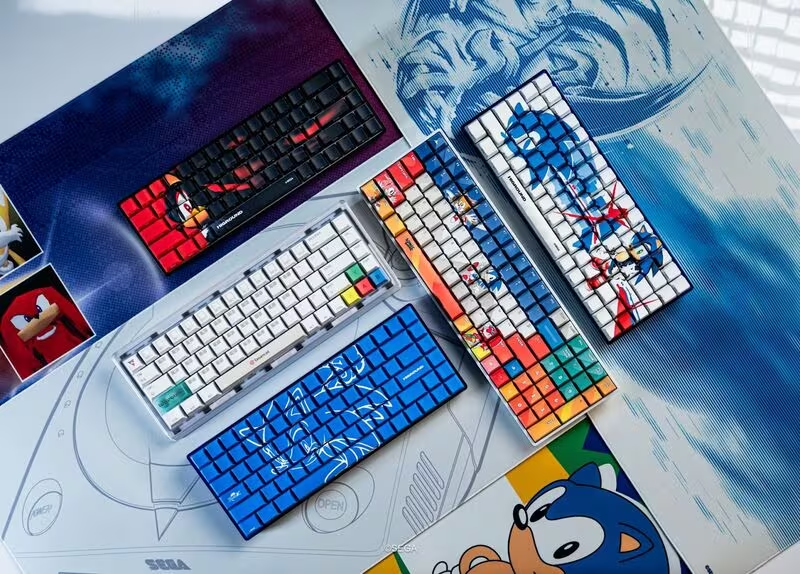
The ‘Summit 65+,’ presented in a Dreamcast-inspired design, features a CNC aluminum case, stainless steel back plate, and Higround’s ‘Dampening Plus’ five-layer system for a stable, quiet typing experience. The ‘Basecamp 65HE,’ influenced by the Radical Highway level, debuts Hall Effect technology for increased precision. Additional offerings—including the Classic Sonic–themed ‘Basecamp 96+,’ two ‘Basecamp 75+’ versions inspired by Escape from the City and Sonic CD, a Sonic CD keycap set, and four coordinated XL mousepads—further unify the collection’s nostalgic yet contemporary character.
Image Credit: Higround
Technology
How Miami’s Sports Culture Reflects the High-Energy Mindset Driving Today’s Tech Innovations – Five Reasons Sports Network

The Competitive Spirit That Powers Both Sports and Startups
Miami sports fans know that greatness comes from more than talent alone. Whether it’s the Heat grinding through a tight fourth quarter or the Dolphins executing a perfectly timed offensive scheme, winning requires discipline, fast thinking, and an unshakeable competitive spirit. Interestingly, these same qualities power the tech and startup world, where entrepreneurs make split-second decisions that can define the future of an entire business.
In both arenas, success belongs to those who can read momentum, adapt under pressure, and turn small opportunities into game-changing wins. That overlap is why so many sports-minded individuals naturally thrive in the world of business, innovation, and technology.
Why Analytics in Sports Fuel Smarter Business Thinking
Today’s sports landscape is driven by analytics—shot charts, win probability graphs, EPA metrics, and possession efficiency numbers are all part of modern fan knowledge. This analytical mindset doesn’t stop at the arena. Tech entrepreneurs, founders, and investors rely on the same data-driven thinking to navigate product decisions, market shifts, and competition.
This crossover is why the startup world attracts problem solvers shaped by sports culture. And platforms in the entertainment-tech space—such as Foxy gold casino—reflect this growing connection between digital innovation, predictive thinking, and user engagement.
Understanding Momentum: A Shared Advantage for Founders and Athletes
Momentum is everything. In sports, a single run, turnover, or three-pointer can change the energy in seconds. In business, momentum might be a viral post, a successful beta launch, or hitting a major funding milestone. Leaders in both fields understand how to recognize momentum and capitalize on it.
This parallels perfectly:
- Athletes ride hot streaks.
- Founders capitalize on traction.
- Sports teams adjust mid-play.
- Startups pivot product strategy just as quickly.
The ability to shift gears on the fly is one of the most important skills in sports and tech alike.
Building a Winning Strategy: What Startups Can Learn From Miami Sports
1. Scouting and Research Matter
Sports teams invest heavily in scouting reports and film studies. They evaluate:
- Opponent strengths
- Player tendencies
- Lineup matchups
- Efficiency ratings
Startups mirror this with market research, user interviews, competitive analysis, and data modeling. Knowing the landscape allows founders to execute smarter, faster, and with more confidence.
2. Team Culture Determines Long-Term Success
The Miami Heat built the “Heat Culture,” known for discipline, conditioning, and accountability. Startups adopting similar cultural principles see major benefits:
- Clear leadership and communication
- Defined expectations
- Continuous improvement
- Resilience under pressure
A strong culture is often the difference between a startup that scales—and one that collapses.
3. Adaptability Separates Winners From the Rest
Sports demand constant adjustments: defensive rotations, halftime strategies, and clutch-time decisions. Startups face equally rapid shifts:
- Market changes
- New competitors
- Shifting user demand
- Technological breakthroughs
Founders who adapt quickly, without losing their vision, stay competitive.
Table: Business Lessons Inspired by Miami’s Sports Playbook
| Miami Sports Principle | Startup Application | Tech/Innovation Impact |
| Heat Culture | Strong internal systems | Higher productivity & retention |
| Film study & analytics | Market and user research | Better decision-making |
| In-game adjustments | Product pivots | Faster adaptation to trends |
| Team chemistry | Cross-functional collaboration | Smoother product scaling |
| Game-winning mentality | Resilient leadership | Strong long-term growth |
How Miami’s Fast-Paced Environment Fuels Innovation
South Florida’s sports scene is known for energy, excitement, and bold plays. Coincidentally, Miami’s startup scene mirrors that same intensity. The city has quickly become a hub for fintech, AI, gaming, and digital entertainment. Entrepreneurs here are used to speed—speed of execution, iteration, and scaling.
A few reasons Miami is thriving in the innovation sector:
- Diverse global talent
- High investor interest
- Strong tech community backing
- Growing digital entertainment market
- Crossover influence from sports and media
Miami is one of the few cities where sports culture and startup culture genuinely feed each other.
Technology Is Changing the Game—On the Field and in the Office
Technology has reshaped sports with player-tracking systems, real-time analytics, and dynamic stat models. Meanwhile, tech startups use automation, AI-driven insights, and SaaS platforms to accelerate growth. Both industries depend on innovation to stay ahead.
Today’s fans and founders alike have access to tools such as:
- Predictive analytics
- Machine learning insights
- Automated reporting dashboards
- Real-time performance tracking
- Competitive intelligence platforms
This shared tech ecosystem keeps both sports teams and startups laser-focused on performance.
The Role of Mindset: What Makes Sports Fans Natural Innovators
Sports fans understand pressure. They analyze plays, debate strategies, track performance trends, and anticipate outcomes. These instincts make them naturally suited for entrepreneurship and tech leadership.
Key mindset overlaps include:
- Confidence under pressure
- Long-term thinking
- Understanding risk and reward
- Embracing competition
- Continuous improvement
Sports create thinkers who thrive in fast-paced, unpredictable environments—the exact conditions startups face daily.
Why the Connection Between Sports and Startups Keeps Growing
Sports influence is everywhere—from data modeling to team culture to leadership strategy. At the same time, tech continues to elevate sports through analytics, digital enhancements, and real-time engagement tools. The crossover strengthens every year, especially in vibrant markets like Miami.
As both industries push forward, one thing remains true: the mindset that wins games is the same mindset that builds the next big company. Athletes, analysts, fans, and founders all share a core advantage—a competitive drive, sharpened by strategy, that fuels consistent growth.

Lakeview Academy in Gainesville recently unveiled its newly renovated Innovation and Technology Wing.
The learning environment is designed to inspire creativity, collaboration, and hands-on problem-solving.
“The expanded robotics and esports facilities give our students room to imagine bigger and build bolder,” Technology Director Mikhail Lovell, said. “With advanced tools like industrial laser cutters and high-performance 3D printers, they can design and create with a level of precision and freedom that we couldn’t offer before. This renovation strengthens the programs our students already love while opening the door to new opportunities for innovation, growth, and achievement.”
School officials said the renovation was made possible through Lakeview donors and community partners who share in the school’s mission to cultivate curiosity, excellence, and forward-thinking leadership.
“This renovation represents more than just new facilities,” John Simpson, Head of School at Lakeview Academy, said. “It is an investment in our students’ future and a reflection of Lakeview’s vision to provide a learning environment that mirrors the innovation and collaboration found in today’s leading industries.”

The Game Awards 2025 concluded on December 11 in Los Angeles, celebrating a standout year in gaming. The ceremony unveiled the full All Winners List across major categories, including Game of the Year, Best Art Direction, Best Narrative, and more. Fans tuned in worldwide to see whether Clair Obscur Expedition 33, Death Stranding 2 On the Beach, or Donkey Kong Bananza would claim top honors.
This year delivered an unusually competitive field. Nearly every major genre saw multiple critically acclaimed releases. The All Winners List highlights how diverse the gaming landscape has become, rewarding innovation, storytelling, performance, and design. Below is the complete breakdown of winners as confirmed during the live show.
Full All Winners List for The Game Awards 2025
The Game Awards recognized excellence across more than 30 categories. The All Winners List below reflects the official results announced during the broadcast. These selections were made through a combination of jury voting and fan participation. Trusted outlets such as Reuters and AP covered the event throughout the week, citing its global impact on the entertainment industry.
The ceremony featured wins for established franchises, emerging studios, and standout indie titles. Clair Obscur Expedition 33 dominated several major categories, cementing its status as one of the year’s most influential releases. Death Stranding 2 On the Beach and Hollow Knight Silksong also secured notable wins across art, music, and direction.

The winners list includes categories such as:
- Game of the Year
- Player’s Voice
- Best Game Direction
- Best Adaptation
- Best Narrative
- Best Art Direction
- Best Score and Music
- Best Audio Design
- Best Performance
- Innovation in Accessibility
- Games for Impact
- Best Ongoing Game
- Best Community Support
- Best Independent Game
- Best Debut Indie Game
- Best Mobile Game
- Best VR/AR Game
- Best Action Game
- Best Action/Adventure Game
- Best RPG
- Best Fighting Game
- Best Family Game
- Best Sim/Strategy Game
- Best Sports/Racing Game
- Best Multiplayer Game
- Most Anticipated Game
- Content Creator of the Year
- Best Esports Game
- Best Esports Athlete
- Best Esports Team
Each winner reflects the shifting trends of interactive entertainment. Publishers invested heavily in cinematic storytelling, AI-driven mechanics, and world-building. Indie studios saw renewed recognition, demonstrating how smaller teams continue to push creative boundaries.
How the 2025 All Winners List Shapes the Industry
The impact of the All Winners List extends far beyond the ceremony. Industry analysts note that Game Awards recognition often boosts sales, renews franchise momentum, and influences publisher strategies for the following year. Reuters reported that award-winning titles typically experience a significant rise in global downloads after the show’s conclusion.
For indie creators, nominations and wins can accelerate distribution partnerships and platform support. For major studios, standout wins in categories such as Game Direction or Narrative reinforce creative leadership and help guide long-term development pipelines.
The All Winners List also redirects attention toward emerging technologies showcased in nominated titles. VR advancements, accessibility innovations, and audio engineering breakthroughs from this year’s winners are expected to shape next-generation game design approaches.
The Game Awards 2025 All Winners List underscores how far the medium has evolved. It highlights a year defined by risk-taking, creativity, and boundary-pushing design. Fans now look ahead to 2026 as studios aim to build on the momentum created by this remarkable lineup of winners.
FYI (keeping you in the loop)-
Q1: What is included in The Game Awards 2025 All Winners List?
The list includes winners across more than 30 categories, covering major genres and industry achievements. Categories range from Game of the Year to Best Esports Team.
Q2: Which game won the most awards in 2025?
Clair Obscur Expedition 33 earned multiple major category wins, reflecting strong critical and fan support.
Q3: Why is The Game Awards All Winners List important?
The list influences sales trends, industry recognition, and future project investment decisions. It sets expectations for upcoming releases.
Q4: How are winners selected for The Game Awards?
A combined jury and public voting system determines winners. Both professional critics and global players contribute.
Q5: Does winning an award impact game development studios?
Recognition often leads to increased funding, hiring, and platform visibility. It can also validate creative direction for future titles.
iNews covers the latest and most impactful stories across
entertainment,
business,
sports,
politics, and
technology,
from AI breakthroughs to major global developments. Stay updated with the trends shaping our world. For news tips, editorial feedback, or professional inquiries, please email us at
[email protected].
Get the latest news and Breaking News first by following us on
Google News,
Twitter,
Facebook,
Telegram
, and subscribe to our
YouTube channel.


Gaming PC Market is witnessing rapid expansion as gaming evolves into one of the largest and most impactful segments of the digital entertainment industry. According to Market Research Future (MRFR), the Gaming PC Market Size was valued at USD 46.98 billion in 2024. The Gaming PC industry is projected to grow from USD 50.41 billion in 2025 to USD 101.9 billion by 2035, exhibiting a strong and consistent compound annual growth rate (CAGR) of 7.29% during the forecast period from 2025 to 2035.
The rise of high-performance gaming hardware, increasing popularity of competitive gaming, and strong global demand for immersive entertainment experiences are major factors supporting market growth. Gaming PCs are now central to professional eSports, casual gaming, and content creation, making the industry a key driver of technological innovation.
Market Drivers Fueling the Growth of the Gaming PC Market
One of the primary drivers accelerating the Gaming PC Market is the explosive rise of the global eSports ecosystem. Millions of players participate in online competitions, and large-scale tournaments attract global audiences. Professional gamers demand high-performance PCs capable of delivering maximum responsiveness, minimal lag, and high frame rates, directly boosting the need for advanced gaming systems.
Another critical driver is rapid GPU and CPU innovation. Leading hardware manufacturers continue to develop powerful processors and graphics cards equipped with next-generation capabilities such as ray tracing, AI-enhanced rendering, and ultra-fast clock speeds. These innovations significantly elevate gaming experiences and motivate both casual gamers and professionals to upgrade their systems.
The increasing popularity of open-world, high-resolution, and graphically demanding games is further boosting Gaming PC adoption. Modern titles require advanced hardware to support realistic visuals and immersive gameplay, pushing consumers toward high-end gaming PCs.
The rise of game streaming and content creation is also contributing to market expansion. Platforms such as Twitch, YouTube Gaming, and Facebook Gaming are encouraging gamers to produce high-quality content. This requires powerful systems that support streaming, recording, editing, and gameplay simultaneously.
Customization and personalization trends are shaping consumer behavior as well. Gamers increasingly prefer custom-built PCs with RGB lighting, advanced cooling solutions, and modular components. This trend is creating new opportunities for manufacturers, retailers, and PC assembly services globally.
Get An Exclusive Sample of the Research Report at – https://www.marketresearchfuture.com/sample_request/26477
Key Market Trends Shaping the Gaming PC Market
The Gaming PC Market is being reshaped by a number of powerful trends. One of the most significant is the integration of artificial intelligence into gaming hardware. AI-driven optimization tools help maximize performance, regulate cooling, enhance frame rates, and adjust settings in real time.
Another major trend is the growing dominance of high-performance gaming laptops. With advancements in thermal engineering and GPU performance, gaming laptops now offer nearly desktop-level power. This trend supports gamers who value flexibility and portability without sacrificing performance.
High-refresh-rate monitors are becoming standard among gamers. Demand for 144Hz, 240Hz, and even 360Hz displays is rising as gamers seek smoother animation and higher responsiveness, driving the need for PCs capable of supporting these advanced displays.
Liquid cooling systems are also gaining popularity. As gaming hardware becomes more powerful, maintaining safe temperatures is essential. Gamers increasingly adopt closed-loop and custom-loop liquid cooling systems to ensure long-term stability and performance.
Sustainable and energy-efficient gaming solutions are emerging as a new trend. Manufacturers are focusing on recyclable components, environmentally friendly production processes, and energy-efficient power supplies. This aligns with global sustainability awareness and appeals to environmentally conscious gamers.
Buy Now Immediate Delivery Available at – https://www.marketresearchfuture.com/checkout?currency=one_user-USD&report_id=26477
Regional Analysis of the Gaming PC Market
North America currently dominates the Gaming PC Market, supported by a large base of professional gamers, robust digital infrastructure, and widespread adoption of high-performance gaming systems. The United States remains a global leader in gaming hardware development and eSports investment.
Europe holds a significant share of the market as well. Countries such as Germany, France, and the United Kingdom have strong gaming cultures, extensive PC gaming communities, and widespread interest in competitive gaming. Government recognition of eSports as an official sport in certain regions has further strengthened market demand.
The Asia-Pacific region is poised for the highest growth rate during the forecast period. Nations such as China, South Korea, Japan, and India are expanding rapidly in the gaming ecosystem. China leads the region with millions of active gamers and strong investment in gaming arenas, esports stadiums, and internet cafés. South Korea remains a global pioneer in professional gaming and eSports.
Latin America is also witnessing rising Gaming PC adoption. Countries such as Brazil, Mexico, and Argentina are experiencing increasing interest in professional gaming and streaming, supported by improved internet connectivity and the establishment of local gaming events.
In the Middle East and Africa, gaming is expanding as younger populations adopt digital entertainment. Countries such as the UAE and Saudi Arabia are investing heavily in eSports infrastructure, creating new opportunities for Gaming PC manufacturers.
Challenges and Constraints in the Gaming PC Market
Despite strong growth potential, the Gaming PC Market faces several challenges. One major constraint is the high cost of components such as GPUs, CPUs, and high-performance RAM. Price fluctuations and supply shortages often discourage consumers from purchasing or upgrading gaming PCs.
Another challenge is the global supply chain volatility that affects semiconductor manufacturing. Limited chip availability during periods of high demand can delay product releases and reduce availability in key markets.
Energy consumption and heat generation are significant constraints as well. High-performance systems require efficient cooling solutions, and inadequate thermal management can impact performance and hardware longevity.
The rapid pace of technological change can also be a barrier for consumers. Frequent hardware upgrades may be required to support the latest games, making ownership costly for budget-conscious gamers.
Cybersecurity concerns surrounding online gaming and digital downloads pose additional challenges. Gamers are at risk of malware attacks, hacking, and data breaches, making security software an essential component of gaming setups.
Opportunities Driving Future Growth of the Gaming PC Market
Despite challenges, the Gaming PC Market offers vast opportunities. The expansion of VR and AR gaming is creating strong demand for powerful gaming PCs capable of supporting immersive experiences. As VR titles grow more sophisticated, hardware requirements will increase, benefiting the Gaming PC industry.
Cloud-connected gaming PCs present another major opportunity. Hybrid gaming systems that combine traditional hardware with cloud-based rendering can enhance performance and enable cost-effective upgrades.
The rise of gaming-focused social platforms is opening opportunities for PC manufacturers and accessories companies. Integrated ecosystems that support gaming, streaming, editing, and social interaction are becoming increasingly popular.
Emerging markets present strong potential for future expansion. Countries in Southeast Asia, the Middle East, Eastern Europe, and Africa are witnessing fast-growing gaming communities and rising disposable incomes, driving demand for affordable gaming PCs.
The growing support for STEM education and gaming-related careers such as game development, animation, and broadcasting is also fueling market demand. Students and professionals require powerful machines that deliver both gaming and productivity performance.
Explore the In-Depth Report Overview – https://www.marketresearchfuture.com/reports/gaming-pc-market-26477
The Gaming PC Market is set for robust expansion as global demand for high-performance gaming systems continues to rise. With a projected CAGR of 7.29% through 2035, the industry will benefit from technological innovation, eSports growth, immersive gaming trends, and rising participation in global gaming communities. Gaming PCs are becoming more advanced, more customizable, and more accessible, making them essential tools for gamers, streamers, content creators, and digital professionals alike. As hardware manufacturers push boundaries and gaming culture expands worldwide, the Gaming PC Market will remain a powerful driver of digital entertainment and global technological development.
About Market Research Future:
At Market Research Future (MRFR), we enable our customers to unravel the complexity of various industries through our Cooked Research Report (CRR), Half-Cooked Research Reports (HCRR), Raw Research Reports (3R), Continuous-Feed Research (CFR), and Market Research & Consulting Services.
MRFR team have supreme objective to provide the optimum quality market research and intelligence services to our clients. Our market research studies by products, services, technologies, applications, end users, and market players for global, regional, and country level market segments, enable our clients to see more, know more, and do more, which help to answer all their most important questions.
Contact Us:
Market Research Future (Part of Wantstats Research and Media Private Limited)
99 Hudson Street, 5Th Floor
New York, NY 10013
United States of America
+1 628 258 0071 (US)
+44 2035 002 764 (UK)
Email: sales@marketresearchfuture.com
Website: https://www.marketresearchfuture.com
This release was published on openPR.

A mobile-class processor powers the unit and includes 16 GB of RAM and up to 1 TB of internal storage. A dual-fan assembly and heat pipe design provide cooling. Battery capacity supports several hours of sustained gameplay, depending on the title and settings. Wireless connectivity includes Wi-Fi 6 and Bluetooth 5.2.
Image Credit: AYANEO

Dale Earnhardt Jr. made feelings clear on NASCAR charters before trial – Motorsport – Sports

Banking on youth, sports to turn villages around

CNN points out ‘cultural problems’ at historic college football program
Creighton vs. Kentucky volleyball: Elite Eight scores, highlights

FIA, Formula 1 and 11 F1 teams sign 9th Concorde Agreement

NASCAR Antitrust Fight Ends With Major Changes to Cup Series Charters

Youngstown little league team wins Pop Warner Super Bowl championship

The Greatest Gift is a Safe Gift

Dale Earnhardt Jr. ‘surprised’ NASCAR was threatened by SRX

A reverse-sweep comeback over Louisville pushes Texas A&M volleyball to third-ever Elite Eight

Witness describes panic, parents shielding children

Retro Cartoon Tech Accessories : Higround x SEGA

Buffs football’s pursuit of ‘powerhouse’ status is unrealistic

Summit Racing Equipment | Error 410: Resource Gone

Gonzaga Volleyball signs Lydia Fisher

First Tee Winter Registration is open

Fargo girl, 13, dies after collapsing during school basketball game – Grand Forks Herald

CPG Brands Like Allegra Are Betting on F1 for the First Time

Volleyball Recaps – November 18

F1 Las Vegas: Verstappen win, Norris and Piastri DQ tighten 2025 title fight

Two Pro Volleyball Leagues Serve Up Plans for Minnesota Teams

Utah State Announces 2025-26 Indoor Track & Field Schedule

Sycamores unveil 2026 track and field schedule

Jo Shimoda Undergoes Back Surgery

Redemption Means First Pro Stock World Championship for Dallas Glenn

Texas volleyball vs Kentucky game score: Live SEC tournament updates

Robert “Bobby” Lewis Hardin, 56

How this startup (and a KC sports icon) turned young players into card-carrying legends overnight

Bowl Projections: ESPN predicts 12-team College Football Playoff bracket, full bowl slate after Week 14

Indiana’s rapid ascent and its impact across college football

 NBA Legend Michael Jordan to Join NBC Sports as Special Contributor
 Why a rising mid-major power with an NCAA Tournament team opted out of revenue-sharing — and advertised it
 Falcons mailbag
 Portal Update – Basketball and Gymnastics Take Hits
 has always dreamed in Mercurial. Now his initials are on the boots.
The new Kyl…
has always dreamed in Mercurial. Now his initials are on the boots.
The new Kyl…
-
 Rec Sports3 weeks ago
First Tee Winter Registration is open
-
 Rec Sports2 weeks ago
Fargo girl, 13, dies after collapsing during school basketball game – Grand Forks Herald
-
 Motorsports3 weeks ago
CPG Brands Like Allegra Are Betting on F1 for the First Time
-
 Motorsports3 weeks ago
F1 Las Vegas: Verstappen win, Norris and Piastri DQ tighten 2025 title fight
-
 Sports3 weeks ago
Two Pro Volleyball Leagues Serve Up Plans for Minnesota Teams
-
 Sports3 weeks ago
Utah State Announces 2025-26 Indoor Track & Field Schedule
-
 Sports3 weeks ago
Sycamores unveil 2026 track and field schedule
-
 Motorsports2 weeks ago
Jo Shimoda Undergoes Back Surgery
-
 Motorsports2 weeks ago
Redemption Means First Pro Stock World Championship for Dallas Glenn
-
 Sports3 weeks ago
Texas volleyball vs Kentucky game score: Live SEC tournament updates