
Podcast
How Ben Tenzer ascended from chauffeuring star athletes to the top of Nuggets' front office


Ben Tenzer spent enough hours at his friend’s house for it to qualify as a second residence by high school. When he would eventually return to his actual home, his parents would ask how his day was. The replies always kept them on their toes.
“Oh, it was fun,” Tenzer would say, as his dad, David, remembers the exchanges usually going. “I hung out with Jason Giambi.”
Tenzer’s classmate and close friend was Michael Tellem, the oldest son of NBA and MLB super-agent Arn Tellem. To the clientele regularly hanging around Tellem’s Los Angeles home, Tenzer was practically indistinguishable from the agent’s own children. “Ben grew up in our house,” Tellem said this week. “He’s like a fourth son to me.”
From running in the same circles as his favorite athletes as an awestruck teenager, to running errands as a student intern for the Nuggets, Tenzer’s rise to the top of Denver’s front office required years of observation, osmosis and eagerness to tackle any task. His promotion this week was a culmination, as he was named executive vice president of basketball operations by the Kroenke family. He and Jon Wallace have been handed the keys to Nikola Jokic’s 30s, which could be the most pivotal stretch in franchise history.
“He worked extremely hard to get where he is,” former Nuggets general manager and current Bulls executive Arturas Karnisovas said. “There’s never a job too small. I think it’s important to go through most of those (front office) positions and know exactly what each position requires, as you’re climbing up the ladder. Ben knows exactly what those positions demand.”
Tenzer’s unique surroundings in Los Angeles proved formative to his principles, even if he didn’t recognize it in real time. The middle child in his family, he was often upbeat but inherently quieter than his older brother. Puzzles and math came naturally to him, maybe more so than leading a conversation at first. “He kept his mouth shut and his eyes and ears open,” his mom, Debbie, said. “That has been a good thing for him his entire life.”
Tenzer’s dad worked adjacent to the entertainment business, representing writers, directors, producers and actors for CAA with an ethos he tried to pass along to his children: “Let other people have the spotlight. It’s about your client.” Needless to say, Ben already had a rudimentary grasp of the agent business when he started spending time with the Tellems.
The entire sports world seemed to function out of their house. It was an energizing space for an adolescent boy to float through. MVPs and top prospects wandered in and out. Hall of Fame guard and Lakers executive Jerry West often brought his children over while he talked business with Arn. Basketball players lived in the house for weeks at a time while preparing for the draft. Tenzer and the Tellem sons ate dinner with them. Kobe Bryant attended Michael’s bar mitzvah.
“He was there for all the discussions,” Arn said. “The tough ones. He was listening in on free-agent discussions, draft pick discussions, hearing me talk to teams. They would all sit there as I would work the phones. … They were there for every blow-by-blow.”
Tenzer’s favorite encounter was always Giambi. Too height-challenged to excel at basketball, he dedicated most of his youth sports career to baseball. The Oakland Athletics were Tenzer’s favorite team, and Giambi was their star slugger while he was in high school — a left-handed batting first baseman, just like Tenzer. Tellem was Giambi’s agent. “I actually got to hang out with him several times,” Tenzer reminisced. “That was probably the coolest. He was my favorite baseball player.”
It wasn’t all fun and games. Tenzer’s interest in Arn’s profession morphed into a recurring summer internship. Statistical research was part of the job, but it also involved a fair share of seemingly menial chores. Tenzer drove Derrick Rose to a commercial shoot. He dropped off a product box at Russell Westbrook’s apartment.
“(Tellem) put Ben and Michael and all those kids to work every summer,” Debbie Tenzer said. “No laziness. They would do anything just to be around the athletes.”
“They would help out at the gym,” Tellem said. “They would do errands for the players. … Sometimes they would have to pick up food late at night for them. All kinds of personal things. Anything the player needed, they were there for.”
Tenzer happily welcomed the assignments. It was later in his career that he understood how educational those were. Choosing to major in business at CU Boulder, he added more internships to his resume before and during college — first at MTV, where he assisted a TV show producer, then in Denver, where Tellem helped connect him with the Nuggets’ front office.
A business school administrator at CU told Tenzer that he needed to intern in a real industry, such as real estate or insurance, Tenzer’s mom remembers. Sports didn’t qualify, apparently. But Tenzer was hooked. He made the 40-minute drive from Boulder to Denver twice a week and paid his dues, often dropping off or picking up players from the airport (another exhausting drive away from downtown).
“I felt comfortable coming in here as an intern, just knowing how to feel out situations. Staying out of the way, or interacting with the players in little quiet ways,” Tenzer said. “I feel like I got experience from Arn’s house, being around all the clients, getting to just be comfortable with them. We’d go pick up the players after a workout (in Los Angeles). Did he have a bad workout? Do you not speak (on the drive), then? I think you learn how to really deal with the players. That was more valuable than I ever realized, actually. Because then you’re here, and you’re like, I get it. You’ve got to feel out how to not stand out, I think.”
Tenzer also sought ways to apply his knack for numbers. He’d always been a fan of Michael Lewis’s book “Moneyball,” a baseball analytics sensation that chronicled the Oakland A’s and was published the year Tenzer graduated high school (2003). In the world of NBA team-building, he decided it was essential to learn and master the salary cap. He attended Southwestern Law School in Los Angeles after graduating from Colorado, honing his skills in sports law while continuing to work jobs in the basketball community, including one for the NBA Summer League.
“When he explained to me the intricacies of the salary cap, I thought, ‘My god, this is like being a sophisticated tax attorney or something,’” David Tenzer said. “It’s that complicated.”
Then Ben returned to Stan and Josh Kroenke’s front office in 2013. (“He’s madly in love with Denver,” his mom said.) Tim Connelly was the general manager. Karnisovas was the assistant GM. Tenzer was regarded as a steady hand behind the scenes, providing his new financial expertise with a friendly demeanor. Karnisovas recalls being holed up in Connelly’s Las Vegas hotel room during Summer League once, laptops splayed out on the floor, while the three of them went through trade scenarios.
Those memories of grueling work nights have aged well for him. It helped that Tenzer was enjoyable to be around.
“I still think that Ben’s wedding was the best wedding that I’ve ever been part of, in Aspen,” Karnisovas said. “His interactions and relationships are probably a very valuable trait.”
“He doesn’t hold onto anything negative. He just likes people,” Tenzer’s mom said. “He’s very open that way. He doesn’t have any kind of grudges.”
Questions of inexperience loom over the beginning of Tenzer’s tenure alongside Wallace. No public evidence has accrued yet as to his capability as an NBA general manager. His negotiating tact. His breadth of relationships. His tactical basketball acumen.
The reason his past colleagues and mentors believe in him, despite his reputation as a numbers guy, is ultimately the relationship-building factor.
He swiftly left his mark in Grand Rapids, Mich., where he was general manager of the Nuggets’ G League affiliate for the last two years (in addition to his front office duties in Denver). Grand Rapids Gold president and founder Steve Jbara watched Tenzer adopt a hands-on approach, addressing players collectively at pregame shootarounds to emphasize the traits he wanted to see from Denver’s pipeline.
“With how good the Nuggets are, Ben’s message to the team was about, ‘Do we need scoring right now? No. Do we need bigs to score right now? No.’ We need freaking culture guys, and we need defense, and we need you to be a piece,” Jbara said. “A lot of guys come down to the G League and they think they need to score 45 points a game to get noticed. … When he’s there, he’s in the locker room. He’s really, really strong at communicating.”
Back in Denver, Tenzer was determined to make sure every person in the Nuggets organization owned a piece of Grand Rapids merch. He beamed the day he learned two-way player Trey Alexander had won G League Rookie of the Year in April. As Jbara saw it, the Gold was more than an irksome side gig to Tenzer; it was a passion project.
But then again, so was chauffeuring draft prospects around Los Angeles as a teenager.
“When I think of him, I think of him sitting at our kitchen table with his big smile,” Tellem said. “Asking questions, loving to hear the stories and listening with his eyes wide open. … It’s really so profoundly emotional to see him succeeding.”
Want more Nuggets news? Sign up for the Nuggets Insider to get all our NBA analysis.



As the clock wound down in a recent contest, the Golden State Valkyries’ Veronica Burton and Kaila Charles swarmed Paige Bueckers on the perimeter to deny the Dallas Wings rookie from even getting off a shot. The 3.2 remaining seconds ticked away, and the ball remained in Bueckers’ hands as the buzzer sounded.
Advertisement
That type of attention has become common for Bueckers in her debut WNBA season, especially as the firepower in the Wings rotation has thinned because of injury — eight of 12 players on the opening-night roster have missed seven or more games — putting more offensive burden on her. Bueckers has also proven increasingly capable of dissecting single coverage and has demanded star-level defense.
“She lets the game come to her, and she takes what the defense is giving her all over the floor,” Wings coach Chris Koclanes said. “She doesn’t get sped up, and it’s really impressive for a rookie in this league to be able to maintain her own speed and tempo.”
But the game was already in hand when the Valkyries corralled Bueckers at the 3-point line. Golden State led by nine and the heightened defense wasn’t because the game was in balance; it was because Bueckers needed one more point to reach double digits, as she had done in every prior game of her rookie year.
With Dallas long since removed from postseason contention and playing out the string over the second half of the season, these are the stakes for Bueckers. She hasn’t been put in position to chase wins; she can only pursue individual accolades while the Wings build for the future. Nevertheless, despite a constantly changing supporting cast, Bueckers has thrived, putting herself in conversation for one of the best debuts in league history.
Bueckers has been the leading rookie scorer every month of the 2025 season, and her average of 18.9 points is seventh in WNBA history among rookies. With three games left, a late surge could move Bueckers past her teammate Arike Ogunbowale, who is sixth on the list at 19.1.
Paige Bueckers in August:
🪽 20.3 PPG | 3.7 RPG | 5.0 APG
🪽 44-point performance: highest by any W player this season
🪽 @Kia Rookie of the Month#KiaROTM | #WelcometotheW pic.twitter.com/Cx09czcFhi— WNBA (@WNBA) September 3, 2025
As was the case during her college career that culminated in a national championship at UConn, Bueckers has been efficient in the process of scoring at a high volume. Among rookies who have averaged at least 17 points per game, Bueckers is sixth in field-goal percentage at 46.7. The only two guards in front of her are Chennedy Carter, whose first season came in the friendly offensive environment of the WNBA bubble, and Cynthia Cooper-Dyke, who was a 34-year-old rookie during the league’s inaugural season.
Bueckers has been an elite playmaker as well. She is on pace to finish the season as one of 12 rookies to ever average five assists per game, and one of two to pair that with 15 points, joining Indiana Fever star Caitlin Clark.
Advertisement
Clark became the standard-bearer for rookie guards during her historic 2024 season, and her production is the only realistic point of comparison for Bueckers. Sue Bird and Diana Taurasi were also first-year All-Stars, but neither displayed the same combination of elite scoring and creation as Clark and Bueckers. The new generation of rookies has the advantage of playing in a more offensive-minded league. Still, their numbers relative to the rest of the league stand out.
The last two No. 1 picks both delivered individual historic moments. Bueckers tied a rookie record last month with 44 points against the Los Angeles Sparks, on a night when she started alongside two players who were signed midseason to hardship contracts. Clark set the single-game assist record of 19 about midway through last season.
But Bueckers trails Clark in most of the counting stats: 18.9 to 19.2 in points, 3.7 to 5.7 in rebounds, and 5.3 to 8.4 in assists. Other than points, those differences cannot be explained by the extra two minutes Clark averaged as a rookie. The major advantage Bueckers possesses is in turnovers, where her 2.1 per game is significantly better than Clark’s 2.8.
Bueckers has a better overall field-goal percentage, but since so many of Clark’s shots came from 3-point range, the Fever guard’s effective field-goal percentage (which weights the point value of each field goal) of 52.2 percent bests Bueckers’ mark of 50.4. Clark also shot better from 3-point range (34.4 percent to 33 percent) despite attempting them three times as frequently.
Those box-score numbers don’t fully account for the surrounding situation of each rookie. Clark’s assists, for example, were easier to come by with All-Star Aliyah Boston in the middle of the floor; the 2023 No. 1 pick was the recipient of 105 of Clark’s helpers, or 2.6 per game. Both Clark and Bueckers had an All-Star guard sharing the backcourt in Kelsey Mitchell and Ogunbowale and a relatively similar level of talent on the rest of the roster, at least to start the season, but Dallas didn’t have anyone resembling Boston.
Another feat for PB5 🙌
Paige Bueckers joins Caitlin Clark as the second rookie in WNBA history to record 500+ PTS, 150+ AST, 100+ REB, and 50+ STL in a season. #WelcometotheW pic.twitter.com/G1rooMRgLo
— WNBA (@WNBA) August 23, 2025
Although Bueckers had a worse net rating than Clark (minus-5.0 compared to minus-2.4), her on-off differential has been better in her rookie season. The Wings are 8.1 points per 100 possessions better with Bueckers on the court, demonstrating her impact, even if it hasn’t translated to victories. Win shares favor Bueckers as well, and she can build on her 3.5-3.0 lead in the final three games.
Advertisement
However one chooses to assess the statistical impact of Bueckers and Clark in their first years, there is one point of comparison that works in Clark’s favor. Bueckers’ production has come in the context of a largely meaningless season, as Dallas hasn’t even spent one day in playoff position. Clark and the Fever, on the other hand, rallied from a 2-9 start to pursue a postseason berth.
That is the next frontier for Bueckers: not be a spoiler, but to play in games of real consequence. Clark’s rookie season ended with a big chasing her on the perimeter as she launched a 3-pointer because a playoff win was on the line. Bueckers’ rookie season could be lost to history if Dallas doesn’t put her in that position sooner than later.
(Photo of Paige Bueckers: Ron Jenkins / Getty Images)
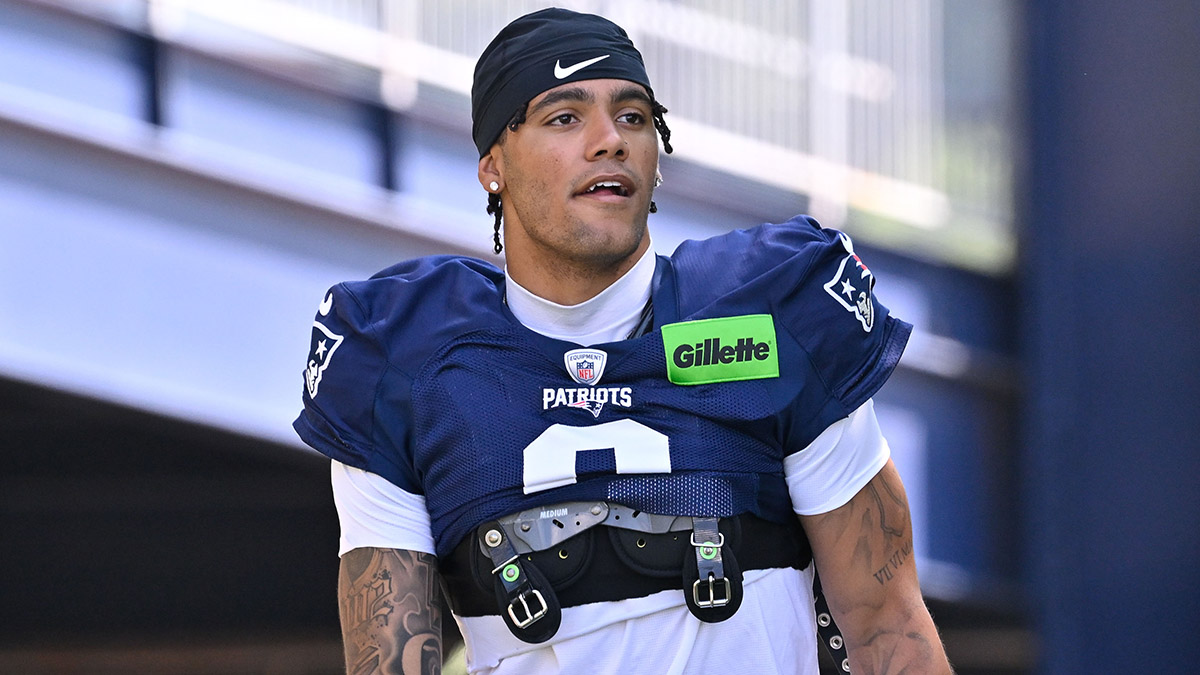
FOXBORO — Christian Gonzalez quietly folded and put away some of the clothing in his locker at Gillette Stadium.
While his Patriots teammates prepared for a fully-padded practice just four days before their season opener, the third-year corner did not. He understood the plan for him on Wednesday was to do some conditioning work on the side and not much more.
“I’m working,” he said softly.
Gonzalez is inarguably his team’s best player. He was named a Second-Team All-Pro last season after routinely matching up with and shutting down opposing No. 1 receivers. He was expected to be one of the linchpins of Mike Vrabel’s defense in 2025, allowing for extensive man-to-man looks and aggressive calls for pressure because of his lock-down coverage skills.
But after Gonzalez missed Wednesday’s practice, his status for Sunday’s game is in doubt, despite Vrabel not ruling him out. Gonzalez hasn’t practiced since injuring his hamstring on July 28.
“He’s continuing to work,” Vrabel said prior to the practice, “and he’ll do some stuff on the side, but I’m not going to rule anybody out. … We’ll continue to work and treat and make sure that we’re doing everything that we can to help him, and he’s doing everything he can to get back out on the field. That’s the only update I have right now.”
Gonzalez rode a stationary air bike on the upper fields behind Gillette Stadium while his teammates practiced on the lower field. He pedaled under the watchful eye of assistant strength and conditioning coach Brian McDonough before pausing and watching the action on the fields below.
“I mean, I do like where he’s at from an engagement standpoint,” Vrabel said. “We’ve been through this with other players, and I like where he’s at from that standpoint. In the meetings, locked in, following along at practice, which is difficult. To think that a player that’s not in there can follow along, I’ve been through that as a player and a coach, and I think he’s done a nice job of being able to do that.”
While Vrabel surely would like to have Gonzalez for Week 1 against a Raiders offense that features second-year standout tight end Brock Bowers and former Patriots wideout Jakobi Meyers, he didn’t indicate that he would be rushing Gonzalez back onto the field, either.
When asked if it was important for him to allow players to get back to “100 percent” before returning to the field, Vrabel shed some light on his thought process.
“I mean, I don’t use percentages,” Vrabel said, “but, again, I’ll remind you what we talked about as far as, when I try to make decisions about players and returning, one, can they make it worse? Can they, two, protect themselves?
“We can all say what we want about this game, but it’s violent, and can you protect yourself? And can you do your job up to the standard that we expect and that the player is used to? So, those are the things that I’ve tried to use when making decisions. Maybe I’ll add some to that, but that’s what I’ve tried to use in my other experience in this position.”



- Loading stock data…


Andy Roddick’s journey back to tennis began during the COVID-19 pandemic, when Tennis Channel asked him to remotely appear on studio programming while the sports world was shut down.
“I didn’t really play. I would come [to the U.S. Open] to do corporate work once a year, and that was it,” Roddick recently told Sports Business Journal. “Tennis Channel was great because I could do it from home. My one thing was, I never wanted the game to control my geography ever again.”
Five years later — and 13 after announcing his retirement from play on his 30th birthday — Roddick has established a pillar of the tennis media ecosystem on his own terms with his “Served” podcast.
Launched in January 2024 with veteran producer Mike Hayden and journalist Jon Wertheim, the show began with ambitions as simple as “a fun side project that I thought no one would listen to,” in Roddick’s words. But since its debut, the show has garnered more than 150,000 YouTube subscribers, 185,000 social media followers and 3.5 million audio downloads while attracting marquee sponsors such as Amazon Prime (2025 French Open, U.S. Open), Mercury Financial (2025 Wimbledon) and ServiceNow (live shows at the upcoming Laver Cup) for events. It also joined Vox Media’s network of sports podcasts last year.
As it’s grown, “Served” has earned bona fides with tennis diehards for long-form interviews with Rafael Nadal and Andre Agassi; laid-back but incisive analysis of tennis’ entire calendar of events (not just the Grand Slams); and the versatility to dig deep into topics such as, in an early sitdown with longtime IMG Tennis agent/executive Max Eisenbud, the economics of tennis player development.
“What makes him special, specific to his podcast, is his ability to transcend the deep tennis insiders, but also the casual tennis fans,” said Eric Butorac, a former doubles player on the ATP Tour and the USTA’s senior director of player relations and business development.
“He’s [Roddick] exactly like he was on tour. You walk into the locker room, and you just hope he’s sitting there, because he’s going to be jabbering away, super engaged, super competitive. … It’s the same way when I turn on ‘Served.’”
Served Media — the media company atop “Served” co-founded by Roddick and Hayden — is now a seven-figure revenue business. Since the debut of its eponymous podcast, it has launched a women’s tennis-focused show hosted by Kim Clijsters, daily recap program hosted by Hayden, active social and newsletter channels, and a merchandise line, with yet-to-be disclosed plans for further content expansion.
“We thought there would be a lane for it for, like, super nerds,” Roddick said. “But I don’t know that we thought it would grow like this.”


RALEIGH, N.C. — NC State needed a fourth-down stop in the red zone to survive, but came away with a 24-17 win over ECU to start the season. The Wolfpack (1-0) finished with 423 total yards behind CJ Bailey’s 318 yards passing with one touchdown through the air and one on the ground.
Cory Smith and Michael Clark share their thoughts after the game, including Bailey’s performance, Wesley Grimes’ career night, Hollywood Smothers’ solid outing, and the defense’s up-and-down night. Get all of that and more on the latest Postgame Podcast.
CLICK HERE TO TRY THE 75% OFF TRIAL TODAY!
Listen to the full podcast below and subscribe on iTunes, the Google Play Store or find us on Spotify by searching for “Pack Pride Podcast” under the podcasts section.
Not a VIP subscriber to Pack Pride? Sign up now to get access to everything R. Cory Smith, Michael Clark and the entire Pack Pride team have to offer on all things NC State and access to the No. 1 site covering the Wolfpack.
Sign up for FREE text alerts to get breaking news on commitments, decommitments, transfers, injuries, coaching changes and much more with our NEW text alert system available to all registered users and VIP subscribers. Click Here to become a FREE registered user and Click Here if you are already a VIP subscriber.
Want the latest news on NC State delivered right to your email? Subscribe to the Pack Pride newsletter here. It is free and a great way to get daily updates on NC State football, basketball, baseball, recruiting and more delivered straight to your inbox.

- Loading stock data…

Pitt Advances to Fifth-Straight NCAA Volleyball Semifinal

Why NASCAR Sponsors Spread Their Brand Across Multiple Drivers and Sometimes Races

Volleyball Ends Season With Elite Eight Loss

Bowl games are under stress. Thank goodness for BYU, Utah and Utah State – Deseret News

Time, TV for Nebraska volleyball vs. Texas A&M in Elite Eight

Nebraska volleyball is playing like a champion but know nothing is guaranteed

How MotorCity Dark Horse Racing Is Using AI To Redefine The Future Of Racing

Pitt women’s volleyball outlasts Purdue for 5th straight trip to Final Four

IHRA Announces Acquisition of Maple Grove Raceway

Pitt volleyball advances to fifth consecutive Final Four, beating Purdue

UK athletic director Mitch Barnhart talks NIL resources

More than just a game: how rugby competitions help integrate young athletes into society
Pitt tops Purdue for fifth straight trip to NCAA volleyball Final Four

Personal Finance: What is umbrella insurance?

Durango boys basketball splits first two games at Marv Sanders, girls lose

First Tee Winter Registration is open

Fargo girl, 13, dies after collapsing during school basketball game – Grand Forks Herald

CPG Brands Like Allegra Are Betting on F1 for the First Time

Volleyball Recaps – November 18

F1 Las Vegas: Verstappen win, Norris and Piastri DQ tighten 2025 title fight

Two Pro Volleyball Leagues Serve Up Plans for Minnesota Teams

Sycamores unveil 2026 track and field schedule

Utah State Announces 2025-26 Indoor Track & Field Schedule

Jo Shimoda Undergoes Back Surgery

Redemption Means First Pro Stock World Championship for Dallas Glenn

Texas volleyball vs Kentucky game score: Live SEC tournament updates

Robert “Bobby” Lewis Hardin, 56

How this startup (and a KC sports icon) turned young players into card-carrying legends overnight

Bowl Projections: ESPN predicts 12-team College Football Playoff bracket, full bowl slate after Week 14

Pohlman admits ‘there might be some spats’ as he pushes to get Kyle Busch winning again

 NBA Legend Michael Jordan to Join NBC Sports as Special Contributor
 Why a rising mid-major power with an NCAA Tournament team opted out of revenue-sharing — and advertised it
 Falcons mailbag
 Portal Update – Basketball and Gymnastics Take Hits
 has always dreamed in Mercurial. Now his initials are on the boots.
The new Kyl…
has always dreamed in Mercurial. Now his initials are on the boots.
The new Kyl…
-
 Rec Sports3 weeks ago
First Tee Winter Registration is open
-
 Rec Sports3 weeks ago
Fargo girl, 13, dies after collapsing during school basketball game – Grand Forks Herald
-
 Motorsports3 weeks ago
CPG Brands Like Allegra Are Betting on F1 for the First Time
-
 Sports3 weeks ago
Two Pro Volleyball Leagues Serve Up Plans for Minnesota Teams
-
 Sports3 weeks ago
Sycamores unveil 2026 track and field schedule
-
 Sports3 weeks ago
Utah State Announces 2025-26 Indoor Track & Field Schedule
-
 Motorsports2 weeks ago
Redemption Means First Pro Stock World Championship for Dallas Glenn
-
 Motorsports2 weeks ago
Jo Shimoda Undergoes Back Surgery
-
 Sports3 weeks ago
Texas volleyball vs Kentucky game score: Live SEC tournament updates
-
 Rec Sports2 weeks ago
Robert “Bobby” Lewis Hardin, 56