
Sports
College Athletics Enters Uncharted Territory July 1

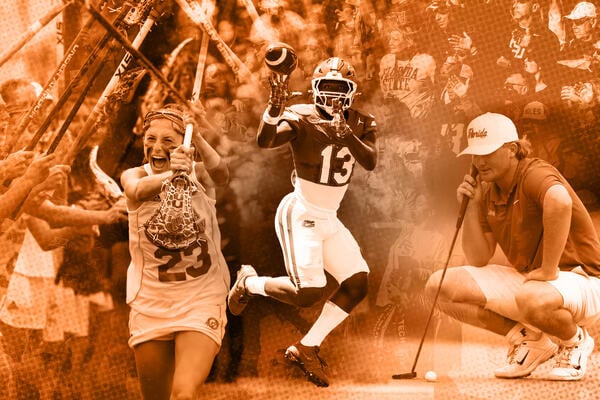
After years of court battles, a federal judge ushered in a new era for college athletics earlier this month when she approved a settlement in the House v. NCAA antitrust lawsuit, effectively ending the century-old model of student athletes as amateurs.
Now students will be able to earn money for their athletic performance at colleges that opt in to the practice known as revenue-sharing, in which institutions share with players the money made off their teams. Former Division I athletes from the recent past will also share a $2.8 billion settlement to compensate for the financial opportunities they were denied due to now-defunct NCAA rules that prevented them from cashing in on name, image, and likeness deals.
Although the NCAA status quo was undone in an instant, many campus leaders had been planning for months, anticipating the outcome of the ruling.
The era of paid college athletes officially begins July 1. With it comes questions about how the landscape will evolve and concerns about equity issues, as well as what the fallout of the settlement may mean for nonrevenue sports.
A State of Transition
Experts view revenue-sharing as the most consequential part of the settlement.
Institutions that opt in to revenue sharing will have up to $20.5 million to spread among their athletes. The lion’s share of that is expected to flow to football, the top revenue-earning sport, followed by men’s basketball, with the second-highest distribution amounts. The annual revenue-sharing cap will increase gradually to $32 million over the course of a decade.
Jason Montgomery, a partner at the law firm Husch Blackwell, said that one commonly discussed formula would see 75 percent of revenue disbursed to an institution’s football team, followed by 15 percent to men’s basketball, 5 percent to women’s basketball, and the remainder spread across all other sports. But he noted institutions can adjust that formula as they see fit.
At institutions that don’t have a football team, the bulk of the revenue will likely be directed to men’s basketball. And some universities that have top basketball programs are tweaking the formula to direct more money to hoops; the University of Houston, for example, may opt for a formula that directs 23 to 25 percent of revenue to men’s basketball, local media reported.
The back-pay provision is also heavily tilted toward football, which has already prompted an appeal on Title IX grounds, with plaintiffs alleging women are being shorted on damages. The suit, brought by eight former college athletes who competed in soccer, track and volleyball, argues that female athletes are being deprived of more than $1 billion in past damages.
Financial Models
For those opting in to revenue-sharing, a major question looms: Where will the money come from?
Sean Frazier, athletic director at Northern Illinois University and president of the National Association of Collegiate Directors of Athletics, said financial models will vary by institution.
“You’re going to see a lot more of that innovative way to revenue-share by getting this money from external sources that are not specific to the universities themselves,” Frazier said.
Some colleges are leaning on boosters and TV deals to bankroll revenue-sharing, while others are taking different approaches. Earlier this month, the Florida Board of Governors approved the use of auxiliary funds to pay student athletes, which could flow from college bookstores, student housing, dining, parking fees and other income streams. (That measure is intended to be temporary as colleges develop long-term plans.)
In addition to increasing revenues, colleges are looking for ways to cut costs. Montgomery said one way colleges can do that is by eliminating non-revenue-earning sports—such as swimming and track and field—which some institutions have done, though that move has also been accompanied by other financial challenges for the sector.
Colleges that opt in to the revenue-sharing model don’t have to pay the maximum amount unless they choose to. That could yield scenarios where less resourced institutions pay much less than the $20.5 million cap.
While experts say there is no firm data point yet on how many colleges have opted in to revenue sharing, those numbers are likely to be just a fraction of the NCAA’s member institutions. As of last summer, that number stood at 1,085 institutions, with 355 at the Division I level.
“The vast majority of colleges are not going to be part of this revenue-share,” said Michael McCann, a professor at the University of New Hampshire’s Franklin Pierce School of Law.
Opportunities for Innovation
Frazier compared college athletics in the aftermath of the House settlement to flying a plane while building it. He expects colleges will adjust their approaches as they go.
“It is clunky right now because of the fact that we do not have certain guardrails yet finalized as we go into this. That’s why it’s going to be a little bit of a wait-and-see on some things,” he said.
He urged patience for those trying to navigate the new landscape.
“I would caution [college] leaders to not jump to trends, to not jump to any situation as a quick fix,” Frazier said. “There’s no silver bullet to be able to manage this. We’re going to have to go through a cycle to really understand what the impacts of the House settlement mean.”
McCann expects that colleges will largely pay football players, as they have signaled. Where the money flows, he said, will depend on institutional priorities. If an athletic department is focused on keeping up with rival football teams and landing on television, revenue-sharing money will be invested in football. But he thinks leaders should consider investing in other areas, including women’s sports—which have boomed in recent years, judging from the record viewership for women’s basketball.
“I see an opportunity for schools that opt in to revenue-share to not follow the script of spending most of the money on football players,” McCann said. “I could see some presidents being innovative and saying, ‘Let’s use that money primarily on women’s basketball; let’s try to create a top women’s basketball team, or softball.’ There are opportunities to distribute money in ways that I think are a lot more innovative than simply trying to catch up with all the other football schools.”
The Professional Era
To many experts, this moment amounts to the professionalization of college athletics.
“If this isn’t pay to play, I don’t know what is,” Montgomery said.
To Montgomery’s point, some colleges have hired general managers and other personnel with professional sports experience. Last year Stanford University tapped former star quarterback Andrew Luck, who spent seven years in the NFL, to return to his alma mater as general manager of the football program. Similarly, in March the University of California, Berkeley, hired former NFL player and head coach Ron Rivera as general manager of its football program.
Noting that trend, McCann suggested such programs are “operating as quasi pro teams.”
Federal Legislation?
For years, observers have speculated that Congress might get involved in college athletics. President Donald Trump has raised the possibility of his own involvement as well; in May, he proposed establishing a presidential commission on college sports before backing off the idea.
However, many experts don’t expect federal legislation to emerge.
“It’s a long shot that Congress intervenes,” Montgomery said, arguing that college athletics is not a priority for lawmakers at the moment. At most, he said Congress might codify the House settlement through federal legislation.
McCann agrees. While he believes “there will be bills introduced, and there will be press conferences and a lot of media coverage,” he doesn’t think such efforts will be fruitful.
But Frazier, who describes himself as an optimist by nature, is hopeful that federal legislation could come to pass in the near future, and he stressed the importance of being part of those talks.
“I think at the end of the day, we need to help [Trump], we need to help the federal government understand what will work,” he said. “Because we have a perception issue that college athletics can’t govern itself. We’ve created that perception as an industry, and what we need to do is take it back. What we need to do is to show the folks that have doubted us, that [think] we’ve lost control, that there is control, and the only way you can do that is with experience, leadership and execution.”

Sports
Isaiah Cadengo Posts Pair of Top 10 Marks as Vikings Close Season-Opening Silver & Blue Invitational
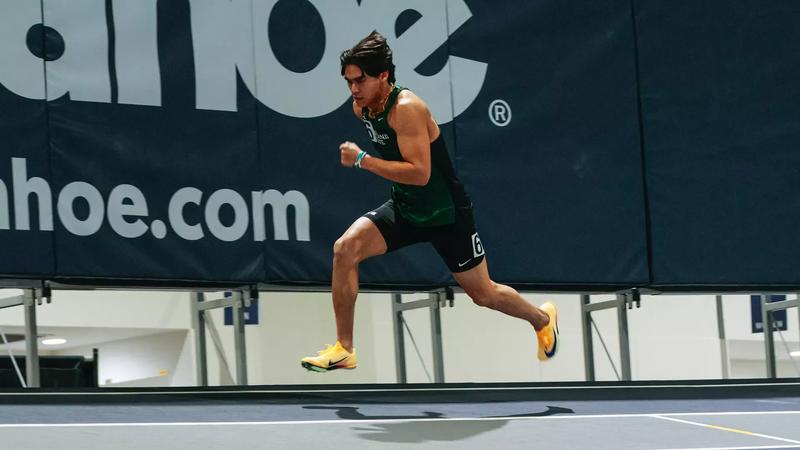
RENO, Nev. — Isaiah Cadengo sat and watched as two of his teammates set top 10 marks on the first day of the Silver & Blue Invitational Friday. Saturday, Cadengo ran like a man eager to put his own name in the record books as the freshman sprinter posted a pair of top 10 marks to lead the Vikings on the second day of the meet at Reno Sparks Convention Center.
Cadengo opened the day in the men’s 400 meters where he placed second overall in 48.56 seconds. The time set a freshman record and moved him up to No. 2 overall in the indoor 400 meters at Portland State, all in his first-ever race as a Viking. Freshman Zach Payne followed at fourth in 49.80 seconds, moving him up to fifth in the freshman top 10.
Cadengo wasn’t done, however. He returned to the track for the 200 meters later in the day, and finished fifth in the event in 21.91 seconds. The time moved him up to second in the freshman rankings and fourth overall at Portland State.
Fellow freshman Jack Macdonald – one of the two stars for the Vikings Friday alongside Emma Stolte – nearly bettered Cadengo in the 200. Running in a later heat, Macdonald finished in 21.95 seconds, putting him third in the freshman rankings and fifth overall. Macdonald may have been able to push for a faster time but won his heat by more than half a second.
It was the second top 10 mark of the weekend for Macdonald. He got his first with a time of 6.93 seconds in the 60 meters Friday, moving him up to second in the freshman rankings and sixth overall.
Payne, meanwhile, followed his classmates with a time of 22.38 seconds in the 200 meters, earning him a second freshman top 10 of the day. Payne now ranks sixth in the 200 in the freshman record book.
Stolte, like Macdonald, followed a top 10 mark Friday with another Saturday. Fifth all-time in the mile after Friday, Stolte moved up to second all-time in the 800 meters with her finish in 2:11.99.
Stolte came within 0.34 seconds of the school record that Katie Camarena set at 2:11.65 in 2022. Camarena set seven school records that season, none of which have fallen since. Stolte came as close as anyone has to bettering one of Camarena’s records Saturday, however.
The Vikings also got a pair of event wins out of their field athletes Saturday. One didn’t come with much suspense as Edward Niyongere was the only athlete in the men’s triple jump after another athlete scratched. Even still, Niyongere jumped 46-07.50 (14.21m) on his second attempt, a mark that would have put him in the top 10 if he wasn’t already ranked sixth all-time.
Freshman Natalie Fisher, meanwhile, had a more dramatic win in the women’s shot put. She passed Nevada’s Johanna Haas on her final attempt with a personal-best throw of 40-00.00 (12.19m). Fisher, who improved on all six attempts during the competition, added close to 15 inches to her overall best in the shot put with the winning mark.
The winning throw also moved Fisher up to third in the freshman rankings in the shot put. She entered the freshman top 10 in the weight throw Friday, moving up to eighth with a throw of 38-04.00 (11.68m).
A number of other Vikings competing Saturday showed improvement over their season openers a year ago. That group included all four Vikings competing in the women’s 200 meters. Tori Forst and Sienna Rosario led that group at third and fourth overall, respectively, while finishing in 25.36 and 25.66 seconds. Forst’s time was better than her first two 200-meter times last season. Rosario’s, meanwhile, was close to two seconds faster than their season opener a year ago.
Savannah Beasley placed 14th in the women’s 200 meters in 26.76 seconds, setting a personal best by 1.7 seconds. Ashley Peterson placed 16th in 26.90 seconds, eleven-hundredths of a second faster than her season opener in 2025.
Dillon Brost did the same thing on the men’s side of the 200 meters. The sophomore placed 17th overall in 22.98 seconds, not a personal best but two and a half seconds better than his season opener as a freshman.
Aidan Sweeney set an overall personal best with his 200-meter finish in 23.71 seconds.
Freshman Farhan Ibrahim shaved close to eight seconds off his indoor best in the 3k while finishing second in the event in 8:56.79. Luke Gillingham followed at fourth in 9:03.13, shaving 13 seconds off his best in the 3k.
The Vikings will be back in action next week when they head to Seattle, Wash., for the UW Preview next Friday and Saturday.
Silver & Blue Invitational
Reno Sparks Convention Center
Reno, Nev.
Jan. 9-10, 2026
Women’s Results:
60m (Prelims): 3. Tori Forst, 7.74; 7. Sienna Rosario, 7.94; 11. Aida Wheat, 8.14. 60m (Final): 2. Tori Forst, 7.67; 7. Sienna Rosario, 7.92. 200m: 3. Tori Forst, 25.36; 4. Sienna Rosario, 25.66; 14. Savannah Beasley, 26.76; 16. Ashley Peterson, 26.90. 400m: 4. Ashley Peterson, 1:00.85. 600m: 6. Hannah Butterfield, DQ. 800m: 2. Emma Stolte, 2:11.99. 1,000m: 1. Hannah Butterfield, 3:07.26. Mile: 1. Emma Stolte, 4:54.25; 9. Sam Sharp, 5:33.24; 11. Libby Fox, 5:45.67. 3,000m: 7. Sam Sharp, 10:59.76; 10. Libby Fox, 11:26.42. 60H (Prelims): 15. Savannah Beasley, 9.66. Shot Put: 1. Natalie Fisher, 40-00.00 (12.19m). Weight Throw: 3. Natalie Fisher, 38-04.00 (11.68m).
Men’s Results:
60m (Prelims): 4. Jack Macdonald, 6.99; 16. Dillon Brost, 7.25. 60m (Final): 4. Jack Macdonald, 6.93. 200m: 5. Isaiah Cadengo, 21.91; 7. Jack Macdonald, 21.95; 9. Zach Payne, 22.38; 17. Dillon Brost, 22.98; 21. Aidan Sweeney, 23.71; Preston Jones, DNF. 400m: 2. Isaiah Cadengo, 48.56; 4. Zach Payne, 49.80; 5. Preston Jones, 51.36. 1,000m: 1. Amir Ahmed, 2:41.49. Mile: 5. Luke Gillingham, 4:29.48; 6. Farhan Ibrahim, 4:31.46. 3,000m: 2. Farhan Ibrahim, 8:56.79; 4. Luke Gillingham, 9:03.13. 60H (Prelims): 4. Aidan Sweeney, 8.66; 5. Deghlan Johnson, 8.68. 60H (Final): 4. Deghlan Johnson, 8.60; 5. Aidan Sweeney, 8.68. Triple Jump: 1. Edward Niyongere, 46-07.50 (14.21m). Weight Throw: 1. Daniel Coppedge, 50-10.75 (15.51m); 3. Carter Green, 36-05.75 (11.12m).
Jan. 11, 2026, 5:01 a.m. ET
The Providence Journal is proud to announce the 2025 All-State Girls Volleyball first and second teams. The Journal Sports staff, with some help from the coaches associations, determines the first- and second-team members.
2025 Providence Journal All-State Girls Volleyball Team
First Team
Lyla Auth, Westerly
Senior, Outside hitter
Auth steered Westerly to its second girls volleyball championship as the best player in Division II. The Manhattan University commit finished with 268 kills and a 49.8 kill percentage this fall. The Bulldogs finished the year undefeated and Auth’s near-perfect play on the outside was the biggest reason.
Sports
Virat Kohli Creates History at 38, Smashes Three World Records in First ODI Against New Zealand

With this feat, Kohli surpassed the record of legendary Sachin Tendulkar by becoming the fastest player to reach 28,000 international runs, achieving the landmark in just 624 innings. In comparison, Sachin Tendulkar took 644 innings, while Sri Lanka great Kumar Sangakkara reached the mark in 666 innings.

Kohli reached the milestone with a boundary, needing just 25 runs before the match to complete 28,000 international runs. Earlier, only Sachin Tendulkar and Kumar Sangakkara had entered this elite club.


The New Zealand ODI also saw Kohli become the second-highest run-scorer in international cricket history. By scoring 42 runs in the match, he overtook Kumar Sangakkara, who has 28,016 international runs to his name. Sachin Tendulkar remains at the top of the list.
In Test cricket, Virat Kohli has scored 9,230 runs in 123 matches, while in T20 Internationals he has amassed 4,188 runs across 125 matches. Before the New Zealand series, Kohli had played 556 international matches, scoring 27,975 runs in 623 innings at an impressive average of 52.58, including 84 centuries and 145 half-centuries.
Adding to his rich vein of form, Kohli has registered two centuries and three half-centuries in his last five matches, underlining his consistency and match-winning ability.
Virat Kohli’s latest achievement not only reinforces his place among the greatest cricketers of all time but also highlights his unmatched longevity and hunger for excellence on the international stage.



Rasheed, also known as Casper, is a sports photographer who interned for The562 throughout his senior year of high school and is currently attending CSULB while continuing to freelance. To access his work, you can check his Instagram and site below:
Instagram: @visuals.casper
https://casper-visuals.com/
The562’s coverage of Long Beach State athletics for the 2025-26 season is sponsored by Marilyn Bohl.
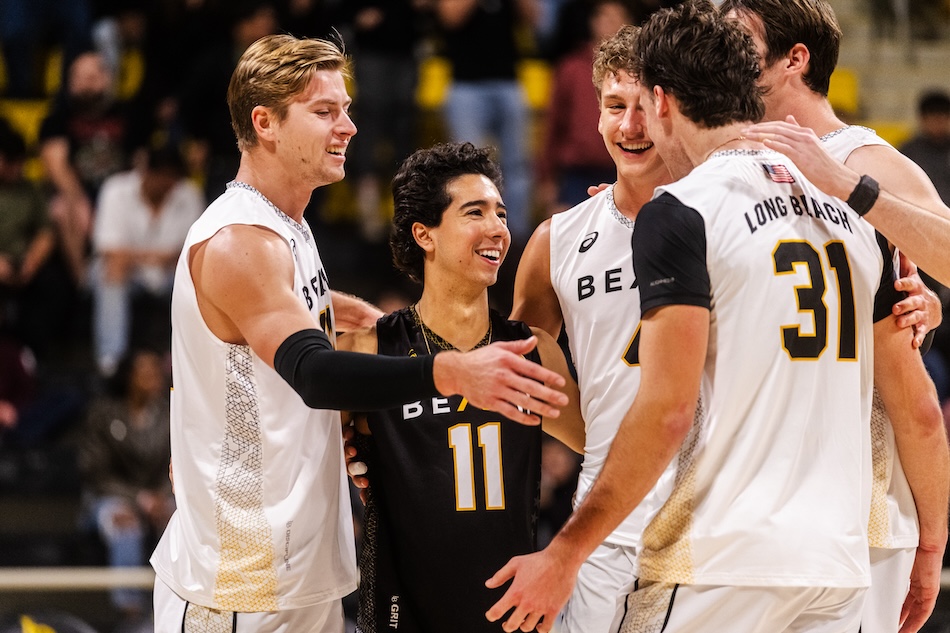
The No. 3 Long Beach State men’s volleyball team didn’t need to drop a set on opening weekend to shake off any early-season jitters.
The defending national champions opened the season at the LBS Financial Credit Union Pyramid with a pair of sweeps, dispatching Lindenwood on Friday before closing the weekend with a straight-set win over McKendree on Saturday night. While the Beach never dropped a set, Saturday’s match provided a sterner test, highlighted by a thrilling second set in a 25–22, 35–33, 25–16 victory.
“We’re proud of how our guys responded after last night,” head coach Nick MacRae said. “Tonight we played a good McKendree team, who we could very well see later in the season. We say in our locker room that we can learn as much from a win as we can from a loss. Last night was halftime, and we got our third-quarter response today.”
The Beach trailed by their largest margin of the night at three points during the second set and went on to fight off a preposterous eight McKendree set points. First-year setter Jake Pazanti led a balanced attack during that stretch and nailed an ace to give the Beach their final set point, followed by a McKendree hitting error that secured a two-set lead.
“It’s good for us long term,” said standout senior Skyler Varga of the second-set rally. “I think we needed to go through that, and even if we didn’t pull out the win in that set, I think it still would’ve been good for us to show that we can come back after being down. It definitely shows our team values, and we really need to go through those moments to be a national championship–level team this year.”
Varga had himself a match, finishing with nine kills on a team-high .368 hitting percentage along with five assists and 11 digs. Perhaps the most impressive stat came from behind the service line, where Varga accounted for seven of the Beach’s 10 aces with just one service error.
The senior outside hitter is coming off a stint as the youngest member of Team Canada in the Volleyball Nations League this past summer, where he emerged as one of the go-to options and capped the season with a 24-kill performance. Varga spoke about his experience and how it has prepared him for his future in the sport.
“Things are faster in international volleyball, and people are consistently hitting harder and making fewer errors,” he said. “It’s forced me to focus more on error management and helped me read the game better. No disrespect to NCAA volleyball, but it’s a little slower, which has made it easier for me to read.”
Opening weekend also gave the Beach a chance to flex some of its depth at opposite, where freshman Wojciech Gajek made his home debut on Friday before Daniil Hershtynovich got the start on Saturday night. Hershtynovich is coming off an injury last season and had a productive night, finishing with a game-high 12 kills.
“We flex our depth yet again, and you’re going to constantly see that,” MacRae said. “[Hershtynovich] got 30 swings and hit nearly .400—that’s a shoutout to him. Maybe early on he wasn’t able to find his serve, but that was part of the process tonight of building him up and letting him be himself, knowing that he’s been in those moments again and again. He was very physical tonight, and that’s exactly what this team needs him to be, and we’re very proud of him.”
Long Beach State also showed its depth on the outside, where Alex Kandev got the start and finished with seven kills. Connor Bloom entered the match permanently while the Beach trailed midway through the second set and chipped in a pair of kills.
At the net, the Beach totaled just 6.5 blocks after recording 12 on Friday night, but Saturday provided the middle blockers opportunities to make an impact elsewhere. Ben Braun had a solid night with seven kills on .500 hitting, while freshman Jackson Cryst finished with four kills on .500 hitting.
“They’re in charge of our entire unit at the net,” MacRae said. “Just because we don’t have the block stat, it’s about being on the other side of the net as much as possible. It was a good response by McKendree, so instead of saying we have to get 20 blocks, it’s about saying, ‘Ok, we had six blocks, but how many balls did we dig?’ It’s a credit to them. They did their job getting across the net.”
Long Beach State will now go on the road next to Ohio, where they’ll face a trio of games next week. That trip will conclude with a match at Ohio State on Saturday, before the Beach returns home to host Fort Valley State on Jan. 23.

LONG BEACH, Calif. – Long Beach State continued its strong start to the 2026 season Saturday night, earning a straight-set victory over McKendree inside the LBS Financial Credit Union Pyramid. The win gave the Beach back-to-back home victories before heading on the road next week for a three-match stretch away from Long Beach.
Long Beach State 3, McKendree 0
(25-22, 35-33, 25-16)
The Beach opened the match with aggressive serving and balanced offense in the first set. After early exchanges between the two teams, Long Beach State used a five-point scoring run to create separation, highlighted by back-to-back aces and steady play in transition. McKendree trimmed the deficit late, but the Beach remained composed, closing the set with an ace to secure a 25-22 win.
Set two turned into a marathon battle, featuring numerous ties and momentum swings. Neither team was able to pull away as both sides traded sideouts deep into the set. Long Beach State fought off multiple set points behind timely kills and disciplined defense. A late service ace helped shift momentum, and the Beach eventually claimed the extended frame, 35-33, on a McKendree attacking error to take a 2-0 match lead.
Long Beach State carried that momentum into the third set, quickly establishing control with strong serving pressure and consistent defensive play. The Beach put together a five-point run midway through the set to open up a lead and never looked back. Solid net play and clean sideout execution allowed Long Beach State to close out the match with a 25-16 victory.
Skyler Varga led the Beach with nine kills and a match-high seven aces, while Daniil Hershtynovich added a team-high 12 kills. Ben Braun contributed seven kills on .500 hitting, and Jake Pazanti directed the offense with 34 assists. Defensively, Long Beach State recorded 48 digs in the three-set match, an impressive effort that fueled transition scoring throughout the night. At the net, the Beach finished with 6.5 team blocks.
Long Beach State will return to action next week when the Beach hit the road for three matches as the 2026 season continues.

Connor Zilisch feelings on working with ex-Busch crew chief – Motorsport – Sports

USA Today sends Alabama, Georgia, LSU, Florida, and Texas A&M a black-pilled message

NASCAR Driver, team and schedule changes for 2026 summarized

Isaiah Cadengo Posts Pair of Top 10 Marks as Vikings Close Season-Opening Silver & Blue Invitational
Meet The Journal’s high school girls volleyball All-State teams

Guven Completes Manthey GTD PRO Entry at Rolex 24 — PorscheSport

Person who makes a difference: Dubuquer reflects on Special Olympics, father’s legacy | Tri-state News

Calendar 2026: Commonwealth & Asian Games, Chess World Championships, Cricket, Football & Hockey World Cups and more

Virat Kohli Creates History at 38, Smashes Three World Records in First ODI Against New Zealand

IndyCar Leaders Circle Program Expands Funding

Youth hockey brawl at intermission of minor league hockey game goes viral: ‘Getting AFTER it’
Florida football transfer tracker as Jon Sumrall works the portal for 2026 class

The good and bad news in girls’ sports participation

4 changes already made to 2026 NASCAR Cup Series playoffs – Motorsport – Sports

Tennessee safety Boo Carter commits to Colorado out of NCAA transfer portal

Stempien to seek opening for Branch County Circuit Court Judge | WTVB | 1590 AM · 95.5 FM

#11 Volleyball Practices, Then Meets Media Prior to #2 Kentucky Match

Ross Brawn to receive Autosport Gold Medal Award at 2026 Autosport Awards, Honouring a Lifetime Shaping Modern F1

Maine wraps up Fall Semester with a win in Black Bear Invitational

Nascar legal saga ends as 23XI, Front Row secure settlement

Princeton Area Community Foundation awards more than $1.3 million to 40 local nonprofits ⋆ Princeton, NJ local news %

Downtown Athletic Club of Hawaiʻi gives $300K to Boost the ’Bows NIL fund

Sunoco to sponsor No. 8 Ganassi Honda IndyCar in multi-year deal

WNBA’s Caitlin Clark, Angel Reese and Paige Bueckers in NC, making debut for national team at USA camp at Duke

Badgers news: Wisconsin lands 2nd commitment from transfer portal

Nike Signs 10 LSU Athletes to NIL deals

Three Clarkson Volleyball Players Named to CSC Academic All-District List

Five Youth Sports Trends We’re Watching in 2026

Beach Volleyball Unveils 2026 Spring Schedule – University of South Carolina Athletics

Kentucky AD explains NIL, JMI partnership and cap rules





-
 Sports3 weeks ago
Badgers news: Wisconsin lands 2nd commitment from transfer portal
-
 Rec Sports1 week ago
Five Youth Sports Trends We’re Watching in 2026
-
 Sports2 weeks ago
Kentucky VB adds an All-American honorable mention, loses Brooke Bultema to portal
-

 Motorsports3 weeks ago
Dr. Patrick Staropoli Lands Full-Time O’Reilly Ride with Big Machine Racing
-

 Motorsports2 weeks ago
BangShift.com IHRA Acquires Historic Memphis Motorsports Park In Millington Tennessee. Big Race Weekend’s Planned For 2026!
-
NIL2 weeks ago
Fifty years after IU’s undefeated champs … a Rose Bowl
-
 Sports2 weeks ago
2025 Volleyball Player of the Year: Witherow makes big impact on Central program | Nvdaily
-
 Sports2 weeks ago
H.S. INDOOR TRACK & FIELD: GLOW region athletes face off at Nazareth University | Sports
-
 Sports2 weeks ago
Colorado volleyball poised to repeat success
-

 Sports2 weeks ago
Texas A&M volleyball’s sweep of Kentucky attracts record viewership