
Rec Sports
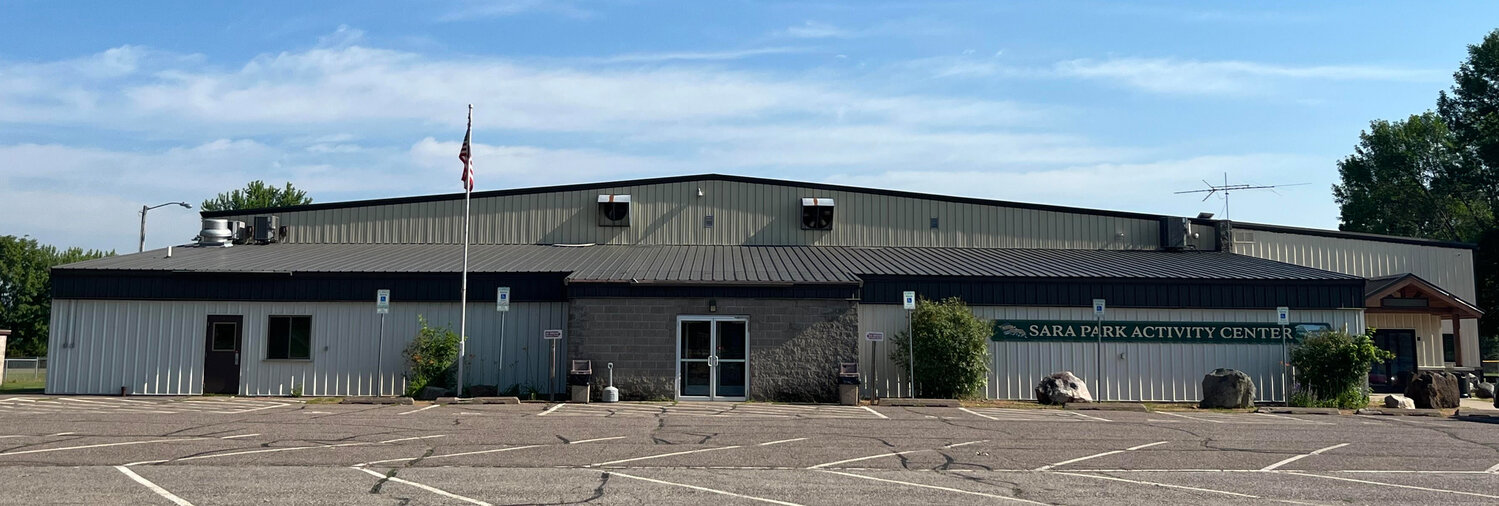
Wa Wui Ltd. working to upgrade, revitalize SARA Park facility

By Jalen Maki
Tomahawk Leader Editor
TOMAHAWK – A local organization has launched a fundraising campaign to upgrade and revitalize a Tomahawk facility used for a variety of purposes.
Wa Wui Ltd. is a volunteer group that oversees the operations of SARA Park, which for years has served as a hub for community recreation and events. The group is currently working to raise $5 million to give the facility a facelift.
The group’s “Bacon and Beer Bash” will kick off the fundraising campaign. The event will be held at SARA Park, 900 W. Somo Ave., Tomahawk, on Saturday, Oct. 4.
In a release, Wa Wui Ltd. said the Bacon and Beer Bash will be a “celebration of local flavor, fun and philanthropy, offering attendees a unique experience featuring craft beer tastings, bacon-inspired dishes, live music, open skate, raffles and more – all in support of a facility that hosts thousands of individuals each year.”
“We’re incredibly proud to launch this campaign with an event that brings the community together in the same way SARA Park has for decades,” said Chris Bembinster, President of the Wa Wui Board. “This is more than just a fundraiser – it’s an investment in the future of youth sports, local events and a place where our community connects.”
Wa Wui Ltd. said the $5 million campaign will fund critical upgrades and improvements, including modernizing electrical systems, installing a new energy-efficient ice plant, replacing aging bleachers and much more to improve accessibility, efficiency and comfort throughout the building.
“SARA Park Arena is home to the current Division 2 High School Hockey State Champions, more than eight youth hockey teams, a figure skating club and a pickleball group,” Wa Wui Ltd. stated. “They continually host bingo, open skate, baseball and softball concessions, as well as rent the facility out year-round for events.”
Wa Wui Ltd. said its 100% volunteer board is “committed to preserving the facility’s legacy while preparing it for the future.”
To learn more about the fundraising initiative, become a sponsor or make a donation, contact the board at saraparkarena@gmail.com.

Rec Sports
New York Liberty and Ant International’s Alipay+ Announce Multiyear Partnership Focused on Empowerment, Sustainability and Youth Development
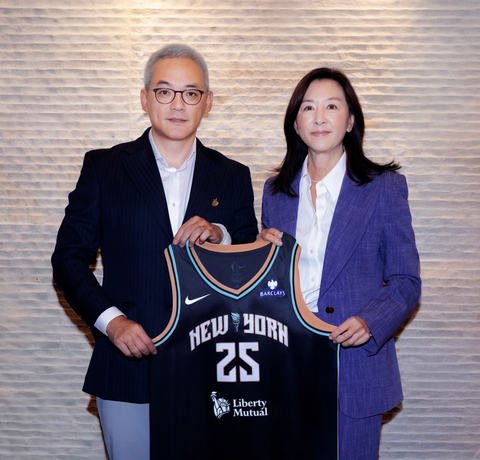
The New York Liberty and Ant International’s Alipay+, a leading cross-border fintech services platform based in Singapore, today announced a multiyear partnership, making Alipay+ an Official Sponsor and Innovation Partner for Sustainability of the New York Liberty. Through this partnership, Alipay+ and the Liberty will jointly support community programs designed to advance community empowerment, environmental sustainability and youth development across New York City.
This press release features multimedia. View the full release here: https://www.businesswire.com/news/home/20251219678825/en/
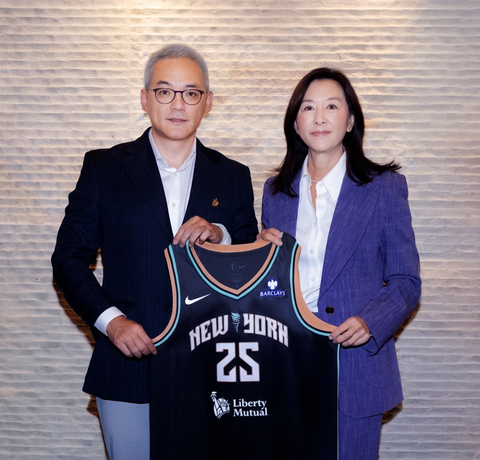
Peng Yang, CEO, Ant International and Clara Wu Tsai, Vice Chair, Brooklyn Sports and Entertainment; Governor, New York Liberty
“Our partnership with Alipay+ goes beyond the game,” said Keia Clarke, Chief Executive Officer, New York Liberty. “Together, we are investing in the future of New York—its people, its environment, and its youth. Ant International’s commitment to community empowerment, sustainability and digital innovation makes them an ideal partner for our mission.”
“To us, the story of New York Liberty embodies the legendary New York spirit: one of incredible talent, passion, teamwork and perseverance,” said Douglas Feagin, President of Ant International. “These winning qualities echo strongly with the Alipay+ community, where young entrepreneurs and global institutions partner up to push the frontier of innovation for underserved communities and small businesses. We are honored to support the Liberty, and look forward to learning from all other Liberty partners in its sustainability and youth programs.”
Alipay+ will become a key contributor to the team’s community-driven initiatives on community empowerment, environmental conservation and youth development. These will include three main areas:
- Community Empowerment: Alipay+ will partner with the Liberty to provide resources and digital tools to empower local communities and foster greater confidence and resilience.
- Sustainability: Alipay+ will support the Liberty and its community in urban reforestation and other conservation initiatives, such as Threes for Trees, whereby trees are planted for every three-pointer made by the Liberty during the season; and a community project to mobilize recycling of used shoes and fund the refurbishing of public basketball courts.
- Youth Sports and Technology Skills Development: Alipay+ will support projects for youth sports and technology training, including a series of youth-focused workshops and clinics to be co-designed and introduced with local partners and tutors, centered on digital skills, technology access and financial literacy, helping to bridge the digital divide and inspire the next generation of leaders.
To launch the partnership, Alipay+ supported the Liberty’s Shoe Sorting Day on December 18, as part of the team’s Season of Giving initiatives. Volunteers sorted donated sneakers for distribution to students experiencing homelessness across New York City, along with handwritten notes of encouragement to uplift them during challenging times. Beyond meeting an immediate need, the initiative also removes quiet barriers that can affect confidence as ill-fitting shoes can keep students from engaging fully. By providing brand-new sneakers students can feel proud to call their own, the Liberty and Alipay+ aim to empower local youth with renewed confidence and belonging.
The partnership will officially tip off next season at Barclays Center with marketing activations including in-arena branding, social media campaigns, and community engagement, amplifying the impact of each initiative across Liberty fans and neighborhoods throughout the city.
About the New York Liberty
The New York Liberty was founded on October 30, 1996 and is one of three original franchises remaining in the Women’s National Basketball Association (WNBA). The Liberty have made six WNBA Finals appearances in its 28-year history, and most recently, won the 2024 WNBA Championship. Owned by Joe and Clara Tsai, owners of the Brooklyn Nets, the Liberty play its home games at Brooklyn’s Barclays Center. For more information, please visit www.nyliberty.com.
About Alipay+
Ant International’s Alipay+ is a global cross-border payment and digitization gateway connecting global merchants to the Asia-Pacific digital wallet community. We offer fintechs and merchants innovative cross-border digital payment and travel services solutions, to enable seamless consumer experience while opening new growth opportunities for businesses, especially small businesses across the world.
View source version on businesswire.com: https://www.businesswire.com/news/home/20251219678825/en/
© Business Wire, Inc.
Disclaimer :
This press release is not a document produced by AFP. AFP shall not bear responsibility for its content. In case you have any questions about this press release, please refer to the contact person/entity mentioned in the text of the press release.
2:19 PM Friday, December 19, 2025
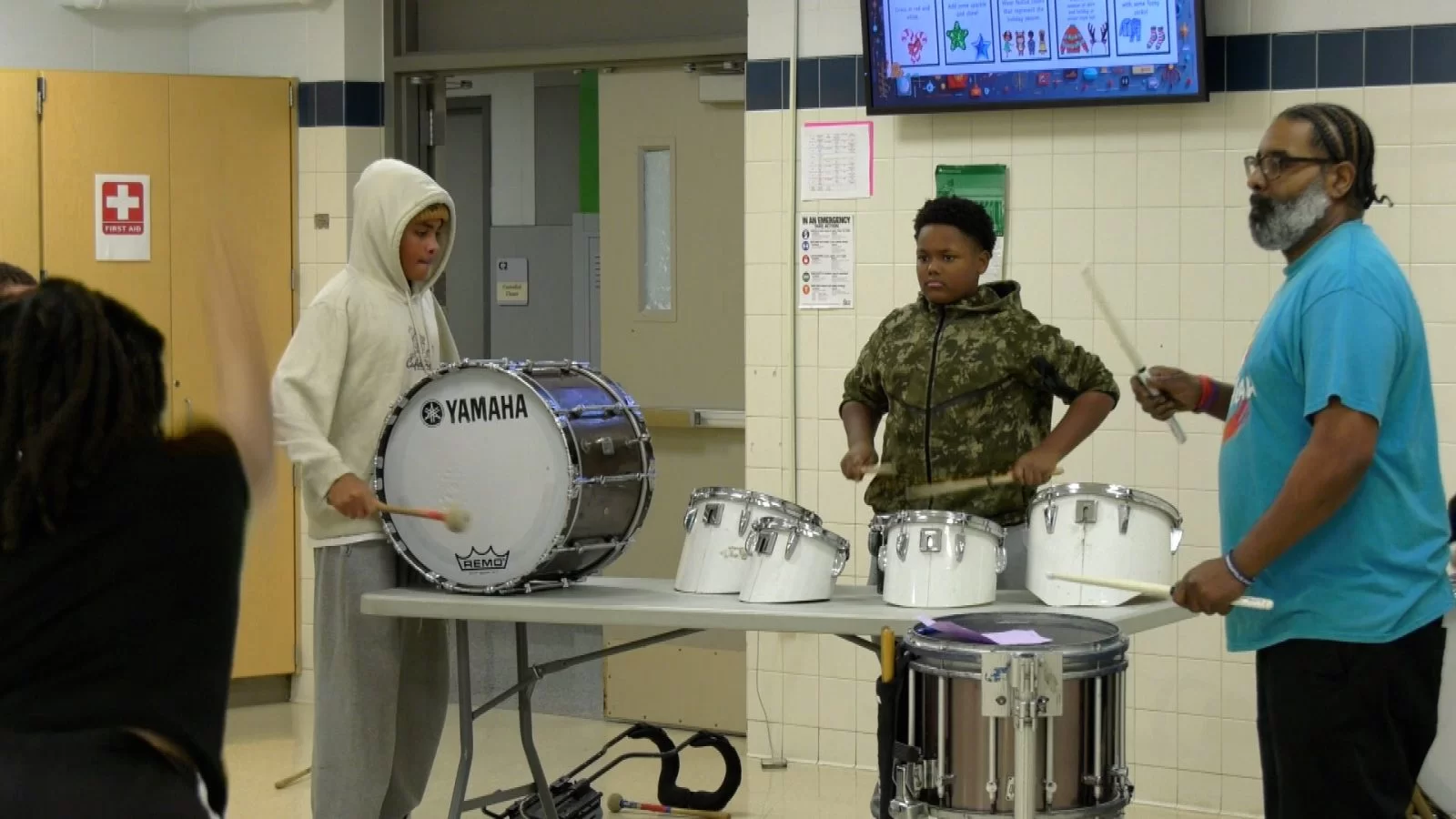
The rhythm is alive at TKO Drumline and Knockout Dance Team practice. There, dancers and drummers ages 5 to 18 are running through beats and choreography — routines that complement each other by design.
Coach Byron Hawkins has been ushering kids through TKO for 20 years — 10 of them in Brooklyn Park.
He said the magic in their routines comes from listening to each other.
“A lot of it is pretty much freestyle,” Hawkins explained. “We also do a lot of syncopation, we also do a lot of creative things where we build from within. We watch our dancers and build a lot of cadences off of that.”
He founded the club to give kids a positive space outside of school and sports.
It’s an added bonus that he’s passionate about drumming himself.
“It’s an outlet,” he said. “We just keep trying to keep pushing kids to do something great. And this is a great way for them to do it.”
Hawkins is a father of six, but jokes he’s a dad of 36, with the 30 current team members under his wing.
In the 20 years he’s ran the program, he expects he’s had about four cycles of kids who’ve aged out of the program and into adulthood. Some of them come back as mentors.
Right now, the Brooklyn Park program is young, with many of the kids still learning the basics.
“All of these kids are my kids,” Hawkins said. “Having new people means that I’m doing something right.”
Work and practice goes year-round.
The team practices at Zanewood Recreation Center twice a week. That adds up to just four hours of time, so Hawkins says it’s important the kids stay focused and work together.
“Our motto is ‘discipline is essential,’” Hawkins said.
The kids show off their hard work in a variety of formats. Sometimes, it’s at competitions across the region.
Others performances take place at parades, and sometimes they even get to perform at Timberwolves games.
TKO Drumline members, along with Coach Hawkins, practice some of their routines early on in class.
On Their Feet
The kids Hawkins recruits don’t mind the push to stay disciplined.
One student, 15-year-old dance captain named Myauna Devine, joined TKO four years ago.
“You know, if you want to be considered the best you just got to put in the work,” Myauna said. “You have to show people that you deserve the title to be the best. It builds your character, it builds you as a person.”
She said she joined because it aligns with her future goals to attend and dance at a historically Black college or university. This combination of drum line and majorette-style dance originated at those HBCUs.
Myauna also said dance makes her feel like she has a talent to offer the world.
“I put my heart, sweat and tears all into it, but I feel free when I do it. I don’t feel judged — I feel very confident when I do it,” Myauna said. “Anybody should try it, because it built me. I gained more confidence, I gained more opportunities.”
Her fellow Knockout Dance teammate , 13-year-old Emmarie Rulford, said there are kids of all ages on her team, and she sees everyone’s hard work pay off.
“They do a lot for us. They’re great people,” Emmarie said about her coaches. “I love the people I’m around, I love the humor. I love what I do.”
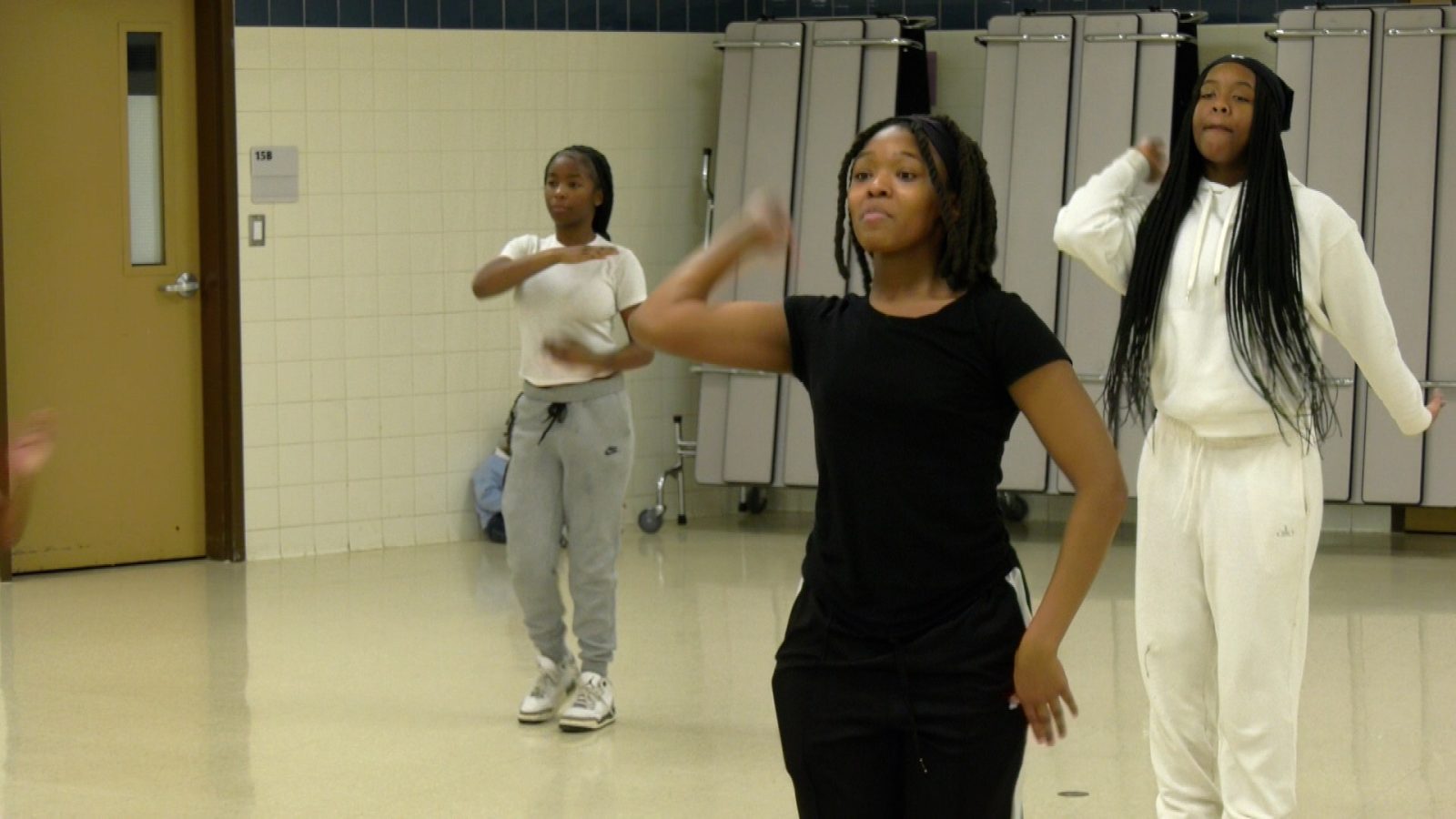
Knockout Dance Team Captain Myauna Davis helps lead her teammates in a run through their routine.
Keeping Time
The drummers have a similar drive.
There are kids on all kinds of drums, from the tenor to the bass drum.
Larry Parker, 13, joined and started on cymbals. Eventually, he worked his way up to the sextuplets.
“The coach helps us a lot to get better,” Larry said.
Meanwhile, 16-year-old Le’Mar Gatlin-Thompson plays the bass drum. He said he enjoys the competition and having fun with his teammates.
“It’s timing, the connection,” Le’Mar said. “The connection’s got to be there at all times.”
9-year-old Brycen O’Brien said his mom signed him up about a year ago, but it was probably because of clues he gave her.
“I used to just hit pans and stuff,” Brycen said. “My mom thought that I would like to do drumline. I would grab pencils and just start hitting the tables, and try to play drums.”
Now, he gets that energy out on the tenor drums. He works alongside a younger member of the group. Hawkins says those collaborations are essential to build the kids’ skills and bonds.
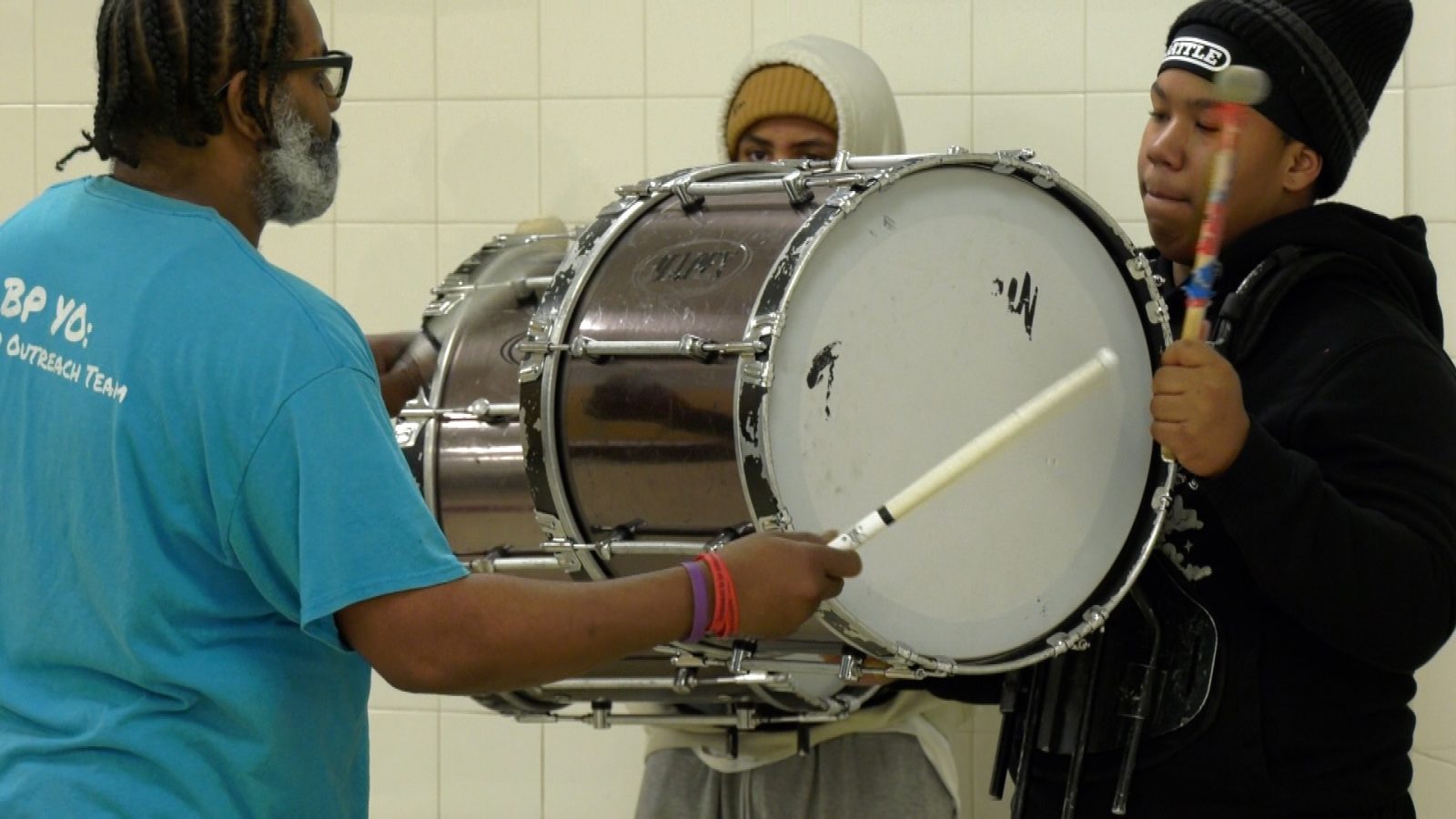
Hawkins practices part of the TKO routine with drummer Le’Mar Gatlin Thompson.
Built to Last
Hawkins said believes they’re set up to succeed largely because they teach each other, and because kids listen to their peers.
“I let them just get in line and learn by watching,” Hawkins said. “Once they catch on by watching, it’s easier to teach them.”
He said he’s just happy to be along for the ride.
“Someone did it for me, so someone has to be there for the new generation of kids. So I’m that person,” Hawkins said.
TKO Drumline and Knockout Dance Team is funded by the families involved and the club’s donors. Hawkins said funding is always needed, and if you’re in a position to help, you can contact him through the TKO Facebook page.
The group is still looking for new members. If you’re interested, you can sign up at Zanewood Recreation Center or contact the drumline at 612-715-2545.
Brooklyn Park
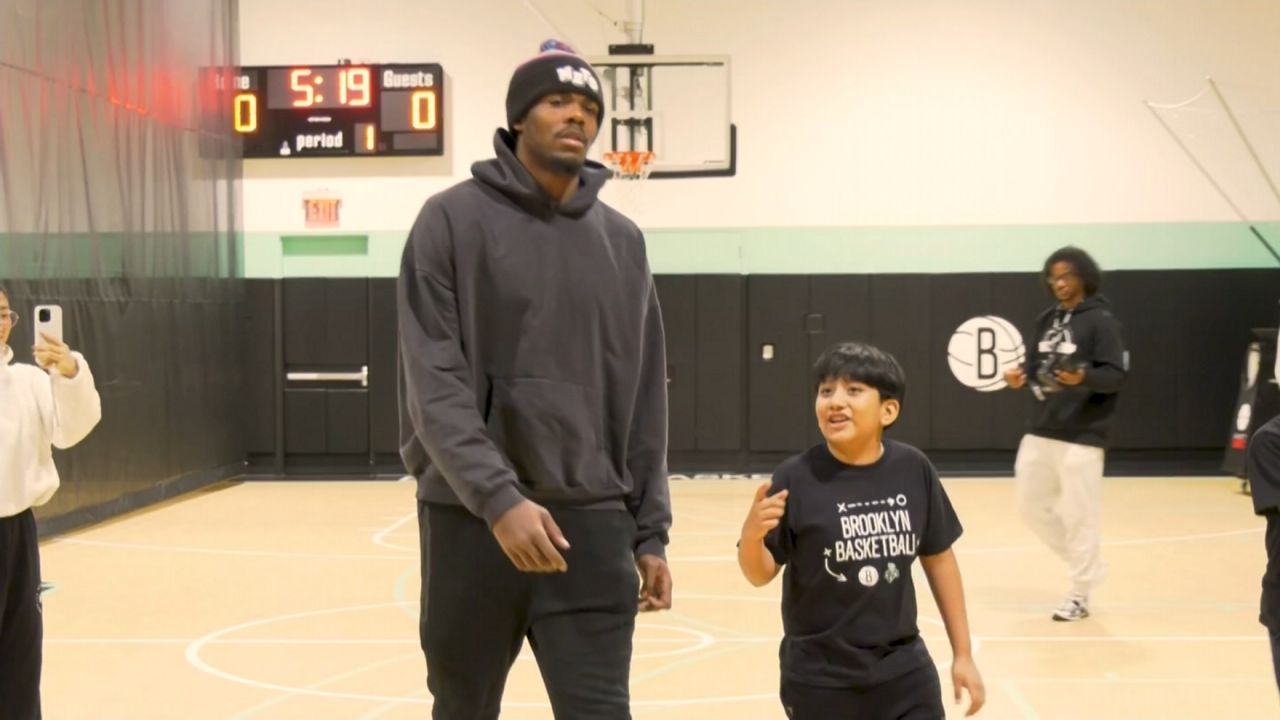
Friday night in Downtown Brooklyn and the newly opened Brooklyn Basketball Training Center is packed with kids practicing their skills.
The night NY1 dropped by, it was all about dribbling, passing and shooting.
“I dribbled with my right hand five times, then I put it through my legs,” said 10-year-old Naji Warlick.
“I do play during gym with my teacher, but I’m not that good,” 13-year-old Khloe Askew said. “I do make a couple shots.”
Brooklyn Basketball head coach Michael Collins runs the programming at the center.
He brings more than 15 years of experience to help grow the game he loves and help kids grow through the game.
“Making sure kids learn resilience through the game, really having to work at something and see incremental improvements over time definitely builds that resilience,” Collins said.
And this night’s clinic was made extra special thanks to a very special guest.
“He has so much aura, like I can feel the aura from so far away,” Askew said.
“Help me out, as an old person, what does that mean when you have so much aura?” NY1 asked.
“Aura is like when you walk in and they can feel like your coolness,” Askew said.
That coolness was emanating from Brooklyn Nets Center, Day’Ron Sharpe, who says he wishes he had a chance to play with the pros when he was a kid growing up in North Carolina.
“It was very rare, being from a rural area, [a] country town, to have this type of thing,” Sharpe said. “And just to see the access these kids have to have is special, I wanted to be a part of it.”
“You spend so much time watching NBA players on TV,” Collins said. “And so many times those kids grow up and you hear the stories about how they remember their first meeting with an NBA player and it invokes [a] sort of success within them, or some sort of confidence within them.”
And while Warlick may already have that confidence, he’ll surely be telling the story of his first interaction with an NBA player for years to come.
“I feel like I want to dunk on him cause, you know, he’s an NBA player — and I’m not, so I gotta dunk on him,” Warlick said.
Then he called Sharpe over and got the chance to take him one-on-one.
Afterwards, Sharpe said, “He’s got a lot of confidence, but I hope he puts in the work, too. He says he loves it, so hope he keeps working at it. Eventually, hopefully, when I’m 50 or something, I’ll see Naji on the court playing for the Brooklyn Nets one day, still talking smack.”
Rec Sports
Special Olympics Completes Georgetown University Innovation Hub Fellowship to Advance Young Athletes App
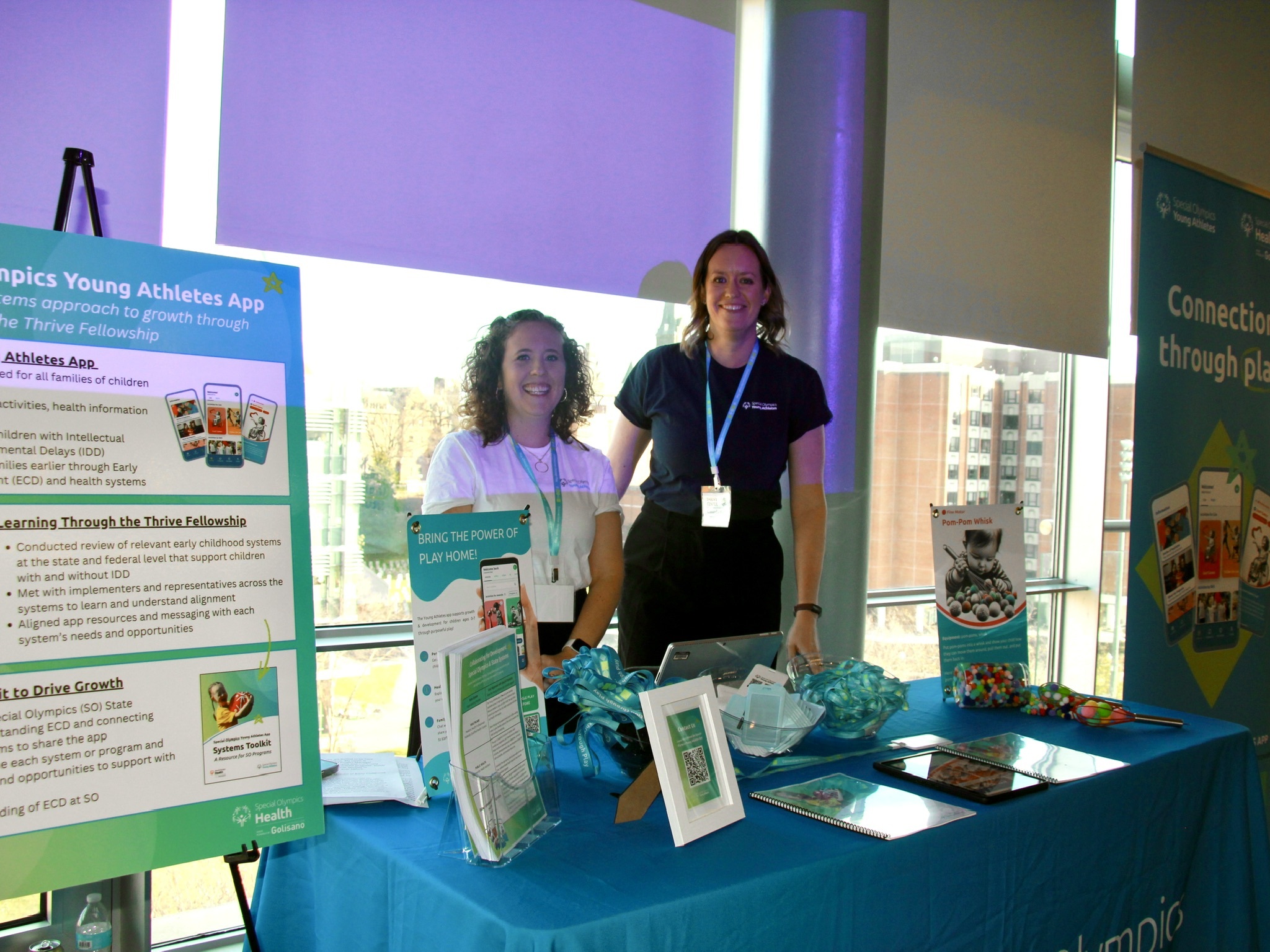

On December 11, 2025, leaders from the Special Olympics Early Childhood Development team successfully completed a 13-week Fellowship with the Georgetown University Thrive Center’s Innovation Hub. The Fellowship supports mission-driven innovations designed to strengthen the early childhood and education workforce through practical, human-centered solutions. Special Olympics was one of six organizations chosen in this competitive process, recognized for its commitment to advancing the health and wellbeing for children with intellectual and developmental disabilities (IDD) and their families.
Throughout the 13 week program, Special Olympics collaborated closely with Georgetown faculty, local early childhood implementers, and national partners to deepen the impact and reach of the Young Athletes app—a free mobile app for families of children ages birth to seven. The app provides personalized, play-based activities tailored to each child’s development, evidence-based health information, and opportunities to connect with other families in their community. At a time when families of children with IDD may face significant challenges, including limited access to early intervention, long waitlists for services, and feelings of isolation, the Young Athletes app provides much needed support to families searching for practical, inclusive solutions that support development from the earliest moments and foster community connection. The Fellowship provided structured opportunities to continue improving the App’s reach and efficacy through rapid-cycle learning, market mapping, strategic visioning, and co-design with providers and families nationwide.
“Participating in the Georgetown Innovation Hub Fellowship has been an invaluable learning experience for our team. The Fellowship gave us the opportunity to deepen our understanding of early childhood systems and explore how to better integrate the Young Athletes app into those ecosystems. By learning from experts and partners, we’ve strengthened our ability to reach families earlier and with greater warmth, ensuring they have access to inclusive, evidence-based tools that support their child’s development.”
Rebecca Ralston, Senior Director, Early Childhood and Preventive Health at Special Olympics
During the Fellowship, Special Olympics focused on building pathways to scale the Young Athletes app through early childhood and health systems. Key outputs included: creating a map of systems where families can seek support, developing an engagement framework with tailored messaging and onboarding strategies, piloting these approaches with select channels to refine tactics, and developing an implementation toolkit to socialize these changes with Special Olympics Programs. These steps position the app for broader, systems-level adoption and impact.
“We’re meeting families where they are, often in moments of concern or frustration, and turning uncertainty into connection and hope. By integrating the Young Athletes app into trusted systems, we can reach families sooner, support them from the start, and build the foundation for even greater growth and impact in the years ahead.”
Cassandra Ryan, Early Childhood Project Manager at Special Olympics
Following the Fellowship, Special Olympics will continue to expand partnerships with early childhood systems and programs at the state and national level to support growth and connection. The experience will also drive the ongoing innovation and evolution for the app, with planned enhancements including personalized health content and deeper integration with providers. Guided by family feedback and insights from the Fellowship, these continuous adaptations ensure the app remains a dynamic, inclusive tool that builds pathways for inclusion, empowers caregivers, and creates opportunities for every child to thrive.
To learn more and download the Young Athletes app, visit the Apple Store or Google Play.
Rec Sports
Inside the NWSL’s first combine: Can the league create a more robust pathway for American talent development?
BRADENTON, Fla. – The politely remixed Christmas music on the IMG Academy’s speakers was no match for the collegiate soccer players near the middle of the lacrosse field on Tuesday morning. The players only began convening in Florida two nights earlier, but they knew each other well enough to know that the best way to get through high performance drills at 10 a.m. was with a healthy dose of encouragement, their exuberant cheers for each other audible to the NWSL scouts watching in the distance and any other passerby.
It was an energetic start to the NWSL’s first-ever combine, the league’s method of making up a developmental gap after abolishing the college draft in a new collective bargaining agreement with the Players Association in August 2024, becoming the first major professional American sports league to do so. Forty-five players from across the NCAA landscape received an invitation to showcase their talents for the NWSL’s clubs, 15 of which sent technical staff to gather information. The event was a year-plus in the making for Karla Thompson, a veteran youth coach and scout who joined the league as the head of player development just weeks after the college draft became a thing of the past, the planning process continuing even as players made their way to the Sarasota metropolitan area.
“We were adding players until probably 48 hours from [the start],” Thompson candidly admitted. “Literally.”
The combine’s main goal is an obvious one — to provide prospective professionals an important avenue to make the leap and for their future clubs to have as much information as possible before offering those contracts. The tangential objectives, as Thompson laid them out, are almost too significant to be considered secondary — the NWSL executive hopes the combine can act as an incubator for female athletes and coaches alike, an important accelerant in a rapidly evolving women’s soccer landscape globally.
“We’ve got the men’s World Cup in 2026, we’ve got the Women’s World Cup in 2027,” she noted. “We’ve got the Olympics in ’28 [in Los Angeles]. We’ve got the Women’s World Cup again in ’31, here [in the U.S.], so the things that we do now is what’s going to affect us in 2031 so I think that we’re looking to try and be an impact in 2031.”
Filling in the developmental gaps
The U.S. is a historic superpower in women’s soccer, even amidst a real belief that the nation is still a sleeping giant in the world’s most popular sport. Six to eight percent of U.S. children aged six to 17 play soccer according to recent data and make up a player pool of several million, but scouring every pocket of a vast nation has been much easier said than done. There are multiple youth soccer set-ups girls can enter, from the Elite Club National League to the Girls Academy and the Olympic Development Program, and a wide network of college soccer teams they can join after the fact. Thompson wanted the combine to be a centralized meeting point for a wide variety of players and for the technical staff members that can offer them a pathway to turning professional.
“Right now I feel like our scouting is very myopic, that we only look at one area,” Thompson said. “I think most of our scouts are going to look at the Power Four, Division I [schools]. Can you look beyond that? There are some players — and there’s some players here – who play for mid-majors, who play for junior colleges, who play for smaller schools. There’s talent all over this country but if we don’t look to enhance that talent, we’re going to continue doing the same thing we are and we’re going to continue bringing in more and more international [players to the NWSL] that I think that we have here in this country so they can develop our domestic talent?”
The list of invitees changed as high profile college prospects landed professional contracts without the help of the combine but by the midway point of the three day event, there was already proof of concept.
“I think it just goes back to Karla’s why of making sure that there is enough platforms for enough of these high-level players and we scoured DI, DII,” Katie Ritchie, an ex-professional turned youth coach who helped facilitate things at the combine. “We weren’t just scouting the Power Fours, put it that way, and it was important to us that we got kids that weren’t necessarily the top ones that all of the clubs have identified. We brought in players that maybe were a little bit more under the radar, not playing in some of these quote-unquote top programs that now that we’ve seen them for two days, we’re like, nobody looks out of place. Do you know what I mean? And that’s what’s been the coolest thing for me is that we’ve found some players that maybe wouldn’t have had the opportunities and we’re providing that landscape for them to still be able to go and show that they deserve to be in this environment.”
The sentiment that valuable talent goes overlooked in the U.S. is pervasive, arguably the only thing stakeholders agree upon as they try to map out what exactly the solution to that issue is. Thompson and her colleagues are quick to admit that the combine is a fix, not the fix. There was some immediacy in the combine’s proceedings, though – the 15 clubs at the IMG Academy had the chance to schedule interviews with any of the 45 athletes on-site, at least a handful likely to earn professional contracts in time for the new season.
“I’ve got a handful of kids that I think that, one, weren’t on the radar at all and now should be on some radars, two or three that I know that some scouts are like, we would like you to come now,” Thompson said. “Now it’s just the decision of the kid, whether or not the player wants to come out of college early or fulfill their four years.”
A focus on humility
While the combine kicked off with high performance drills, the most anticipated events were the scrimmages, the first of which came after lunch on Tuesday. The scouts’ greatest learning opportunity came in settings that most resembled professional games, but there was just one issue as team news came in – the teammates had very little familiarity with one another.
Much like the first session of the day, the players were louder than any external noise. Shortly before kickoff, teammates stood in a circle introducing themselves one by one. The very first scrimmage was defined by a cacophony of instructions – players trying to work out their newly-formed team’s press, building defensive organization on the fly, asking for the ball to ensure there was no silence. They settled in eventually but not entirely – the ball was at a goalkeeper’s feet on Wednesday and just before play resumed, a very important question was clear for many to hear: “Who’s my left back?”
Adding to the hilarious confusion was the fact that the scrimmages served as full-throttled auditions, players receiving instructions to change positions at different times. It may have felt like a departure from a professional game but the takeaways were plentiful for the combine coaches and the scouts alike.
“Actually, I brought that up to a couple individual players because I said you could tell that at the beginning, you were a little hesitant, but you could see yourself get played into the game,” Thompson said. “We tried to do our best to put them into their primary positions but then we started moving players around and just kind of said, ‘Look, it’s just soccer. You dribble, you pass, you shoot, that’s the game, no matter where you are,’ and the willingness for them to just take that was fantastic, because we know when you go into the pro environment, you may be coming in as a winger, but you probably end up as a fullback so having that flexibility and that humility to say, ‘Yes, I’m willing to go wherever you put me,’ Is important, and it’s important that we show them that.”
Humility was a buzzword at the combine, one that was drilled into the prospective professionals by a batch of visitors. Retired player and current NWSLPA deputy executive director Tori Huster provided an introduction to the union, while current NWSL players Abby Smith and Messiah Bright hosted a question-and-answer session.
No query was off topic as combine participants asked about everything from the on-field transition to personal finances and managing free time, Bright and Smith especially offering a truthful and unvarnished outlook on a future that hopefully awaits some of the combine’s participants. They appreciated the insight on the ups and downs of the professional experience, as well as dealing with agents not settling for the first contract offer they see. The one takeaway that had most of the combine participants scribbling in a notebook gifted to each of them by Thompson, though, was about what rookies should do to serve as the best colleagues possible to the veterans on their new teams. Smith and Bright were straightforward – an open-mindedness and willingness to ask questions. Smith referencing U.S. women’s national team midfielder Sam Coffey as an example to follow, recalling with a laugh how Coffey always had a notebook with her during her rookie season with the Portland Thorns in 2022.
“Look at where she is now,” Smith concluded.
A marker for the NWSL’s evolution
The combine served as a crash course to professional soccer, especially when grouped with the youth combine that took place days earlier that served as a platform for high school-aged players. The jam-packed nature of the NWSL’s convention at the IMG Academy was by design, in part because recruitment pathways in a post-draft reality are not the only gaps the league needs to fill in.
“If you compare girls and boys playing football, boys enter into academies and these types of really systemized development programs a lot earlier than girls do,” Sarah Gregorius, a former New Zealand international and the NWSL’s senior sporting director, said. “Someone like a Jude Bellingham or a Phil Foden, taking an England example, they spend a much longer period of time in an environment like a Manchester City academy, not only just learning how to play football and all of the technical and tactical and physical things that need to be developed to do that, but also just having access to nutritionists, sport scientists, understanding loading, having their loading being tracked over an extended period of time. Girls just don’t have access to that at that same level just yet and I think what we’re trying to do in the NWSL is reach further down, make sure that we are giving girls who are developing, going through those pubescant and pre-pubescant years access to more opportunities to learn what is to be a professional so that by the time they arrive on the NWSL stage, on the professional stage, they just more equipped.”
The combine is merely one facet of a larger focus the NWSL has taken in the youth game, the league’s leaders frequently honing in on the importance of a pipeline to maintain a high product quality. The investments include a forthcoming Division II league, currently slated for a 2027 start, as well as additional tools for clubs who have finally begun to create full-fledged scouting departments. For some of them, the youth and adult combines were a fact-finding mission first.
“Through the lens of Gotham specifically, we have a scouting department, we have resources allocated to scouting so we’ve been working across the calendar year in both these spaces, identifying college players that are looking to go professional and young players to identify them for future as they go through their college journey,” Gotham scout Richard Gundy said. “For us, it’s very much about just broadening our knowledge of players. We have specific needs right but we also are maybe looking at tracking players for the future, et cetera, so no specifics from our standpoint.”
Thompson also used the combine as a pathway for female coaches at the early stages of their careers, hoping to provide clubs with a glimpse of their potential. Ritchie was joined by the likes of Gina Lewandowski and Sammy Jo Prudhomme, the pair formerly competing in the NWSL and now working as coaches at varying levels of the youth game. Creating that pipeline is vitally important – the NWSL will have 16 teams next season but there are just four female head coaches in the league, headlined by 2025 Coach of the Year Bev Yanez.
“My first priority was to make sure that we had a female staff,” Thompson said. “It was very important because I just feel like there needs to be a better pathway and pipeline of female coaches that we can present to our clubs that they are capable of coaching at a high level, so that was my first priority. Then my priority was like, now I need to go and find high level coaches, coaches that either coach pro, played pro or coached for the national team and surprisingly, that list is very small. I really didn’t have a big list. Luckily enough, I know a lot of them personally, so I reached out to them early, I think in June or July and said hey, can you put this on your schedule? And they were like, ‘I’d like to be a part of this.’ I think all of them were just like jumping at the chance because they understand the importance.”
It calls back to Thompson’s opening remarks the night before the combine began, anchored by a reminder to the players to have fun. That piece of advice may as well have been for everyone else on the premises, too.
“We’re still losing a lot of players out of the game because the game’s no longer fun,” Thompson said. “It’s just so structured and so [focused on] winning mentality that if you’re not enjoying it, you’re not going to continue doing it and whether or not they continue on in a professional life or career, or the length of the professional career, we still want to be fans of the game and still love the game so even if I get injured and I still love the game, then I’ll still want to be part of the game so I have to have fun and then on top of that, when you’re having fun, you play better.”
Rec Sports
Tahoe-Truckee Unified School District caught up in a dispute over transgender athlete policies
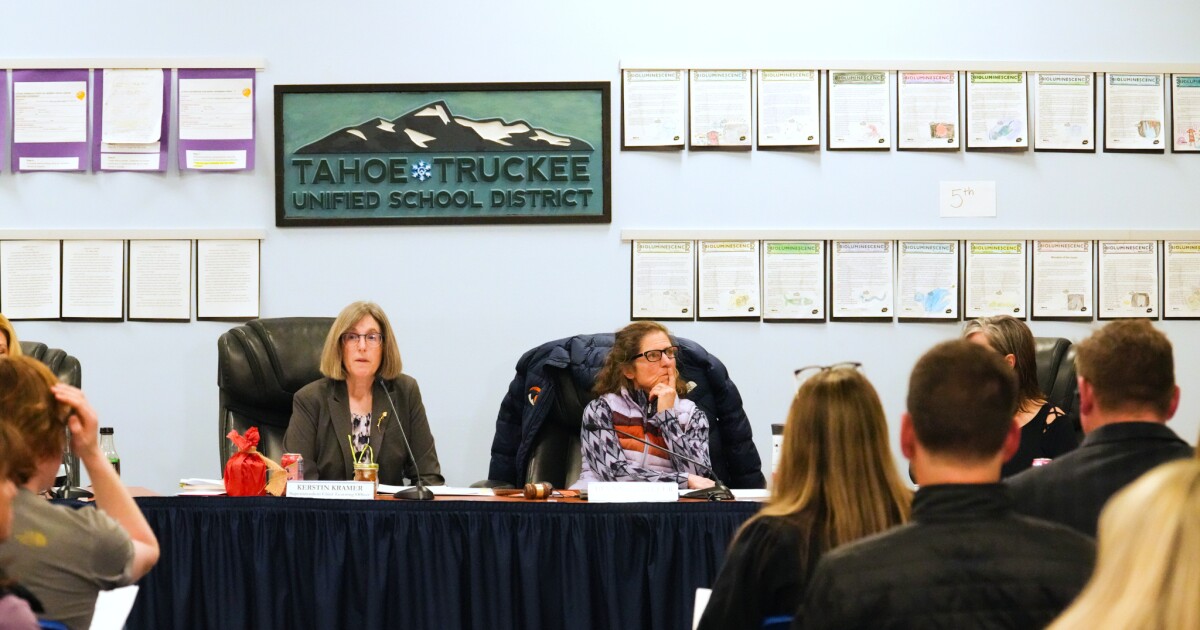
SACRAMENTO, Calif. (AP) — A Lake Tahoe school district is caught between California and Nevada’s competing policies on transgender student athletes, a dispute that’s poised to reorder where the district’s students compete.
High schools in California’s Tahoe-Truckee Unified School District, set in a mountainous, snow-prone area near the border with Nevada, have for decades competed in the Nevada Interscholastic Activities Association, or NIAA. That has allowed sports teams to avoid making frequent and potentially hazardous trips in poor winter weather to competitions farther to the west, district officials say.
But the Nevada association voted in April to require students in sex-segregated sports programs to play on teams that align with their sex assigned at birth — a departure from a previous approach allowing individual schools to set their own standards. The move raised questions for how the Tahoe-Truckee district would remain in the Nevada association while following California law, which says students can play on teams consistent with their gender identity.
Now, California’s Department of Education is requiring the district to join the California Interscholastic Federation, or CIF, by the start of next school year.
District Superintendent Kerstin Kramer said at a school board meeting this week the demand puts the district in a difficult position.
“No matter which authority we’re complying with we are leaving students behind,” she said. “So we have been stuck.”
There are currently no known transgender student athletes competing in high school sports in Tahoe-Truckee Unified, district officials told the education department in a letter. But a former student filed a complaint with the state in June after the board decided to stick with Nevada athletics, Kramer said.
A national debate
The dispute comes amid a nationwide battle over the rights of transgender youth in which states have restricted transgender girls from participating on girls sports teams, barred gender-affirming surgeries for minors and required parents to be notified if a child changes their pronouns at school. At least 24 states have laws barring transgender women and girls from participating in certain sports competitions. Some of the policies have been blocked in court.
Meanwhile, California is fighting the Trump administration in court over transgender athlete policies. President Donald Trump issued an executive order in February aimed at banning transgender women and girls from participating in female athletics. The U.S. Justice Department also sued the California Department of Education in July, alleging its policy allowing transgender girls to compete on girls sports teams violates federal law.
And Democratic Gov. Gavin Newsom, who has signed laws aimed at protecting trans youth, shocked party allies in March when he raised questions on his podcast about the fairness of trans women and girls competing against other female athletes. His office did not comment on the Tahoe-Truckee Unified case, but said Newsom “rejects the right wing’s cynical attempt to weaponize this debate as an excuse to vilify individual kids.”
The state education department said in a statement that all California districts must follow the law regardless of which state’s athletic association they join.
At the Tahoe-Truckee school board meeting this week, some parents and one student said they opposed allowing trans girls to participate on girls teams.
“I don’t see how it would be fair for female athletes to compete against a biological male because they’re stronger, they’re taller, they’re faster,” said Ava Cockrum, a Truckee High School student on the track and field team. “It’s just not fair.”
But Beth Curtis, a civil rights attorney whose children attended schools in Tahoe-Truckee Unified, said the district should fight NIAA from implementing its trans student athlete policy as violating the Nevada Constitution.
Asking for more time
The district has drafted a plan to transition to the California federation by the 2028-2029 school year after state officials ordered it to take action. It’s awaiting the education department’s response.
Curtis doesn’t think the state will allow the district to delay joining CIF, the California federation, another two years, noting the education department is vigorously defending its law against the Trump administration: “They’re not going to fight to uphold the law and say to you at the same time, ‘Okay, you can ignore it for two years.’”
Tahoe-Truckee Unified’s two high schools with athletic programs, which are located about 6,000 feet (1,800 meters) in elevation, compete against both California and Nevada teams in nearby mountain towns — and others more distant and closer to sea level. If the district moves to the California federation, Tahoe-Truckee Unified teams may have to travel more often in bad weather across a risky mountain pass — about 7,000 feet (2,100 meters) in elevation above a lake — to reach schools farther from state lines.
Coleville High School, a small California school in the Eastern Sierra near the Nevada border, has also long been a member of the Nevada association, said Heidi Torix, superintendent of the Eastern Sierra Unified School District. The school abides by California law regarding transgender athletes, Torix said.
The school has not been similarly ordered by California to switch where it competes. The California Department of Education did not respond to requests for comment on whether it’s warned any other districts not in the California federation about possible noncompliance with state policy.
State Assemblymember Heather Hadwick, a Republican representing a large region of northern California bordering Nevada, said Tahoe-Truckee Unified shouldn’t be forced to join the CIF.
“I urge California Department of Education and state officials to fully consider the real-world consequences of this decision—not in theory, but on the ground—where weather, geography, and safety matter,” Hadwick said.

New York Liberty and Ant International’s Alipay+ Announce Multiyear Partnership Focused on Empowerment, Sustainability and Youth Development

Brooklyn Park Area Drumline and Dance Team Gives Area Youth Positive Outlet

Nets Center hosts Brooklyn basketball youth clinic

Special Olympics Completes Georgetown University Innovation Hub Fellowship to Advance Young Athletes App
Inside the NWSL’s first combine: Can the league create a more robust pathway for American talent development?

Driving Digital Innovation: Sultan Almasoud on the Top Trends in Technology and Esports in Saudi Arabia | Morgan Lewis – Tech & Sourcing

Arch Manning agrees to reduced NIL share to help Texas build roster

Allick Joins LOVB Madison – University of Nebraska

Women’s Volleyball Adds Two Transfers for 2026 Season

Creighton volleyball adds second high-major transfer commitment in Ayden Ames

Miami WR Malachi Toney inks NIL deal with Hellstar

No. 1 seed Kentucky volleyball advances to National Championship after beating No. 3 seed Wisconsin in 5-set thriller – Kentucky Kernel

Complete 2026 NASCAR Regional Schedule – Speedway Digest

NASCAR Team Ownership With Michael Jordan Has Led to Denny Hamlin Giving Up On His Precious Golf Time

Arch Manning taking pay cut after first Texas season didn’t go as planned

First Tee Winter Registration is open

Fargo girl, 13, dies after collapsing during school basketball game – Grand Forks Herald

CPG Brands Like Allegra Are Betting on F1 for the First Time

F1 Las Vegas: Verstappen win, Norris and Piastri DQ tighten 2025 title fight

Sycamores unveil 2026 track and field schedule

Two Pro Volleyball Leagues Serve Up Plans for Minnesota Teams

Utah State Announces 2025-26 Indoor Track & Field Schedule

SoundGear Named Entitlement Sponsor of Spears CARS Tour Southwest Opener

Jo Shimoda Undergoes Back Surgery

Redemption Means First Pro Stock World Championship for Dallas Glenn

Texas volleyball vs Kentucky game score: Live SEC tournament updates

Bowl Projections: ESPN predicts 12-team College Football Playoff bracket, full bowl slate after Week 14

Robert “Bobby” Lewis Hardin, 56

How this startup (and a KC sports icon) turned young players into card-carrying legends overnight
Wisconsin volleyball sweeps Minnesota with ease in ranked rivalry win






-
 Motorsports1 week ago
SoundGear Named Entitlement Sponsor of Spears CARS Tour Southwest Opener
-
 NIL3 weeks ago
Bowl Projections: ESPN predicts 12-team College Football Playoff bracket, full bowl slate after Week 14
-
Sports3 weeks ago
Wisconsin volleyball sweeps Minnesota with ease in ranked rivalry win
-

 Motorsports2 weeks ago
Donny Schatz finds new home for 2026, inks full-time deal with CJB Motorsports – InForum
-

 Rec Sports2 weeks ago
How Donald Trump became FIFA’s ‘soccer president’ long before World Cup draw
-
 Sports3 weeks ago
Men’s and Women’s Track and Field Release 2026 Indoor Schedule with Opener Slated for December 6 at Home
-

 Rec Sports2 weeks ago
Black Bear Revises Recording Policies After Rulebook Language Surfaces via Lever
-

 Motorsports3 weeks ago
Michael Jordan’s fight against NASCAR heads to court, could shake up motorsports
-
 Rec Sports2 weeks ago
David Blitzer, Harris Blitzer Sports & Entertainment
-

 Motorsports2 weeks ago
JR Motorsports Confirms Death Of NASCAR Veteran Michael Annett At Age 39