EZRA FRECH PLACES two black boxes in his backpack and jumps on his electric scooter to ride a few blocks to the University of Southern California, where he is about to give his professors a very good reason for having missed the first three weeks of the semester.
The boxes contain the two gold medals the 19-year-old just won at the 2024 Paralympics in Paris, in the 100-meter and the high jump for the T63 classification (athletes with a single-leg amputation above the knee).
“It’s USC; they are known for their Olympians,” says Frech, who was born with congenital limb differences. “I know the professors can understand the Olympics, but I wasn’t sure if they even realized the Paralympics were going on.”
As Frech, wearing shorts and a T-shirt, waits at a stoplight on Jefferson Boulevard near downtown Los Angeles, two USC students not-so-subtly whisper, “Is that that Paralympian?” One student takes out her phone and snaps a picture of him crossing the street. By the time Frech arrives at the Cinematic Arts building, multiple people have stopped him to ask for photos.
“I had been recognized before Paris, a little bit, because of the Tokyo Paralympics and my social media where I posted everything from my disability to training to modeling for fashion brands, but never to this extent,” Frech says. “I couldn’t believe it, honestly. It just made me feel like, ‘Wow, this is happening. I’m here for a purpose and reason.'” Frech keeps his gold medals in his backpack for his first few weeks of school, handing them to anyone who wants to put them around their necks.
Frech has been in the national spotlight since the 2020 Tokyo Games, where he was featured in the ads from Team USA and NBC. He’s also one of the faces of the 2028 Olympic and Paralympic Games in Los Angeles, where his Angel City Sports foundation provides sports clinics and competition opportunities to people with disabilities. With a social media following of more than 250,000, and celebrities such as Selena Gomez reposting his achievements, Frech gained the attention of the fashion world, where he has modeled for designers such as Hugo Boss.
But Paris brought new levels of fame to Frech, who, on his way to class on this clear September day, knows he’s making history just by being on USC’s campus. As the first above-the-knee amputee to be recruited to an NCAA Division I track and field program — let alone the winningest program in the country — Frech’s goal is to show the world that an athlete with a disability can compete against the best college athletes without disabilities.
He embraces the pressure of that goal with USC’s outdoor track and field season just months away. It will be a season in which he’ll struggle to medal as he confronts the challenges of such competition, and where he’ll hear from coaches, teammates and those he has inspired that his effort and determination are what matter the most. He’ll hear those messages, but he’ll also resolve to make the marks.
“For me, this is life or death,” Frech says. “I believe what I do out on the track, my marks, my medals, all impact how the world views disabilities. I genuinely believe my purpose on this Earth is to normalize disability, be an example of what’s possible as an amputee.”
HIGH JUMPER SAM Grewe, now Ezra’s mentor and Team USA teammate, became the first amputee to compete in NCAA Division I track and field when he walked onto Notre Dame’s track and field program in 2019. When Frech was in high school, he realized there weren’t any adaptive programs at the colleges he wanted to attend. So he made it his goal to become the first above-the-knee athlete to be recruited to a Division I program.
“I wanted to do something no one’s ever done before,” Frech says. “Trailblazing is in my DNA. I love pursuing things that seem impossible.”
Frech, who won gold in the high jump at the World Para Athletics Junior Championships at 15 and placed fifth in the high jump at the Tokyo Paralympic Games at 16, reached out to hundreds of NCAA coaches during his junior and senior years at Brentwood School in Los Angeles. “Our current marks to make the squad are seven meters in the long jump and 1.96 meters in the high jump,” one coach wrote to Frech. “We have some guys on the squad who are not quite at those marks yet, but they’re primarily decathletes or have other events.”
Those marks became a recurring theme in the coaches’ responses. “I realized that a lot of it had to do with the numbers alone,” he says. “And although I was trying to do everything to get there, I think it was also a little bit that some coaches weren’t willing to take a risk on a kid who was an amputee. There’s a lot of variables and unknowns with that. And maybe they just didn’t know if I was going to hit them in the time period, or ever.”
At the 2020 Tokyo Paralympics, 16-year-old Frech placed fifth in the high jump with a personal best 1.80 meters and eighth in the long jump with 5.85 meters. Shortly after, he was jumping 6.20 meters in the long jump and 1.83 meters in the high jump. Between his junior and senior years in high school, Frech raised his marks to 6.86 meters in the long jump and 1.95 meters in the high jump. In 2023, Frech set a world record and earned the gold medal in the men’s high jump T63 category with 1.95 meters at the world championship. Before his Paralympics and worlds experiences, Frech held the title for high jump at the World Para Athletics Junior Championships.
“I needed someone to believe in the vision,” Frech said. “Because this is the coach that I was going to be spending the most important four years of my career with. And if this coach isn’t going to believe in me when I’m on the cusp of accomplishing a specific mark, then how am I going to sit here with this coach and say, ‘I want to win three gold medals in L.A. in 2028 at the Paralympics’?”
The inquiries and rejections went on for nearly six months. Then, in summer of 2023, he heard from USC’s newly hired jumping coach, Jeff Petersmeyer.
“The first time I saw him jump, he just kept making bars,” Petersmeyer said. “He just kept making bars, and I was really impressed. And I was like, ‘Man, this guy’s got some potential.’ You could be the highest high jumper, the further long jumper, but if it’s not a good match, then you’re probably not the right person for us here at USC.
“But for Ezra, it’s not all about how high he jumps and how far he jumps, it’s about the person and what he brings to us and what we can bring for him and his development.”
By December, USC had offered Frech admission to the university with “the understanding that you will compete as a member of USC’s Men’s Track and Field team during at least your first year of enrollment at the university.” Ezra also received the inaugural Swim With Mike Foundation’s Amir Ekbatani Paralympic Scholarship, awarded to a Paralympian attending USC or UCLA.
“Ezra brings so much to the table with the team,” Petersmeyer said. “His energy, his drive, his resolve, his determination, his charisma. Everything is so important and salient to what we’re trying to do as a team. Having Ezra train with the upperclassmen who have titles and records already is so important to not only his success but the success of them too. He’s a valuable member of this team.”
ON MAY 11, 2005, Bahar Soomekh lay in the hospital bed at Cedars-Sinai in Los Angeles, her newborn son wrapped in a blanket in her arms. She wasn’t aware of the pandemonium happening around her in the delivery room.
Soomekh heard her husband, Clayton, asking everyone to leave the room. “What’s going on?” Soomekh remembers asking. She saw her doctor pacing back and forth. “What’s happening?” Soomekh yelled.
More doctors piled into the delivery room and took the newborn out of his mother’s arms. Bahar and Clayton were told their son was born with congenital limb differences — a condition where the limbs do not fully develop or form while the baby is in the womb. Physically, the newborn didn’t have a left knee, left fibula or four fingers on his left hand. His left leg was curved up toward his waist, and his left arm and hand were curled toward his chest. Despite numerous tests and 3D ultrasounds during the pregnancy, doctors missed the signs of a congenital condition.
Less than 24 hours later, doctors told the new parents that their son’s leg would have to be amputated and discussed options for surgeries that would provide mobility on his left hand. Soomekh’s mind raced. How is he going to be at school? Is he going to have problems? Are kids going to make fun of him? Bully him? What is his life going to be like?
The new parents decided on a name for their newborn: Ezra. The biblical name meaning “help” or “helper” in Hebrew spoke to the parents.
At 2 years old, Frech underwent groundbreaking surgery to amputate his left leg and transplant his left big toe to his left hand. Frech’s surgeons, at Boston Children’s Hospital pioneered the procedure with the goal of improving hand function and allowing engagement in physical activities. While his parents made a point of never hiding his disabilities, as he grew older, Frech began to realize how his body was different from those of other people he saw.
When he was 4, the year he got his first prosthetic leg, Frech was staring at himself in the bathroom mirror at his home in Brentwood, tears streaming down his face. He called to his mother. “Who looks like this, Mom? Who? No one is like me,” Frech sobbed. “Why did God pick me to not have the leg? Why did God pick me not to have the fingers?”
This was the first time Soomekh had seen her son break down over his disabilities. “Look at me,” she told him. “Remember your name. Ezra, which means to help, which means to teach. Your purpose is to help and teach the world about the beauty of disability. God picked you because you’re going to change the world.”
“Everything we did for Ezra was to build him up,” Soomekh says. “I would tell him, ‘Ez, put your head up. Walk with your chest out. I want you to walk into every room, every park and look and stare down everybody in that room. You let them know you arrived.'”
A few years later, on the grassy field at Brentwood School, 6-year-old Frech cradled a football in his left arm and looked around to see who was open. He was playing flag football with his classmates, and he was the quarterback. With only a few yards between him and the end zone, Frech took off running.
As he picked up speed, he realized his prosthetic leg was starting to detach. Within a matter of seconds, Frech’s running blade flew off his body and landed in front of four kids from the opposing team. Everyone froze. Still clutching the football, he hopped into the end zone for a touchdown.
“Everywhere I went in public, people were staring and pointing fingers and whispering. I felt like a zoo animal,” Frech says. “I was battling my own insecurities, battling my own perception of myself. The way I got through that was genuinely realizing that there was nothing I could do. I might as well make the most out of my life.”
By his 10th birthday, sports had become a huge part of that life. “When I was playing a sport, I wasn’t thinking about the fact that I was the only person at my school with a disability,” he says. “I was just one of the athletes.”
Playing on a club basketball team, Frech practiced a few times a week with his teammates and coaches. But he would dedicate time in his backyard, before and after school, to honing his skills, dribbling the basketball between his right leg and left prosthetic, navigating his own mobility on the court.
At practice and on game days, Frech displayed unwavering confidence. But as his skills developed, so did the disparaging comments. One day during basketball practice, Frech heard his coach yelling, “Are you guys kidding me? You’re letting the kid with one leg score on you right now?”
“Underestimating me probably pisses me off the most,” Frech says. “I always had to go the extra length to prove my worth, because it was so unlikely that the kid with the disability was going to be a starter on the team.”
“I’M READY TO go,” Frech says, as he walks onto the field at Allyson Felix Stadium on USC’s campus.
It’s February, less than one month away from his collegiate debut, and Frech has arrived at the track almost an hour before his teammates. He starts his warmup routine. After a few minutes, he removes his walking prosthetic and wipes down the upper part of his left thigh. Sliding on a rubber covering, he pushes his running blade onto his left thigh. Frech jogs up and down the turf field.
He removes his running blade and replaces it with his jumping prosthetic. “I’m ready to go,” he says again.
With teammates Elias Gerald and Brady Palen and Coach Petersmeyer standing adjacent to the high jump, Frech walks to his starting mark. In his first attempt, he clears the bar at 1.90 meters. Bouncing off the bright red mat, Frech races back to the starting mark. “Let’s go again,” he says. Catapulting off his right leg, he rotates his body to face his chest toward the sky and positions his left prosthetic to swing over the bar. Creating a gap between his body and the bar, Frech clears it with room to raise the bar even more.
Running into a curve with his prosthetic, Frech has little room for error in the high jump. Without a foot or ankle on his left leg, he can’t strike the ground in an angled position. Instead, he must run on the outside of the prosthetic, which increases his chances of slipping or falling. While propelling himself over the bar, Frech doesn’t have any control over the lower part of his prosthetic leg.
“If I place the blade literally centimeters to the left, right front or back off in any direction, it will throw off the entire run and everything will be messed up,” Frech says. “I’ve gotten really good at learning how to place it over the last 19 years so I know how to put it in the right position. Once I’m in the air, the prosthetic leg doesn’t provide me with a ton of momentum the same way swinging an able-bodied leg would. The reason I miss bars is because the blade takes it off.”
Springing off the mat, Frech moves to the side to watch a replay video from his coach’s phone. Catching his breath, Frech watches closely as his teammates prepare for their jumps.
Having recently returned from winning the NCAA Division I men’s indoor national championship — the 32nd national championship for the Trojans men — Gerald and Palen are two of the best jumpers in the nation. Clearing above 2.0 meters on a regular basis, the two upperclassmen set the standard for USC’s team. As the two took turns clearing above 2 meters, Frech focused on their form and energy.
“Having these three guys train together is so important to success, and Ezra’s development is going to be enhanced by having Brady and Elias,” Petersmeyer says. “Realistically, this season, we want him to earn a spot on the Big Ten roster. I know that’s something he’s trying to attain. He needs to get faster and stronger, and that’ll happen.”
Retreating back to the men’s locker room, Frech grabs at his phone and starts scrolling on social media. He shakes his head in disbelief. “Can you believe this?” Frech says to Gerald and Palen, showing them his phone. After posting videos on social media of him clearing bars at practice from the past few weeks, in anticipation of his season opener, Frech received a flood of comments and messages: “Isn’t this cheating?” “How is this not an advantage?” “Bro has a built in spring!” “You’re cheating.”
“People don’t understand how a prosthetic works,” Frech says. “They don’t understand the disabled community. And they just say ignorant stuff that makes absolutely zero sense. But usually the good comments outweigh the bad.
“But ever since posting about USC, it’s definitely increased.”
A few hours later, Frech sits in his car and hits record on his phone. The next day, he uploads a reel on Instagram: “People say I have an advantage. Let’s talk about it.
“If having a prosthetic leg was cheating, then why is my world record in the long jump, 100-meter and high jump way less than an able-bodied athlete?”
In the weeks following, Frech competed for USC at four invitationals where he battled to find a place on the leaderboard. After claiming second in the high jump and seventh in the long jump at the first outdoor meet of the year, the Trojan Invitational, Frech traveled with the team to the LSU Battle of the Bayou, where he failed to clear a valid height and didn’t place on the leaderboard. Finishing 27th in the long jump at the 65th annual Mt. SAC Relays in April, Frech knew his first season was coming to a close. In his last meet with the team, at the USC vs. UCLA Invitational, Frech finished fifth in the high jump and seventh in the long jump.
“It’s disappointing to not perform my best,” Frech says. “I know what I’m capable of, and I know I have what it takes to get there. We knew that there was going to be a learning curve and that it would take some time.”
USC went on to win its 33rd men’s national championship in June.
“Ezra wasn’t one of the jumpers for us at the national championships, but he showed up and gave it his all,” Petersmeyer says. “He helped us win these titles. He’s a valuable member of the team.”
This summer, as Frech prepares for the 2025 World Para Athletics Championships in October, he’s not shy about his goals for his next season with the Trojans.
“I will make the Big 12 team. I will travel to more away meets. And I will continue to improve my skills and develop.
“It wasn’t expected that I would come out and win everything in college. This is new territory. But I’m here,” Frech says.
WHEN FRECH WAS 12, he sprinted to the middle of a grassy field, away from other competitors and parents. He pounded his hands against his head and started crying.
It was the 2013 Endeavor Games in Oklahoma, Frech’s first time participating in sporting events alongside other athletes with disabilities. The 8-year-old’s father, Clayton Frech, signed him up for everything, including every track and field event.
Frech attempted the long jump first. With his running blade securely attached, Frech took off down the runway. He sprang into the air and landed in the sand. “We had no idea what we were doing,” Clayton Frech says. “It was his first time long-jumping. He was just running and jumping.” But then, Frech jumped farther and farther, soon breaking the youth record in long jump.
Later in the day, in the high jump, Frech ran toward the mat and flung himself in the air. His prosthetic hit the bar. Some of the adult athletes in attendance started giving him pointers to control his prosthetic and carry himself high enough over the bar.
After multiple failed attempts, Frech scurried to the middle of the grassy field adjacent to the high jump event. “I was so upset about how I jumped,” Frech says. “This was my first time ever high-jumping. I don’t even know what I was comparing myself to, why I was so upset. I was so competitive. It’s not even competitive against other people but competitive against what I believe I’m capable of.”
Clayton Frech saw a need for more sporting events and clinics for children and adults with physical disabilities. Soon after that first Endeavor Games experience, he created Angel City Sports, a nonprofit dedicated to providing free access to adaptive sports opportunities for youth, veterans and other adults in Southern California. The organization hosts the Angel City Games each year in L.A., with sports clinics and competitions.
Five years later, in 2018, Frech walked onto the track at Harvard-Westlake school in Los Angeles. He watched as a young boy hurled himself over the high jump bar at the fifth annual Angel City Games. Nathan Kuhn, a 7-year-old born with congenital limb differences, was clearing bar after bar. “Is this his first time?” Frech asked the officials. “This is unbelievable.”
Kuhn, inspired by Frech’s social media posts as he trained for Tokyo, had asked his mother, Patty Kuhn, if he could attend the Angel City Games and try “Ezra’s events.”
“I just wanted to be like him,” says Kuhn, now 12. “I watched videos of him jumping over the bar, and I thought if he could do it, then maybe I could try it too. It was the first time I ever saw anyone that looked like me do something like that.”
Kuhn is in the stands at USC in March as Frech prepares to compete in the high jump competition of his first collegiate meet.
Frech swaps out his prosthetic for his high jump blade. There are only four competitors in the high jump event. Gerald, who holds the collegiate record for high jump at 2.30 meters, told Frech when he joined the team, “Welcome home. This is where you belong.” Gerald reminds him of that today. “You are USC track now. Show everyone why you’re here.” Frech takes his starting mark and clears his first attempt at 1.80 meters.
In his second attempt, Frech clears 1.85 meters. Pushing him to the top spot on the leaderboard. Frech clears his next attempt at 1.90 meters. For his fourth attempt, the bar is raised to 1.95 meters, just above his Paris Paralympic record of 1.94.
Looking at the crowd, Frech stars clapping his hands. “Let’s go!” he yells. The crowd chants, “Ezra, Ezra, Ezra.” Kuhn nudges his mom, smiling. “This is so cool.”
With a dash toward the mat, Frech leaps over the bar before snagging it with the crest of his body. The bar drops to the mat. “Ahhh,” the crowd sighs collectively. The scoreboard flickers to reveal Frech’s second-place finish, behind USC alumnus Earnest Sears III, who entered the competition as an unaffiliated competitor and finished with a 2.15-meter best. Frech ties with Long Beach State’s Cytres Vives, finishing ahead of Harvard’s Daire Mahon.
Hugging his coach, Frech pauses on the track before retreating to the stands to greet his family and friends. A small crowd grows around Frech, and he shakes hands and poses for more photographs. Clayton pulls out Ezra’s two gold medals.
“Nathan, want to put them on?” Frech says. “You’re going to get these one day.”
JAMESTOWN — If you know anything about Annie Nabwe, you know she is never satisfied.
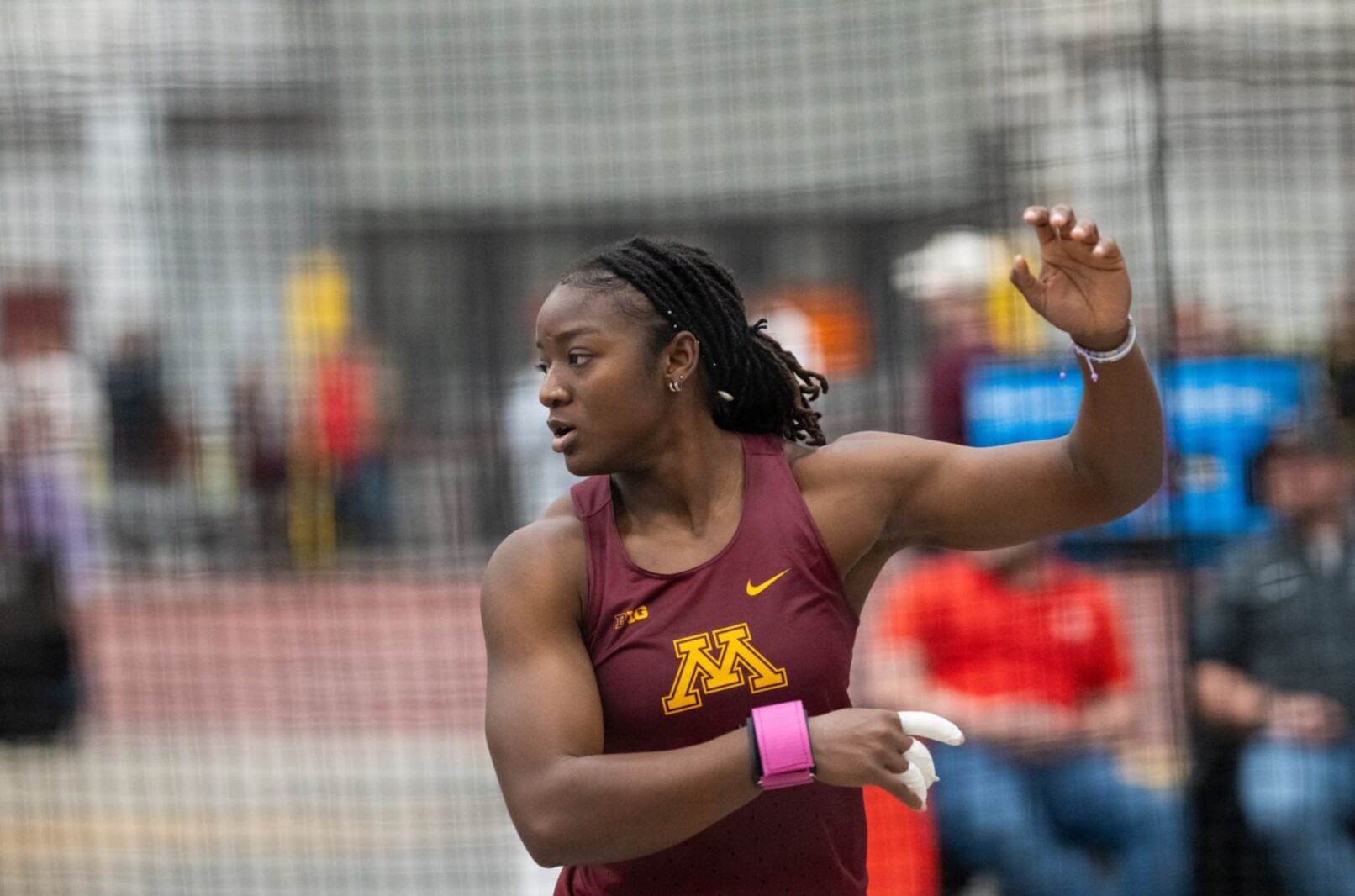
Last May, Nabwe completed the University of Minnesota’s hammer throw sweep at the BIG 10 Championships. Nabwe, a Jamestown High School Class of 2022 grad, set a BIG 10 Championships meet record with a lifetime best throw of 69.85 meters (229 feet, 2 inches), which also goes down as a new Minnesota program record.
Prior to that, Nabwe earned her second-straight conference title in the women’s weight throw at the 2025 BIG 10 Indoor Track and Field Championships. Nabwe’s championship throw measured 24.22 meters (79 feet, 5 inches) — a personal best for the former Blue Jay. With the win, Nabwe became the fifth BIG 10 women’s weight thrower to defend her conference title and the first to do so since 2016 when two-time Olympian Kelsey Card of the University of Wisconsin went back-to-back.
Nabwe owns the NCAA No. 21 mark all-time in the weight throw and also holds the second-best indoor shot put mark all-time at the University of Minnesota at 56 feet, 6 1/2 inches.
Still — the former Blue Jay would categorize her second season with the Gophers as a “learning experience.”
“I had a lot of highs but also challenges both mentally and physically,” Nabwe said. “I didn’t finish exactly where I wanted, but that helped me grow more as a person and an athlete.”
What she’s growing into should scare her competition.
At the university’s M City Classic on Dec. 5, Nabwe secured wins in the weight throw and the shot put. Both of Nabwe’s winning marks in the shot put and weight throw were school records. Nabwe launched the shot 16.40 meters (53 feet, 9 3/4 inches) and the weight 23.74 meters or 77 feet, 10 3/4 inches.
Annie Nabwe prepares for her weight throw.
Contributed / Annie Nabwe
“People should know that I am motivated, focused, committed and overall having fun,” Nabwe said. “I am thankful for the support that I have gotten from loved ones, teammates, coaches, and everyone who has supported me. I am grateful and excited to keep growing and to see what the future holds.”
Nabwe’s season-opening weight throw mark is more than 4 feet farther than her 2024 opening weight throw of 73-8. Nabwe’s mark in shot was also an improvement from last year’s opening indoor competition by nearly 2 feet.
On Dec. 9, the Big Ten tabbed Nabwe as the conference’s indoor track and field athlete to watch.
“People should know that I am ready, working hard, and I don’t give up easily,” Nabwe said. “They should know that every time I show up, I give my best.”
Her “best” is honed daily by the University of Minnesota’s training program.
Since the season officially began, Nabwe and her teammates weight lift on Mondays, Wednesdays and Fridays for four hours. On Tuesdays and Thursdays, team members lift for anywhere between 1 hour, 45 minutes, and 2 hours. On Saturdays, the team practices or lifts for about 90 minutes.
“A typical training session is based on my class schedule,” Nabwe said. “A normal, let’s say, Monday, I have practice at 8:30 (a.m.) so I wake up at 7, get ready and eat breakfast. Then I scooter over to practice, warm up with my teammates and have practice.
“After, I go home and if I have time to eat and shower, I do, then I have class from 11:15 a.m. to 12:30 p.m.,” she said. “I try to eat in between or after that class, because my next class is at 1 to 2:15 and after that class I have lift at 3. … After lift, I go to the trainer’s to get worked on and after that it’s about 5 o’clock. I go to the dining hall to eat dinner and then go home around 6-7 (p.m.) and do school work or if I do not have any I try to relax.”
The next competition on the docket for Nabwe is the Minnesota Open at the University of Minnesota on Jan. 10. The indoor season will conclude with the BIG 10 Indoor Track and Field Championships on March 13-14.
“My goals for this year are being more confident, being mentally tough and starting off competitively instead of laid back, breaking some records and winning titles,” Nabwe said. “These are all achievable because I have worked hard and I am in the position to do it. All I have to do is connect the pieces.”
Shot put is one of the events Annie Nabwe participates in for the University of Minnesota.
Contributed / Annie Nabwe
Katie Ringer is a sports reporter for the Jamestown Sun. Katie joined the Sun staff in the summer of 2019 after graduating from the University of Wisconsin Eau Claire with a degree in journalism. She can be reached by email at kringer@jamestownsun.com or by phone at 701-952-8460.
The historic Texas A&M volleyball season has concluded, and now the seniors are moving on to pursue other endeavors. For some, it might be entering the job market, while for a few, it might be beginning a professional volleyball career. However, for one Aggie, it’s the restart of another college athletic career.
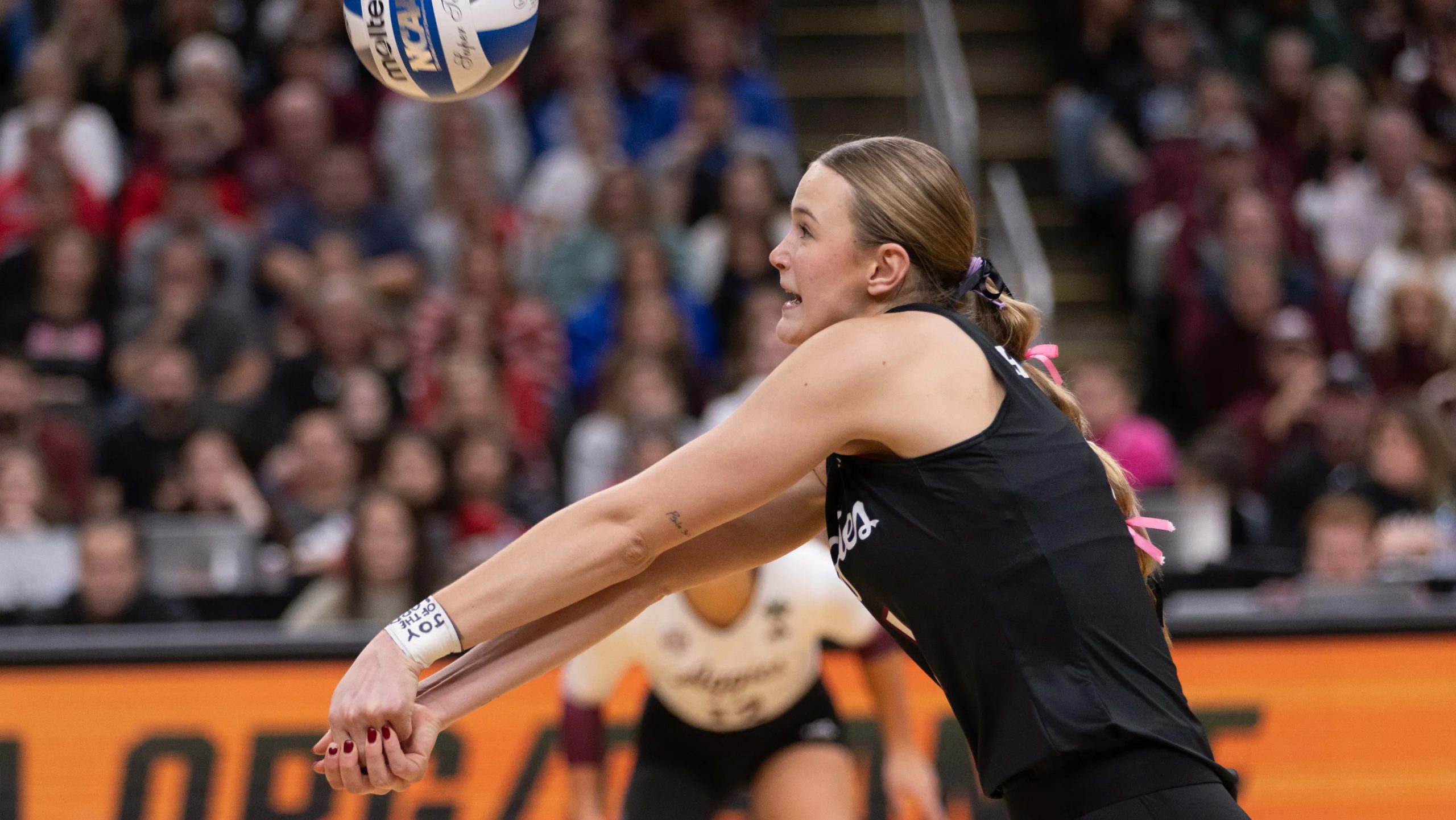
On Friday, it was announced that senior outside hitter Emily Hellmuth will be transferring to LSU to compete in beach volleyball. Although she is not eligible for indoor sports, beach volleyball is considered a separate sport and is not offered at Texas A&M. That means she would have to transfer, regardless of whether she wants to continue playing. She will be eligible for the spring season and will have two years remaining.
Hellmuth was excellent in her role at Texas A&M, appearing in several crucial moments that helped propel the Aggies to their first national title. Below is the official announcement from the LSU beach volleyball X account.
Emily Hellmuth Career stats:
Kills: 646 / 2.85 per set
Hitting %: .178
Blocks: 98 / 0.4 per set
Aces: 16 / .07 per set
Contact/Follow us @AggiesWire on X and like our page on Facebook to follow ongoing coverage of Texas A&M news, notes, and opinions. Follow Jarrett Johnson on X: @whosnextsports1.
CAMBRIDGE, Mass. – Harvard Men’s Basketball closes the 2025 calendar year at Colgate University on Sunday, Dec. 28 at 2:00 p.m. (ESPN+) at Cotterell Court in Hamilton, New York in the Crimson’s non-league finale.
What to Know
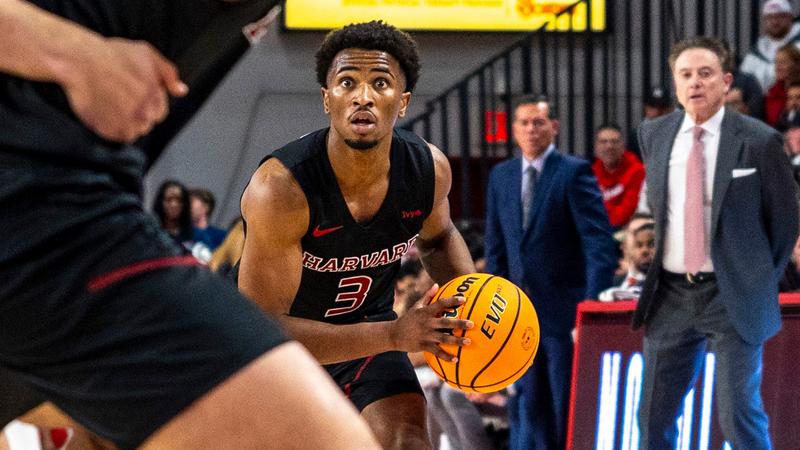
Harvard features four double-figure scorers on the year in a group that includes sophomore guard Robert Hinton (16.5 points per game), senior guard Chandler Piggé (13.7), sophomore guard Tey Barbour (11.5), and junior forward Thomas Batties II (10.3).
Among the Crimson’s four double-figure scorers, three of them averaged fewer than 7.0 points per game as first-years. Senior Chandler Piggé (1.9 points per game in 2022-23; 13.7 in 2025-26), junior Thomas Batties II (6.8 points per game in 2023-24; 10.3 in 2025-26), and sophomore Tey Barbour (4.8 points per game in 2024-25; 11.5 in 2025-26) have all increased their production over their careers.
In the Ivy League rankings, Harvard stands second in free throw percentage (78.5), second in steals per game (7.46), third in scoring defense (68.3), and fourth in field goal percentage (47.0). In the NCAA, the Crimson sits sixth in fewest fouls per game (13.5), ninth in free throw percentage (78.5), and 70th in scoring defense (68.3).
Sophomore guard Robert Hinton has averaged 16.5 points, 5.2 rebounds, 1.8 assists, and 1.6 steals per game on the year, while shooting 84.5 percent on free throws. Hinton ranks first in the Ivy League in field goals (79), second in steals per game (1.6), third in points (214), third in free throws (49), third in free throw percentage (84.5), sixth in points per game (16.5), and sixth in minutes per game (31.2). On the year, he has scored in double figures 10 times, netted 20 or more points four times, and eclipsed 30 points twice. He earned Ivy League Player of the Week honors on Dec. 8. Hinton – the 2024-25 Ivy League Rookie of the Year – averaged 14.6 points and 4.1 rebounds per game in 2024-25.
Hinton dropped a career-high 35 points on 12-of-22 field goals and 11-of-12 free throws with eight rebounds at UMass (Dec. 3). Hinton poured in 34 points on 13-of-17 field goals, 4-of-5 3-pointers, and 4-of-4 free throws vs. BU (Nov. 22). He totaled 26 points, five rebounds, and five assists at Furman (Dec. 6) and scored 22 points vs. UNH (Nov. 9). Hinton notched 16 points and seven boards vs. Holy Cross (Dec. 20) and contributed 16 points at Army (Nov. 15). He netted 13 points, including the go-ahead free throws with 5.1 seconds left at Marist (Nov. 16) and added 12 points and nine rebounds at BC (Nov. 26).
Senior guard Chandler Piggé has posted 13.7 points, 3.6 rebounds, 3.5 assists, and 1.5 steals per game on the year. He ranks fourth in the Ivy League in field goals (70), fourth in assist/turnover ratio (2.2), fourth in steals per game (1.5), fourth in minutes per game (32.4), fifth in assists per game (3.5), seventh in points (178), and ninth in points per game (13.7). He has scored in double figures in 10 games on the year. Piggé – an Honorable Mention All-Ivy selection and CSC Academic All-District honoree last season – notched 13.1 points, 6.7 rebounds, and 2.6 assists per game in 2024-25. He has steadily increased his production over his career, averaging 1.9 points per game in 2022-23, 8.1 points per game in 2023-24, and 13.1 points per game in 2024-25.
Piggé totaled 23 points and six assists, while shooting 8-of-11 from the floor vs. UNH (Nov. 9). He dropped 21 points with a career-high nine assists at Penn State (Nov. 19). Piggé posted 16 points and seven rebounds vs. Holy Cross (Dec. 20). He registered 14 points against both Army (Nov. 15) and Marist (Nov. 16), connecting on a game-tying 3-pointer with 35.8 seconds left against the Red Foxes. He netted 15 points against both Northeastern (Nov. 11) and Bryant (Nov. 29).
Sophomore guard Tey Barbour has registered 11.5 points and a team-high 5.5 rebounds per game on the year, while shooting 41.0 percent from 3-point distance. Barbour ranks fourth in the Ivy League in 3-pointers made (32), fifth in 3-pointers per game (2.5), fifth in minutes per game (31.5), and 11th in rebounds per game (5.5). He has scored in double figures in nine games on the year. Barbour notched 4.8 points and 1.8 rebounds per game on the year in 2024-25.
Barbour scored a career-high 18 points with eight rebounds vs. Holy Cross (Dec. 20), hitting 4-of-5 3-pointers. He posted 15 points and nine rebounds at BC (Nov. 26) after scoring 15 points vs. BU (Nov. 22). He posted 14 points, six rebounds, and a career-high four made 3-pointers vs. UNH (Nov. 9) before netting 12 points on four 3-pointers vs. Northeastern (Nov. 11). He compiled 12 points and seven rebounds at Penn State (Nov. 19). Barbour netted 10 points and hit the game-winning 3-pointer vs. Bryant (Nov. 29).
Junior forward Thomas Batties II has registered 10.3 points, 3.5 rebounds, and 2.3 assists per game on the year, while shooting 48.5 percent from the field and 52.4 percent from 3-point distance. He ranks fourth in the Ivy League in 3-point percentage (52.4) and sixth in blocks per game (1.0). He has scored in double figures eight times on the year. In 2024-25, Batties II averaged 11.0 points and 5.0 rebounds per game on the year after registering 6.8 points and 4.2 rebounds per game on the 2023-24 season.
Batties II tallied a season-high 17 points, career-high five made 3-pointers, and a career-high six assists at Penn State (Nov. 19). He scored a game-high 17 points against both MIT (Nov. 7) and Army (Nov. 15). Batties II posted 14 points and a career-high six assists vs. BU (Nov. 22) and notched 13 points at BC (Nov. 26) and vs. UMass (Dec. 3). He totaled 12 points and nine rebounds vs. Bryant (Nov. 29).
Sophomore guard Austin Hunt has tallied 7.2 points and 3.1 rebounds per game on the year, while shooting 55.1 percent from the field. He ranks sixth in the Ivy League in field goal percentage (55.1). Hunt scored a career-high 19 points on 8-of-9 field goals and 3-of-4 3-pointers vs. Holy Cross (Dec. 20). He notched 13 points, six rebounds, and three assists vs. UNH (Nov. 9) and netted 10 points at Furman (Dec. 6). Hunt averaged 7.8 points and 3.6 rebounds per game in 2024-25.
Sophomore guard Ben Eisendrath has notched 5.1 points, 3.0 assists, 1.8 rebounds, and 1.6 steals per game on the year, while shooting 51.1 percent from the field. Eisendrath ranks third in the Ivy League in steals per game (1.6) and 10th in assists per game (3.0). He scored a career-high 15 points on 6-of-7 field goals at Penn State (Nov. 19) and netted 10 points at Furman (Dec. 6). Eisendrath distributed a career-high nine assists vs. BU (Nov. 22).
Harvard and Colgate have met 24 times with the Crimson holding a slight lead in the all-time series, 13-11. The Crimson has won the last eight matchups, including a 78-67 home victory last season.
Next Up
Harvard hosts Dartmouth on Monday, Jan. 5 at 7:00 p.m. (ESPN+) at Lavietes Pavilion in its Ivy League opener.
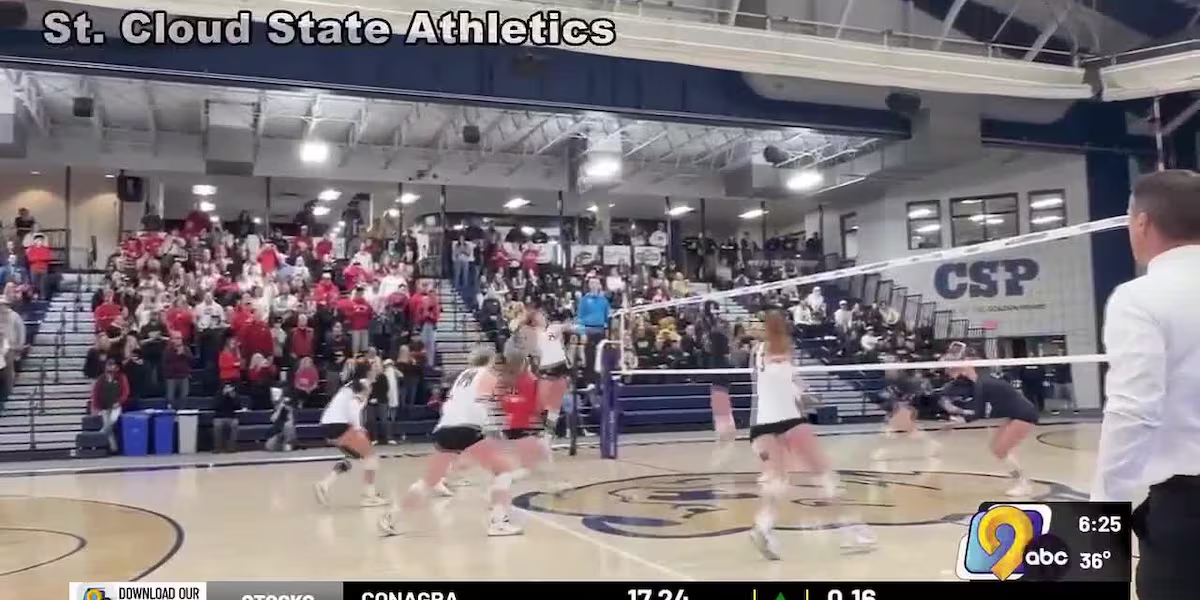
NORTH Liberty, Iowa (KCRG) – A former Iowa high school volleyball star has earned All-American recognition at the college level.
Shelby Kimm, a three-time all-state selection at Iowa City Liberty, was named a Division II All-American this year for St. Cloud State University in Minnesota. The junior led her Husky team this season with nearly 3.4 kills per set.
The Huskies have made it to the round of 16 of the NCAA Tournament each of the past two years, which is tied for the best finish in program history.
After winning a state title at Liberty, Kimm wanted to experience college outside of Iowa.
“We had so many people on our team that were probably their best or one of the best on their high school or club team when you put a lot of those players together it can be a little challenging cause they’re not used to maybe not playing as much,” Kimm said. “You definitely have to work really hard and I think I learned that nothing is guaranteed you have to go into college and work your butt off and hopefully your coaches recognize that and that’s why I try to do.”
Kimm says she’s already excited to get back on the court for her senior season next year.
Three other Iowans are listed on the SCSU roster, including Kimm’s Liberty teammate Asta Hildebrand, Grundy Center alum Carlie Willis and Aplington-Parkersburg alum Kinsey Mohwinkle.
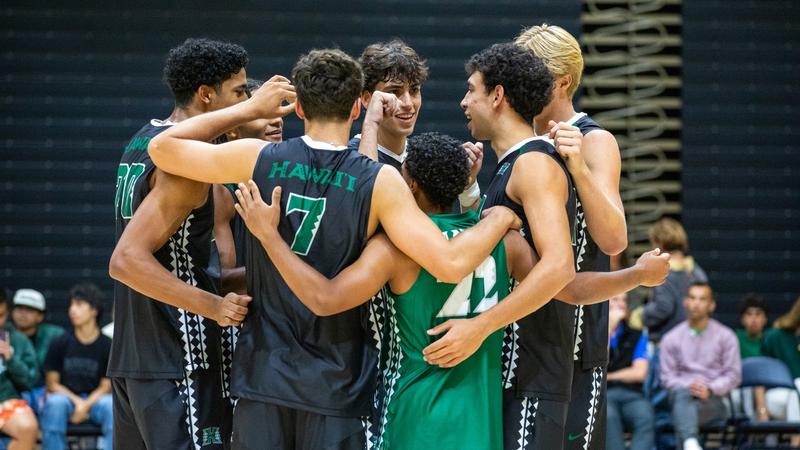
LEXINGTON, Ky. – The University of Hawai’i men’s volleyball team was picked No. 2 in the AVCA preseason poll, marking the eighth consecutive year it earned a top 3 preseason ranking.
The Rainbow Warriors earned seven first place votes and 473 total points, just eight points behind preseason favorite UCLA, who garnered 12 first place votes. Long Beach State was third with five first place votes and 460 points.
UH’s schedule features seven teams ranked in the preseason Top 10 and 11 teams in the Top 20.
Hawai’i finished last season with a No. 3 final AVCA ranking after advancing to the NCAA Championship semifinal round. The No. 3 ranking marked the eighth consecutive year with a Top 5 national finish. The Warriors completed the year with a 27-6 mark and captured their fourth Big West Championship title, defeating eventual national champion Long Beach State in the championship match.
Head coach Charlie Wade, who became the program’s all-time winningest coach last season, is entering his 17th season at the helm with a career record of 319-131.
UH opens the 2026 season with a two-match series against NJIT, Friday, Jan. 2 and Sunday, Jan. 4.