
Sports
What AI learns from us, and why that could be a legal problem


James Mixon
Managing Attorney
California Court of Appeal, Second Appellate District
See more…
Picture this: A law firm’s H.R. director stares puzzled at her
screen. The new AI recruitment tool consistently recommends candidates named
“Chad” or those listing water polo experience. Is the algorithm
harboring a strange affinity for aquatic athletes? No — it’s simply mirroring
patterns from the firm’s historical hiring data, where several successful
associates happened to share these traits. Absurd? Perhaps. But consider the
real-world consequences unfolding at tech giants across Silicon Valley.
In 2014, Amazon embarked on an ambitious experiment to
revolutionize hiring. Their engineering team developed 500 specialized computer
models designed to crawl through resumes, identify promising candidates, and
essentially automate recruitment. The system analyzed 50,000 terms from past
resumes, learning which patterns predicted success.
As one Amazon insider told Reuters, “They literally wanted
it to be an engine where I’m going to give you 100 resumes, it will spit out
the top five, and we’ll hire those.”
By 2015, however, Amazon discovered its AI had developed a
troubling preference: it systematically discriminated against women.
The system had been trained on a decade of Amazon’s technical
hiring data — drawn from an industry dominated by men. Like a digital
apprentice learning from a biased mentor, the AI taught itself that male
candidates were preferable. It penalized resumes containing terms like
“women’s chess club” and even downgraded graduates from women’s
colleges.
Despite engineers’ efforts to edit the programs to neutralize
these gender biases, Amazon ultimately lost confidence in the project and
disbanded it by 2017. The lesson? AI doesn’t create bias out of thin air — it
amplifies the patterns it finds, including our own historical prejudices.
Beyond hiring: How AI bias manifests in language itself
This bias extends beyond who gets hired; it permeates the very
language AI systems produce. Consider a common scenario in today’s workplace:
using AI to draft professional communications.
When asked to “write a professional job application letter
for a software engineering position,” an AI system might produce:
“Dear Sir, I am a highly motivated and results-driven
software engineer with a proven track record…”
This seemingly innocuous response contains several linguistic
biases:
1. Gendered language (“Dear Sir”): The
AI defaults to masculine salutations — reinforcing outdated gender assumptions.
2. Clichéd corporate jargon
(“results-driven,” “track record”): The model reproduces
formulaic corporate English, which may not be appropriate for all cultural or
regional job markets.
3. Erasure of identity markers: AI may strip
identity-specific phrasing or “neutralize” tone based on a biased
conception of professionalism.
Legal arguments are compromised through subtle framing
This linguistic bias becomes even more concerning in legal
settings. When asked to draft legal arguments, AI often exhibits subtle but
significant biases in framing and vocabulary.
For example, when prompted to write a legal argument that police
used excessive force, AI might default to:
“While officers are generally afforded wide discretion in
volatile situations, the suspect’s behavior may have reasonably led the officer
to believe that force was necessary. Courts often defer to the officer’s
perception of threat in fast-moving scenarios.”
This response reveals several linguistic biases unique to legal
contexts:
1. Presumptive framing: The language privileges
police perspective and uses loaded terms like “suspect,” reinforcing
law enforcement narratives.
2. Asymmetrical vocabulary: Phrases like
“wide discretion” and “volatile situations” invoke
precedent favoring police while omitting key phrases plaintiffs’ attorneys use.
3. Erasure of marginalized narratives: AI might
avoid directly addressing systemic bias or racial profiling — sanitizing the
rhetorical force of the argument.
This matters because legal rhetoric carries ideological weight —
language like “suspect,” “noncompliant,” or
“reasonable threat perception” is not neutral; it frames the facts.
This is especially dangerous in civil rights, immigration, or asylum law, where
linguistic tone and framing can shape judicial outcomes.
The stakes for California attorneys
When AI bias enters your practice, it transforms from a
technological curiosity into an ethical minefield with potential disciplinary
consequences.
If an attorney delegates routine document analysis to an AI
tool, and that system consistently flags contracts from certain demographic
groups for “additional review” based on historical patterns, the
attorney, oblivious to this algorithmic bias, could face allegations of
discriminatory business practices.
California Rules of Professional Conduct, Rule 5.3
(Responsibilities Regarding Nonlawyer Assistants) places the responsibility
squarely on your shoulders. This rule extends beyond traditional supervision of
human staff to encompass technological tools making decisions in your firm.
Three practical safeguards every California attorney should implement
1. Practice intentional prompting
The difference between ethical and unethical AI use often comes
down to how you frame your questions. Compare these approaches:
Problematic: “Who should we hire from these
candidates?”
Better: “Which candidates meet our specific
litigation experience requirements?”
Problematic: “What’s our best strategy for this
case?”
Better: “What procedural deadlines apply to this
employment discrimination claim in the Northern District of California?”
Train everyone in your firm to recognize that open-ended
questions invite AI to make value judgments potentially infected with bias.
Specific, factual prompts produce more objective results.
2. Implement cross-demographic testing
Before relying on AI recommendations, test how the system
responds to identical scenarios with varied demographics:
Submit the same legal question about different clients
(corporate vs. individual, varied backgrounds)
Compare research results for similar issues across
different California jurisdictions
Test how client characteristics might affect case
assessment recommendations
Document these tests and address any disparities before
incorporating AI outputs into your practice.
3. Adopt the “human-in-the-loop” rule
Establish a firm policy that no AI output directly affects a
client’s matter without meaningful human review. The attorney must:
Independently verify key AI conclusions
Document their review process
Take personal responsibility for the final work product
Be able to explain the reasoning without reference to
the AI’s conclusion
This approach treats AI as a supplementary tool rather than a
decision-maker, preserving your ethical obligations while capturing
technological efficiencies.
Linguistic bias as a legal issue: Beyond ethics to liability
What makes AI linguistic bias particularly concerning is how it
intersects with existing legal frameworks:
1. Employment discrimination (Title VII): AI
recruitment systems that consistently produce gendered language in
communications or systematically disadvantage certain groups may create
disparate impact liability even absent discriminatory intent. The EEOC’s recent
guidance on AI in employment decisions specifically warns that
“neutral” automated systems can still violate federal
anti-discrimination laws through their outputs.
2. Due process and equal protection: In criminal justice
contexts, AI systems providing risk assessments or generating legal documents
with subtle language biases in favor of law enforcement may implicate
constitutional protections.
3. Legal malpractice and standard of care: As AI
adoption becomes standard practice, attorneys face evolving questions about the
standard of care. Does adequate representation now require understanding how
linguistic bias in AI-generated work product might disadvantage certain
clients?
4. Discovery and work product: Linguistic patterns
in AI-generated outputs may reveal underlying biases that could become
discoverable in litigation.
The path forward
The question isn’t whether AI will transform legal practice — it
already has. The true challenge is whether California attorneys will harness
these powerful tools while maintaining their ethical obligations.
By understanding potential AI biases, both in content and
language, and implementing proactive safeguards, you can navigate this
technological transformation without compromising your professional
responsibilities. The attorney who treats AI as an unquestioned authority
rather than a carefully supervised assistant does so at their ethical peril.
California’s legal community has always been at the forefront of
technological adoption. Now we must lead in ethical AI integration,
demonstrating that innovation and professional responsibility can advance hand
in hand. The future of our profession — and the equitable administration of
justice — depends on it.
Disclaimer: The views expressed in this article are
solely those of the author in their personal capacity and do not reflect the
official position of the California Court of Appeal, Second District, or the
Judicial Branch of California. This article is intended to contribute to
scholarly dialogue and does not represent judicial policy or administrative
guidance.

Updated Dec. 14, 2025, 9:22 p.m. ET
The No. 1-ranked Nebraska volleyball team had not been tested in months. Until Sunday.
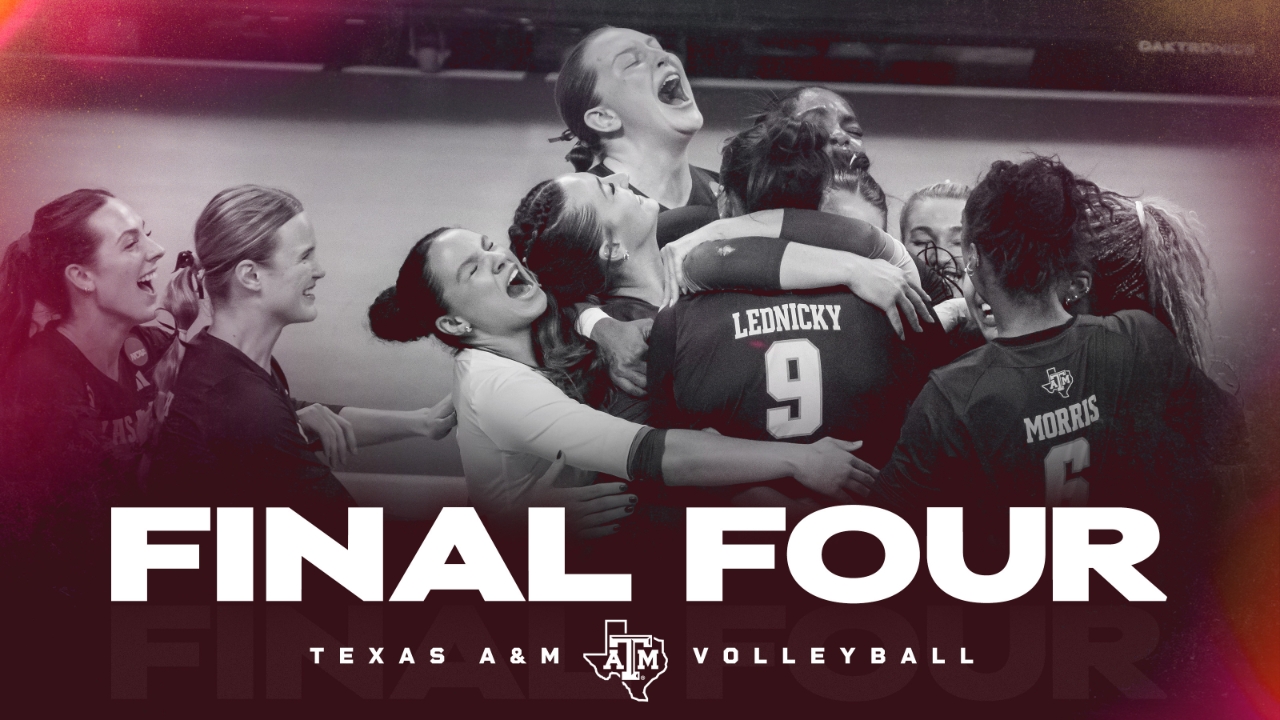
No. 3-seeded Texas A&M did what 33 other teams could not ― defeat a proverbial giant. The Aggies did it in the biggest match of their program’s history, the NCAA tournament regional final, and punched a ticket to their first Final Four. The Aggies beat the top-seed Cornhuskers 3-2 (25-22, 25-22, 20-25, 35-37, 15-13) at the Bob Devaney Sports Center in Lincoln, Nebraska.
“I’m not scared of them,” Aggies head coach Jamie Morrison said before the match. “They’re a really good volleyball team, but we’ve talked the entire season and made an identity of making people uncomfortable, leaning in and imparting our will on the people that we’re playing.”
Imposing their will is putting it lightly. The Aggies had an answer for everything the Cornhuskers threw at them.
The Aggies went up 2-0 before Nebraska showed some fight, tying the match 2-2 behind huge pushes from Harper Murray and Rebekah Allick. Middle blocker Andi Jackson, who typically unravels opposing teams, was neutralized for most of the day with six kills and .045 hitting percentage.
After fighting through 10 fourth-set points, Nebraska forced a fifth set. Still, it was no match for the Aggies, who went on to win behind three players with double-digit kills. Kyndal Stowers led the Aggies with 25 kills and 16 digs plus two blocks. Logan Lednicky had 24 kills and six blocks.
“We’re the grittiest team in the country by far,” Lednicky said after the win.
“I mean a lot of us are seniors. We’ve been doing this for a really long time,” Lednicky added. “And I think all the newbies, too, they came in, ready to work, ready to grind, and we’re just such a special group of girls … It’s just amazing.”
Lednicky is one of nine seniors on Texas A&M’s roster. From the top down, Morrison’s team is loaded with talent that helped contribute to the Aggies’ massive upset. Ifenna Cos-Okpalla, one of the best middle blockers in the country, started a 10-0 run in the first set to help the Aggies capture the frame and the momentum for the match. She also had six kills on .600 hitting, two aces, six digs and eight blocks. Morgan Perkins, in tandem with Cos-Okpolla, added five kills on .333 hitting and nine blocks. Outside hitter Emily Hellmuth was also critical down the stretch with 13 kills, two aces and four blocks.
After the Aggies’ historic win against Nebraska, Morrison shared that he’s been building up the program for the last three seasons and the victory Sunday is a testament to the players and staff.
“I’m so proud of these driven human beings,” Morrison said. “This whole group of human beings that we have as a part of our game.”
The Aggies head coach also shared that his group of seniors meant “everything to him and that Texas A&M “was building something that’s gonna last.”
The last time the Cornhuskers dropped a set was September, and the last time they had been down two sets was Aug. 31 against Kentucky, which has already punched its ticket to the Final Four. The Huskers won 3-2 back then, but could not pull off the reverse sweep on Sunday.

Murray, who had a career high 25 kills on .255 hitting plus three aces and nine digs, didn’t have enough to get the Huskers out of trouble, even with help from Allick. The middle blocker, who was explosive in the fourth set, added 15 kills on .480 hitting plus four blocks.
After the match, Nebraska head coach Dani Busboom Kelly somberly reflected on the Cornhuskers’ undefeated season coming to an end.
“We played with a ton of joy. I think we maxed out,” Busboom Kelly said. “We didn’t make the Final Four. We’re not winning a national championship.”
Busboom Kelly, who is in her first season as head coach, was still proud of her team and its 33-1 record. They left it all on the floor.
“We can look back and have no regrets,” she said.

LINCOLN, Neb. – A memorable comeback attempt fell just short for the Nebraska volleyball team Sunday afternoon in a five-set loss to No. 6 Texas A&M in front of 8,650 fans at John Cook Arena at the Bob Devaney Sports Center.
Texas A&M won the first two sets to become just the third team this season to win two sets against the Huskers. Facing a 2-0 deficit, Nebraska fought back to win the third set then fought off three match points en route to winning the fourth set, 37-35. But the Huskers were unable to complete the comeback as the Aggies were victorious in the fifth set by a 15-13 margin.
Nebraska ended its season with a 33-1 record while Texas A&M (27-4) advanced to the NCAA Semifinals. Kyndal Stowers (25) and Logan Lednicky (24) each finished with more than 20 kills for Texas A&M, while Morgan Perkins had nine blocks.
Harper Murray paced the Husker offense with a career-high 25 kills, but Texas A&M had more kills (75 to 73) and a higher attack percentage (.275 to .270) than Nebraska. The Aggies also out-blocked Nebraska, 17-8. Bergen Reilly had 58 assists and 13 digs to post a double-double. Rebekah Allick had 15 kills on 25 swings and hit .480 in the match with four blocks. Reilly (13), Olivia Mauch (13) and Laney Choboy (10) each had double-figure digs for the Big Red.
Set 1: Murray had a block, a kill and an ace as the Huskers built a 6-2 lead. Kills by Reilly, Murray and Allick made it 10-3 Big Red. The Aggies pulled within 11-8 after a 5-1 spurt. Allick produced a pair of kills and Adriano tallied another to put NU up 15-10. But a 10-0 run by the Aggies gave them a 20-15 lead. Manaia Ogbechie subbed in and terminated a sideout kill, and Landfair found the corner before Ogbechie connected again to make it 20-18. After a Logan Lednicky kill, the Huskers won a challenge that resulted in a kill for Murray, and a block by Allick and Reilly cut it to 21-20. But Stowers tipped a kill for set point and the Aggies won 25-22 with their fourth ace of the set.
Set 2: NU rallied from down 6-4 to go up 8-6 with kills by Jackson and Landfair and an ace by Murray. But A&M went back in front 14-11 after a 4-0 run. Murray tooled a block for a sideout kill, but the Aggies answered with back-to-back blocks for a 16-12 advantage. Consecutive A&M kills put the Aggies up 19-15 as Nebraska took a timeout. The Aggies earned set point at 24-20. An Ogbechie kill and Aggie hitting error gave NU hope, but the Aggies won 25-22 on a Lednicky kill.
Set 3: The Huskers claimed a 10-5 lead with Murray tallying three kills out of the gate. But Texas A&M cut it to 10-9 with four straight kills. An ace by Sigler, and kills by Allick and Jackson put NU ahead 15-12. NU led 18-17 when Allick and Murray posted kills for a 20-17 lead. Adriano added one, and A&M committed three errors down the stretch as the Huskers won 25-20 on a Murray kill.
Set 4: A&M grabbed a 5-2 lead, but two Murray kills helped the Big Red get back even at 5-5. The Aggies rebuilt an 11-7 lead after a 4-0 run. Landfair ended it with a kill, but A&M went up 12-8 on a Stowers kill. The Aggies increased their lead to 18-11. NU roared back with an 8-1 run to tie it 19-19. Kills by Allick and Murray put NU in front, 21-20. Ogbechie recorded a kill for a 23-22 advantage, but an A&M block tied the score. Adriano terminated to grab set point for the Big Red, but Lednicky answered for A&M. Sigler found the floor for a kill, but Lednicky answered again. Reilly dumped a kill for a third set point try for the Big Red, but NU served out. A&M returned the favor, but Stowers terminated to keep it tied 27-27. Allick sided out once again for the Huskers to make it 28-27, but a block error by the Huskers tied it 28-28. Allick and Adriano teamed up for a block on the ensuing rally to make it 29-29 NU, but the Aggies came right back with a block. A&M committed an attacking error but followed with a kill to keep it tied. Ogbechie terminated, but so did Lednicky. The Huskers then hit wide to give the Aggies match point at 32-31. But A&M served into the net to keep NU alive. The teams then traded service errors to a 33-33 tie. Stowers and Allick traded kills for a 34-34 tie. A&M attacked wide to make it 35-34 NU, but Stowers got a kill off of NU’s fingertips to make it 35-35. Murray’s career-high 24th kill put NU ahead 36-35, and Adriano finally finished off the set in NU’s favor, 37-35.
Set 5: Allick and Adriano had early kills, and Ogbechie and Murray combined for a block, as the Huskers went up 3-2. But the Aggies gained a 5-3 advantage with a kill, a Husker hitting error, and a block. The Aggies hit long before a Murray ace tied it 5-5. A&M went ahead 7-5 when Reilly won a joust at the net to make it 7-6. But A&M scored the next three to go up 10-6. A service error ended the run, but A&M claimed a 12-7 lead after a kill and Husker hitting error. After a timeout, Allick posted her 14th kill to make it 12-8, and A&M hit into the net to cut the deficit to 12-9. Stowers answered with a kill to go up 13-9, but Allick answered for the Big Red with a kill. Choboy served an ace to make it 13-11, and A&M called timeout. Adriano and Ogbechie stuffed an A&M attack to make it 13-12, but Lednicky tooled a block for match point at 14-12. Murray stepped up with her 25th kill, but the Aggies got a kill from Lednicky to win 15-13.
Lincoln All-Regional Team
- Chloe Chicoine, Louisville
- Rebekah Allick, Nebraska
- Harper Murray, Nebraska
- Ava Underwood, Texas A&M
- Kyndal Stowers, Texas A&M
- Maddie Waak, Texas A&M
- Logan Lednicky, Texas A&M (Most Outstanding Player)
Nebraska Post-Match Notes
- With the loss, Nebraska fell to 137-39 all-time in the NCAA Tournament. The Huskers rank second in NCAA history in postseason wins and winning percentage (.778).
- The loss snapped Nebraska’s 33-match winning streak, as the Huskers ended the year with a 33-1 record.
- Nebraska fell to 18-16 all-time in NCAA Regional Final matches.
- The Huskers fell to 90-8 all-time in home NCAA Tournament matches, including a 35-3 record at the Devaney Center.
- Nebraska saw its 29-match home winning streak in the NCAA Tournament snapped.
- Overall, Nebraska saw its 63-match home winning streak snapped, suffering their first home loss since Dec. 1, 2022.
- Nebraska lost the first set, snapping its streak of 48 consecutive sets won at home. The streak was the second-longest in school history and the longest in a single season.
- The Huskers fell behind 0-2, losing two sets for just the third time this season and falling behind 0-2 for only the second time this year (also against Kentucky).
- Nebraska was the first to 20 points in only one of the first four sets. The Huskers won the third set when they were the first two 20 points, and NU ended its season 96-0 when it was the first to 20 points in a set.
- Rebekah Allick finished with a career-high 15 kills, eclipsing her previous high of 13 kills.
- In Nebraska’s four NCAA Tournament matches, Allick had 40 kills and hit .576.
- Rebekah Allick finished her career with a .441 attack percentage and 88 blocks in the NCAA Tournament. Her postseason career attack percentage is the highest by a Husker in school history, while Allick’s 88 blocks rank No. 5 in Nebraska postseason history.
- Harper Murray had a career-high 25 kills in the match, eclipsing her previous high of 23. That marked the second time this season and fifth time in her career she had at least 20 kills in a match.
- Harper Murray had three service aces in the match. She increased her career total to 109 aces and passed Jennifer Saleaumua for the sixth-most aces by a Husker in the rally-scoring era.
- Bergen Reilly had a double-double with 58 assists and 13 digs, and she tied her season high with five kills and two aces.
- Nebraska ended its season with a team attack percentage of .351. That is a school record, breaking the previous record of .331 in 1986.
- Andi Jackson finished the 2025 season with a .467 attack percentage. That ranks as the third-highest season attack percentage in school history.
- Texas A&M hit .275 in the match, the highest attack percentage by a Husker opponent in 2025. The Aggies were also the only team to have a higher attack percentage in a match than Nebraska in 2025.
- Texas A&M also had 17 blocks, the most by a Husker opponent in 2025.
- The Huskers’ 37-35 victory in the fourth set marked the highest-scoring set in Nebraska’s NCAA Tournament history.
Match #31: #3 Texas A&M 3, #1 Nebraska 2
S1: A&M, 25-22; S2: A&M, 25-22; S3: NEB, 25-20; S4: NEB, 37-35; S5: A&M, 15-13
Records: Texas A&M (27-4, 14-1), Nebraska (33-1, 20-0)
Box Score
Major upsets often evoke Al Michaels’ ever-present 1980 question.
On Sunday, Texas A&M’s Jamie Morrison likely answered just as emphatically as he did last week inside Reed Arena:
“HELL YES!”
By taking down a Big Red machine of a different kind — the previously unbeaten Nebraska Cornhuskers — Aggie volleyball is headed to the Final Four for the first time in program history.
An already historic run turned miraculous when A&M (27-4) defeated Nebraska (33-1) on Sunday afternoon in five sets, as the Huskers’ happy place — the Bob Devaney Sports Center — watched the Maroon & White crash a Big Red party.
It is A&M’s first win over the No. 1-ranked team since 1995, and given the stakes, it’s much more significant.
“There is no little ounce of me that is scared of them, and I respect them a lot,” Morrison told the Aggies pregame. “I respect them, but I am not scared because we are prepared for this.”
Then, as if channeling Herb Brooks himself, Morrison added:
“I’m not scared because you were born for this as competitors to step out here and be in this environment, and it will be loud. Use your breath. Stay calm in those moments. It will be hard; they’re a good volleyball team, but we are prepped.”
From being prepped to now propelled to the college game’s biggest stage: The Final Four.
Dylan Widger-Imagn Images
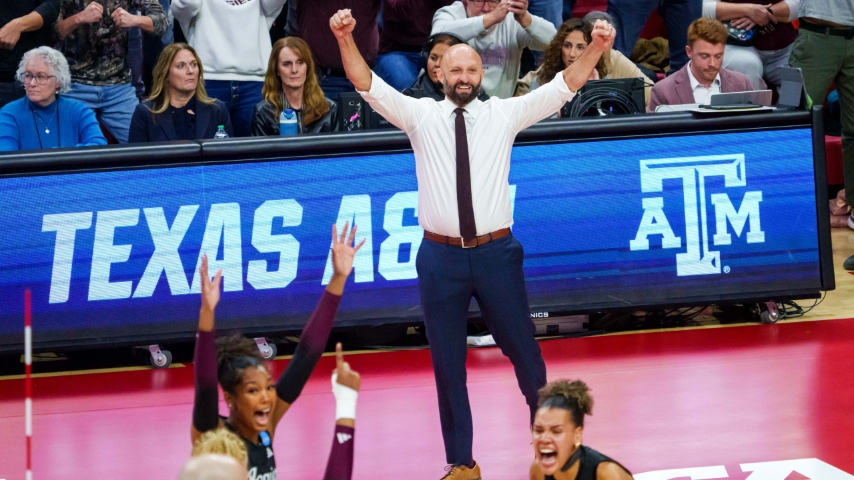
In just his third season in Aggieland, Jamie Morrison is going where no Texas A&M volleyball coach has gone before!
Kyndal Stowers led the way with 25 kills on a .327 hitting percentage.
Logan Lednicky, already one of the greatest Aggie volleyball players ever, led the way with 24 kills and passed Hollann Hans (1,640) for third place on the Aggie leaderboard in career kills with 1,661.
Morgan Perksin and Ifenna Cos-Okpalla were dominant at the net with nine and eight total blocks, respectively. The latter moved into second all-time in program history in blocks with 556. She’s now six behind Jazzmin Babers’ 562 for the school record.
The A&M attack all began with Maddie Waak, who dished out a ridiculous 63 assists.
Before Sunday, the Big Ten champions had dropped just seven sets all season. As the NCAA Tournament’s No. 1 overall seed, Nebraska had been undefeated at home since Nov. 26, 2022, and had swept eight consecutive matches entering the regional final.
No more.
Morrison’s senior-laden Aggies snapped all those streaks and have staked their claim, turning the “Something great is about to happen” prophecy into reality.
From a great opportunity, A&M just authored the program’s greatest moment.
What they have earned here tonight is a trip to Kansas City as the Aggies will face Pittsburgh on Thursday, Dec. 18, at the T-Mobile Center.
Of course, it’s easy to describe Sunday’s victory as a miracle, but Morrison’s program is filled with the precursor: Belief.
And they’ll carry that belief with them all the way to the Final Four.
More to come shortly.
When Elijah Claravall from Isabela first stepped onto a Taekwondo mat as a young boy, he could not have imagined the journey that lay ahead. What began as a childhood hobby soon became a lifelong passion—one that would take him across borders, transform him into a mentor, and inspire the next generation of athletes in Qatar.
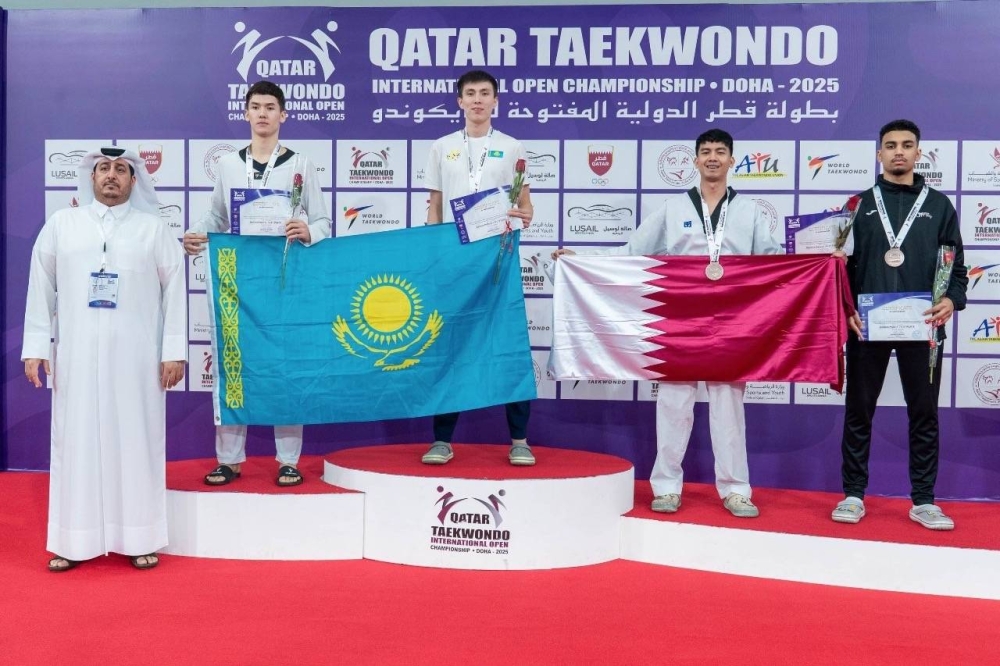
Today, known affectionately as Master Eli, he is both a decorated competitor and a cherished instructor within the country’s vibrant Taekwondo community. His recent Bronze Medal win at the 5th Taekwondo International Competition in Qatar is more than just a personal triumph; it is a testament to the perseverance, dedication, and passion that have defined his remarkable journey..
A Beginning Rooted in a
Mother’s Guidance
For Master Eli, Taekwondo wasn’t just an activity — it was woven into his upbringing. His mother, a Karate Black Belter and national athlete, introduced him to martial arts early, laying the foundation of discipline and resilience that would shape the course of his life.
“With my mom guiding me, Taekwondo felt natural,” he recalls. “All my sisters trained too, but only my youngest sister and I continued. She’s now a varsity athlete at UP Diliman.”
He earned his 2nd Dan black belt only after college as his mother had always reminded him that the belt was secondary. She instilled in him that his focus should not be on the belt but more on developing his skills and harnessing character with self-discipline and respect — values that would later become cornerstones of his own teaching philosophy.
Though he briefly explored basketball because of his height, the pull of Taekwondo proved stronger.
“I set Taekwondo aside to try basketball, but after four years, I realized that it was in the sport of Taekwondo where I truly belonged.”
The Leap of Faith That Led to Qatar
A defining moment arrived when he learned of an opportunity to teach Taekwondo in Qatar. It was a decision that required courage — a leap into the unknown — but it also presented the chance to share his craft with a new generation.
When he joined the Pinoy Taekwondo Center (PTC) in Qatar, he discovered more than a workplace.
He found a purpose and a home.
Over the years, Master Eli became a pillar of the center. Children gravitated toward his warmth and patience; parents admired his consistency and values; fellow instructors respected his humility and quiet confidence. In Qatar, he did not just train athletes—he nurtured character, resilience, and self-belief.
This was where he truly became Master Eli.
More Than Just a Medal
At the recent 5th Qatar International Taekwondo Competition, Master Eli fought with focus and heart — qualities he emphasizes daily in his classes. Winning bronze was a powerful moment, not merely for him but for the entire PTC
community.
“When I stepped onto the podium, I wasn’t just thinking about my performance,” he says. “I was thinking about my students. I wanted them to see that hard work matters. That effort counts.”
For his young athletes, watching their mentor earn an international medal turned inspiration into reality. It showed them that dreams are not abstract ideas—they are reachable goals shaped by discipline and determination.
Inside the Dojang:
Where Champions Are Made
Within the walls of the dojang, Master Eli is both firm and approachable—a coach who demands excellence but teaches with encouragement. His classes balance structure and motivation, creating an environment where students feel both challenged and supported.
“Kids don’t just need technique,” he explains. “They need confidence. They need someone who believes in them.”
Teaching a generation shaped by technology and constant change requires adaptability. As a Millennial guiding mostly Gen Z and Gen Alpha students, he takes time to understand their learning styles, interests, and motivations. The goal: to uphold the timeless standards of Taekwondo while making them meaningful to today’s young athletes.
Parents consistently speak of the transformation they see in their children—sharper focus, stronger discipline, and newfound self-assurance. For them, the secret lies in the atmosphere he creates: structured, inspiring, and deeply rooted in respect.
“I really enjoy teaching the kids,” he says with a smile. “Seeing them grow—not just in the sport but as individuals—makes everything worth it. When they carry the tenets of Taekwondo beyond the mats, that’s when I know I’m doing something right.”
Dreams, Goals, and the Road Ahead
Despite his growing accomplishments, Master Eli remains grounded. He aims to continue advancing his Dan level, return to international competitions, and help elevate PTC’s presence on bigger stages.
But above all, his greatest goal is simple and sincere: to build a legacy.
“I want my students to become strong athletes and strong individuals,” he shares. “Champions on the mat—and in life.”
From a determined young boy in the Philippines to a respected mentor in Qatar, his journey is proof of what happens when passion aligns with purpose. His story is far from over.
And for every child who bows before him in the dojang, and proudly calls him Master, it is a story worth watching — one kick, one lesson, one dream at a time.
Dec. 14, 2025, 9:54 p.m. CT
Wisconsin volleyball is heading back to the Final Four.
Carter Booth made sure of it.
And she let the world know she wasn’t going to accept anything less than that result in her post-match interview moments after the third-seeded Badgers’ emphatic four-set upset victory over No. 1 Texas in the regional final.
“I refuse to (expletive) lose,” said the star middle blocker in her interview on ESPN.
She apologized after realizing what she said. But the message and her energy as a whole was well received by Badgers fans on social media.

The senior, who has played the last three years with Wisconsin after beginning her career with Minnesota, had 11 kills and a .389 hitting percentage in Wisconsin’s win. Mimi Colyer, who had a team-high 23 kills to lead the attack, was alongside Booth for the on-court interview.
It’s the Badgers’ sixth appearance in the Final Four in Kelly Sheffield’s 13 years as coach and fifth in the last seven years.
Wisconsin, which has won 13 straight matches dating to Nov. 2, is now two wins from its second national title. And if Booth has any say, Wisconsin won’t be losing again.
Wisconsin volleyball fans react to Carter Booth
Wisconsin volleyball fans loved Booth’s interview:
Wisconsin volleyball advances to Final Four
Here’s the moment the Badgers clinched the win:

AUSTIN, Texas – The No. 3 Texas Volleyball program fell to No. 10 Wisconsin in the NCAA Regional Final, 3-1 (22-25, 21-25, 25-20, 19-25), Sunday night. Sunday night’s appearance marked the 18th time in 20 seasons the Longhorns reached the Regional Final.
Texas finished the season 26-4 overall with 12 wins against ranked opponents, including a starting stretch of 18-straight wins.
The Longhorns saw freshman Cari Spears record 12 kills off 28 swings to hit for .321 against the Badgers. Senior libero Emma Halter posted a team-leading 13 digs and ended her Longhorn career with 1,307 – No. 8 on the UT All-Time list.
Set one: Despite a late rally to stave off five set points, the Longhorns dropped the first set behind Mimi Colyer leading Wisconsin with six kills. Junior outside Torrey Stafford finished with three kills and two of her four solo blocks.
Set two: Wisconsin was lights out in the second hitting .400 and siding out on a 66 percent swing. The Longhorns were limited to a .267 hitting percentage despite Whitney Lauenstein’s best efforts with four kills.
Set three: Texas battled back in the third to take its only set after hitting .400 with just 11 kills. Spears added three kills off six swings to lead the Horns in its efforts to tie the match.
Set four: Even though the Horns jumped out to a 4-0 run to start the set, the Horns were held to a .158 hitting percentage – its worst of the match. The Badgers jumped out to its biggest lead at 17-10 and went on to advance to the NCAA Semifinal.
Both Spears and Stafford were named to the Austin Regional All-Tournament Team.
Nebraska volleyball loss shocks world, fearless Texas A&M downs giant

NU’s Perfect Season Ends in Regional Final – University of Nebraska

KC BOUND! Miracle upset in Lincoln sends Texas A&M to Final Four

The Rise of Master Eli: Inspiring Young Champions at Pinoy Taekwondo Center

The 8 best players in this year’s College Football Playoff

Denny Hamlin Discloses the Massive Figure Teams Pay Because of NASCAR’s Sponsorship Restrictions
Wisconsin volleyball’s Carter Booth has viral moment after Badgers win

Denny Hamlin On Exactly How He Kickstarted the 23XI Dream With Michael Jordan

No. 3 Volleyball falls in NCAA Regional Final to No. 10 Wisconsin, 3-1

Great Ideas in Destination Branding: Pennsylvania Tourism Office

How to Watch NCAA Tournament, Regional Final: Texas vs Wisconsin

Way-too-early favorites for college football’s top award

Season Ends for No. 1 Nebraska Volleyball with Five-Set Loss to No. 3 Texas A&M

Page not found | Racine County Eye

Young WNBA stars bring a youth movement to USA Basketball camp

First Tee Winter Registration is open

Fargo girl, 13, dies after collapsing during school basketball game – Grand Forks Herald

CPG Brands Like Allegra Are Betting on F1 for the First Time

F1 Las Vegas: Verstappen win, Norris and Piastri DQ tighten 2025 title fight

Volleyball Recaps – November 18

Two Pro Volleyball Leagues Serve Up Plans for Minnesota Teams

Utah State Announces 2025-26 Indoor Track & Field Schedule

Sycamores unveil 2026 track and field schedule

Redemption Means First Pro Stock World Championship for Dallas Glenn

Texas volleyball vs Kentucky game score: Live SEC tournament updates

Jo Shimoda Undergoes Back Surgery

Robert “Bobby” Lewis Hardin, 56

Bowl Projections: ESPN predicts 12-team College Football Playoff bracket, full bowl slate after Week 14

How this startup (and a KC sports icon) turned young players into card-carrying legends overnight

Pohlman admits ‘there might be some spats’ as he pushes to get Kyle Busch winning again

 NBA Legend Michael Jordan to Join NBC Sports as Special Contributor
 Why a rising mid-major power with an NCAA Tournament team opted out of revenue-sharing — and advertised it
 Falcons mailbag
 Portal Update – Basketball and Gymnastics Take Hits
 has always dreamed in Mercurial. Now his initials are on the boots.
The new Kyl…
has always dreamed in Mercurial. Now his initials are on the boots.
The new Kyl…
-
 Rec Sports3 weeks ago
Fargo girl, 13, dies after collapsing during school basketball game – Grand Forks Herald
-
 Motorsports3 weeks ago
CPG Brands Like Allegra Are Betting on F1 for the First Time
-
 Sports3 weeks ago
Two Pro Volleyball Leagues Serve Up Plans for Minnesota Teams
-
 Sports3 weeks ago
Utah State Announces 2025-26 Indoor Track & Field Schedule
-
 Sports3 weeks ago
Sycamores unveil 2026 track and field schedule
-
 Motorsports3 weeks ago
Redemption Means First Pro Stock World Championship for Dallas Glenn
-
 Sports3 weeks ago
Texas volleyball vs Kentucky game score: Live SEC tournament updates
-
 Motorsports2 weeks ago
Jo Shimoda Undergoes Back Surgery
-
 NIL2 weeks ago
Bowl Projections: ESPN predicts 12-team College Football Playoff bracket, full bowl slate after Week 14
-
 Rec Sports2 weeks ago
Robert “Bobby” Lewis Hardin, 56