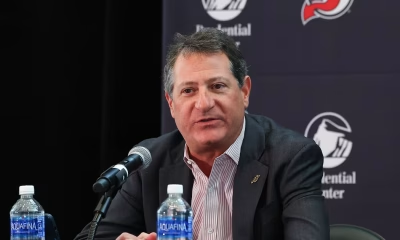
University of Nebraska Director of Athletics Troy Dannen met with members of the media Friday morning.
Dannen touched on a number of issues regarding Husker Athletics and the changes in collegiate athletics.
To watch Dannen’s press conference, click on the video above, and a transcript of the press conference is below.
University of Nebraska Director of Athletics Troy Dannen
Press Conference – Aug. 8, 2025
Opening Statement
“First, a couple things from last year that I want to talk about. Competitively, I think we have five sports in the top-10, bowl champion, Crown champion, and a couple of Big Ten champions. It was a really good year competitively. A lot to celebrate.
We also won off the field. We had a 3.46 department GPA, which is a record at Nebraska. Nobody talks about academics anymore, but internally, we talk about academics all the time. So everybody’s very proud of that. We had 11 more Academic All-Americans last year.
We also did some really good things financially. We set a record with 17,663 donors. We also passed $70 million dollars in donations last year for the first time, another Nebraska record. Tyler Kai and his crew did a remarkable job. And then the other area where I think no one compares to Nebraska from an attendance standpoint, two things that I’ve learned to look at here. One is the women’s four. If you take the FBS schools and the sports that we all almost compete in the women’s four, which is volleyball, softball, basketball and soccer, our attendance last year was 337,000 in the women’s sports. That’s second in the country, which is pretty remarkable. I think South Carolina was ahead of us. LSU was right behind us. And then the seven, if you expand it to include men’s basketball, baseball, and football. So of the seven ticketed sports, we were at 1.3 million. That’s seventh in the country, second in the Big Ten, behind Ohio State. I think four of the schools above us were 100,000 seat football stadiums. So, 1.3 million in a state with a population of two million is really remarkable, just a credit to the fans. I saw it from a distance, but in my first full year of living it, I saw the power of the fan base. But, the windshield is bigger than the rear view mirror for a reason, so we’re looking forward.
A few things just in general. One, two new coaches this year. Dani (Busboom-Kelly), as everybody is very familiar with, but since Dani wasn’t here at the start of this new school year, and then Breanne Hall coming in to coach women’s golf, who will do a great job and did a great job at Illinois State. I haven’t really talked publicly about Kyle Crooks joining the team. We’re going to have a lot of memories of Greg (Sharpe) this year and a lot of things we’ll talk about. But, I am thrilled with Kyle. I’m thrilled that he was able to be recruited into the pool. The last conversation before I met with him was with Ian Eagle, who’s really his mentor. I have great respect for Ian and the things he said about him. When I met with Greg and talked to Greg in those last few months, we talked about his successor and what I should look for in that. He talked a lot about humility and I think that’s really important in the state of Nebraska and Kyle has great humility. But, he also talked about relationships and how important the relationships were with coaches and kids. Kyle, I see him at almost every practice. He’s starting to build those relationships. I couldn’t be happier with him.
Aramark is coming in to take over concession sales and alcohol, which is going to be a big transition in the stadium. We had a little bit of a trial run during the scrimmage last Saturday night, and everything went as smoothly as it could be. They’ve invested about $7 million dollars in capital inside the stadium kitchens and different ways to distribute concessions to enhance the fan experience as much as possible.
There’s fully mobile ticketing in the stadium, we’re instituting the no re-entry policy. Both of those things will cause consternation, I understand that. I think our group has done a really good job of trying to make it as seamless for our fans as is going to be possible. I talked about it a little bit, I think there was a World Herald piece this morning on a deal I did in Omaha yesterday.
Internally, security is a big focus of our year. Last year we put the Evolve technology in at the entrances. We didn’t do it every place and back entrances, and we’re doing that this year. We spent a lot of time studying security. One, with the inclusion of alcohol in the stadium and two, there’s just a lot of things some of us that were new noticed last year that maybe was not our best practice. You won’t see most of it. We will have between 100 and 110 uniformed officers this year. At home games last year we were at 75. We’ll probably increase that again next year. While we’re in a place where security is an afterthought, I don’t think in this day and age we can do anything less than best practice and anything less than have a secure and safe environment as to the extent that we can do.
We are hosting five Big Ten championships this year. Both gymnastics’, both outdoor tracks and field and baseball. The track facility is progressing well, it should be done by mid-fall. It’s something we’re all going to be very proud of when it’s done. It will seat about 2,500 people and we’ll bring in temporary bleachers for the Big Ten championships.
We are moving forward with plans to extend Cook Arena. When the winter sports season is over, we will take the plywood that’s back behind the benches and take that plywood out. The treads from the old basketball arena are still there. We’ll put new seats on those. I think capacity right now, we’ll get to 10,200, give or take a few. The lower bowl will be replaced with seat backs, with the exception of one end where the students will be. That means all the students will go from four corners to one end. A lot of work will take place inside the arena at the end of the spring sports.
Last year, I think internally, one of our big focuses was nutrition and getting Flik off the ground. This year, it’s event planning. We’ve hired two of a three-person events crew, special events division. We have to use our venues. One, a 10,000 seat venue. We have PBA at 16,000, and then we have obviously the stadium. We have to start thinking entrepreneurially. The days are past when we can just rely on ‘hey, there’s seven home football games and we’re going to sell out the stadium’. We have to find ways to generate revenue. I know everybody’s tired of hearing about it, but we have to generate revenue outside of raising ticket prices, and one of the ways to do it is capitalizing the venues. One, it’s great for the community. We have to start thinking about heads and beds. We have to start thinking and acting like we’re a convention visitors bureau. We can’t be passive any longer. I hope somebody calls us and wants to perform in our stadium. So the idea of this events group is to actively pursue events. We’re having the Nebraska Chamber of Commerce in the west side that I speak to in a couple of weeks. I’m talking events from that to stadium shows to concerts, to other events. That’s what this group is there to do. They’re just getting here, but we’re engaged with three different potential events for calendar year 2026. We aren’t going to see anything in the stadium this fall, but it takes time. Most of these are a year, 18 months in advance. That’s a big focus for us. We recruit coaches, we recruit kids. We have to recruit everything, and not just passively sit by.
A lot of people are interested in speaking of the stadium and where the Memorial Stadium project is, I would tell you the status quo. A couple of things – when I say we’re continuing to plan, in a normal time a stadium project like this, all of this work would be done without anyone knowing we’re doing it. But, the fact that the project was out there in the public, approved to some degree by the planning board, everybody’s waiting for the next step. We’re continuing basically looking at east, west, north and south in totality. This week, the chancellor sent a note out talking about the structural deficit of the university. The president has spoken about some of the system-wide financial issues. There’s going to be a lot of trauma ahead. We’re not going to take anything to the board for their approval, and I don’t know when we will. The time is not now in the midst of what I would level some degree of crisis on campus, consternation at the very least, crisis at the very most. Now is not the time to debut a big capital project. But, we’re going to continue to work on the plans. We’re going to continue to fine tune the financial model, and at whatever point in time, I think we can comfortably take it back, we’ll take it back. Otherwise, I would just say status quo.
One last thing maybe, Husker Athletics is a part of a much larger enterprise here, and sometimes we forget about it. This is our life. And I say our life – mine, our staff, our athletes, and everything else. But we have to never forget we’re part of a bigger enterprise and we’re part of the university. About the time the tail tries to wag the dog, the dog’s going to bite it. We need to understand what we do and how we support the university in general and other things that have to be done besides just athletics. Finally, I want to talk a little bit about house, and maybe a lot a bit about house to fill everybody in on where we’re at. First, we are paying the full $20.5 million dollars that’s permitted by the settlement this year to the athletes, or committing that to the athletes. I don’t think that’s a surprise to anyone. Four sports – football, men’s and women’s basketball and volleyball are allocated a cash pool from that $20.5 million dollars. I’m not going to talk about the numbers and I don’t think anybody in the country is talking about the numbers that’s going sport by sport. I don’t think anything’s out of whack with what happens in most places. When the coaches get that pool of money, they decide who gets what and how much. Whether it’s one year, two years, whatever the contract terms are with the individual athletes. It harkens back to the days of Northern Iowa when football was an equivalency, and did you give an athlete half of scholarship or a quarter scholarship? That’s what this is. Coaches have to make those decisions. That’s why we have GMs. That’s why coaches and everybody’s moved to GMs, because there is now a strategy. How are we, where are we allocating those resources? Not to mention the fact that nearly every athlete has an agent. The head football coach cannot be expected to deal with 80 agents, and that’s the role of the general manager right now. Soccer, wrestling, baseball, softball, men’s and women’s track and field have additional scholarships. I bring that up because the additional scholarships count against that $20.5 million dollar total, $16.5 million in total this year. That number is going to grow, I think in the long term as to, how do scholarships count against the cap? We’ve made the conscious decision here to allocate cash and not allocate scholarships before cash, with the exception of those sports.
Where did the $20.5 million come from here? A combination of reducing our operating expenses. We eliminated 27 positions, starting last fall when this looked imminent. We held a lot of positions and just didn’t fill them. At the end of the day we eliminated I believe seven active positions, and then the other 20 positions had been vacant, and we just eliminated them off our books. That was two to three million dollars of savings in those positions. We reprioritized expenses, probably good timing with a lot of us knowing to just go through everything we did. This may be the last budgetary item to be added, but I would tell you, it’s probably first in priority. That means everything else had to be re-evaluated and looked at. What do we do? What do we not do? How are things going to be different? So that’s where the savings were.
The flip side from a revenue standpoint, obviously the sale of alcohol, the changes with Aramark. Those decisions were made knowing that his financial liability was going to be on our books this year. I think by the time the advertising pieces and everything else is added, we hope to be around $5 million positive with what we’re doing from that side of it. With Big Ten distributions, Tom Osborne is going to get credit for a lot of things. He’ll never get enough credit for bringing us to the Big Ten. That has allowed us to do some things and that gain in resources from our development staff, those things allowed us to not cut any budgets. We didn’t cut any sports budget. We did some things administratively that probably needed to be done that nobody will ever see. But, it also allowed us to protect the financial model.
I want to talk about the Nebraska model for a second. I would tell you now, having been here about 18 months, the number one job that I have, all of you think it’s winning. And when I say I, I mean I, my team, our department. It’s winning games. Now, faculty will tell you its graduation and grade point averages, and the CFO will tell you its balance in the budget. But, the number one priority is protecting the financial model that I walked into that had been developed over the years. A financial model that’s possible because of those attendance numbers I talked about earlier. That’s why the financial model is viable here. And that financial model is this. We don’t take any student fees, we don’t take any institutional subsidies. We don’t take any state dollars. We pay full rack rate for scholarships. There’s no out of state differential wavers. And, we pay the last two years, and this year again, $5 million back to the university as a subsidy. That financial model has to be protected at all costs. It’s that financial model that allowed us to do essentially nothing draconian to get to the $20.5 million that is growing 4% a year. That cost is going to continue. It allowed us to not raise ticket prices. It allowed us not to reduce the subsidy. It allowed us to keep the budgets whole through the 24-sport lineup. That financial model is the fuse that’s going to light whatever success we have. And so I will tell you, we will protect it at all cost.
I’ve been asked about the collective. A lot of institutions have changed their collective. Their collectives have rolled in-house first. It cannot be overstated the appreciation that we need to give to Tom and Rhonda Peed and to those who are behind 1890. They’ve done everything we’ve asked and we’ve needed. Whatever position, whatever trajectory that Matt (Rhule) has been able to take, football in particular, has been because of what the collectivist has allowed us to do. As we’ve talked through with the collective, what do these new rules mean? Their message to me is, tell us what you need us to be, and that is what we will be. The days of the collective collecting cash and distributing it as if it’s NIL, but it’s pay for play, those days are gone. The settlement stopped that. They can still facilitate NIL deals. 1890 has a lot of branded products and they can still enter into NIL contracts with athletes to promote their branded products. And until we know, really, you’re starting to see a lot of discussion about it, what is going to happen with NIL with high school students. What can collectives do before they get here, which is not necessarily contemplated by the settlement, but needs to be contemplated by anti-circumvention rules that are being developed right now? Until we know that, I don’t think we really know what exactly the full role of the collective is going forward. I would expect it, dependent upon the rules, it may diminish. It may reduce. And, it may eliminate the role of the collective. We’re really focusing right now on 24, 36, 48 months from now, what structure do we need to have in place to optimize our chances to win , and whether it’s a revised version of the collective, or whether the collective will get a new breath of life through how the settlements are operationalized. That’s what we’re working on right now.
As far as the settlement in general, I will tell you, I would urge our fans, as I have urged our coaches. Do not get frustrated with the growing pains associated with CSC and all the things that come with the settlement. This thing is six weeks old, and it’s no different than a freshman showing up. Peak performance does not happen on day one. I think a lot of people had this unreasonable expectation that day one, everything was going to run as efficiently as it’s ever going to run. I’ve been thrilled with everything that’s happened and I’m a governance nerd, I think they’re doing a great job. There’s a learning curve. Some people are going to embrace everything and some people are going to fight everything, which makes it just that much harder for them. It needs to work, it has to work, for the sake of the enterprise. If we give it the chance and find the patience and tolerance to let this thing find its equilibrium, it’ll work great. We’ve never demonstrated patience and tolerance as soon as something happens that we don’t like. We’ve tried to regulate it in a different direction. We’ve just got to go through some growing pains, and that may prove to be some inequities. But, I will tell you, I will take Nebraska’s problems before anybody else’s problems as we go through that. And that goes right back to the financial model. Everybody asks the role and importance of the fans. It’s showing up right now. It is showing up in rare form. We’ve had 39 NIL deals submitted to the NIL Go clearing house, 20 of those have been approved. Four of them just went in, so we haven’t had a chance to get them back. The deals have been in range from $600 to $40,000. We’ve had three, I think, above $35,000. Not every deal that an athlete has has been submitted yet. It’s up to the athlete to submit deals so that number will continue to grow. There’s 15 deals that there’s been no decision. We haven’t had any deals rejected. But there are 15 sitting there awaiting a response. All 15 are deals between collectives and student athletes. That’s probably tied into the kind of back and forth over what the collectives are going to be able to do and what they weren’t going to be able to do. So, we’re expecting some answers. Most of those deals are small, under $10,000 of value. Most of them are not cash, but they’re in kind. We’ll see how those deals play out. But honestly, I’ve been thrilled with everything that’s happened with NIL Go. I think it’s exceeding expectations for six weeks in.
I talked a little bit about the track and the arena project. I do want to talk about a couple of other capital projects. It is hard to believe that 12 months ago, we were moving into OLC. Talk about the differences in the football program this year versus last year. They were still trying to find light switches and plugins in OLC. The nutrition program is a badge of honor that we should all wear very proudly. They hadn’t even served their first full set of meals at this time 12 months ago. So, we’ve come a long, long way. You talk about differences, that’s a huge difference. I think that just operationally behind the program, you saw the grass fields. We’ve talked about them. The first time in 30 years we put new grass on top, but there were still rocks that were coming up and everything else. So it was dug down 36 inches and rebuilt. It’s rebuilt in a way that we can turn the fields in a couple of different directions. That project is complete. New turf in the stadium, the same turf that’s inside the Hawks (Championship Center) indoor. The north scoreboard is new. It may not look new, but everything had to come out. I think you saw last year, it fritzed on us a couple of times during games. So that’s been replaced. Verizon has made a $20 million investment in cellular service in the stadium. No promises that everybody’s going to be able to stream other games when they walk in like they would if they were at home on their wifi. Wifi will be a part of the stadium project eventually. We’re not doing wifi until the stadium project is done, but we expect this to be a huge upgrade for the fan experience. Golf, bowling and rifle, there’s noise you hear upstairs sometimes and sometimes not. That’s golf, bowling and rifle locker rooms. Believe it or not, they didn’t really have locker rooms. They do now. Golf will have men’s and women’s hitting space and a putting space. Because, as I remember coming back to the midwest, golf is not a 12 month a year outdoor sport here. As much as we can do here for those sports, we want to continue to do. I hope the soundproofing is good enough that we don’t hear balls hitting all season, but I think we’re in a really good place moving into the year. The last thing I will tell you is we just had a head coaches meeting two days ago and I think every coach in this department would tell you expectations, competitive expectations, for this year are equal to or greater than they were last year. And frankly, that’s all I can ever ask for. That’s all any of us can ever ask for our programs.”
On the relationship a winning football team has to revenue generation
“You can argue that in the last 20 years, football maybe hasn’t won at that level and the financial model still works. I don’t think that’s infinite. We have to win. If you’re doing this to not win, if you’re not in it to win it, get out. We’ve invested a lot of resources in football in the last couple of years. Investing resources not to compete where we were, but to compete where we expect to be. We’ve done it in personnel, we’ve done it in infrastructure, we’ve done it in every way we can. Football needs to win. I want 24 sports to win. I want 24 sports to be in the position to win a conference championship. Just a rough estimate now, our budget – $225 million, give or take. The Big Ten and CFP monies, let’s just say it’s about $100 million. That’s 92-93% football related. The donation is at $70 million. Not all of it is football, but I would tell you at least 85% of it is football. A home game in football is worth $10 million. Take 10 plus 90, pretty close. You look at that revenue model and say, how much of that is attributable to football? That’s the majority of it. Volleyball will be on or about the Mendoza line from a financial standpoint. That’s not because volleyball doesn’t generate money. It generates money at a magnitude and a delta above anyone else in the country. But we invest a lot in volleyball as well. But football is the engine in every way and it’s important that you win.”
On his expectations for football this season
“In the goals sessions that I have with our coaches – what are my goals, what are your goals – I have never given anybody a competitive goal. Too many factors that cannot be controlled. I know this is very subjective. I don’t sit in my office. I couldn’t call a play. I couldn’t recruit a player. You can tell a lot about where a program is at by being amongst it and within that program. Haven (Fields) is at practice every day. I’m there two, three times a week. I’m over in the football offices. I’m walking around. I’m in the locker room. They’re coming to the house on Sunday for a hog roast. To have great success, the culture that needs to be in place for it is there. I don’t know that it’s always been there, but it’s there right now. I want to win at a level that Nebraska has seen before. You don’t go from where we’ve been to that today. In some ways you’re right, there has to be progress. I talk a lot about building blocks. Getting to the bowl game, as absurd as that seems, given our last decade, that was a foundational block that needed to happen before we could take the next step. Winning the game was a foundational block. The next one is going to be that fourth quarter drive that everybody talks about – what hasn’t happened. Then we can finally start talking about what has happened. There’s a lot of things that, however the record turns out, I think you know whether the program is progressing or whether the program has been progressing.”
On the process of how revenue share funds get to individual sports
“About a year ago, we met with every coach. Jonathan Bateman, who is our guru. He’s our NIL guru. He became – I don’t know what exactly the terminology is, but every campus has one – he’s kind of the point person into the system. He is that person. He and I met with a sport administrator and every head coach and talked about what they thought they needed. And again, we’re starting from nothing. Nobody knows what anybody else is doing. Normally, coaches will say ‘I need what they have.’ They had to really show some initiative – what do you think you need? We took that and then had another meeting a little bit later, got the coaches’ input. My mindset coming in changed from talking to the coaches. I thought we were going to have one program and one plan and one size fits all. I would tell you we probably have 24 different models for, what does football need? Because it’s different from baseball. Baseball needs scholarships maybe before they need revenue share dollars. There’s a lot of that that the coaches have to decide. Then once we make the allocation of the revenue, it’s no different than allocating budget dollars to them – here’s how much you get this year. Just like a scholarship, the coach decides how much money someone should have. Then the coach and the sport administrator make that decision, then it goes to Jonathan. Jonathan makes sure that from a compliance standpoint, are we within the $20.5 million? Are we within the number that’s been allocated? Before we submit it, does everything work? Everyone who’s getting a dollar in cash from the revenue share has to sign a contract. It’s a contract that’s common across the Big Ten. My guess is this contract will be common throughout the A-4. They sign that contract and then it gets to me. Ultimately then, I sign off on the contract.”
On if sports can get scholarships and revenue share dollars
“No. They could use those dollars for scholarships if they chose. But we didn’t say, here’s money plus scholarships. It was, here’s a pool of money, if you decide you want to add scholarships. So, Matt (Rhule) wanted to be at 86, he wanted to be at 83. He has that flexibility, whatever he thought his needs were. The question for Matt was, if you have a dollar, is it best invested in your two deep or is it best invested in your 87th player? Those are hard decisions but those are decisions that every coach had to make.”
On if he expects sports to be able to get scholarships and revenue share dollars
“I don’t think there will be unanimous support to change it. This is a very provincial world and people only want to do what is in their best interests. It is in Nebraska’s best interest for that to change. We’d add 125 scholarships tomorrow if that changes. That’s because of the financial model. If the financial model isn’t in place at another school, it may not be in their interest and they may not want to do it.”
On how the frontloading of NIL money will correct itself
“I think some people are betting on the fact that since it’s happened, there’s no way you go backwards. I talk a lot about that. This has to hold. This has to work. It has to for that reason. Don’t think that the money that was coming in and frontloading and the money that was there for NIL the last two, three years – that was not an endless stream. It’s not just here but it’s across the country. There was some donor weariness to this. And now the fact that we’re actually paying them, I think some donors are questioning, ‘why am I writing a check if you’re paying them?’ The biggest question is, what are we going to do with high school recruiting? Because the frontloading has moved to high school recruiting. Because you can give anybody anything right now and it’s unregulated by the terms of the settlement. It’s probably circumvention of the settlement. I hear various things about what’s happening. Some of it’s true, some of it’s not true. I’m not sure I should repeat it because I don’t trust a lot of what I hear unless I see it, to be sure. I do know there’s a lot of money going pre-enrollment right now as a way to circumvent the gap. I’d say it’s moved from recruitment and retention to recruitment. How that’s handled, there’s a lot of us that have made suggestions about what we should do from a regulatory standpoint. We’re waiting. This gets back to the fact that there’s a lot of frustration. Why don’t we have that answer right now? It’s because it’s brand new and it’s going to take a little bit of time. That’s where we have to have patience. We can be frustrated that this is happening at that school or this is allegedly happening at that school, but we’re going to get a set of rules to deal with and then we’re going to go forward and we’re going to optimize what we can do with that set of rules.”
On if he takes revenue share dollars into account when evaluating coaches
“I stand up here and I’m telling you I don’t know what other programs are paying. I don’t know what other programs are paying. What I do know is that everybody lies. ‘We’re doing x and that school is doing y.’ Are they really? A lot of the numbers you see right now are a result of frontloading. Money that came in. This roster is getting x. That x is not a part of the $20.5 million. That’s impossible. If you want to have a thriving program, then you don’t have a $10 million basketball chunk out of your $20.5 million. The one thing about no transparency – we all try to keep this provincial because there’s this competitive piece to it – is that we’re liable to the misinformation that’s flowing around. At the end of the day, one thing is still true, no matter what the number is. If they took the cap off and we could spend as much as we wanted, it still comes down to, do you get $1.25 out of a $1 spend? Or do you get 75 cents value out of $1 that you spend? In some ways, having a dollar is one thing, but what you get out of it is another. Talking about evaluating coaches – I’ve told the coaches, at the end of the year, when we have our evaluations, we’re going to go through the allocation of revenue share dollars and we’re going to talk about ROI. Was the ROI on this allocation good? Was the ROI on that allocation good? It’s going to impact what happens the following year. Coaches have always been accountable for budgets and in some ways, if you missed on a scholarship, eh, you missed on a scholarship. If you miss on a $250,000 revenue share allocation, that’s a big deal now. Back to the role of the GM – why are we spending so much on GMs and adding that person in now? The stakes are really high right now. The $20.5 million, that is about 1.5x greater than the scholarship budget of the entire department. So it’s a big number.”
On how Nebraska’s men’s basketball team competes with schools who don’t have a football team to give money to
“Well I think historically, those who have spent the most have not won the most. You have to spend reasonably. You have to make certain investments. If your decision as to whether we have success is whether I have the largest NIL budget, there’s going to be a lot of places that aren’t your place. I think basketball coaches are challenged right now that have big football programs because of what they see in the programs that don’t have the football expense, if you will. They also don’t have the revenue driving in. Very few basketball-only schools are self-sufficient. How and if they’re able to drive enough revenue to provide numbers of a magnitude, we’ll see over time. There’s a lot of stories out there. The fact of the matter is, one donor could write that check and donate it to the university and there you have it. It is different. This sounds cold and hard, but if you’re at a school with major college football, there’s a cost to major college football. We’ve talked about the revenue that it drives to the rest of the department. The investment in major college football is the priority. Finding a way to support basketball the way it needs to be supported. When I talk about football and basketball, when you look at the percentage of revenue – just take revenue at the University of Nebraska. This is one of the exercises we went through. How much revenue of our $225 million, when you can drive it by sport, how much of it is driven by sport? The percentage of money that’s being allocated to basketball and allocated to football is much higher than the percentage of revenue being driven by basketball vs. football.”
On ticket sales
“I know Michigan is sold out. I’m looking at Haven (Fields) back here, because I haven’t had an update. For the most part, here’s what happens. We have 66 thousand season tickets out. We have about seven thousand students. That gets you to 69. You have to give three thousand to opponents. We have the band, we have other things in there. It leaves a very small number of tickets that can be sold for every game. Those tickets normally sell two weeks prior. Some games will sell faster than that. Then, the Monday before a game, the three thousand that the visiting team gets get returned to us if they didn’t sell them all. And nobody sells them all. Then it’s game week, we often have tickets. That sellout streak is a sellout streak. One of the things I didn’t mention – our ticket office, we’ve been very passive because everybody bought their tickets. Now we’re actually trying to sell tickets. The sellout streak isn’t going to be threatened, but the only game I know where everything is out right now is Michigan.”
On tickets for the football opener in Kansas City
“I think 66 thousand is the number that they’ve sold. Near as we can tell, about six thousand of those were what I would call Ohio, Kentucky, type Cincinnati addresses. That’s what we’ve been told. That doesn’t mean it’s 60 thousand vs. six thousand. I said it yesterday, it’s a virtual home game. We think we’re about 60 thousand and I think they expect to sell out before game day. Thursday night, eight o’clock doesn’t help that in the stadium on Labor Day weekend, but we’ll be close, especially if the weather the week of turns out well.”
On football scheduling and Friday games
“We’ll have to host one again. I don’t expect one next year, I really don’t. All bets are off. I expected our Friday night game to not be at Minnesota this year. I’m sure we’ll have one a year. I’m sure when the Iowa game is here, we’ll never have another Friday. I expect over the life of the current contract, so through 2032, probably two more.”
On non-conference scheduling and Colorado wanting to play Nebraska every year
“With the exception of what we did with Tennessee as it relates to the football schedule, the schedule here – and I haven’t really touched it – is virtually complete through 2032. I think Arizona is 2028 and 2031 with a home-and-home. I don’t know which is which. Oklahoma is 2029 and 2030 home-and-home. We have Oklahoma State right behind that. A perfect schedule today – until the CFP looks different and says ‘you need to schedule this way’ or the Big Ten does something different – is a home-and-home against an A-4, a bye, a G-6 and an FCS. That’s kind of the way it’s set up. I do not expect to touch the schedule or make any scheduling changes until after the stadium is done and after the CFP decides what its model is going to be. It’s like basketball. You have to schedule to get into the postseason. You have to. I don’t care if we haven’t been close to it. That’s where we want to be, that’s how we have to schedule. We’ll schedule what is optimal to get into the postseason.”
On the CFP committee and Tony Pettiti’s comments about the committee not having too much influence
“I joked with Tony, he’s never said that before and I’m on the committee now and now he’s worried about the committee. I’m trying to stay away from it just because it is a unique place. The one thing I will say – Tony has the room. Nothing Tony’s saying does not have the unanimous – maybe there’s one different voice – but the near unanimous support of the athletic directors. Tony’s job is to fight for the Big Ten and he does a great job. I talked about us needing to be entrepreneurial. We’re asking him to be entrepreneurial. Talk about the ways to generate new revenue. We can’t raise ticket prices by too much here. We can do the things we’re doing, but the delta in revenue is fundraising or Big Ten. We’re asking him to grow that and keep an advantage over everyone else. He’s doing a great job.”
On if he was surprised to see John Cook take a new job
“No, I’m thrilled. John and I talked about it probably two or three times over the last couple of months. Volleyball is better with John in it. I don’t want him coaching in college at any place.”
On what he’s seen from Dani Busboom-Kelly leading up to the AVCA First Serve
“The cool thing is, at Dani’s practice, everything is a competition. Everything. And I love that. Whether it’s serving drills, she’s keeping score of everything. That mindset, she has a lot of talent. There’s a curse and a blessing in dealing with that much and that depth of talent. She’s been awesome. I can’t wait – everybody here sees great volleyball. Everybody here waits for Wisconsin and Penn State and some of those matches and they come once or twice. That is going to be a wonderful two or three days. Talk about our fanbase, there is no better place in the country for volleyball than Nebraska. It’s cool that everybody is going to get to see not just Nebraska, but the depth of great volleyball.”
On if he wants to see Nebraska volleyball play the Supernovas
“We’re going to use the building in any way we can. The one thing about all these revenue generation items in the stadium and everything like that, we cannot take away from our programs. The challenge for the professional volleyball season is that when it happens, we have gymnastics, gymnastics and wrestling. Not just competitions, but that’s where their practices are often. The availability of the building is really tight in the winter outside of a day or two. I’m open to absolutely anything. It’s not something John (Cook) and I have talked about, but if John calls, his name is on the arena now. We’ll have to listen.”
On stadium hawkers having to be 18+ now
“First, alcohol changed a lot of things, even if we didn’t have Aramark. The sale of alcohol was going to change how we were able to staff from a legal standpoint. Aramark’s corporate policy is 18+ and they have gotten permission for the non-profits that come in and work the stands to have 16+. There’ll be 16+ in there as well. I have to tell you, I walked through there last year and got to see – my kids are 12 and 11 and there’s 12 and 11-year-olds walking through there selling pop in the hallways. As we move to cashless, it’s just part of the evolution that makes it make less sense to do it the way we were doing it before. We’ll still have hawkers. But their corporate policy on age makes a lot of sense.”
On John Cook’s role in the athletic department and if it’s changing since he’s now the general manager for the Omaha Supernovas
“The role John is going to have with us, one, is wisdom and guidance. Two is, helping the fundraising side, particularly as we get some of the projects both in the arena and with the stadium up and going. Those things don’t interfere and that’s why he reached out to me – is this going to be a problem, because if it is, I won’t do it. I said no, in fact, I think it’s better for us for him to continue to be involved in the game and his presence.”
On a target number of special events in the stadium
“Right now, it’s seven. There’s only one way to go. The next step for me is that I need to meet with the city leaders and talk more about it. Because some events, not concerts, but some events require almost a bid fee. One of the things we’re not equipped to do is to back events financially. We may build a revenue pool by bringing other events in that we can do that, but one of the things that CBBs and sports commissions do is pay a bid fee to get things to come into the city. We need to figure out how to work together to do that. That’ll decide maybe how many are viable and how many are not. I’ve talked about weddings. That may not seem like much, but if in a revised stadium, there’s an open-air space for two thousand people to have a wedding, that’s pretty cool. Part of the integration of the plans as we develop it is, how can we use this for other things? Not just an 80 thousand seat football game. But how does 2,500 seats work?”