Chris Acker arrived at an exciting moment: Long Beach State had just won its conference and made its first showing in the March Madness men’s basketball tournament in 12 years.
Acker, the incoming head coach, had been on the job a mere days that spring 2024 when other universities began plundering the players he inherited. Xavier and Louisville snagged two of their starters with six-figure offers.
“It was disheartening,” Acker said.
Long Beach was the only university in its conference that didn’t pay players last season, and assembled a team with less than 5 minutes of on-court Division I playing time. The season didn’t go well.
A year later, as chaos settles around college sports’ new supercharged economy of talent, a coalition of local private sector leaders has stepped in, quietly raising capital for top players in at least three sports and nudging the university to start thinking like a business rather than a bureaucracy.
Rules are now in place that allow universities and outside firms to pay athletes directly for use of their “name, image and likeness.” Long Beach State must create an atmosphere in and around the iconic Walter Pyramid stadium that people want to be part of — and must build an active and engaged donor base that supports players who can win games.
“A good team enhances the community and the city,” said Sean Rawson, co-founder of Waterford Property Company and one of the investors hoping to boost the team’s roster of talent.
Gonzaga University’s success put Spokane, Washington, on the map. Applications doubled and civic pride soared.
Rawson and Blake Klingeman, the COO of Curtin Maritime, who moved to Long Beach from Seattle five years ago, and others believe the same can happen here. The men’s basketball collective has committed to raising $500,000 — what Acker believed was enough to recruit a quality team this fall.
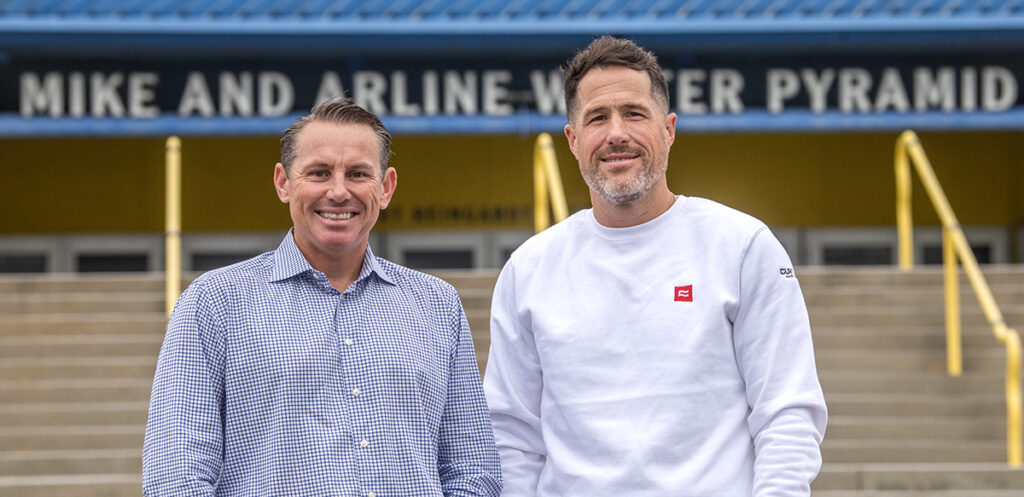
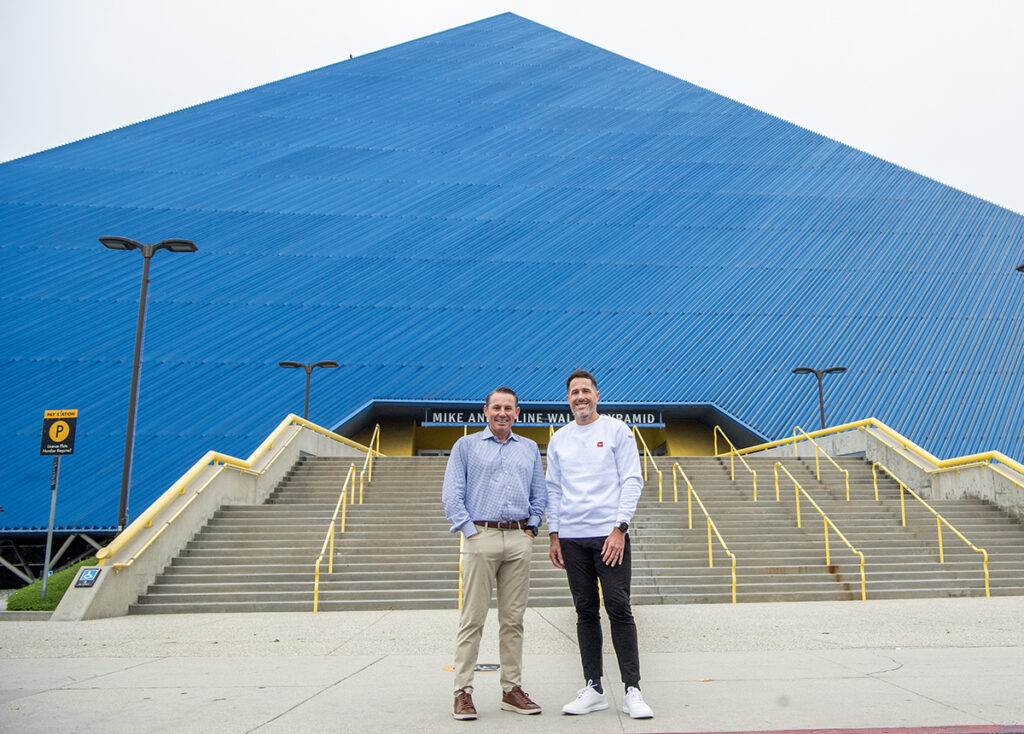
Sean Rawson, left, and Blake Klingeman, in front of the Walter Pyramid at Long Beach State, Wednesday, July 30, 2025. Photo by Thomas R. Cordova.
The urgency is pressing for a university like Long Beach, which plays in the top division but not in a top conference. A larger portion of the nearly $1 billion in revenue from the NCAA March tournament flows to conferences with big-name schools.
Ohio State’s athletic department budget tops $250 million; Long Beach has $52 million. More locally, UCLA has paid nearly $7 million to athletes since 2021; Long Beach State has paid just over $30,000.
The new “NIL” rules are supposed to be about “revenue sharing,” but most athletics departments in the university’s conference run at a deficit, said Bobby Smitheran, the Long Beach State athletic director for the last two years.
“In reality, there isn’t a whole lot of revenue to share,” he said.
The university is also in the midst of a major leadership transition. Not only are Smitheran and Acker both relatively new to the city, but the university is still searching for its next president.
Long Beach State doesn’t expect to come near the $20.5 million annual limit the new rules allow for total player pay.
The university is still internally getting a handle on the new rules, which just became operational July 1. Smitheran said he must also balance revenue and scholarships across 19 sports, including a national champion men’s volleyball team and the Dirtbags, the baseball team.
Confusion has also clouded the rules much of this calendar year. The Department of Education said in a fact sheet in January that universities would be required to spend NIL dollars evenly across men’s and women’s sports. Then the page disappeared.
Off campus, progress is moving more quickly. Private collectives have formed around baseball and volleyball, too, and in many cases, those involved are working together.
Acker spent the spring and summer shaking hands, networking and fundraising — among the new duties tacked on to the job description of every college coach who wants a competitive team in this new economy.
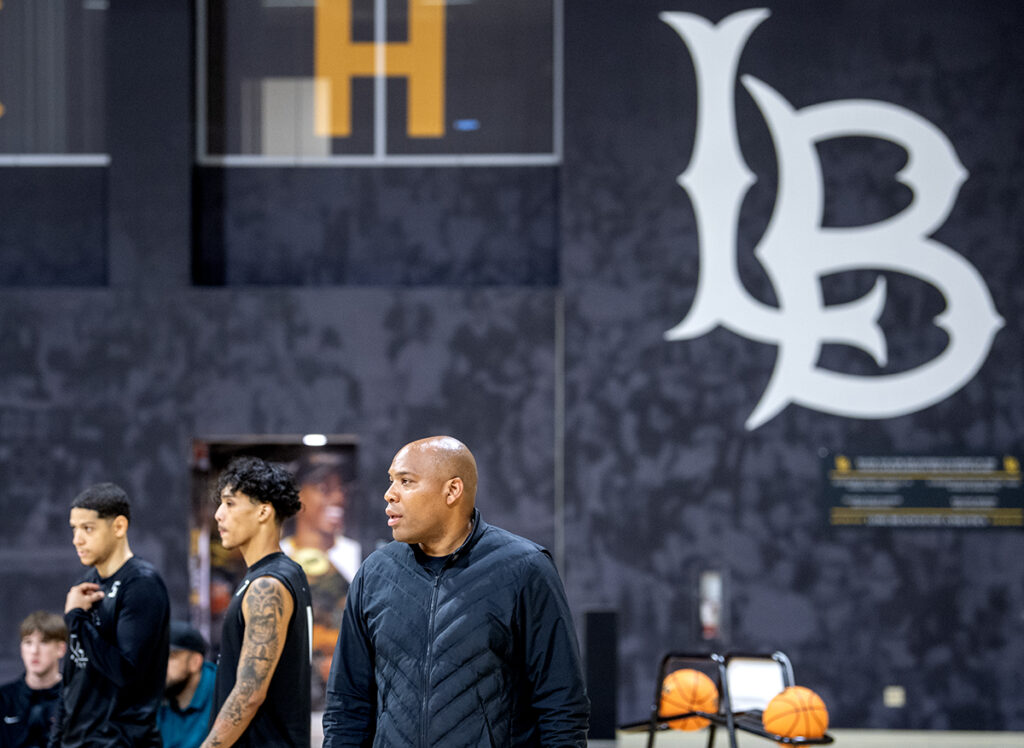
Chris Acker, head coach of the men’s basketball team at the Pyramid on the campus in Long Beach, Thursday, July 10, 2025. Photo by Thomas R. Cordova.
Mayor Rex Richardson has met with the coach and others involved, and said he’s on board.
“We’ve got to create a donor base and excitement to compete with teams that have been doing this a long time,” the mayor said in an interview. “It’s going to take an all-hands-on-deck approach.”
Richardson has pushed to elevate the city’s profile, particularly around entertainment. Long Beach has flirted with professional sporting teams in the past and is now pursuing a minor league baseball team. The LA Force, a third division professional soccer team, signed a deal last year to play here. Long Beach also has a long pedigree of high schoolers who have competed professionally in a range of sports.
Getting into the Sweet Sixteen — the third round of March Madness that draws 10 million viewers — would be a significant coup and windfall, the mayor said.
“There’s enormous value there,” he said.
Rawson and Klingeman’s Long Beach State Basketball Collective hosted a gathering of potential investors in July at the Boathouse on the Bay restaurant. They presented a business plan built as much on attracting top players as strengthening grassroots portals of entry — like youth basketball camps — bolstering community and business interest, and critically, enhancing and leveraging the fan experience at the Pyramid.
Rawson said one investor told him that he’d give $10,000 to the collective — all he wanted in return was to be able to easily get a beer in his courtside seat.
Sean Rawson, left, and Blake Klingeman want to elevate the fan experience at The Pyramid. Photo by Thomas R. Cordova.
They are hoping to attract a range of investments for players who are still developing skills to those who could earn as much as $150,000 for their game-changing impact.
Part of their pitch is the well-documented downstream value that athletic success brings. Schools that make deep runs in the NCAA tournament receive millions in revenue, along with a boost in applications and academic interest.
Rawson, a 15-year resident, said he’s motivated by wanting to see the city and his kids experience the kind of pride a winning team can bring. He and Klingeman both have three kids under 12.
“We want to go to games and see the community come out around a great team and a great story, and have a VIP experience at a game,” Klingeman said.
They’ve also become quick friends with Acker, also in his 40s, with a wife and young daughter. The coach is hopeful about the coming season.
Thanks to financial backing, Long Beach was able to sign a crop of talented players for this year’s team, including Petar Majstorovic, a transfer from Syracuse.
Acker, who spent five years as an assistant at San Diego State and has been coaching since 2007, said his coaching style won’t change, even though money is now in the mix. He said the young men he leads still need the same qualities, both physical and mental, to play well on the court.
“All those things, discipline, hard work — they still matter,” Acker said. “Probably more so now.”
During the first week of practice in July, the screech of shoes quieted as the coach implored the players to drive the ball harder and to up their energy.
“We can’t wait for November,” he said. “We do this now, today!”
His goal is to win the Big West Conference, and he believes he has the right team — and the start of strong community backing — necessary to make it happen.
A day ahead of the panchayat polls on December 14, it is the youth of the four villages he represents, whose issues weigh heavy on his mind.
The scourge of drugs, taking youth back to sports, freeing villages of long-standing issues like waterlogged roads — are the key issues around his election campaign has been centred.
Thirty-eight-year-old Parshotam Singh — activist, panch and a highly qualified candidate (MSc in IT and MA in Punjabi) — has had his entire campaign centred around the village populace and their issues, especially the youth. Contesting the Block Samiti elections from the Nagar Zone in Phillaur, Parshotam represents the villages Katpalon (where he is also the panch), Nagar, Ashahoor and Fatehgarh Lakkha.
Ask him about the pivot around which his campaign revolves, and pat comes the reply, “Youth”.
Parshotam Singh says, “Naujawani nu bachaya jave (youth must be saved). The prime concern with any well-meaning citizen in Punjab today must be that our youth is heading in the wrong direction and they must be brought back from drugs or other ills afflicting their culture and moorings. Very few people know about the power of these elections. An elected representative of the Block Samiti can be instrumental in getting sportsgrounds, gyms and culture-related means of recreation in villages which could ensure the transformation of youth — instead of falling prey to drugs. This is immense power.”
Having been a youth leader and a member of the Shaheed Bhagat Singh Naujawan Sabha, vice-president of the Punjab Students Federation and currently a member of the Lok Insaaf Manch, Parshotam is well-versed with Punjab’s issues. He has fought for the rights of youths falling prey to unemployment despite degrees, fellow students’ bus pass and right to reservation, ridding a local activist of false cases against him and also the struggle for Panjab University, Chandigarh.
He has also been among the activists holding month-long dharnas to free villages of contaminated water and sanitation woes besides approach roads.
Speaking on the issue, he says, “So many villages don’t have proper drainage these days. This is an ever increasing problem. In some villages, even the entry gates are waterlogged. Villages do not have plants to clean water, they don’t even have ROs. Villagers have the right to clean water and dry spaces. This has been a major fight of our region and an important element of my campaign.”
Planning of village ponds according to new technology to counter spillovers is also among his plans, he says.
Speaking specifically on his plans, if he’s elected, he says, “It’s a misconception that an MLA or MP is empowered but a Block Samiti member isn’t. Anyone who is aware and knows what he wants for his area is actually more empowered. For a member of the Block Samiti, Zila Panchayat funds could be spent on villages. They can also use their part of the district budget to build villages. Sportsgrounds, stadiums, spaces and gyms could be facilitated by Block Samiti members. So people must choose and vote wisely.”
Zila Parishad – Patara Zone
Lakhvir Singh Hazara, a farmer who is an avid sports promoter of his area, is set to take his message of sports promotion to the ZIla Parishad polls as well.
Contesting from the AAP, Hazara, a candidate for Zila Parishad election from the Patara zone, is known best in the region for the sports activities he has been undertaking. While he contested elections from the same zone last time, he had lost to the Congress candidate Mehtaab Singh Lali. The years-long delay in the panchayat coupled with simmering issues of people, make him confident that people are fed up with false promises and need real change on the ground.
His spirit to promote sports and wean children away from drugs, keeps him upbeat.
At Patara and in neighouring villages, Lakhvir Singh has been holding various sports tournaments. An annual soccer tourney is slated for December 16 and he also hosts a Kabaddi Cup.
On why the elections are important this time, Lakhvir says, “The Block Samiti and Zila Parishad elections are happening after a gap of seven years during which various works have piled up.”
The final score was 33 to 0 against the West Boynton Wolfpack from Florida, winning the Youngstown Little Bears the championship.
Members of the Youngstown Little Bears football team were in Charlotte, North Carolina, on Friday, December 12, 2025, to participate in the final matchup of the 2025 Pop Warner Super Bowl championship game.
The final score was 33 to 0 against the West Boynton Wolfpack from Florida, winning the Youngstown Little Bears the championship.
Previously in the 9U bracket, the Youngstown Little Bears fought the Geddes Knights from New York and the Spanish Spring Cougars from Nevada.
“This championship represents more than a trophy,” said a representative with the Youngstown Little Bears organization in a news release.
The representative continued,” It represents hope, opportunity and the limitless potential within our youth when they are supported, mentored and challenged to be their best.”
The Pop Warner Super Bowl is described as the “premier national championship event for youth football,” according to the Pop Warner website.
In order to progress through the rankings, a team must win its respective League Championship, as well as the Regional Championship. Each advancing team is guaranteed to play two games at the Super Bowl.
Football
Cheerleading
Basketball
The Youngstown Little Bears extend gratitude to the coaches and staff for their leadership, parents and families and the Youngstown community for believing in the team’s athletes.
Download the WFMJ app for your Apple or Android smartphone or tablet to get our push alerts as news happens.
Adobe Express via County News Center Credit: Adobe Express via County News Center
The holiday season is here and kids across the county are excited for their presents. With that it’s important to make sure the toys they receive are age appropriate and safe.
Every year hundreds of San Diego children end up in an emergency department from mishaps with toys. That’s why choking, swallowing or interacting with toys or jewelry made with lead, or those that have button or coin batteries are high on the list of doctors’ holiday concerns. Fortunately, San Diego parents can take steps to keep their family holiday safe from dangerous gifts.
First, make sure the toy is age appropriate: toy packaging will have a recommended age range. That label should also say “nontoxic” to ensure it is safe especially for infants and toddlers. Keep toys for older children out of reach especially because their small parts can be a choking risk. If a toy has a part that will fit through a cardboard toilet paper roll, it is small enough to pose a choking risk.
If possible, avoid using or buying button or coin batteries or toys that require them. Button batteries and batteries in general should be kept away from children in a drawer or cabinet out of reach. Button batteries are particularly concerning as they are a common choking hazard with serious consequences. A battery can get stuck in the child’s throat and burn a hole. This burn can quickly turn into infection, permanent damage, or even death if it’s not treated fast enough. Immediately seek emergency care if you think your child swallowed a battery.
Among other gifts to watch out for are antique toys or hand-me-downs which were already flagged as dangerous. Knowing what toys have been recalled, which toys may have lead and where to go to with concerns are essential.
Watch out for toys made in other countries or made in the United States before 1978, as they may have lead paint. Toys can only be tested for lead by a certified laboratory. At-home tests do not identify how much lead is present. It is best to check for recalls on old toys.
Lead exposure can harm a child’s brain and nervous system, slow their growth and cause learning difficulties. If you suspect your child has been exposed, remove the toy immediately. Anyone who is concerned about lead poisoning should ask their doctor for a blood test.
Washing your hands and wiping down surfaces and toys are also great ways to ensure any lead dust in the environment is removed.
Eating foods high in calcium, vitamin C and iron protect the body from absorbing lead. Fun recipes in English and Spanish are featured near the bottom of the Family Lead Safety website.
To avoid choking, swallowing and other hazards, anyone giving a gift to a child should consider the following questions:
Are there parts that are too pointy or dangerous for the child’s age?
Can any small parts come off the toy, even by design?
Does an older child’s toy have parts that pose a choking hazard for another child or siblings?
Can the toy be crushed or broken apart if stepped on, sat on or from falling?
Those gifting sports equipment or anything with wheels should also include appropriate protective gear, like helmets and pads.
The U.S. Consumer Product and Safety Commission reports that toys for children 12 and under are inspected by the American Society for Testing and Materials (ASTM). All toys that have passed inspection will have a label showing it meets those standards.
By following safe gift giving you can keep your loved ones safe too!
ALSO BEEN RESOLVED. NEW AT 11, THIS IS OUR FIRST LOOK AT THE MAN ACCUSED OF SHOOTING SOMEONE AT A YOUTH FOOTBALL GAME IN COLLIER COUNTY TODAY. DEPUTIES SAY WILLIAM WHARTON OPENED FIRE IN THE PARKING LOT OF THE PARADISE. SPORTS COMPLEX, SENDING 7 YEAR-OLD KIDS RUNNING FOR COVER. WELL, THEIR PARENTS FLIPPED OVER TABLES TO SHIELD THEM FROM BULLETS. GULF COAST NEWS REPORTER MADISON ADAMS IS IN NAPLES WITH NEW DETAILS ON HIS ARREST. >> TONIGHT, THE AMERICAN NATIONAL FOOTBALL CHAMPIONSHIPS CONTINUE JUST HOURS AFTER A MAN WAS SHOT IN THIS PARKING LOT. YOU CAN SEE COLLIER COUNTY DEPUTIES ARE STILL HERE INVESTIGATING TEAMS FROM ALL ACROSS THE COUNTRY ARE HERE COMPETING EVEN FROM HAWAII. I GOT 7 YEAR-OLD. 5 THE HOME. >> COME ON. MEN DYING FOR FUN OR DOWN TO THE SPORT OF DOWN HERE FOR LIFE. LESSONS NOT DOWN HERE FOR LOSING LIVES. ALLEN, PAPA DEANS HAS BEEN COMING TO THE PARADISE SPORTS COMPLEX IN NAPLES FOR THE PAST 4 YEARS TO RECRUIT YOUNG PLAYERS AT THE AMERICAN YOUTH FOOTBALL NATIONAL CHAMPIONSHIPS, SECURITY PRESENCE. HERE WAS 10 TIMES MORE THAN ANY OTHER YOUTH FOOTBALL. THEN AROUND 8 THIS MORNING, MOMENTS AFTER A CHAMPIONSHIP GAME, HE HEARD GUNSHOTS. THEY WERE SAYING, MIKE AND, YOU KNOW, GET THE BABIES GOING TO SOFT, FEEL PROTECT THE KIDS. HE SAYS PLAYERS THAT LOOKED 6, 7, 8, YEARS OLD, WERE RUNNING AWAY TO SAFETY. I SAW SEVERAL PARENTS COME THROUGH AND AGAIN, LITERALLY THROWING THE TABLES BEHIND THEM AND THE SECURITY TABLES. I DON’T I WOULD EVEN SAY AS PROTECTION. THE COLLIER COUNTY SHERIFF’S OFFICE SAYS WILLIAM MORTON FROM NORTH CAROLINA SHOT JAMES REYNARD ALSO FROM WINSTON-SALEM IN THE PARKING LOT. THEY ARRESTED WHARTON FOR AGGRAVATED BATTERY. I COUNTLESS POLICE CARS, AMBULANCES, FIRE TRUCKS, POLICE HELICOPTER OVER OVERHEAD. I REACHED OUT TO THE SHERIFF’S OFFICE TO ASK HOW THE VICTIM IS DOING. HE WAS TAKEN TO THE HOSPITAL. WE’LL LET YOU GUYS KNOW
Gunfire at Youth Football Nationals: Witness describes panic, parents shielding children
Updated: 11:52 PM EST Dec 12, 2025
Editorial Standards ⓘ
A shooting in the parking lot of the Paradise Sports Complex in Collier County interrupted the American Youth Football National Championships on Friday morning, leading to a significant law enforcement response.One person is in custody and another was taken to the hospital. The condition of the victim remains unknown, as the sheriff’s office has yet to provide an update.According to the Collier County Sheriff’s Office, the shooting was reported at 10:30 a.m. Deputies responded to the scene and quickly took a suspect into custody. CCSO deputies identified the victim as James Raynard, 43, of Winston-Salem, North Carolina. Raynard is a youth football coach.William Wharton, 38, also of Winston-Salem, is facing an aggravated battery with a deadly weapon charge in connection with the shooting at this time, according to the CCSO.Deputies remain on the scene to process evidence and interview witnesses.Football games continued on Friday evening.Alan Popadines, the national scouting director for Prep Redzone Next, has been attending the championships for four years to recruit young football players.He said he heard gunshots around 8 a.m.”I got a 7-year-old, a 5-year-old at home. They play sports, I love sports, it’s my profession. And like, I think this is what it is like. Come on, man, we’re down here for fun. We’re down here for sports, are down here for life lessons, not down here for losing lives,” Popadines said. Popadines noted the heightened security presence at the event, describing it as “10 times more than any other youth football event.””I cannot stress enough, like, these people, if the complex itself, they could not have done more, there could not have been more security, like, every bag got screened, every people got wanded. If someone walked through who didn’t have a wristband that wasn’t supposed to be with the team, they were stopped at the gates and turned around or told to go to the main gate,” Popadines said. Despite this, he recounted the chaos that ensued after the gunshots, with people urging, “get the babies off, get the babies off the field, protect the kids,” as young players, some as young as 6, 7, and 8 years old, ran for safety. Popadines said the shooting happened in the parking lot outside the security gates that everyone has to enter to get on the nine playing fields.Popadines said he witnessed parents taking drastic measures to protect their children.”I see a bunch of kids running or running into in from the parking lot, into the facility, you know, through security, then I see parents very quickly rushing up behind the kids, telling them to move or to get behind, and almost like throwing the tables at the security, I would even say as protection,” Popadines said. He also witnessed parents taking drastic measures to protect their children, saying, “I saw several parents come through and again, literally throwing the tables behind them, the security tables, I don’t know, I would even say as protection.”Popadines described the scene following the shooting, saying, “I saw countless police cars, ambulance, fire truck, police helicopter overhead. Today and tomorrow were some of the championship games for some of the age groups.”This is a developing story and will be updated.Correction: An earlier version of this story stated that Paradise Sports Complex is in Golden Gate Estates. It is in unincorporated Collier County.DOWNLOAD the free Gulf Coast News app for your latest news and alerts on breaking news, weather, sports, entertainment and more on your phone or tablet. And check out the Very Local Gulf Coast app to stream news, entertainment and original programming on your TV.
COLLIER COUNTY, Fla. —
A shooting in the parking lot of the Paradise Sports Complex in Collier County interrupted the American Youth Football National Championships on Friday morning, leading to a significant law enforcement response.
One person is in custody and another was taken to the hospital. The condition of the victim remains unknown, as the sheriff’s office has yet to provide an update.
According to the Collier County Sheriff’s Office, the shooting was reported at 10:30 a.m. Deputies responded to the scene and quickly took a suspect into custody.
CCSO deputies identified the victim as James Raynard, 43, of Winston-Salem, North Carolina. Raynard is a youth football coach.
William Wharton, 38, also of Winston-Salem, is facing an aggravated battery with a deadly weapon charge in connection with the shooting at this time, according to the CCSO.
Deputies remain on the scene to process evidence and interview witnesses.
Football games continued on Friday evening.
Alan Popadines, the national scouting director for Prep Redzone Next, has been attending the championships for four years to recruit young football players.
He said he heard gunshots around 8 a.m.
“I got a 7-year-old, a 5-year-old at home. They play sports, I love sports, it’s my profession. And like, I think this is what it is like. Come on, man, we’re down here for fun. We’re down here for sports, are down here for life lessons, not down here for losing lives,” Popadines said.
Popadines noted the heightened security presence at the event, describing it as “10 times more than any other youth football event.”
“I cannot stress enough, like, these people, if the complex itself, they could not have done more, there could not have been more security, like, every bag got screened, every people got wanded. If someone walked through who didn’t have a wristband that wasn’t supposed to be with the team, they were stopped at the gates and turned around or told to go to the main gate,” Popadines said.
Despite this, he recounted the chaos that ensued after the gunshots, with people urging, “get the babies off, get the babies off the field, protect the kids,” as young players, some as young as 6, 7, and 8 years old, ran for safety.
Popadines said the shooting happened in the parking lot outside the security gates that everyone has to enter to get on the nine playing fields.
Popadines said he witnessed parents taking drastic measures to protect their children.
“I see a bunch of kids running or running into in from the parking lot, into the facility, you know, through security, then I see parents very quickly rushing up behind the kids, telling them to move or to get behind, and almost like throwing the tables at the security, I would even say as protection,” Popadines said.
He also witnessed parents taking drastic measures to protect their children, saying, “I saw several parents come through and again, literally throwing the tables behind them, the security tables, I don’t know, I would even say as protection.”
Popadines described the scene following the shooting, saying, “I saw countless police cars, ambulance, fire truck, police helicopter overhead. Today and tomorrow were some of the championship games for some of the age groups.”
This is a developing story and will be updated.
Correction: An earlier version of this story stated that Paradise Sports Complex is in Golden Gate Estates. It is in unincorporated Collier County.
DOWNLOAD the freeGulf Coast News app for your latest news and alerts on breaking news, weather, sports, entertainment and more on your phone or tablet. And check out the Very Local Gulf Coast app to stream news, entertainment and original programming on your TV.
During a recent panel discussion at the California Journalism Symposium in Monterey, the speakers were asked to explain their origin stories, essentially, how each panelist first got into the news business. It got me thinking about how I first connected to the news so many years ago.
I was just a school kid when my hometown newspaper, The Fresno Bee, ran our baseball score in tiny 6-point type, listing the “batteries”—the pitcher and catcher. It read: “O’Brien and Boren.” Seeing my name in the paper hooked me instantly on the power of the printed word.
The Bee was covering everything, right down to local youth baseball games, which built a sense of place and identity in the community. Everyone from elected officials to youth league catchers could see themselves reflected in the paper. It was a place for a common community conversation.
Today, the landscape of local journalism looks very different. Decades of shrinking advertising revenue, consolidation, layoffs, and the rise of digital platforms have hollowed out many community newsrooms. Entire regions are becoming “news deserts,” where no one is consistently reporting on schools, neighborhoods, or even City Council meetings.
The watchdog role that local papers once played—monitoring power, tracking taxpayer dollars, holding leaders accountable—has weakened as staffs have thinned. Community features that once created connection and pride have disappeared as well.
The result is a less-informed civic life. When no one is regularly covering City Hall, residents know less. When youth sports, school board meetings, community events, and local milestones go unreported, people feel less connected to one another. And when fewer journalists are present to shine light on local issues, problems deepen while going unnoticed.
Communities blur into ghost towns. The shared sense of belonging that once came from seeing your name in the paper, even in 6-point type, slowly disappears.
I didn’t realize it at the time, but it was more than just my name in print. It was proof of a newsroom deeply rooted in its community. Today, that kind of commitment is harder to sustain, but it remains the clearest path back to relevance, trust, and connection.
Jim Boren is the executive director of the Fresno State Institute for Media and Public Trust, and former executive editor of The Fresno Bee.
Tyla Armendariz, Arbor Moran, Mackenzie Hardesty each won last weekend
Ignite Gymnastics’ Arbor Moran was the state champion on uneven bars at the state competition in Aurora on Dec. 6-7. (Courtesy Liz Herring)
Ignacio’s Ignite Gymnastics showed their gymnasts can compete with any in the state as Ignite returned from Aurora last weekend with three state champions.
Tyla Armendariz, 10, Arbor Moran, 8, and Mackenzie Hardesty, 8, became the latest state champions to come out of Ignite Gymnastics after impressive performances at the Colorado USA Gymnastics Level 2, XCel Bronze and Silver State Competition on Saturday and Sunday at Colorado Gymnastics Institute in Aurora.
“We had an incredible season,” Ignite coach Liz Herring said. “So we had high hopes for state, and it panned out.”
Armendariz was the silver state champion on balance beam in the Junior A Group 4 with a 9.65 score. Armendariz has been competing in gymnastics for the last seven years, and she has been competing with Ignite for the last 1.5 years.
Ignite Gymnastics’ Tyla Armendariz was the state champion on balance beam at the state competition in Aurora on Dec. 6-7. (Courtesy Liz Herring)
It was an especially impressive state championship for Armendariz because her routine was riskier than others. There are a wide range of skills the gymnasts can do, with some skills being easier than others. Some gymnasts in the competition group do easier skills perfectly, but Armendariz did a high-level skill perfectly, according to Herring.
Moran won the silver state championship in uneven bars in the Child Group 4, scoring 9.75. Moran lives in Pagosa Springs, but began her gymnastics journey in Alaska and has been competing with Ignite for about a year.
Herring said it’s not uncommon for young gymnasts to get nervous at the state competitions, and Moran has done a great job progressing in her first two state meets before this one.
Hardesty was the silver state champion on uneven bars in Child Group 2, scoring 9.725. She shared the top step of the podium with another gymnast with the identical score.
“Mackenzie is one of our babies,” Herring said. “I’ve been coaching her since she was 2 years old. She’s very experienced in a lot of ways; it’s so weird because she is young. But this year, every meet she went to, if she knew she had messed up the turn, she never even said a word about it. She just kept smiling.”
Ignite Gymnastics’ Mackenzie Hardesty was the state champion on uneven bars at the state competition in Aurora on Dec. 6-7. (Courtesy Liz Herring)
Ignite had eight XCel Bronze gymnasts and nine XCel Silver gymnasts qualify for the state competition. The difference between the bronze level and the silver level is the skill level of the gymnasts. Bronze is the beginner competition level for gymnastics.
Herring said 17 girls is a pretty high number for how little Ignacio is, compared to the Denver teams that have up to 40 girls per level, according to Herring. The Denver gymnasts also have an advantage because they get to wake up in their own bed and drive to the meet. The Ignite gymnasts have to leave their homes two days in advance to travel up and stay in a hotel.
“I have a kind of different philosophy for our area,” Herring said. “I try to expose them to those upper-level meets, do more things with them and have them travel. So they get more experience doing those things … so when they get to gold, they’re going to start going to places; the gold regional meet last year was in Arkansas, and then the year before that, the platinum regionals were in Dallas.”
Of the 17 gymnasts who qualified, Adeline Crouch, Henley Beck, Emerson Conroy, and Evelyn Gosney also came home as medalists.