
NIL
Trump Executive Order, SCORE Act signal renewed federal policy focus on college sports industry


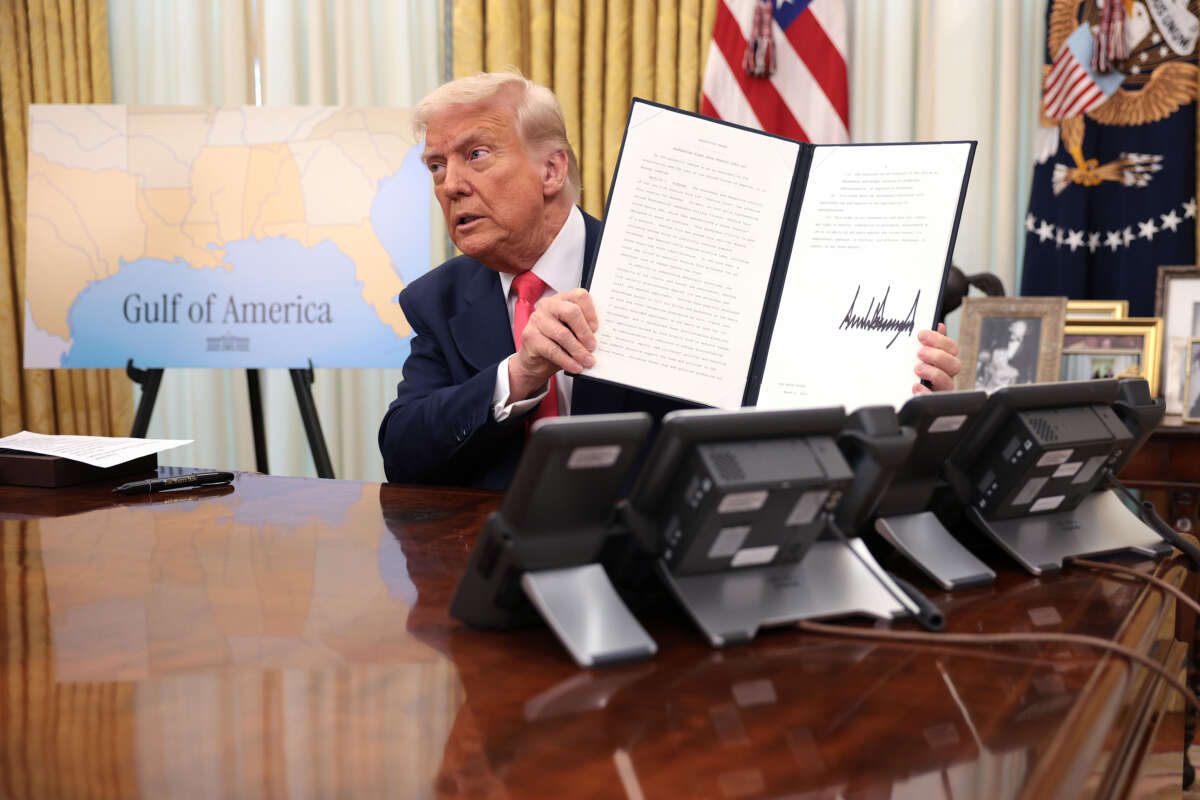

In late July, two significant federal policy developments emerged from Washington, D.C. in the ongoing overhaul of college sports. On July 24, 2025, President Trump issued an Executive Order entitled “Saving College Sports” (the “EO”).1 The EO was issued a day after two House committees approved the SCORE Act, a comprehensive federal college sports bill, making it the first college sports legislation to emerge from committee in either the House or the Senate in the post-Alston NIL era.2 Taken together, these actions indicate that federal policymakers are placing an increased focus on the regulation of college sports. The EO and the SCORE Act also provide additional insight into the two political parties’ positions with respect to codification of the House Settlement, federal antitrust protection for the NCAA and conferences, pre-emption of state NIL laws, and the classification of student-athletes as employees.
Saving College Sports Executive Order
Describing the college sports industry as an “out of control, rudderless system” whose future is under “unprecedented threat,” the Trump EO states that a national solution is needed “to protect non-revenue sports, including many women’s sports, that comprise the backbone of intercollegiate athletics, drive American superiority at the Olympics and other international competitions, and catalyze hundreds of thousands of student-athletes to fuel American success in myriad ways.”3 The EO declares it is the policy of the administration to “provide the stability, fairness, and balance necessary to protect student-athletes, collegiate athletic scholarships and opportunities, and the special American institution of college sports.”4
The EO lays out several directives to accomplish these policy priorities. First, the EO directs institutions to take steps to preserve and expand opportunities for scholarships and competition in women’s and non-revenue sports, and states that any revenue sharing arrangements between institutions and student-athletes should be implemented in a manner that furthers these goals.5 Notably, the EO encourages institutions to take the following specific measures with respect to scholarships and roster spots for non-revenue sports in the upcoming academic year:
- Institutions with greater than $125 million in athletic revenues should increase scholarship opportunities and maximize roster spots in non-revenue sports during the 2025-2026 academic year.
- Institutions with greater than $50 million in athletic revenues should at a minimum maintain the number of non-revenue scholarships and maximize roster spots for the 2025-2026 academic year.
- Institutions with less than $50 million in athletic revenues should not disproportionately reduce scholarship opportunities or roster spots based on the amount of revenue the sport generates for the institution.6
The EO also directs the Secretary of Education, the Attorney General, the Secretary of Health and Human Services, the Secretary of Education, and the Chairman of the Federal Trade Commission to develop a plan within 30 days of the date of the EO to advance these policies through federal funding decisions, administrative rulemaking, regulatory enforcement, and litigation.7 The deadline for the plan is August 23, 2025 and we are monitoring for any specific policy that emerges.
In addition to the guidance related to non-revenue sports, the EO also contains more general directives related to “pay-for-play” prohibitions, student-athlete employment status, and antitrust protections for the college athletics industry. Specifically, the EO declares that third-party, pay-for-play arrangements with student-athletes are improper and should not be allowed (but notes that this policy does not apply to compensation provided to an athlete for the fair market value that the athlete provides to a third party, such as an endorsement deals), and directs executive agencies to develop plans to enforce this prohibition through funding decisions, litigation, and legislative efforts.8 The EO also directs the Secretary of Labor and the NLRB to “clarify the status of collegiate athletes” through guidance and actions to “maximize the educational benefits and opportunities provided by higher education institutions through athletics.”9 Finally, the EO directs the Attorney General and the Chairman of the FTC to “stabilize and preserve college athletics through litigation, guidelines, policies, or other actions” when the “rights and interests of student-athletes and the long-term availability of college athletic scholarships and opportunities” are challenged on antitrust or other legal grounds.10
The Trump EO is important for at least two key reasons. First, it clarifies the policy priorities of the administration with respect to college sports and directs executive agencies to take action to implement such priorities through administrative guidance, regulatory enforcement, and litigation. It suggests institutions that cut scholarships and roster spots in non-revenue sports may face regulatory scrutiny, which underscores the need for institutions to think boldly and strategically about how to fund payments to student-athletes under the House settlement. Second, the EO provides additional momentum for federal policymaking related to college sports generally (especially when combined with the progress of the SCORE Act, discussed below), as it lays out the preferred positions of President Trump, who holds significant sway over a Republican party that controls both houses of congress.
That said, the EO ultimately leaves many key questions unanswered. It does not provide affirmative guidance on the application of Title IX to institutional revenue sharing, nor does it provide clarity as to whether the Trump administration considers student-athletes to be employees (although the administration has already rescinded Biden-era guidance stating that Title IX applies to revenue sharing and that student-athletes should be classified as employees for purposes of the National Labor Relations Act).11 Additionally, although the EO can direct the Department of Justice and Federal Trade Commission to take positions in litigation that might aid antitrust protection for the NCAA and conferences, it cannot unilaterally provide such protection, which would require an act of Congress (and, as described below, is one key feature of the SCORE Act). Ultimately, given that the EO does not carry the force of law, its actual effect, especially in the immediate term, may be limited. Indeed, NCAA President Charlie Baker recently acknowledged, “You can’t fix this stuff from executive order,” and noted that the NCAA’s focus “really needs to be trying to get stuff dealt with through the legislative process.”12
SCORE Act
On July 23, 2025, the Student Compensation and Opportunity through Rights and Endorsements (“SCORE”) Act was approved by the House Energy and Commerce Committee and the House Committee on Education and the Workforce.13 Both committees approved the bill with only Republican votes, although the legislation was co-sponsored by two Democrats.14
Overall, the proposed legislation contains many of the policy items pushed by the NCAA and certain conferences through their lobbying efforts in the post-Alston era. Specifically, the legislation largely codifies the powers extended to the NCAA and College Sports Commission under the House Settlement. The Act permits “Interstate Athletic Associations” (e.g., the NCAA) to establish and enforce rules 1) requiring student-athletes to disclose NIL agreements (i.e., the NIL Go framework); 2) prohibiting certain forms of NIL compensation from associated entities and individuals; 3) setting rules for the recruitment of student-athletes, the eligibility of student-athletes to participate in intercollegiate athletics, and the ability of student-athletes to transfer between institutions; and 4) providing for a revenue sharing model mirroring the pool limits set forth in House.15
Additionally, the bill provides broad antitrust protections for the NCAA and its member institutions to enforce and comply with the terms of the Act, provides that student-athletes shall not be considered employees of institutions based on their participation in intercollegiate athletics, and explicitly preempts state laws with respect to the regulation of student-athlete compensation, NIL rights related to broadcasting, employment, and eligibility for participation in intercollegiate athletics.16
The SCORE Act is the first major piece of college sports legislation to emerge from committee in recent years, reflecting an increased sense of urgency on Capitol Hill to address the uncertainty surrounding intercollegiate athletics. Additionally, the Act’s passage out of committee places a marker down for support among House Republicans for many of the NCAA and conferences’ policy priorities. That said, even if the bill were to pass the Republican-controlled House later this year, it faces challenges in the current Senate, given that it would need 60 votes, including seven Democrats, to overcome a filibuster. Indeed, critics of the legislation, including many Democrats in the House and Senate, as well as state attorneys general and the players’ associations of several professional sports leagues, contend that the Act vests too much power with the NCAA and the power conferences, fails to adequately address concerns over compliance with Title IX, and does not go far enough in addressing the concerns of student-athletes.17 Ultimately, congressional approval of a comprehensive college athletics bill will likely require a negotiated compromise in the Senate, where Republican Senator Ted Cruz, chairman of the Senate Commerce Committee, has been engaged in negotiations with Democratic Senators Cory Booker and Richard Blumenthal.
Takeaways for institutions
While the EO does not carry the force of law, NCAA institutions, particularly those in Division I and that have opted into the House Settlement, should proactively consider how to comply with the terms of the EO pending additional regulatory guidance issued by executive agencies. This is particularly true for the provisions of the EO addressing scholarships and roster spots for non-revenue sports. Additionally, institutions should continue to carefully monitor new administrative guidance issued by agencies to ensure compliance in an evolving regulatory environment. Furthermore, given the policy positions staked out by President Trump and House Republicans, institutions should give thought to their own policy preferences and whether increased advocacy on Capitol Hill makes sense to help advance the best interests of their athletic departments and student-athletes.
References
1 The White House, Executive Order “Saving College Sports,” July 24, 2025, available at https://www.whitehouse.gov/presidential-actions/2025/07/saving-college-sports/.
2 Ralph D. Russo and Chris Vannini, SCORE Act advances through committee, moving college sports reform closer to House floor, New York Times (July 23, 2025), available at https://www.nytimes.com/athletic/6511289/2025/07/23/score-act-congress-college-sports/ https://www.usatoday.com/story/sports/college/2025/07/23/college-sports-bill-passes-house-committees/85333821007/; Ralph D. Russo and Chris Vannini, SCORE Act advances through committee, moving college sports reform closer to House floor, New York Times (July 23, 2025), available at https://www.nytimes.com/athletic/6511289/2025/07/23/score-act-congress-college-sports/.
3 EO, Section 1.
4Id.
5 EO, Section 2(a); 2(b).
6 EO, Section 2(a)(i)-(iii).
7 EO, Section 2(d).
8 EO, Section 2(c).
9 EO, Section 3.
10 EO, Section 4.
11 Paula Lavigne, Dept. of Education Revoked Guidance on Title IX and Athlete Pay, ESPN (February 12, 2025), available at https://www.espn.com/college-sports/story/_/id/43809645/dept-education-revokes-guidance-title-ix-athlete-pay; Eli Henderson, Memorandum Viewing College Athletes As Employees Rescinded by Trump Administration, Sports Illustrated (February 15, 2025), available at https://www.si.com/college/nil/nil-news/memorandum-viewing-college-athletes-employees-rescinded-trump-administration.
12 Ross Dellenger, President Trump’s executive order on college sports: Here’s what it actually means, Yahoo Sports (July 24, 2025), available at https://sports.yahoo.com/college-football/breaking-news/article/president-trumps-executive-order-on-college-sports-heres-what-it-actually-means-001007183.html?guccounter=1.
13 Ralph D. Russo and Chris Vannini, SCORE Act advances through committee, moving college sports reform closer to House floor, New York Times (July 23, 2025), available at https://www.nytimes.com/athletic/6511289/2025/07/23/score-act-congress-college-sports/.
14Id.
15 SCORE Act, Section 6.
16 SCORE Act, Section 7, 8, 10.
17 Steve Berkowitz, Tom Schad, College sports bill moving to House floor in Congress after passing committee votes, USA Today (July 23, 2025), available at https://www.usatoday.com/story/sports/college/2025/07/23/college-sports-bill-passes-house-committees/85333821007/; Ralph D. Russo and Chris Vannini, SCORE Act advances through committee, moving college sports reform closer to House floor, New York Times (July 23, 2025), available at https://www.nytimes.com/athletic/6511289/2025/07/23/score-act-congress-college-sports/.
[View source.]

NIL
Ty Simpson Reportedly Getting NIL Contract Offers After NFL Draft Decision, New Rumors on Alabama QB

Ty Simpson has declared for the 2026 NFL Draft, but that hasn’t curbed college football programs from trying to get the Alabama quarterback on their roster.
According to AL.com’s Nick Kelly, Simpson has been offered “a deal that could total $6.5 million” from one program, while three SEC teams have offered “at least $4 million and more.”
Simpson was the No. 26 overall player and No. 4 quarterback in the class of 2022, according to 247Sports’ composite rankings. He’s a bit of a rare breed in today’s college football landscape in the fact that he waited three years at Alabama before becoming the starter, rather than transferring somewhere else.
Simpson played behind Bryce Young in 2022 and Jalen Milroe in 2023 and 2024 before eventually landing the starting job in 2025. While he had a few shaky outings, he was one of the best quarterbacks in the SEC this year, throwing for 3,567 yards, 28 touchdowns and five interceptions
His final game with the Crimson Tide came in the College Football Playoff quarterfinal against Indiana, where he threw for just 67 yards in a 38-3 blowout loss.
Bleacher Report’s NFL Scouting Department considers Simpson to be the No. 30 overall player and the No. 3 quarterback in this year’s draft class. In the latest mock draft from B/R, Simpson is projected to land with the Los Angeles Rams with the No. 13 pick.
While Simpson is widely projected to be a first-round pick, the NFL combine should give him a good idea of where he might land in April. Assuming he’s a consensus first-round pick, it’s hard to imagine Simpson will return to the collegiate level.
If he isn’t so confident about going in the first round, perhaps he’ll take one of the lucrative NIL offers he’s reportedly received.
Jan. 11, 2026Updated Jan. 12, 2026, 1:12 a.m. ET
Quarterback Ty Simpson may be headed to the NFL, but it’s not because he didn’t have suitors in college football.
Simpson, who started for Alabama during the 2025 season, declared for the 2026 NFL Draft on Jan. 7.
A source close to Simpson told The Tuscaloosa News on Jan. 11 that Miami offered him $6.5 million to play for the Hurricanes in 2026. That would have made him the highest-paid player in college football.
Tennessee and Ole Miss each offered Simpson $4 million, the newspaper reported through the same source.

Simpson is a Tennessee native from Martin, where he won a TSSAA state championship his senior season at Westview in West Tennessee.
Simpson’s base salary at Alabama was $400,000, the newspaper reported. That doubled to $800,000 with incentives.
Simpson has not entered the NCAA transfer portal and has not yet signed his NFL paperwork. However, he plans to play in the Senior Bowl later this month in Mobile, Alabama, according to the newspaper.
Simpson played all four seasons for the Crimson Tide, but did not start until 2025, when he threw for 3,567 yards and had 28 touchdowns and five interceptions. He helped Alabama reach the College Football Playoff quarterfinals, where it lost to Indiana in the Rose Bowl.
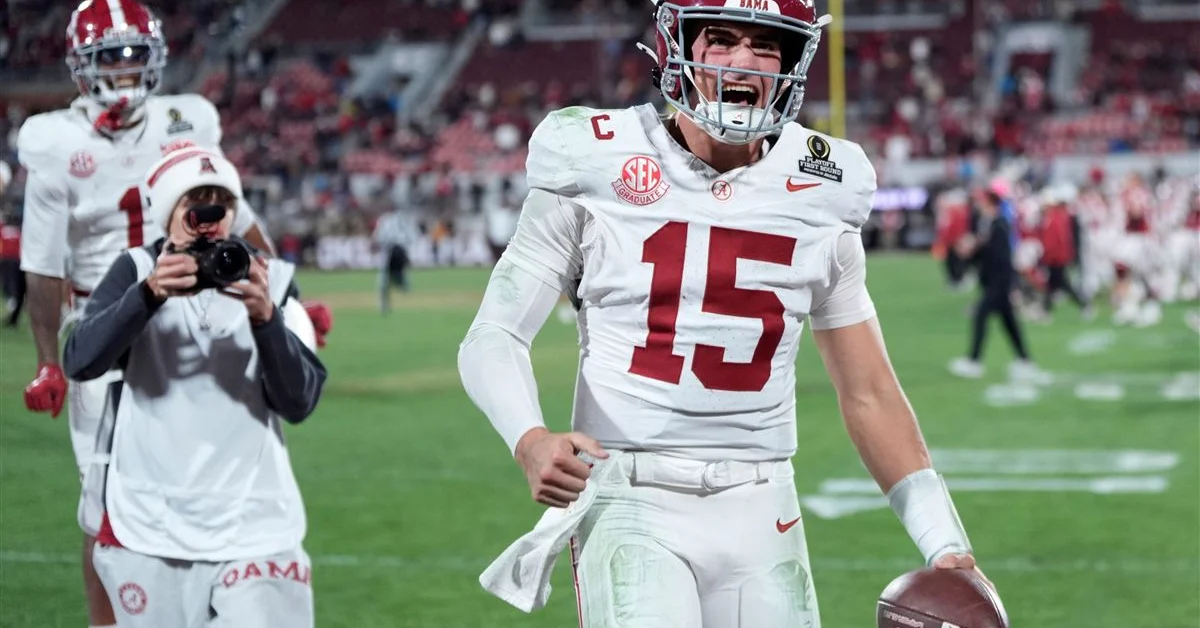
Alabama quarterback Ty Simpson announced last week that he was leaving school early to enter the NFL draft. But that hasn’t stopped other college programs from offering him lucrative NIL deals.
What started out in the $4 million range has reached in excess of $6 million, a source with knowledge of the situation told Bama247.
But that same source said the offers were unsolicited and that Simpson “hasn’t wavered” in his decision to enter the NFL draft. The expectation is he will not change his mind before the Wednesday deadline for underclassmen to declare.
Al.com was first to report the unrelenting interest in Simpson as the draft deadline approaches.
Simpson went 11-4 in his lone season as the starter, leading Alabama to the College Football Playoff and a come-from-behind victory at Oklahoma in the first round. But his season ended on a sour note as he threw for only 67 yards and no touchdowns in a 38-3 loss to Indiana in the Rose Bowl that saw him sidelined for much of the second half with a rib injury.
Simpson, who was named a team captain in the summer, finished the season with 3,567 passing yards, 28 passing touchdowns and five interceptions. He also ran for 93 yards and two scores.
Recent NFL mock drafts have had Simpson ranked among the top three quarterbacks — behind Indiana’s Fernando Mendoza and Oregon’s Dante Moore — and a borderline first-round pick.
Alabama 2026 NFL draft decision tracker: Who will stay in school or enter draft?
With Simpson gone, Mack and Russell are the two most experienced quarterbacks on the roster. The two were listed as co-backups this season with Mack having a 62-to-36 edge in total offensive snap over Russell.
Both Mack and Russell resigned with Alabama last week.

When Ohio State made the decision to hire Ross Bjork as athletic director once Gene Smith stepped down, a large reason was that he was supposed to be an expert in the NIL space. Bjork touted his ability to galvanize donors and pay the athletes what they rightly deserved.
The end of his tenure at Texas A&M did see the football program spend a lot of money on recruits. It backfired spectacularly. Jimbo Fisher did not coach the team well, and Bjork had to fire him and pay him around $77 million to not coach the program.
Since coming to Columbus, Bjork has used the opposite approach. He has been borderline stingy at every corner when it comes to NIL for the Ohio State football program. Instead of helping the Buckeyes, he is actively sinking the ship just a year after winning a national title.
Ross Bjork is actively hurting the Ohio State football program
30 players have entered the Transfer Portal from this year’s version of the Ohio State Buckeyes. That is by far the most since the portal became a widely used thing. What’s even worse is that Bjork has refused to pay enough to bring enough players in to replace those guys leaving.
There have been several instances of the Buckeyes losing out on talented portal players because they did not use their NIL money correctly. Bjork seems to think that the College Sports Commission is actually going to be able to enforce any sort of cap when it comes to revenue sharing.
No other high-major program is operating under those assumptions. In fact, most of Ohio State’s competitors keep reloading in the portal. Indiana is arguably passing the Buckeyes when it comes to finding talented older players in the portal, and that’s why they are playing for a national title.
Bjork was a questionable hire when he was brought in. The shine has worn off from the 2024 national championship, and more people are realizing that the title was won in spite of him, not because of him. Ryan Day needs to start putting his foot down when it comes to the football program.

After some marquee portal losses, the Texas Longhorns needed to add elite talent to the wide receiver room and did just that with the addition of Auburn Tigers transfer Cam Coleman over the Alabama Crimson Tide, Texas A&M Aggies, and Texas Tech Red Raiders.
Coleman is one of the crown jewels of the portal class, the No. 4 player overall and the No. 1 wide receiver and five spots ahead of the next-best offensive player — former Alabama wide receiver Isaiah Horton. The elite wideout made the most of his second recruiting cycle, but traveled to Austin first before trips to College Station, Lubbock, and Tuscaloosa. He’s ranked as a five-star portal prospect after arriving at Auburn two years ago as a five-star high school prospect, the second-ranked wide receiver behind Ohio State’s Jeremiah Smith.
In two years at Auburn, the 6’3, 200-pound wideout emerged as one of the nation’s most explosive targets despite the Tigers struggling to find consistency at quarterback. In two seasons, he accounted for 1,306 yards and 13 touchdowns catching passes from Peyton Thorne, Jackson Arnold, and Ashton Daniels. The hope for both Texas fans and Coleman is that putting him with a quarterback who specializes in the deep ball, like Arch Manning, will both open up the Texas offense and set him up for a one-year springboard on the Forty Acres.
This plan has worked wonders for Texas in previous years, with Matthew Golden and Adonai Mitchell putting up big numbers in Burnt Orange and hearing their names called early in the NFL Draft.
Texas was likely heading to the portal in the offseason regardless, but the departures of DeAndre Moore and Parker Livingstone made it a true necessity for the Longhorns. The Longhorns have bolstered the skill position talent on offense with the additions of Coleman and former Arizona State running back Raleek Brown.

As more and more Ohio State football players enter the Transfer Portal, the Buckeyes continue to let prospects go by without adding them to the roster. Despite several high-profile visits, the Buckeyes have only brought in five players from the portal to offset the 30 they’ve lost.
Ross Bjork should receive the majority of the blame. His failure to use NIL effectively, while every other major program seems to be able to, is a massive problem. Of course, there is something to be said for the change in mindset for some of the college football players these days.
Former Ohio State running back Maurice Clarett had his own gripes with the NCAA. He tried to challenge the NFL rule so that he could enter the NFL after his freshman season. Ultimately, that failed. Regardless, he gave his take on the portal situation.
Maurice Clarett explains why Ohio State football players are transferring
From Clarett’s perspective, he believes that college kids are just looking around to capture the most money possible.
There’s nothing going on besides money. Kids talk to kids. Parents talk to parents. Programs around the country need to win now. They’re paying a premium for guys. Not really hard to leverage yourself when you’re a former 4-5 star recruit that comes from Ohio State. 🤷🏾♂️
Not…
— Maurice Clarett (@ReeseClarett13) January 11, 2026
Clarett isn’t wrong that Ohio State certainly props up other kids who aren’t at the top of the depth chart. The cache of being at an elite program for a year helps them get more NIL money from a lower-level school, allowing them to maximize their earning potential.
That’s still no excuse for what is happening with the Ohio State Buckeyes. There is no reason that they should have this many players exiting the program and so few coming in. Ryan Day needs to get Bjork’s expectations in line for how the NIL game is played.
If that doesn’t happen, Ohio State is going to start to fall behind very quickly. Other programs have risen, and old powers are using NIL to get back to the top, as well. The Buckeyes need to fix their approach before it is too late and they fall too far behind.

Ty Simpson Reportedly Getting NIL Contract Offers After NFL Draft Decision, New Rumors on Alabama QB
Tennessee football offered Alabama quarterback Ty Simpson $4 million

SBU Sports: Women’s Track & Field returns to competition at TCNJ Invitational

Ty Simpson “not wavering” on decision to turn pro amid NIL bidding war

Upcoming season could be last for transgender teen athlete | Shareable Stories

Community and Youth | Miami Recreation

The Ohio State football program is in Transfer Portal crisis thanks to Ross Bjork

Two School Records Fall for Women’s Track & Field in VIrginia

No. 1 portal WR Cam Coleman commits to Texas

Legend posts Transfer Portal message that Ohio State football fans needed to see

Ball State Finishes Weekend Victorious Versus NJIT

Fort Lewis College women’s basketball uses strong shooting in win over Westminster

Vasseur outlines Ferrari’s 2026 development strategy

Steelers surprise local flag football leader with Super Bowl LX tickets

Gauchos Down Harvard to Start Season 3-0

Stempien to seek opening for Branch County Circuit Court Judge | WTVB | 1590 AM · 95.5 FM

Ross Brawn to receive Autosport Gold Medal Award at 2026 Autosport Awards, Honouring a Lifetime Shaping Modern F1

Maine wraps up Fall Semester with a win in Black Bear Invitational

Downtown Athletic Club of Hawaiʻi gives $300K to Boost the ’Bows NIL fund

Princeton Area Community Foundation awards more than $1.3 million to 40 local nonprofits ⋆ Princeton, NJ local news %

Badgers news: Wisconsin lands 2nd commitment from transfer portal

Three Clarkson Volleyball Players Named to CSC Academic All-District List

Five Youth Sports Trends We’re Watching in 2026

Nike Signs 10 LSU Athletes to NIL deals

Beach Volleyball Unveils 2026 Spring Schedule – University of South Carolina Athletics

Kentucky AD explains NIL, JMI partnership and cap rules

Badgers news: Final Four Game Thread vs. No. 1 Kentucky Wildcats

PRI Show revs through Indy, sets tone for 2026 racing season

Central’s Meyer earns weekly USTFCCCA national honor

Kentucky VB adds an All-American honorable mention, loses Brooke Bultema to portal





-
 Sports3 weeks ago
Badgers news: Wisconsin lands 2nd commitment from transfer portal
-
 Rec Sports1 week ago
Five Youth Sports Trends We’re Watching in 2026
-
 Sports3 weeks ago
Kentucky VB adds an All-American honorable mention, loses Brooke Bultema to portal
-

 Motorsports3 weeks ago
Dr. Patrick Staropoli Lands Full-Time O’Reilly Ride with Big Machine Racing
-

 Motorsports2 weeks ago
BangShift.com IHRA Acquires Historic Memphis Motorsports Park In Millington Tennessee. Big Race Weekend’s Planned For 2026!
-
NIL2 weeks ago
Fifty years after IU’s undefeated champs … a Rose Bowl
-
 Sports2 weeks ago
Colorado volleyball poised to repeat success
-
 Sports2 weeks ago
2025 Volleyball Player of the Year: Witherow makes big impact on Central program | Nvdaily
-
 Sports2 weeks ago
H.S. INDOOR TRACK & FIELD: GLOW region athletes face off at Nazareth University | Sports
-

 Motorsports3 weeks ago
NJ Motorsports Park Announces 2026 Event Schedule