A new youth sports complex opens on the edge of town. Ten or twelve pristine fields. Acres of parking. A name that signals ambition… Regional, Legacy, Premier. On weekends, the place is packed with tournament traffic: minivans, tents, folding chairs, vendors. On weekdays, it sits largely empty. At the same time, closer to the city’s core, school fields are locked after hours. Park courts lack lights. Neighborhoods dense with children and young adults have no playable space within walking distance.
This coexistence (abundance on the outskirts, scarcity at the center) does not feel accidental. It’s the result of a set of incentives that consistently push cities toward large, centralized sports complexes rather than small, distributed neighborhood fields.
The question is not whether these complexes “work.” Many of them do exactly what they are designed to do. The question is what problem they are actually solving.
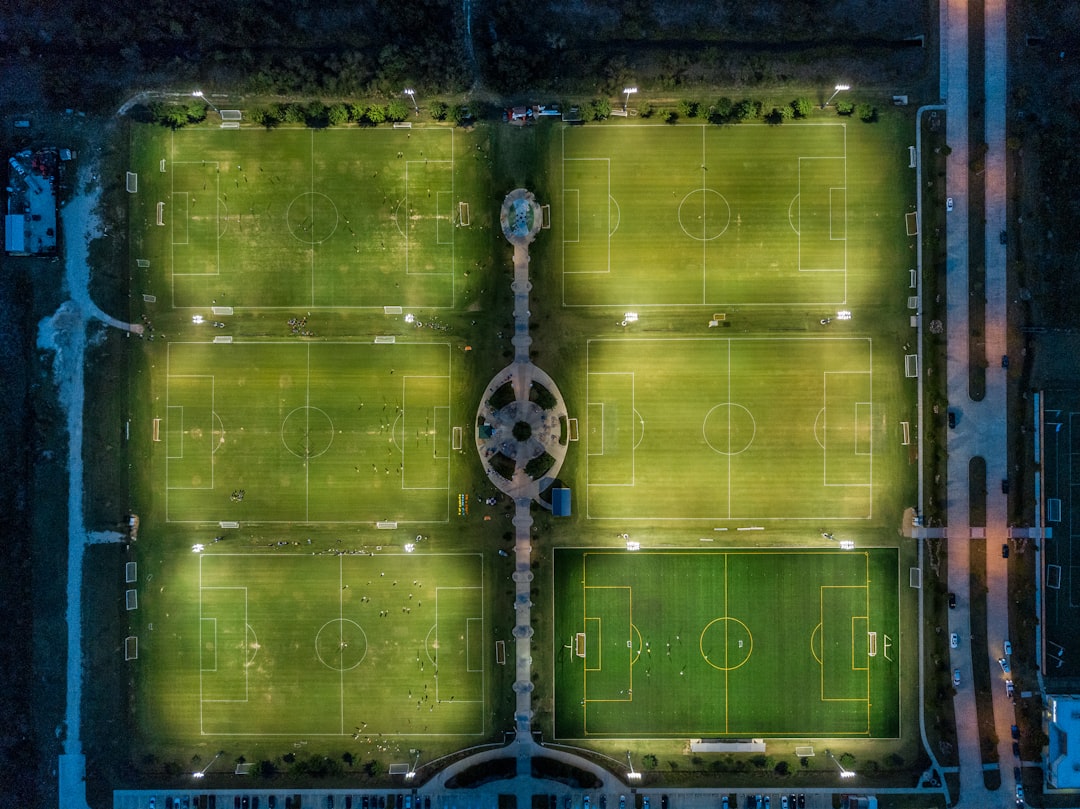
Photo by Alexander Londoño on Unsplash
Large sports complexes are attractive to city governments because they are easy to explain. They arrive with economic impact studies attached: hotel nights, restaurant spending, regional visitors. They come with clear capital budgets, naming rights, and ribbon-cutting ceremonies. They can be photographed from the air and branded as evidence of investment. A $30 million complex feels like progress because it is visible.
Neighborhood fields, by contrast, don’t always photograph well. A lit mini-pitch on a residential block looks like maintenance instead of transformation. Ten small investments scattered across a city do not produce a single moment of political credit in the way one large facility does.
In the end, cities are not only responding to community need; they are responding to the logic of governance. Centralized projects are legible to councils, donors, and the press. Distributed infrastructure is quieter and harder to narrate. The result is predictable: cities optimize for visibility rather than proximity.
Beyond politics, sports complexes solve a series of administrative challenges. They centralize scheduling, liability, maintenance, and security. They allow recreation departments to manage sport as a contained activity rather than a diffuse one. Insurance is simpler, permitting clearer, and staff can be concentrated in one place.
Neighborhood fields demand something different. They require tolerance for informal use. They require shared ownership and ambiguity. They invite unscheduled play, mixed ages, and overlapping activities. They make risk harder to quantify and control.
Over time, American cities have made a quiet tradeoff: In the name of safety, efficiency, and liability management, they have narrowed the conditions under which play is allowed to happen. Locked school fields are the clearest example. Publicly funded land—arguably the most evenly distributed athletic infrastructure in the country—is increasingly inaccessible outside of sanctioned hours for certain groups. What once functioned as a neighborhood commons now operates as a reserved facility.
This is not some sort of conspiracy; it is a cumulative effect of policy choices that privilege order over use. In any case, the outcome is the same: informal play disappears, not because people stopped wanting it, but because cities stopped permitting it.
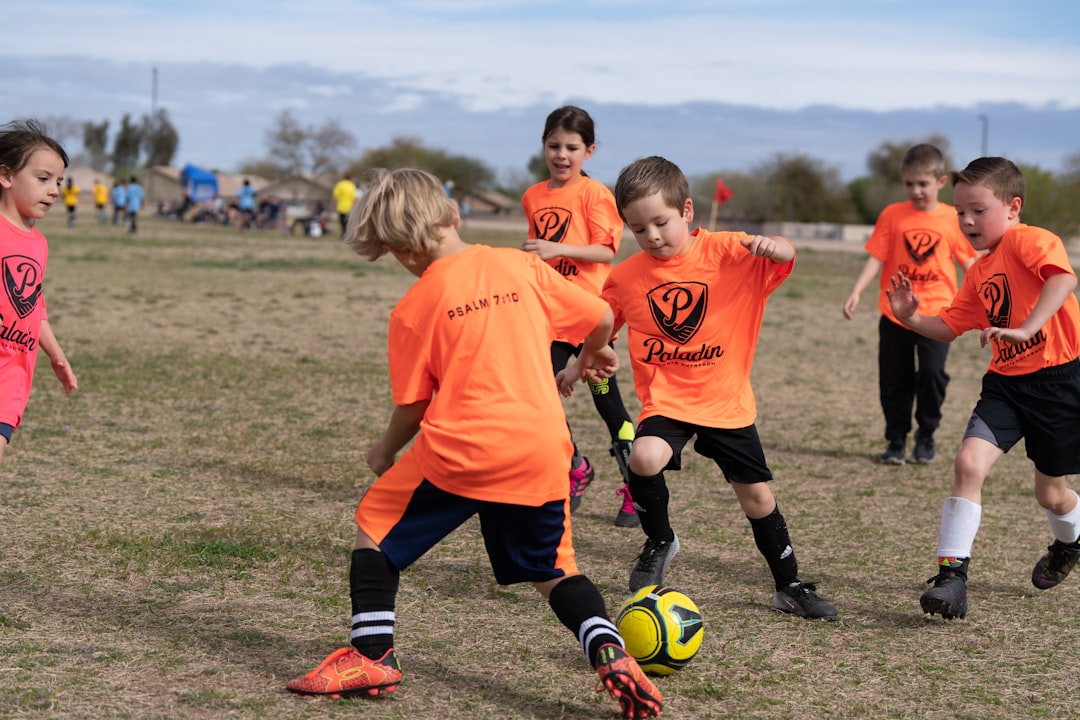
Photo by Matthew Osborn on Unsplash
Sports complexes are often defended as “for the kids”, which is true, but incomplete. They are for a specific kind of kid: one whose family has transportation, flexible weekends, and the means to pay tournament and registration fees. They are for teams already inside organized systems.
A facility located thirty minutes from most neighborhoods, designed around weekend tournaments, implicitly excludes:
children who rely on public transit
adults who work nonstandard hours
people seeking casual, after-work play
families for whom sport is not a full-time logistical project
By contrast, neighborhood fields, especially when lit and unlocked, serve a much broader population. They support:
spontaneous play
intergenerational use
adult recreation
repeated, low-pressure participation
The difference is not simply access, but frequency. A child who can play three nights a week within walking distance accumulates far more meaningful engagement than one who plays once a week at a distant complex.
Complexes maximize peak usage. Neighborhood fields maximize lifetime usage. Cities tend to choose the former.
One reason this pattern persists is scale. A single large complex carries a large price tag, which paradoxically makes it easier to justify. It feels like a serious investment and a line item that commands attention. Distributed infrastructure does not. Ten $1 million neighborhood projects feel incremental rather than transformative, even if they serve more people more often. Maintenance budgets are harder to celebrate than capital expenditures.
Yet from a public-health and civic perspective, the return on neighborhood infrastructure is often higher. A small field used daily by dozens of people across age groups produces more cumulative hours of movement, social contact, and belonging than a complex used intensely but intermittently. The problem is not that cities lack resources. It is that they measure success at the wrong scale.
Photo by Joshua Kettle on Unsplash
This is not an abstract critique. Other cities offer concrete alternatives. In the Paris suburbs, municipal pitches are embedded directly into residential neighborhoods. These are not elite facilities. They are durable, visible, and permissive. Community tournaments like the Coupe d’Aulnay use public fields to create large-scale civic events without privatizing space. In Medellín, small neighborhood courts—canchas de barrio—were built deliberately as tools of violence reduction and social cohesion. Lighting, visibility, and accessibility mattered more than surface quality. These spaces became anchors of daily life, not destinations.
Even within the United States, basketball provides a telling comparison. For much of the twentieth century, cities invested heavily in outdoor courts. These were cheap, ubiquitous, and politically uncontroversial. They produced a culture of pickup play that persists decades later. Basketball did not become a public language because of professional leagues alone. It became a public language because cities made it unavoidable.
Soccer, by contrast, was routed into complexes and clubs. This difference was not inevitable. It was designed. So… what would change if cities asked a different question?
Instead of:How do we host more tournaments?
Ask:Can a twelve-year-old play within a ten-minute walk of home, three nights a week?
Instead of: How do we attract regional events?
Ask:Where do adults play after work without registering, paying, or driving across town?
These questions point toward a different set of investments:
lighting instead of fencing
unlocked gates instead of reservation systems
durable surfaces instead of showcase turf
policy that tolerates informal use rather than suppressing it
The most powerful sports infrastructure is not the kind people travel to; it’s the kind they stop noticing because it is always there.
Cities keep building sports complexes not because they are the best way to create access, but because they are the easiest way to demonstrate investment. They are legible, controllable, and photogenic. Neighborhood fields are none of those things. They are messy. They are dispersed. They blur the line between program and public life… But they do something complexes cannot.
They turn play into a daily practice rather than a scheduled event. They allow sport to function as civic infrastructure rather than consumer experience. American cities do not lack ambition when it comes to sports. They lack imagination about scale.
Ultimately, the choice is not between excellence and access. it’s between building for moments and building for lives. If cities want sport to serve public health, belonging, and community—rather than only weekends and tournaments—they will need fewer showcases and more spaces where nothing is scheduled, and everything is possible.
[[divider]]
This article was originally published, in slightly different form, on Noah Toumert’s The People’s Pitch. It is shared here with permission.
Players in the 2012 NPL boys soccer team practice at Cubberley’s turf soccer field in Palo Alto on January 28, 2025. Photo by Anna Hoch-Kenney.
In the pursuit of easier maintenance and year-round playability, Palo Alto officials approved installing new artificial turf at the El Camino Park playing fields Monday night, concluding, at least for now, the prolonged debate that pit environmentalists against soccer players and their coaches.
However, the approved fields look a bit different than the ones that were proposed before the City Council in November. That’s because a council ad hoc committee was tasked with learning more about the technology and risks associated with synthetic turf, and recommended a natural cork infill as opposed to the typical rubber pellets. The goal of the cork infill is to reduce the amount of plastic as well as the surface temperature of the fields, which tend to develop heat islands during warmer weather. Other risk mitigation efforts include annual testing and site-specific filtration to limit the plastic runoff into stormwater drains.
“There was just no way to replace the El Camino fields with grass without displacing huge numbers of players,” said Mayor Vicki Veenker, who served on the ad hoc committee.
It only took a consultant study, two Parks and Recreation Commission discussions, two council discussions, and a specially appointed council hoc committee to decide which material the city should use to resurface the El Camino turf fields, which are reaching the end of their usable life. The ad hoc committee was formed at the end of a lengthy discussion on Nov. 17, when instead of taking a vote, the council deferred the decision yet again
Council members Julie Lythcott-Haims, Keith Reckdahl and George Lu were ready that night to go with the committee and consultant recommendation of synthetic turf — but their three votes were not enough to muster a majority. Instead, then-Vice Mayor Veenker, then-Mayor Ed Lauing and Council member Pat Burt joined the ad hoc committee to further review the issue.
The committee’s meetings were not publicly available, but a staff report summarizing the discussion took care to emphasize the greater number of playable hours offered by synthetic turf compared to natural grass. According to the staff report, a natural grass replacement could displace more than 1,000 players annually due to winter weather rendering the grass unplayable.
While the consultant study and the Parks and Recreation Commission both recommended artificial turf as the best option for El Camino, the City Council initially appeared keen to heed the warnings of environmental advocates who raised concerns about microplastics and forever chemicals. They have argued before the council several times that the increased playability of synthetic turf — or “plastic carpet,” as some call it — is not worth the environmental contamination.
Advocates have also taken issue with the consultant study upon which city officials have relied to make their decision, saying that it exaggerates the playable hours of turf and minimizes the long-term costs and risks of playing on plastic. Some argued that the city does not truly understand the hazards of synthetic turf. Claire Elliott, an ecologist who lives in Ventura, urged the council to formally reject the consultant study that recommended turf.
“I am frankly dismayed that we are still considering plastic-coating our parks with this material,” Elliott said. “It’s really not an environmentally sound decision and I think of Palo Alto being a city that generally makes environmentally sound decisions, so it’s disappointing.”
Even at just one minute per speaker, the public comment portion of the meeting took close to an hour, with 42 people (and more than a few youth soccer players) lined up in the council chambers and on Zoom to offer their support or condemnation of synthetic turf fields.
Speakers who have opposed turf previously were not satisfied with the risk mitigation efforts proposed by the ad hoc committee, arguing that “better plastic” is still plastic at the end of the day.
The back-and-forth also got testier on Monday night compared to previous meetings, with several residents addressing other speakers directly instead of the council.
“To the patronizing speakers who think that we’re too dumb to understand this, I’m a professor in public health, and look how healthy the soccer players look versus the people who spoke against the soccer fields,” said Adam Olshen, who spoke in favor of synthetic turf.
While the rest of the council was persuaded by the upgraded synthetic turf option, Vice Mayor Greer Stone found himself as the sole no vote. He acknowledged this fact on the dais, but said the health risks described by the Santa Clara County Medical Association were too great to vote in favor of synthetic turf.
“I think it’s a false choice to say that we’re choosing synthetic turf and then youth sports, or if we choose natural grass we are voting against youth sports,” Stone said. “Sports will continue; I think we can find better ways to create access to it.”
Stone added that he hopes the resurfacing of the El Camino fields will be the last time synthetic turf is used in Palo Alto.
The council’s motion leaves room to pursue a natural grass pilot elsewhere in the city, with fields at Greer Park and Cubberley Community Center floated as options. The motion also makes explicit reference to transitioning the Cubberley synthetic fields to natural grass when they are due for resurfacing in 2028.
“We don’t have time to go through that (natural turf) learning curve while the kids are sitting there waiting for the grass to grow,” Reckdahl said. “I think in the short term, we unfortunately have no option but to go to the artificial turf field.”
Following a breakout inaugural season that captivated fans nationwide, the Athletes Unlimited Softball League (AUSL), today announced the host cities and venues for its teams beginning with the 2026 season, marking a watershed moment for the league and for professional softball.
With teams spanning six Top 50 U.S. media markets and two of the nation’s leading innovation hubs and fastest-growing cities, the announcement cements AUSL’s transition to a fully city-based league and reflects the widespread resonance of softball across the United States. In addition, AUSL’s national reach allows the league to authentically connect with fans across diverse regions and communities. Collectively, these markets significantly over-index in Millennial and Gen Z populations, women-led and college educated households, and youth sports participation – all audiences that are shaping the future of professional women’s sports fandom.
This milestone builds on a historic inaugural season fueled by sellout crowds, record viewership and social engagement, a strategic investment by Major League Baseball, expansion to six teams, and a multi-year media rights renewal with ESPN.
After evaluating numerous potential markets against a comprehensive set of criteria, each AUSL host city was ultimately selected for its authentic connection to softball, demonstrated support for women’s sports, access to professional-caliber facilities and ability to serve as a long-term home for professional teams. Together, these markets reflect the nationwide resonance of softball and AUSL’s commitment to building a league rooted in community, culture, and competitive excellence.
The six teams and their home venues are:
The Carolinas have produced generations of elite softball talent, and Durham sits at the heart of that tradition. With a strong youth pipeline and a deep appreciation for high-level competition, the region offers an ideal home for the Blaze.
Duke University Softball Stadium provides a premier venue where the Blaze can connect with fans who value the growth and development of women’s sports. With former Duke standouts Ana Gold and Jala Wright on the roster, the Blaze reflect the pride and passion of Carolina softball.
Chicago is one of the most passionate and knowledgeable softball markets in the country, and the birthplace of the sport itself. The return of the Bandits brand represents both a homecoming and a new chapter, blending deep regional roots with the future of professional softball.
Rosemont has served as the home of Athletes Unlimited Softball since its 2020 inception and offers an outstanding, centrally located venue for Midwest fans. Chicago is the ideal market to build the next era of professional softball, honoring tradition while pushing the sport forward.
Oklahoma stands as one of the most influential softball markets in the world, with a rich culture spanning youth, collegiate, and national levels. As the home of USA Softball and the Softball Hall of Fame, Oklahoma City represents the heart of the sport.
The University of Oklahoma’s storied softball history and the city’s growing appetite for women’s professional sports make Oklahoma City a cornerstone market for AUSL. Announced as the league’s first city and joining in late 2025, the Spark deepen AUSL’s central U.S. footprint while connecting with a passionate fan base. The return of hometown favorites Kinzie Hansen, Haley Lee and Sydney Romero further strengthens that bond.
The Pacific Northwest has consistently led the way in supporting women’s sports, and Portland stands as the epicenter of that movement. The city offers a community that embraces innovation, inclusion, and high-level competition—making it a natural fit for AUSL and its athletes.
With a passionate fan base and a strong softball culture, the Cascade will thrive in a region where women’s sports are celebrated year-round. The presence of Pacific Northwest standouts Sis Bates and Paige Sinicki further deepens the connection between the team and its fans.
Texas is synonymous with softball excellence at every level, and the Volts’ home reflects that legacy. Strong fan support during AUSL games last summer confirmed the region’s appetite for elite professional softball, while the fast-growing women’s sports community provides a powerful platform for long-term growth.
Dell Diamond offers a world-class venue and fan experience, and AUSL is proud to partner with Reid Ryan and his team to establish a premier destination for the Volts. With Texas legends including GM Cat Osterman, Head Coach Ricci Woodard and recent Longhorn standout Mia Scott, the Volts are anchored in a region that lives and breathes the sport.
Salt Lake City has emerged as a dynamic sports market with a strong youth softball foundation and growing enthusiasm for women’s professional sports. Following sellout crowds during last season’s series, the Talons return as the reigning AUSL champions, bringing momentum and excitement to the Mountain West.
The University of Utah provides an exceptional setting for the Talons and for league expansion in the region. Led by hometown hero Hannah Flippen, the Talons are deeply connected to the community they represent.
“These host cities represent the next major chapter of the AUSL’s growth,” said Kim Ng, Commissioner of the Athletes Unlimited Softball League. “We are building on the momentum of an historic inaugural season by establishing franchises in markets with strong softball traditions, proven fan engagement, and the infrastructure to support a world-class professional experience. This is about creating lasting connections between our athletes, our teams, and the communities they represent, and setting up the sport of softball for long-term success at the professional level.”
The 2026 AUSL regular season will begin June 9 with an Opening Day featuring all 6 teams – the Utah Talons hosting the Chicago Bandits, the Carolina Blaze hosting the Portland Cascade and the Oklahoma City Spark hosting the Texas Volts. The full 2026 schedule can be found below. At www.theAUSL.com, fans can become Founding Season Ticket Members for any of the six teams beginning today at 12:00pm ET*.* Group tickets for all games are also available. Single game tickets will be available at a later date.
The AUSL playoff format will expand to include a play-in game between the second- and third-ranked teams, with the top performing team earning a bye into the best-of-three AUSL Championship. The AUSL Championship and play-in game will take place at a neutral site, to be announced at a later date. Following the AUSL Championship, a select group of players will be chosen to compete in the AUSL All-Star Cup, a high-stakes showdown held in Rosemont to crown the ultimate individual softball champion utilizing the innovative Athletes Unlimited format.
Earlier this offseason, AUSL announced a veteran leadership group of General Managers and Head Coaches across its six teams, a collective that brings six Olympic medals, 17 NCAA championships as players and coaches, and 17 NCAA All-American honors to the league. The league’s original teams — the Bandits, Blaze, Talons, and Volts — will be joined by expansion teams OKC Spark and Portland Cascade, forming a six-team league that will compete beginning in 2026.
Last month, AUSL also completed its 2026 player acquisition process with a two-part Draft that aired live on ESPNU. The Draft opened with an Expansion Draft, allowing the OKC Spark and Portland Cascade to establish their rosters, followed by an Allocation Draft in which all six teams selected from a wider pool of professional athletes. In the spring, remaining roster spots will be filled through the AUSL College Draft, with selected NCAA athletes receiving Golden Tickets to join the league.
Earlier this offseason, Athletes Unlimited and ESPN announced a multi-year media rights extension that will make ESPN an official broadcast partner of the Athletes Unlimited Softball League beginning in 2026. Under the three-year agreement, ESPN will carry 50 exclusive AUSL games annually, including 47 regular season contests and the best-of-three AUSL Championship Series. Coverage will span ESPN platforms and include a marquee game on ABC — marking the first time professional softball will air on broadcast television in the United States.
On May 29, 2025, MLB announced a strategic investment in the AUSL, marking a first-of-its-kind, comprehensive partnership with a women’s professional sports league to help establish and grow the AUSL as a sustainable organization. As a part of MLB’s ongoing commitment to supporting the growth of softball at all levels, MLB will work collaboratively
University Heights, OH — The University of Pittsburgh at Bradford women’s basketball team had a tough challenge on Monday evening as they headed to John Carroll to face the 10th-ranked Blue Streaks. The Panthers struggled to keep up with John Carroll and fell 112-41.
The Panthers started fast, matching John Carroll’s five early points with a three-pointer by Amber Murak and a jumper from Ella Gettings. Unfortunately, they were unable to keep pace after the Gettings bucket, and the Blue Streaks rolled off 10 straight points. Murak ended the run with a layup, but it was followed by another Pitt-Bradford scoring draught that saw John Carroll push their lead to 16. Murak and Zennette Zigler combined for three free throws in the last few minutes, while their effort was matched by the hosts, who finished the period with a 31-10 lead.
John Carroll opened the second with a 9-0 run before Murak got the Panthers on the board with a pair of free throws. Gettings made a short jumper with 4:15 left in the half, ending an 11-minute drought from the field. It was in the midst of an 18-4 run that also included two free throws by Raquel Sewell. Dalayla Alexander added a late jumper, but the hosts hit two more three-pointers in the final minute to send the game to the break with Pitt-Bradford trailing 64-18.
The hosts continued their run as the 2nd half began, scoring the first 10 points of the 3rd quarter. Murak stopped another run with a driving layup. It started the Panthers’ best offensive stretch of the game, as a minute later, they scored on three straight possessions. A Murak layup was followed by an Alexander three and a tip-in from Sewell. Alexander added another layup in the quarter, but the Blue Streaks closed with a 7-0 run to end the quarter.
The Panthers were able to score first in the fourth as Alexander made a jumper in the lane on Pitt-Bradford’s second possession. Murak added two more layups and a three-pointer in the quarter. Abigail Goss closed the game with two free throws, putting the final score at 112-41.
Amber Murak led all scorers in the game with 19 points. Dalayla Alexander added 9 points, while also tallying 4 rebounds and 2 steals. Raquel Sewell and Zennette Zigler each grabbed 7 rebounds in the loss.
Pitt-Bradford falls to 0-12 on the season with the loss. The Panthers will be back in action on Thursday, when they return to AMCC play with a home matchup against Alfred State. Tipoff is set for 7:00 p.m., and the game will include a halftime game played by teams from the Bradford Youth Girls Basketball League.
A live TV broadcast of races for children under 16, complete with professional graphics, a studio setup, and expert commentary — just like a World Cup event. Four disciplines across four venues in Slovakia, Czechia, Poland, and Austria, completely free of charge for all young racers. The competition culminates with an unforgettable main prize: an inside-the-ropes World Cup experience in Alta Badia, Italy. Add to that special guests from the world ski scene, valuable prizes, and a rich side program for visitors of all ages. Can you imagine a stronger spark for young athletes dreaming of a future in ski racing?
A Brotherhood Bringing Positive Change
Behind the idea of motivating young athletes for more than a decade stands a trio of brothers from Slovakia, well known within the ski community. Adam, Andreas, and Teo Žampa made history as the first brother trio to compete in the same discipline at the World Championships — lining up together in the giant slalom at Saalbach 2025. Their careers include notable achievements, such as a silver medal from the World Championships in the team parallel event and several top-10 finishes at major competitions.
In Slovakia, they rank among the country’s most popular athletes, not only because of their racing success but also because of the initiatives they actively support in alpine skiing development, along with the expert insights they regularly share on TV studios.
Giving young racers a taste of the World Cup
Together with his brothers, Andreas Žampa explained that they have been organizing the BILLA Žampa Cup for ten years and that he was genuinely happy to welcome last season’s winning club to Alta Badia. The overall points winner — the Czech club TJ Slovan Pec — earned a unique opportunity to experience the World Cup from the inside. The kids stood at the start, watched the top racers train, took part in the bib draw, and met the fastest men on the World Cup circuit. Žampa emphasized that experiencing life at the highest level firsthand can inspire young athletes to one day stand there as racers themselves.
The selection of the six children who participated in the trip was about more than results. The club considered discipline, regular training attendance, school performance, fair play, effort and overall attitude.
Inspiration beyond results
Žampa said the project’s goal is to give back to the next generation. He emphasized the importance of helping children feel motivated to improve a little every day and noted how meaningful it was to create something special in collaboration with World Cup organizers.
Click on images to enlarge
The Žampa brothers and the winning ski club on their way to training in Alta Badia, credit: Teo Žampa
TJ Slovan Pec in the World Cup grandstands, credit: Kateřina Matasová
When a Win Means More
“We watched the giant slalom training and saw all those world-class skiers up close. We were at the bib draw, collected autographs, and even met Jan Zabystřan — our successful compatriot who recently celebrated his first World Cup victory,” said Emilija Ivanovska from the winning Czech club TJ Slovan Pec. “It’s an incredible experience for our entire team.”
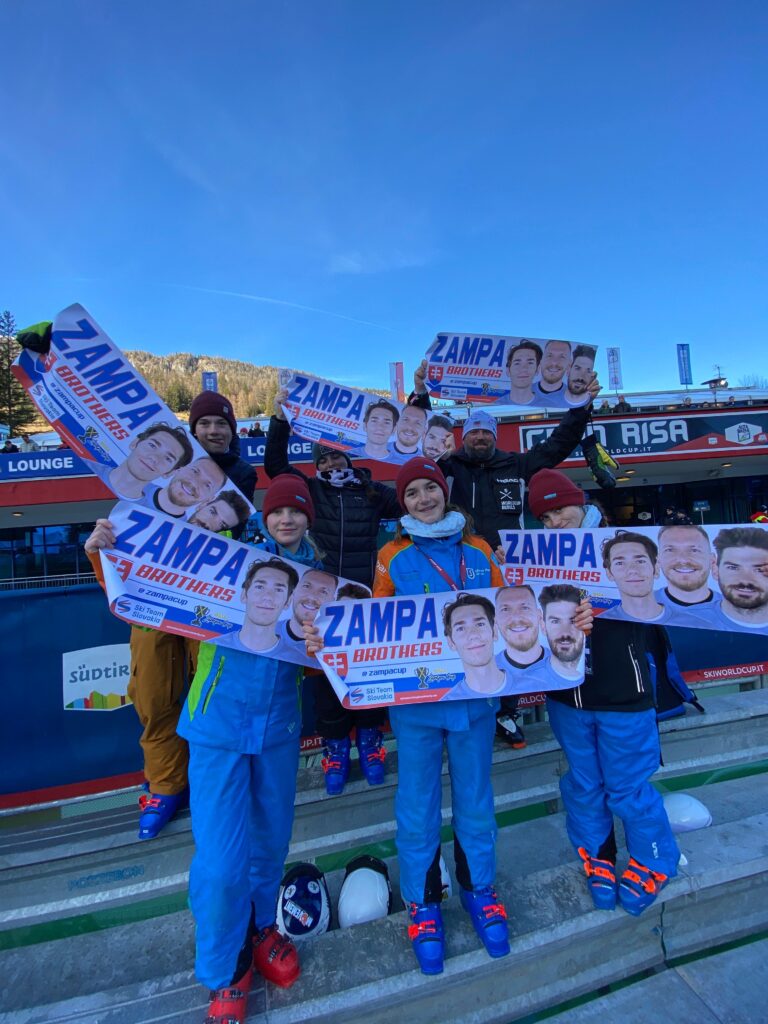
When asked who they would be cheering for, the answer was unanimous — the Žampa brothers — a fact clearly visible from the banners they proudly held. You can see how the winners enjoyed their time in Alta Badia here.
“For the kids, this is an huge motivation, and I’m really happy the guys are organizing this event. It truly inspires young athletes,” says Lukáš Wondráček, coach of TJ Slovan Pec.
Motivation that carries forward
And he’s not wrong. Slovakia was represented in Monday’s slalom by young skier Adam Nováček, a 20-year-old athlete who once competed at the Žampa Cup himself. In Alta Badia, he made his second World Cup start — and celebrated his first successful World Cup finish.
Billa Žampa Cup 2025 – Štrbské Pleso (SVK)
Ljutić Brought the Globe — and the Energy
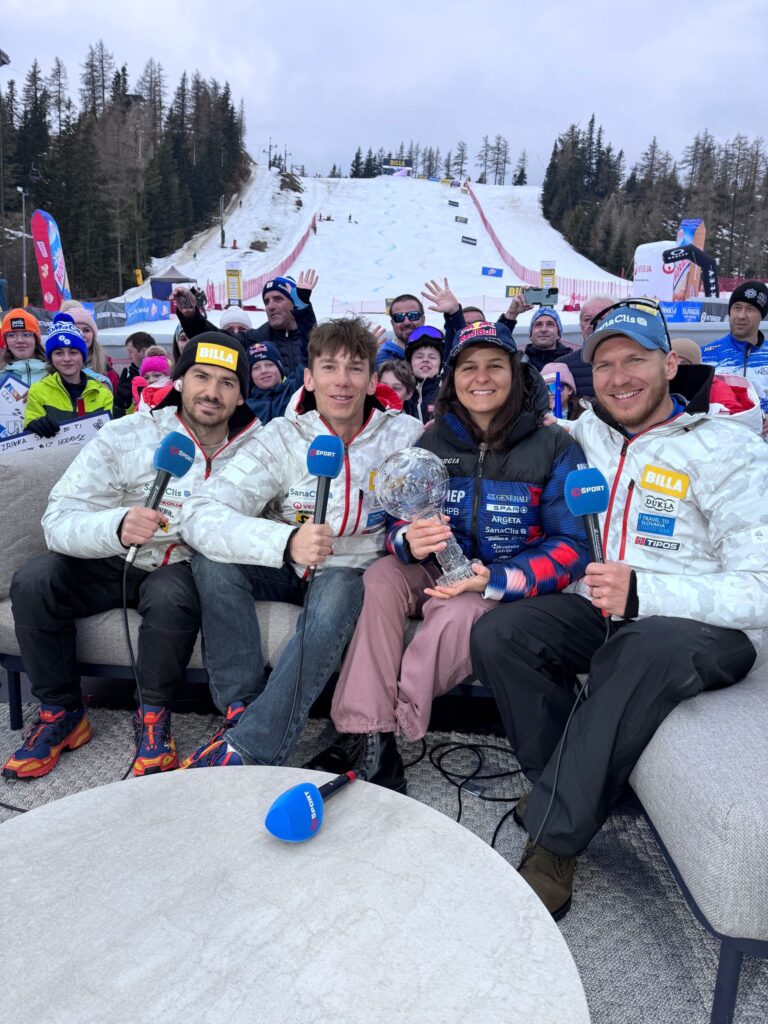
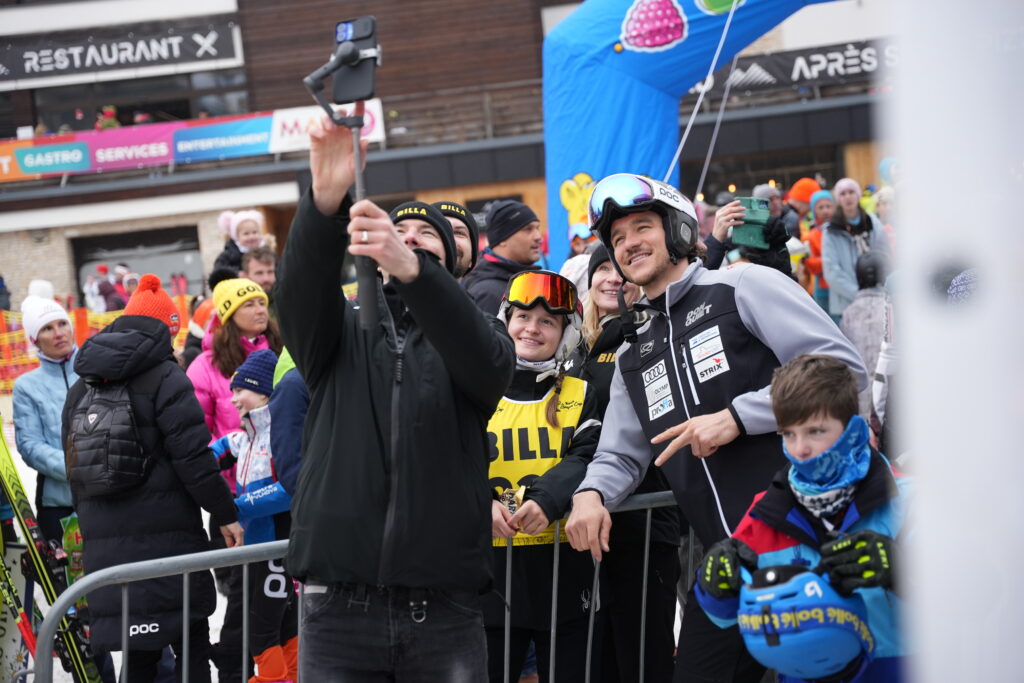
One of the special guests at the Žampa Cup finals in Štrbské Pleso (SVK) in March 2025 was Zrinka Ljutić, the freshly crowned slalom globe winner, who arrived straight from the World Cup Finals in the United States. She visited the race start, spent time with thousands of fans during the autograph session, and brought not only her trophy but also an incredible dose of energy and motivation to the event.
Slovak and Croatian skiing have shared warm relations for years, and Croatian success is genuinely celebrated by Slovak fans. Zrinka’s fan club is even led by a young Slovak woman, Nina, who attended the event with Billa Žampa Cup banners in hand.
Winning the small globe was a dream come true for Ljutić, who said she was deeply happy to share the moment with everyone at the Billa Žampa Cup.
Ljutić also appeared in the live finish-area studio of JOJ Šport TV, which broadcast the entire race with full graphics and expert commentary. That level of professionalism matters, accordingly to organizers and parents.
Feeling part of something bigger
One attending parent shared that both of their children raced and truly felt part of something big — just like what they see on TV. Even without podium results, the experience itself made the day special, capped off with hot chocolate and autograph sessions.
In addition to Ljutić, visitors and young racers also met Zabystřan, Martina Dubovská, and Finnish star Erika Pykäläinen.
The Žampa brothers and Zrinka Ljutić in the live studio, credit: Billa Žampa Cup
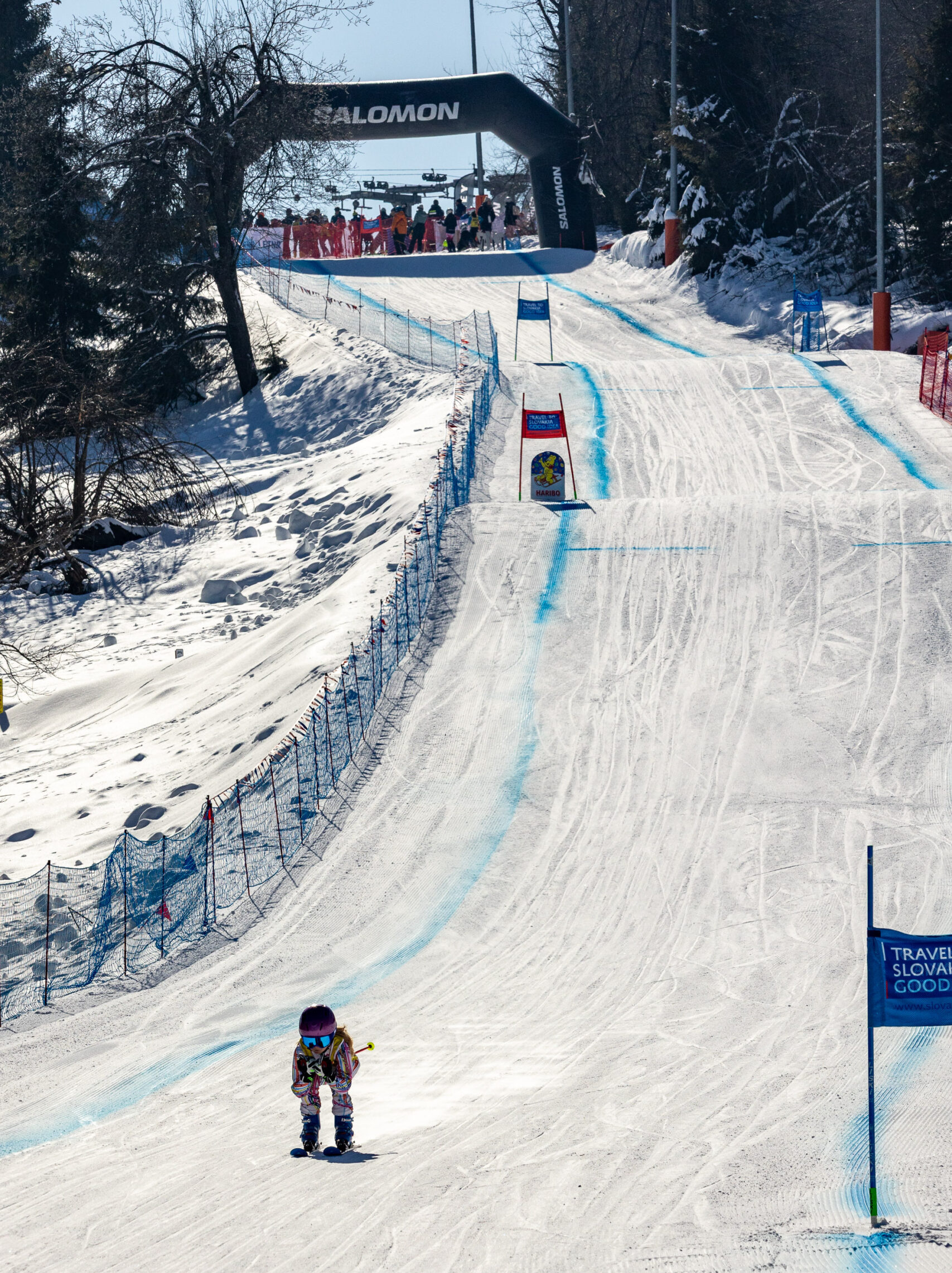
Billa Žampa Cup – Downhill, credit: Billa Žampa Cup
Great Potential Ahead
The Billa Žampa Cup 2026 will introduce several new developments. For the first time, the series will expand to Austria, partnering with Ski Club Arlberg, the world’s oldest ski club. In Lech/Zürs, young racers will take part in a unique ski challenge designed to test overall skills while prioritizing fun with competition.
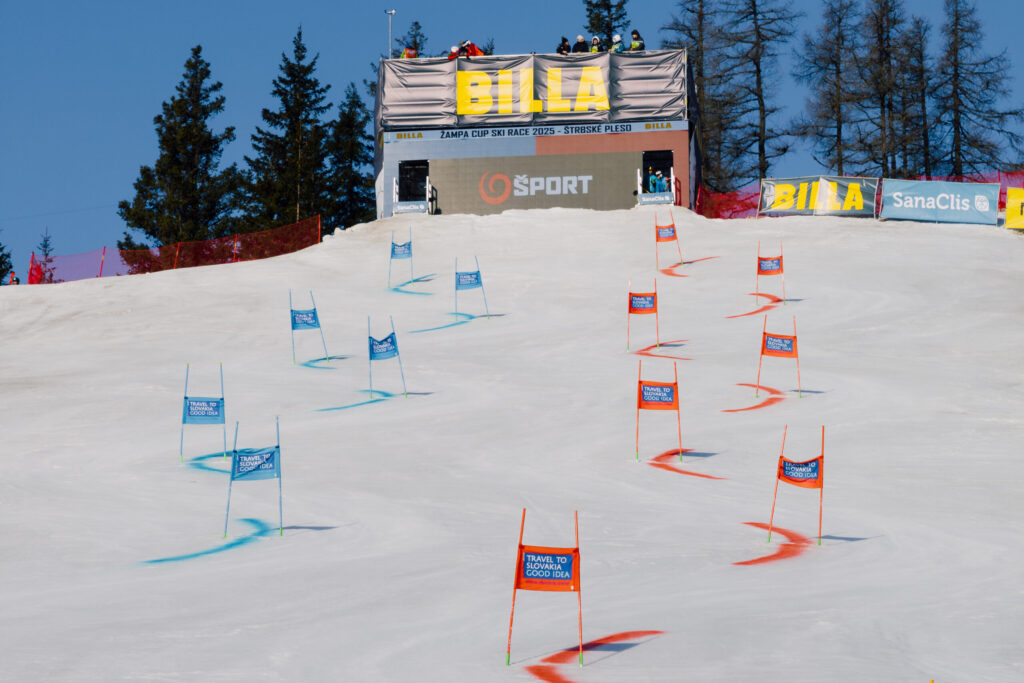
Each event has its own distinct character. In Pec pod Sněžkou, young skiers will compete in a combi race blending alpine skiing and ski cross. In Białka Tatrzańska, the program includes a children’s downhill — a discipline many young racers aspire to try. The season finale at Štrbské Pleso will feature a parallel slalom broadcast live on television, along with side events such as a speed challenge, skills run, and the Winter Youth Olympics of the High Tatras. Children will also have the opportunity to try snowboarding, cross-country skiing, and ski mountaineering at Teo Žampa.
Organizers promise a special atmosphere, a record number of World Cup guests, and a professional environment for all participants. The goal remains clear: to help young racers feel like stars, build friendships, and embrace the challenges of alpine skiing.
Registration for all Billa Žampa Cup events is free of charge. The initiative is not limited to future professionals. It also welcomes recreational skiers who want to try racing or simply enjoy the atmosphere.
Building community, not just champions
“One of our missions is to bring skiing closer to everyday people. This is not just about professionals, but about the entire community that shares winter, a love for snow sports, mountains, slopes, and nature. We simply want to strengthen that mountain spirit,” adds Andreas Žampa.
You can also find an interesting interview with the three Slovak brothers in the Skiing is Believing podcast, where they were guests a year ago. On behalf of Ski Racing Media, we wish them the best of luck in continuing to inspire future generations of skiers.