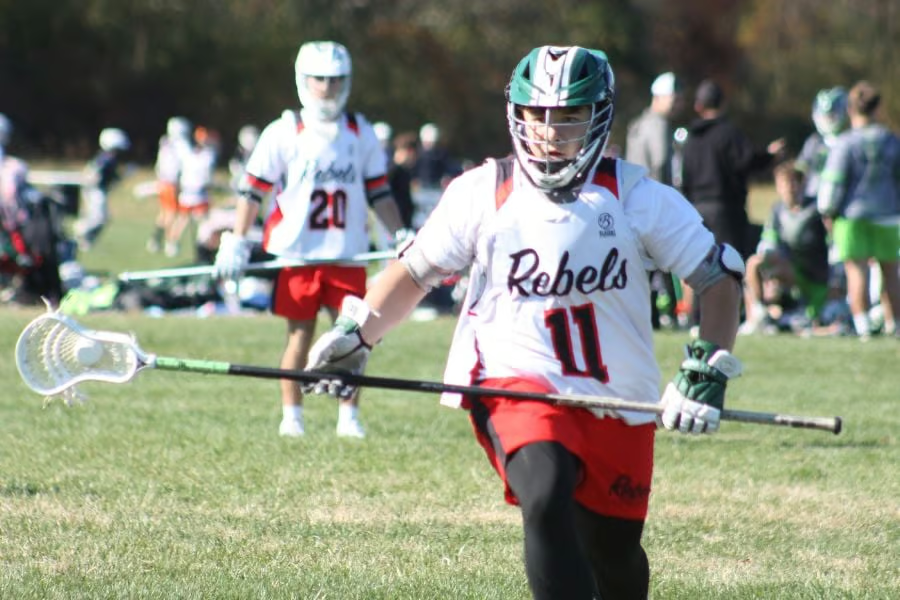
• Hundreds of youth laxers across Long Island are without a team after the abrupt shutdown of Rebels Lacrosse, one of the region’s largest travel lacrosse organizations. • The collapse has left families out thousands of dollars and high school juniors scrambling to salvage their college recruitment prospects.
When Craig McElwee’s 15-year-old son Brady worked a 10-hour shift at a Rebels Lacrosse tournament at Stony Brook last year, the teenager earned $150.
When he tried to cash his pay check, it bounced, his dad said.
“A league that collected one and a half million dollars in freaking dues… bounced a $150 check,” said McElwee, a Bethpage attorney whose son plays on the Raiders ’27 team, a squad of high school juniors that was affiliated with Rebels Lacrosse until the organization’s shutdown last week.
That bad check, McElwee said he now realizes, was an early warning sign of what would become a devastating collapse affecting hundreds of Long Island youth lacrosse players and their families.
On Thursday, the owners of Rebels Lacrosse LLC and its parent company Blatant LLC, Mike Brennan and Joe Potenza, announced that the company after 15 years in the travel lacrosse business had filed for bankruptcy and ceased operations, leaving dozens of boys and girls teams — ranging from elementary school through high school — without an organization, and families out of thousands of dollars in paid fees.
The outfit additionally has training programs for kids as young as 3 years old.
“You stole some kid’s dream,” McElwee said, expressing his frustration with Brennan and the organization’s collapse.
Brennan, in a statement to Greater Long Island, said the shutdown was not planned and happened quickly — right after several teams dropped out of the organization.
“We never had any intention of shutting down our business after 15 years, as we were currently in the middle of our 8th season with Rebels Lacrosse,” Brennan wrote. “Once we had a few teams get poached, and all file disputes, we realized we could no longer operate and immediately made the decision to close and consult a bankruptcy attorney.”
He added: “We have received an outpouring of support from former athletes, parents, and those who truly know us best, for the last 15 years of our work.”
The business of youth sports
Photo by Jay Brand
Travel youth sports has evolved into a multi-billion-dollar industry nationwide, with club lacrosse representing one of its most expensive sectors.
On Long Island, where lacrosse is deeply embedded in suburban culture, families routinely invest $3,000 to $6,000 per child annually for the privilege of playing on elite travel teams — and to increase their chances of earning scholarship money to play in college.
The investment extends far beyond tuition. Families pay for specialized equipment, tournament travel, and — for high school-aged players — premium recruiting services designed to attract college coaches.
For many families, particularly those in middle- and lower-income brackets, these expenses represent significant financial sacrifice, justified by the promise of college scholarships and opportunities their children might not otherwise access.
“The unfortunate truth is nowadays, if you don’t play club, you don’t play school ball because everybody is so far ahead of you,” McElwee said.
The stakes are particularly high for high school juniors, who face their most critical recruitment window. This is when college coaches attend tournaments and exposure events — often paid by travel organizations to do so — to evaluate prospects, when highlight videos are assembled, and when recruiting relationships are cultivated.
Losing a season — or even part of one — while in 11th grade can effectively end college athletic aspirations, parents said.
For the Raiders ’27 team, composed entirely of juniors from communities across Nassau and Suffolk counties, the Rebels collapse came at the worst possible moment.
But the team over the weekend received a lifeline of sorts from Team 91 lacrosse. The parents voted to stay together as a team, keep the same coaches and play under the Team 91 banner, albeit with renewed costs for things they had already paid for with Rebels, parents said.
Years of warning signs
The signs of trouble at Rebels Lacrosse had been accumulating for years, parents told Greater Long Island.
Parents said equipment promised never arrived and that tournaments were sometimes canceled at the last minute. Additionally, coaches went unpaid for months, according to multiple families.
But families tolerated the dysfunction, clinging to the relationships their children had built with teammates and coaches, hoping the organization would stabilize — or in the Raiders ’27 case — at least make it through next summer’s key recruitment period.
Kim Libertini, whose son Matthew, a junior at Locust Valley High School, plays defense for the Raiders ’27 team, paid for a Rebels helmet and equipment package when he joined the team as an eighth grader in 2022.
The helmet took a year and a half to arrive, she said. The gloves, bag, and sweats never came, she added.
“That tells you something was wrong,” said Libertini, an assistant superintendent with Cold Spring Harbor Central School District. “So, Matthew ended up playing with his Locust Valley helmet.”
Parents said that this past March — eight months before the shutdown — Brennan began pressing families for early payment for the following season, despite families having already paid in full for the current year.
“He reaches out in March saying, ‘We’re just trying to gather up and solidify next year.’ And I said, ‘You’re looking for payment in March?’” Libertini said. “At that point, I had already paid in full for the whole year.”
Parents said the demand for advance payment signaled cash flow problems.
The pattern extended to tournament operations. Parents said a scheduled tournament at Stony Brook in early November was canceled with Rebels telling parents that teams had dropped out.
Parents said they later learned from people familiar with the situation that unpaid officiating fees were the cause.
When Rebels attempted to place teams in a tournament operated by Team 91, a competing lacrosse organization, the teams weren’t added to the tournament registration app, said John Peragine, a Patchogue restaurateur whose son played on a seventh-grade Rebels team.
When some of the moms with Peragine’s son’s team called to complain, Peragine said, a Team 91 staff member delivered a blunt message: “Instead of you calling me and yelling at me, why don’t you call your directors and tell them to pay the bill?”
“That was the first time somebody actually spoke about what we’re all feeling,” Peragine said.
GENEVA (AP) — The IOC took a big step toward reintegrating Russia and Belarus into world sports Thursday by advising governing bodies to let the countries’ teams and athletes compete in international youth events with their full identity of national flag and anthem.
Athletes have “a fundamental right to access sport across the world, and to compete free from political interference or pressure from governmental organizations,” the International Olympic Committee said in a statement.
That message in support of athletes will be welcomed in Russia and Israel, whose athletes have faced recent discrimination, and comes less than three years out from the 2028 Los Angeles Summer Games that risks facing political crosswinds in the United States.
The updated Olympic strategy gave Russia significant progress in sports politics at a time when Moscow appears to be making no political or military concessions to Ukraine.
The IOC move is separate to the upcoming Milan Cortina Winter Games where a small group of Russian and Belarusian athletes will compete as neutral individuals who pass vetting for not having publicly supported the war.
Summit decision
The decision came at an Olympic Summit — an annual meeting chaired by IOC president Kirsty Coventry that invites key stakeholders from the Olympic family.
“It was recognized that implementation by the stakeholders will take time,” the IOC said in a statement, adding that each sport’s governing body should decide how to define youth events.
Some sports bodies likely will face resistance from their national member federations, especially in Europe, to the updated IOC advice which repeats that Russia should still not be picked to host international events.
The IOC’s latest move to ease the sporting isolation of Russia can apply to its own Youth Olympic Games which are held next year in Dakar, Senegal, from Oct. 31 to Nov. 13. The Russian Olympic body is still formally suspended by the IOC and currently could not compete with its national identity.
“The above principles should apply to the Dakar 2026 Youth Olympic Games, and are recommended for adoption by all governing bodies and international sports event organizers for their own youth events,” the IOC said.
Banned from soccer, track and field
Russian teams have been fully excluded from international soccer, track and field and other sports since the full military invasion of Ukraine in February 2022, while Russian and Belarusian athletes in winter sports are now starting to return with neutral status ahead of the Milan Cortina Olympics in February.
A small group of Russian and Belarusian athletes competed as neutrals without their national identity at the Paris Summer Games last year, where those countries were banned from team sports.
A previous attempt to enable Russia’s potential return to youth sports was met with strong pushback by European soccer federations including Ukraine in September 2023.
European soccer body UEFA moved to reintegrate Russian Under-17 teams into its competitions but dropped its policy within weeks amid boycott threats by at least 12 of the 55 member federations.
Though Russian soccer teams have been banned from World Cups and club competitions like the Champions League for four seasons, their national soccer body is not suspended by FIFA or UEFA and its officials have been eligible to stand for elections.
The IOC reminded Thursday that a block should remain on inviting or accrediting government officials from Russia and Belarus to international sports events or meetings.
“With its considerations today,” the IOC said, “the Olympic Summit recognized that athletes, and in particular youth athletes, should not be held accountable for the actions of their governments.”
___
AP Winter Olympics at https://apnews.com/hub/milan-cortina-2026-winter-olympics
Springfield, IL (CAPITOL CITY NOW) – The highly anticipated Scheels Sports Park is giving the public another chance to experience its state-of-the-art facilities this weekend with a special soft opening event inside its newly completed dome.
Brandon Doherty, General Manager of Scheels Sports Park, says the event will feature the Midwest Archery competition along with more than 80 local vendors. “We thought it would be a great idea to do something that would draw the community in,” Doherty explained. “This is a free event for everybody, so if you’ve been wanting a sneak peek of the dome, this is the weekend.”
The dome now boasts two turf fields, a sport court area, banners, and a food court, creating what Doherty calls “the complete picture” of the indoor space. While minor construction details remain, visitors will see a polished facility ready to impress.
The excitement surrounding Scheels Sports Park has been building for months.
Doherty revealed that the complex is already booked solid for events through fiscal years 2026 and 2027, with more than 100 events annually. “From April through August, we’ll often have two or three different youth or adult activities happening at once,” he said. Springfield’s new sports hub isn’t just about athletics.
Doherty says the venue is designed for versatility, hosting everything from car shows to banquets, all aimed at boosting the local economy. “We’re not limiting ourselves to sports,” he noted. “This development was built with diversification in mind.”
As for safety during the archery event, Doherty reassures visitors that the dome’s durable design can handle anything from heavy snow to stray arrows. “These domes today are built to withstand these types of things,” he said with a laugh.
The free event runs this weekend at Scheels Sports Park, offering residents a chance to explore a facility that’s already putting Springfield on the map for major youth sports and community events.
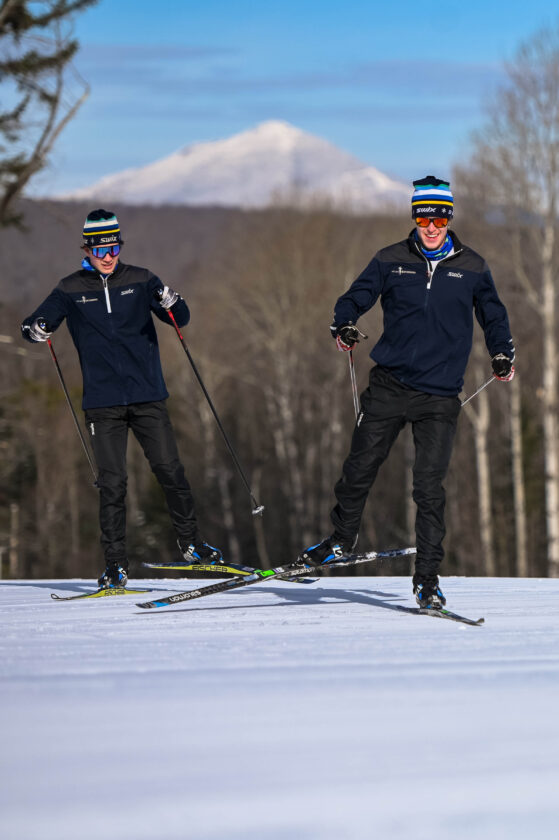
Skiers smiles as a he goes along a trail at Mount Van Hoevenberg.
(Provided photo — ORDA)
LAKE PLACID — The state Olympic Regional Development Authority recently announced an expanded slate of community cross-country skiing programs and events for the 2025-26 winter season at Mount Van Hoevenberg. These feature new offerings and returning favorites; the lineup is designed to make Nordic skiing more accessible for participants of all ages and abilities while complementing the venue’s daily skiing and year-round activities.
These community programs and events are available in addition to daily skiing and other activities available to all visitors:
Youth Skiing Programs are offered for two different age groups to provide area youth with safe opportunities to discover cross-country skiing as a healthy and fun recreational alternative.
¯ Wee Ski — for youth ages 3 to 6 (with an adult), this 11-week program provides a playful setting for youth to take their first strides on cross-country skis. From 10 a.m. to noon on Saturdays from Dec. 13 through Feb. 21. Single-day options are also available.
¯ Pathfinders — for youth ages 7 to 12, this 12-week program offers dynamic opportunities for more independent skiers to develop skills and discover more. From 10 a.m. to noon on Dec. 13 through Feb. 28.
¯ Through a collaboration with the New York Ski Educational Foundation and other partner organizations, MVH also offers additional skiing opportunities.
Snowboomers is a weekly guided ski session that provides camaraderie, coaching and fun for active adults aged 50 and older. From 1 to 3 p.m. each Thursday from Dec. 11 through March 12. Free for season pass holders, while the $28 non-passholder drop-in fee includes a trail pass as well as equipment rental if needed.
ADK Tour De Ski is a citizen race series offering both youth and adults a chance to explore six different cross-country ski venues across the North Country with events of multiple distances throughout the winter months. The series begins on Sunday, Dec. 14.
Full Moon Parties are guided group ski adventures for all ages that explore the MVH trails at night while allowing everyone to ski their preferred distance at their own pace. Includes bonfires and an apres ski party with live music inside the Mountain Pass Lodge. Tickets are $6 per person with parties on Saturday, Jan. 3, Jan. 31, Feb. 28 and March 28.
Lake Placid Loppet is a long-standing traditional celebration of Nordic skiing that provides events for all ages and abilities. The event’s signature 50K and 25K races are on challenging courses, while a Citizen’s Series provides three shorter distance events (2, 7.5 and 13K) on relatively flat terrain for those newer to the sport or looking for a simpler experience. All races can be skied using either the classic or skate technique. Start times vary from 9 a.m. to noon on Jan. 25.
In addition to youth-skiing classes, MVH will offer cross-country ski lessons for all ages and abilities through Discover Cross-Country Skiing, as well as a biathlon experience combining Nordic skiing with marksmanship. For visitors interested in the venue’s Olympic heritage, guided Legacy Tours are also available and the Mountain Pass Lodge features an indoor climbing center for year-round adventure.
Cross-country skiing at MVH officially opened for season pass-holders Nov. 15 and for the general public on Nov. 28. Season passes for the 2025-26 winter are available now and can be purchased online through the MVH website or in person at the Mountain Pass Lodge. Daily conditions reports for the Nordic ski trails at MVH are available on the venue’s website.
Spectate and Recreate
In addition to community skiing and lessons, MVH will host several elite international events this winter.
The venue will welcome the International Biathlon Union Cup from Feb. 26 to March 1 and March 4 to 7, featuring sprint, pursuit, individual and mixed relay races at the recently upgraded biathlon stadium. From March 19 to 22, the Lake Placid Finals, the Coop FIS Cross-Country World Cup, will bring the world’s fastest Nordic skiers to the venue for the season’s culminating cross-country ski event — the first time the U.S. will host the World Cup Finals since 2001. These marquee competitions complement MVH’s full winter calendar of youth programs, recreational skiing, lessons and guided tours, with full event schedules and ticket information available on the venue’s events page.
LAKE PLACID — The Lake Placid boys basketball team secured a 34-24 road victory over the St. Regis Falls Saints …
OSTERSUND, Sweden — Team USA’s biathlon mixed relay squad delivered a thrilling performance under the lights at …
LAKE PLACID — U.S. Biathlon recently announced the 16 athletes who will represent the United States at World Cup …
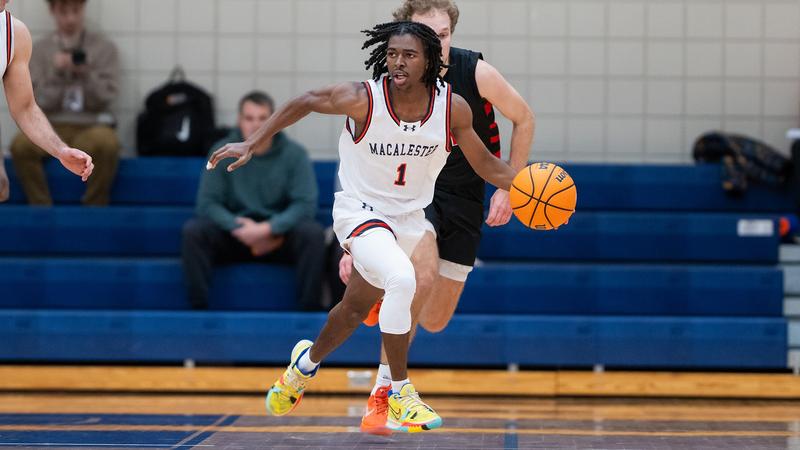
NORTHFIELD, Minn. – The Macalester College men’s basketball team held a narrow second-half lead but could not hold off Carleton College in an 86-78 defeat Wednesday evening at West Gym. The Scots are now 5-6 overall and 0-3 in the conference, while the Knights improve to 5-2, 3-0 MIAC. First year guard Jamal Randle (St. Paul, Minn./Great River School) came off the bench to provide a team-best 21 points in 19 minutes.
Carleton took control early by scoring the first 13 points over the first 3:50 before senior forward Noah Shannon (Northfield, Ill./New Trier) scored for Macalester. After a three from Sam Koelling pushed the lead to 16-2, a pair of three-pointers by Randle and baskets from Shannon and senior forward Ryan Brush (Bellevue, Wash./Bellevue) brought the Scots to within four, 16-12.
Another three from Randle followed two Knights’ free throws to make it a three-point game, 18-15 with 11:25 left in the half. Carleton increased its lead to as many as nine and led, 35-27 when a three from first year guard Noah Hamburge (Minneapolis, Minn./Minnehaha Academy) sparked a 15-4 run to close the half and give the Scots a 42-39 halftime lead. Randle, who hit three more threes in the run, finished the half with 18 points on 6-of-8 shooting from three-point range.
As they did at the beginning of the game, the Knights started the second half on fire with eight straight points to regain the lead, 47-42 three minutes into the half. Junior guard Kyle Jilla (Dallas, Texas/Plano West) tallied Macalester’s first points of the half, then answered a Carleton three with one of his own to make the score 50-47 Knights. Randle made a free throw to bring the Scots to within two, only to have Carleton stretch the lead to 51-57 with 12:43 remaining. Brush drained a pair of threes sandwiched around a Tobias Averill three to cut the deficit to three, 60-57. After George Norsman scored for the Knights, sophomore guard Joaquin Aguillon (San Rafael, Calif./The Branson School) hit another three for the Scots to make it a two-point game, 62-60 midway through the half.
Following two Carleton free throws, first year guard Lucas Myer (San Diego, Calif./The Bishop’s School) made a three and stole the ball that led to a layup by Shannon for a 65-64 advantage with nine minutes to play. Later in the half, a basket by Myer put the Scots up 68-66 at the 7:26 mark. The Knights regained the lead by scoring the next seven points, then first year guard Owen Walther (St. Louis, Mo./John Burroughs School) hit a three-pointer to make it a two-point game, 73-71 with 4:07 left. From that point, a 10-2 Carleton run gave the Knights an 83-73 edge, and Macalester never came closer than seven points the rest of the way.
Carleton outscored the Scots 44-22 in the paint and had a 38-28 rebounding advantage. Randle finished with a career-high 21 points on 6-of-9 shooting from deep to go with four steals in 19 minutes off the bench to help the Macalester bench take a 43-7 advantage in bench points. Shannon finished with 15 points, seven rebounds, five assists and two steals, while Walther had nine points in 20 minutes off the bench. Jilla matched Shannon with seven rebounds and added six points. Koelling tallied 21 points and 10 boards to pace Carleton.
Macalester returns to action after the new year, with a non-conference game at home against UW-Superior. The game starts at 4:00 p.m. in the Leonard Center.
A left high ankle sprain and the continued rehab from a torn left ACL didn’t stop brothers Franz and Moe Wagner, respectively, from treating local youth to a holiday surprise Wednesday night inside the AdventHealth Training Center.
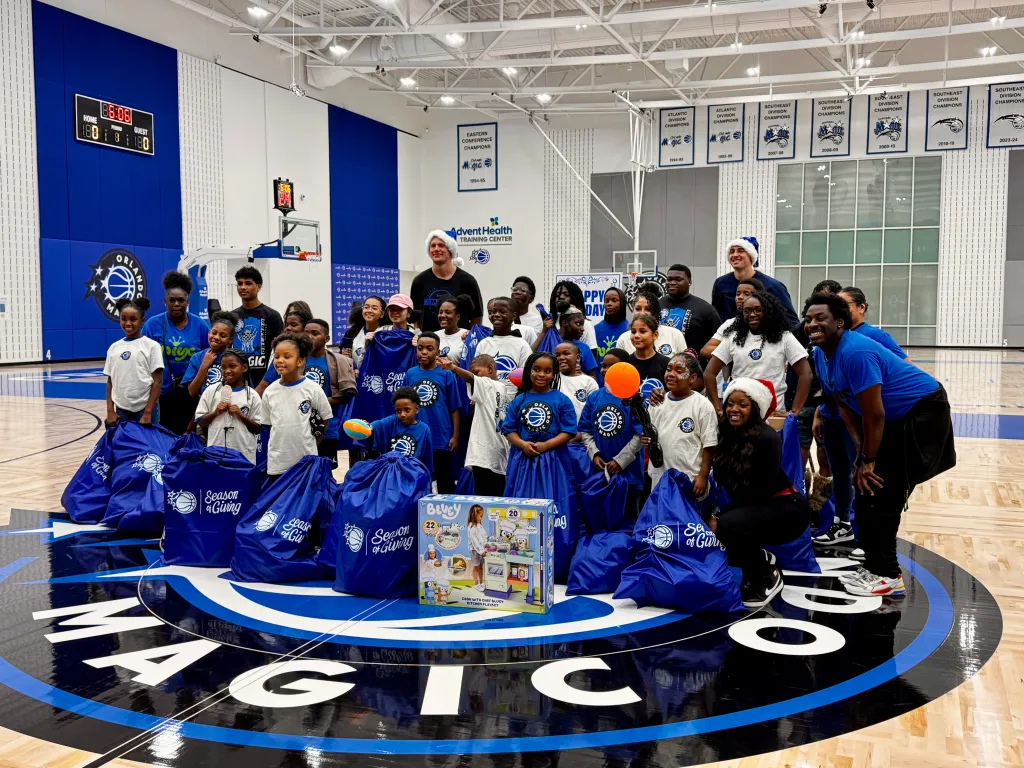
The Magic teammates granted holiday wishes for 30 local kids from the New Image Youth Center in Parramore when they spent time coloring, playing games and eating a meal together with Christmas music buzzing in the background.
Then came the big surprise.
As the youth made their way onto Orlando‘s practice court, it was hard not to spot a smile on their faces as they saw groups of gifts wrapped and tagged for each kid.
Some got new Hot Wheels cars, others pink plushy stuffed animals. Whether it was a shiny new bike or a “Chef Bluey” kitchen playset, none of the kids could believe their eyes.
“It’s really, really cool,” Franz Wagner said about having an opportunity to host such an event for the second year in a row. “Growing up, Christmas was our favorite holiday. So, it’s cool to provide these moments for these kids that are here, and just give back to the Orlando community.”
Added Moe Wagner: “It’s a huge part of what we considered childhood, our memories. We did it last year and it was so much fun to see the joy in their eyes. That’s fun for us to share that with them and it makes our Christmas cool, too.”
Franz Wagner received an early gift himself when an MRI on Monday confirmed he only suffered a left high ankle sprain during the first quarter of Sunday’s game at New York.
Although he’s expected to miss multiple weeks, it’s far from the initial concern the team had when Wagner landed awkwardly on his left leg, grabbed near his knee in immediate pain and needed help to the locker room.
Wagner, who had his left ankle in a boot and used crutches to walk around, described the outcome as “just a little bump in the road in the grand scheme of things.”
“Kind of mixed feelings,” Franz Wagner said about the moment he learned he avoided a major injury. “Super relieved, but at the same time, bummed that I’m going to be out for a couple weeks.
“Definitely caught a break there a little bit and I’m blessed that it’s just a high ankle sprain,” he added.
Jason Beede/Orlando Sentinel
Magic forward Franz Wagner, in a boot and crutches because of a left high ankle sprain, talks with a young girl from the New Image Youth Center in Parramore as she opens up presents during a special holiday event at the AdventHealth Training Center on Wednesday night. (Jason Beede/Orlando Sentinel)
While Franz Wagner expects to be back within a month’s time, his older brother is approaching the one-year anniversary of tearing the ACL in his left knee. Moe Wagner last played Dec. 21, 2024, against the Miami Heat and he continues to rehab.
“I’m doing really good,” Moe said about his recovery. “I’m feeling really good about where I’m at, finding the joy again of playing basketball and enjoying the process a little more.”
There was plenty of joy to go around Wednesday night in Orlando when the brothers tag-teamed for the holiday event.
“It feels so real,” Moe said about collaborating with his brother. “Because obviously we grew up together, sharing all of these moments together, and now it’s a family holiday. Our family is here. So being able to give back as a family to other families is really cool and authentic. It makes it so much more enjoyable.”
Added Franz Wagner: “It means a lot, especially for a holiday like this. We connect this holiday with spending time with family and loved ones, so it’s really cool now to be in this position together and share this moment with the kids.”
Jason Beede can be reached at jbeede@orlandosentinel.com
Jason Beede/Orlando Sentinel
Magic center Moe Wagner helps a child from the New Image Youth Center in Parramore open presents during a special holiday event Wednesday night at the AdventHealth Training Center. (Jason Beede/Orlando Sentinel)
What if every young person in the Pittsburgh region was lifted up by strong relationships with caring adults? Three decades ago, that’s the vision that gave rise to The Mentoring Partnership of Southwestern PA.
The Mentoring Partnership (TMP) helps make this vision a reality through their work with formal mentoring programs, community organizations, schools, youth sports leagues and more. Their goal? To create relationship-rich environments for young people.
Recently, Kidsburgh sat down with two people at the heart of TMP — long-time executive director Colleen Fedor, who is retiring this month, and Kristan Allen, who has served as associate executive director for many years and will take over as executive director in the new year.
If you’ve ever wondered about helping out as a mentor or about adding mentorship to your child’s life, this conversation is for you:
Photos courtesy of The Mentoring Partnership of SWPA.
Kidsburgh: Draw us a picture of what was happening in 1995 when TMP was created.
Colleen Fedor: “In 1995, the U.S. Attorney in Pittsburgh was Fred Thieman, who was concerned about crime prevention, as compared to remediating or dealing with things after crime. So he convened the Youth Crime Prevention Council with a group of community leaders who cared about the challenges that young people face and they asked: How might we address the needs of children before crime happens? That was the beginning of The Mentoring Partnership. Through discussion, they identified three areas for focus: After-school programming, youth employment and mentoring. MENTOR: The National Mentoring Partnership was celebrating its fifth year, and they were forming affiliates around the country. Thankfully, the Heinz Endowments and Grable Foundation staffers saw this as an opportunity to really help. There was already a loosely convening group of mentoring programs and they were asked if capacity-building support would be valuable to their program(s). They voted 100% that yes, The Mentoring Partnership would be helpful to us.”
Kidsburgh: As the organization and its work in Pittsburgh has grown over these 30 years, how have you seen mentoring change kids’ lives?
Colleen Fedor: “There are so many examples. They range from kids who learn to golf and now are enjoying life with a sport and a mentor they never would have otherwise met to young people in their first jobs through Summer Learn and Earn and to Reading Buddies in local elementary schools. At this year’s Magic of Mentoring, Dr. Armani Davis shared his experience as a mentee while he was a student in the Steel Valley School District. Armani talked about how many members of the community surrounded him — including one who provided him with a job and a place to stay. From there, he met Greg Spencer who got to know him and has served as a mentor ever since. Armani is an incredible young man with a doctorate degree and a wonderful career at Johnson & Johnson. He expressed his gratitude for the people who saw the potential in him, who stood beside him and opened the doors that helped him as he navigated college and adulthood. And there are so many examples like that, kids who didn’t know careers existed, and yet they found their spark, and that became the opportunity to help them look further. There are examples of other kids, who may have been on the wrong path, but thanks to local violence prevention diversion programs were matched with a mentor who is there with a listening ear, an offer of support and more — helping them see that making better choices is a much better idea. So there are endless examples, big and small. It’s a powerful thing when someone cares about you — someone who isn’t paid and isn’t family, but who has the open-mindedness to listen to a young person and help them.”
Kristan Allen: “As a young person, or even as an adult, how amazing is it when someone sees you and wants to support you, just because they know you’ll do great things and the world will be a better place for it? Sometimes our work can be very challenging, in that we’re playing the long game. It’s not ‘Hey, this kid had a mentor for a few months and things might have gone one way for them, but now everything is good.’ Mentors tell us, ‘I don’t think I’m doing anything special. I’m just showing up.’ But it’s that consistent presence, that intentionality that you bring to being with the young person. Mentoring isn’t just a preventative measure that keeps kids on the right track. Mentoring is for all kids. Every young person can benefit from having adults in their sphere, and also peers, who take an interest, who listen, who take the time to see them for themselves and guide and listen. and the work belongs to all of us too, right? It’s not just one person, it’s not even just one organization. This is the collective work of all of us.”
Volunteer mentor Malissa Seman with one of her mentees. Photo used by permission.
Kidsburgh: Tell us about Everyday Mentoring®, which is related to the idea that this is the collective work of all of us.
Colleen Fedor: “Everyday Mentoring® is about connection, which has a whole lot of benefits. In school, kids who feel connected show up, they work harder, they have better performance, they have fewer disruptive challenges. When there are problems at school and the adults step back to understand, often we see that the kids having problems are not connected. Many years ago, connection happened more naturally. People didn’t move as often. All the neighbors knew you and you knew all the neighbors. Your parents would know about something before you even got home. That’s different now. Parents are working very hard and even in the best of scenarios, kids get lost. So mentoring is about connection, whether that’s formal connection as a one-on-one mentor in a small group program, or it’s about everyday mentors. Maybe it’s the crossing guard who sees a kid every day, twice a day, for 10 years, and knows their name. Crossing guards are consistent. They see kids, and if they take that time, and a young person feels like ‘this person looks out for me,’ the kid knows that might be a person they can go to. It matters if you acknowledge kids. Now, not all kids will want to talk to me or to you, but maybe one kid will. And so my ability to be present, be thoughtful and be a good listener and supporter is important. Many adults express concern that they may not know how to respond to a kid for every single thing that they bring up. Kids sometimes share things we don’t expect. So The Mentoring Partnership is ready to support with trainings and resources on our website. We also know that time is your most precious commodity. But you can show up for kids in many ways other than a one-on-one mentoring program. We have more opportunities than we realize to be valuable in kids’ lives. We just need to notice. And if we do, we may discover how rewarding that can be.”
Kidsburgh: How have you seen this experience change the lives of mentors?
Colleen Fedor: “You know, I had the opportunity to be a mentor to a little third grade boy. We were in RIF’s Reading Buddies program. It was hard to get there at the time. Some days, I’m running down Centre Avenue to get to the school, so I’m not late. Each time, he was very excited to see me. I didn’t think he would be, and yet there he was, waiting and smiling as I got there. He’d pick up the books and we’d talk about ‘Captain Underpants’ or build a puzzle, or whatever. But it was just time — him and I with no phones out and no distractions. It’s that undivided attention that is mutually beneficial. He valued it, he showed up to school on those days. We see that all the time: Kids who are mentored in a school program, for the most part, are less absent on the days that their mentors are there. How about that? It’s even true with high school students. They say, ‘The mentors choose to be here. They don’t have to be here, and we want to be here when they’re here.’ It changes your life to know that it matters to these kids. And watching Greg Spencer be so proud of Armani Davis at the Magic of Mentoring event, you could see it: Mentoring didn’t just change Armani’s life. It definitely changed Greg’s life, too.”
TMP partners with Reading is Fundamental to bring mentors to students.
Kidsburgh: Be a Sixth-Grade Mentor, which became Be a Middle School Mentor, began in 2009. Tell us about why that was created and how it grew?
Colleen Fedor: Transitions for school districts are a challenge, no matter which grade or age. Middle school to high school is a transition challenge for many students so we see a number of schools choose to put a mentoring program in for that transition. But in this case, Pittsburgh Public said sixth grade was where they saw dramatic challenges in attendance and performance. So the district requested it and the mentoring providers in those buildings fully agreed that that was an area of need. But it was interesting: We started out calling the program Be a Sixth-Grade Mentor, but midway through that first year, we were like, ‘Well, what do we do next year?’ The mentors were saying, ‘Wait a minute, we want to stay connected.’ So we grew it to be all of middle school. We saw the desire of the mentors and mentees to remain connected. There was always that choice for adults and kids — you could bow out after your one year commitment, or you could stay committed. A greater percentage wanted to stay on than not. Many middle schools also offer peer mentoring. It’s a great thing, maximizing and utilizing the talent that you have already at your disposal, when high school kids mentor middle schoolers or your middle school kids mentor elementary. At some schools, the high school football players go down to the elementary school. Those are really valuable ways to harness the assets you have in the buildings and use them well. The importance is planning it out, training and preparing high school kids on how to do all of that. That’s where we help.”
Kidsburgh: Tell us how things have and haven’t changed over these 30 years. Are there similar challenges in kids’ lives and families’ lives? Where does mentoring fit in with that?
Colleen: “Adults may look at kids today and think, ‘I don’t know what to do with these kids today.’ But kids are kids. They want to feel needed and valued and heard and noticed and missed, just like we did at their age! At a time when we’re busier than ever, kids and adults, and because of our phones we don’t have to go to the library to get information or even go to the school building to ‘go to school,’ a kid can get lost. So that need for connection is, I think, actually greater than ever. But what all people need is no different. When we talk about the youth mental health crisis, we’re talking about loneliness and a sense of lack of purpose. Families need support and mentors — all kinds of mentors — provide that support. We all have a role to play.”
Photo at top of story from the 2025 Magic of Mentoring courtesy of The Mentoring Partnership of SWPA. (L to R: Kristan Allen and Colleen Fedor.)