
Rec Sports
For Black Youth, Public Golf Courses Are Entry Points

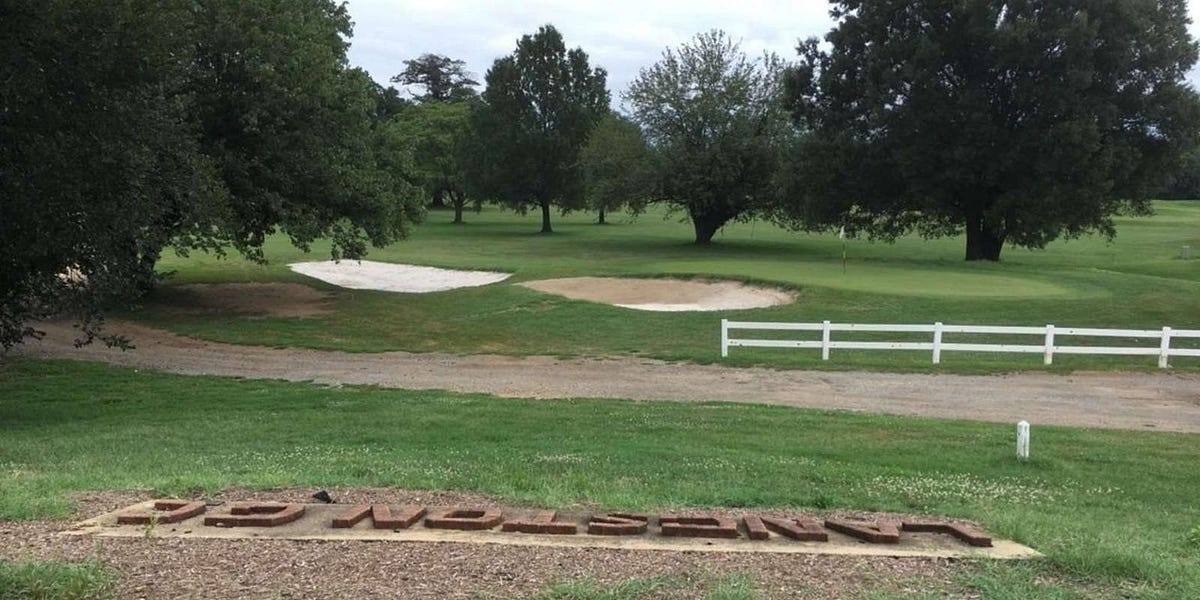
Imagine as the sun rises higher, you know it is almost time. You head to the putting green and sink a few practice putts, listening to the quiet rhythm of the golf course waking up. When it is time to start your round, you pick up your clubs and walk to the first hole, your club heads softly clanking with each step. Dry leaves crunch under your feet. You finally reach the tee box and take in the course waiting for you, trees decorated in orange, red, yellow, and brown, contrasting with the bright-green fairway. You tee up your ball, take a breath, and hit one of the purest shots you have hit in a while. You put your club away and begin the long walk forward, surrounded by a peaceful, comfortable, and calming environment.
This is how I feel every time I play golf. This is my happy place.
What makes this moment meaningful is not just the game itself, it is where I play. I grew up playing golf on public courses in Washington, D.C., operated by the National Links Trust. These courses were my introduction to a sport that has long been seen as exclusive, elite, and overwhelmingly white. Here, I learned my first swing, played my first full round, and began to understand that golf could belong to people like me, too—Black players, young players, and players without generational access or private club memberships.

That is why Donald Trump’s recent efforts to take control of the public golf courses in D.C.—East Potomac, Langston and Rock Creek golf courses—feel so personal. This is not just a fight over land management or branding. It is about power, access, and who gets to claim ownership of a sport that is struggling to outgrow its deeply racialized past. Under an administration widely criticized for its hostility toward Black communities, diversity initiatives, and public institutions, the attempt to wrest control from the National Links Trust, an organization dedicated to accessibility and inclusion, is alarming. These courses are not just fairways and greens, they are rare entry points into a sport that has historically shut people like me out.
Trump’s political record makes it even worse. His administration’s policies and rhetoric disproportionately harm Black communities, whether through the rollback of civil rights protections, open hostility toward diversity initiatives, or framing public resources as commodities to be privatized rather than preserved for the communities they serve. When viewed through that lens, the attempt to take over these public golf courses feel less like a neutral administrative decision and more like part of a familiar pattern, stripping control from institutions that prioritize access and placing it in the hands of private interests aligned with wealth, exclusivity, and power.
The National Links Trust nonprofit was created in 2019 to protect public golf courses and ensure that they remain affordable, accessible, and rooted in the local community. It holds a 50-year lease signed in 2020 with the National Park Service to manage the courses. In Washington, D.C., where Black residents have historically fought to maintain control over public spaces during gentrification and political disenfranchisement, that mission matters. These courses are not just recreational facilities, they are community anchors. They provide young people with exposure to a sport that serves as a gateway to scholarships, careers, and professional networks, opportunities that Black golfers have long been denied.
The courses in D.C. had been managed by the National Park Service (NPS) not as commercial spaces but as places meant to serve the community while honoring their historical significance. Langston, founded in 1939, was created specifically to provide Black golfers access to the game when they were banned from white-only courses throughout the city. That made federal oversight especially important. National Links is specifically equipped to manage golf while maintaining that same public mission.
Because golf’s history in this country can’t be separated from race, Trump alleged intent to prioritize private interests over public access is especially concerning. For decades, Black players were explicitly banned from courses, tournaments, and professional organizations. Even after formal barriers were removed, the cost of entry, equipment, lessons, and private memberships kept the sport inaccessible. Public courses became rare spaces where Black golfers could learn, play, and belong without facing the same financial and cultural exclusion. I am a product of that access. Without these courses, I likely would not have found my way into the sport at all.
That is why the prospect of these courses being taken over by an administration that has shown little regard for racial equity feels so threatening. It suggests a future in which public land becomes a branding opportunity, profit and power outweigh community impact, and inclusion is treated as optional rather than essential. When leadership consistently dismisses conversations about systemic racism, it becomes difficult to trust that decisions about public spaces, especially those with meaning for Black communities, will be made with fairness or care.
There is also a symbolic weight to this moment. Golf is in the middle of a slow, ongoing effort to shed its “white man’s sport” image. Professional tours have invested in diversity programs, youth outreach, and public-private partnerships designed to increase participation. Taking public courses from an organization that actively supports those goals sends the opposite message. It reinforces the idea that golf’s progress is fragile, conditional, and easily reversed when power shifts.
For me, this issue is not hard. It is about preserving the spaces where I learned confidence, discipline, and patience, where I discovered that I belonged in a sport that never seemed designed for people who look like me. Losing these courses or seeing them transformed into something unrecognizable would be closing a door that generations before me struggled to pry open.
My dad signed me up for First Tee classes. Early one Saturday morning, we drove to Langston Golf Course. I walked onto the course with my First Tee class, holding a second-hand but very real putter, and hit my first real golf ball on a real course.
I remember telling my dad after that class that I loved it and could not wait to go back the next week. The rest was history.
Every time I returned to Langston or East Potomac, I was met with smiles, greetings, and conversations that never made me feel out of place as a young, Black, amateur golfer. I was welcomed. I was encouraged. I was seen. Those moments mattered more than I realized at the time. They taught me that golf could be a space where I belonged, where I was supported, and where my presence was not an exception.
That is what is at stake now. These courses are not just patches of green in the nation’s capital, they are entry points, lifelines, and sanctuaries for metropolitan youth who might never otherwise see themselves reflected in this sport. To allow an administration with a documented disregard for racial equity to threaten that access is to risk undoing years of quiet progress. It is to tell young Black golfers that their place in this game is conditional.
Golf cannot claim to be evolving while the spaces that foster inclusion are stripped of their purpose. I am here because Langston and East Potomac existed as public, welcoming courses, because organizations like the National Links Trust believe that golf should belong to everyone. No child should be denied the chance to fall in love with this game. For me, golf began on public land, with borrowed clubs and open arms. That experience shaped who I am. Protecting these courses means protecting the possibility that the next young Black golfer will step onto the tee box, feel that same sense of belonging, and know without question that this game is for them, too.


The ‘Moving for Change’ corporate social responsibility initiative is designed to support UNHCR’s Sports for Protection programming and Primary Impact education initiative. The first focuses on utilizing structured sports activities for child protection and psychosocial support, while the second aims at sustaining primary education in refugee settings by funding teachers and essential learning materials.
ANTA Group reports that these combined efforts have reached an estimated 300,000 children and adolescents to-date.
Image Credit: UNHCR/Eric Bakuli
Rec Sports
California orders Tahoe Truckee schools to leave Nevada sports over transgender athlete dispute
The California Department of Education is requiring the Tahoe Truckee Unified School District to follow state law in another clash over transgender athletes in youth sports in the state.
Currently, student-athletes in Tahoe Truckee Unified play sports in Nevada because of how close they are. But Nevada now bans transgender athletes in girls’ sports, which is against California state law.
So after decades of playing in Nevada, California’s Department of Education is requiring the Tahoe Truckee Unified School District to compete in California to comply with state laws that allow student athletes to compete based on their gender identity.
David Mack is the co-founder of Tahoe Pride and describes the new youth sports divide in the Tahoe region.
“So no one’s happy, it’s really sad, it’s quite tragic in that way,” Mack said. “People feel really upset that the school moved so fast on this. They feel blindsided, they feel not listened to, and then other people, like the trans kids, are getting steamrolled over like they’re not recognized in this argument.”
Nevada state lawmakers passed a law in April requiring a mandatory physical signed by a doctor to deem the athlete male or female based on their birth sex.
“This is a politically manufactured issue to try to divide people,” Mack said.
The Tahoe Truckee Unified School District is responding to the California Department of Education with a solution that the district legally join the California Interscholastic Federation in 2026, but continue to play in the Nevada Interscholastic Activities Association through 2028.
When asked if transgender athletes would be able to compete while operating in the NIAA, the district said it’s “still in the early stages of this transition, and many details are still being developed.”
In an October letter addressed to the California Department of Education, the school district’s attorney, Matthew Juhl-Darlington, said the Tahoe Truckee Unified is “not aware of any transgender youth who have expressed interest in participating in its 2025-2026 athletic programs.”
“While the NIAA recently updated its polices to define ‘male’ and ‘female’ based on sex assigned at birth and not as reflected in an individual’s gender identity, as required under California law, the District is interpreting and implementing this policy in a manner consistent with California’s legal requirements,” Juhl-Darlington said in the letter.
California Republican Rep. Kevin Kiley is opposed to the state order, arguing the weather conditions in Tahoe need to be considered.
“So in order to compete in a California league, you have to deal with this snowy weather and the travel dangers and so forth,” Kiley said.
The school board was expected to explain its solution to both join California’s CIF while playing in the NIAA through 2028 to parents and students Wednesday night at a board meeting.
So far, the California Department of Education has not said if it will accept this as a solution.
Rec Sports
Quincy University on probation after allowing over 100 ineligible students to participate in sports
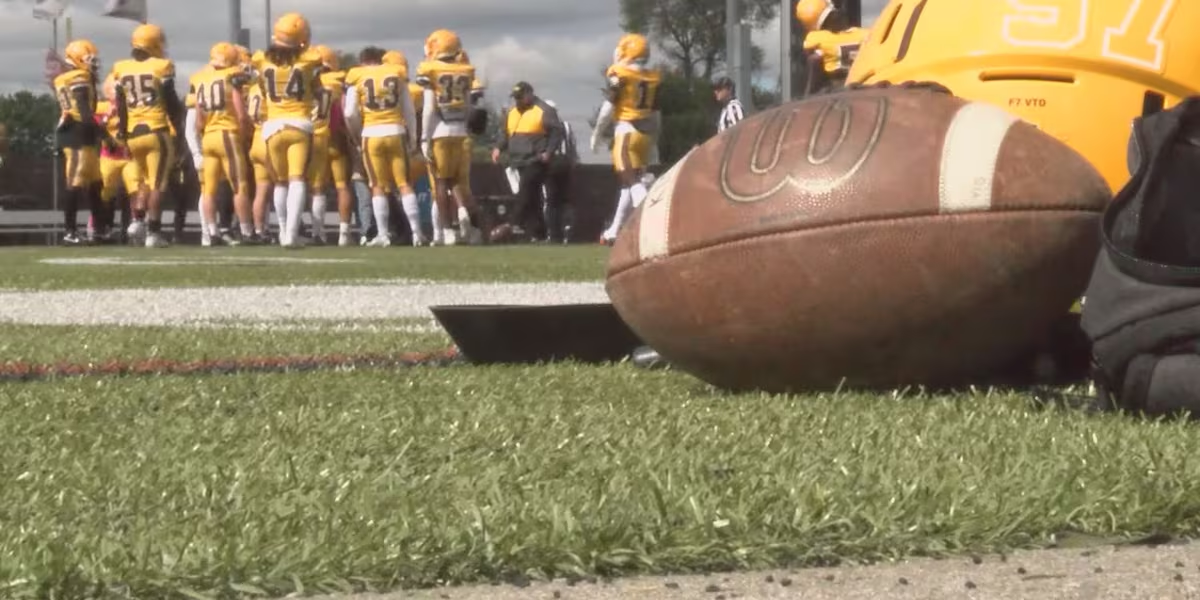
QUINCY (WGEM) – Quincy University has to pay a $5,000 fine and spend two years on probation after the NCAA issued sanctions tied to more than 120 ineligible student-athletes who were allowed to play for the school.
The problem first surfaced in August 2024 when staff preparing the men’s and women’s soccer roster lists discovered three players had not received the required amateurism certification. That same day, another school alerted QU’s athletics office that a transfer student from Quincy also lacked the certification. The athletic office then launched a broader review.
What began as a handful of missing documents quickly grew. The department found potential eligibility problems for 95 student-athletes during the 2022-23 and 2023-24 school years. In November 2024, the department self-reported the findings to the NCAA and cooperated with an investigation.
The NCAA report names former Assistant Director of Athletics for Compliance Taylor Zerbe as central to the violations. Zerbe admitted to changing 74 student-athletes’ eligibility certifications and told investigators she felt overwhelmed by the workload. According to the report, she did not raise those concerns with her supervisor. Zerbe also admitted to knowing some athletes were ineligible when she altered their certification. She was not employed by QU when the problems were discovered.
QU’s internal review reached back to the 2021-22 school year, which coincided with Zerbe’s employment. That review uncovered additional violations. Overall, the NCAA says Zerbe falsified eligibility squad lists and that QU improperly certified 121 student-athletes across 17 sports.
The report details several consequences for those athletes: 93 practiced beyond the allowable 45-day period, 78 competed when they were not eligible, and 26 received financial aid while ineligible. The university also allowed 27 student-athletes to compete before their eligibility was formally reinstated, and two transfer student-athletes competed despite not meeting transfer eligibility rules.
QU and the NCAA agreed to a set of penalties intended to correct the system and increase transparency. In addition to the $5,000 fine and two-years probation, the school must tell prospective student-athletes in writing that the program is on probation and disclose the violations.
- Vacate any wins, records or participation that involved ineligible student-athletes from the time those athletes became ineligible until they were reinstated.
- Prevent head coaches from counting wins from games where ineligible athletes competed toward milestone totals (for example, a coach’s 100th win).
- Allow individuals who were eligible to keep any personal records or awards they earned.
- Undergo a comprehensive external review of certification and eligibility procedures during the probation period.
The NCAA report contains the full list of prescribed penalties.
Regarding Zerbe, the NCAA has barred her for two years from working at a member institution in any role that involves eligibility certification responsibilities.
QU declined on-camera interviews, but Athletic Director Josh Rabe told WGEM the university acted with integrity by self-reporting and taking steps to address the problem. Rabe said the department has tightened procedures and added what he called “a double-check to check the double-check.”
QU released the following statement:
Below is the full case summary:
Copyright 2025 WGEM. All rights reserved.

PRESS RELEASE
Minnesota Legislature
Rochester Delegation
FOR IMMEDIATE RELEASE
December 18, 2025
HOUSE CONTACT: Marlee Schlegel
651-296-9873 or marlee.schlegel@house.mn.gov
SENATE CONTACT: Jack Vinck
651-440-5056 or jack.vinck@mnsenate.gov
Rochester DFL Legislators to Take Action on Rochester Sports Complex
Rochester, Minn – On Monday, Rochester Mayor Kim Norton vetoed the city council’s plan for a $65 million sports complex that is not reflective of the ballot initiative that funded the project in 2023. The city council is expected to overturn the Mayor’s veto at their December 22nd meeting.
In response, the DFL Rochester delegation intends to introduce legislation to revoke authorization of the Local Option Sales Tax they previously passed into law to fund the project. The delegation released the following statement:
“Rochester residents deserve to get what they paid and voted for. The updated plan for the sports complex no longer serves the best interests of Rochester residents. Rather, it serves a narrow set of special interests and ignores the community’s need for indoor recreation space — the very reason voters approved the project in the first place.
“Both as legislators who passed the legislation that allows the complex to be funded by the Local Option Sales Tax, and as voters who were excited to support the community-oriented initiative, we feel deceived. The changes made to the project to eliminate the indoor portion of the complex also eliminates the reason that many Rochester residents supported the project.”
Not long after the ballot approval of the complex, a new cost assessment was completed. Updated estimates came back at $120 million, nearly twice the cost of the initial $65 million proposal approved by voters.
“It’s unclear to us how such an expensive oversight was made on cost — and it’s equally unclear why the city council has chosen to prioritize the outdoor complex over the part of the project that won community support in the first place. Whatever the reason, the city council should either find a way to deliver on what voters approved or bring these significant changes back to the ballot.
“As legislators, we urge the Rochester council to change course and return to the original goal of meeting residents’ needs for indoor recreational space. After many conversations with stakeholders and community members, it is clear to us that as proposed, the project now falls outside of the parameters outlined in the original use of funds request. If the city council does not change course, we plan to introduce legislation to revoke authorization to use Local Option Sales Tax funds for the project. We remain committed to meeting the needs of our community and seeing that the residents of Rochester get what they’ve voted for, and we remain willing to work with the city council toward that goal.
“We want to see this project fully realized in a form that serves the entire community, as we were all assured it would.”
The DFL Rochester Delegation includes Senator Liz Boldon (DFL—Rochester), Representative Kim Hicks (DFL—Rochester), Representative Tina Liebling (DFL—Rochester) and Representative Andy Smith (DFL—Rochester).
###

TWIN FALLS, Idaho (KMVT/Gray News) – Two children in Idaho are critically injured after a tree fell on them while they were waiting for the school bus.
The Twin Falls County Sheriff’s Office said high winds caused rotten trees to fall on power lines before collapsing on the children.
The kids, both under the age of 10, and an older sibling were waiting outside for their bus when the tree collapsed. According to the sheriff’s office, the older sibling was not injured.
Aaron Hudson, the Twin Falls fire deputy chief, told KTVB first responders had to first get the kids out from the tree and downed power lines before they could prepare them for transport.
The sheriff’s office said one of the children was taken to the hospital by ambulance, while the other was airlifted.
According to Hudson, the weather conditions caused difficulties during transport. He said that it prevented the helicopter from going any further than the local hospital.
The family of the children has started a GoFundMe to help cover medical expenses.
Copyright 2025 KMVT via Gray Local Media, Inc. All rights reserved.
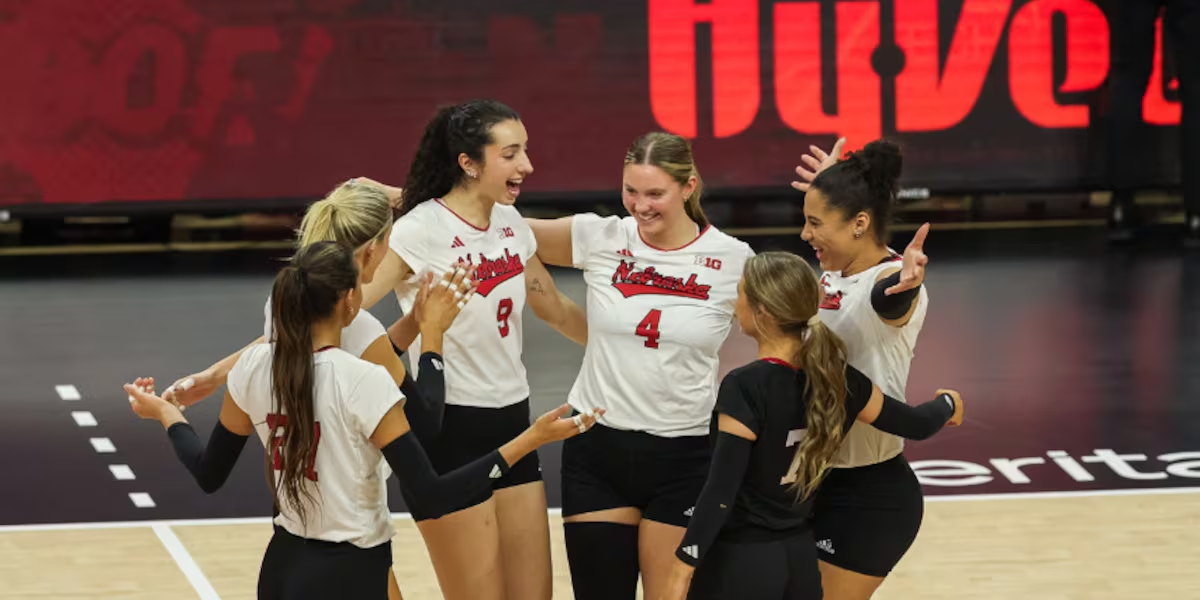
LINCOLN, Neb. (KOLN) – Athletic Director Troy Dannen reflected on another year of Nebraska Athletics, sharing highlights and achievements of the men’s and women’s sports teams and hinting at what’s to come.
In competition, Huskers excelled in multiple sports:
- Nebraska volleyball team just completed a remarkable 33-1 season
- Wrestling finished as the national runner-up as a team and two Husker wrestlers won individual national championships
- Softball made an NCAA Super Regional appearance
- Football earned a second straight bowl berth
- Both basketball teams are undefeated and ranked in the AP Top 25.
This year, student-athletes set a school record with a 3.464 GPA, led the Big Ten Conference with 117 fall Academic All-Conference selections and once again posted a Graduation Success Rate over 90%, among the best in the nation. Dannen said they also made a positive impact in Lincoln and surrounding communities through their volunteer work.
Alcohol and food sales at Husker venues
The start of alcohol sales at all on-campus venues and the addition of new food options resulted in an increase of 75% in total concession revenue compared to last year, Dannen said.
“More than 313,000 alcoholic beverages were served and new food options were added to the menu, resulting in an increase of 75% in total concession revenue compared to last year,” Dannen said.
The introduction of alcohol sales came with concerns about the impact on fan behavior, but Dannen said it remained consistent with the previous five years.
John Cook Arena reseating
The John Cook Arena reseating process planned for 2026 has drawn criticism from longtime season ticket holders.
Dannen said the athletic staff has developed a plan that ensures that season-ticket holders in 2025 will be guaranteed season-tickets next year.
Dannen said 10% of current season-ticket holders did not use their tickets this year but rather sold those tickets through secondary markets. Those tickets, originally purchased for a total of $600,000 by those ticket holders, were then resold for a total of $3.2 million on the secondary market. Ticket use for this purpose is strictly prohibited.
The accounts that resold the entirety of their tickets will be excluded from the ability to purchase season-tickets in 2026, Dannen said.
1890 Nebraska winding down operations
With the implementation of the House settlement, 1890 Nebraska, Husker Athletics’ NIL collective, has begun winding down its operations.
“Hundreds of Husker fans donated millions of dollars over the past 24 months to support NIL for our student-athletes, as the rules at the time permitted,” Dannen said the in the letter.
The House settlement now prohibits much of what 1890 Nebraska provided, but in turn allows the university to share $20.5 million directly with student-athletes as they pay to license their NIL rights.
The five sports primarily supported by the collective include the Nebraska wrestling team, football team, two basketball teams and the volleyball team.
Facility upgrades
Several Nebraska athletic facilities saw enhancements including the completion of the track and field complex, along with new facilities for golf, rifle, swimming and diving and bowling.
In 2026, the athletics department is planning to renovate the softball and baseball clubhouses. Dannen said they are also looking forward to expanding the Devaney Center.
Entertainment
Three shows have been scheduled to take place inside Memorial Stadium next year. Zach Bryan will perform on April 25, the Savannah Bananas on June 13 and The Boys from Oklahoma on Aug. 22.
“Our plan is to continue to utilize our facilities for outside events to bring new events to our spaces and to help drive entertainment options in Lincoln,” Dannen said.
Due to anticipated construction, Nebraska Athletics will hold off on booking events for Memorial Stadium in 2027.
The athletics department is expecting to make two “big announcements on the Husker women’s sports front” early next year that will have a tremendous impact on its female student-athletes.
Click here to subscribe to our 10/11 NOW daily digest and breaking news alerts delivered straight to your email inbox.
Copyright 2025 KOLN. All rights reserved.

Assistant Women’s Volleyball Coach in Cleveland, TN for Lee University

Reaction To The Loss Of NASCAR Driver Greg Biffle, His Wife-Cristina, Daughter-Emma, Son-Ryder, Friend-Craig And Pilots-Dennis and Jack

Joel Klatt admits his viral NCAA Tournament stance ‘was a terrible take’

Wilson aiming for Olympic heights following graduation

Pitt Falls In National Semifinal

TOYOTA GAZOO Racing Announces 2026 Motorsport Program | Corporate | Global Newsroom

The 2025 Bowerman Finalists and Watch List for men’s and women’s NCAA track and field

Marshall Faulk adds Les Miles’ son to football staff

Jordan Anthony Wins the 2025 Bowerman Award

Texas’ Michael Taaffe reveals ‘different’ approach to navigating NIL

Refugee-Focused Youth Sport Initiatives : Moving for Change

California orders Tahoe Truckee schools to leave Nevada sports over transgender athlete dispute

Quincy University on probation after allowing over 100 ineligible students to participate in sports

Rep. Kim Hicks – Rochester DFL Legislators to Take Action on Rochester Sports Complex

Tree collapses onto 2 young children waiting for school bus

First Tee Winter Registration is open

Fargo girl, 13, dies after collapsing during school basketball game – Grand Forks Herald

CPG Brands Like Allegra Are Betting on F1 for the First Time

F1 Las Vegas: Verstappen win, Norris and Piastri DQ tighten 2025 title fight

Volleyball Recaps – November 18

Sycamores unveil 2026 track and field schedule

Two Pro Volleyball Leagues Serve Up Plans for Minnesota Teams

Utah State Announces 2025-26 Indoor Track & Field Schedule

SoundGear Named Entitlement Sponsor of Spears CARS Tour Southwest Opener

Redemption Means First Pro Stock World Championship for Dallas Glenn

Jo Shimoda Undergoes Back Surgery

Texas volleyball vs Kentucky game score: Live SEC tournament updates

Bowl Projections: ESPN predicts 12-team College Football Playoff bracket, full bowl slate after Week 14

How this startup (and a KC sports icon) turned young players into card-carrying legends overnight

Robert “Bobby” Lewis Hardin, 56




-
 Motorsports1 week ago
SoundGear Named Entitlement Sponsor of Spears CARS Tour Southwest Opener
-
 Motorsports3 weeks ago
Jo Shimoda Undergoes Back Surgery
-
 NIL3 weeks ago
Bowl Projections: ESPN predicts 12-team College Football Playoff bracket, full bowl slate after Week 14
-
 Rec Sports3 weeks ago
Robert “Bobby” Lewis Hardin, 56
-
Sports3 weeks ago
Wisconsin volleyball sweeps Minnesota with ease in ranked rivalry win
-

 Motorsports1 week ago
Donny Schatz finds new home for 2026, inks full-time deal with CJB Motorsports – InForum
-

 Motorsports3 weeks ago
Increased Purses, 19 Different Tracks Highlight 2026 Great Lakes Super Sprints Schedule – Speedway Digest
-

 Rec Sports2 weeks ago
How Donald Trump became FIFA’s ‘soccer president’ long before World Cup draw
-
 Sports2 weeks ago
Men’s and Women’s Track and Field Release 2026 Indoor Schedule with Opener Slated for December 6 at Home
-

 Motorsports3 weeks ago
Michael Jordan’s fight against NASCAR heads to court, could shake up motorsports