Connect with us
https://yoursportsnation.com/wp-content/uploads/2025/07/call-to-1.png

Rec Sports

Arizona youth sports’ cost rises steadily for parents | Sports

Published

on


As the cost of youth sports continues to rise, families across Arizona are being priced out of participation.

From local clubs to travel teams, the expenses add up with equipment, uniforms, tournament fees and more totaling thousands of dollars annually, putting pressure on families and widening the gap between those who can afford to play and those who can’t.

The financial strain is reshaping who gets to participate, raising concerns among researchers, nonprofits and parents about long-term access and equity.

According to a 2023 study by the Aspen Institute’s Project Play, Arizona ranked second to last in the country for youth ages 6-17 who played on a team or took lessons. 

Less than half of high school students reported playing on one or more sports teams during the past 12 months according to research done by the Arizona Department of Health Services Bureau of Nutrition and Physical Activity.

“Costs are rising and as a result of that we are seeing lower rates of participation, particularly in under-resourced, traditionally underrepresented communities,” said Eric Legg, assistant professor in Arizona State University’s School of Community Resources & Development. 

“It’s a wrecked relationship,” he said. “Costs go up, participation goes down, and it most impacts underrepresented communities.”

Youth sports play a crucial role in children’s development, allowing for positive social, emotional and physical growth.

The U.S. Anti-Doping Agency (USADA) found that physical activity enhances self-perceptions of body, competence and self-worth and that playing a sport can even protect against suicide risk in youth.

At the Boys & Girls Club of the Valley (BGCAZ), the importance of youth development is embedded in their subsidized sports, fitness and recreation programs.

“Unfortunately, as kids have started to specialize in sports, they’re dropping out of sport at a younger and younger age,” said Josh Stine, BGCAZ vice president of external affairs. 

“Our goal is to keep [them] playing sports longer. We want you to play for the health benefits, for the social recreation, for the communication skills you build.”


cost2.jpg

In the past year, the average amount AZ families spent on all their children’s sports programs was just short of $1500.


Rising costs for both families and organizations like BGCAZ affect equipment, staffing and facility rentals.

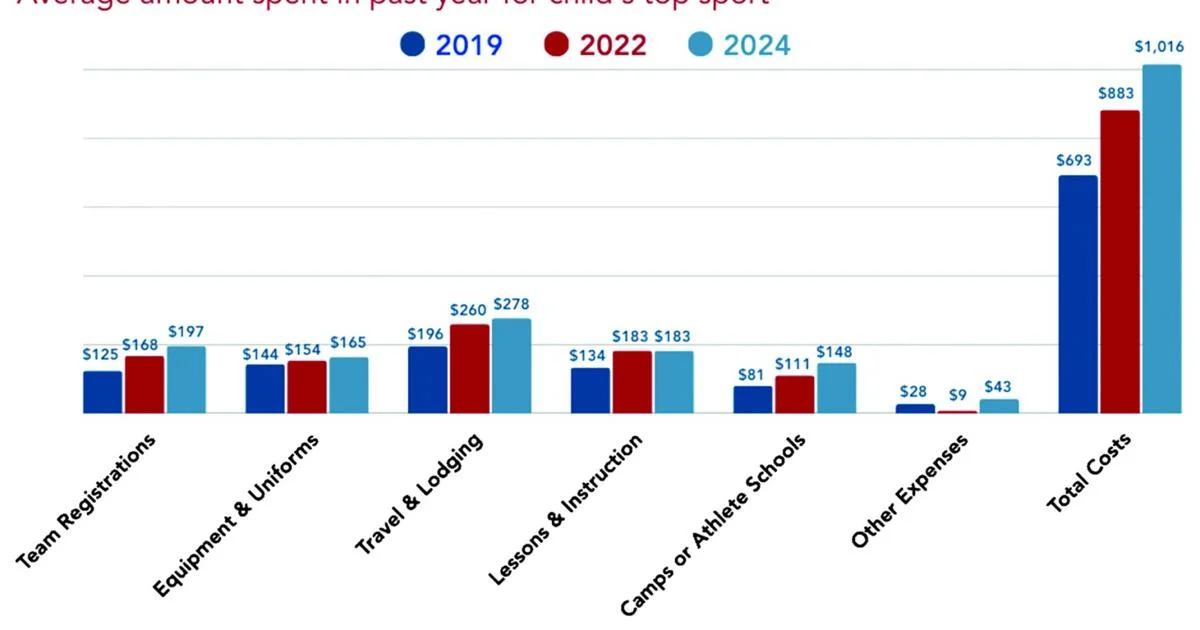
Project Play found that the average U.S. sports family spent $1,016 on a child’s primary sport in 2024. This is a 46% increase from 2019, twice the rate of price inflation in the U.S. economy during the same period.

Some companies and organizations are trying to fill the financial gaps for these families.

“Our corporate partners and our community partners are able to provide access to equipment and uniforms at a lower cost or donated so kids have access,” Stine said. “We don’t want a kid not playing or not signing up because they don’t have the proper shoes or the glove. 

“It’s really trying to lean into our partners where we can to help cover the costs that were traditionally passed on to our students or players.”

Local government has been an option, but Legg said a major issue is the massive reduction in how much local governments invest in youth sports.

Legg said that youth sports programs were at one point primarily subsidized by tax dollars and community support. This practice has shifted as the more commonly used funding model is the “pay to play” model, where the program is supported by participant fees.

“Youth sports create healthy youth, healthy youth create healthy communities,” Legg said. “It’s actually a cost saver in the long term and investing more in those communities through tax dollar support.”

The “pay to play” model is just one of the effects of the rapid commercialization of youth sports. This commercialization is prominent in the increase in club sports, programs that are run by private associations and often have much higher fees than traditional school or nonprofit youth sports programs.

For many families, cost is often the most important factor when considering youth sports programs.

Nick Girard, father of two and current president of Recreation Association of Madison Meadows & Simis (RAMMS), said cost is something he and many other parents weigh thoroughly.

“From the parents’ standpoint, I see that [rising cost] when I pay the registration fees, in RAMMS recreational sports and club sports,” Girard said. “I have kids who do club sports so I see all aspects of this.”


cost3.jpg

Not surprisingly, the money parents pay for a child to participate in a primary sport and other sports along the way in one year varies with the child’s age. 


RAMMS is a parent-run, volunteer-led nonprofit that provides recreational youth sports for children in North Central Phoenix. Like BGCAZ and similar nonprofits, it relies on registration fees and sponsorships to fund venues, uniforms, equipment and improvements to local schools.

RAMMS was created to provide recreational sport options for families who may be priced out of club or travel teams. 

Another factor that often deters parents from club sports involves the number of costs involved. Unlike recreational sport programs that charge one upfront fee, club and travel teams come with add-ons parents may not have accounted for.

 “In club sports, you’re typically paying a monthly fee for the club, you’re paying per event fees, you’re paying admission fees to get into those sports, you’re paying for the cost of uniforms separately oftentimes,” Girard said. :There’s a lot of different add-on pieces that add up.”

Even with the higher costs, parents often feel pressure to turn to club programs for many reasons, most notably when their child specializes in one sport.

Project Play found that the most common justifications for parents to enroll their children in club sports and specialize in one sport are that their child wants to play in high school, college or professionally. 

The study also found that one in four parents felt societal pressure to have their child stick to one sport while parents of older children feel the most pressure from their child and school coaches to specialize.

Girard, who’s been involved in youth sports for over eight years, said he’s noticed more younger children being pushed into club sports out of fear of being left behind.

But the great fear these days may be one of being left out by costs.

“What worries me the most about where youth sports are headed is kids leaving,” Girard said. “If it’s too expensive to play and families can’t sign up then kids stop participating.”  



Link

Continue Reading
Click to comment

Leave a Reply

Your email address will not be published. Required fields are marked *

Rec Sports

Rookie of the Year MLB front office selections 2026

Published

on


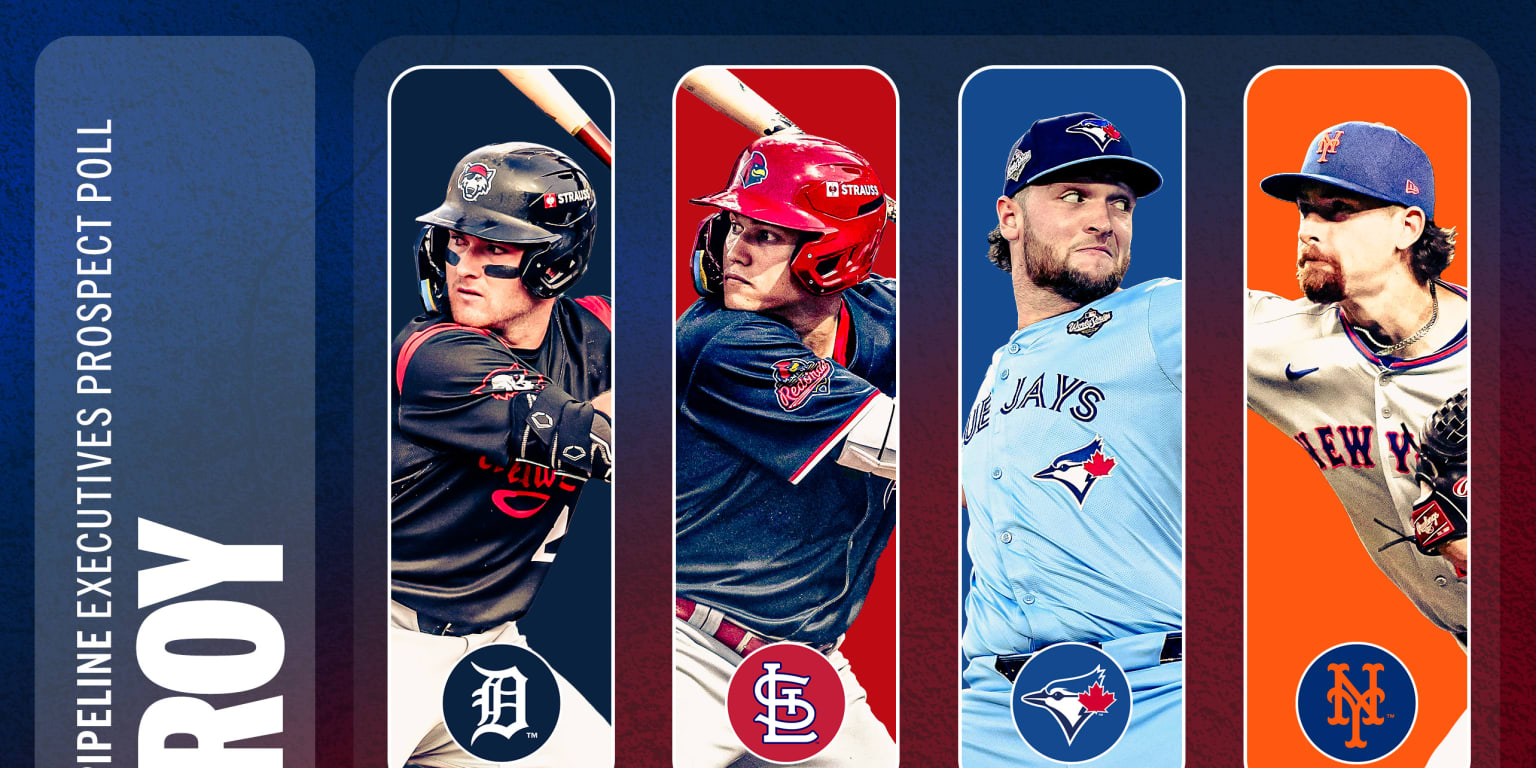
Welcome to the fourth annual MLB Pipeline Executive Poll. Starting before the 2023 season, we surveyed front offices across baseball — from general managers to scouting directors, farm directors, analysts and beyond — on a number of questions regarding prospects.

As has been our tradition, we’re beginning with who they think will win Rookie of the Year honors in each league in 2026. They started out on fire in ’23, choosing Gunnar Henderson and Corbin Carroll, both of whom took home that hardware. In 2024, winners Paul Skenes and Jackson Chourio got votes, though the survey leaders were Yoshinobu Yamamoto in the National League and Evan Carter in the American League.

Last year, the industry picked Dylan Crews and Roman Anthony (though most felt Roki Sasaki would be the front-runner in whichever league he signed). Drake Baldwin, the NL winner, didn’t appear on a ballot. In the AL, winner Nick Kurtz did get some attention and Anthony finished third in actual voting at season’s end.

Can front offices hit the nail on the head in ’26? There’s far from a consensus in either league this time around, with more than 40 front office officials weighing in on an array of topics that will be discussed in a week-long series.

Let’s kick things off with the results of the American League Rookie of the Year survey:

Also received votes: Jamie Arnold, LHP, A’s; Travis Bazzana, 2B, Guardians; Max Clark, OF, Tigers; Chase DeLauter, OF, Guardians; Leo De Vries, SS, A’s; Colt Emerson, SS, Mariners; Gage Jump, LHP, Athletics; Carson Williams, SS, Rays

That’s a total of 14 players getting at least one vote. And having two leaders at the top, one pitcher and one hitter, is something that will be mirrored when we get to the NL. It’s interesting, though, that the two tied in the AL are a pitcher who starred in the postseason and a hitter who has yet to play a game above Double-A.

Trey Yesavage (MLB No. 26), taken by the Blue Jays as the No. 20 overall pick in the ’24 Draft, had a meteoric rise through Toronto’s system in ’25, starting the season with Single-A Dunedin and finishing it by appearing in three World Series games as perhaps the most dependable arm on the postseason staff. He’s still only 22 and it will be fascinating to see if he can pick up where he left off and how the league adjusts after getting a longer look at him, especially that devastating splitter.

Kevin McGonigle (MLB No. 2) will be just 21 for most of the ’26 season and has a grand total of 46 games above A ball on his resume. But he also has a career .922 OPS in the Minors, and some voters were no doubt swayed by his Arizona Fall League showing in ’25, when he was named MVP after posting a .362/.500/.710 slash line with five homers and 19 RBIs in 19 games. He’s considered by many to be the best pure hitter in the Minors, with an advanced approach that should enable him to hold his own at the plate. Where he fits in the Tigers’ infield might be one of the more intriguing storylines in Lakeland this spring. He’s primarily been a shortstop (where he’ll see plenty of time in Spring Training), could no doubt handle second base and looked good at third in the AFL.

The other four on our leaderboard all have at least touched the big leagues. Samuel Basallo (MLB No. 7) debuted in August, just days after his 21st birthday, and homered four times in 109 at-bats. The power will play and it’ll be interesting to see how the Orioles get him at-bats behind the plate, at first base and as a DH. Carter Jensen (MLB No. 39) was a September callup for the Royals and after a solid debut (.941 OPS in 60 ABs), he should get a chance to make the Opening Day roster, learning behind Salvador Perez and getting plenty of plate appearances as a DH as well. Payton Tolle (MLB No. 28) and Connelly Early (BOS No. 4) are two Red Sox lefties who showed glimpses of what might be possible with a full season in Boston’s rotation.

In addition to the Red Sox, the Tigers (Max Clark, McGonigle), Guardians (Chase DeLauter, Travis Bazzana) and A’s (Jamie Arnold, Leo De Vries) all had multiple vote-getters. It was the Athletics who finished 1-2 in the AL ROY voting in ’25, with Jacob Wilson (who got multiple survey votes a year ago) right behind Kurtz.

Also received votes: Carson Benge, OF, Mets; Aidan Miller, SS, Phillies; Thomas White, LHP, Marlins

There was a clear top three among the 10 players who received votes in the NL, and like with the AL, it’s led by a hitter who has yet to get a single big league at-bat and a pitcher who made a very strong first impression at the highest level.

Cardinals infielder JJ Wetherholt (MLB No. 5) had an outstanding first full season of pro ball after being the No. 7 overall pick in the 2024 Draft, splitting the year between Double-A and Triple-A and posting a combined .306/.421/.510 slash line with 17 homers and 23 steals. Some were surprised he didn’t get a late-season audition in St. Louis, but you have to figure his bat will work its way into that lineup sooner rather than later. He’s played three infield positions, which should help give the big league staff options for him to make the Opening Day roster.

Like Yesavage, Nolan McLean (MLB No. 11) not only made his Major League debut, but did so under a very large spotlight, making eight outstanding starts down the stretch during the Mets’ ill-fated playoff push. With a 2.06 ERA, 10.7 K/9 rate and .200 average-against, McLean was the Mets’ best starter at the end of the season and is the only vote-getter in either ’26 survey to have received actual ROY votes in ’25. He was just two innings shy of surpassing rookie status for the upcoming season.

Behind the two leaders is No. 1 prospect Konnor Griffin, and the fact he received such a healthy percentage of votes shows how far and how fast he’s come. The No. 9 overall pick in the ’24 Draft, Griffin went from Single-A Bradenton to Double-A Altoona and hit absolutely everywhere, finishing with a combined .333/.415/.527 line, 21 homers and 65 steals, making him the easy pick for MLB Pipeline’s Hitting Prospect of the Year award. He should get a long look this spring at shortstop and clearly several executives believe he belongs.

Of the remaining four on the leaderboard, Bubba Chandler (MLB No. 14) and Sal Stewart (MLB No. 31) have big league time, while Justin Crawford (MLB No. 54) and Zyhir Hope (MLB No. 20) do not. Chandler should be in the Pirates’ rotation (and is the only player who got votes in last year’s poll to appear this time around), and Stewart in the Reds’ lineup, from Day 1 of the ’26 season. All signs point to Crawford getting every chance to roam the outfield for Philadelphia on Opening Day, while Hope is a bit of a long-shot play.

With Griffin and Chandler, the Pirates are the only team with two players among the leaders, but the Phillies (Aidan Miller, Crawford) and the Mets (Carson Benge, McLean) also had multiple prospects receiving votes.


Link

Continue Reading

Rec Sports

Meeting to focus on youth sports’ future | Archives

Published

on


1389226337_b214

1389226337_b214


The subject of what agency will provide youth sports programs in Englewood in the future will be explored at the meeting that will be held from 4 to 6 p.m. Jan. 16 in the community room on the second floor of the Englewood Civic Center. “The city parks and recreation program will put on the summer baseball program this year but that will be the last youth sports program we will offer,” said Gerald Black, parks and recreation director. In a letter sent to members of youth sports programs and the Englewood school district, Black explained the changes are a result of the need to meet 2014 budget requirements. For years, Englewood Parks and Recreation Department offered an extensive youth sports program that included baseball, basketball and tackle football. A few years ago, the department abolished the tackle-football program, which led to the creation of the Englewood Youth Football Association. The association grew, offering competitive baseball, softball and basketball programs so the name was changed to the Englewood Youth Sports Association. Also, the middle school established separate seventh- and eighth-grade basketball teams for boys and girls. “We don’t really know where we will go from here now that the recreation department is no longer doing youth sports programs,” said Debbie Penn, EYSA board member and community relations representative. “There are options available but we’ll have to see how programs develop.” She said Jan. 16 is a brainstorming session about the future of youth sports programs. Penn said issues include access to facilities at fees that keep youth sports participation costs reasonable for Englewood families. She added that the association is currently operated by a small group of volunteers. “We’ll need some volunteers to help us if we add additional programs or expand our existing programs,” she said. “The current handful of association volunteers can’t efficiently operate expanded programs.”


Link

Continue Reading

Rec Sports

Registration opens for 2026 flag football season on Kauai

Published

on


LIHUE (HawaiiNewsNow) – The Kauai Police Activities League is now accepting applications for the 2026 flag football season.

For years, K‑PAL has connected hundreds of local youth with its athletic programs to further its mission and empower them to live drug-free lives and reach their full potential through positive activities, mentorship, and fun.

The K‑PAL flag football program is open to school-aged youth from kindergarten through high school seniors.

Registration is free and available online through April 1, 2026. Early registration is encouraged, as space is limited. Applications received after the deadline will be placed on a waitlist and are not guaranteed a spot.

Practices will begin on May 1. Games will take place on Saturdays at the auxiliary field next to Vidinha Stadium, starting in June and running through mid-July.

K‑PAL is also seeking volunteer coaches. If you’re passionate about football and want to make a difference in the lives of Kaua‘i’s youth, please visit the K‑PAL website and complete the Volunteer Form.

For more information, call (808) 241-1924 or email KPAL@kauai.gov.


Link

Continue Reading

Rec Sports

University of Washington Launches Free Legislative Tracker for Youth Sports Policy Across All 50 States

Published

on


Key Takeaways

  • Over 700 bills compiled covering youth sports and physical activity legislation at state and federal levels
  • 11 policy categories tracked, including concussion protocols, mental health training requirements, and abuse prevention standards
  • Interactive map reveals gaps in coaching qualifications, safety protocols, and recess mandates across states
  • Free resource developed by University of Washington Center for Leadership in Athletics with four partner organizations
  • First comprehensive tool to centralize fragmented youth sports legislation into one searchable database

USE THE TOOL HERE:
Youth Sports and Physical Activity Legislation Tracker, The Sports Institute, University of Washington, (2025). https://thesportsinstitute.com/youth-sports-and-physical-activity-legislation-tracker/


A Centralized View of Fragmented Policy

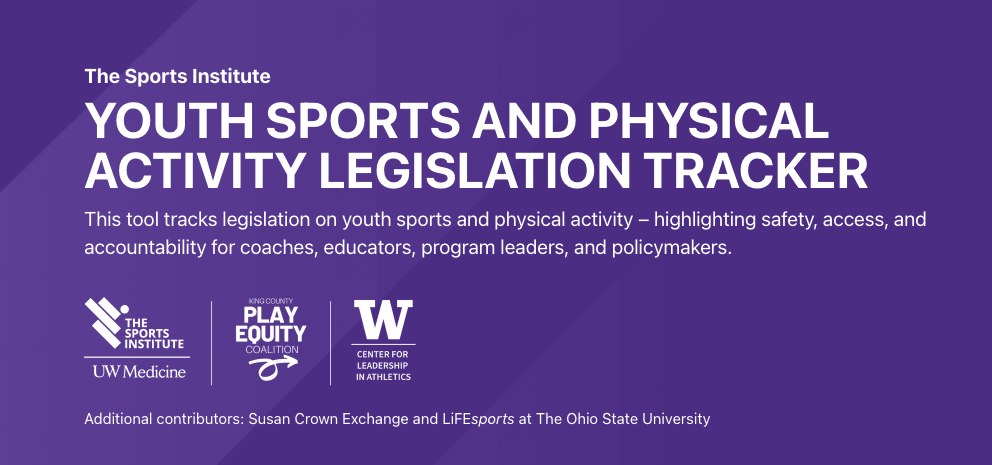
The University of Washington Center for Leadership in Athletics released the Youth Sports and Physical Activity Legislation Tracker, a free interactive tool that compiles state and federal laws affecting youth sports programs. The resource was developed in partnership with The Sports Institute at UW Medicine, King County Play Equity Coalition, Susan Crown Exchange, and LiFEsports at The Ohio State University.

The tracker includes over 700 bills and allows users to search by state or topic. It covers legislation on concussion management, cardiac arrest protocols, abuse prevention, coaching qualifications, recess requirements, and physical activity standards in schools.

What the Tracker Covers

The tool organizes legislation into 11 categories. Safety-related topics include concussion protocols, sudden cardiac arrest response standards, general safety requirements, and abuse prevention measures. Training categories address both school sport coaching qualifications and youth sports (non-school) coaching requirements. Additional sections cover mental health training mandates, physical activity minimums in schools, and recess policies.

Each category includes definitions and context. For example, the concussion section tracks which states require return-to-play protocols and assigns responsibility to coaches, schools, or organizations. The mental health category identifies states requiring coaches to complete training on adolescent mental health or suicide prevention.

The abuse prevention section focuses on background checks, mandatory reporting requirements, and codes of conduct. The tracker notes that while most states require background checks for paid school employees, significant gaps remain for volunteer and unpaid coaches.

Addressing Policy Inconsistencies

The tracker highlights variation in requirements across states. Concussion and cardiac arrest protocols differ by jurisdiction. Coaching qualification standards for school sports vary significantly, and requirements for non-school youth sports coaches are even less consistent.

Physical activity and recess policies also show disparities. Not all states mandate minimum recess time for elementary students or require specific amounts of daily physical activity that align with CDC recommendations of 60 minutes of moderate to vigorous activity.

Who Benefits From This Resource

The tool serves coaches, program administrators, policymakers, and facility operators who need to understand compliance requirements. Youth sports organizations operating in multiple states can use it to identify different standards across their footprint. School districts can compare their policies to state requirements or peer districts.

Advocacy groups and researchers can use the data to identify gaps in youth athlete protection or inconsistencies in safety standards. The tracker provides a baseline for understanding where policy exists and where it does not.

Building Toward Standardization

The release of this tracker provides the youth sports industry with its first comprehensive view of legislative requirements across jurisdictions. Access to centralized policy data may support efforts to address gaps in coach training, safety protocols, and athlete protection standards.

The tool’s ability to filter by topic or geography allows users to identify specific compliance needs or compare approaches across states. As youth sports organizations face increasing scrutiny around safety and accountability, this resource offers a practical starting point for understanding the regulatory landscape.


YSBR provides this content on an “as is” basis without any warranties, express or implied. We do not assume responsibility for the accuracy, completeness, legality, reliability, or use of the information, including any images, videos, or licenses associated with this article. For any concerns, including copyright issues or complaints, please contact YSBR directly.


About Youth Sports Business Report

Youth Sports Business Report is the largest and most trusted source for youth sports industry news, insights, and analysis covering the $54 billion youth sports market. Trusted by over 50,000 followers including industry executives, investors, youth sports parents and sports business professionals, we are the premier destination for comprehensive youth sports business intelligence.

Our core mission: Make Youth Sports Better. As the leading authority in youth sports business reporting, we deliver unparalleled coverage of sports business trendsyouth athletics, and emerging opportunities across the youth sports ecosystem.

Our expert editorial team provides authoritative, in-depth reporting on key youth sports industry verticals including:

  • Sports sponsorship and institutional capital (Private Equity, Venture Capital)
  • Youth Sports events and tournament management
  • NIL (Name, Image, Likeness) developments and compliance
  • Youth sports coaching and sports recruitment strategies
  • Sports technology and data analytics innovation
  • Youth sports facilities development and management
  • Sports content creation and digital media monetization

Whether you’re a sports industry executive, institutional investor, youth sports parent, coach, or sports business enthusiast, Youth Sports Business Report is your most reliable source for the actionable sports business insights you need to stay ahead of youth athletics trends and make informed decisions in the rapidly evolving youth sports landscape.

Join our growing community of 50,000+ industry leaders who depend on our trusted youth sports business analysis to drive success in the youth sports industry.

Stay connected with the pulse of the youth sports business – where industry expertise meets actionable intelligence.

Sign up for the biggest newsletter in Youth Sports – Youth Sports HQ – The best youth sports newsletter in the industry 

Follow us on LinkedIn

Follow Youth Sports Business Report Founder Cameron Korab on LinkedIn


Are you a brand looking to tap into the world’s most passionate fanbase… youth sports?

Introducing Play Up Partners, a leading youth sports marketing agency connecting brands with the power of youth sports. We specialize in youth sports sponsorships, partnerships, and activations that drive measurable results.

About Play Up Partners

Play Up Partners is a leading youth sports marketing agency connecting brands with the power of youth sports. We specialize in youth sports sponsorships, partnerships, and activations that drive measurable results.

Why Sponsor Youth Sports?

Youth sports represents one of the most engaged and passionate audiences in sports marketing. With over 70 million young athletes and their families participating annually, the youth sports industry offers brands unparalleled access to motivated communities with strong purchasing power and loyalty.

What Does Play Up Partners Do?

We’ve done the heavy lifting to untangle the complex youth sports landscape so our brand partners can engage with clarity, confidence, and impact. Our vetted network of accredited youth sports organizations (from local leagues to national tournaments and operators) allows us to create flexible, scalable programs that evolve with the market.

Our Approach

Every partnership we build is rooted in authenticity and value creation. We don’t just broker deals. We craft youth sports marketing strategies that:

  • Deliver measurable ROI for brand partners
  • Create meaningful experiences for athletes and families
  • Elevate the youth sports ecosystem

Our Vision

We’re positioning youth sports as the most desirable and effective platform in sports marketing. Our mission is simple: MAKE YOUTH SPORTS BETTER for athletes, families, organizations, and brand partners.


Common Questions About Youth Sports Marketing

Where can I sponsor youth sports? How do I activate in youth sports? What is the ROI of youth sports marketing? How much does youth sports sponsorship cost?

We have answers. Reach out to info@playuppartners.com to learn how Play Up Partners can help your brand navigate the youth sports landscape.

Youth sports organizations: Interested in partnership opportunities? Reach out to learn about our accreditation process.


Link

Continue Reading

Rec Sports

Spurs and UT Health San Antonio bring health lessons and joy to PE class

Published

on


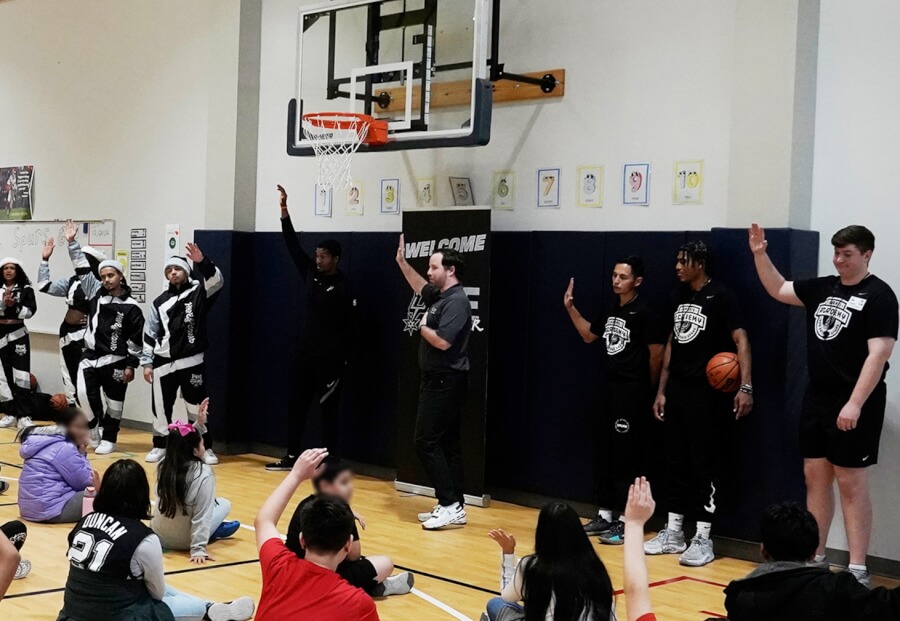
The San Antonio Spurs, in partnership with UT Health San Antonio, the clinical enterprise of The University of Texas at San Antonio, took charge of the physical education classes at Park Village Blended Learning Academy on Dec. 9 as part of a program to give back to the community and talk to kids about how to make healthy choices.

Park Village is a small, Title I elementary school in the Judson Independent School District. As of the 2023-2024 school year, it had 400 students, with around 70% of its students considered at risk of dropping out of school. The event was an opportunity for the students to participate in a day of fun that helped them feel part of their community.

“Having this type of event shows that our community cares,” said Kayone Bedford, principal of Park Village. “Sometimes our kids will say, nobody thinks about us because we’re such a small school or because of what side of town we’re from. But for an organization as large as the Spurs to come out here, that makes our kids feel proud and like they’re part of something bigger.”

The Spurs PE Takeovers are part of the Spurs Sports Academy’s broader community impact programs that also include community-wide events, clinics and camps offered to kids from six years old to 18.

“Our objective is to come and spread joy for these kids and have a good time while teaching basketball skills,” said RJ Sanchez, community sports manager for the Spurs Sports Academy. “Since our partnership with UT Health San Antonio, we’ve implemented a learning curriculum to teach the kids about their health and the value of exercise. But the most important thing we bring to every school is the joy factor.”

Kevin Ozment, MD

During the event, Kevin Ozment, MD, sports medicine physician at UT Health San Antonio and assistant clinical professor in the Department of Rehabilitation in the Joe R. and Teresa Lozano Long School of Medicine at UT San Antonio, taught the students healthy lifestyle tips, emphasizing the importance of sleep, exercise and nutrition. After the lesson, the Spurs Sports Academy coaches led the students in warm-up drills and basketball skills from ball handling to passing and shooting. Then the Spurs Hype Squad, donning black and silver Santa hats, got the students moving with festive dance moves, offering something for everyone.

Ozment emphasized that building healthy habits early can have lasting benefits.

“I see a lot of patients who weren’t as involved in regular exercise or physical activity when they were younger, which can translate to potential health issues when they get older,” Ozment said. “That’s why it’s important to get involved early and implement healthy habits. A little bit of knowledge about healthy lifestyle choices can go a long way.”

Ozment also noted that while getting involved in sports is important, any kind of movement or activity — like riding a bike, taking a walk or going for a swim — can be beneficial for kids.

“It’s also important that kids diversify their sports and activities. When your kid is young, they don’t need to just stick to only one sport. By trying out different sports and being open to all kinds of activity, they can activate different muscle groups and down the line be less prone to injuries,” he advised.

UT Health San Antonio is the official sports medicine partner of the San Antonio Spurs. In 2023, the Spurs announced a multi-year partnership with UT Health San Antonio in a joint effort to pursue innovations in human performance and improve the health of the greater San Antonio community.


Link

Continue Reading

Rec Sports

Retired Marshalltown police chief announces campaign for Iowa House | News, Sports, Jobs

Published

on


Tupper

Former Marshalltown Police Chief Mike Tupper, who served the community for 13 years before retiring in February of 2025, has announced that he will be running for a seat in Iowa House District 52 as a Democrat, according to a press release issued Monday.

District 52 covers the city of Marshalltown and southeastern Marshall County, and the seat is currently held by Republican David Blom, also of Marshalltown. Before Blom defeated Sue Cahill in the 2024 election, the seat had been held by Democrats for over two decades. Notably, Democrat Mark Smith represented Marshalltown from 2001 to 2020.

“I’m running for the Iowa House to restore community-focused leadership and trust at the Capitol. Every day, I hear from neighbors who feel left behind by politicians in Des Moines, and I know I can rebuild that trust by showing up and listening to our community, as I did for years in law enforcement,” Tupper said.

In the press release, Tupper indicated that his priorities would be “fully funding our public schools, tackling the affordability crisis in Iowa by working to make housing cheaper for working families, and working with local officials to keep our communities safe.”

As the next Representative from Marshalltown, I will focus on:

“As a longtime community leader and recently retired Chief of Police in Marshalltown, I know folks across House District 52 know me as someone who leads with integrity and puts our community first. They can trust that I’ll be a reliable advocate for them in the Iowa House,” he said.

Tupper worked for 32 years as a police officer in Iowa and served as a police chief for 20 of those years in Nevada and Marshalltown. He currently works as a law enforcement consultant in the public entity insurance industry, has served as a community volunteer, nonprofit board member, youth sports coach and church leader. He is married to Sarah Tupper and has four daughters and one son.

Blom, the incumbent, issued the following statement when contacted by the T-R Monday.

“I’m running for re-election to the Iowa House to continue fighting for property tax relief, a major factor in rent and housing affordability, Marshall County jobs and economic development, Iowa veterans, teachers, and Marshall County families. It’s my honor to serve and I look forward to working to earn every vote in 2026,” he said.


Link

Continue Reading

Most Viewed Posts

Trending