

Rec Sports
WNBA, F1 Soar, While MLB, MLS Lag


Sports team investments have received outsized attention in recent years, with dozens of new funds chasing market-beating returns in a category that is not correlated with most other assets.
But not all leagues are created equal and returns varied wildly in 2025. In the WNBA, the average franchise value rose 180% year-over-year, according to Sportico’s May WNBA valuations. On the other end, MLS team values ticked up only 6%, as the league grapples with generating more media revenue.
Here is a look at the eight sports entities Sportico valued in 2025 and what is fueling those changes. Leagues are ranked in order of the average team value. Sportico’s NWSL team valuations, which were delayed by a few months, will return in early 2026.
NFL ($7.13 billion)
Owners debated for several years about opening their league to institutional investors, and if they did, what it might mean for franchise values. The pro-PE crowd got its way in 2024, and a flurry of LP deals were inked over the next 12 months.
A half-dozen teams sold stakes at valuations of at least $8 billion, led by the Koch family’s purchase of 10% of the New York Giants at a valuation just over $10.5 billion. Almost no one thinks these LP deal values are at premiums to control ones, as can happen in startup leagues or with tiny stakes.
Sportico’s NFL valuations were led by the Dallas Cowboys at $12.8 billion, with the Cincinnati Bengals at No. 32 ($5.5 billion). The one-year average jumped 20%.
“Private equity represents a sea change for the NFL, and you have almost every team talking to the approved PE firms,” Jeffrey Kaplan, Andalusian Sports Advisors co-founder, told Sportico in August. “It makes a lot of sense for NFL teams to consider the role of minority private equity capital.”
NBA ($5.51 billion)
The average NBA franchise value is up 113% from 2022, as a half-dozen teams were sold since then at ever-escalating prices. The latest was Mark Walter’s $10 billion buy of the Los Angeles Lakers that blew past the previous record sale for any sports team. William Chisholm’s group bought the Boston Celtics months earlier in a deal that valued the first tranche at $6.1 billion.
The Golden State Warriors led Sportico’s NBA valuations for the fifth straight year at $11.33 billion—only the Cowboys rank higher among global sports franchises. The league’s “get-in” price is $4 billion, with the Memphis Grizzles at No. 30, and the average rose 20%, matching the NFL’s gain.
League revenue is projected to hit $14.3 billion during the 2025-26 season, up 12% from last season. It marks Year 1 of the new media contracts with Amazon, ESPN/ABC and NBC that will bump each team’s TV revenue from $103 million to $143 million. The payouts rise roughly 7% per year on average, resulting in each team on track for $281 million for the 2034-35 season, based on a 30-team league. Forty years ago, each NBA team received roughly $1.5 million from national TV.
Formula 1 ($3.42 billion)
The 10 teams on the grid in 2025 rose 48% in value and are now more than double Sportico’s 2023 F1 team valuations, when the average was $1.61 billion. Ferrari was on top for the third straight year at $6.4 billion, but Mercedes ($5.88 billion) and McLaren ($4.73 billion) closed the gap at the top with their values up 49% and 78%, versus 34% for Ferrari.
“It’s a great time to be in Formula 1, as I think the pie is growing for everyone,” Jefferson Slack, Aston Martin’s head of commercial operations, said in a November interview. “The sport is moving towards a very healthy ecosystem. I think it is already there.”
Control sales are rare in F1, with only 10 teams ahead of Cadillac’s entry in 2026, but teams have sold LP stakes in recent years that reflect investor appetite for the race series that has thrived under Liberty Media’s ownership and the introduction of cost caps. The biggest deal was CrowdStrike CEO George Kurtz buying 5% of Mercedes from its CEO and principal Toto Wolff at a $6 billion valuation.
MLB ($2.82 billion)
The New York Yankees lead the way at $8.39 billion, but the Los Angeles Dodgers ($7.73 billion) have closed the gap between the sport’s two financial titans. The valuation gap was $2.1 billion in 2022, but was $660 million in Sportico’s 2025 MLB valuations.
In 2024, the Dodgers became the first MLB team to reach $1 billion in gross revenue, thanks to the arrival of Shohei Ohtani, a World Series run and the biggest TV deal in the sport. The only other sports teams in the world to hit that mark are the Cowboys and LaLiga giants Real Madrid and Barcelona.
The Dodgers’ 23% increase and double-digit bumps for the Philadelphia Phillies ($3.39 billion) and San Diego Padres ($2.31 billion) drove the average value up 7%, but the gains aren’t consistent all the way down as the league grapples with a series of challenges that are intertwined with revenue disparity, media distribution and looming labor negotiations.
Global Soccer ($2.33 billion)
Sportico’s 50 most valuable soccer teams include 19 MLS franchises and 14 EPL clubs. Europe dominates the top of the financial table with six Premier League clubs in the top 15 and three each from LaLiga and Serie A. But MLS heavily populates the bottom 70% of the list, led by Los Angeles FC at No. 16.
The top 30 non-MLS teams were valued in May at $2.33 billion on average, with Real Madrid first at $6.53 billion, up 8% and ahead of Manchester United ($6.09 billion). Real Madrid is the first soccer club to generate €1 billion in operating revenue, and its fortunes soared with the five-year, $1.2 billion renovation of its Santiago Bernabéu Stadium.
Revenue multiples remain the standard by which most bankers value sports franchises. In MLS, teams are valued at an average of 9.4 times revenue, versus 4.9 times for the non-MLS teams in the top-50 list. Relegation risk and lack of restraints on player spending drive the discount.
Five of the top 15 clubs had an operating loss greater than $60 million combined during their past two seasons. PSG lost $60 million during the 2023-24 season, but it was better than the $117 million and $400 million shortfalls the previous two years.
NHL ($2.1 billion)
The good vibes between the NHL and its players union are in sharp contrast to the four work stoppages over the past two decades, including the cancellation of the entire 2004-05 season. In June, the two sides ratified a new four-year labor deal, more than a year ahead of the expiration of the current CBA. The newfound harmony and hard salary cap are both notches in the league’s growth story.
The average NHL franchise was up 17% from 2024 by Sportico’s calculations. The total is more than double the $1.01 billion average in 2022. By comparison, the three-year change for the NBA is 83%, followed by the NFL at 72% and MLB lagging at 22%. The Toronto Maple Leafs rank first at $4.25 billion, while the Columbus Blue Jackets are No. 32 at $1.3 billion.
Among the five biggest North American sports leagues, a pair of NHL teams had the biggest valuation gains, as the Carolina Hurricanes ($1.92 billion, up 49%) and Florida Panthers ($1.89 billion, up 51%) converted dominant on-ice results into thriving businesses.
MLS ($721 million)
MLS is facing an inflection point in several ways, with a critical 24 months ahead covering a trio of major areas. The 2026 World Cup offers an opportunity to convert more casual sports fans—and more serious American soccer fans—into MLS fans. The league will pursue this objective as it changes its playing schedule to match the FIFA soccer calendar. And top of mind for many teams is how to unlock more value from media, after the league cut its 10-year Apple deal short three-and-a-half years to end in 2029.
The average team value rose 6% in Sportico’s January MLS valuations, with LAFC at No. 1 and worth $1.28 billion. Yet, the gains are not shared equally. Six teams rose in value at least 10%, fueled by new stadium projects or thriving local businesses, while a dozen teams inched up 3% or fewer.
The average club rose 31% from Sportico’s first MLS valuations in 2021, while the least-valuable club rose 22% during that time. For comparison, the NBA get-in price is up 127%, versus 122% in the NFL and just 10% for MLB, the latter of which has been hampered by the melting regional sports network model. The NHL had the greatest growth for its club ranked last, up 159%.
Real Salt Lake is the only MLS team sold during the past four years, but three teams are currently on the market in the Vancouver Whitecaps, San Jose Earthquakes and Seattle Sounders.
WNBA ($269 million)
WNBA values rose 180% compared to 2024, which is more than double the previous biggest year-over-year gain for a major sports league—that happened when Steve Ballmer bought the Los Angeles Clippers in 2014 and drove NBA prices higher across the board.
The Caitlin Clark-led Indiana Fever had the biggest one-year value gain at 273%, ranking third overall with a $335 million valuation. The 2024 champion New York Liberty were second at $420 million, with the second-largest gain of 222%.
Meanwhile, the WNBA’s most valuable team didn’t play its first game until 2025. The Golden State Valkyries led our May WNBA team valuations at $500 million, a 10x return from the expansion fee Golden State Warriors ownership, led by Joe Lacob and Peter Guber, agreed to pay in October 2023.
Lacob and Guber bought the Warriors in 2010 for $450 million, and it took nine years for the franchise value to rise 1,000%. For the Valkyries, it was less than two years.

Continue Reading

Joseph “Joe” Edward Studeny, 61, of Renfrew, passed away peacefully Tuesday, Dec. 23, 2025, surrounded by his family after an extended illness while under the care of Butler Memorial Hospital.
Born June 1, 1964, in Pittsburgh, he was the son of the late Joseph G. Studeny and Mary Katherine (Locher) Studeny.
Joe was a 1982 graduate of Butler High School. He then served in the U.S. Navy from 1982 until 1987. Joe graduated from Villanova University with a bachelor’s degree in chemical engineering in 1991. He later went on to further his education and graduated from Duquesne University with a Master of Business Administration in 2006. He worked as a financial analyst for FedEx for nearly 20 years.
Joe was a member of St. Conrad Catholic Church. He was an avid sports fan. He enjoyed coaching his kids’ sports teams and played soccer recreationally. He was a dedicated fan of the Pittsburgh Steelers and Pittsburgh Penguins. He had a heart for animals and was especially fond of his pets. Above all, he loved his family and his children and was a devoted father and husband.
He leaves behind to cherish his memory his fiancée, Kelly Griggs; his daughter, Katie (Aaron) O’Leary; and his granddaughter, Jade O’Leary.
In addition to his parents, he was preceded in death by his wife, Christine (Walters) Studeny; they were married for 26 years before her passing on Aug. 18, 2017. He was also preceded in death by his son, Joseph B. Studeny, who passed away April 17, 2019.
STUDENY — Friends and family of Joseph “Joe” Edward Studeny, who died Tuesday, Dec. 23, 2025, will be received from 1 to 3 and 5 to 7 p.m. Monday, Dec. 29, at BOYLAN FUNERAL HOME & CREMATION CENTER, 856 Evans City Road, Renfrew.
A Mass of Christian burial will be held at 10 a.m. Tuesday, Dec. 30, at All Saints Parish, St. Conrad Roman Catholic Church, 125 Buttercup Road, Butler, with Father Kevin Fazio officiating.
A private entombment will take place following Mass at Butler County Memorial Park.
The family kindly requests that, in lieu of flowers, donations be made to the American Cancer Society in Joe’s honor.
Expressions of sympathy may be shared with the family at www.boylanfuneralservices.com.
Please sign the guest book at www.butlereagle.com.
Rec Sports
‘It’s for everyone’: Phantoms youth program promotes girls’ involvement in the sport | Homepage Top Stories

BETHLEHEM, Pa. – From learning how to pass the puck to skating.
“Hockey is a great sport, it’s for everyone and we want everybody to be able to play,” said Keith Krem, Phantoms Youth vice president of hockey operations and Steel Ice Center owner.
Girls ages 4-12 from across our area hit the ice inside Steel Ice Center in Bethlehem on Saturday.
“This is a try hockey for free event, which is a USA Hockey sponsored event but this is for girls specifically,” said Krem.
Krem said girls hockey is a significant part of the Phantoms Youth program and is definitely growing.
“The idea here is that they get to come out and try the greatest game on earth and experience it for free and hopefully get interested and funnel into some of our other programs,” said Krem.
“We’re trying out ice hockey today. There’s lots of kids here,” said Savannah, who participated in the event. “I’ve took two lessons and done one of these practices once before and I wanted to try it again,” said Savannah.
“I think that they’re doing great, especially because it’s mostly their first time playing,” said Lauren Hawk, a volunteer.
Hawk said she has been playing hockey for around 10 years now.
She was one of the volunteers sharing her passion for the game to inspire other girls.
“I hope that they enjoy their time here and I hope that they learn new things and I hope that it makes them want to pursue hockey and continue playing,” said Hawk.
Krem said there is one thing specifically he hopes girls on the ice here walk away with.
“That it’s fun, you know. More than anything, they have a little bit of fun. I think that’s the number one thing without question cause if it’s fun they’re going to want to come back,” said Krem.
Rental skates were free and sticks were donated for Saturday’s event.
Girls who participated are also receiving free tickets for a Phantoms game at the PPL Center.


Traditionally, youth hockey players ages 14 to 18 have been permitted to participate in games and practices for both their local high school and Team Alaska, the state’s lone AAA tier competitive league program.
After receiving feedback from a majority of players’ parents, Team Alaska program director and 18U head coach Matt Thompson and fellow coaches at other age levels decided that their players wouldn’t be permitted to play both this year.
“When you’re reviewing things, you’re trying to look at what is the bigger voice and what do people want: How did our teams do? Did we have success? Were there issues here? And then we ask all the coaches,” Thompson said.
The high school and comp teams share the goal of developing young Alaska hockey players, but the decision has put a strain on their relationship. Many high school coaches disagree with the either/or approach. Generally, high school teams acquiesce to regular absences by some of their top players during the regular season to allow them to compete at both levels.
“You’re taking kids away from the game they love and they’ll never get these years back,” West High head coach Rob Larkey said.
Every year, the coaches of each youth program from 14U to 18U are allowed to decide whether to allow players to take part in both the high school and competitive league seasons.
Last year only the 14U team, which consists of mostly high school freshmen and middle schoolers, and 18U, which includes high school juniors and seniors, permitted their players to do both.
At the end of every season, Thompson sends surveys to parents and legal guardians of players so they can provide feedback on how the program can improve and voice concerns anonymously.
Thompson said after last season, they sent out 60 surveys, and only a few voiced appreciation for dual participation. Many more came back expressing frustrations about a lack of commitment from the team as a whole.
By late summer, the Team Alaska coaches had decided to stop allowing dual participation.
“This isn’t just a decision on me, it’s a decision by the program collectively,” Thompson said. “I backed those coaches, and they asked me to send an email out at the end of August just to reaffirm that we were doing that because there were a lot of people asking questions to those coaches.”
After sending the email, he said he didn’t receive any correspondence from concerned parents or coaches about the decision aside from Kevin Fitzgerald, an assistant coach at West High School.
Thompson and 18U coach William Wrenn met with the coaches from West in June, but the meeting turned sour on the topic of dual participation, which led to some friction between the two parties.
In early October, Fitzgerald, himself a former comp coach, sent a lengthy letter to hockey families outlining his criticisms of the decision. It included a number of responses to issues raised in the meeting as well as reasons players should consider high school hockey as opposed to club hockey.
“That was the only school that we heard from,” Thompson said. “One school that had an opinion on something. A school that I went to and played for sent out a letter that stirred up the pot a little bit.”
Forcing a decision
There was a point earlier in the year when it was unclear whether there would even be a 2025-26 high school hockey season. It was one of three high school sports on the chopping block during the Anchorage School District’s budget discussions in the face of a large budget deficit.
During the summer, when the season was still up in the air, Larkey said Team Alaska asked West players who play for both teams about their plans for the upcoming winter. The players couldn’t give a concrete answer because nothing had been finalized at the time.
Since the sport was ultimately spared from cuts, Larkey believes it’s unfair to make players and their families choose between the two.
“You’re forcing the kids that love the game and want to play the game to make a choice on that,” Larkey said.
In doing so, he thinks that Team Alaska has put more pressure on itself to perform better if they’re going to have players who play only for them year-round.
“Where are you going to measure yourself?” Larkey asked. “You should be getting out of regions and going to nationals. If not, then where are you at and how many of your players are going on (to play at the next level)?”

Chugiak head coach Rodney Wild believes kids are being forced to make a choice between the two, and in most cases, it’s not theirs to make.
“I don’t buy the reasoning as to why,” he said. “They’re doing it because they believe it’s in the kids’ best interest, I truly believe that. They’re not doing it to hurt the kids or put the kids at a disadvantage. They truly believe that what they’re doing is best for their players. I just don’t agree with it.”
Often, it’s the parents who are making the final decisions on behalf of their student-athletes. In many cases, players want to play for their high school teams as well.
South High lost between 10 and 15 players to the decision, but that hasn’t stopped them from opening the season on a high note as the lone undefeated team in the Cook Inlet Conference.
“South gets hammered the most with those Team Alaska guys but it’s OK,” Wolverines head coach Daniel Ramsey said. “We’ve had some JV kids come up, we’re in our fourth season now so our seniors are big on this team. That’s who our first line is, all seniors.”
High school hockey benefits
The high school coaches at West, Chugiak and South referenced the type of overwhelming support that comes with playing at that level. There are often big crowds featuring friends, family, faculty, alumni and the community at large. In travel hockey, teams typically play in front of scarce audiences predominantly made up of parents.
“I coached comp hockey too, and all you do is go to the arenas and moms and dads are the only ones in the arenas,” Larkey said. “There’s no cheerleaders in the crowd leading chants or a band being played. It’s a different excitement.”
The rivalry games between Chugiak and neighboring Eagle River average around 1,000 fans filling the stands and lining the rink at the Harry J. McDonald Memorial Center, providing an atmosphere that is “absolutely raucous,” said Wild.


“I feel like the kids are being forced to sacrifice an experience that they will not be able to replicate after they’re done playing (youth) hockey,” Wild said. “They’re robbing these kids of an opportunity, and they’ll tell you that there’s nothing like playing high school hockey.”
Many youth hockey players won’t get a chance to play in front of a packed arena outside of high school unless they play for a good junior hockey team in a passionate community.
“I think it’s really cool being able to play for your high school because you get to represent your school and represent the hockey team,” South sophomore forward David Berg said. “You really get to put out for your school and your fans.”
West wasn’t hit as hard as some of the other teams when it came to the volume of players they lost to Team Alaska’s decision. Larkey said five players are forgoing the high school season to commit to Team Alaska.
“We don’t want kids to throw their Team Alaska away either,” he said. “We don’t want to interrupt them as well.”
Possible resolutions
Youth hockey is the rare sport in the state in which the high school season overlaps with the competitive league season.
According to Thompson, the Team Alaska program director, the conflicting schedules are the most detrimental to Team Alaska at the time when the team needs to be at its best and sharpest, around the time of the high school regional tournament.
Thompson said he’s spent the past four years trying to work with the Alaska School Activities Association on a possible resolution.
“Before I was event program director, I was meeting with them to see how we can make this work because I get that high school hockey more than anything is the experience,” Thompson said. “The way that the schedules are built up for high school and our comp, it doesn’t set either of us up for success.”

His proposals to ASAA over the years when there has been dual participation included moving up the dates of the high school postseason or changing the start of the regular season to earlier in October.
“That would give us more wiggle room for our teams to prepare for the regional tournament and hopefully punch a ticket to nationals,” Thompson said. “Unfortunately, ASAA doesn’t want to separate the big schools from the small schools, and the difficulty there is that the smaller programs practice outside, so their season is surrounded by the temperatures to have outdoor ice.”
To develop a possible resolution for future dual participation, Thompson wants to work with ASAA to ensure a pathway that is beneficial for all parties.
“It wasn’t an easy decision. It is not one that is set in stone that no matter what moving forward, that’s what we’re doing,” he said. “It all comes down to that I think there’s a way for this to work for both, and I think that adjusting the (high school) season even by a couple weeks would change a lot of things.”
Finding success
All six Alaskans currently on the Anchorage Wolverines junior hockey team have come through the Team Alaska pipeline, which Thompson believes is a direct reflection of how the program sets its athletes up for success.
“These kids who are aspiring to play for the Wolverines one day or for any of our other junior programs in the state or any program that is outside the country, they’re (on a) stepping stone by playing at (our) level,” he said.
Thompson regrets that his players won’t get to have the same types of experiences as those who opt to play at the high school level, but knows that the sacrifices they make now have the potential to pay major dividends later.
“A lot of these players are asking for more of a challenge and unfortunately, in high-level athletics in high school, college or junior hockey, there is sacrifice,” he said. “Anybody that’s gone through it understands that. Unfortunately, you can’t have everything.”

Thompson and Team Alaska compiled a list of youth hockey players with birth years of 1975 until present day who have left the state to pursue higher levels of competition, and the number of those who leave each year has grown.
In 1992, there were only a handful, and that number stayed low through 2005. But there have been double-digit departures in 19 of the last 20 years. The most in a year during that span was 43 in 2019, and departures remained in the double digits during the COVID-19 pandemic with 11 in 2020.
“Our goal is to keep these kids at home,” Thompson said. “When you’re sitting there and thinking that Team Alaska hasn’t won anything, our goal is to keep some of these best kids here.”
Larkey, the West High coach, pointed to a large number of players who have participated in high school and have gone on to bigger things in hockey as well. Among them is Boston Bruins goalie Jeremy Swayman, who played at South High and the AAA Alaska Junior Aces before moving up in competition.
Thompson said the fact that Team Alaska has been able to consistently contend for region titles despite not having the top local talent is tangible proof of their growth as a program. They’re seeing sustained success and better results this year on their travel teams with no dual participation, he said.
“We’re clearly doing something that people appreciate because they want to be a part of it and they’re staying in it,” Thompson said. “That is probably more rewarding than anything. Seeing kids staying in Alaska and staying in the program to represent Alaska.”
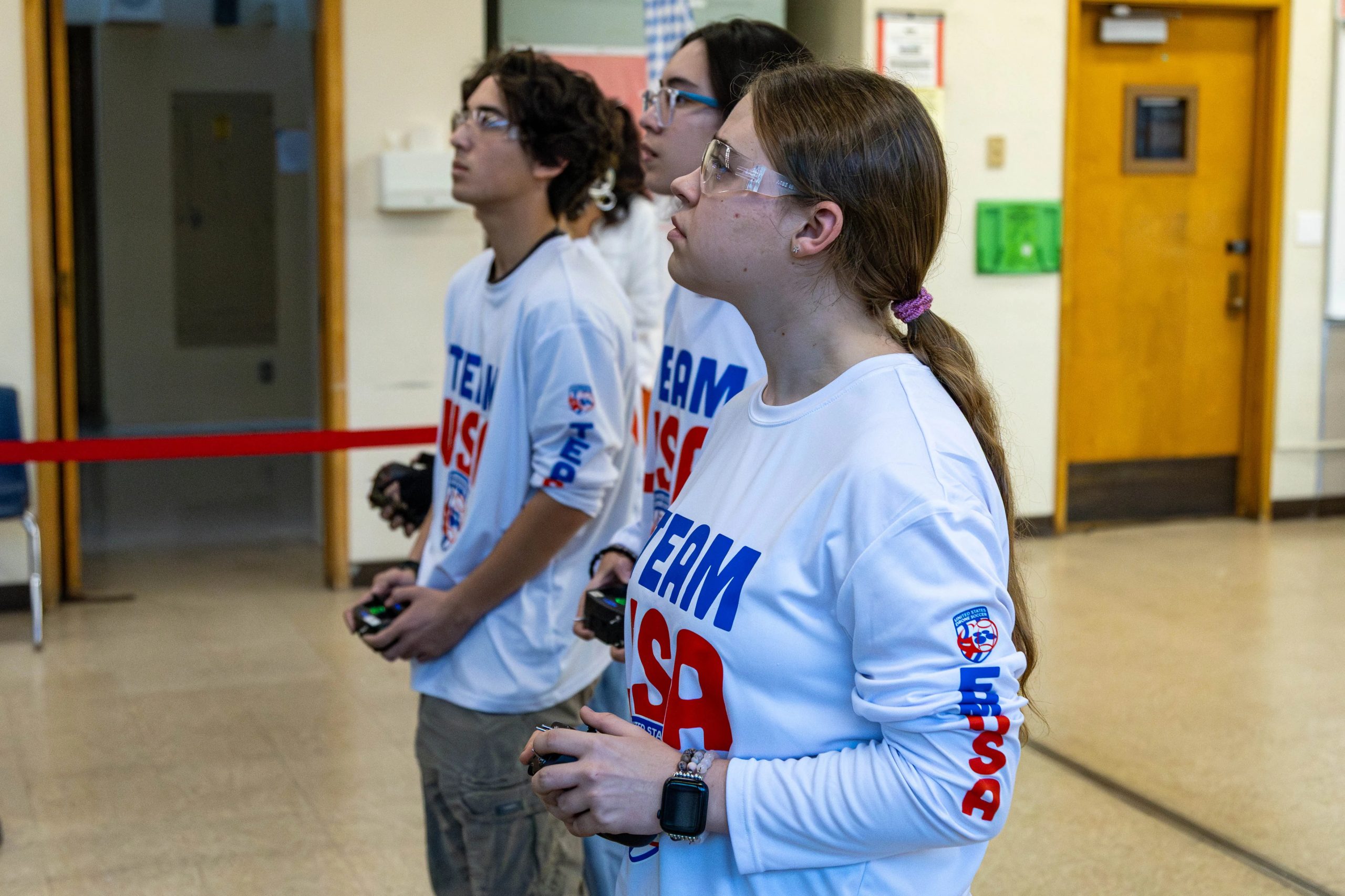
What began as California’s first drone soccer team has made breakthroughs in the sport to become the gold standard of academic and competitive success in Long Beach within just three years of its founding.
The SATO Academy of Mathematics and Science Drone soccer team represented the United States during the 2025 Fédération Aéronautique Internationale (FAI) World Drone Soccer Championships in China from Nov. 15-18, where the team placed fourth in the 40 centimeter section and fifth in 20 centimeter matches.
“It’s honestly mindblowing because I didn’t think we were gonna get that far,” said Kira Black, president of the SATO Drone Soccer Club and the team’s goalie.
SATO Drone Soccer head coach Albert Gallo founded the program after he heard about the U.S. Drone Soccer League and subsequently pitched the idea to the principal, who “absolutely loved it,” he said. Gallo then began pitching the program to kids he taught in his engineering class during the 2022 school year, and it has grown ever since.

Drone soccer is a five-on-five sport where the aim of the game is to score as many goals as you can by driving a “striker drone” completely through the opponents goal. Two members of each team are designated as the “striker” and “goalie” as the match is broken up into three, three-minute sets. The team who scores the most goals wins each set, and whoever wins two sets wins the match.
The SATO Drone Soccer program is broken up into two senior-led official teams they send to tournaments, “Mushu” and “Dragon Fire.” The two separate groups of seniors have been on the team since its inception at SATO. The school also has a separate club for students to join recreationally.
“I told them [the professional players from Mushu and Dragon Fire] from the beginning that, ‘you guys are the pioneers of this sport,’ we’re rewriting playbooks [and] we’re writing strategies.”
– SATO drone soccer coach and team founder Albert Gallo
SATO’s drone soccer team has been dominating the U.S. drone soccer sphere since its inception.
Since starting the program in 2022, they’ve placed first in the U.S. Drone Soccer Championships in 2023 and 2025, and earned a second-place finish in 2024. Multiple members of the program have received recognition from the United States Drone Soccer Association.
Most recently, team Mushu won the U.S. Drone Soccer Championship on May 3, 2025 and had the opportunity to represent the U.S. National Team in China.

“I’m extremely proud of our students and our pilots, I couldn’t have done it [without] my wife helping me, the principal of the school helping, the district helping us finance the equipment. Seeing all that growth is very satisfying,” Gallo said.
Drone Soccer originated in South Korea in 2016 from the research team in CAMTIC Institute of Technology, but the first tournament in the U.S. started in April 2021 in Colorado, with the United States Drone Soccer Association formally launching near the end of 2021.
SATO’s Drone Soccer program has helped students apply the skills they learn in STEM classes as well as build their communication and teamwork skills.
“I’ve made a bunch of new friends just by being in the club, I’ve been more social, I’ve been a better communicator,” Black said.
As their success has catapulted them into a Long Beach sports powerhouse, the team’s goals have shifted from just having fun to placing first in every single tournament they enter.

SATO’s program has also helped influence other schools across the United States. According to the U.S. Drone Soccer Association, U.S. Drone Soccer has reached 300+ schools and organizations, serving 5,000+ students in 38 states.
The team has also been instrumental in getting other drone soccer teams in Long Beach started, allowing the Millikan High School drone soccer team to practice at SATO and loaning them drones to use.
Albert and his wife, Andrea Gallo, are co-founders of California Drone Sports, which holds camps, coaching clinics and helps fundraise for schools with the goal of continuing to expand, promote and support drone soccer programs throughout California.
Even with all of the success as one of the pioneers of drone soccer in California, the team faces challenges on the horizon.
Twelve seniors from the official teams will soon be graduating from SATO, which means more than half the program is leaving. Gallo’s main goal is restructuring the team while maintaining their competitiveness, he said.

“I’m gonna miss these kids the most because there’s 12 of them,” Gallo said. “[To] see them go on to do great things is gratifying, but it’s also the knowledge base that is leaving.”
The other challenge is finding money to get students to international tournaments. During the tournament in China, donations from the Long Beach Airport and Supervisor Janice Hahn were divided between hotel rooms and equipment, while the students’ parents paid for the flights to China.
“I heard there’s a tournament coming up in April in France and I would love to take a team, but where do we find the money? You could probably find money for hotels and food but who’s gonna pay for the flights?” Gallo said.
Gallo said they’re hoping to have an invitational on Jan. 31 and host a regional competition on March 21.
“I would love to fill the stands with more fans and more people wanting to come,” he said. “[The March 21 event] would be great just for people to come out and watch and see what drone soccer is about.”
For more information about their program and events, follow SATO’s Drone Soccer Club on Instagram.

Samuel Chacko
Photojournalist
Samuel Chacko is an award-winning photojournalist from Long Beach, California. Samuel currently works as a freelance journalist for multiple publications and he is a class of 2025 Cal State Long Beach graduate. Samuel loves watching sports (the Ravens and the Yankees) and taking photos.
Check out more of Samuel’s work here: https://samuelchacko.com/


“His sudden passing will be felt deeply by all who knew him.” That’s what the East Alton Police Department posted on social media, Friday, following the death of Officer Jack Stalcup on Christmas Day.
The 69-year-old Stalcup had served in various capacities with EAPD since his retirement as a South Roxana police officer. He served 32 years there.
East Alton Police say Stalcup also worked with parks and recreation to coordinate youth sports and volunteered with village events.
Visitation is from four until seven Tuesday afternoon at Mark’s Mortuary in Wood River. The funeral service will be on Wednesday at eleven.

A friend sent me a photo of Mt. Holly in Michigan. Funny thing is, that’s where I first learned how to ski with my brother and my parents. I wore two pair of heavy socks and a pair of red rubber boots. My feet froze and I don’t remember having fun. Just being cold.
Mt. Holly opened in 1956, I was 8 years old and my brother was 10. My parents were in their early 40s. I’ve always thought that they were brave to begin a sport like skiing in their 40s.
But in Michigan, you either huddle by a fire or get out and enjoy the snow. My family enjoyed the snow.
I remember wearing an old pair of my mom’s ice skates. They weren’t figure skates just plain white skates. I always thought that if I had had figure skates I could have been a contender. But no, I ended up skating on my ankles with absolutely no support. I was the worst skater in the neighborhood.
Skiing was about the same. My brother got a pair of Head skis, great ones available at the time, and I skied on a pair of wooden skis until I was 16. It was after my brother died that I inherited his skis. At 6 feet 3 inches, his skis weren’t for me at 5 feet 7 inches. They completely ruined my skiing. But that’s what I got.
It’s my belief that if your children are going to participate in a sport, they should have the tools/equipment to do so, even though it’s not always easy as equipment is expensive.
Maybe my parents knew I was clumsy. But then they must have known that I persevered for decades in skiing, even after a ski accident that caused a spinal injury. Not in skating though as I never skated on a pair of descent skates.
Renting equipment helps while learning to ski.
My friend Mabel said, “Being one of the parents in the stands for wrestling competitions was like watching paint dry because it would take forever with only two wrestlers wrestling at a time. It was boring and I’d take a book. If my son didn’t make it to the next level, I’d have to stay, for it was a team sport, even for the parents as it wasn’t good sportsmanship to dip out. Rah, rah, rah.”
One friend told me they were dirt poor when she was a kid, and she tried soccer but wasn’t good at it. But she found her love for horses through her dad, a horse trader, so she rode horses and still does.
MoneyFit had great tips on how to budget for youth sports.
Rather than buying all the equipment at one time, get the most important gear, i.e. helmets and cleats for football and skates and helmets for hockey.
Many sports stores have used gear. As with clothing, kids outgrow equipment so it’s a good idea to check with sport stores in your area for items. Also, teams have gear-swaps. If your child is moving up an age bracket, there are others also moving up and leaving their equipment for a child behind them.
Comments on Reddit say that Rec Leagues are much more affordable than competitive sports travel/clubs. Rec Leagues also provide great coaching and skill building for players.
Several comments said the players’ parents should look at helping the team with coaching and other volunteering, plus consider working at events to raise funds for the team to offset the cost of their child/children’s sports.
I have three great grandsons and I’m sure (knock wood) their parents are planning wisely as all three are playing sports.
What’s a girl to do?…guess it’s time to start a “sports fund.”
Lucy Llewellyn Byard welcomes comments lucywgtd@gmail.com

Sports33 minutes ago
Top honours for national volleyball

NIL43 minutes ago
Athletic Director Confident Wyoming is ‘Catching Up’ in NIL Game
Sports49 minutes ago
Adriana Jeanpierre, Beachside, All-First Coast girls volleyball award

Sports1 hour ago
Assistant Director, Behavioral Health & Performance in New Orleans, LA for Tulane University

Sports1 hour ago
Prep Volleyball: Texas High earns multiple honors in District 10-5A awards

NIL2 hours ago
Clemson Fans Want Dabo Swinney Fired Immediately After Bowl Game

Sports2 hours ago
USA Volleyball Mourns the Passing of Hall of Fame Leader and Visionary Glen Lietzke

Sports2 hours ago
Kentucky Wildcats volleyball player transferring to Louisville

Sports2 hours ago
Kentucky Wildcats volleyball star Eva Hudson signs pro deal

Sports2 hours ago
Kentucky volleyball lands star but suffers rivalry blow in Transfer Portal whiplash

NIL2 hours ago
Oregon QB Austin Novosad plans to enter NCAA Transfer Portal

Sports3 hours ago
Cienna Alvarez, Cardinal Newman – The Press Democrat

NIL3 hours ago
No. 1 college football team linked to 1,700-yard RB in transfer portal

Sports5 hours ago
Inside App State Athletics: 12.27.25

Sports5 hours ago
Victoria East Sprinter Kiani North Signs With University of North Texas | Sports

Motorsports3 weeks ago
SoundGear Named Entitlement Sponsor of Spears CARS Tour Southwest Opener

Rec Sports3 weeks ago
Black Bear Revises Recording Policies After Rulebook Language Surfaces via Lever

Motorsports4 weeks ago
Jo Shimoda Undergoes Back Surgery

Motorsports3 weeks ago
Donny Schatz finds new home for 2026, inks full-time deal with CJB Motorsports – InForum

NIL4 weeks ago
Bowl Projections: ESPN predicts 12-team College Football Playoff bracket, full bowl slate after Week 14

Rec Sports4 weeks ago
Robert “Bobby” Lewis Hardin, 56

Rec Sports4 weeks ago
How this startup (and a KC sports icon) turned young players into card-carrying legends overnight

Rec Sports3 weeks ago
How Donald Trump became FIFA’s ‘soccer president’ long before World Cup draw

Rec Sports3 weeks ago
David Blitzer, Harris Blitzer Sports & Entertainment

Sports4 weeks ago
Men’s and Women’s Track and Field Release 2026 Indoor Schedule with Opener Slated for December 6 at Home

Motorsports4 weeks ago
Michael Jordan’s fight against NASCAR heads to court, could shake up motorsports
Sports4 weeks ago
Wisconsin volleyball sweeps Minnesota with ease in ranked rivalry win

Motorsports4 weeks ago
Pohlman admits ‘there might be some spats’ as he pushes to get Kyle Busch winning again

Motorsports3 weeks ago
JR Motorsports Confirms Death Of NASCAR Veteran Michael Annett At Age 39

Motorsports4 weeks ago
Increased Purses, 19 Different Tracks Highlight 2026 Great Lakes Super Sprints Schedule – Speedway Digest






-
 Motorsports3 weeks ago
SoundGear Named Entitlement Sponsor of Spears CARS Tour Southwest Opener
-
 Motorsports3 weeks ago
Donny Schatz finds new home for 2026, inks full-time deal with CJB Motorsports – InForum
-
 Rec Sports3 weeks ago
David Blitzer, Harris Blitzer Sports & Entertainment
-

 Motorsports3 weeks ago
Rick Ware Racing switching to Chevrolet for 2026
-

 NIL2 weeks ago
DeSantis Talks College Football, Calls for Reforms to NIL and Transfer Portal · The Floridian
-
 Sports2 weeks ago
#11 Volleyball Practices, Then Meets Media Prior to #2 Kentucky Match
-

 Technology3 weeks ago
Wearable Gaming Accessories Market Growth Outlook
-

 Motorsports2 weeks ago
Sunoco to sponsor No. 8 Ganassi Honda IndyCar in multi-year deal
-

 Motorsports3 weeks ago
NASCAR owes $364.7M to teams in antitrust case
-

 Motorsports2 weeks ago
Nascar legal saga ends as 23XI, Front Row secure settlement