Image credit:
Fifth Third Park in Spartanburg, S.C. (Photo by J.J. Cooper)
What is state of the art in baseball stadium construction is an ever-evolving concept.
A smart idea at one new stadium—see Camden Yards in the early 1990s and its nod to past parks—is quickly adopted elsewhere. Well-designed group/picnic areas, table tops and open concourses went from cutting edge to standard practice quite quickly.
This year, new minor league ballparks have opened in Spartanburg, S.C. and Knoxville, Tenn. A near complete rebuild of a park in Columbus, Ga. also opened. Next year will see another wave of new ballparks in Richmond, Va., Wilson, N.C., Chattanooga, Tenn., Ontario, Calif. and Hillsboro, Ore. All of these are the first of the Professional Development League (PDL) era, replacing stadiums that were deemed unsuitable for upgrading to meet significantly increased facility requirements. They are stadiums built from the start to meet the stricter requirements, and as such, we’re seeing how stadiums have continued to adapt and change.
MiLB ballparks have largely been divided into a small number of eras. Because of the steady decline of the minor leagues in the 1960s, 70s and early 80s, many minor league teams were still playing in Works Progress Administration (WPA)-built, depression-era ballparks until the 1990s. Ballparks built in the 60s and 70s were rarities, as most teams largely operated in old ballparks that had received little more than modest maintenance for years.
The 1990 Professional Baseball Agreement (PBA) changed expectations. Major League Baseball pushed through increased facility standards in its agreement with Minor League Baseball.
At the time, many MiLB owners thought the new requirements would be impossible to meet and that the PBA could kill the minors. Instead, numerous cities agreed to build new ballparks to meet the demands. Fans found new seats, improved bathrooms and concession areas much more inviting than ancient stadiums with sun-bleached bleachers and plenty of peeling paint.
The PBA era showed how far stadiums had come over the preceding few decades. The building boom led to an attendance boom. And that led to a second building boom, because even the WPA-era stadiums that had been upgraded to meet the PBA standards soon found themselves left behind. Before long, they were replaced by newer stadiums. By 2021, 80% of MiLB full-season teams were playing in ballparks built after the 1990 PBA was adopted.
We won’t see that kind of building boom in the 2020s, but we are seeing a new wave of construction. With that in mind, Baseball America recently traveled to Fifth Third Park in Spartanburg to see the Hub City Spartanburgers’ new home and provide a look at what’s new in ballparks in the PDL era.
New Parks Are Roomier Than Ever
In the 21st century, stadiums have largely adopted a more open concourse design that allows fans to continue to see the field/game while walking around the stadium. But the concourses themselves were asked to do a lot, as they were both the main traffic arteries, spaces for concessions and a standing room area for fans taking in different views of the park.
The idea remains an excellent one, but congestion often defeated some of the goals of these open concourse designs. The concourses were designed to encourage fans to check out the field from multiple angles and to wander around, but long lines and packed concourses discouraged getting up and exploring different areas of the park.
Much like the U.S. Interstate system, the answer has been to widen the traffic arteries. In Spartanburg’s Fifth Third Park (and other new designs), the concourses are extremely wide, allowing enough room for fans heading in either direction, plus room for small stand-up concession stands and their lines without halting traffic flow.
According to Hub City general manager Tyson Jeffers, feedback on the roomier layout has been positive.
“A comment that we’ve gotten a lot in these first two homestands of games is that, even with a full crowd, people still feel like they have space within the concourses to move about freely,” Jeffers said.
Concession Stands Are More Efficient & Fan-Friendly
In the WPA era, concession stands were afterthoughts. They were placed seemingly wherever there was space and plumbing. If stands caused traffic jams, so be it.
The second wave of PBA-era stadiums fixed many of those problems but did so by putting the concession stands largely against the back walls of the concourses. An unintended result was the creation of new pinch points for traffic jams. Long lines meant fans were blocking other fans from crossing through the concourse. They also discouraged fans from making repeat trips to the concession stands.
Jeffers said the team was “really conscious” of potential foot traffic headaches in constructing the park.
“(With the concourse concessions) you might be making that person’s buying experience a little bit better while they’re waiting, but then you’re ruining someone else’s while they’re trying to get wherever they need to go,” Jeffers said, adding that the stadium’s property footprint helped make addressing traffic flow problems easier.
“It gave us the real estate to be able to do this. To be able to tuck (concessions) back beyond the concourse a little bit, create them in a marketplace style so that they flow a lot easier.”
Fifth Third Park puts the main concession stands into cutouts that extend off the back side of the concourse. Doing so ensures any lines are contained within the concession area without causing backups on the concourses. In the 1990s and 2000s, such construction would have meant fans couldn’t see the game. Today, television monitors line the area so fans can watch the broadcast if they don’t have a direct sightline to the field.
The concession stands themselves have also been updated. Traditional ballpark items such as popcorn, hamburgers and chicken sandwiches are self-serve fare.
“Each of those marketplaces have their own kitchen,” Jeffers said. “So they’re cooking hot food and just sliding it out. You’re grabbing it, you’re going. There’s always a little bit of fear about what happens when it sits there, but our food and beverage department has done an amazing job to make sure that they’re pushing it out when people need it. And those people can grab it and keep going.”
The grab-and-go setup reduces lines by allowing fans to quickly get their food, scan and pay at a self-checkout touch-screen display and then quickly return to their seats. The end effect, Jeffers said, is fans feel more comfortable in their decision to get up from game action to buy food.
“If you know you’re going to have to stand in line, you’re making a conscious decision of ‘Do I need that extra hot dog?’ You might say it’s not worth the minutes that I’m going to miss some of the game.”
For MiLB teams, in addition to increased concession stand sales, the marketplace layout may also reduce employee head count. Not dramatically, as the self-service food areas need continual restocking, and the self-pay kiosk area needs multiple employees supervising and helping any customers who have issues, but it’s a change from traditionally-staffed concession counters.
Parks Are Year-Round Facilities
It’s hard to imagine any team building a new park in the 2020s without a multi-purpose club-level area. Such a space can serve as an upscale restaurant/bar during games, but just as importantly, it provides an all-weather area for non-game day activities.
Spartanburg features a large club area on the second level that serves as a restaurant/bar/gathering place during games. It can also be used for conferences, wedding receptions, proms and most any other event a group could conceive. It has a full-service kitchen/bar as well as an outdoor patio area for events that want inside-outside versatility. In an era when teams are looking to increase the number of calendar dates the stadium is used, these types of multi-purpose areas are becoming must-haves in both new and retro-fitted ballparks.
“We’re providing an unbelievable experience and a top-tier experience for our fans at baseball games,” Jeffers said. “But then we have an amazing space that we can utilize on non-game days. And so we’re talking about our facility operating 365 days out of the year or as close to that as possible.
“Conferences coming in, chamber events, wedding receptions—all of those things. And it’s built in a way that one gives it the square footage and the layout to be able to accommodate those. But then it also has the technologies to be able to execute every type of event that you can think of.”
Seating Areas Are More Intimate
Under the old PBA rules, different MiLB levels had different seating requirements. A Triple-A stadium had to have 10,000 seats, a Double-A stadium required 6,000 and a Class A stadium needed 4,000. Those rules do not exist in the current PDL era, so individual teams can decide how big to build their stadium bowls.
Fifth Third Park’s seating bowl reflects this. The stadium has roughly 3,500 fixed seats, although group areas and berms mean up to 5,000 can get into the park.
“All of that was built intentionally to make sure that it always felt like that place is rocking and rolling every single night,” Jeffers said. “There was a stretch there in the 90s where people overbuilt. On July 4th, it’s great, but it makes your normal night crowd feel like it kind of loses something in exchange. To build for those anomaly games—opening night, the Fourth of July—you’re building for two days out of your year. We built for every day.”
There’s A Lot Fans Never See
Modern PDL requirements were focused on items for MiLB players, staff and player development. For example, the required size of visitor clubhouses was increased significantly. There must now be dining areas for the players. There must be bathrooms that are easily accessible from the dugouts.
Stadiums are required to have air-conditioned batting cages/pitching tunnels and enlarged weight rooms and storage space, as well as locker rooms for female staff and umpires.
Ballpark lighting and field requirements have also been increased.
These are non-negotiable requirements for both upgraded existing stadiums and new construction, so much of what’s been done in the bowels of a stadium will be similar to what’s been upgraded elsewhere. But with a new build, it’s possible to leave room for further expansion, new loading docks and other touches that may be tougher to add to an existing facility.
HANOVER, N.H. – The Dartmouth men’s and women’s track and field teams hosted the Ivy vs. America East Challenge, marking their final home meet of the indoor season.
Both teams had impressive finishes, placing first overall. The women wrapped up the meet with a final score of 73.83, while the men finished with a score of 63.
Andie Murray won the women’s 500m, finishing the race in 1:15.39. Emmy Thornton clinched the 800m with a final time of 2:20.65. Claire McDonald placed first in the 3000m with her 9:59.68 mark. Mariella Schweitzer won the 60m hurdles with an impressive 8.67 finish, as well as the long jump with a 5.97 mark.
Charlotte DiRocco secured points for Dartmouth after clearing 1.65m in the high jump, finishing in first place. Similarly, Ellison Weiner cleared 3.65m to clinch first place in the pole vault. As for the throws, Kylee Bennett and Zaneta Pivcova clinched the weight throw and shot put, with 15.41m and 14.54m marks, respectively.
Jack Rousseau won the 400m for the men with his final time of 50.13, followed by Noe Kemper clinching the 800m with a 1:54.31 finish. Michael Bueker, Keion Grieve, Jack Inglis and Jack Intihar clinched the men’s 4×4 with a 3:27.64 finish. As for the jumps, David Adams cleared 4.95m to clinch the pole vault for the Big Green, Intihar clinched the long jump 7.14m mark and Roy Leibovitz won the triple jump with a 15.45m mark, which is good for No. 14 in the nation.
Colton McMaster rounded out the meet for the men, clinching the shot put and weight throw with 17.53m and 19.17m marks, respectively.
The Big Green will return to action when heading to New Haven, Conn., for the annual Dartmouth-Yale-Columbia meet on Saturday, Jan. 17.
A brand-new track and field facility will open in Athens on Feb. 18, aiming to serve both the University of Georgia campus and the local community, according to its athletic department.
Located on South Milledge Avenue, the complex will feature a 400-meter, nine-lane Spec Towns Track with an infield long jump, a triple jump and a pole vault facility. The venue will have a capacity of 2,500 that can accommodate up to 4,000 for select events with a grandstand, a press box, an observation deck, restrooms and concession stands.
The new venue replaces the old one on South Lumpkin Street, which had not hosted an event for the Georgia men’s or women’s track and field team since April 2023. Now, the Bulldogs are slated to host the Spec Towns Invitational at the new complex this April, the Torrin Lawrence Memorial in May and the SEC championships in 2027.
High school competitions will also be held at the new facility with theClassic City Track and Field Invitational scheduled for March, making it the first competition on the venue’s calendar, and the GHSA state track meet in May.
The project, which cost $59.8 million, was funded exclusively by donations and gifts, and will become one of the “premier track and field destinations in the country,” according to the university’s director of athletics Josh Brooks.
“We are excited about the opportunities this facility will create for our athletes, our campus and our community,” Brooks said. “While it will support our student-athletes at the highest level, it will also create opportunities that will bring athletes of all ages to our campus throughout the year.”
The new complex will have a strong emphasis on strengthening ties between the university and local community, as public usage hours will give residents a new place to run and exercise, while big events can boost the local economy through hotel stays and visits to local businesses and restaurants.
“The Classic City Track and Field Invitational in March will mark the first competition in the new facility, bringing a regional high school meet to campus and expanding access to elite facilities for local student-athletes,” Alison McCullick, the university’s director of community relations, said. “In addition to competitions, the space will remain open for walking, running and everyday recreation, making it a year-round asset for the university and Athens.”
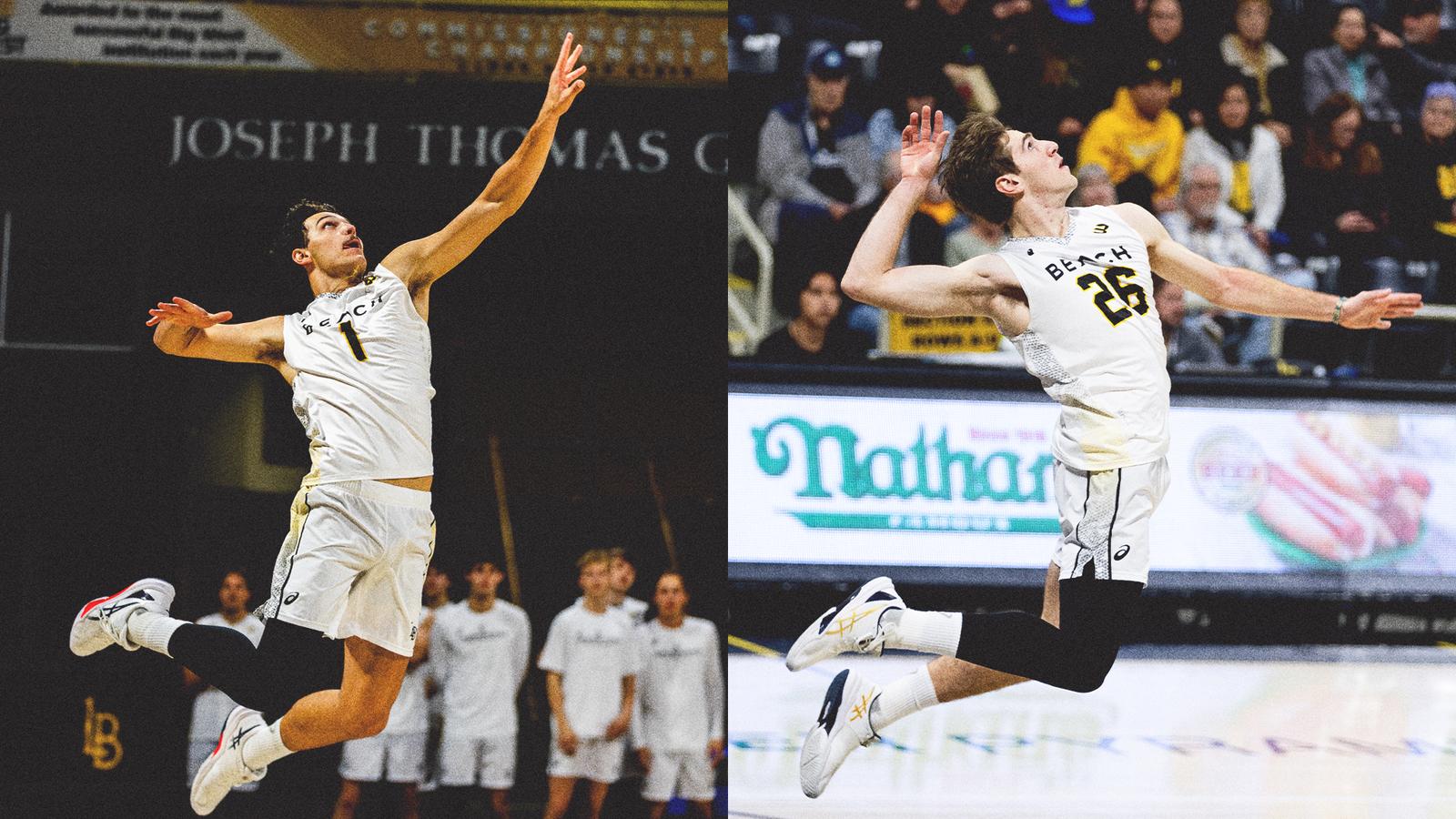
LONG BEACH, Calif. — In their collegiate debuts, Jackson Cryst and Jake Pazanti made immediate impacts for Long Beach State men’s volleyball, earning Big West Player of the Week honors following a dominant opening weekend. The Beach opened the 2026 season with two straight-set victories, defeating Lindenwood and McKendree at the Pyramid, as Cryst was named Men’s Volleyball Defensive Player of the Week and Pazanti earned Long Beach State Freshman of the Week recognition.
Cryst anchored the Long Beach State defense in his first collegiate action, averaging 1.50 blocks per set and totaling nine blocks over the weekend. His presence at the net helped limit opponents to a combined .157 hitting percentage and contributed to the Beach averaging 3.33 blocks per set across the two matches. Cryst also added seven kills on .462 hitting, showing efficiency and composure on both sides of the net.
Pazanti also impressed in his collegiate debut, directing the Long Beach State offense with poise and balance. The freshman setter recorded 58 assists (9.67 per set) while guiding the Beach to a .351 team hitting percentage in the opening weekend.
In addition to his setting responsibilities, Pazanti contributed six kills on .750 hitting, 16 digs, five blocks, and two service aces, impacting the match in every phase during his first career starts.
Long Beach State men’s volleyball returns to action this week with a three-game road stretch through the Buckeye State to face Central State, George Mason and Ohio State as the Beach continue early-season competition following a successful opening weekend.
WESTON, Mass. — Hannah Griffin, Zoe Kirk, and Justin Thuotte each represented the Pride this week in the Great Northeast Athletic Conference (GNAC) weekly awards. Kirk earned her second Rookie of the Week honor of the season, while Griffin collected her first career Track Athlete of the Week award. Thuotte was named Field Athlete of the Week, marking his first honor of the season and the fifth weekly award of his career.
Zoe Kirk continued her strong rookie campaign with a pair of top-10 finishes. She placed third overall in the high jump with a mark of 1.50 meters, setting a new indoor program record and surpassing the previous mark of 1.46 held by teammate Grace Micklon. Kirk also finished ninth in the 60-meter hurdles, clocking a time of 9.93.
Hannah Griffin captured the top spot in the 800 meters with a time of 2:44.36, edging her nearest competitor by nearly one second.
Justin Thuotte delivered another standout performance at the Wesleyan Winter Invitational, winning the long jump with a mark of 6.70 meters to set a new indoor program record, besting his own previous mark of 6.65 from the last meet. He also placed third in the triple jump at 12.99 meters and rounded out his day with a 10th-place finish in the weight throw, posting a personal-best mark of 13.59 meters.
Regis track and field stays close to home this weekend, traveling to Brighton, Massachusetts, to compete at the Suffolk Ice Breaker at The Track at New Balance.
MILWAUKEE – Ella Parker has been announced as the newest addition to the Milwaukee volleyball roster, head coach Susie Johnson announced on Monday afternoon.
Parker will join the Panthers this spring after spending the last three semesters at St. John’s University in Queens, N.Y., where she was a member of the Red Storm for the past two seasons.
“We are excited to add Ella to our team this spring,” said Johnson. “Having played in the Big East Conference, she has match experience and will bring a lot to our program in the Horizon League. We’re excited that she not only can score points for us but defend as well.”
This past fall, Parker played in 16 matches for St. John’s and recorded 138 kills, along with 10 service aces, 26 digs, and 15 blocks. She posted a season-high 16 kills on Oct. 4 at UConn while hitting .361 and later recorded a season-best .692 hitting percentage with nine kills without an error against LeMoyne earlier in the year.
As a true freshman in 2024, Parker saw action in three matches before an injury ended her season.
Originally from Corrales, New Mexico, Parker was a three-year member of the Cougar volleyball team at Cibola High School in Albuquerque. During her prep career, she earned AVCA Girls High School All-Region honors as both a junior and a senior and was named to the All-American Watch List.
A multiple-time All-State, All-Region, All-Area, and All-Conference selection, Parker was also chosen for the New Mexico Red and Green All-Start Team. She set Cibola program records for both most kills in a season and most kills in a match.
Parker played club volleyball for Duke City Volleyball Academy and competed in beach volleyball with the Albuquerque Beach Volleyball Academy. Away from the court, she was also a competitive swimmer for more than 10 years.
Parker joins fellow transfer Kameron Stover, along with incoming freshmen Olivia Doerre, Emma Duffy, Kayla Landerud, and Hope Wagner as newcomers for the 2026 volleyball season.
PORTLAND, ORE. – The University of Alaska Anchorage had three Seawolves earn GNAC Athlete of the Week honors for indoor track and field.
Liv Heite was named the women’s track athlete of the week. Her top effort was a 60-meter hurdles time of 8.91 seconds, upping her name to third on the GNAC performance list this winter. Heite is the reigning GNAC silver medalist in the event from last season. She also ran 8.09 seconds in the 60 meters, 26.02 seconds in the 200 meters and ran a leg of a UAA 4×400 meter relay squad that posted 3:57.48 minutes to round out her productive weekend. Now in her third season at UAA, Heite is a four-time GNAC medalist earning silver in both the 2024 and 2025 100-meter hurdles (outdoor), silver in the 2025 60-meter hurdles (indoor), and silver in the 2025 400-meter hurdles (outdoor)
“Liv looks like she is ready to pick up where she left off,” said head coach Ryan McWilliams. “She started the season off faster than she did last year and ran consistently over the weekend. I think she is ready to take it to the next level.”
Sarah Dittman was named the women’s field athlete of the week. She kicked things off with a high jump mark of 4-11.75 feet (1.52 meters) and a long jump of 17-4.25 feet (5.29 meters), placing fifth in both events. Each of those marks slotted her fourth among GNAC competitors so far in the indoor season. Dittman also contributed on the track, running a 200 meters time of 26.79 seconds, a 60-meter hurdles time of 10.61 seconds and running a leg of UAA’s 4×400 meter relay unit that posted a time of 4:14.89 minutes.
“Sarah had an encouraging start to her college career,” said head coach Ryan McWilliams. “I am really looking forward to seeing where her growth and development over the course of this season is going to take her.”
Tyler Drake was named the men’s field athlete of the week. His weekend was highlighted by a third-place finish in the long jump, as he cleared 22-3 feet (6.78 meters). That stands as the second-best long jump by a GNAC athlete so far this season. On the track, he posted times of 23.55 seconds in the 200 meters and 8.36 seconds in the 60-meter hurdles.
“Tyler had himself a great start to his college career,” said head coach Ryan McWilliams. “He set personal bests in the hurdles and long jump and moved himself into the top-10 on UAA’s performance list. His long jump start is even more encouraging because of how obvious it is that he still has so much room to grow.”