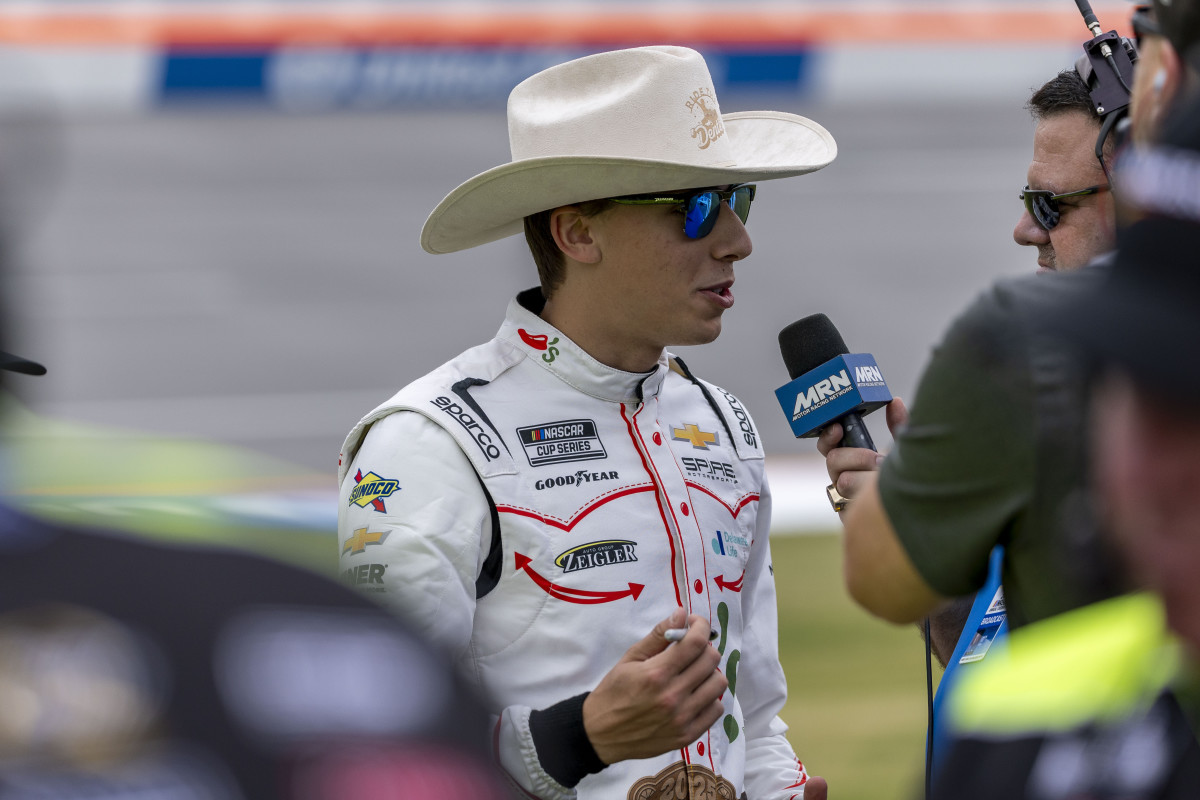
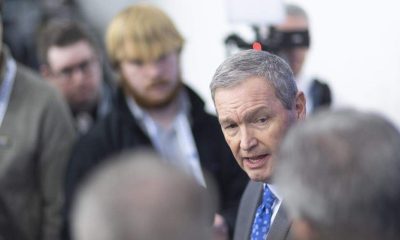
With a time of 28.174 seconds, Carson Hocevar bests the field in Saturday’s qualifying session at Texas Motor Speedway, the first of his NASCAR Cup Series career.
After setting the fastest time in practice earlier in the morning from his 36 laps, Hocevar will lead the field to the green flag in tomorrow’s Würth 400.
Advertisement
Hocevar holds a unique perspective in utilizing sound and visual cues, watching in car cameras and observing other races to learn what he can do in the car and in the moment. He doesn’t downplay the technology side of things with SMT (Sports MEDIA Technology) or ghost cars, but sticks to his strengths to fuel his performance.
Carson Hocevar talks with Motor Racing Network on pit road.Vasha Hunt-Imagn Images
“I guess it just comes from me racing quarter midgets.”
Daytona 500 winner and current championship leader William Byron was second quickest by a hundredth and a half of a second (28.188 seconds) to share the front row with Hocevar.
Last weekend’s winner at Talladega Superspeedway, Austin Cindric, will start third, with Kyle Larson and Hocevar’s Spire Motorsports teammate Michael McDowell round out the top five starting positions.
Advertisement
“We are in a great spot for tomorrow and should have a good pit stall, so I feel good about where we are at for tomorrow,” Cindric shared. “We will try to go get another one.”
Ty Gibbs was the highest qualifying Toyota in sixth. Josh Berry, Denny Hamlin, Bubba Wallace and AJ Allmendinger complete the top 10 spots.
Last year’s winner Chase Elliott qualified 29th.
The green flag is scheduled to wave for Sunday’s Würth 400 at 3:30 p.m. ET, airing on FS1 and over radio on PRN and SiriusXM NASCAR Radio Channel 90.
NASCAR Cup Series Starting Lineup Würth 400 Texas Motor Speedway May 3, 2025
1. 77, Carson Hocevar, Chevrolet, 28.175 sec. (191.659 mph)
Advertisement
2. 24, William Byron, Chevrolet, 28.189 sec. (191.564 mph)
3. 2, Austin Cindric, Ford, 28.195 sec. (191.523 mph)
4. 5, Kyle Larson, Chevrolet, 28.210 sec. (191.421 mph)
5. 71, Michael McDowell, Chevrolet, 28.223 sec. (191.333 mph)
6. 54, Ty Gibbs, Toyota, 28.229 sec. (191.293 mph)
7. 21, Josh Berry, Ford, 28.233 sec. (191.266 mph)
8. 11, Denny Hamlin, Toyota, 28.248 sec. (191.164 mph)
9. 23, Bubba Wallace, Toyota, 28.249 sec. (191.157 mph)
10. 16, AJ Allmendinger, Chevrolet, 28.276 sec. (190.975 mph)
11. 48, Alex Bowman, Chevrolet, 28.284 sec. (190.921 mph)
12. 17, Chris Buescher, Ford, 28.309 sec. (190.752 mph)
Advertisement
13. 38, Zane Smith, Ford, 28.325 sec. (190.644 mph)
14. 43, Erik Jones, Toyota, 28.334 sec. (190.584 mph)
15. 7, Justin Haley, Chevrolet, 28.337 sec. (190.564 mph)
16. 20, Christopher Bell, Toyota, 28.356 sec. (190.436 mph)
17. 45, Tyler Reddick, Toyota, 28.363 sec. (190.389 mph)
18. 4, Noah Gragson, Ford, 28.368 sec. (190.355 mph)
19. 3, Austin Dillon, Chevrolet, 28.381 sec. (190.268 mph)
20. 41, Cole Custer, Ford, 28.438 sec. (189.887 mph)
21. 35, Riley Herbst #, Toyota, 28.447 sec. (189.827 mph)
22. 19, Chase Briscoe, Toyota, 28.449 sec. (189.813 mph)
23. 10, Ty Dillon, Chevrolet, 28.475 sec. (189.640 mph)
Advertisement
24. 12, Ryan Blaney, Ford, 28.512 sec. (189.394 mph)
25. 99, Daniel Suarez, Chevrolet, 28.532 sec. (189.261 mph)
26. 8, Kyle Busch, Chevrolet, 28.541 sec. (189.201 mph)
27. 22, Joey Logano, Ford, 28.545 sec. (189.175 mph)
28. 42, John Hunter Nemechek, Toyota, 28.554 sec. (189.115 mph)
29. 9, Chase Elliott, Chevrolet, 28.588 sec. (188.890 mph)
30. 6, Brad Keselowski, Ford, 28.636 sec. (188.574 mph)
31. 1, Ross Chastain, Chevrolet, 28.658 sec. (188.429 mph)
32. 34, Todd Gilliland, Ford, 28.659 sec. (188.422 mph)
33. 60, Ryan Preece, Ford, 28.696 sec. (188.180 mph)
34. 47, Ricky Stenhouse Jr., Chevrolet, 28.704 sec. (188.127 mph)
Advertisement
35. 62, * Jesse Love(i), Chevrolet, 28.935 sec. (186.625 mph)
36. 51, Cody Ware, Ford, 28.942 sec. (186.580 mph)
37. 88, Shane Van Gisbergen #, Chevrolet, 29.193 sec. (184.976 mph)
38. 66, * Chad Finchum, Ford, 29.833 (181.008 mph)
Related: Connor Zilisch Sidelined with Lower Back Injury After Talladega Crash
There are a few deviations from recent years, but the local race calendar looks to be another strong one at Sebring International Raceway. As usual, much of the early action at the track will come in the form of preseason testing, some of it private team testing and other test days are sanctioned by the corresponding series.
The SSCA has a general test slated for Jan. 8, while the Trans Am Series presented by Pirelli will take over the track Jan. 21-22. IndyCar make its typical stop at Sebring on Feb. 9-10, where the cars test over the raceway’s short course.
The first event for fans will be the quick turnaround for the last major event held at Sebring, Historic Sportscar Racing’s Sebring Pistons & Props Presented by Alan Jay Automotive Network on Feb. 13-15.
The event will again feature a collection of top-notch vintage airplanes and cars for three days of action on and off the track. Tickets will go on sale shortly.
The season-opener for Sebring the past few years, the Trans Am Series, will now be the second event at SIR this season, running Feb. 26-March 1. The Trans Am races will again be run with the Sportscar Vintage Racing Association.
Trans Am will introduce the TA Sprint Championship at Sebring, a new series of five races that are 50 miles or 35 minutes. The series is designed to make it easier for club racers to make the move into a professional series.
“We couldn’t be more thrilled to announce the TA Sprint Championship”, said Trans Am President Andy Lally. “With shorter races and a limited schedule, we believe that TA Sprint will be an exciting opportunity for non-pro club racers who want to experience a professional-level event with live streaming. With TA Sprint holding its own races, it’s a great first step for those who may want to eventually step up into our TA2 Pro/Am Challenge.”
March 18-21 brings the marquee event of the year, the Mobil 1 Twelve Hours of Sebring, one of the top sportscar races in the world. There will be plenty of other racing action, with the IMSA Michelin Pilot Challenge Alan Jay Automotive Network 120, along with the Mustang Challenge, Lamborghini Super Trofeo and Porsche Carrera Cup North America races.
May 8-10 sees the return of SRO Motorsports and GT World Challenge America powered by AWS. The SRO series provide excellent GT racing and the races feature a handful of drivers who will be competing in the 12 Hours of Sebring.
There’s a bit of a lapse before the final big event of the season, the HSR Classic 12 Hour and Sebring Historics, which will feature some of the finest vintage sportscars still racing. The event is slated for Dec. 3-6. The Classic 12 Hour isn’t a 12-hour race, but rather 12 races for four different run groups, with the winner decided by cumulative time.
There will also be two appearances from the ChampCar Endurance Series, World Racing League and a number of club races, including the National Auto Sport Association Championships in September.
Chevrolet revealed its revised NASCAR Cup Series bodywork in November, shortly after Kyle Larson secured his second Cup championship at Phoenix. The updated body draws inspiration from a performance accessories package developed for the street-going version of the car. On track, the Camaro race body will now carry a taller hood dome, a reshaped front grille, and reworked rocker panels.
Chevrolet explained that those elements mirror the Carbon Performance Package Accessories Kit, which features carbon-fiber components on the hood and rockers, along with a new grille and front splitter. The changes have already sparked renewed belief inside the walls of Hendrick Motorsports.
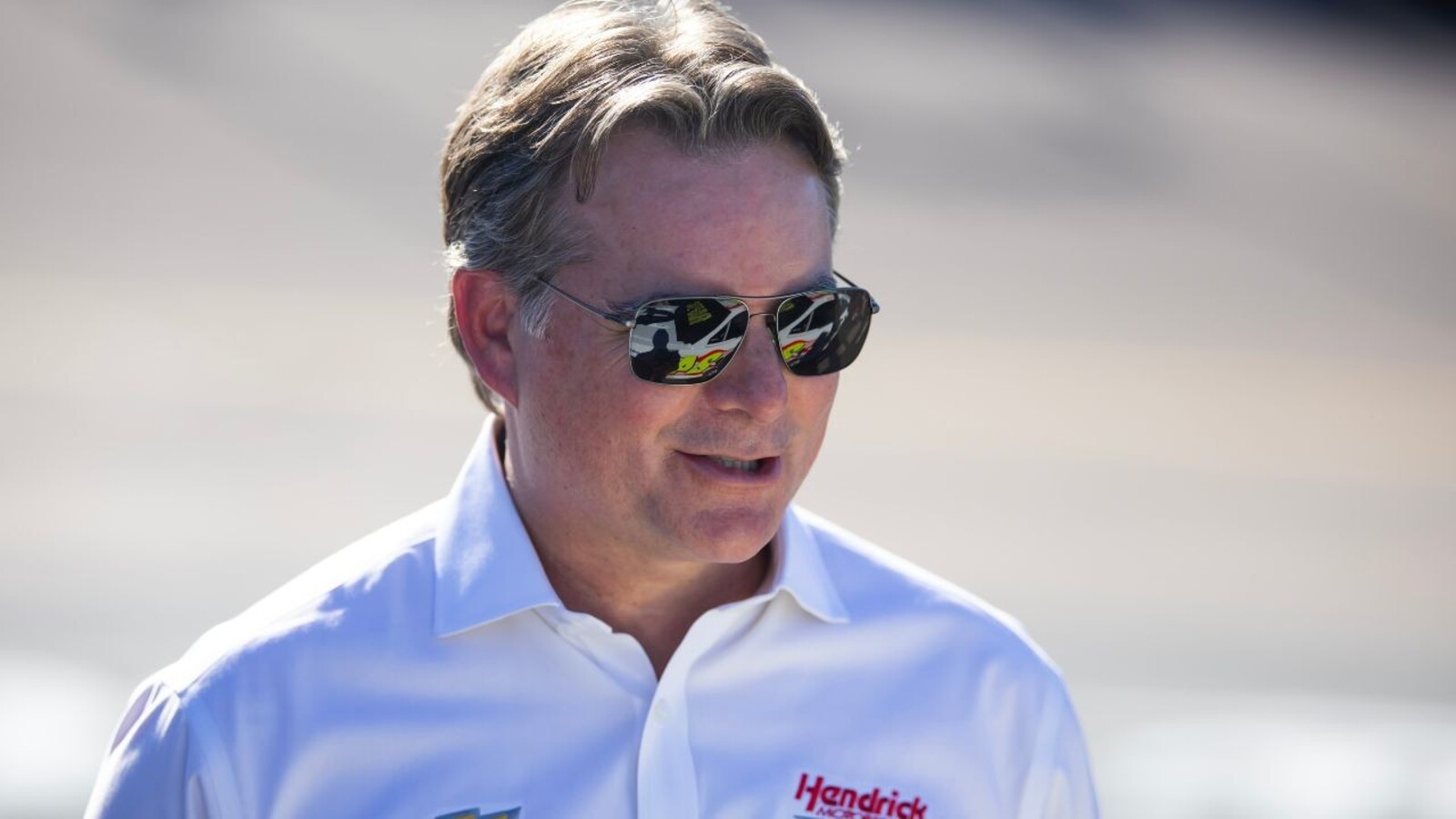
According to Jeff Gordon, the updated Chevrolet Camaro ZL1 could prove transformative when it makes its competitive debut at the season-opening Cook Out Clash exhibition at Bowman Gray Stadium. The new body underwent on-track testing in November, and the early indicators seemingly left the organization encouraged.
“When you’ve done what we’ve done with our car and our teams and one of those things is winning a lot of races and winning a championship, I get really excited when I think we’ve got something that’s an upgrade. I don’t want to get too caught up in that because sometimes, it takes time to fine-tune that change.”
Gordon acknowledged that HMS had been trailing some rivals in aerodynamic efficiency, particularly when comparing HMS Chevrolet entries to competitors. With the revised body now in hand, he believes the gap has closed. “I feel like we’ve gotten ourselves on a level playing field with them, so I’m very excited about that,”he said.
Though the visual changes appear restrained, their purpose runs deeper because the engineers designed the refinements to enhance stability and trim drag, a combination that could sharpen performance as Chevrolet aims to extend its run of five consecutive manufacturer championships. Improved airflow management should translate into greater downforce and a steadier balance at speed.
Chevrolet first introduced the Camaro ZL1 to NASCAR competition in 2018, replacing the outgoing Chevy SS. The body evolved into the Camaro ZL1 1LE in 2020, before transitioning to a Next Gen version when the platform arrived in the Cup Series two years later. On the consumer side, Chevrolet closed the chapter on the passenger-car Camaro after the 2024 model year.
Dale Jr. is skeptical about the new Chevy model
While many teams welcome the update, Dale Earnhardt Jr. finds himself split between anticipation and caution. The JR Motorsports co-owner, who plans another Daytona 500 entry in 2026, admitted the announcement unsettled him. His unease does not stem from budget or preparation but from the uncertainty that accompanies a brand-new body.
From a financial perspective, Junior views the timing as favorable, offering a chance to compete without bleeding resources. Still, the unknowns are haunting. He noted that when manufacturers roll out a new body, early returns at Daytona rarely come easily. Teams must first learn how that shape behaves in race trim, and without inside knowledge of the finer details, he said he will have to take the results as they come.
History also supports his concern. Fresh body designs often force teams into an early-season learning curve, deciphering aerodynamic traits under pressure. The task extends beyond power or mechanical grip, demanding balance where airflow and stability intersect. Manufacturers also tend to prioritize intermediate tracks when refining new bodies, a reality that explains Junior’s apprehension heading into superspeedway competition.
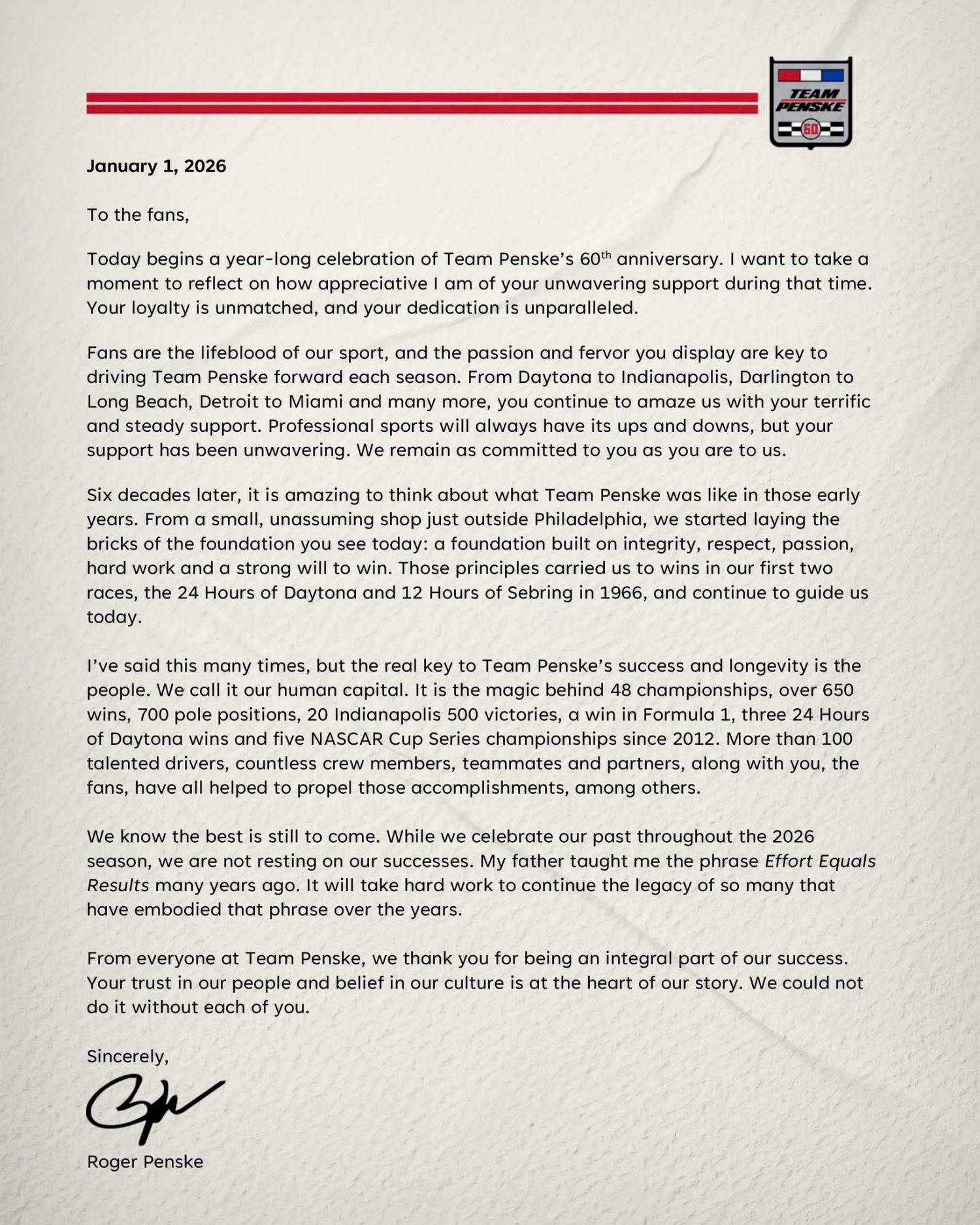
On January 1, 2026, Roger Penske, the legendary founder of one of motorsport’s most enduring empires, released a deeply personal open letter to fans, marking the start of a year-long celebration of Team Penske’s 60th anniversary.
–by Mark Cipolloni–
The letter, penned in Penske’s characteristic straightforward and grateful tone, reflects on humble beginnings, unwavering fan support, and a commitment to future success—reminding everyone why “The Captain” has built a legacy that spans generations.
What began in 1966 as a modest operation in a small shop just outside Philadelphia has evolved into a powerhouse with over 650 major race wins, more than 700 pole positions, and 48 championships across IndyCar, NASCAR, IMSA, and beyond. Penske vividly recalls those early days: victories in the team’s first two outings—the 24 Hours of Daytona and 12 Hours of Sebring—set the stage for decades of dominance, all grounded in core values of integrity, respect, passion, hard work, and an unrelenting will to win.
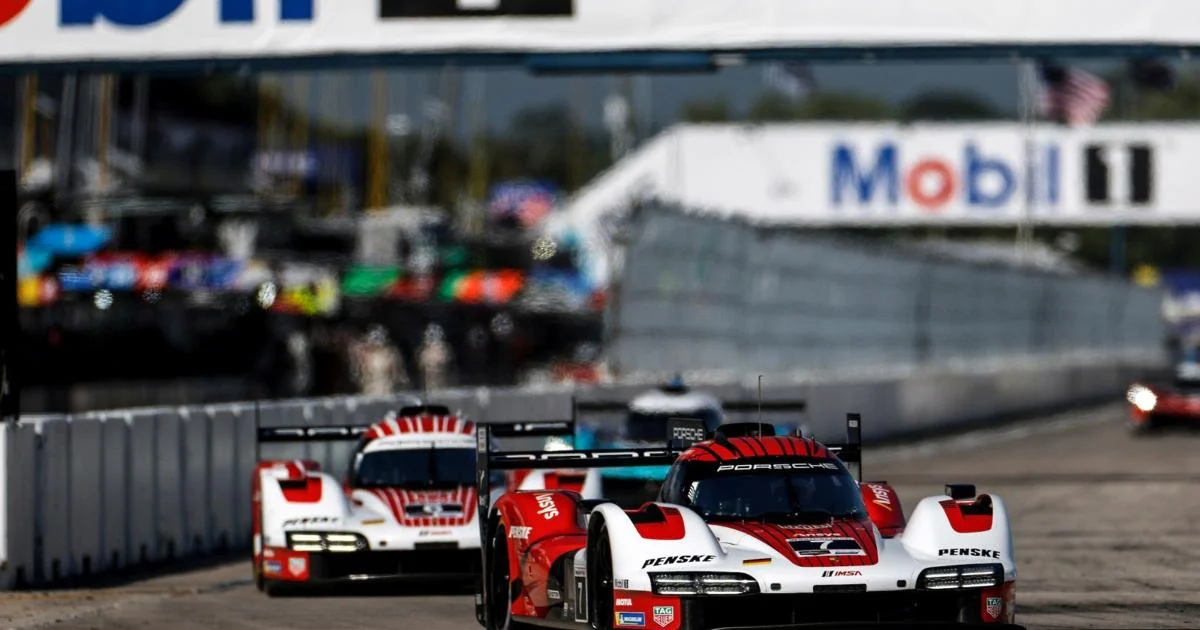
Yet, amid recounting milestones like 20 Indianapolis 500 triumphs, five NASCAR Cup Series titles, three Daytona 500 wins, and recent back-to-back GTP championships with Porsche Penske Motorsport, Penske reserves his warmest words for the fans. “Your loyalty is unmatched, and your dedication is unparalleled,” he writes, calling supporters the “lifeblood” of the sport whose passion fuels the team through highs and lows.
He also emphasizes the human element—”our human capital”—crediting countless drivers, crew members, partners, and fans for the organization’s longevity. A poignant nod to his father introduces the guiding mantra: “Effort Equals Results,” a principle Penske vows will drive the team forward as they honor the past without resting on it.
The 2026 season promises to be unforgettable, with celebrations including retro paint schemes across entries in multiple series, a refreshed 60th anniversary logo on cars, uniforms, and merchandise, an elevated Team Penske Hall of Fame program, and a special Fan Day offering behind-the-scenes access and driver meet-and-greets.
Highlights include dedicated exhibits showcasing historic cars, trophies, and rare artifacts at the NASCAR Hall of Fame in Charlotte, the Indianapolis Motor Speedway Museum, and the Penske Racing Museum in Scottsdale.
Iconic victories like these will be relived throughout the year.
As Penske signs off with sincere thanks, he affirms: “We know the best is still to come.” For a team that has defined excellence in American motorsport for six decades, 2026 isn’t just a milestone—it’s a launchpad for the next chapter. Fans are invited to join the journey using #Penske60.
CONCORD, NC, UNITED STATES, January 2, 2026 /EINPresswire.com/ — Wheelhouse Motorsports today announced a new strategic partnership with Robert Noaker Racing (RNR), uniting two leading organizations known for their development of competitive Mustang racing programs. The collaboration brings together RNR’s championship-winning expertise with Wheelhouse’s operational strength, deep technical resources, and nationally recognized driver development capabilities.
Robert Noaker Racing enters the partnership following back-to-back Team and Driver Championships in 2024 and 2025, including a flawless 2025 Mustang Challenge season in which the Noaker-prepared car led every lap of every race. Wheelhouse Motorsports will integrate this proven technical knowledge with its own established infrastructure, including its GT4 Mustang program competing in the World Racing League (WRL).
Operations will be based at the Wheelhouse Motorsports facility located on the campus of Charlotte Motor Speedway. The Wheelhouse team, including the manager, engineering staff, and technical crew, brings over 100 years of combined motorsports experience to the program. At the track, competitors will also recognize familiar faces, as the RNR crew, led by Bob Noaker, will collaborate with Wheelhouse personnel to support all Mustang Challenge efforts.
“As we continue to expand Wheelhouse Motorsports, this partnership represents a significant step forward,” said Dan McKeever, owner of Wheelhouse Motorsports. “Robert Noaker Racing has demonstrated exceptional proficiency in the Mustang Dark Horse R platform, and by combining that expertise with our operational systems and our long-standing commitment to driver development, we are well-positioned to deliver a next-level experience for our customers and competitors.”
The alliance leverages Wheelhouse’s roots in operating the Ford Performance Racing School, the nation’s premier performance driving school since 2006. The organization operates owner-experience programs for Ford and offers 1-day, 2-day, and Advanced high-performance driving courses, giving clients access to top-tier coaching and continuous development. Integrating this expertise with RNR’s race-winning preparation provides a comprehensive solution for drivers seeking a pathway into professional competition.
“This partnership allows both of our organizations to do what we do best,” said Robert Noaker, owner of Robert Noaker Racing. “Wheelhouse brings unmatched operational depth, driver training, and a world-class facility. When we combine that with the experience our team has developed running and winning with the Dark Horse R, we create a program built to elevate any driver who wants to compete at a higher level.”
Through this partnership, drivers have the following opportunities:
– Lease a Mustang Dark Horse R for the entire 2026 Mustang Challenge season.
– Contract Wheelhouse/RNR to maintain and operate their own cars.
– Compete with Wheelhouse Motorsports in the WRL series, piloting a GTO-class Mustang GT4.
Wheelhouse Motorsports and Robert Noaker Racing look forward to delivering a comprehensive, competitive, and professionally supported environment for drivers seeking championship-caliber performance in 2026 and beyond.
Bill Johnson Wheelhouse +1 910-658-1447 email us here
Legal Disclaimer:
EIN Presswire provides this news content “as is” without warranty of any kind. We do not accept any responsibility or liability
for the accuracy, content, images, videos, licenses, completeness, legality, or reliability of the information contained in this
article. If you have any complaints or copyright issues related to this article, kindly contact the author above.
In the high-octane world of NASCAR, where sponsorships can make or break a team’s fortunes, Roush Fenway Keselowski Racing (RFK) finds itself navigating uncertain terrain at the dawn of 2026. The team, co-owned by six-time Cup Series winner Brad Keselowski, had long relied on the steady backing of Castrol, the iconic motor oil brand that powered their engines and adorned their cars since 2019. But as the new year unfolded, whispers of doubt swirled around their partnership, triggered by a massive ownership shakeup at Castrol’s parent company, BP.
–by Mark Cipolloni–
It all started on Christmas Eve 2025, when BP announced it was offloading a 65% majority stake in Castrol to Stonepeak, a New York-based investment firm, in a deal valued at around $6 billion—pushing Castrol’s total enterprise value to a staggering $10.1 billion. BP, grappling with a hefty $26.1 billion in net debt, saw the move as a lifeline, part of a broader $20 billion divestment strategy to slim down and strengthen its balance sheet.
Carol Howle, BP’s interim CEO, hailed the transaction: “We concluded a thorough strategic review of Castrol, which generated extensive interest and resulted in the sale of a majority interest to Stonepeak.” While BP retained a 35% minority share, control would shift to Stonepeak once the deal closed in about a year, transforming Castrol into a joint venture.
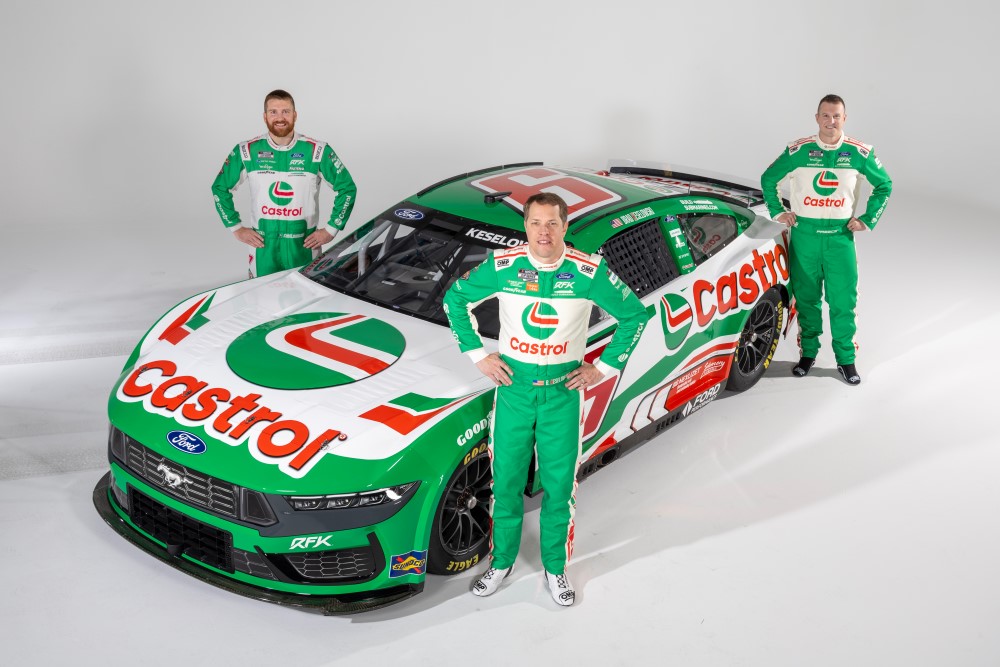
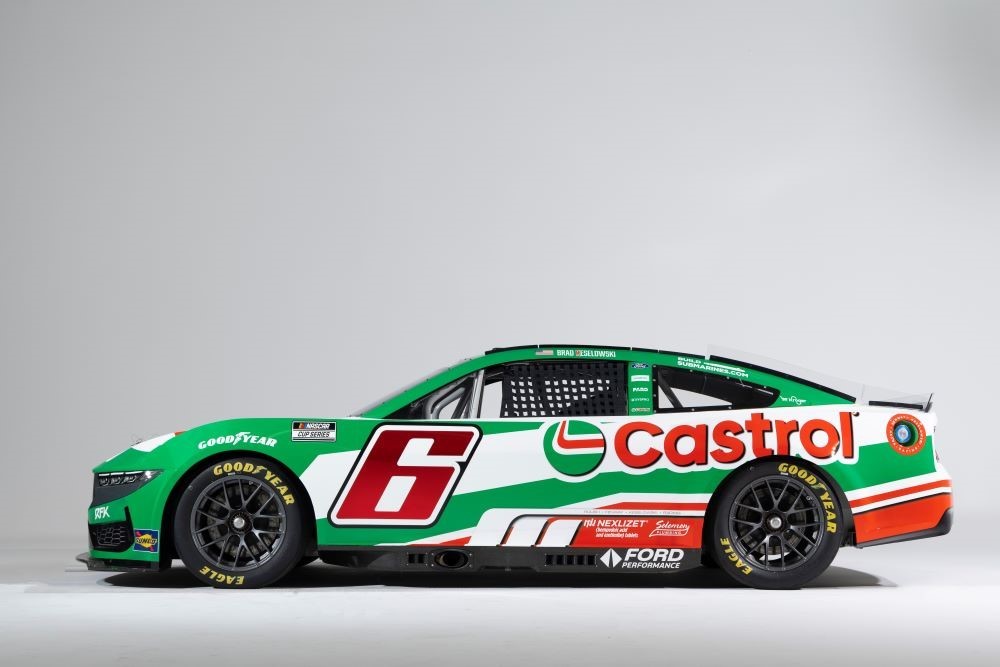
For RFK Racing, the news hit like a sudden caution flag. Castrol had been more than just a sponsor; it was a cornerstone of the team’s three-car operation—the No. 6 Ford driven by Keselowski, the No. 17 helmed by Chris Buescher, and the No. 60 piloted by newcomer Ryan Preece.
Brad Keselowski livery. Photo Supplied
Over six seasons, the partnership had fueled six Cup Series victories, including Keselowski’s triumphant throwback scheme win at Darlington in 2024, and supported consistent playoff runs. Andreas Osbar, CEO of Castrol Americas, reflected on the collaboration’s success: “RFK has been at the forefront of innovation, testing and winning races with our Castrol MoreCircular engine oils since 2022. Putting our products to the test in extreme racing conditions has been critical.”
Yet, the ownership pivot cast a shadow over the future. The current agreement locked in Castrol’s support through the 2026 season, providing RFK with a buffer to revamp and chase victories after a winless 2025 campaign that left them hungry for redemption. But come 2027, when Stonepeak fully assumes the reins, the commitments would expire, forcing RFK to negotiate anew with the investment firm’s leadership.
Insiders noted that without strong on-track results—like a long-elusive Daytona 500 win for the recovering Keselowski, who vowed not to miss the iconic race despite a recent injury—the new owners might balk at renewing, potentially seeking fresher alliances elsewhere.
RFK president Steve Newmark had previously underscored Castrol’s value: “For years now, Castrol has been an integral part of our success both on and off the track. From product superiority to collaborations around sustainability… Castrol has ensured we operate at peak performance.”
As the team geared up for the 2026 opener, bolstered by other sponsors like Kroger and Fastenal, the uncertainty loomed like storm clouds over Daytona. Would Stonepeak see the same synergy that BP had nurtured, or would RFK need to scout new partners to keep their engines roaring? In NASCAR’s relentless pursuit of speed and stability, only time—and perhaps a few checkered flags—would tell.
RFK Racing faces a critical juncture as it navigates potential changes in its long-standing sponsorship with Castrol, following BP’s major ownership shakeup of the oil brand. The partnership, crucial for team operations since 2019, is now under threat as Castrol transitions to new ownership with Stonepeak Investments. While RFK is secure through the 2026 season, outlooks for future agreements remain uncertain, contingent on performance and new leadership priorities.
By the Numbers
Castrol’s parent company BP sold a 65% stake for approximately $6 billion.
RFK Racing secured six Cup Series victories during its partnership with Castrol, including one in 2024.
Yes, But
Despite Castrol’s historical support, RFK’s future negotiations could be challenged without strong performances on the track. The new ownership may seek different sponsorships if the team’s results do not align with their business strategy.
State of Play
The partnership with Castrol is secured through the 2026 season, but expiration looms in 2027.
RFK has other sponsors like Kroger and Fastenal, providing some financial stability amidst uncertainties.
What’s Next
As RFK races into the 2026 season, their success or failure in upcoming events could critically influence negotiations with Stonepeak. A strong showing could retain Castrol, while a lackluster performance might force the team to seek alternative partnerships.
Bottom Line
RFK Racing must capitalize on the 2026 season to establish a robust case for continued support from Castrol’s new owners and ensure stability in sponsorships to remain competitive in NASCAR.