Connect with us
https://yoursportsnation.com/wp-content/uploads/2025/07/call-to-1.png

NIL

Contracts? Buyouts? Study at 1 school, play for another? Ambitious pitches to revamp college sports | Sports

Published

on


Oregon State basketball

Courtesy: MGN


As the amateur model of college athletics disintegrates, a handful of unusual ideas have been floated as ways to reign in some of the chaos surrounding the explosion in name, image and likeness compensation and a transfer portal that sees thousands of athletes changing schools every season.

Whether any of the ideas end up being implemented is unknown and every school is awaiting a decision from a federal judge on whether a $2.8 billion antitrust settlement against the NCAA and the five largest conferences will take effect as early as July 1. If it does, that opens the floodgates for schools to share millions in revenue directly with their athletes amid a host of other changes.

Here is a look at some of the topics:

Athlete contracts

A formal agreement between an athlete and a school is not a new concept, but with the uptick of NIL deals the thought of pro-style contracts is becoming increasingly more common.

There are plenty of ways to get creative with contracts. Rich Stankewicz, operations director for Penn State’s NIL collective Happy Valley United, said he favors an incentive-based approach — essentially adding money for athletes who not only perform but stick around.

“I personally really like the idea of incentivizing performance in school, those kinds of things that would only be occurring in the season while they’re playing,” Stankewicz said. “If more money is paid out in those time frames, then that gives the incentive for the player to stay and see those dollars from their contract, rather than potentially collect up front and then decide the grass is greener somewhere else three months later, barely doing any school, you know, without playing at all.”

Transfers and buyouts

This topic is red hot at the moment. Entering the transfer portal comes with the risk of not landing in a better spot — or any spot — but athletes have shown every single season over the past few years that they are comfortable going anyway. Athletic departments are beginning to fight back.

Arkansas athletic director Hunter Yurachek recently encouraged the school’s NIL collective to pursue legal action after quarterback Madden Iamaleava departed for UCLA after just five months in Fayetteville. Iamaleava allegedly collected significant money upfront and cited homesickness as his reason for following his brother to California.

This is a scenario Penn State hopes to avoid. And the importance of contract details is clear.

“Commonly, there’s nothing binding students in certain instances to the institution they’re with for the entirety of the contract,” Stankewicz said. “We’ve definitely looked into having measures in place to discourage transfers during the time of the contract. There are a bunch of different ways to do that, from buyouts to how you load the contract.”

Athletes as employees

Groundbreaking shifts in the landscape have sparked conversations about athletes becoming official employees of their universities.

It’s a controversial subject to say the least. Universities would become responsible for paying wages, benefits, and workers’ compensation and schools and conferences have insisted they will fight any such move in court (some already have).

Complexities go beyond the concept. While private institutions fall under the National Labor Relations Board, public universities must follow labor laws that vary from state to state and it’s worth noting that virtually every state in the South has “right to work” laws that present challenges for unions.

There is also a new administration in power now, said Michael LeRoy, a labor and employment professor at Illinois who has studied the NCAA and athlete rights.

“With the election of Donald Trump, and what that would mean for a new National Labor Relations Board, what that would mean for repopulating the courts with judges who are likely not congenial to that view, I no longer have much hope that we’ll get a ruling in the next 5-10 years that these are employees,” LeRoy said.

Despite the lack of employment status, LeRoy said, athletes should advocate for themselves and use the entertainment industry as a model. He said athletes currently are offered “take-it-or-leave-it” NIL contracts when a broader approach might have benefits.

“I think athletes should start to look at Hollywood and Broadway contracting arrangements that deal with publicity rights,” he said. “I think there’s a way to frame this collectively. The framework of collective bargaining and employment, I would say, the entertainment industry generally offers a blueprint for success.”

Playing for another school

Things are so chaotic right now that the very lines of who an athlete is playing for could get blurred.

Saying he was inspired by the NBA’s G League, University of Albany basketball coach Dwayne Killings is proposing a two-way contract for college players. Albany would welcome transfers from top-tier programs who need more seasoning and help them develop — with plenty of game time vs. sitting on the bench — before sending them back to their original program, where they’d be ready to compete.

“The best development happens on the floor, not necessarily on the scout team, given the new 15-man scholarship limits,” Killings told CBS Sports.

And then there is Division III, which recently approved an unusual pilot program: Athletes would play for one school but do their coursework at another school that does not sponsor varsity athletics.

The NCAA said the program, which would run during the next academic year, “will offer expanded pathways for student-athletes to pursue their academic objectives and complete their participation opportunity.”

“This program intends to address the changing, dynamic higher education environment we find ourselves in right now,” said Jim Troha, president of Juniata and chairman of the DIII President’s Council. “It recognizes existing academic programs and provides flexibility to expand participation opportunities for student-athletes.”

The program will be assessed before any decisions on whether to make it permanent or expand it.


AP college sports: https://apnews.com/hub/college-sports



Link

Continue Reading
Click to comment

Leave a Reply

Your email address will not be published. Required fields are marked *

NIL

No. 1 transfer portal quarterback predicted to join major college football program

Published

on


The NCAA transfer portal will feature hundreds of players across all levels of college football in the 2026 offseason.

Prominent quarterbacks have begun to declare their intent to enter the transfer portal in the weeks before it opens. DJ Lagway, Josh Hoover, Rocco Becht and Dylan Raiola are among the Power Four quarterbacks who will be at a new school in 2026.

One of the first Power Four quarterbacks that decided to enter the transfer portal was Arizona State quarterback Sam Leavitt. He will have two seasons of eligibility at his next school.

One program linked to Leavitt when he enters the portal is Oregon. Leavitt is from West Linn, Oregon, just south of Portland and an hour and a half drive from Eugene by interstate highway.

Oregon has not started a quarterback that it recruited from high school for an entire season since Justin Herbert in 2019. Bo Nix, Dillon Gabriel and Dante Moore (transferred back) all came to the Ducks via the transfer portal.

The 6-foot-2, 205-pounder began his college football career at Michigan State in 2023. He played in a maximum of four games to keep his redshirt for the Spartans, passing for 139 yards, two touchdowns and two interceptions on 15-of-23 passing.

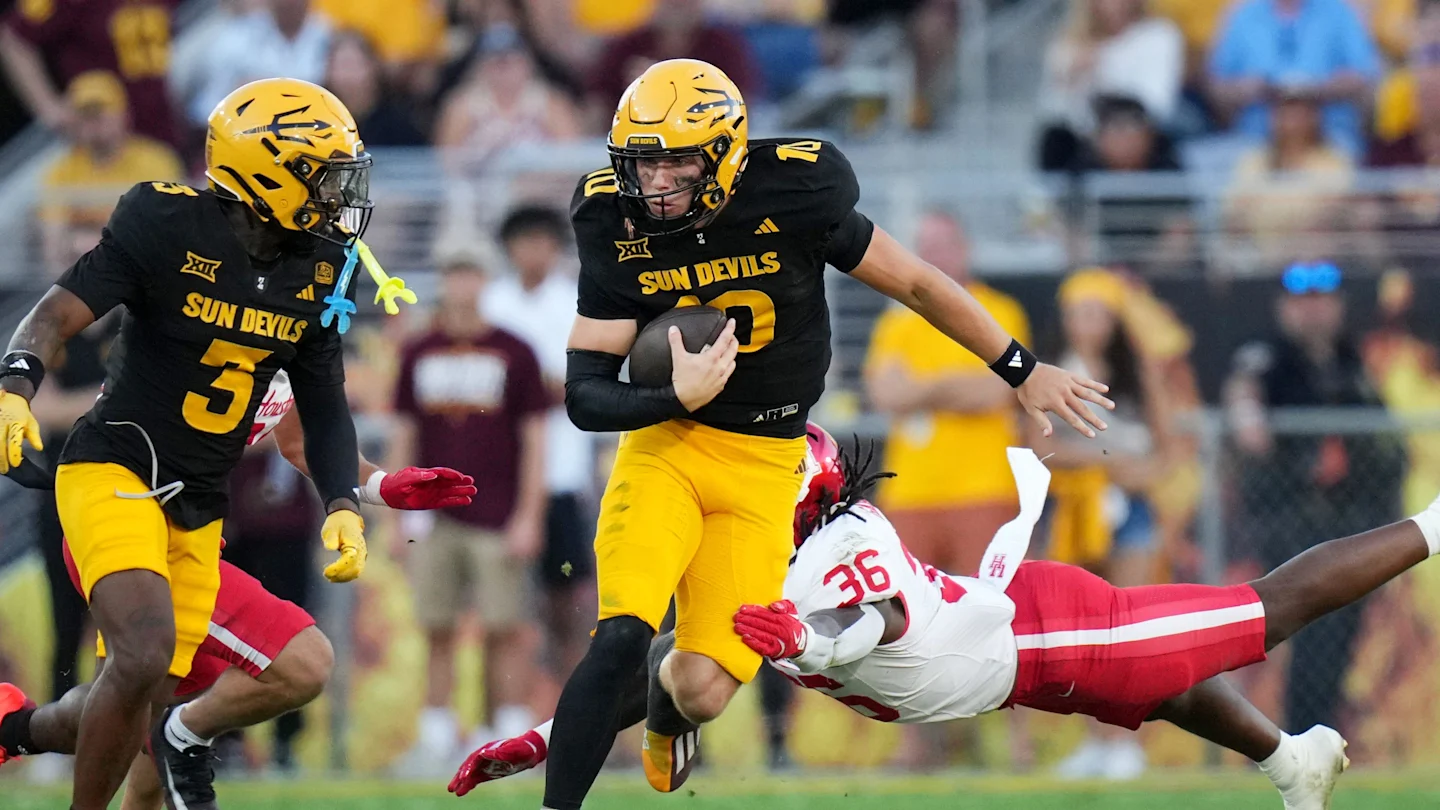
Sam Leavitt throws the ball in Arizona State's game against Houston.

Arizona State Sun Devils quarterback Sam Leavitt (10) | Mark J. Rebilas-Imagn Images

Leavitt transferred to Arizona State in the 2024 offseason. He started every game for the Sun Devils while accumulating 2,885 passing yards, 24 touchdowns and six interceptions while rushing for 443 yards and five touchdowns en route to their Big 12 Championship victory and subsequent College Football Playoff appearance.

The Big 12 named Leavitt its Freshman of the Year and Second-Team All-Big 12 for his heroics. The conference also named him as its Newcomer of the Week on multiple occasions. He finished 2024 with the most passing yards by a freshman in a season in Arizona State history.

Leavitt’s 2025 season was cut to just seven games due to injuries. He passed for 1,626 yards, 10 touchdowns and three interceptions while rushing for 306 yards and five touchdowns.

The Sun Devils will not start Leavitt in their bowl as he has declared his intent to leave. Arizona State (8-4, 6-3) will face ACC champion Duke (8-5, 6-2) in the Tony the Tiger Sun Bowl in El Paso, Texas on Dec. 31 (3 p.m. EST, CBS).

The NCAA transfer portal will officially open for all college football players looking for new destinations on Jan. 2, 2026. The portal will stay open until Jan. 16, 2026.


Link

Continue Reading

NIL

This college football team is creatively approaching NIL like NFL free agency

Published

on


The way college football operates in the NIL/revenue-sharing era has moved a lot closer to the NFL model, and one high-profile program is acknowledging that in a very public way.

USC has been announcing on social media that players have “re-signed” with the program, essentially acknowledging that all college football players are free agents each year now, thanks to the transfer portal and the ability to chase better compensation elsewhere.

A big one for the Trojans this week was quarterback Jayden Maiava’s decision to return to USC rather than pursue the NFL draft this year or a bigger payday from another school, but USC has publicized the return of more than two dozen players in this way — from starters to little-used freshmen and even its kicker.

Coach Lincoln Riley was asked about this new approach for his program.

“I think that’s something that should be celebrated. In this day and age, it’s almost more like an NFL team. Like, it’s an accomplishment to be welcomed back, and then on top of that, when you do have that option, it’s something that should be celebrated by a school or a program that somebody wants to continue on what’s being built or what they’ve already started at that place,” Riley said.

“… It’s changed so much on all accounts. It’s changed a lot for the players. It’s obviously changed a lot for us.”

USC overhauled its player personnel/recruiting department a year ago by hiring general manager Chad Bowden away from Notre Dame and building a new staff for him. Bowden has a reputation for thinking outside the box, so this was likely an idea that he and his staff came up with for the Trojans.

College football analyst Adam Breneman chimed in with his thoughts on USC’s “creative” approach to roster management.

“To me, USC has always been known for creativity. They’re in Los Angeles, the creative capital of the world, that’s where great things happen, and a great job here by USC’s creative department, having this idea. I think we’ll see teams around the country copy this, announcing the re-signing of players to new contracts for the upcoming season with NIL and rev-share deals,” Breneman said.

“Chad Bowden, the USC general manager, is ahead of his time. He’s innovative, he thinks forward, he’s proactive, and his staff clearly has something here, really great with announcing the re-signing of the roster at USC. What a great idea.”

USC may have indeed started something with this, as Missouri announced the return of star running back Ahmad Hardy in the same way.


Link

Continue Reading

NIL

College Football Playoff is here, but sport’s soul is gone

Published

on


Amid the spectacle of the College Football Playoff’s opening weekend — and the nagging sense that we’re watching a sport we no longer love — here’s the uncomfortable question no one in power seems eager to answer:

Is college football slowly turning off the very fans who built it?

The other day on our radio show, we asked a simple poll question: “What’s your excitement level for this year’s College Football Playoff?” The result wasn’t close. The runaway winner was: “Mild at best.”

No, it wasn’t a scientific poll by any means. But it was taken in a college-football-crazed state, in a city that hosts three bowl games, from listeners who have spent decades scheduling fall Saturdays around kickoff times. These are not casuals. These are the lifers.

And they sound tired.

College football has always thrived on passion — irrational, inherited passion. We fell in love with this sport because we were loyal to our hometown or home-state schools. Because our dads and moms went there. Because our grandparents wore the colors. Because even when our teams were bad, they were ours. We believed players loved our schools the way we did. We believed coaches were stewards of something bigger than themselves.

That belief is gone.

What we’re left with now is a sport that feels increasingly transactional, untethered from its own history, and openly hostile to the idea of loyalty. The transfer portal and NIL didn’t just change college football — they rebranded it. Players are no longer student-athletes growing into men within a program; they’re year-to-year contractors shopping their services to the highest bidder. And coaches are no longer culture builders; they’re free agents with obscene contracts and super-agents who are already negotiating new deals with new teams by midseason.

Lane Kiffin didn’t even wait for the College Football Playoff selection committee to put his Ole Miss team in the 12-team field before bolting for his next big job. Think about it: the head coaches from three CFP teams will be elsewhere next season, meaning in the most important tournament in the sport that a quarter of its leaders already had one foot out the door before the playoff even started.

That’s not continuity. That’s chaos.

And the collateral damage is everywhere. Bowl games — once the measuring stick of success — are now disposable. This year alone, Notre Dame opted out because it got snubbed by the CFP committee while Kansas State and Iowa State opted out because they lost their coaches. Bowls used to mean something. They were a reward, a destination, a final chapter. Now they’re an inconvenience.

Missouri coach Eli Drinkwitz didn’t mince words when he said earlier this week: “College football is sick.” He warned that the sport is “cracking” — not metaphorically, but structurally. Rules without consequences. Participation agreements nobody honors. Tampering without punishment. Freedom without guardrails.

UCF coach Scott Frost went even further. He said the quiet part out loud: “It’s broken.” And for that honesty, he was attacked. Not because he was wrong — but because he threatened those who benefit from the disorder. Frost described a world where participation agreements are ceremonial, salary caps are fiction and booster money determines competitive balance more than coaching or development ever could.

That’s not college football. That’s the NFL without contracts, unions or rules.

Minnesota coach P.J. Fleck summed it up best: “College football does not have any of what the NFL has in place. … I don’t think the general public actually knows what it looks like when you peel back the onion.”

And that’s the point. Fans (and coaches) are finally peeling it back — and they don’t like what they see.

Conferences now stretch from coast to coast, stripping the sport of its regional soul. Rivalries that once defined generations are disappearing in favor of television windows. Which brings us to a fair question for UCF fans: With USF no longer on your schedule, who’s your big rival? Answer: You don’t have one.

A sense of place used to matter in college football. Geography mattered. Identity mattered. Tradition mattered. Now everything is optimized for TV inventory and gambling markets.

Don’t get me wrong, college football is still idiot-proof. It will march on. ESPN needs the programming. Sportsbooks need the content. Saturdays will still be filled with games, spreads and parlays. The machine will not stop.

But what happens when the true fans — the ones who stayed and cheered through the losing seasons, NCAA sanctions and decades of irrelevance — start checking out emotionally? When excitement becomes obligation? When loyalty feels foolish?

We’re already seeing the signs. Fans less invested in bowls. Fans less connected to rosters that turn over annually. Fans who no longer recognize their own conferences. Fans who watch out of habit, not hope.

This isn’t about opposing player compensation. Players deserve to be paid. It’s not about nostalgia for unpaid labor or closed systems. It’s about structure, fairness and meaning. A sport without rules isn’t freedom — it’s anarchy. And anarchy is exhausting.

College football was never supposed to be perfect. It was supposed to be personal. It was supposed to mean something beyond the scoreboard. It was supposed to connect campuses, communities and generations.

Right now, it feels like a sport in disarray where even coaches and administrators are just  hopeless spectators to its unraveling. It’s so bad that they are begging the federal government to get involved. Can you name another multi-billion-dollar business that actively seeks governmental regulation?

The scariest part isn’t that coaches like Frost and Drinkwitz are speaking up.

It’s that we longtime fans are starting to quietly nod along and wonder why we’re still watching.

Yes, the College Football Playoff arrived this weekend and it’s never been bigger.

But, sadly, the sport itself has never felt emptier.

Email me at mbianchi@orlandosentinel.com. Hit me up on social media @BianchiWrites and listen to my new radio show “Game On” every weekday from 3 to 6 p.m. on FM 96.9, AM 740 and 969TheGame.com/listen


Link

Continue Reading

NIL

$2.1 million transfer portal QB predicted to join College Football Playoff team

Published

on


Aftter helping propel Arizona State to its first College Football Playoff run in 2024, quarterback Sam Leavitt is officially preparing to test the transfer market.

Multiple outlets report Leavitt intends to enter the portal when the window opens in January, and early lists of suitors already include Oregon, Indiana, LSU, and Miami. 

Leavitt’s 2025 season was cut short by a persistent foot injury that required surgery and ended his year after seven appearances.

Despite limited time, he finished the campaign with 1,628 passing yards, 10 touchdowns and three interceptions, and leaves Tempe with a two-year body of work that includes a 2024 breakout season (2,885 passing yards, 443 rushing yards, 29 total TDs).

ASU closed 2025 at 8–4 under coach Kenny Dillingham, going 6-3 in Big 12 play.

On Wednesday, Mike Golic Jr. weighed in on potential transfer portal destinations, explicitly linking Leavitt to Miami as a natural schematic fit.

“Sam Leavitt, to me, would be a fascinating fit at the University of Miami. We reckon Carson Beck is going to be out after this playoff run, and when I look at Sam Leavitt’s game, I think about the Miami offense they ran with Cam Ward, an offense predicated on the quarterback’s ability to drop back, create, and make plays with both his arm and his legs. That feels like a very easy comparison.”

Arizona State Sun Devils quarterback Sam Leavitt.

Tempe, Arizona, USA; Arizona State Sun Devils quarterback Sam Leavitt (10) against the Houston Cougars in the second half at Mountain America Stadium. | Mark J. Rebilas-Imagn Images

The Hurricanes went 10-2 this season and enter the postseason with a quarterback (Beck) who posted 3,072 passing yards and 25 passing touchdowns with a 74.7% completion rate.

However, despite Beck’s productive year as the starter and Miami’s CFP berth, the senior quarterback is widely expected to move on after the season, opening a potential vacancy at one of college football’s biggest brands.

Leavitt combines a CFP start, redshirt-sophomore eligibility, mobility, and a nationally ranked NIL valuation (estimated at $2.1 million), positioning him as one of the portal’s most attractive quarterbacks.

Read More at College Football HQ

  • $2.1 million QB ranked as top quarterback in college football transfer portal

  • $87 million college football coach predicted to accept Michigan head coaching job

  • Top transfer portal QB reportedly receives ‘multiple offers’ over $4 million

  • Kirby Smart sends strong message on Nick Saban before College Football Playoff


Link

Continue Reading

NIL

ESPN’s Pete Thamel: ‘Tip-top’ of transfer portal quarterback market could reach $5 million

Published

on


Although the transfer portal doesn’t open until Jan. 2, the quarterback market is starting to take shape. Multiple high-profile signal-callers announced their plans to hit the portal, and ESPN’s Pete Thamel reported how much the top QBs could make.

Thamel reported the “tip-top” of the quarterback market could reach $5 million. For comparison, Duke quarterback Darian Mensah was one of the highest-paid players in the country this past season at $4 million, On3’s Pete Nakos previously reported.

SUBSCRIBE to the On3 NIL and Sports Business Newsletter

Multiple big-name schools are expected to be looking for a quarterback in the portal this year, and names such as Brendan Sorsby, Dylan Raiola and Josh Hoover are already front-and-center. As a result, the market could surge, Thamel said.

“This market looks robust already, guys. … I made some calls today. Sources told me the tip-top of this quarterback market, financially, could reach $5 million for one season,” Thamel said Friday on ESPN College GameDay. “Look, it’s supply and demand. You have all those guys. Sorsby’s been linked early to Texas Tech. Dylan Raiola, there’s some smoke to Louisville, although maybe a playoff team jumps in late there. There’s been early links between Indiana and Hoover, assuming that [Fernando] Mendoza goes pro.

“Look, this is what’s going to drive the market. Oregon may lose Dante Moore, Miami’ll be in the quarterback market, so will LSU. So when you really take a look at what’s going to drive this quarterback market, it’s going to be the most expensive in the history of college football.”

Quarterback remains one of the biggest positions in the transfer portal, especially considering the recent success. Seven of the last nine Heisman Trophy winners have been transfers, including Mendoza this year. DeVonta Smith and Bryce Young are the only ones to stay with their own program at Alabama and win the award during that time.

Last year’s transfer quarterbacks were also among the highest-paid players in college football, On3 previously reported. Mensah’s $4 million payday was part of a two-year, $8 million deal at Duke. At Miami, Carson Beck inked a deal worth between $3 and $3.2 million, but up to $6 million with incentives.

The NCAA transfer portal window officially opens Jan. 2, meaning that’s when players’ names will start to appear. It will stay open for two weeks, closing Jan. 16.


Link

Continue Reading

NIL

College football team set to be without nearly 20 players for upcoming bowl game

Published

on


The perception of bowl games and their significance to college football programs and players has undergone a rapid shift over the last decade.

In the current age of the sport, teams are turning down postseason bids while the transfer portal is filling up before most bowl games even kick off.

That’s just the reality of the situation. Normally, it’s the needy who are hit the hardest as G6 schools and poorly constructed FBS programs have their rosters raided.

Just take a look at what’s happening at UTSA.

UTSA’s Jeff Traylor: ‘I Hate What’s Going On In College Football’

Since transitioning to the FBS over a decade ago, UTSA has established itself in the Conference USA and the American Conference.

Head coach Jeff Traylor has led the program to six consecutive bowl games. That includes an up-and-down campaign in 2025, when the Roadrunners started 0-2 and won two of their final three games to finish 6-6.

UTSA is a week away from taking on FIU in the First Responder Bowl on December 26.

Going into the matchup, the Roadrunners could be without as many as 20 players. Many of those losses are due to the portal.

“We’ll be a shell of ourselves, but whoever we got out there, we’re going to go out there and play the best we can,” Traylor said, according to KENS 5’s Vinnie Vinzetta. “It’s just the numbers are so big with all the tampering. All the agents, it’s coaches too, it’s all of them. Our kids are being promised such incredible numbers, they’re getting lured into the portal.

“I just hope all the things those coaches and agents are promising they’re going to do for my kids. I hate it because I really want to coach them in a bowl game, but they’re getting leveraged out of it,” Traylor continued. “Their agents are telling them, they’ve got to not play in the bowl, they’ll get this number, they don’t play in the bowl [they’ll get this number].”

“I hate what’s going on in college football. I just think the numbers have gotten so large. You’re talking about teams that have $26 million to $40 million, and the number’s just too big, and who knows if they’re being told the truth? It’s sad, it really is sad,” Traylor added. “I never thought we’d be punished for making a bowl game by being leveraged, that if you don’t give them a certain number, they’re not going to play in a bowl.

UTSA Roadrunners head coach Jeff Traylor

UTSA Roadrunners head coach Jeff Traylor | Kim Klement Neitzel-Imagn Images

Traylor is focused on the players still with the team, but he couldn’t help but recognize that college football looks a lot different than it did in his first season on the job.

“I’m going to celebrate the kids we have left, whoever that is, we’re going to go out there and play our tails off, and I’m very grateful for them,” Traylor said. “Again, I hate we’re talking about the 10 to 15 that probably are not going to play in the game, or 20, whatever that number ends up being. We should be talking about the 90 to 85 that are going to play with their teammates.”

“It’s like I just woke in another world as compared to where we were six years ago,” Traylor added.

Is there a way to combat what’s going on? Not really. There have been calls for coaches to report instances of tampering.

Most of the time, it’s hard for the people in charge to get the specifics of whose saying what.

“There’s no such thing as tampering. Coaches talk to players, agents talk to players,” Traylor said. “Oh, then turn them in, coach. You think those players are going to give me the coach that’s actually talking to them? Why? It’s driving the price up. The more they get driven up, the price goes up higher and higher.

“As long as there’s people gonna pay it, who’s going to stop it? What’s going to stop this? What’s going to stop it? Only the freedom of process is going to stop because when there’s no money left, what are we going to all do?”

As of December 19, four players who started multiple games for UTSA have announced plans to enter the transfer portal, including cornerbacks Davin Martin and KK Meier, defensive end Kenny Ozowalu, and defensive tackle Chidera Otutu.

More attrition is possible in the next seven days.

Read more on College Football HQ

• $45 million college football head coach reportedly offers Lane Kiffin unexpected role

• Paul Finebaum believes one SEC school is sticking by an ‘average’ head coach

• SEC football coach predicts major change after missing College Football Playoff

• Predicting landing spots for the Top 5 college football transfers (Dec. 17)


Link

Continue Reading
Sports11 minutes ago

Kelly Sheffield is ‘extremely supportive’ of 5 Badgers in portal

NIL47 minutes ago

No. 1 transfer portal quarterback predicted to join major college football program

Motorsports1 hour ago

Epic Boat Rentals & Motorsports Repair Expands Jet Ski Rental

Sports1 hour ago

Paulson Leads UMD Men’s Basketball in 80-65 Victory Over UMary

Motorsports1 hour ago

Toyota GR Corolla Rally Car Will Take on American Rally Championship in 2026

Rec Sports1 hour ago

Legacy of Portland youth basketball coach lives on

NIL2 hours ago

This college football team is creatively approaching NIL like NFL free agency

Sports2 hours ago

Details for Purdue volleyball coach Dave Shondell’s new contract

Sports2 hours ago

2025 All-Area Volleyball Coach of the Year: Cissna Park’s Josh Landon | Sports

Rec Sports2 hours ago

Fargo students use their swimming experience to help teach youth – InForum

Sports2 hours ago

Kentucky ‘playing with joy’ heading into NCAA volleyball title match

Rec Sports2 hours ago

How Dallas Converts Sporting Events Into Long-Term Economic Growth

NIL3 hours ago

College Football Playoff is here, but sport’s soul is gone

Sports3 hours ago

2025 AVCA All-American | First Team At the AVCA Major League Volleyball All-America / Players of the Year Banquet presented by Nike, Elia Rubin was recognized as a 2025 AVCA All-American First Team selection. Reflecting on the honor, Rubin shared: “It’s such a huge honor. Being surrounded by so many amazing people makes it even more special. We were a young team, and every day brought a different challenge—but that’s what made it so much fun.” Rubin emphasized the importance of enjoying the journey and credited her teammates and coaches for creating a season defined by growth, connection, and joy. Congratulations to Elia Rubin on an outstanding season and First Team All-American recognition.

Sports3 hours ago

2025 Mirror Girls Volleyball All-Stars | News, Sports, Jobs

Most Viewed Posts

Trending