
Rec Sports
How The Japanese-American Basketball Leagues Built Natalie Nakase

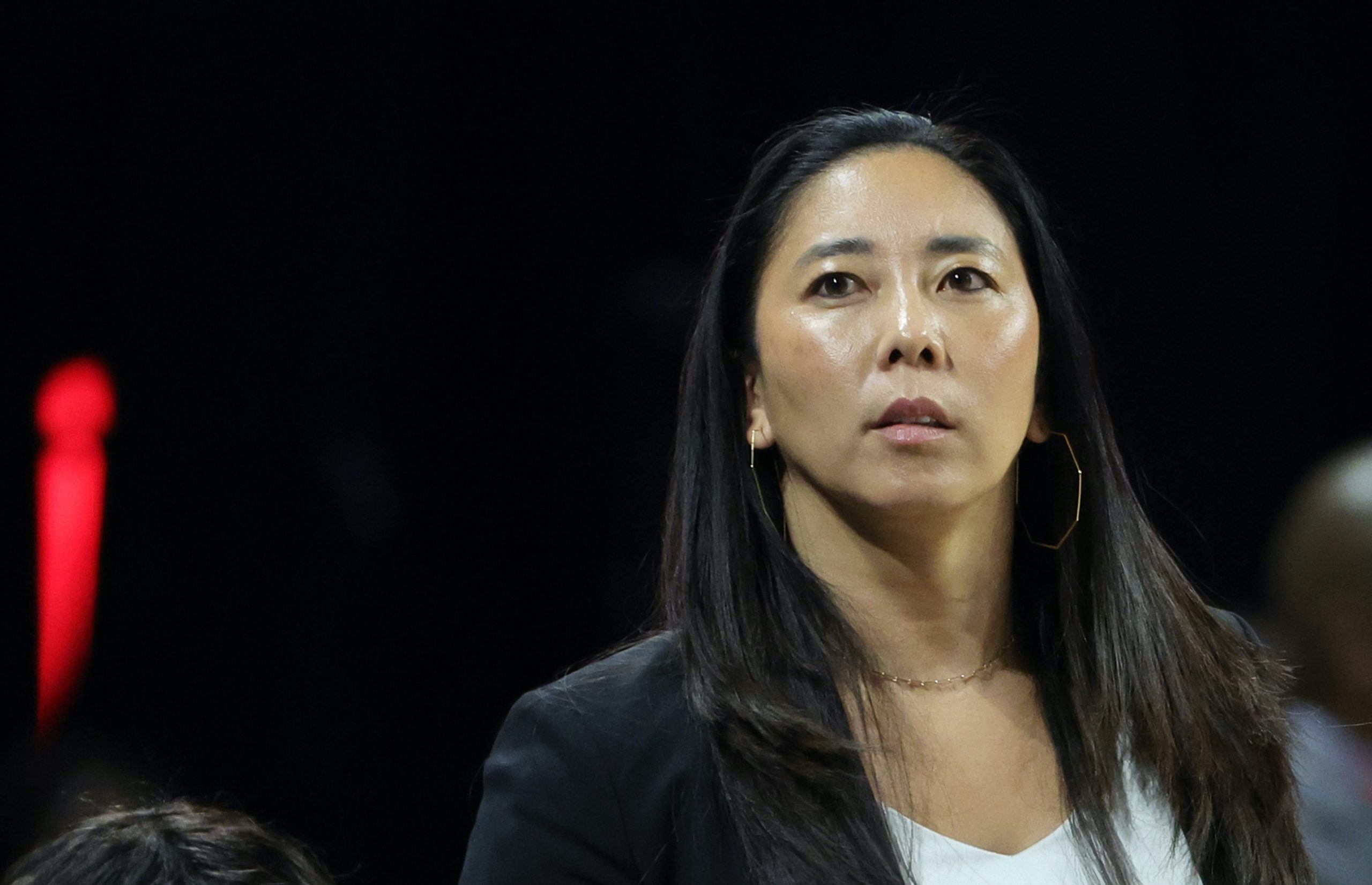
Natalie Nakase is many things: a 5-foot-2 former walk-on who became the starting point guard for UCLA, a WNBA champion as an assistant coach with the Las Vegas Aces, and “a unifier,” as Golden State Valkyries general manager Ohemaa Nyanin put it in an introductory presser last October. When the Valkyries play their season opener in San Francisco this Friday, Nakase will add to that list, becoming the first head coach of the franchise, and the first Asian-American head coach in WNBA history. She is a third-generation Japanese American from Southern California, raised by a basketball-loving father who kept his daughters in the gym the way some parents bring their children to church.
Basketball has been an integral part of Japanese-American communities on the West Coast since the early 1900s. Shaped by forcible internment during World War II, Japanese-American basketball leagues (colloquially known as the “JA leagues”) flourished for decades as a way to cultivate second- and third-generation talent, and still operate to this day. The use of digital archives dating back to the 1940s, as well as interviews with relatives and members of the JA league community, can demonstrate how the story of Natalie Nakase is the story of Japanese-American basketball. Go through her family history, and you’ll find competition and resilience that transcends the sport itself.
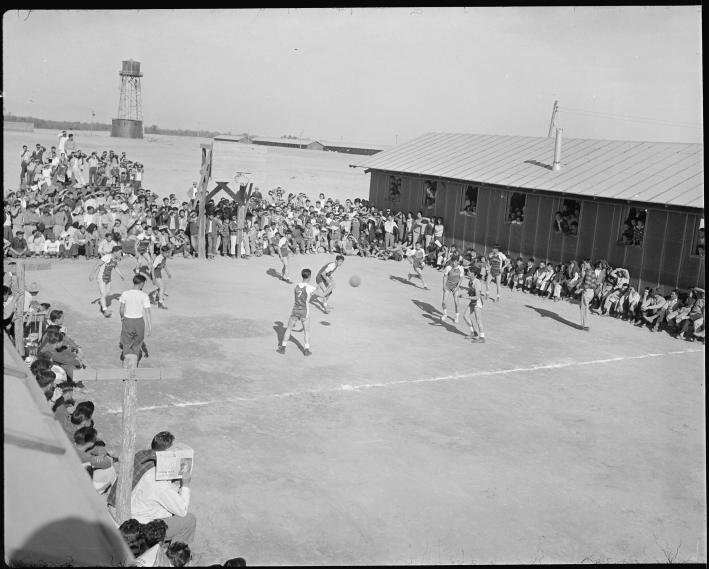
To conclude the 1943 basketball season at Rohwer Relocation Center, in the southeastern corner of Arkansas, the boys and girls “inter-Center” all-star games took place on a Sunday afternoon. Rohwer’s all-stars faced off against opponents from nearby Jerome Relocation Center. All the players were incarcerated in prison camps. They competed on an outdoor dirt court, built atop a strip of drained swampland, surrounded by mud, ringed by barbed wire fences and guarded by military police.
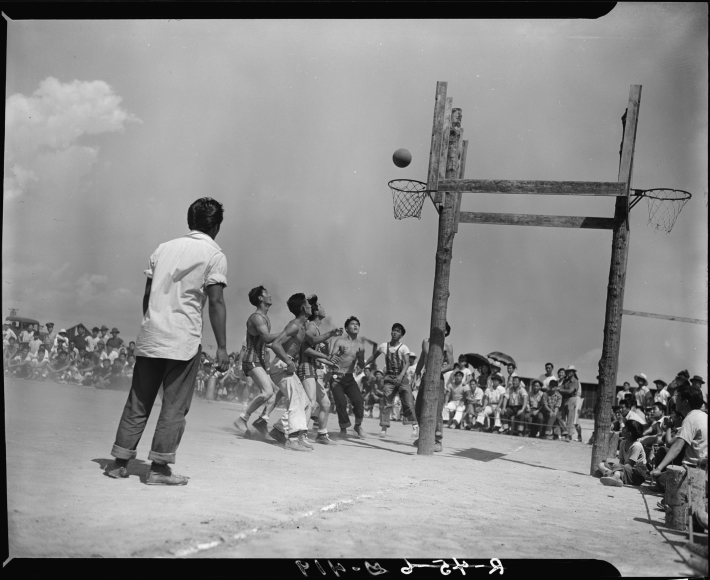
Until recently, the young basketball players of Rohwer had never stepped foot in Arkansas. They were almost all from California, growing up amidst the brown plains of Lodi or the city blocks in downtown Los Angeles. West Coast kids and Nisei (second generation) took to the sport in an era marked by discrimination, when many Japanese Americans were systematically banned from buying or owning property, not to mention exclusion from organized athletics. Perhaps, the thinking went, by mastering a homegrown sport, the Nisei would be more warmly received by their fellow Americans.
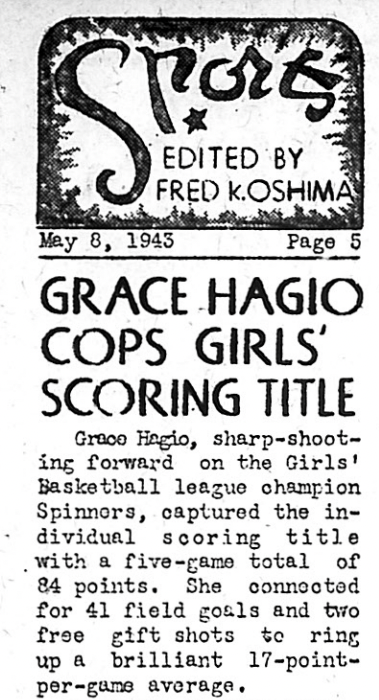
At the start of the 1940s, many Nisei were building flourishing basketball careers. Rohwer’s Tosh Ihara was a standout freshman on UCLA’s 18-6 “lightweight” team during the 1940-41 school year, while Grace Hagio led the Stockton Busy Bees to defeat all Northern California rivals in the Young Women’s Buddhist Association, outscoring opponents 477-228, according to archival records. Hagio, known by her nickname “Yoshi” in her hometown, was a dominant offensive presence as a forward on the Busy Bees, while the team competed across the western U.S.
But no amount of skill on the court could counter the wave of anti-Japanese hysteria that overtook the country during World War II. President Franklin D. Roosevelt became increasingly preoccupied by the perception of Japanese Americans as a potential military threat—despite intelligence from reports, ordered by Roosevelt himself, finding no serious threat to the country. Following Japan’s surprise attack on Pearl Harbor in December of 1941, Roosevelt invoked the Alien Enemies Act of 1798, widely credited as paving the way for the impending incarceration of Japanese Americans. (The beats of this process may sound familiar to those paying attention to the current presidential administration.) Despite opposition from numerous high-ranking government officials, Roosevelt signed Executive Order 9066 in February of 1942. What followed was the forced removal of over 120,000 people of Japanese descent on the West Coast, including American citizens and young Nisei hoopers from Washington, Oregon, and California, detained and sent to prison camps in remote areas of the country.
Athletics, including the increasingly popular sport of basketball, were an essential outlet for Japanese Americans who endured incarceration, as documented by the local newspapers published in each camp. Using digital archives provided by the nonprofit organization Densho, I found clippings and articles full of details about the Nisei athletes’ dedication to the sport. At Poston Relocation Center in Arizona, residents evaded the burning 100-degree weather by hooping at night, cutting down cottonwood trees as poles for floodlights. All-star “quintets” received special permission to travel beyond camp for showdowns against local high schools; at Heart Mountain Relocation Center in Wyoming, the all-star boys basketball team practiced outdoors in freezing weather before traveling to a nearby Mormon town to take on future regional champions Lovell Westward High School. And at Rohwer, where the 1942-43 basketball season was troubled by terrible weather and a contaminated water supply that had to be boiled before drinking, the all-stars defeated their rivals from Jerome. As Bradford Pearson wrote in The Eagles of Heart Mountain, which tells the story of that camp’s undefeated high school football team, some of the camps were built on former swampland so easily overrun by floods and poisonous snakes that landowners had abandoned it long ago. The land wasn’t much better for basketball courts.
Around the same time as that Rohwer all-star game, a young woman named Takayo Maeda arrived at the Arkansas camp. Months earlier, she’d been separated from her husband Kenichi and infant son, held back at the Santa Anita Assembly Center in California to give birth alone to her second-born son. According to her eldest son’s account, published in 2022, she and other internees were forced to live in converted horse stables. Finally, Takayo was sent by the War Relocation Authority via train, unaware that she was headed to be with the rest of her family in the prison camp. With her was her baby, Shigeo “Gary” Nakase.
Decades later, on the way to a basketball tournament in Tennessee with his daughter, Gary Nakase drove through the site of what had been Rohwer Relocation Center. According to Natalie, he didn’t talk much about his family’s experience at the camp, or of the fact that he was born into incarceration at the Santa Anita Assembly Center in October of 1942. “He doesn’t speak about it unless we ask,” Natalie said in a 2019 interview. “From the small pieces that my dad did tell us, my grandfather had everything taken away from him and had to start over from scratch.”
Kenichi Nakase and Takayo Maeda’s return to California in 1945 was difficult; they struggled to rebuild amidst anti-Japanese sentiment whipped up from the war, and moved between farm towns as both parents worked the fields. According to Gary’s brother, Frank Nakase, the family settled in 1954 in the suburban city of Whittier, near Los Angeles. The family swelled to the size of a small hoop squad itself, with five more children born after Gary for a total of seven.
“I think my dad always tried to protect us [from] the struggles that he went through,” Natalie told me. “I think that’s why my dad never brought that up, and then if pain ever came to us, he was like, ‘No, don’t pay attention to it.’ My dad was iconic, man.”
In that same post-war period, the JA leagues expanded. New leagues with roots in the camps formed across the West Coast, largely revolving around Buddhist centers and churches, with raucous showdowns between rival cities, from Seattle to San Jose to Los Angeles.
At a time when girls basketball, if offered in schools or physical education programs at all, was subject to highly restrictive rules, the JA leagues actually welcomed women to the court. For her book When Women Rule the Court: Gender, Race, and Japanese American Basketball, Dr. Nicole Willms interviewed Ed Takahashi, a local businessman from Los Angeles who was in charge of the youth leagues for the Japanese Athletic Union in the late 1960s. “What I did was, I changed the rules,” Takahashi told Willms. “Instead of… where you had three girls on defense and three girls on offense and they could never cross the line, and you had two dribbles and you had to pass, I changed it to boys’ rules.” According to Willms’s analysis, gender exclusion and gendered hierarchy in the JA leagues were often “subdued in favor of asserting a Japanese-American identity.” This meant a more promising environment for the women’s game, particularly in Southern California.
“I stuck with the Asian leagues,” recalled Colleen Matsuhara, who played at Sacramento State and was an assistant coach for the Los Angeles Sparks in 1998-99. As a teenager, Matsuhara quit her high school team for better opportunities in the JA leagues, where she competed with a sense of survival. “Very deep in the subconscious, at least for me,” Matsuhara told me, “is that I was outraged when my parents told me about camp. Like, they [had] to come back and start from the ground up. You can’t take anything for granted.”
As the Nakase family entered the 1960s, their Nisei kids developed a passion for basketball, primarily led by Gary, a hyperactive teen who constantly wanted to play. “He was the one who wanted to get a basketball hoop and put it up on the garage,” said Frank Nakase, who admired his older brother’s basketball talent. “I recall him being able to touch the rim with his hands with a running start. He was very quick and very fast, and really a crafty player.”
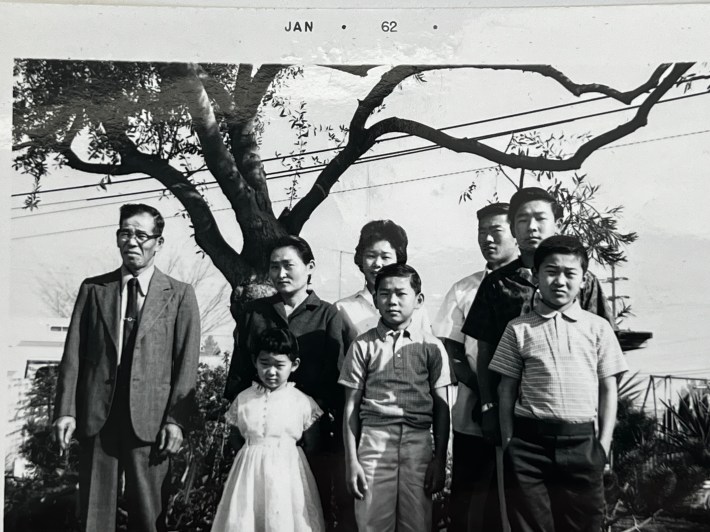
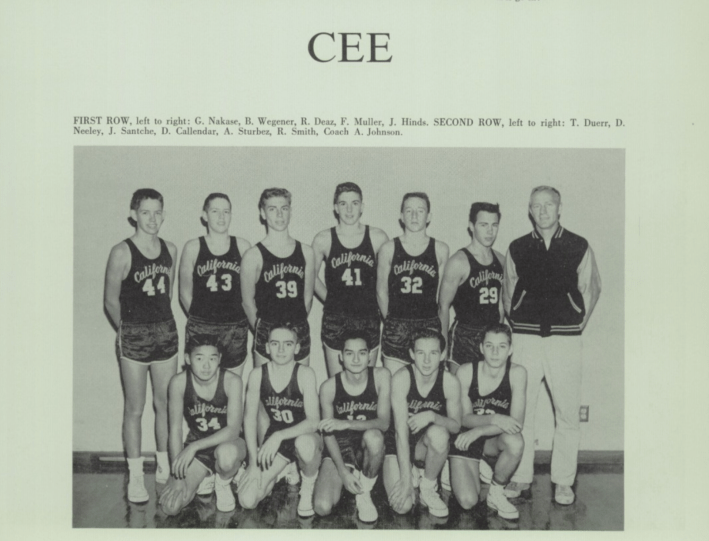
As a senior at California High School in Whittier, Gary is pictured on the boys basketball “Cee” team in 1960, one of the few Asian-American players to compete at his school. “At that time, being a Japanese person and a minority, you’re easily overlooked,” Frank Nakase told me. “I’m sure he could have played varsity, but because of his size he was overlooked.”
By the time the JA leagues reached their prime in the 1970s—with a reported 162 Japanese-American teams in the Bay Area alone for the 1973-74 season—Gary was deeply involved in Orange County’s local recreational leagues. After graduating from California Polytechnic State University with a horticulture degree and meeting his wife Debra in a coed volleyball league, Gary ran a successful landscaping business, spending much of his free time playing and promoting recreational sports.
Later in life, Natalie learned from one of Gary’s relatives that her father got his renowned work ethic from Kenichi. “When I went to Japan, I was able to meet one of my dad’s second or third cousins,” she said. “He only spoke Japanese with very little English, but what I got from him was that my grandfather was the hardest worker he’s ever known. I’m like, ‘OK, no wonder that my dad is who he is. No wonder I am who I am.’ Because it’s come through our bloodline.”
The community around Gary also benefited from his dedication. “The father of adult sports, Japanese-American sports here in Orange County,” said Jesse James, who met Nakase as a friend and mentor in the mid-1970s. The two men, along with close friends Tom and Ben Morimoto, were both tight-knit and fiercely competitive with one another. And in a meeting in 1981, according to James, the men created the Orange Coast Sports Association, a youth sports organization that still exists to this day.
Around that same time, Gary hoped to have a son, so he could coach him from a young age. “I was supposed to be Nathan,” Natalie told the San Francisco Chronicle. Then he had a third daughter.
Nicola, Norie, and Natalie Nakase grew up in basketball gyms, watching their father play in the JA leagues. Gary’s close-knit group of friends continued their love of basketball; now with their own kids, the competition changed. “They didn’t really care about how much money they made,” Nicola, the oldest of the three, told me, remembering the intensity of the youth leagues. “But they did compare us based on how well their kids did in sports.”
Their obsession was distinctly Japanese. “Traditionally, like Asian culture, you would think you should be studying, becoming a doctor, becoming a lawyer, right?” Nicola said. “But not the Japanese Americans, two generations in. No, you’re gonna play basketball.”

As Gary’s youngest, Natalie was different from her sisters. “More so than athletic,” James said. At three years old, he said, she was “swimming underwater like a darn fish.” Natalie was a lot like her father: unable to sit still, and a sponge for his love of basketball. “We had tons of VHS tapes of games, you know, instructional tapes from old college coaches that he recorded,” Nicola remembered. “[Our dad] was obsessed with learning different techniques and different things, and then making us do it.” And Natalie, far more than her two sisters, loved it.
“All I knew was playing basketball every single day because he played,” Natalie told reporters in her Valkyries introduction. “He made us play every single day. That’s all we knew. Because he was passionate about the sport, I became passionate about the sport.” Gary’s youngest daughter trained with him every Sunday.
“When most people say ‘I’m going to church,’ I was like, ‘Oh, I’m going to basketball practice,’” Natalie told Willms in 2008. “Everyone always said, ‘Do you go to church?’ And I was like, ‘Well, I go to basketball church, is that considered the same thing?’ I just called it that because it was every Sunday morning.’”
Gary fully invested in Natalie’s basketball career. He started Natalie in the JA leagues early, always having her play with kids a couple grades ahead of her. While he found success with his nursery business, using skills passed down from his own parents’ agricultural expertise, Gary hired various coaches for his daughters: strength and conditioning, dribbling, and shooting, repeated compulsively with the goal of mastering the game.
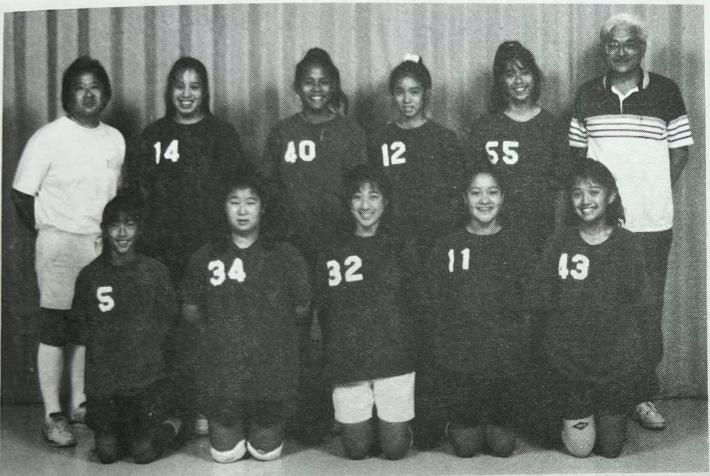
Through middle school, while Natalie was often the tiniest player, she also became the most “relentless and fearless” on the court, according to her oldest sister. “Other teams’ parents would cheer for her, which was really funny because she would be like the smallest person on the court, but she would just be very feisty,” Nicola said, remembering Natalie’s time in AAU. “They just liked the way she played, so they would be cheering for her too … she would get a lot of fans just because she was so energetic.”
As a point guard at Marina High School in Huntington Beach, Natalie Nakase led the team to its first CIF-SS title in 1998, earning Orange County Player of the Year. She drew some attention from recruiters—including Colleen Matsuhara while she was the head coach at UC Irvine—but Natalie had become dead set on playing at UCLA. At her height, she faced an uphill battle. “She was too short, and she was Japanese,” James said. “So she had two things against her.” Nonetheless, Natalie held firmly to her self-belief, cultivated by her father Gary.
Natalie began her career at UCLA in 1998 by walking on to the women’s basketball team, then redshirted her freshman season after tearing her ACL in a summer league game. By her senior year, she became the starting point guard and team captain. With a player bio describing her at the time as “a coach on the floor,” she became a source of pride among Asian-American communities in Southern California (even if she was often mistaken for a gymnast or tennis player on campus). After a brief professional stint, Natalie began her coaching career overseas, rising through the ranks of the Los Angeles Clippers to become a player development/assistant coach, before she joined the Las Vegas Aces for back-to-back championships in 2022 and 2023.

The throughline of Natalie’s success was her father’s lessons. “My philosophy is going to be tough love, same as how my dad raised me,” Natalie told reporters after the Valkyries’ preseason victory over the Phoenix Mercury. “Strict. Stern. Truth teller.” Like many other Japanese-American families, the Nakases passed basketball down as resilience. With the history of incarceration, discrimination and hysteria not as distant as we’d like to think, generations of Nisei and Sansei (third generation) athletes made Japanese-American basketball leagues a focal point of their communities. This is the culture that shaped Natalie Nakase, whose new challenge is to lead the WNBA’s latest expansion team, with minimal roster depth and everything to prove. Once again, the only option is to start over.
She’ll have to do so without her father Gary, who died in 2021. “For those that just don’t know my background: My dad, who also was my best friend, he passed away a couple years ago,” Natalie said in her introductory Valkyries presser. “And so he was always my first phone call. Whether it was life or basketball, that was my first phone call.”
Her voice trembled slightly as she continued, speaking to her obsession with winning. “What drives me is, again, like my dad taught me when I was young: ‘You always gotta be the best.’ And so I almost feel like he has trained me in a way, or he’s raised me, to be where I am today.”

Continue Reading


Jill Schramm/MDN
Gene Yeater holds his Mentor of the Year award from Minot’s Companions for Children Friday, Jan. 9.
Gene Yeater’s positivity and willingness to go above and beyond caught the attention of Minot’s Companions for Children recently.
The Minot Air Force Base firefighter was named the organization’s Mentor of the Year for his mentorship of a middle school youth and his overall support for mentoring in the community.
“Gene is definitely someone who has supported us at our events. He brings mentoring to those events as well, and just kind of represents us as a whole for what we do,” said Kat Howard, community outreach manager at Companions for Children. “He’s very, very involved. And I think it just speaks for his care and mentoring by seeing how he shows up for his mentee. He plans a lot of different fun activities and keeps it engaging for his mentee, too. Those are just highlights that we look for when it comes to this award, just showing an above-and-beyond type of attitude toward mentoring.”
Yeater said the award was unexpected. He didn’t know he was in consideration for the annual honor until the organization handed him the award.
Yeater began volunteering with Companions for Children in November 2023. While working on his master’s degree, he took nonprofit leadership class in which he studied the leadership structure of Companions for Children. His interest in studying the organization came from his own positive experience as a young mentee with the Big Brothers program in California.
Upon completing his master’s, he signed up to volunteer with Companions for Children.
Yeater and his mentee share interests in a number of activities, including video games and sports. They engage in about three outings a month.
“We hang out. We play video games together. We go to the park. We’ll go to the arcade. We’ll watch movies together,” Yeater said. “We’ll spend a lot of time at the park, playing baseball, football. I have a whole bag full of sports equipment we’ll bring with us.”
Companions for Children also hosts a group event about once a month, such as an upcoming scavenger hunt, which Yeater and his mentee take part in.
Yeater has three children of his own, including one who is the same age as his mentee. He said it’s been helpful for him to see the similarities in what the two middle-school youth are going through as he helps them brainstorm solutions to problems they face.
Yeater said his relationship with his mentee has grown close over the past two years. They’ve become good friends who can talk about almost anything, he said. He would encourage others to consider becoming mentors for the opportunity to experience the satisfaction he has known.
“Part of it is getting to see the mentee grow and become a better person,” Yeater said. “I’ve seen him become a lot more confident.”
Minot’s Companions for Children has about 250 mentors across its five programs, Howard said. Some programs are school-based, such as Lunch Pals or Pen Pals. Another program is expected to begin soon that will be geared toward middle school girls.
Companions for Children will begin recruiting this week for an internship program through a partnership with Minot High’s Magic City Campus. Businesses willing to open their doors to high school seniors are invited to get involved. The fall semester each year features the World of Work Program, in which business people come into the classroom to engage with Minot High students.
But the largest program and the one in greatest need of additional mentors is the community-based program, in which Yeater participates. Men, in particular, are needed as mentors, Howard said. Mentees range in age from 6-18.
Companions for Children hosts a Mentor Mingle event each year to recognize the work of its volunteers. Mentors are encouraged to bring along a friend or family member who is interested in learning about possibly volunteering, Howard said. This year’s event will be May 7.
However, Howard added, “We are always recruiting for community-based (volunteers) at any time of the year.”
Yeater considers mentoring to be a valuable investment of time for anyone who enjoys being around children and youth.
“Getting to see your influence on the kids, I think, is probably the biggest benefit of it,” he said, “and getting to know that you’re really making a difference.”
January is National Mentoring Month
This month is National Mentoring Month, a designation that has been in place since 2002.
According to the nonprofit MENTOR, the organization and the Harvard T.H. School of Public Health launched National Mentoring Month to amplify, encourage and strengthen mentorship for young people. The goals of National Mentoring Month are to raise awareness of mentoring, recruit mentors and recruit organizations to engage their constituents in mentoring.
Within National Mentoring Month this year are: I am a Mentor Day, Jan. 6; International Mentoring Day, Jan. 17; Martin Luther King Jr. National Day of Service, Jan. 19; and Thank Your Mentor Day, Jan. 28.
– MDN STAFF
Rec Sports
What Kevin Young, Alex Jensen said about each other’s programs after their first BYU-Utah matchup – Deseret News
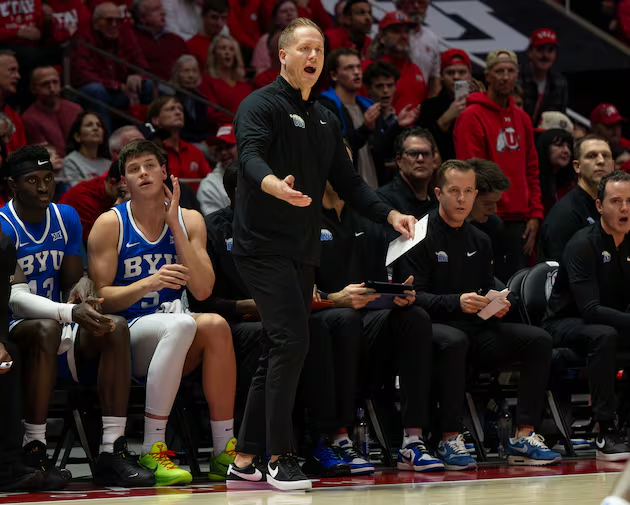
If things go according to plan, Saturday’s game between the BYU and Utah men’s basketball programs will be the first of many pitting Cougars coach Kevin Young against Utes coach Alex Jensen.
Young and Jensen have some similarities in their journeys toward becoming the head coach at their respective schools: they both have G League head coaching experience and they both spent more than a decade in the NBA as assistant coaches before landing in their current roles.
Young has one year of experience on Jensen in his current job — he is in his second year as BYU’s head coach, while Jensen is in his first season coaching his alma mater.
That familiarity with each other has fostered a healthy respect between the two coaches. On Saturday, Young’s No. 9 BYU team got the best of Jensen’s Utes, as the Cougars held off Utah, 89-84.
BYU (15-1, 3-0 Big 12) relied on its Big 3 — Robert Wright III, AJ Dybantsa and Richie Saunders — to carry the load.
Wright scored 23 points and added six assists, Saunders logged a double-double with 24 points and 14 rebounds, along with three assists, and the freshman sensation Dybantsa contributed across the board with 20 points, six rebounds, four assists, one block and a steal.
BYU led for more than 31 minutes against its rival, and the Cougars never trailed in the second half, though Utah climbed within one at one point.
“It’s hard to give up 89 points and win, right? And if you look at all the good teams in college that win, (they) are the teams that defend and rebound,” Jensen said, about two factors that prevented Utah from pulling the upset.
He was then complimentary about the program Young is building in Provo.
“BYU has done a great job. Kevin does a good job. It’s hard to have those guys be together. They’ve done a great job as an institution, and (BYU athletic director) Brian (Santiago), giving the resources to the program,” Jensen said. “Just like (Utah’s recent loss to No. 1) Arizona, it’s a great lesson for us to learn from. They play well together.”
Utah (8-8, 0-3 Big 12), for its part, had arguably its best overall effort of the season, perhaps only bested by a one-point win over Ole Miss during nonconference play.
Terrence Brown (25 points, five assists, three rebounds, two blocks) and Don McHenry (21 points, two rebounds, two assists, one steal) led a spirited Utah attack Saturday, while James Okonkwo’s energy and results — 13 rebounds, 4 points and two assists — helped the Utes keep pace in front of an electric crowd.
“I’ve known Alex for a long time,” Young said. “We’ve coached against each other (a) long time ago in the G League. We sort of broke into the NBA around the same time, and when I was with the Suns, he was with the Jazz.
“We had a ton of battles, so I’m very familiar with him. He’s a good person, but you still want to beat him in a game like that.”
BYU’s coach, too, was complimentary about the organization and work that Jensen has already put into revitalizing the Runnin’ Utes program.
“He’s smart, man. He’s a smart coach, and he’s just figuring it all out, all the idiosyncrasies. He joked before the game — in the NBA, you do the anthem and the coaches wave and you play the game; in college, before the game, you walk the line, shake, and he’s still trying to figure out if we’re supposed to do this,” Young said.
“He’s still figuring everything out, but he’s a smart guy, and (Utah basketball general manager) Wes Wilcox, too. They’re smart. They have a lot of experience, and this will be some fun games over the years between our groups.”

Jan. 12, 2026, 4:04 a.m. ET
- Texas Rangers player Wyatt Langford hosted his second annual baseball camp for over 100 kids in Newberry, Florida.
- Langford, a Trenton native and former Florida Gators star, aims to provide local youth with the mentorship he lacked growing up.
- Former UF teammates joined Langford as coaches, and about half the campers were from the surrounding tri-county area.
- Langford, a 2023 World Series champion, still lives in the area during the offseason and is seen as a role model by young players.
It’s rare for kids to agree on anything, especially a desire to wake up early on a Saturday.
Yet, over 100 kids from around the Gainesville-area willingly braved tiredness and the odd January heat to drive to Newberry.
Why? Because a local superhero offered his tips on how these 8-14 year olds can reach the big leagues.
Trenton native and Florida baseball legend Wyatt Langford hosted his second annual baseball camp at Champions Park in Newberry — three months before his third season with the Texas Rangers begins.
Despite his new big city digs with the 2023 World Series champions, Langford remains committed to the area. He still lives in Trenton in the offseason with his wife Hallie. A college softball player, Hallie will play her final season with North Florida. She’ll visit Gainesville on Tuesday, February 17.

It’s his love for the area that pushed Langford to begin the camp. He said that when he grew up in Trenton, youth baseball camps weren’t popular, despite the proximity to UF.
“There wasn’t a lot of people you can look up,” Langford said. “People who could tell you what to do and what not to do.”
The lack of resources didn’t hurt Langford much, who won two state championships in Gilchrist County. That led to a scholarship from Florida. He became of the Gators best offensive player in program history and a College World Series finalist in 2023.
The campers benefited from Langford’s connections as his former UF teammates Colby Halter, Blake Purnell and Ryan Slater served as coaches. The camp was run by the Florida Hardballers, the travel baseball team Langford played for.
About half the kids came from the tri-county area of Levy, Dixie and Gilchrist Counties. This pleased Langford even more.
“We’re lucky enough to be role models to them, so it’s our duty to be good role models and show them a little something that gives them hope and ambition to continue practicing,” Langford said.
![Florida's utility Wyatt Langford (36) celebrates his home run in the bottom of the first inning against the Miami Hurricanes, Friday, March 3, 2023, at Condron Family Baseball Park in Gainesville, Florida. The Gators beat the Hurricanes 10-4 in Game 1. [Cyndi Chambers/ Gainesville Sun] 2023
Gator Baseball March 3 2023 Condron Family Ballpark Miami Hurricanes](https://www.gainesville.com/gcdn/authoring/images/smg/2025/02/14/SGAT/78591442007-7-102875.jpeg?width=660&height=637&fit=crop&format=pjpg&auto=webp)
Calling himself a role model isn’t far enough. For the kids at the camp, he’s a superhero.
Mason Depaola, a 12-year-old, called Langford a superhero and an inspiration to him.
“If you’re playing with better guys, they’ll push you, and if you see guys in the majors, you can strive to be like that,” Depaola said. “That’ll make you the best player.”
The Rangers 2026 season begins on March 26 at the Philadelphia Phillies. Texas will visit the Tampa Bay Rays July 28-30, the Atlanta Braves July 17-19 and the Miami Marlins June 22-24.
Noah Ram covers Florida Gators athletics and Gainesville-area high school sports for The Gainesville Sun, GatorSports.com and the USA TODAY Network. Contact him at nram@gannett.com. Follow him on X @Noah_ram1. Read his coverage of the Gators’ national championship basketball season in “CHOMP-IONS!” — a hardcover coffee-table collector’s book from The Sun. Details at Florida.ChampsBook.com

WASHINGTON — Becky Pepper-Jackson finished third in the discus throw in West Virginia last year though she was in just her first year of high school. Now a 15-year-old sophomore, Pepper-Jackson is aware that her upcoming season could be her last.
West Virginia has banned transgender girls like Pepper-Jackson from competing in girls and women’s sports, and is among the more than two dozen states with similar laws. Though the West Virginia law has been blocked by lower courts, the outcome could be different at the conservative-dominated Supreme Court, which has allowed multiple restrictions on transgender people to be enforced in the past year.
The justices are hearing arguments Tuesday in two cases over whether the sports bans violate the Constitution or the landmark federal law known as Title IX that prohibits sex discrimination in education. The second case comes from Idaho, where college student Lindsay Hecox challenged that state’s law.
Decisions are expected by early summer.
President Donald Trump’s Republican administration has targeted transgender Americans from the first day of his second term, including ousting transgender people from the military and declaring that gender is immutable and determined at birth.


Heather Jackson, left, and Becky Pepper-Jackson pose for a photograph outside of the U.S. Supreme Court on Sunday in Washington.
COPYRIGHT 2025 THE ASSOCIATED PRESS. ALL RIGHTS RESERVED. THIS MATERIAL MAY NOT BE PUBLISHED, BROADCAST, REWRITTEN OR REDISTRIBUTED.
Pepper-Jackson has become the face of the nationwide battle over the participation of transgender girls in athletics that has played out at both the state and federal levels as Republicans have leveraged the issue as a fight for athletic fairness for women and girls.
“I think it’s something that needs to be done,” Pepper-Jackson said in an interview with The Associated Press that was conducted over Zoom. “It’s something I’m here to do because … this is important to me. I know it’s important to other people. So, like, I’m here for it.”
She sat alongside her mother, Heather Jackson, on a sofa in their home just outside Bridgeport, a rural West Virginia community about 40 miles southwest of Morgantown, to talk about a legal fight that began when she was a middle schooler who finished near the back of the pack in cross-country races.
Pepper-Jackson has grown into a competitive discus and shot put thrower. In addition to the bronze medal in the discus, she finished eighth among shot putters.
She attributes her success to hard work, practicing at school and in her backyard, and lifting weights. Pepper-Jackson has been taking puberty-blocking medication and has publicly identified as a girl since she was in the third grade, though the Supreme Court’s decision in June upholding state bans on gender-affirming medical treatment for minors has forced her to go out of state for care.
Her very improvement as an athlete has been cited as a reason she should not be allowed to compete against girls.
“There are immutable physical and biological characteristic differences between men and women that make men bigger, stronger, and faster than women. And if we allow biological males to play sports against biological females, those differences will erode the ability and the places for women in these sports which we have fought so hard for over the last 50 years,” West Virginia’s attorney general, JB McCuskey, said in an AP interview. McCuskey said he is not aware of any other transgender athlete in the state who has competed or is trying to compete in girls or women’s sports.
Despite the small numbers of transgender athletes, the issue has taken on outsize importance. The NCAA and the U.S. Olympic and Paralympic Committees banned transgender women from women’s sports after Trump signed an executive order aimed at barring their participation.


Protestors hold signs during a rally on March 9, 2023, at the state capitol in Charleston, West Virginia.
COPYRIGHT 2025 THE ASSOCIATED PRESS. ALL RIGHTS RESERVED. THIS MATERIAL MAY NOT BE PUBLISHED, BROADCAST, REWRITTEN OR REDISTRIBUTED.
The public generally is supportive of the limits. An Associated Press-NORC Center for Public Affairs Research poll conducted in October 2025 found that about 6 in 10 U.S. adults “strongly” or “somewhat” favored requiring transgender children and teenagers to only compete on sports teams that match the sex they were assigned at birth, not the gender they identify with, while about 2 in 10 were “strongly” or “somewhat” opposed and about one-quarter did not have an opinion.
About 2.1 million adults, or 0.8%, and 724,000 people age 13 to 17, or 3.3%, identify as transgender in the U.S., according to the Williams Institute at the UCLA School of Law.
Those allied with the administration on the issue paint it in broader terms than just sports, pointing to state laws, Trump administration policies and court rulings against transgender people.
“I think there are cultural, political, legal headwinds all supporting this notion that it’s just a lie that a man can be a woman,” said John Bursch, a lawyer with the conservative Christian law firm Alliance Defending Freedom that has led the legal campaign against transgender people. “And if we want a society that respects women and girls, then we need to come to terms with that truth. And the sooner that we do that, the better it will be for women everywhere, whether that be in high school sports teams, high school locker rooms and showers, abused women’s shelters, women’s prisons.”
But Heather Jackson offered different terms to describe the effort to keep her daughter off West Virginia’s playing fields.
“Hatred. It’s nothing but hatred,” she said. “This community is the community du jour. We have a long history of isolating marginalized parts of the community.”
Pepper-Jackson has seen some of the uglier side of the debate on display, including when a competitor wore a T-shirt at the championship meet that said, “Men Don’t Belong in Women’s Sports.”
“I wish these people would educate themselves. Just so they would know that I’m just there to have a good time. That’s it. But it just, it hurts sometimes, like, it gets to me sometimes, but I try to brush it off,” she said.
One schoolmate, identified as A.C. in court papers, said Pepper-Jackson has herself used graphic language in sexually bullying her teammates.
Asked whether she said any of what is alleged, Pepper-Jackson said, “I did not. And the school ruled that there was no evidence to prove that it was true.”
The legal fight will turn on whether the Constitution’s equal protection clause or the Title IX anti-discrimination law protects transgender people.
The court ruled in 2020 that workplace discrimination against transgender people is sex discrimination, but refused to extend the logic of that decision to the case over health care for transgender minors.
The court has been deluged by dueling legal briefs from Republican- and Democratic-led states, members of Congress, athletes, doctors, scientists and scholars.
The outcome also could influence separate legal efforts seeking to bar transgender athletes in states that have continued to allow them to compete.
If Pepper-Jackson is forced to stop competing, she said she will still be able to lift weights and continue playing trumpet in the school concert and jazz bands.
“It will hurt a lot, and I know it will, but that’s what I’ll have to do,” she said.
The new playbook: Why personalized coaching is taking over youth sports
The new playbook: Why personalized coaching is taking over youth sports


In the past, finding a private sports coach often meant word-of-mouth referrals, expensive training facilities, and time-consuming scheduling. But as technology continues to reshape the way we work, learn, and connect, the world of youth sports training is getting its own upgrade.
Just as Airbnb revolutionized travel and Uber reimagined transportation, new digital platforms are now decentralizing the $20 billion youth sports industry, giving families more direct access to qualified coaches—and providing former athletes with flexible, gig-style income opportunities after their playing careers end. It’s the era of on-demand coaching.

Training on Your Terms


This model, often referred to as the “platformization” of sports training, is catching on fast. Rather than committing to year-round training fees or expensive academies, families can now access high-quality coaching one session at a time—often from athletes who’ve competed at the highest levels. Proprietary data from Athletes Untapped, an on-demand coaching platform, shows a threefold increase in the number of youth training sessions booked online between 2018 and 2024. The spike reflects a growing comfort with using digital tools to find and schedule specialized coaching, echoing consumer trends seen in fitness, tutoring, and other service sectors.
Much of this growth has been driven by parents seeking personalized, flexible training options that fit into increasingly busy family schedules. Rather than enrolling in seasonal or year-round programs, families are opting to book single sessions based on their child’s needs and availability—often working directly with former collegiate or professional athletes in their local area.
A Win-Win Era for Sports

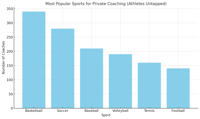
Former athletes get a meaningful, flexible path forward. And the game itself? It gets to live on in new and evolving forms.
Further analysis of platform data reveals which sports are driving the most interest in private coaching. Basketball, soccer, baseball, and volleyball rank as the most-booked disciplines on Athletes Untapped, consistent with broader youth sports participation trends in the U.S.
That data shows some of the most popular sports for youth training—including basketball, soccer, and baseball. But the bigger takeaway? The way we think about skill-building is changing. Kids want coaches they connect with. Parents want transparency and trust. And both want access—without the red tape.
Whether you’re a parent looking for flexible training options or an ex-athlete figuring out your next chapter, the message is clear: Coaching, like almost everything else, is going on-demand.
This story was produced by Athletes Untapped and reviewed and distributed by Stacker.
COPYRIGHT 2025 THE ASSOCIATED PRESS. ALL RIGHTS RESERVED. THIS MATERIAL MAY NOT BE PUBLISHED, BROADCAST, REWRITTEN OR REDISTRIBUTED.

Miami Recreation Services proudly serves the Miami and Oxford community with state-of-the-art fitness facilities, quality programming for all ages and exceptional customer service. We offer programs for fitness, sports, equestrian, aquatics, outdoor adventures, food and drink sales, facility rentals, and informal recreation with the same goal: enhancing the physical, mental, and social well-being of the community.
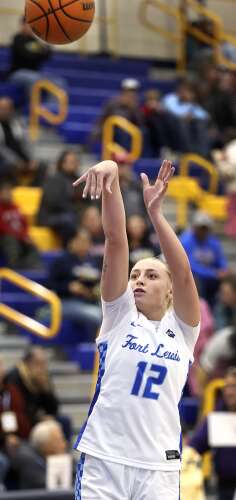
Lamb’s 16 points propelled Skyhawks to 72-53 win on Saturday
Katie Lamb of Fort Lewis College puts up a 3-point shot against Westminster University on Saturday at FLC. (Jerry McBride/Durango Herald)
Jerry McBride
Fort Lewis College women’s basketball coach has been confident in her team’s shooting this week, and her confidence was rewarded in the Skyhawks’ 72-53 home victory over Westminster on Saturday.
The Skyhawks have struggled to shoot from 3-point range and from the free-throw line at times this season, including in the team’s loss to Western Colorado on Thursday. But Zuniga liked her team’s shot selection, and the shots finally fell against Westminster.
After going 6-9 from 3-point range in the first half, the Skyhawks shot 50% in the fourth quarter to pull away from the Griffins. On defense, FLC forced 22 turnovers and Westminster never looked comfortable when it could hang on to the ball in the half-court.
“It was a really great response overall,” Zuniga said. “That’s all we can ask for. It’s just better all-around, better offensively, better effort, better communication, just more disciplined.”
FLC improved to 10-4 overall and 3-3 in the Rocky Mountain Athletic Conference after it shot 41% from the field, 43% from 3-point range and 75% from the free-throw line.
Sophomore guard Katie Lamb led the Skyhawks with 16 points on 6-15 shooting from the field and 4-7 from 3-point range. Junior Makaya Porter had 14 points off the bench for the Skyhawks on 5-13 shooting from the field, 1-2 from 3-point range and 3-4 from the free-throw line. Sophomore guard Claudia Palacio Gámez had a quality all-around game, finishing with five points, seven assists and seven rebounds.
Westminster dropped to 3-9 overall and 0-6 in the RMAC after it shot 32% from the field, 24% from 3-point range and 60% from the free-throw line. Ellie Mitchell and Madison Anderson each had 14 points to lead the Griffins.
FLC mixed it up offensively to take the lead in the first. Skyhawks freshman forward Alemanualii Fonoti got inside to finish or get to the free-throw line, and Lamb hit a nice transition 3-pointer to take a 12-7 lead with 1:30 left in the first.
Both teams could’ve scored more, but they couldn’t finish inside. Fonoti’s misses were especially tough with her size advantage and how close she was to the basket. Regardless, FLC ended the first quarter with good momentum thanks to a great step-back 3-pointer by Palacio Gámez to give FLC a 15-11 lead after the first quarter.
After allowing nearly 40 free throws the previous game against Western Colorado, FLC did a great job pressuring in the half-court without fouling, causing some poor late shot clock shots from the Griffins.
However, that work wasn’t shown in its lead early in the second quarter because the Skyhawks were unsuccessfully trying to force the ball into Fonoti. She had a clear size advantage, but the Griffins were bringing timely double teams and forcing turnovers.
The Skyhawks’ defense continued to be fantastic in the half-court, disrupting Westminster’s sets and forcing turnovers. Without Fonoti on the floor as someone to force the ball into, the Skyhawks got to the basket, got to the free-throw line and pushed the pace, creating looks in transition. The Skyhawks finally hit some 3-pointers, went on a 14-0 run and took a 34-20 lead into halftime.
Savanna Dotray, left, and Katie Lamb of Fort Lewis College fight for the ball while playing Westminster University on Saturday at FLC. (Jerry McBride/Durango Herald)
Jerry McBride
Zuniga said she didn’t call one set play for a 3-pointer. FLC was getting its 3-pointers off drive and kickouts.
“We were not forcing so much,” Zuniga said. “We were just making our shots, and our offense maybe had a little bit more of a rhythm.”
FLC continued to play well to start the second half with strong half-court defense and impressive shot-making. Martinez made a contested driving layup with Lamb and senior guard Laisha Armendariz making 3-pointers. The Skyhawks led 43-24 with 3:45 left in the third quarter.
Westminster responded with a 9-2 run off some sloppy play from FLC, but FLC stayed composed and got to the free-throw line after crashing the offensive boards. The Skyhawks led 49-38 after three quarters.
The Griffins made a run to start the fourth quarter, cutting the FLC lead to 53-46 after some good ball movement and good shooting. FLC’s lack of a dominant offensive player showed in a moment like that, with no single player stepping up to stop the run, slow things down and take control.
“That’s a super great learning moment in a maturity moment for Claudia or Katie Lamb, but especially Claudia, just because she is our point guard and just knowing the trust is in her,” Zuniga said. “She needs to get the ball in her hand and slow it down; we want her to do that. She’s still learning, but she did a better job of that tonight.”
Lauren Zuniga, left, Fort Lewis College women’s head coach, and assistant coach Maggie Espenmiller-McGraw are all smiles with player Claudia Palacio Gámez after winning the game against Westminster University on Saturday at FLC. (Jerry McBride/Durango Herald)
Jerry McBride
However, FLC’s defense stayed consistent as the offense ebbed and flowed, allowing Lamb to hit a 3-pointer and Davis to finish an old-fashioned 3-point play to seal the win with a 64-50 lead with 2:20 left.
FLC hits the road to play at South Dakota Mines on Thursday at 5:30 p.m.
bkelly@durangoherald.com
Sports13 minutes ago
Here is the 2025 Lubbock Avalanche-Journal volleyball Super Team

NIL20 minutes ago
Demond Williams Jr. stays at Washington: Did revenue share contract work as intended?

Sports29 minutes ago
ETBU beach volleyball team serves Honduras communities on mission trip

Sports45 minutes ago
Cougar volleyball adds two attackers on the outside – The Daily Evergreen

Motorsports54 minutes ago
NASCAR Horsepower Explained: New Testing Insights

Sports1 hour ago
Tritons Sweep Hawks – UC San Diego

NIL1 hour ago
Ty Simpson reportedly receiving NIL offers to stay in college

Sports1 hour ago
Leah Edmond Dominates in Atlanta Vibe Volleyball Sweep of Grand Rapids | Sports

Sports2 hours ago
Stanford men’s volleyball falls to Lewis in season opener

Motorsports2 hours ago
Biffle crash witness says ‘Nobody alive’ in painful 911 call – Motorsport – Sports

Sports2 hours ago
Instant impact: 13 Section III girls volleyball players who are turning heads early

Motorsports2 hours ago
Why Williams doesn’t see F1 2026 as an acid test

Sports2 hours ago
Men’s Volleyball Completes Second Sweep of Weekend Against Wildcats

NIL2 hours ago
$2 million QB could redshirt next college football season amid transfer portal entry

Motorsports2 hours ago
Alex Bowman Credits Dale Earnhardt Jr. for Giving Him His First Big Break in NASCAR

Rec Sports4 weeks ago
Stempien to seek opening for Branch County Circuit Court Judge | WTVB | 1590 AM · 95.5 FM

Sports4 weeks ago
Maine wraps up Fall Semester with a win in Black Bear Invitational

Motorsports4 weeks ago
Ross Brawn to receive Autosport Gold Medal Award at 2026 Autosport Awards, Honouring a Lifetime Shaping Modern F1

NIL4 weeks ago
Downtown Athletic Club of Hawaiʻi gives $300K to Boost the ’Bows NIL fund

Rec Sports3 weeks ago
Princeton Area Community Foundation awards more than $1.3 million to 40 local nonprofits ⋆ Princeton, NJ local news %

Sports3 weeks ago
Badgers news: Wisconsin lands 2nd commitment from transfer portal

Rec Sports1 week ago
Five Youth Sports Trends We’re Watching in 2026

NIL4 weeks ago
Nike Signs 10 LSU Athletes to NIL deals

Sports4 weeks ago
Three Clarkson Volleyball Players Named to CSC Academic All-District List

Sports4 weeks ago
Beach Volleyball Unveils 2026 Spring Schedule – University of South Carolina Athletics

Sports3 weeks ago
Badgers news: Final Four Game Thread vs. No. 1 Kentucky Wildcats

NIL4 weeks ago
Kentucky AD explains NIL, JMI partnership and cap rules

Sports4 weeks ago
Central’s Meyer earns weekly USTFCCCA national honor

Sports3 weeks ago
Kentucky VB adds an All-American honorable mention, loses Brooke Bultema to portal

Motorsports4 weeks ago
PRI Show revs through Indy, sets tone for 2026 racing season

 NBA Legend Michael Jordan to Join NBC Sports as Special Contributor
 Why a rising mid-major power with an NCAA Tournament team opted out of revenue-sharing — and advertised it
 Trackhouse to pair Chastain with McSwain
 Volleyball Falls to SEMO – Tennessee State University
 Kennewick School Board backs changes to gender inclusion in sports | News
-
 Sports3 weeks ago
Badgers news: Wisconsin lands 2nd commitment from transfer portal
-
 Rec Sports1 week ago
Five Youth Sports Trends We’re Watching in 2026
-
 Sports3 weeks ago
Kentucky VB adds an All-American honorable mention, loses Brooke Bultema to portal
-

 Motorsports3 weeks ago
Dr. Patrick Staropoli Lands Full-Time O’Reilly Ride with Big Machine Racing
-

 Motorsports2 weeks ago
BangShift.com IHRA Acquires Historic Memphis Motorsports Park In Millington Tennessee. Big Race Weekend’s Planned For 2026!
-
NIL2 weeks ago
Fifty years after IU’s undefeated champs … a Rose Bowl
-
 Sports2 weeks ago
H.S. INDOOR TRACK & FIELD: GLOW region athletes face off at Nazareth University | Sports
-
 Sports3 weeks ago
Colorado volleyball poised to repeat success
-
 Sports3 weeks ago
2025 Volleyball Player of the Year: Witherow makes big impact on Central program | Nvdaily
-

 Motorsports3 weeks ago
NJ Motorsports Park Announces 2026 Event Schedule