Jim Rice, who has spent his entire adult life in professional baseball, has added ownership to his extensive resume.
The Class of 2009 Hall of Famer, who slugged his way to Cooperstown thanks to a 16-year career spent entirely with the Boston Red Sox, finds his latest venture in the game 20 miles south of Fenway Park, where he was recently named part owner of the Frontier League’s Brockton Rox.
As a Massachusetts resident, Rice is thrilled to be part of a professional baseball organization in his own backyard.
“I don’t think it’s giving back. It’s giving kids the opportunity to maybe becoming a major league player,” Rice said. “This is about going back to Brockton, putting guys on the field and kids in the stands. And these young kids, the next generation of ballplayer, though they could go to Fenway Park, but instead they’re in Brockton thinking one day I may be able to play in a major league ballpark, I may be able to be a major league player.
“When I was growing up in South Carolina, the closest major league team was the Atlanta Braves and Hank Aaron was my favorite. And the only thing I was thinking about when I was watching Hank was maybe one day I’d be able to be on that field. The dream for all of us is one day that could be me.”
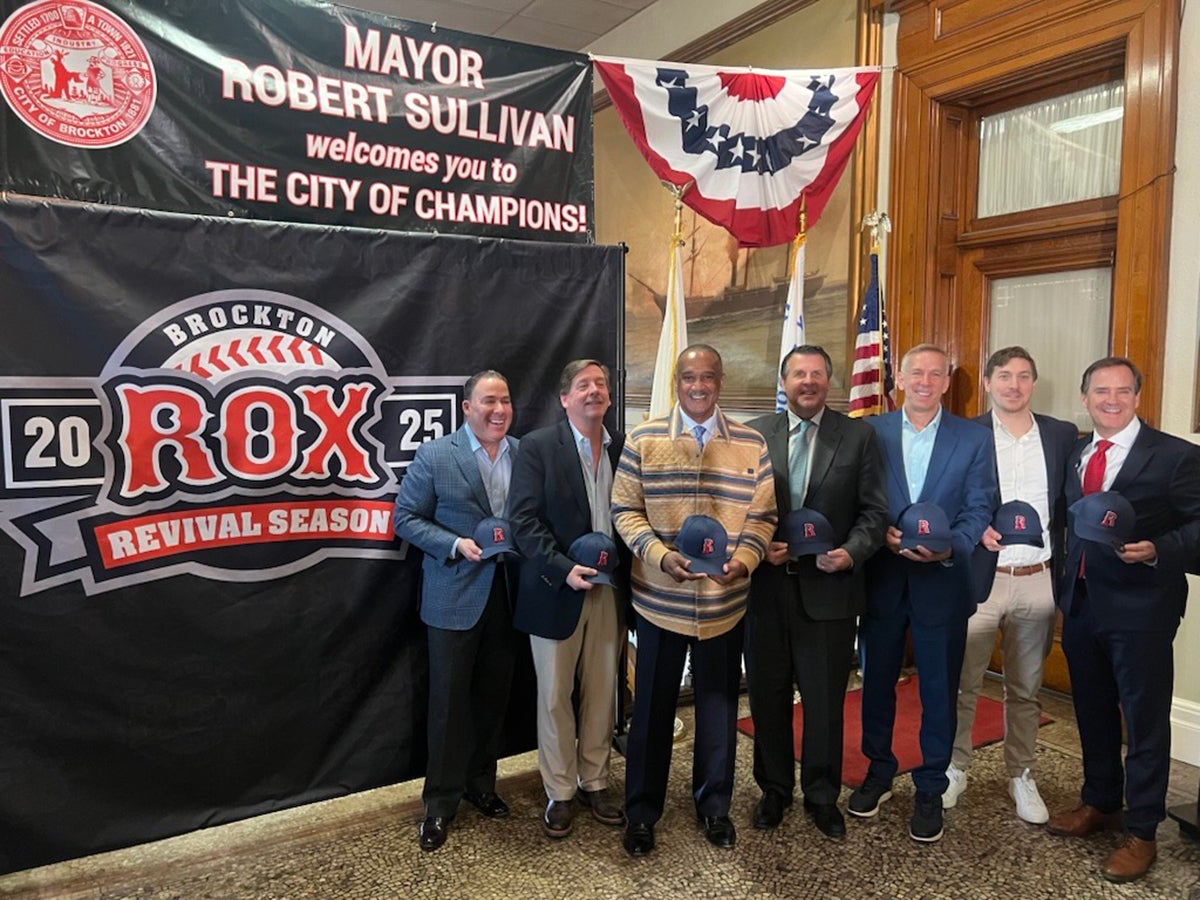
From left: Bob Rivers, Eastern Bank; new Rox owners Bill Janetschek and Hall of Famer Jim Rice; Mayor of Brockton Bob Sullivan; Brockton Rox Team President Shawn Reilly; new Rox ownership Rob Janetschek; and Metro South Chamber President Chris Cooney introduce the club’s revival season under the Brockton Rox name. (Courtesy Brockton Rox, City of Brockton and Eastern Bank)
The history of Hall of Fame players getting involved in ownership of baseball teams dates back to the 19th century when labor strife led to the formation of the Players League in 1890. Led by pitcher-turned-shortstop John Ward, elected to the Hall of Fame in 1964, the Players League would feature teams that were cooperatively owned by players and investors. Though it lasted only one season, it included more than a dozen future Hall of Famers, including Hugh Duffy, Dan Brouthers, Jake Beckley, Roger Connor, Ed Delahanty, King Kelly, Buck Ewing, Tim Keefe and Pud Galvin.
More recent examples include Cal Ripken Jr. (Class of 2007), who in 2024 was part of an investor group – led by David Rubenstein – that agreed to buy the Baltimore Orioles. Later in ’24, Ripken sold his majority stake of the Aberdeen IronBirds, a minor league team he has owned since 2002.
Another Hall of Fame shortstop, Derek Jeter, was part of the Miami Marlins’ ownership group for four-and-a-half years. In 2017, a group including Jeter and principal owner Bruce Sherman purchased the Marlins from Jeffrey Loria.
Fire-balling righty Nolan Ryan, a Hall of Famer in 1999, was a member of the ownership group that purchased the Texas Rangers in 2010, selling his ownership stake three years later. He’s also been involved in the ownership of minor league teams in San Antonio, Round Rock and Corpus Christi.
George Brett, the Hall of Fame third baseman, has been part of a group that purchased such minor league squads as the Bellingham Bells, the Spokane Indians, the Tri-City Dust Devils, the High Desert Mavericks and the Rancho Cucamonga Quakes.
In 2021, longtime Seattle centerfielder Ken Griffey Jr. joined the Mariners’ ownership group. The 2016 Hall of Fame inductee said in a statement at the time: “As I said in my Hall of Fame speech, I’m very proud to be a Seattle Mariner…This is a dream come true because of the relationship I’ve always had with the team, its fans and the city of Seattle. I view this as another way to continue to give back to an organization and community that has always supported me and my family. I’m looking forward to continuing to contribute to this organization’s success in any way possible.”
Even a fledgling loop such as Baseball United, the first professional baseball league focused on the Middle East and Indian Subcontinent, includes among its ownership group a trio of Hall of Famers: Adrian Beltré, Barry Larkin and Mariano Rivera.
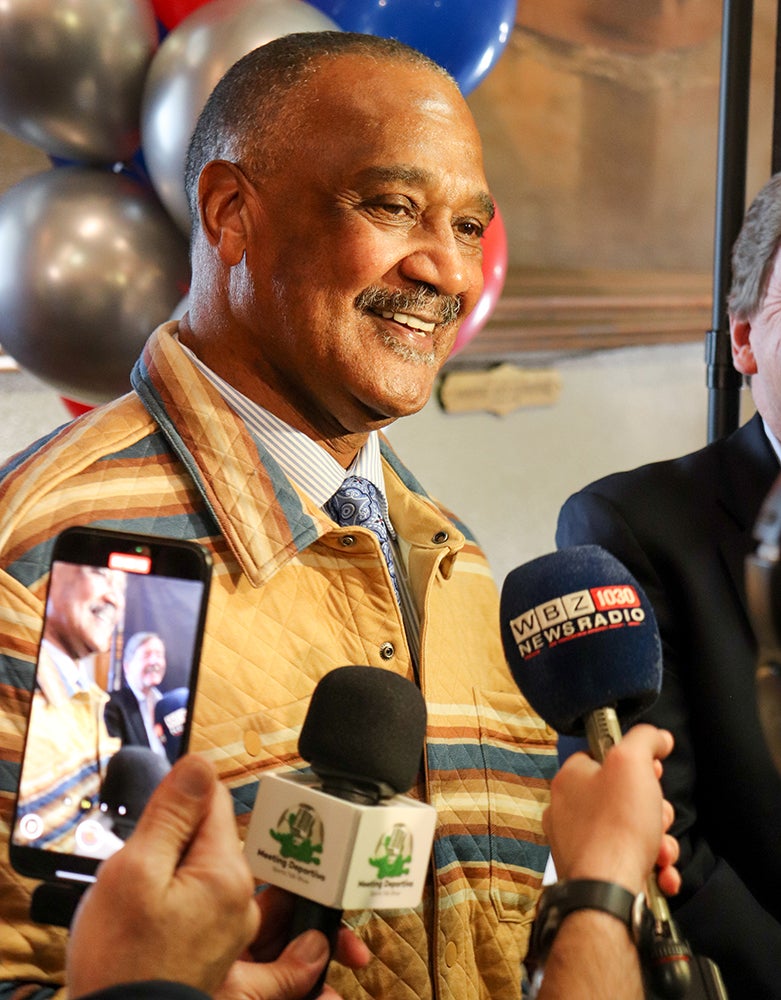
Jim Rice is one of several Hall of Famers whose post-playing careers have extended to ownership opportunities. (Courtesy Brockton Rox)
Rice, 72, currently in his 23rd season as a Red Sox studio analyst on NESN, was an eight-time All-Star and finished his career with a .298 batting average, 382 home runs and 1,451 RBI. Voted the American League MVP in 1978, he helped lead the Red Sox to two World Series (1975 and 1986).
Since retiring after the 1989 season, Rice has remained active in the Red Sox organization, serving as a minor league hitting instructor from 1992 to 1994 before joining the parent club in a similar position in 1995. He currently serves as a special organizational instructor for the team.
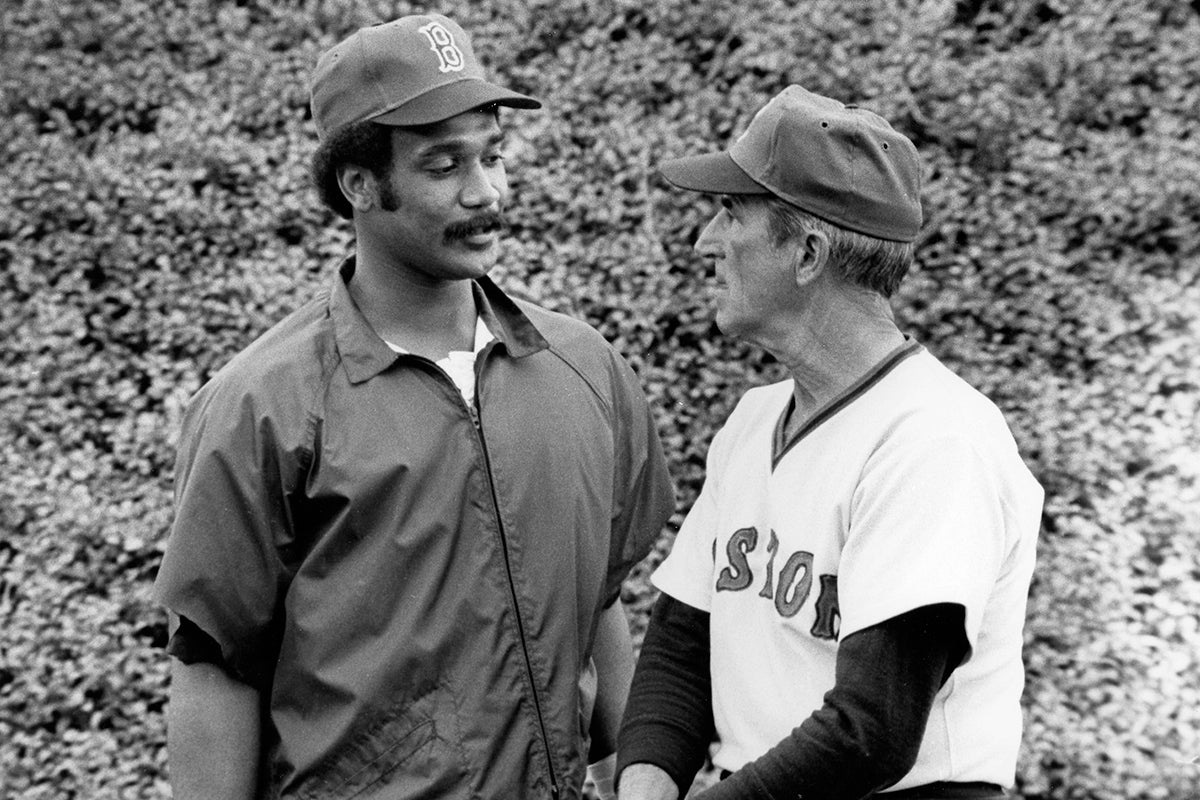
“When I was coming up through the Red Sox system I had a lot of mentors,” Rice said. “Johnny Pesky was my hitting instructor. I listened to Ted Williams, but Ted was a little different because he was a .400 hitter. A lot of things that Ted was talking about were way beyond me. Carl Yastrzemski and Rico Petrocelli were there. The thing about it was you always had good hitters around. You had guys in the Red Sox organization that played for years, and they knew the game.
“We’re hoping that we can get these guys down at Brockton to play the game the right way, too. We’ll have scouts there, and they’ll say, ‘Hey, this kid can play. He plays the right way.’ That’s what they’re looking for. When I started, I played three years of A ball, then with Double-A and Triple-A. It all depends on how you’re able to adjust every pitch, not every at bat. If you try to adjust every at bat, you’re 0-for-1. If you try to adjust every pitch, you still could be 1-for-1. And that’s what I tell people. You hate guys coming to the bench saying, ‘I’ll get them next time.’ Hey man, next time, you’re 0-for-1. Why didn’t you get them this time? Because you didn’t make that adjustment.”
Rice feels like he’s in a situation with Brockton where he can help a young player trying to get to the big leagues.
“Oh, I would love to, but the thing is you can’t step over someone’s toes because they’re going to spend more time with the kids than I am,” Rice said. “But still I’m going to give my insights. I was always told you can always give information, but if you’re not willing to receive it’s not going to do you any good. You’ve got to find the kid that wants to receive that information, and you’ve got to find out how he’s going to accept it.
“Everybody’s happy when you are successful, but when you start failing? That’s it. You can go 0-for-4, but you can be very successful. You can be productive. And people say, ‘Well, he went 0-for-4.’ I say, ‘Look, there’s a man on second base, fly ball, ground ball, to the right side. Man goes to third base. Next guy, drive me in.’ That’s productive.” So that’s what you have to look at.”
Jim Rice, left, credits the mentorship of longtime Red Sox coach Johnny Pesky, right, and teammates Ted Williams and Carl Yastrzemski for helping reach the Hall of Fame. (Boston Red Sox)
The Frontier League, founded in 1993, is an official MLB Partner League with 15 teams in the United States and three in Canada. Teams sign their own players, who usually are undrafted or one-time prospects who have been released.
“I’ll say it’s probably a level a little higher than college baseball. You’re finding the best kids you can put on the field. And that’s what it’s all about – being competitive, being the best that you can be,” Rice said. “And once you associate that with the league, you’re going to see some players that are really going to excel because they want to get to the big leagues.
“The dream is there. In other words, you’re given an opportunity – take advantage of it if you can.”
The Brockton Rox started in 2002 as part of the Northern League, which became the Can-Am League in 2005. After the 2011 season, the team was sold and transitioned to an amateur status, joining the Futures Collegiate Baseball League. Professional baseball returned to Campanelli Stadium in 2024 as the New England Knockouts in the Frontier League and are re-branding to the Rox.
“I’m excited about bringing Rox baseball back to Brockton,” Rice said. “In any sport, it doesn’t have to be baseball, the key thing here is to get the young kids off the street and into the ballpark.
“We will be spending a good amount of effort focusing on getting the younger generation involved in baseball.”
With Brockton’s home opener on May 16, Rice was looking forward to the reaction.
“I’m really excited, but I’m more excited for the people in Brockton and the players and the management. And when you see young kids in the stands, that is joy. It’s the next best thing to Marvin Hagler (boxing champion raised in Brockton),” Rice said with a laugh. “We had a big crowd when I was down there. We had a lot of hype down there. They were happy to get professional baseball back to Brockton. Very happy.”
Bill Francis is the senior research and writing specialist for the National Baseball Hall of Fame and Museum
UC San Diego men’s volleyball (1-0, 0-0 Big West) kicked off its 2026 campaign with a hard-fought 3-1 victory over Jessup (0-1, 0-0 MPSF) on Tuesday, Jan. 6, at LionTree Arena.
The key to the Tritons’ victory was the offensive firepower of junior outside hitter Josh Ewert, who racked up a game-high 17 kills, including the final point in two of the four sets. Junior outside hitter Leo Pravednikov added 15 kills of his own.
The first set showcased opening-game jitters with both sides committing a multitude of attacking errors. Ewert came to play from the first serve, racking up five kills in the opening set alone. However, Jessup had its own go-to guy — senior middle blocker Clement Osahon Jr. caused major issues for the Tritons early on. By the end of the set, UCSD shook off its early errors and created some separation. Fittingly, Ewert scored the set point, a kill that pushed his team over the line to clinch the first set with a score of 25-20.
The second set started sloppily, but a vicious kill from Triton junior middle blocker Leo Wiemelt ignited a spark. A sneaky dump set from senior setter John Luers extended the Tritons’ lead to six. Yet, UCSD was plagued by service errors following strong kills, allowing Jessup to remain on the Tritons’ heels.
“[The offense] is so potent at times, and then, at times, we struggled with the blockers and getting the ball in the court consistently,” head coach Brad Rostratter said in a postgame interview with The UCSD Guardian. “So, our strengths can be our weaknesses.”
Ewert led the Tritons to set point after a crafty tool of the Warriors’ block. Despite a final 3-point push from Jessup, a powerful kill from senior middle blocker Peter Selcho drove UCSD over the line 25-22.
Jessup refused to go quietly in the third. After a couple of early kills from Ewert, the Warriors found their momentum. UCSD responded with a block from Wiemelt and an emphatic kill and ace from junior outside hitter Sebastiano Sani. However, a solo 3-0 run from Jessup’s senior opposite hitter Carter Depue tied the game at 18. Late Triton errors ultimately allowed Jessup to build its lead and eventually take the set 25-22.
“Their middles did a really good job of committing, slowing down our middles, and touching and defending the middle of the court,” Rostratter said. “It’s something they did really, really well. And we struggled; it took a little bit of adjusting to their higher quick set.”
The Tritons decisively regained control in the fourth set, and Ewert set the tone with back-to-back service aces. UCSD went on an 8-2 run, which included a vicious kill from Selcho and another ace from Ewert. For the first time in the match, the Tritons had a comfortable lead at 18-11. Ewert sent one last back-row kill past the unresponsive Warriors to take the fourth set 25-20 for UCSD.
The Tritons stayed hot with a 3-1 home victory against Daemen on Friday, Jan. 9. UCSD will finish off its three-game homestand against Rockhurst on Sunday, Jan. 11, before heading to Utah to face BYU in a two-game road trip from Jan. 16-17.
FORT WAYNE, Ind. – The Purdue Fort Wayne men’s volleyball team collected their first win of the season on Sunday night (Jan. 11), topping NJIT in the Mastodons’ second five set match of the season (25-20, 18-25, 25-22, 23-25, 15-12).
Owen Banner and Carlo Huisden led the ‘Dons offensively in the match, combining for 43 of the ‘Dons 67 kills. Banner finished with 21 kills, two aces, nine digs and three total blocks. Huisden tallied 22 kills on a .472 hitting percentage, along with seven digs.
Both teams battled early in the first set, until NJIT took the lead with a 5-1 run. Purdue Fort Wayne rallied back midway through the set with their own 6-1 run to claim a 16-13 lead. The Mastodons finished the set on a .481 hitting percentage to take the frame 25-20.
The Highlanders jumped out to an early second set lead, using a 6-2 run. NJIT added onto their lead with the help of another 6-1 run, sitting on top of a 16-9 score. Despite the ‘Dons boasting another high hitting percentage (.429), the Highlanders maintained the lead and finished out the set at 25-18.
Purdue Fort Wayne rallied to begin the third set, shooting out on a 7-0 run. Banner earned nine of his kills and the Mastodons defense rejected four attacks during the frame. The ‘Dons took a 2-1 set lead after a 25-22 conclusion.
The fourth set was highly contested, neither side owned larger than a three point lead. Both teams were held to under .100 hitting percentage. NJIT forced a fifth set after taking the fourth 25-23.
Purdue Fort Wayne dropped the first two points of the final frame, but bounced back with a 6-1 run. NJIT closed the gap to 9-11 after a 3-0 run of their own. The Mastodons managed to hold on to their lead and close out the contest at 15-12.
Hunter Hopkins finished with a near double-double of 53 assists and nine digs. Casey Lyons tied his career-high with eight block assists. Andrew Mayer dug out 11 attacks in the contest.
Purdue Fort Wayne moves to 1-1. NJIT falls to 0-5. The Mastodons will take on the Under Armour Challenge, hosted by Lindenwood, next weekend. The ‘Dons will face off against Menlo on Friday (Jan. 16) and No. 11 CSUN on Saturday (Jan. 17).
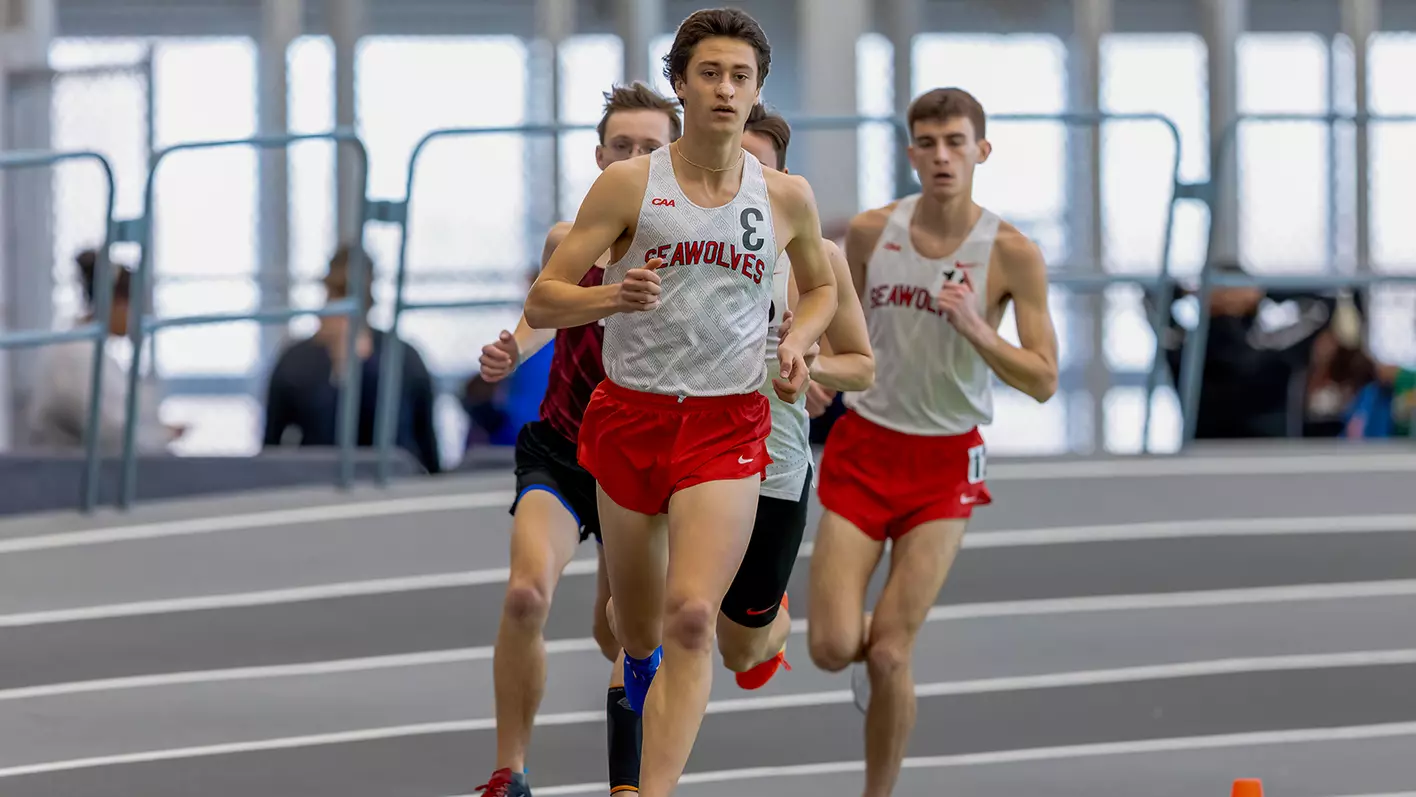
Brian Liebowitz during Jan. 10 race. Photo courtesy of Stony Brook Athletics
Stony Brook men’s track & field competed in its first meet of the New Year on Jan. 9 at the TCNJ Invitational from The Armory in New York City. As a team, the Seawolves recorded eight top-eight placements, including a first-place finish in the 3000m race by Brian Liebowitz.
HIGHLIGHTS
Liebowitz won the 3,000m, with a time of 8:33.52, setting a new PR.
Luca Maneri recorded a third-place finish in the mile run (4:23.26).
Freshman Jamal Joseph finished third in the 200m (22.41).
Cain Lawler placed fourth in the mile run (4:23.42).
Andrew Lawler posted a fifth-place finish in the mile run event, setting a new PR with a time of 4:23.65.
The team of Walesky Nowak, Andres Acosta Mondriguez, Jaden Medrano, and Matthew Brodsky finished fifth in the 4x400m relay (3:23.20).
Chris Tardugno recorded an eighth-place finish in the mile run, setting a new PR with a time of 4:27.64.
Brodsky finished eighth in the 500m and set a new PR in the event (1:06.37).
The team continues its busy January slate returning to The Armory for the Ramapo College Invitation on January 16, with action set to begin at 9:30 am.
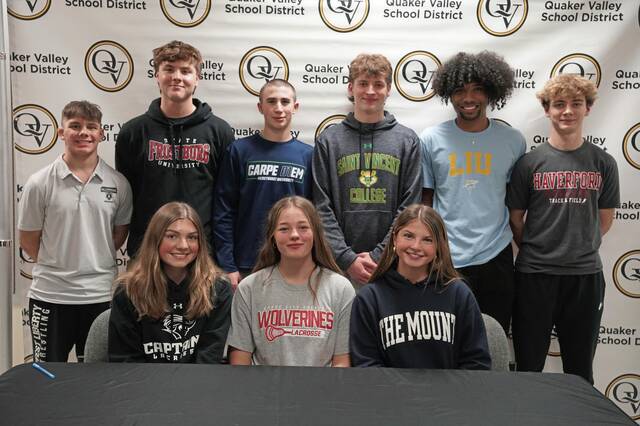
Seniors at Quaker Valley who will continue their careers at the next level include, in front, from left, Meredith Fallgren, Alexa Westwood, Makenna Kamnikar; in back, from left, Eoin Parnell, Todd Kagle, Bruce Anderchak, Henry Zupanc, Jayden Juliano and River Capek.
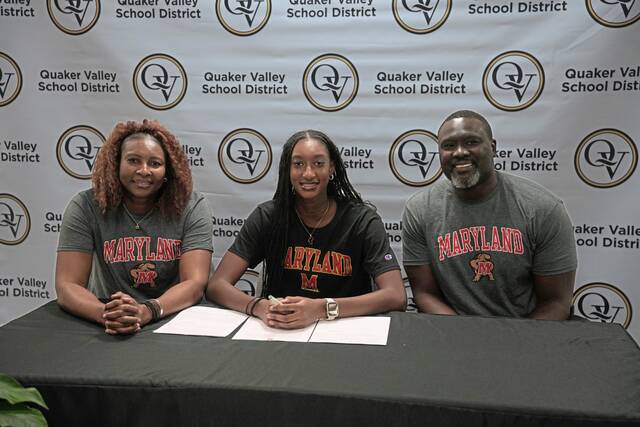
Quaker Valley senior Mimi Thiero signed to play basketball at Maryland. She was joined by her parents, from left, Mariam and Almany. (Photos: Quaker Valley School District)
Previous
Next
Quaker Valley’s college signings for 2025-26 hit double figures in December.
A total of 10 senior athletes at QV finalized their college commitments last month including Todd Kagle (Frostburg State baseball), Meredith Fallgren (Christopher Newport lacrosse), Bruce Anderchak (Mercyhurst wrestling), River Capek (Haverford cross country and track and field) and Alexa Westwood (Grove City lacrosse).
Kagle is a 6-foot-2, 195-pound right-handed pitcher/shortstop/third baseman. He was recruited as a pitcher by Frostburg State, located in Western Maryland.
“The baseball team has been successful over the past couple years, making a run in the MEC tournament four years in a row,” said Kagle, who has a 3.7 GPA. “It’s a great opportunity and felt like the best overall fit for me. I also really liked the coaches.”
Fallgren is a midfielder/defender on the QV girls lacrosse team. She also participates in Student Council, Key Club and Letters of Love.
The 5-2 Fallgren actually made an early commitment to Christopher Newport, located in Newport News, Va.
“Christopher Newport University has a great balance of academics and athletics. They also have excellent facilities,” Fallgren said. “The lacrosse program is amazing. They are a very competitive team. They have a great team culture that I’m excited to be a part of, and they are a very competitive team.”
Christopher Newport proved to be the frontrunner for Fallgren.
“CNU was the first school I visited,” she said. “After being there, I kept comparing the other schools I visited against it. It always just stood out to me. CNU plays a very challenging schedule, and they often are in the (Division III) NCAA Tournament. I was impressed by how hard they work playing that schedule.
“In addition, CNU is bigger than other schools I looked at, has great academics and offers a lot of majors. It is also beautiful and near the beach.”
Fallgren is looking to majoring in business and also has an interest in sports management.
Capek (5-10, 140) competes mainly in the 400- and 800-meter races on the track. He plans to pursue a double major in biology and psychology on a premed track and has a weighted GPA of 4.54.
“I decided to sign with Haverford because it is an academically strong school and the track team has shown a lot of success over the years,” Capek said. “Haverford is a small liberal arts school outside of Philadelphia and is pretty academically competitive. The track and field and cross country programs have seen a lot of success in the past, including sending many track athletes to NCAA nationals in the past years.
“There are also very strong community and honor values at Haverford, which I appreciate a lot.”
Rounding out the 10-pack of recent college signings at QV are Henry Zupanc (Saint Vincent baseball), Eoin Parnell (West Liberty wrestling), Makenna Kamnikar (Mount St. Mary’s golf), Jayden Juliano (Long Island track and field) and Mimi Thiero (Maryland basketball).
The 6-1, 175-pound Zupanc is a pitcher/outfielder who plans to major in sports management in college.
“I chose Saint Vincent because it felt like the best fit for me with both my academic and athletic goals,” Zupanc said. “I really liked the campus environment and the coaching staff’s approach to the game.
“Saint Vincent emphasizes strong academics, character building and community. The baseball program is competitive and focused on player development on and off the field, and I like the culture around the team that the program promotes.”
Zupanc also was on the boys golf team at QV and participates in the sports medicine club.
“I take pride in working hard, being a good teammate and leader, and I’m excited to contribute to the Saint Vincent baseball program,” he said.
Zupanc was a .300 hitter last season with four triples.
Parnell (5-4, 120) has been a member of the QV wrestling program for four years. He has been unable to compete this season because of an injury that surgery will address.
“However, I’m still going to be as active as possible on the team as a captain,” he said, “and try to do as much as I can with the team.”
Parnell has a 4.18 GPA, is a peer jury member and plans to major in prelaw at West Liberty.
“I felt that the culture they’ve built in their wrestling program would benefit me the most and help me build to my fullest potential,” Parnell said. “I also feel at home there. The people are amazing and overall it just felt right.
“The wrestling program is run by head coach Danny Irwin, who I have known and built a really good connection with over the past few years. I know their assistant coach Alec Cook as well, who I wrestled with at my wrestling club since I was 5. They truly operate as a family and really make you feel comfortable and at home. And to add, signing with West Liberty was not an easy decision, but through their guidance and advice of my parents and my coaches, the answer became pretty clear.”
The Fury lost to the Omaha Supernovas 3-1 on Jan. 10 but set a franchise record with 17 blocks.
The final scores were 25-22, 25-22, 24-26, 25-23. The loss, before an announced crowd of 5,881 at Nationwide Arena, dropped the Fury to 1-1. The Supernovas are 2-0.
The Fury were led by Megan Lush, who finished with 12 kills, 10 digs and five blocks. Raina Terry added 10 kills and 15 digs. Abby Walker added 10 kills. Regan Pittman-Nelson had eight kills and four blocks.
The Fury opened their season with a 3-1 win over the Atlanta Vibe on Jan. 8.
“What we take away from the first week is that we have a team to compete with anybody,” coach Ángel Pérez said in a team-issued release. “There is so much growth still to go but with the base that we have we are in a far better place than years before. We are all excited about it.”
Ashley Evans had 35 assists and 13 digs. Aleksandra Jegdic finished with 17 digs and chipped in three assists.
The 17 blocks by the Fury surpassed the previous record of 16 blocks against Indianapolis on April 5.
An old proverb says the best way to learn to swim is to be thrown in the deep end. With the blue waters of the Pacific Ocean in sight, the Harvard men’s volleyball team dove into the deepest waters of collegiate men’s volleyball at the ASICS Invitational hosted by the University of California Santa Barbara.
Harvard (0-3) sank for much of its first two matches against No. 6 UC Irvine (3-0) and No. 11 California State University, Northridge (CSUN) (3-0) before showing growth in its final match against the hosts. Although the Crimson also dropped its final game against No. 17 UCSB (3-0), Harvard played its best volleyball of the weekend and generated hope for the future.
“This definitely helped prepare us for the challenges of the conference season,” said captain and middle blocker Brian Thomas, when reflecting on the gauntlet of nationally-ranked opponents that his team faced this weekend. “These teams are incredible. Being able to test ourselves in these tougher matches, see what is working, what’s not, and kind of find our identity, I think, is instrumental.”
Harvard 0 UCI 3
The Crimson faced a tall task for the first matchup of the season with the Anteaters being ranked as the sixth best team in the nation by the American Volleyball Coaches Association national preseason poll. The Anteaters showed why the AVCA lofted this high praise on them early in the contest as they stormed out to a 6-1 lead.
Harvard, looking to replace the production of graduated star setter James Bardin, turned to junior Adrian Shevchuk for the first match. Shevchuk and talented freshman Kai Gan exchanged setter duties throughout the preseason and continued to do so throughout the tournament. Shevchuck finished the match with 12 assists and one error.
Shevchuck found junior outside Quinn Bishop for the first kill of the season. He then found sophomore outside Sawyer Nichols for Nichols’ first point in what turned into a strong weekend for the sophomore.
Errors and a powerful UC Irvine offense proved too much for the Crimson to overcome in the first set, which proved to be a theme for the entirety of the match.
Harvard showcased its strengths to start the second set. Thomas’s gigantic presence in the middle contributed to a block, and athletic junior middle Owen Woolbert flew high for a kill. Bishop and Nichols added to their point totals as the Crimson opened an 8-5 lead.
But, in a similar fashion to the first set, the Anteaters ultimately took the lead and pulled away. Harvard struggled with serve receive during the UC Irvine run and put itself consistently behind the eight ball.
The final set looked much like the first two, with the Crimson struggling to find a rhythm offensively and proving overmatched by the athleticism and talent of the Anteaters. Struggles were a common sight for teams facing UC Irvine during the weekend, as the Anteaters did not drop a single set at the invitational.
Harvard 1 CSUN 3
Life did not get much easier for Harvard as another highly rated opponent awaited the team for the Friday game. The Matadors came out strong, dominating all aspects early and taking advantage of the shaky Crimson serve receive.
Harvard opted for the younger setter in this match, and Gan delivered with a strong performance of 24 assists, one setting error, and five kills. The Crimson also turned to a freshman at libero, with Eric Su entering the game and staying the rest of the way.
After a rough first set, Harvard came out strong and took an early lead in set two. The two middles, Thomas and Woolbert, contributed kills to the Crimson attack. Returning All-EIVA honorable mention and captain Zach Berty also got in on the action with a kill. A Nichols kill stretched the Harvard lead to 15-10.
It was all CSUN from there as the Matadors rattled off 15 of the next 19 points to turn what could have been a bright spot for the Crimson into a comfortable set for CSUN.
Harvard played the role of comeback kids in the third set as the Matadors jumped out to an early lead. The Crimson then put together its best stretch of the match, firing on all cylinders. Nichols especially stepped up for Harvard, hammering eight kills in the set.
The final set proved forgettable for the Crimson. Despite the Crimson’s early lead in the third set, the team quickly succumbed to the Matadors. Harvard ended the game with a stronger performance than it displayed in its season opener, but still searching for consistency.
Harvard 1 UCSB 3
With two straight losses to start the season and tournament, Harvard looked to turn the tide in its final match in California. Unfortunately, the Crimson once again proved overmatched.
Harvard stuck with the young players for the final game, awarding Gan and Su the starting positions.
The Crimson played its best volleyball of the weekend in the opening set, winning a back-and-forth thriller behind strong play and cohesion. Harvard played particularly well at the net, stifling the Gauchos’ offense. After a slow first two games, Bishop came alive for the Crimson, contributing to the block and the net and scoring in crafty ways.
UCSB came out with a vengeance in the second set, but Harvard recovered and turned the set into a battle. Down 18-19, the Crimson fell apart to end the set as the Gauchos scored six straight to clinch the second set.
To make matters worse for Harvard, UCSB continued that momentum to score four more to start the third set. By the time the Crimson had recovered, the deficit was insurmountable, as a chance to be up two sets had turned into a set deficit.
The Crimson battled again in the fourth set, but the Gauchos’ consistency ultimately won out. Throughout the weekend, Harvard showed flashes of great volleyball but could not sustain it for long stretches.
The difficult weekend helped grow the team both on and off the court. “Huge for team chemistry,” said Thomas.
The weekend also provided a rare chance to play near home for many of the players who grew up in California.
“My senior year, my last season, being able to play at the school that my sister attends is a really unique opportunity that I’m grateful for,” said Thomas, who grew up in Morgana, California.
The Crimson return to the court on Friday, Jan. 17th at home against Manhattan University. The game starts at 7 p.m. EST and airs on ESPN+. The team will also play Saturday at 3 p.m. EST.
– Staff writer Reed M. Trimble can be reached at [email protected]. Follow him on X at @ReedTrimble1. Follow @THCSports for all of The Crimson’s sports coverage.