CINCINNATI, Ohio – Behind five scoreless innings from Tazwell Butler and five runs batted in by David Bishop, K-State set a school record for most conference wins in a season en route to a 9-5 victory against Cincinnati Saturday afternoon at UC Baseball Stadium.
With the win, the Wildcats (31-23) finish the regular season with a winning record for the sixth consecutive year, that includes a 17-13 mark in Big 12 play. The Cats’ 17 conference wins are the most in school history, breaking the previous record held by the 2013 team.
“Guys played well in a pressure situation, you always love to see that,” seventh-year head coach Pete Hughes commented. “They set the tone early. They didn’t let the first two games in the series beat them today, and we took the momentum right from the beginning of the game and kept it in large part by great offensive efforts, by Seth Dardar and David Bishop.”
Bishop, a native of Marietta, Georgia, achieved his career day with a three-run blast in the second – his fourth homer of the year. The senior first baseman ended the day going 2-for-5 with five RBI and two runs scored.
In addition to Bishop, seven other players contributed to the Wildcats’ 12 hits. Dardar posted a three-hit day (3-for-4) to pace the offense, that included his 12th homer, while Maximus Martin was 2-for-4 with two runs scored. The 1 through 4 spots in the lineup combined to hit .412 (7-for-17) with four RBI.
“Tazwell Butler was our MVP today. He settled in with a lead, let people make plays behind him, and got some strikeouts. He was our MVP today,” added Hughes.
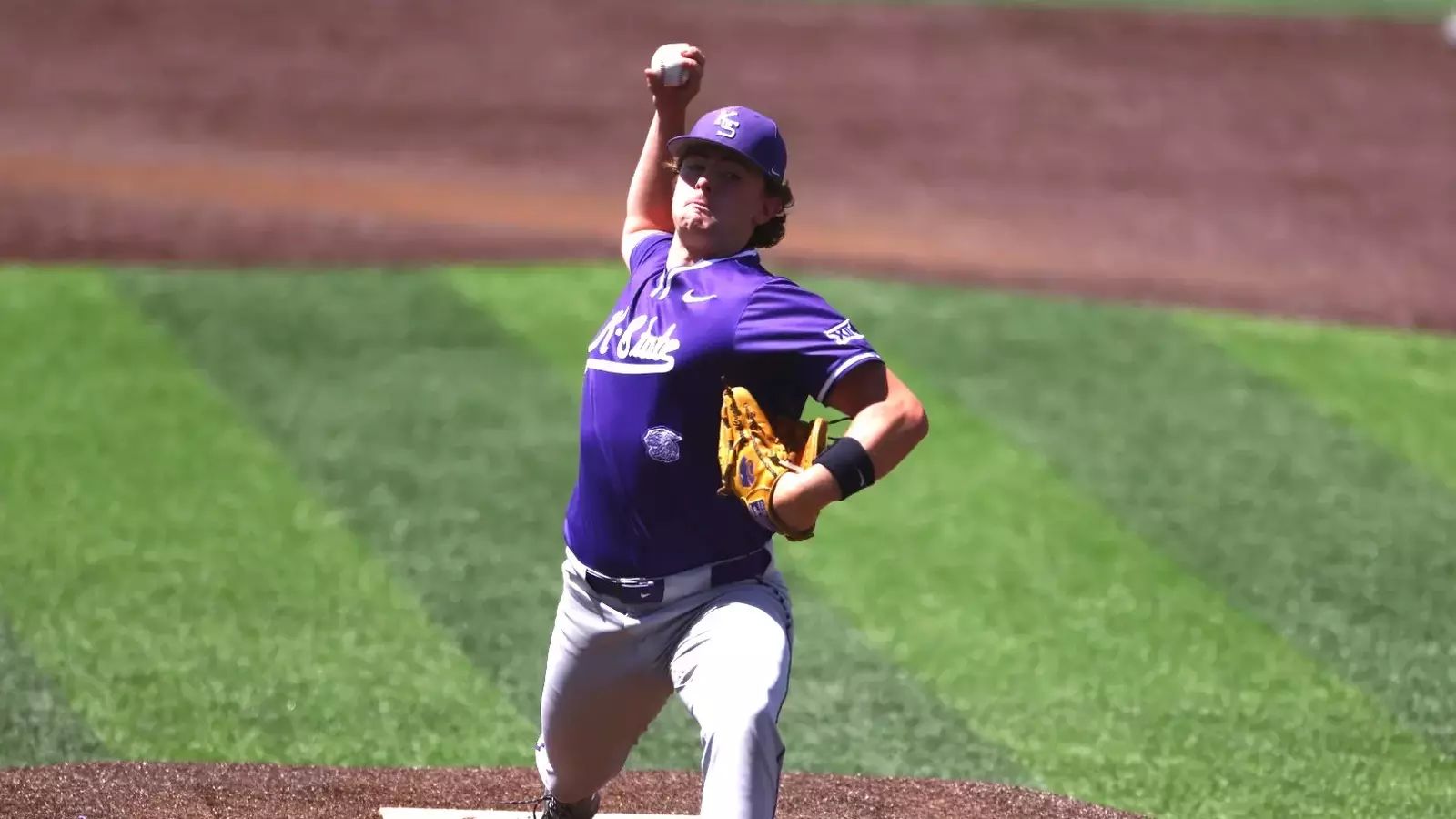
Butler (1-1) was awarded his first victory at K-State, after firing five scoreless innings in relief of starter Lincoln Sheffield. The Sandy Springs, Georgia product limited the Bearcats (31-23, 16-14 Big 12) to just two hits in his 15th outing of the season.
K-State now turns its efforts towards the Phillips 66 Big 12 Baseball Championship at Globe Life Field in Arlington, Texas, starting Wednesday, May 21. The single-elimination championship field of 12 will be announced at the conclusion of the conference’s final game on Saturday.
HOW IT HAPPENED K-State jumped on the board in the first, as Keegan O’Connor drilled a two-out double off the wall in right field to drive in Martin from second.
The Wildcats continued to put pressure on early, exploding for five runs in the second.
Dee Kennedy was hit by a pitch to lead off the inning, followed by catcher Bear Madliak’s bunt for a single, before the duo each advanced 90-feet on a wild pitch. With runners in scoring position, Bishop doubled into right center to extend the lead, 3-0.
A sacrifice bunt moved Bishop to third, until Shintaro Inoue lifted a ball deep into left field, allowing Bishop to score.
Maximus Martin singled up the middle and came around the bases in the next at bat, as Dardar hit a towering shot off the basketball arena in right field to hand the Wildcats a 6-0 lead.
In the third, AJ Evasco and Dee Kennedy each walked and moved into scoring position with a sacrifice bunt from Madliak. With one out, Bishop belted his fourth homer of the year out to left center, making it a 9-2 ball game.
The Bearcats chipped away at the Cats’ lead, tallying a run in four of the first five innings to pull the score within four, 9-5.
Butler relieved Sheffield in the fifth and inherited a runner on first with no outs. The right-hander retired 11 consecutive batters to preserve the four-run lead.
INSIDE THE BOX
K-State scored nine runs on 12 hits, committed no errors, and left eight runners on base.
UC scored five runs on 11 hits with one error committed and six men left stranded.
Eight players contributed a hit with three recording multiple.
Dardar went 3-for-4 with two RBI and a run scored, followed by Bishop and Martin each with two hits.
Bishop drove in a career-high five RBI, highlighted by a three-run homer in the second.
Dardar and Bishop each homered, marking K-State’s 28th game hitting two or more.
Sheffield was tagged for five earned runs on nine hits in his four innings.
Butler fired five scoreless innings in relief, allowing just two hits and striking out five to earn the win (1-1).
K-State scored all nine runs in the first three innings.
Schultz (0-2) took the loss, surrendering five earned runs in 1 2/3 innings.
Niehaus led UC’s offense, going 3-for-4, while Sefcik drove in a team-high two RBI.
TEAM NOTES
The Cats’ 17th Big 12 victory marks the most conference wins in a season in school history.
With the win, K-State tied the all-time series 3-3, while it was the Cats’ first win in Cincinnati.
K-State has homered in 39 of 54 games this season, hitting multiple in 28 of those (25-3).
The win marked the first regular season finale victory since 2017.
BERKELEY, Calif. — Cal quarterback Jaron-Keawe Sagapolutele is a college football conundrum.
His debut for the Golden Bears in August defied traditional expectations for a true freshman. He was composed. He was accurate. He showcased his big arm and the physical attributes — at 6-foot-3, 225 pounds — that made him one of the most coveted high school quarterbacks in the 2025 class. For anyone who remembered Jared Goff’s debut in Berkeley over a decade earlier, the feeling was familiar. Here was a player for which college football would serve as a pit stop to the NFL.
In another era — like with Goff, not that long ago — Sagapolutele’s arrival would have translated into optimism about the future. If he was this good already, what will he look like as a junior or senior? How good will the team be once he develops?
Sagapolutele’s emergence, though, was processed differently. It was still natural to wonder about how he would progress, but it was accompanied with inevitable speculation: Can Cal keep him?
From the beginning, Sagapolutele said what Cal fans wanted to hear.
“This is where I want to be. I want to be at Berkeley. I want to be a Bear,” he told ESPN in September. “And going forward, I just hope everyone knows that. This is where I want to be. This is my home.”
As the season unfolded, the dips arrived. Turnovers. Missed reads. They were normal hiccups of a freshman quarterback learning on the fly. Meanwhile, Fernando Mendoza — Cal’s starting quarterback for most of the previous two seasons — had developed into a surefire first-round NFL draft pick and was on his way to winning the Heisman Trophy and leading Indiana to the top seed in the College Football Playoff.
Nothing in college football exists outside the quarterback transfer prism anymore. Every roster decision, coaching hire, NIL budget and depth-chart conversation is filtered through the same question: Who’s the quarterback, and how long do we actually have him?
EVEN BEFORE TRANSFER restrictions were lifted, quarterbacks always moved at higher rates than other positions. Only one is on the field, and without a clear path to playing time, players were willing to sit out a year — even losing a year of eligibility — just to try their shot elsewhere.
Now, with the ability to transfer and play immediately, things have been accelerated. When the transfer portal opened last week, there were more than 100 quarterbacks on the move. Done correctly, the portal offers a fast track out of offensive irrelevance. The safest formula has proved to be the least imaginative: bring the quarterback with the coach.
This past year, John Mateer went with his offensive coordinator, Ben Arbuckle, from Washington State to Oklahoma. Devon Dampier did the same at Utah, moving with offensive coordinator Jason Beck from New Mexico. And in both cases, it worked: Each helped guide their team to a 10-win season, a year after the Sooners and Utes finished with losing records.
They were hardly unique. Bo Nix transferred to Oregon to reunite with offensive coordinator Kenny Dillingham, who coached him for a year at Auburn. Caleb Williams followed Lincoln Riley to USC and won the Heisman Trophy. Cam Ward thrived after moving with Eric Morris from Incarnate Word to Washington State. Dillon Gabriel reunited with Jeff Lebby, his former coordinator at UCF, when he transferred to Oklahoma.
When a player moves with a coach, it simplifies the evaluation. Michael Penix Jr. transferred to Washington to reunite with Kalen DeBoer, who had coached him as the offensive coordinator at Indiana. Ryan Grubb, UW’s then-offensive coordinator and the current OC at Alabama, said because Penix already spoke the language, the transition was easy.
“Michael was in our system in Indiana. You saw him running our stuff and it was like, ‘Oh wow he’s not only going to be able to come in and do the things that we believe he can do, but being able to understand the system — this is how we call this, this is going to go pretty quick,'” Grubb said.
It becomes harder to evaluate, Grubb said, if a quarterback had been operating in a completely different style of offense.
“If a player was running Tennessee’s offense and then trying to come in and run ours — and Tennessee’s a really good offense. But it’s like if they’re trying to run our system, is that going to translate?” he said. “Just two really, really different systems, where I don’t know if this guy’s already been there for a couple years and he’s entrenched, it’s going to take a little bit of time.
“And if you’re saying this guy’s coming here to be your starter, you better be pretty certain that he has the capabilities mentally to run your system.”
Penix’s familiarity translated directly to production. At Washington, Penix threw for 4,641 yards and 31 touchdowns in 2022, then followed it with 4,903 yards and 36 touchdowns in 2023, turning the Huskies into a national contender almost overnight. Over two seasons, Washington went 25-3, reached the College Football Playoff National Championship game, and Penix finished as a Heisman Trophy finalist before being selected No. 8 in the 2024 NFL draft. Since the portal opened, multiple teams are following a similar path.
Rocco Becht has said he plans to reunite with Matt Campbell after Campbell’s move from Iowa State to Penn State. Drew Mestemaker announced he would follow Eric Morris from North Texas to Oklahoma State. And AJ Hill committed to Arkansas, following new Razorbacks coach Ryan Silverfield from Memphis. The logic is the same: minimize uncertainty and shorten the time between arrival and impact.
Texas hasn’t used that model, but offensive coordinator Kyle Flood sees the logic.
“I think if you asked any college coach, they would tell you, in a perfect world, you would love to recruit your own players, retain them and develop them over three, four, five years, whatever that looks like,” Flood said. “But kind of like what I said before, that is not college football anymore. It is not.
“I think the art of recruiting is really the art of evaluation. It is not evaluating if he is a good player or not. That is not really the evaluation. The evaluation is does he have the traits to really excel at a high level in your system.
“Meeting them now, when they are in the portal, is not like meeting them in high school. It is really like your NFL top-30 visits where you say, ‘Hey, I have to get this guy in a room and I have to find out does this guy want to be coached, does he believe in the things that we believe in, how great does this player really, really want to be.'”
DESPITE SAGAPOLUTELE’S CONSTANT refrain throughout the season that he wanted to remain in Berkeley, there is only so much trust that can be placed in that sort of talk.
After all, Sagapolutele had committed to Cal, flipped to Oregon, enrolled, spent time on campus in Eugene and then reversed course again to land in Berkeley. That’s all to say, circumstances change.
As the season wore on, the skepticism about his future never fully disappeared, and when coach Justin Wilcox was fired, it was again front and center.
As general manager Ron Rivera began Cal’s coaching search, the quarterback position was part of the discussion from the start. Rivera relayed to candidates he felt strongly they would be able to retain Sagapolutele and laid out the plan to do so. There were no guarantees offered. Rivera described a process that mirrored free agency as much as recruiting.
The pitch wasn’t just about retaining one player.
“With a guy like that, people are going to want to come play for him and play with him, be a receiver, be a tight end, be a running back, be an offensive lineman,” Rivera said. “Why? Because not only are the scouts going to come watch him, but they’re going to see the other people around him.”
After Tosh Lupoi was hired, the urgency turned concrete. One of Lupoi’s first moves was to board a commercial flight to Hawai’i, where Sagapolutele was home on a brief visit. Lupoi met him face-to-face and quickly secured his commitment to stay.
Keeping Sagapolutele in place had a cascading effect. Retention became easier. Recruiting did, too. Receivers and skill players want to know who’s throwing the ball. Stability at quarterback, even if temporary, creates momentum.
But nothing about it is permanent. These are battles won a year at a time now. If Sagapolutele takes the expected step forward next season, the speculation will return just as quickly. That isn’t a judgment on him or on Cal. It’s simply the reality of modern college football.
BERKELEY, Calif. — Calquarterback Jaron-Keawe Sagapolutele is a college football conundrum.
His debut for the Golden Bears in August defied traditional expectations for a true freshman. He was composed. He was accurate. He showcased his big arm and the physical attributes — at 6-foot-3, 225 pounds — that made him one of the most coveted high school quarterbacks in the 2025 class. For anyone who rememberedJared Goff’sdebut in Berkeley over a decade earlier, the feeling was familiar. Here was a player for which college football would serve as a pit stop to the NFL.
In another era — like with Goff, not that long ago — Sagapolutele’s arrival would have translated into optimism about the future. If he was this good already, what will he look like as a junior or senior? How good will the team be once he develops?
Sagapolutele’s emergence, though, was processed differently. It was still natural to wonder about how he would progress, but it was accompanied with inevitable speculation: Can Cal keep him?
From the beginning, Sagapolutele said what Cal fans wanted to hear.
“This is where I want to be. I want to be at Berkeley. I want to be a Bear,” he told ESPN in September. “And going forward, I just hope everyone knows that. This is where I want to be. This is my home.”
As the season unfolded, the dips arrived. Turnovers. Missed reads. They were normal hiccups of a freshman quarterback learning on the fly. Meanwhile, Fernando Mendoza — Cal’s starting quarterback for most of the previous two seasons — had developed into a surefire first-round NFL draft pick and was on his way to winning the Heisman Trophy and leading Indianato the top seed in the College Football Playoff.
Nothing in college football exists outside the quarterback transfer prism anymore. Every roster decision, coaching hire, NIL budget and depth-chart conversation is filtered through the same question: Who’s the quarterback, and how long do we actually have him?
EVEN BEFORE TRANSFER restrictions were lifted, quarterbacks always moved at higher rates than other positions. Only one is on the field, and without a clear path to playing time, players were willing to sit out a year — even losing a year of eligibility — just to try their shot elsewhere.
Now, with the ability to transfer and play immediately, things have been accelerated. When the transfer portal opened last week, there were more than 100 quarterbacks on the move. Done correctly, the portal offers a fast track out of offensive irrelevance. The safest formula has proved to be the least imaginative: bring the quarterback with the coach.
This past year, John Mateer went with his offensive coordinator, Ben Arbuckle, from Washington Stateto Oklahoma. Devon Dampier did the same at Utah, moving with offensive coordinator Jason Beck from New Mexico. And in both cases, it worked: Each helped guide their team to a 10-win season, a year after the Sooners and Utes finished with losing records.
They were hardly unique.Bo Nix transferred to Oregon to reunite with offensive coordinator Kenny Dillingham, who coached him for a year atAuburn. Caleb Williams followed Lincoln Riley toUSCand won the Heisman Trophy. Cam Ward thrived after moving with Eric Morris fromIncarnate Wordto Washington State. Dillon Gabriel reunited with Jeff Lebby, his former coordinator atUCF, when he transferred to Oklahoma.
When a player moves with a coach, it simplifies the evaluation.Michael Penix Jr. transferred toWashingtonto reunite with Kalen DeBoer, who had coached him as the offensive coordinator at Indiana. Ryan Grubb, UW’s then-offensive coordinator and the current OC atAlabama, said because Penix already spoke the language, the transition was easy.
“Michael was in our system in Indiana. You saw him running our stuff and it was like, ‘Oh wow he’s not only going to be able to come in and do the things that we believe he can do, but being able to understand the system — this is how we call this, this is going to go pretty quick,'” Grubb said.
It becomes harder to evaluate, Grubb said, if a quarterback had been operating in a completely different style of offense.
“If a player was runningTennessee’s offense and then trying to come in and run ours — and Tennessee’s a really good offense. But it’s like if they’re trying to run our system, is that going to translate?” he said. “Just two really, really different systems, where I don’t know if this guy’s already been there for a couple years and he’s entrenched, it’s going to take a little bit of time.
“And if you’re saying this guy’s coming here to be your starter, you better be pretty certain that he has the capabilities mentally to run your system.”
Penix’s familiarity translated directly to production. At Washington, Penix threw for 4,641 yards and 31 touchdowns in 2022, then followed it with 4,903 yards and 36 touchdowns in 2023, turning the Huskies into a national contender almost overnight. Over two seasons, Washington went 25-3, reached the College Football Playoff National Championship game, and Penix finished as a Heisman Trophy finalist before being selected No. 8 in the 2024 NFL draft. Since the portal opened, multiple teams are following a similar path.
Rocco Becht has said he plans to reunite with Matt Campbell after Campbell’s move from Iowa Stateto Penn State. Drew Mestemaker announced he would follow Eric Morris from North Texasto Oklahoma State. And AJ Hillcommitted to Arkansas, following new Razorbacks coach Ryan Silverfield fromMemphis. The logic is the same: minimize uncertainty and shorten the time between arrival and impact.
Texashasn’t used that model, but offensive coordinator Kyle Flood sees the logic.
“I think if you asked any college coach, they would tell you, in a perfect world, you would love to recruit your own players, retain them and develop them over three, four, five years, whatever that looks like,” Flood said. “But kind of like what I said before, that is not college football anymore. It is not.
“I think the art of recruiting is really the art of evaluation. It is not evaluating if he is a good player or not. That is not really the evaluation. The evaluation is does he have the traits to really excel at a high level in your system.
“Meeting them now, when they are in the portal, is not like meeting them in high school. It is really like your NFL top-30 visits where you say, ‘Hey, I have to get this guy in a room and I have to find out does this guy want to be coached, does he believe in the things that we believe in, how great does this player really, really want to be.'”
DESPITE SAGAPOLUTELE’S CONSTANT refrain throughout the season that he wanted to remain in Berkeley, there is only so much trust that can be placed in that sort of talk.
After all, Sagapolutele had committed to Cal, flipped to Oregon, enrolled, spent time on campus in Eugene and then reversed course again to land in Berkeley. That’s all to say, circumstances change.
As the season wore on, the skepticism about his future never fully disappeared, and when coach Justin Wilcox was fired, it was again front and center.
As general manager Ron Rivera began Cal’s coaching search, the quarterback position was part of the discussion from the start. Rivera relayed to candidates he felt strongly they would be able to retain Sagapolutele and laid out the plan to do so. There were no guarantees offered. Rivera described a process that mirrored free agency as much as recruiting.
The pitch wasn’t just about retaining one player.
“With a guy like that, people are going to want to come play for him and play with him, be a receiver, be a tight end, be a running back, be an offensive lineman,” Rivera said. “Why? Because not only are the scouts going to come watch him, but they’re going to see the other people around him.”
After Tosh Lupoi was hired, the urgency turned concrete. One of Lupoi’s first moves was to board a commercial flight to Hawai’i, where Sagapolutele was home on a brief visit. Lupoi met him face-to-face and quickly secured his commitment to stay.
Keeping Sagapolutele in place had a cascading effect. Retention became easier. Recruiting did, too. Receivers and skill players want to know who’s throwing the ball. Stability at quarterback, even if temporary, creates momentum.
But nothing about it is permanent. These are battles won a year at a time now. If Sagapolutele takes the expected step forward next season, the speculation will return just as quickly. That isn’t a judgment on him or on Cal. It’s simply the reality of modern college football.br/]
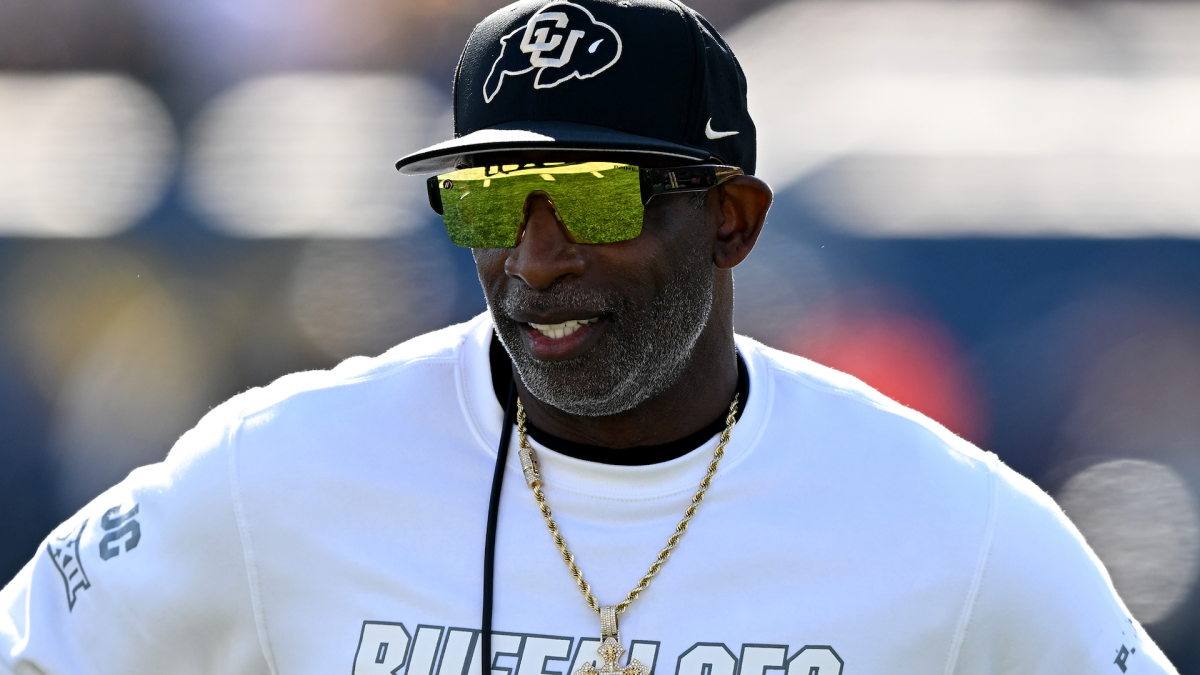
Colorado’s rebuild is full tilt under Deion Sanders, who enjoyed the confidence of outgoing athletic director Rick George amid the most important two-week stretch of his coaching career with the Buffaloes.
During this singular transfer portal window, Sanders will try and piece together a two-deep of newcomers that sparks on-field change in 2026 ahead of spring practice and a positive leap forward after a disappointing campaign.
With minimal returning starters from a 3-9 team, this is the Buffaloes’ opportunity to hit the reset button. It comes with considerable pressure after several personnel department and coaching staff changes followed the program’s second tumultuous stretch in three years. Colorado only signed a dozen players in its 2026 recruiting class from the prep ranks, a group slotted outside the top-50 nationally per 247Sports’ rankings.
The Buffaloes are only expected to add two more current verbal commits in February, so this roster overhaul will be portal-driven next season.
“Punter Damon Greaves is committed to returning to Boulder as a senior, but otherwise there are needs across the roster, at every position group,” BuffStampede insider Adam Munsterteiger told CBS Sports. “Even the quarterback room, with a solid young (starter) in Julian Lewis, needs multiple additions following the graduation of Kaidon Salter and the decision from Ryan Staub to hit the portal. There is some solid skill and offensive line talent in the program to build around and add to.”
Personnel changes at Colorado
Colorado’s newly-promoted director of player personnel, Darrius Darden-Box, has his hands full with talent assessment and evaluations after the exit of Corey Phillips to Memphis. Phillips was the primary driver behind Sanders’ first three portal classes at Colorado along with the Buffaloes’ signings of Lewis, cornerback Cormani McClain and five-star offensive tackle Jordan Seaton.
Promoted internally by Sanders, Darden-Box faces an exodus of contributors like all others on Colorado’s staff, with the most notable defections to the portal as of Jan. 3 to include safety Tawfiq Byard, edge rushers London Merritt and Alex McPherson, wideout Omarion Miller, defensive tackle Brandon Davis-Swain and offensive playmaker Dre’lon Miller.
More than two dozen Colorado players have left the program since the Buffaloes’ season-ending loss to Utah.
“The thing about these guys man, you’ve got to understand when a guy leaves a program that selected him or picked him out of the portal, he leaves for a multitude of reasons,” Sanders said after that game on expected roster changes. “The No. 1 reason people leave is money. It’s not a disdain for staff or a disdain for player, it’s money. Let’s just be honest man and stop sugar-coating this foolishness. That’s why most people leave.
“I admire the guys that want to go for another opportunity or bigger opportunity and play for a national championship … I applaud that, but that’s not the No. 1 reason people leave programs.”
Much like Jeff Brohm’s recruiting philosophy at Louisville and what Lane Kiffin previously spearheaded at Ole Miss before leaving for LSU, Sanders’ transfer-first mindset has featured 128 total transfer signings over the last three cycles — the most in college football.
Sanders landed the top-ranked transfer class in 2023 ahead of his first season with the Buffaloes and finished inside the top-20 each of the past two cycles. For 2026, Sanders has an uphill climb with more than two-dozen expected signings based on the number of scholarships now available.
Sanders’ transfer portal hauls at Colorado
Making new pieces fit, at least on offense, will be the job of new play-caller Brennan Marion. Sacramento State’s head coach last season, Marion brings his “Go-Go” scheme to the Buffaloes after Pat Shurmur was stripped of play-calling duties in November given third-down struggles and seemingly abandoning the run game.
Marion’s system is tempo-based, heavy on running the football and utilizes a two-back look most of the time. All of those factors should benefit Lewis in his continued development after he made couple starts during the final month of the season.
Sanders called Marion a “creative, innovative and knowledgeable” addition to his staff. His rushing offense at Sacramento State last fall was the second-best in FCS and the plan’s not changing with the Buffaloes.
Defensive portal focus
While both sides of the football command improvement, Colorado’s defense was taken to task against Big 12 competition this season, giving up 425.7 yard per game, which ranked last in the conference. One of the program’s first offers after the portal opened on Friday was Mercer edge rusher Andrew Zock, an FCS All-American who registered 21.5 sacks this season.
Zock was identified as an immediate need, along with a number of other Group of Five difference-makers on defense, including Bowling Green linebacker Gideon Lampron, James Madison cornerback Justin Eaglin, Tulane edge Jordan Norman and Louisiana Tech defensive back Michael Richard.
The Buffaloes have offered each of those defenders in addition to defensive linemen Dylan Manuel and Ezra Christensen from Appalachian State and New Mexico, respectively, in the early going.
“Defensively, there are needs across the board,” Munsterteiger said. “There are no returning defensive tackles, Colorado’s top five edge players are all gone and there is only one scholarship linebacker back from 2025. The Buffaloes are even going to have to revamp their cornerbacks room in the coming days and weeks.”
Carter Stoutmire, who was primarily used at safety, is the only returning player from last season’s regulars at cornerback after the loss of two-year starter DJ McKinney to the portal. The safety room is barren, too. Over the weekend, Colorado hosted New Mexico State safety Naeten Mitchell, who recorded 100 tackles and three interceptions this season.
Defensive line is another obvious position group of need after Colorado gave up 222.5 yards rushing per game last season, second-worst in FBS. The Buffaloes have reportedly reached out to several players up front in the portal.
The portal’s two-week window closes on Jan. 16, which always coincides with the final day student-athletes can enroll at Colorado for the spring semester.
Sanders was asked about the Buffaloes “resources” relating to player retention and portal signings after the season, but refused those limitations as an excuse in college football’s portal arms race in the NIL and revenue-sharing era. However, he did say changes were coming in “both” areas as it relates to staff and funding efforts.
“Yeah, it helps with a bag (of money), but it helps with having the right personnel on the sidelines as well as playing the game,” Sanders said.
Texas Tech quarterback Brendan Sorsby was the hottest player in the transfer portal from the outset, though the race to sign him ended up coming down to the Red Raiders and LSU.
He met with both schools, though he chose the team that was the odds-on favorite at the outset — inking a reported $5 million NIL deal with Texas Tech to be their starting quarterback for one season.
More news: Alabama Loses Five-Star Defender to Transfer Portal After Rose Bowl Loss
His new deal is one of the biggest in the NIL era thus far, rivaling some of the top earners in college football. Sorby was contemplating entering the NFL Draft, but he decided it was better to stay in college for another year, potentially raise his draft stock, and make more money than he would as a Day 2 pick.
In fact, he is making more in one year of college ball than Sanders will make through his rookie NFL deal with the Cleveland Browns.
Sanders is set to make $4.6 million across his rookie deal over the four years, paling in comparison to the college senior’s payday.
Now, the Browns QB was a fifth-round pick in the 2025 draft, meaning that Sorsby, who was graded as a Day 2, would have eclipsed that number in total, though he would not have reached the yearly sum that he is getting.
More news: Florida State Gets DJ Lagway Update As Seminoles Look For Starting QB
Texas Tech is going all-in on the upcoming season, investing millions in football’s premier position and targeting other big-money transfers.
In 2025, the Red Raiders signed multiple players in the portal for over $7 million, including defensive linemen David Bailey, Romello Height, Lee Hunter, Skyler Gill-Howard, and A.J. Holmes Jr.
The defensive front was elite all year, and it was not the reason they lost to Oregon in the Orange Bowl. Their quarterback play led to their downfall, and they are hoping Sorsby can help lead them to a National Championship.
If he does, Sorsby will be well worth the massive investment.
More news: Top Transfer QB Brendan Sorsby Signs With Texas Tech as LSU Misses Out
For more college football news, head to Newsweek Sports.
Good morning, and thanks for spending part of your day with Extra Points.
We’re in the middle of #PORTALSZN here in college football, which means we’re likely to see more headlines from coaches, athletic directors and others in the industry about chaos. The calendar doesn’t make any sense. Athlete labor costs are skyrocketing, and recent attempts to get anything passed in Congress have failed.
❝
Players and coaches are frustrated with the current system, wanting to negotiate salaries and build rosters with a clear idea of what rules will actually be enforced. [Boise State athletic director Jeramiah] Dickey says fans are frustrated as they invest energy and money into their favorite teams without understanding what the future holds. And athletic directors, who want to plan a yearly budget and help direct their employees, are frustrated too.
“It has been very difficult on campus. I can’t emphasize that enough,” [Tennessee athletic director Danny] White said. “It’s been brutal in a lot of ways. It continues to be as we try to navigate these waters without a clear-cut solution.”
The potential benefits of a CBA are clear: it would come with built-in antitrust protection, the very thing that Power 4 and NCAA leaders want from Congress. But it’s also complicated and expensive, seeing as there’s nobody for schools to negotiate with (yet) and the law doesn’t grant full antitrust exemptions to CBAs without employee status, among many other potential roadblocks.
We can talk about those until we’re blue in the face. But in December, somebody did the hard and difficult work of at least coming up with a first draft.
Athletes.org released its own potential college athlete CBA, one that explains what sorts of things could fall under the purview of a CBA, how to structure a it and comply with current law and what the end results of such an agreement could look like.
Is it a final draft? Of course not. But I’m glad an organization did the difficult work of completing the first and most challenging part of a brainstorm: getting something on paper.
I wanted to dig into this more before the holiday break, now might actually be a better time. I’d encourage all of you to give the draft a read, but here were a few things I liked (and a few I didn’t like so much) from the first effort:
What I really like
It’s very specific about what sorts of questions a CBA can address
A lot of the conversation around college sports CBAs have centered on restrictions of athlete compensation and movement — I.e., salary caps, transfer windows/limitations, etc. Those are certainly examples of issues that would probably fall under the purview of a CBA. But they aren’t anywhere close to the only issues athletes would want to negotiate over and that would probably fall under the jurisdiction of a CBA. This is a useful graphic:
As the document states a few times, it is a first draft, not a final product. But laying this out would be useful not just for an athlete who isn’t sure about whether they want to be involved with a players organization, but also for reporters and fans who want to engage with labor issues more fully.
Just about everything on this list is dictated to players, rather than meaningfully crafted with them … from gambling policies to biometric data ownership to anything resembling a standardized grievance process. Some of this stuff might be spelled out in an athlete rev-share agreement or an NIL contract, and others are the products of NCAA and conference staff meetings.
When any of us talk about CBAs, I think it’s important to think holistically about what that entails. This graphic (and first draft) do a great job of that, IMO.
There are a few concrete policy proposals worth discussing
Virginia Tech defensive end Kemari Copeland, a Kellam High graduate who earned third-team All-Atlantic Coast Conference honors in 2025, is returning to the Hokies.
Agency Grady Sports posted on X that, led by agent Nicole Kotler, it helped make Copeland, one of their NIL clients, one of the highest-paid players in college football. No details were given.
Copeland had 48 tackles (11 solo) in 2025, including 7.5 for loss. He led the Hokies with 4.5 sacks
More ex-Nittany Lions set to join Hokies
Meanwhile, Virginia Tech gained a commitment from Penn State transfer quarterback Ethan Grunkemeyer. The 6-foot-2, 212-pounder stepped in for the Nittany Lions after Drew Allar’s injury and threw for 1,339 yards in 2025, accounting for nine total touchdowns.
Another former Nittany Lion headed to play for James Franklin with Tech is Daniel Jennings, a 6-2, 257-pound edge rusher. Yet another is tight end Matt Henderson of Powhatan, who redshirted in 2025.
The Hokies also added a commitment from former Michigan State offensive tackle Justin Bell, a 6-6, 311-pounder who redshirted in 2025 as a true freshman, and one from former Louisiana Ragin’ Cajuns running back Bill Davis.
Virginia Tech also landed edge Javion Hilson, a 6-5, 250-pounder from Cocoa, Florida, with four years of eligibility. He had just one tackle in 2025.
Ex-ODU receiver Brown chooses LSU
Former Old Dominion wide receiver Tre Brown III committed to LSU after leading the Sun Belt with 20.1 yards per catch in 2025.
He became the latest contributor to the Monarchs’ 10-3 season to join a Power Four conference team, joining quarterback Colton Joseph (Wisconsin) and running back Trequan Jones (Maryland).
Ex-Nansemond River star going to Colorado
Former Nansemond River High star Immanuel Ezeogu, who played for James Madison, committed to Deion Sanders’ Colorado program, the defensive lineman revealed on X. He had 15 tackles and a sack and forced a fumble in 2025.
Former Virginia wide receiver Trell Harris committed to Oklahoma, according to On3 Sports. The 6-foot, 200-pounder had 59 receptions for 847 yards and five touchdowns in 2025.
UVA gained a commitment from Rutgers transfer defensive back Jacobie Henderson, according to the Daily Progress. He had 42 tackles (three for loss) and five pass breakups in 2025.
Defensive lineman Jason Hammond will return to Virginia, the Cavaliers announced, but cornerback Emmanuel Karnley will enter the transfer portal.
Karnley had 26 tackles, an interception and eight pass breakups for UVA in 2025.
Pittsburgh is set to hire Brent Davis as the Panthers’ tight ends coach, according to ESPN’s Pete Thamel. The former Army offensive coordinator was last at Virginia Tech as the tight ends coach.
JMU comings, goings take shape
Alonza Barnett III, the quarterback who led James Madison to the Sun Belt championship and a College Football Playoff berth, revealed his commitment to Central Florida. Meanwhile, former JMU running back Ayo Adeyi committed to Oklahoma State.
JMU defender Aiden Gobaira, who had 38 tackles and four sacks for the Dukes this season after his injury-plagued time with Notre Dame, committed to UCLA, according to On3 Sports, reuniting him with coach Bob Chesney.
Gobaira will be joined at UCLA, according to On3 Sports, by former Virginia Tech cornerback Dante Lovett, who has 36 career tackles, an interception and a forced fumble.
JMU gained a commitment from running back Seth Cromwell, a 5-10, 215-pounder who rushed for 646 yards and nine touchdowns for Northern Arizona in 2025, according to his agency. Also committing to JMU was Danny Royster, a first-team All-Great Lakes Valley Conference defensive end from the Division II University of Indianapolis. So did long snapper Mitchell Dietzel from Eastern Michigan and tight end Cole Keller from East Tennessee State.
Former East Carolina quarterback Katin Houser committed to Illinois. He was 269 for 408 for 3,300 yards, 19 touchdowns and six interceptions in 2025.
ECU hires defensive coordinator, receivers coach
Jordon Hankins was named East Carolina’s defensive coordinator, according to an announcement by head coach Blake Harrell.
Hankins comes from the University of Memphis, where he served as the defensive coordinator (2024-25), linebackers coach (2021-25) and assistant special teams coordinator (2021-23).
Also, ECU hired Juan Soto as the receivers coach. He spent the last two years as the assistant wide receivers coach for North Texas under new Pirates offensive coordinator Jordan Davis.
COLLEGE WOMEN’S LACROSSE
UVA 7th, JMU 20th in preseason poll
Virginia was ranked seventh and James Madison 20th in USA Lacrosse’s preseason poll. Defending champion North Carolina, which will open its season at noon Feb. 7 at JMU, was ranked No. 1.
PRO FOOTBALL
Commanders do deal with ex-ODU cornerback
Former Old Dominion cornerback Tre Hawkins signed a reserve/futures contract with the Commanders. He spent the second half of the season on Washington’s practice squad.
COLLEGE MEN’S BASKETBALL
NSU assistant makes prestigious list
Norfolk State assistant coach Leonard Fairley has been named to the 2025 Silver Waves Media Rising Stars Mid-Major Assistant Coaches and GMs List, recognizing top emerging talent.
Fairley has been a member of the Spartans’ men’s basketball program for eight seasons, including his time as a student manager before transitioning into a coaching role.
During his tenure on the coaching staff, NSU has compiled a 155-88 overall record and a 77-23 mark in Mid-Eastern Athletic Conference play, capturing five regular-season championships and three MEAC Tournament titles.
COLLEGE WOMEN’S BASKETBALL
Radford freshman takes Big South honor
Radford forward Georgia Simonsen was named the Big South Freshman of the Week after totaling 30 points, 13 rebounds and two assists in two games.