We tend to look back at MMA’s early days as a volatile, unpredictable and borderline unhinged collection of bizarro pugilism loosely defining the “era.”
Japan’s all-women fight promotion Smackgirl, founded in 2001, couldn’t have matched that description any better during its eight-year existence. As its principals will tell you now, few of them had any clue what they were doing — whether it was the fighters or the people running the company. Those who did made the most of their experiences, but they still hold obscured spots in the MMA history books.
Advertisement
Advertisement
Advertisement
Advertisement
There’s no telling when I first heard about Smackgirl. Realistically, there shouldn’t be a time when someone should hear about it, especially if you were a young teenager during its boom. Smackgirl was dead and dusted by the time my MMA fandom fully developed. The more I analyzed over time, digging into the history of women’s MMA, the more I realized that some of the accomplishments and streaks produced by its most notable fighters were fascinating on paper and carried over to other promotions. The roots ran too deep not to treasure hunt. But where does one even start looking?
Women in MMA badly needed time and opportunity. America was slow to get on board with the idea despite great efforts from U.S.-based products like early MMA pioneer HOOKnSHOOT and Strikeforce. So, what was Smackgirl? Simply the Japanese version of HOOKnSHOOT? Was it even real fighting?
That depends on who you ask.
Dec. 29, 2002. Yuka Tsuji (right) attacks Mari Kaneko at Smackgirl: Japan Cup 2002 Grand Final in Tokyo, Japan. (Photo via BOUTREVIEW)
If MMA was the Wild West entering the new millennium, it was like visiting a new planet on the women’s side. Signs of life were extremely limited, and what existed was unlike its counterpart for various reasons. But any experience was better than nothing, which is what led Kinya Hashimoto, a blue-belt jiu-jitsu player, into the fold. Smackgirl needed help to get off the ground, and Hashimoto became a key anchor thanks to the slight connections he had with only two years of training at Japan’s famed Paraestra gym.
Advertisement
Advertisement
Advertisement
Advertisement
Kinya Hashimoto, Smackgirl matchmaker: “The fighters were all former pro wrestlers. Megumi Yabushita, Yoko Takahashi, Arya — they were all former pro wrestlers putting on a real fight. When I got involved, I started to [introduce] the new generation from different backgrounds. I’d bring in all these female athletes and give them the basics for martial arts [at Paraestra], and then send them over to Smackgirl.
“I brought in [western MMA pioneer] Erica Montoya through my friend, Kyle Takao, and I’m bringing over my friends to fight these Japanese fighters and all the friends are getting beat up. It’s memorable in kind of a bad way, or in a guilty way. I always can’t [shake] the feeling of guilt of bringing in my friends, talking my friends into taking the fights and getting beat up.”
Emi Fujino (went 5-0 in Smackgirl): “Back then they didn’t have any ground-and-pound [in Japanese women’s MMA]. They only had 30-second ground rules. It was definitely differentiated between men’s rules. I think when the [Smackgirl] promoters decided to have women fight the same rules as men, that was a big turning point for us and our sport. Obviously, there is still that prejudice that remains where people don’t want to see girls punch each other in the face on the ground, but that stereotype and that angle [of the rules changing] sort of led to that prejudice disappearing.
Hisae Watanabe (went 11-4 in Smackgirl): “Back in the day, Smackgirl knew how to entertain the people, and they knew how to deliver their content more. They tried to reach out more.
Advertisement
Advertisement
Advertisement
Advertisement
“For instance, they used to hand out teddy bears for winners’ prizes instead of trophies. That in itself is just fun. I have two of them at home.”
Fujino: “I remember my debut fight was at the Gold’s Gym in Omori. It’s a very small location. I also remember when Smackgirl had their first event at the Korakuen Hall [in Toyko], which is a very historical arena where all combat sports began. At the time, I remember Smackgirl was just doing events at very small venues, very small amount of spectators — and I realized that even an all-women’s fight organization can put on a big event at a prestigious hall like Korakuen Hall. I think they were doing the tournament at the time, [and Megumi] Fujii-san was the headliner.”
Seo Hee Ham, UFC veteran (went 2-2 in Smackgirl): “When signing with Smackgirl [in 2007], it wasn’t for a one-fight deal, it was for a tournament. When the tournament was still ongoing, in the middle of the tournament, the organization ended [in 2008]. They closed down, so I was never able to finish that tournament. Even until now, I sometimes wonder and think to myself, ‘What if I was able to finish it? Was I going to win? What if Smackgirl was still here and ongoing?'”
Seo Hee Ham parlayed her time in Smackgirl into a run in the UFC.
(MediaNews Group/Los Angeles Daily News via Getty Images via Getty Images)
Tracking down Hashimoto, the Smackgirl promoter, felt like dusting off a relic from another dimension. He comes off as a man who is incapable of telling anything but the truth — or at least his truth. His voice is rugged, bitter and passionate all at once. It’s hard to blame him, considering the tall task he was given back then.
Advertisement
Advertisement
Advertisement
Advertisement
Ultimately, Hashimoto and Smackgirl did their jobs and added to the legacies of numerous unheralded legends of Eastern women’s MMA like Ham, Watanabe and Fujino. They all look back on that time differently. But, for the most part, they also appreciate its purpose.
A mention of Smackgirl to anyone involved prompts interesting reactions. There was nothing taboo or controversial about it on a surface level, but some fighters are generally surprised at again hearing a name that was once so important to their lives. Is the surprise good? Most of the time.
Hashimoto was a character, and finding him took some particular connections. An individual like the cheetah-print slugger Watanabe, however, took years to pinpoint. The atomweight veteran fell off the face of the planet in 2016, before she reemerged out of nowhere in 2021 at age 41.
A person can create an element of intimidation by avoiding the world, so I wasn’t sure what to expect, and was nervous it could be a bumpy road down memory lane. I couldn’t have been more wrong. Watanabe was as glowing as ever when we spoke, smiling through her protective mask as the pandemic was still fading from Japanese society at the time of our conversation.
Advertisement
Advertisement
Advertisement
Advertisement
Vicious in the ring, Watanabe flourished under the banner more than almost anyone else. Her talent led her to become a staple of the promotion, a fan-favorite for good reason from 2002-06, with eight of her 12 career knockouts coming during her Smackgirl tenure.
Building stars takes time, though. Just like pro wrestling, which was in many ways built into Smackgirl’s foundation, MMA also benefits significantly from rivalries and drama.
Hashimoto was mostly an advocate upon his arrival in Smackgirl at its official launch in 2001, working in his role as a matchmaker more out of passion than anything else. Three years later, he fully invested, mostly because no one else with MMA experience ever found their way into the regime. Even then, Hashimoto was only paid per event until 2007, when he finally restructured a deal for a monthly salary.
The promotion, with Hashimoto’s aid, went as far as to create a gym for non-associated fighters, with the goal of helping them become “real” athletes in MMA as a whole. That wasn’t needed for names like Watanabe — or her greatest rival, Satoko Shinashi.
Dec. 29, 2002. Satoko Shinashi submits Hisae Watanabe to win the Smackgirl 2002 Japan Cup lightweight tournament. (Photo via BOUTREVIEW)
Shinashi (went 12-0 in Smackgirl): “I remember when I first started back then, the women’s MMA competition level was not high. I do feel that there were a lot of weird competitors. It just wasn’t competitive. But as it continued to grow, the level of competition would slowly start to rise, and there would be more competitive athletes that would join and mature the sport.
Advertisement
Advertisement
Advertisement
Advertisement
“Back then, when I started, Smackgirl was the only promotion around. So I just kind of felt that I needed to become No. 1 in this promotion and continue to be that in order for other doors to open.”
Watanabe: “Back at the time, Smackgirl was the only women’s MMA organization. That’s the only platform where women could perform. Pancrase was this full-on guys, straight-up men fighting men, right? It was just a crazy idea [to propose], ‘Wouldn’t it be fun if we could just go in there and put on a women’s fight under a brand that just represents men?’ It was just that crazy idea that got everything started — and I do believe that Smackgirl was the promotion that tried taking on many challenges.
“The prejudice was still there. There were some men who refused to fight on the same card as women.”
Hashimoto: “When I got involved, the level for Smackgirl was just so low. The reason was because the promoter for Smackgirl, Mr. [Motoki] Shino, he was a pro wrestling promoter. He had his own women’s pro wrestling promotion called Neo Wrestling, and after that went bad, he started Smackgirl and kind of women’s fighting [in Japan]. Mr. Shino had no experience in actual martial arts, and he didn’t think of women’s fighting as an actual sport. He thought it would be like a spinoff from pro wrestling.
Advertisement
Advertisement
Advertisement
Advertisement
“The fights that he had were very low level; these women didn’t know how to strike, they couldn’t do the proper jiu-jitsu, they didn’t have the correct skill sets to call them an MMA fighter. Being from the Paraestra network, they are very hardcore with Shooto. I have a background in Brazilian jiu-jitsu. We had more of a martial arts mentality, and when we looked at [the beginning of] Smackgirl, it was just catfights going on. We looked at [early era] Smackgirl as a disgrace to the sport: ‘Don’t call this MMA.’”
Shigeru Saeki, Deep founder: “Women were frowned upon at the gym with grappling and everything that comes with MMA. The rise of popularity and the rise of the population of the sport has made other women accessing MMA much easier. Especially, I see amateur athletes with solid backgrounds such as Judo and wrestling getting into MMA, but on the flip side, anybody can now become a professional fighter so the contrast between amateur athletes and regular people is big.”
Satoko Shinashi and Yuka Tsuji poses with the spoils of war in 2002. (Photo via BOUTREVIEW)
Promoters can be tricky to tackle in conversation thanks to the various hats they wear. Shigeru Saeki, the founder of Japan-based MMA promotion Deep, has as unique of a personality that a frontman could have, using event promo packages that involve everything from physical comedy to footage of him eating. In one vignette, he’s seen casually walking until his pants suddenly fall to his ankles.
Advertisement
Advertisement
Advertisement
Advertisement
Imagine if UFC CEO Dana White did that.
Saeki effectively became the one to keep Smackgirl’s legacy alive to this day.
“I started off as a fan watching pay-per-view, I started promoting pro wrestling events and made connections with Pancrase,” Saeki said. “I was more fascinated with the show aspect than the sport itself. My connections through the BJJ gym helped out with contacts.”
Like the early UFC, MMA tournaments existed in Japan, but structure and expansion developed quickly. Unlike in America, everyone got on board. In the words of White, it took a reality show to “save” the UFC early on. The Eastern part of the world just needed passion and a little bit of pro wrestling influence for sanctioned violence to evolve by any means — and anyone — necessary.
Advertisement
Advertisement
Advertisement
Advertisement
“I started Deep in 2001, and Smackgirl started their own promotion,” Saeki said. “At the time, I didn’t have any interest in women’s MMA.”
Women entered the picture after their version of UFC 1 — the openweight ReMix 2000 World Cup. That event captivated the Japanese MMA scene so much that Smackgirl was birthed one week later, thanks to founder Koichiro Kimura and president Motoki Shino. It then relaunched in May the following year, and brought Hashimoto into the fold.
Everything was experimental. Combat sports blueprints existed like boxing and pro wrestling, but where was the common ground? How could this new sport maximize interest with so many possibilities in a single competition? These were the questions many promoters faced, regardless of their knowledge levels — or lack thereof.
It was definitely differentiated between men’s [and women’s] rules. I think when the [Smackgirl] promoters decided to have women fight the same rules as men, that was a big turning point for us and our sport.
Emi Fujino
As it often is, winning was the cure. The eventual — and continued — breakthrough success of Shinashi helped build not only herself, but also Smackgirl as a brand. Shinashi was a finishing machine, scoring nine submissions in her 12 Smackgirl appearances. It led Shinashi to believe she was an outcast in a way, because even as the sport itself was just beginning to find a foothold in Japan, criticism of Smackgirl and women’s fighting remained commonplace.
Advertisement
Advertisement
Advertisement
Advertisement
An abundance of “non-fighters” still filled the roster as well, which was part of Hashimoto’s challenge, if not his most prominent.
“My goal was to draw the line between pro wrestling and actual fighting,” said Hashimoto. “So I focused on selecting and bringing in the quality fighters to raise the value and show the promoter and people who watch Smackgirl the legitimacy of this actual sport.”
In a way, Hashimoto faked it until he made it, and he had mixed feelings about that.
Under a bigger spotlight, Shinashi also felt the heat from peers. She hated always seeing women on the prelims outside of Smackgirl. Actually being able to land a fight in those days, in general, was a positive every time. But headlining over men? That was the ultimate goal.
Advertisement
Advertisement
Advertisement
Advertisement
At the very least, a main card slot was something to be proud of.
“I would like to hope that people give credit to the Japanese women’s scene and what we’ve accomplished that led to the popularity of where the sport is now,” Shinashi said. “But that really doesn’t matter, because I think that the fact that the current times, where the [old] prejudices toward women — the discrimination, the labeling — it’s all kind of become equal, and it’s [become] time for all humans to be all equal. So I think it would be nice for everybody to give credit to Japanese women’s MMA in history, but I think it was just meant to be — and we were all just a part of what was destined to be.”
If breaking ground and refusing “no” for an answer embodied any fighter who went through Smackgirl, one in particular stood out above than the rest.
Megumi Fujii was an unbeatable force in MMA’s early days. (Photo via BOUTREVIEW)
Fujino: “When I fought Megumi Fujii, it was a very last-minute fight. She was supposed to fight somebody else and I guess that opponent fell off and the offer came to me. At the time, I fought Fujii-san in December, but I also fought in October and November [before that]. I got this very short-notice fight against Fujii-san and everybody around me told me not to take the fight. Once a month was just way too much against the best pound-for-pound at the time. But for me, I didn’t want to miss this opportunity to fight the best pound-for-pound woman in the world.
Advertisement
Advertisement
Advertisement
Advertisement
“So obviously, I fought her. I went in there with a lack of preparation, but my mindset was that I was going to fight as myself. No game plans, I was just going to bring myself and see how I would be able to hang against the world’s best. I just wanted to know how I would perform against the best in the world. And it was just out of curiosity.”
Jessica-Rose Clark, UFC veteran: “My very, very first coach, he loved Megumi Fujii. Like, loved her. He used to make me watch her all the time, and then I f***ing loved her. I thought she was amazing.
“I don’t think anyone [else] will be able to take that GOAT mantle.”
Jessica Aguilar, UFC veteran who fought Fujii twice: “That was my toughest opponent skill-wise. Like, you look at all of my opponents — tough opponents. But skill-wise, Megumi Fuji is the cream of the crop.
Advertisement
Advertisement
Advertisement
Advertisement
“She was huge. She was a big part of the MMA world because of who she was, all her accomplishments. She was a black belt in Judo, a black belt in Brazilian Jiu-Jitsu, wrestler, ADCC champ. She was just so many things; she had accomplished so much. So much that not another female had her accomplishments. She was the only one that had those accomplishments. So she was a big part of that, her legacy. She’s still huge. That’s what kind of upsets me — that she doesn’t get the recognition that she should. Easy, easy Hall of Famer.”
Megumi Fujii (left) poses with Yuka Tsuji. (Photo via BOUTREVIEW)
Do you ever just feel when someone is wise? Those people who make you feel smarter through a simple conversation. That’s Megumi Fujii, MMA’s wise sage, the arguable grandmother of the sport who’s still as respected as ever throughout the inner workings of Japanese MMA.
Fujii made her professional debut at Smackgirl: Holy Land Triumphal Return in 2004. A pioneer and future legend, she chased supremacy in scattered North American appearances and jumped around the Japanese circuit. Despite being undersized in most matchups, Fujii set herself apart with an even more violent and dominant game than some of her star contemporaries.
Advertisement
Advertisement
Advertisement
Advertisement
To put it bluntly, Fujii was too good for her time — and was too good for what Smackgirl or Hashimoto had to offer, which made business difficult behind the scenes.
“I was very frustrated that Megumi had no opponents,” Hashimoto said. “There just weren’t enough competitors for her. My job was to find her opponents. I would randomly go on MySpace and I would contact people who looked like they were involved with martial arts judging by their profile pictures. That’s how I was desperately scraping from the bottom of the barrel. I would talk them into coming to Japan to get destroyed by Megumi Fujii.”
Social media, still in its infancy, made Hashimoto’s task more manageable. His job, by his own description, was to find sacrificial “tomato cans.” It didn’t sound like the worst offer for the women — until they stepped in the ring or cage with an all-time great.
Advertisement
Advertisement
Advertisement
Advertisement
The offer was simple: Travel overseas, get destroyed and go home. All for a meager $500.
“I built Megumi’s record,” Hashimoto said. “It was me who built her and her reputation. I was behind everything because there weren’t many [competitive opponents] left in Japan.
“There were times where I’d bring a karate girl who doesn’t know crap about the ground game, but Megumi is so intense, she’s stoic. She would go full force against anybody, which would result in my fighter being destroyed or a limb torn off. Broken ankles and what not. I was like, ‘Come on. Take it easy. These guys don’t know how to fight.’
“Part of my job was to take care of fighters I brought in to get destroyed by Megumi,” he continued. “Take them around Tokyo, show them a good time, and make sure that they’re not going to go back all beat up and feeling miserable.”
Advertisement
Advertisement
Advertisement
Advertisement
Fujii’s historic run superseded that of her old teammate Shinashi with a 22-fight undefeated streak from 2004-10 — a record for women’s MMA. Smackgirl played a large part in “Mega Megu’s” run, hosting six of her fights.
Fujii speaks humbly, even dismissively, about her legacy. She’s just glad to have made any impact at all. For her, it was about leading a charge for women and proving women had as much talent as men — even if that meant taking a MySpace girl’s arm home with her.
Is Hashimoto’s perspective wrong? Not necessarily, but there’s more to the story than a mad scientist creating his version of Frankenstein’s monster.
Megumi Fujii celebrates with her coach Josh Barnett in her later years. (Doug Murray/Icon SMI/Icon Sport Media via Getty Images)
(Icon Sports Wire via Getty Images)
Josh Barnett, Fujii’s coach: “You have to understand what that means when you say ‘pro wrestlers in Japan,’ and we’ll even distill it to women’s pro wrestlers in Japan.
Advertisement
Advertisement
Advertisement
Advertisement
“Pretty much all the women’s pro wrestlers in Japan are trained like fighters to a degree. Also, pretty much all the girls that used to be in pro wrestling would come from a background of karate or judo or whatever. There was a lot of martial arts that you would pick up as a kid — boy or girl — in middle school or high school. It’s quite possible that you could get in the ring with a ‘pro wrestler,’ and this girl’s a judo black belt as well. Like Megumi Yabushita, who competed internationally in judo and is a pro wrestler who went into those early ReMix tournaments. Shinobu Kandori is a ‘wrestler,’ but she has a fight background, so it’s just the nature of where this stuff comes from. I mean, hell, early mixed martial arts in Japan was from pro wrestling. Japan was the place where fights were happening.”
Fujii (went 6-0 in Smackgirl): “Back when I started getting involved in MMA, I always had the desire where I wanted to fight abroad. I wanted to fight international competition, and luckily, for my second fight, I was able to fight in the States. I got my second fight in the U.S., but the main reason is because women’s MMA didn’t have [a place in Japan] back in the day. I wanted to prove a point where I’m such a small fighter, a small athlete, and have such a small figure, but even I can go jump outside of Japan and accomplish things and achieve things internationally as a Japanese woman. I wanted to bring back those achievements to Japan so that it would help us get our presence in the Japanese society.
“So that was the main reason why I really was upset with fighting abroad and even fighting in Japan. I wanted to fight international fighters to prove a point that Japanese women could take on the world. So, that concept is something that I always had. It was an obsession that I always had, and I think in that sense, Hashimoto-san did a really great job of booking these international fighters and bringing them over to Japan. So I’m very grateful for that.
“The reason why I was obsessed with fighting international fighters is because if I continued to beat international fighters, it would eventually lead me to the best fighter in the world.”
Megumi Fujii in 2010 fighting — and submitting — future two-time UFC champion Carla Esparza. (Doug Murray/Icon SMI/Icon Sport Media via Getty Images)
(Icon Sports Wire via Getty Images)
Ultimately, Fujii’s intentions played out to near-perfection in the latter stages of her career, but Japanese MMA still missed out on some explosive collisions between the stars of that early time.
Advertisement
Advertisement
Advertisement
Advertisement
Yuka Tsuji had her success in the unheralded tier of MMA pioneers involved in Smackgirl. Watanabe and Shinashi made magic when they battled twice, proving that it never fails to have the best fighting the best. There was the potential for alternatives — streak vs. streak, Fujii vs. Shinashi — but none materialized.
These names, built through Smackgirl, garnered so much attention that more significant ideas arose. Fights between big names were worth seeing on a big stage. With PRIDE FC as the force it was — arguably the No. 1 MMA promotion on the planet for a time — Barnett pushed to get his pupil in front of that audience, and later again for the short-lived Affliction brand, both unsuccessfully.
PRIDE founder Nobuyuki Sakakibara explained to me in 2020 how, if his promotion had brought women into the mix, Fujii vs. Shinashi would have been the fight. The concept had a myriad of positives, but as someone who worked with both, Barnett would have expected more of the same.
The victors are announced after a 2002 event. (Photo via BOUTREVIEW)
Barnett: “Megumi would have annihilated Shinashi. But it also, in a way, would have been kind of cool — not to see Shinashi lose at all because Shinsashi’s awesome — but Shinashi was Megumi’s student, so [we were] watching Megumi in the room tap Shinashi and beat her all the time. It would have been a good fight just to see, one, two really skilled athletes go at it, and two, to see the teacher and the student get in the ring and do it and see how it goes.
Advertisement
Advertisement
Advertisement
Advertisement
“It would have been a big fight for Japan, for Japanese MMA, and that would have been great in and of itself.”
Hashimoto: “Shinashi’s much smaller. They used to train together. Unfortunately, they split up because of some egos and jealousy, but Megumi was bigger. She had more opponents to fight. She didn’t have to struggle with any opponents. For Shinashi, it was hard. She was much smaller, and it was hard to find and bring in international fighters her size. Fujii was getting more of the attention; she was the one in the spotlight, and I’m sure there were some personal emotions that led to that split.
“Tsuji and Fujii were the queenpins of Smackgirl at that time for that weight class. The contrast was very interesting. Tsuji in Osaka in the West with wrestling, and Fujii with the Sambo in Tokyo. It was a battle of styles, a battle of regions. There was so much contrast in interest to put that fight together. I think that was the dream fight. Smackgirl tried to book that fight, and at a certain point, they did come to an agreement. But at the same time, there was an offer from Bodog for Fujii. They took that offer instead of fighting Tsuji.”
An entire card of Smackgirl athletes in 2002. (Photo via BOUTREVIEW)
The end came in late 2008, when Saeki acquired Smackgirl and rebranded it into Jewels before eventually integrating it into his original brand. This is how Deep Jewels was created, as an all-female version of Deep.
Advertisement
Advertisement
Advertisement
Advertisement
“It just made sense for me,” Saeki said.
The promotion remains strong today, as Saeki hit 47 events with Deep Jewels to close out 2024.
MMA’s polarization in those dark ages couldn’t be any more different than the modern day. There wasn’t an exorbitant amount of money or a career to be had solely by competing in this sport. Structural issues remain in 2025, but it was a wholly different beast 20 years ago — especially for women.
The legacies and stories that were crafted during that era helped to build the women’s side of MMA today. Smackgirl’s existence — and, in a strange way yet just as importantly, its end — may have been the best outcome for women.
“I feel that the defining moment for women in MMA history is when Smackgirl no longer existed,” Watanabe said. “Back in the day, Smackgirl was the only promotion that had women’s fights. I do believe that once the other promoters saw Smackgirl’s success, they knew that women’s MMA could be something, and that’s when they all started.”
Watanabe points to the fall of PRIDE FC in 2007 as an example, and the vacuum it created that’s since been filled by other promotions. Even the juggernaut that is the UFC was only born after its initial ownership group had floundered long enough that it was forced to sell.
“When you think about new promotions and how things happen,” Watanabe said, “it’s when something dies.”
TEMPE – The 2026 Sun Devil Beach Volleyball schedule has been announced, marking the Sand Devils’ third season with head coach Kristen Glattfelder and second in the Big 12 conference.
The Sand Devils have 10 weekends of competition, two of them at home. The team will face 10 of the 16 teams that competed in the 2025 NCAA Beach Volleyball Championship and will play against all four national semifinalists (TCU, LMU, Cal Poly and UCLA).
ASU will start its season across the Valley at the Canyon Classic at Grand Canyon from February 20-21. The Sand Devils will face host GCU along with Colorado Mesa, UC Davis and reigning 2025 NCAA Champion and Big 12 Champion TCU.
The Sun Devils will continue to stay in state and head south to Tucson to compete in the Cactus Classic on February 27, where they will compete against Arizona and Georgia State.
The home opener will be from March 6-7, as ASU will host Arizona, Southern Miss, Arizona Christian and Nebraska at the Sun Devil Classic.
The Sand Devils will be out of state for three-consecutive weeks. From March 13-14, they will compete in Manhattan Beach at the East Meets West Invitational where they will go head-to-head against NCAA runner-up LMU, as well as UCLA, Hawai’i and Cal. ASU will travel to LSU for the Death Volley Invitational from March 20–21, facing Georgia State, Texas, Florida State and LSU, before heading to TCU for the Big 12 Preview Tournament from March 27–28.
To start the final month of the regular season, the Maroon and Gold will head home and host the Sparky Invitational where they’ll play Stetson, GCU, FIU and Ottawa from April 3-4. The Sand Devils will be back on the road the following week and compete at the COE Challenge at Cal Poly from April 10-11 and face California, Cal Poly and UCLA.
ASU will play at lone dual at Long Beach State on April 17 before heading to Tucson for the Big 12 Championships on April 23 and 24.
In its first Big 12 season, Arizona State went 22-14, setting a new win record for the program. The Sand Devils also went 9-1 on home sand and finished the season ranked No. 12 in the AVCA Coaches Poll. The team also finished second at the first Big 12 Beach Volleyball Championships, falling to TCU 3-2.
The program and players earned several awards and accolades after finishing second in the league. Daniella Kensinger, Ava Kirunchyk and Samaya Morin were all named to the Big 12 All-Conference Team. Morin was also named an AVCA Second Team All-American. In addition, the team had three pairs named Big 12 Pair of the Week.
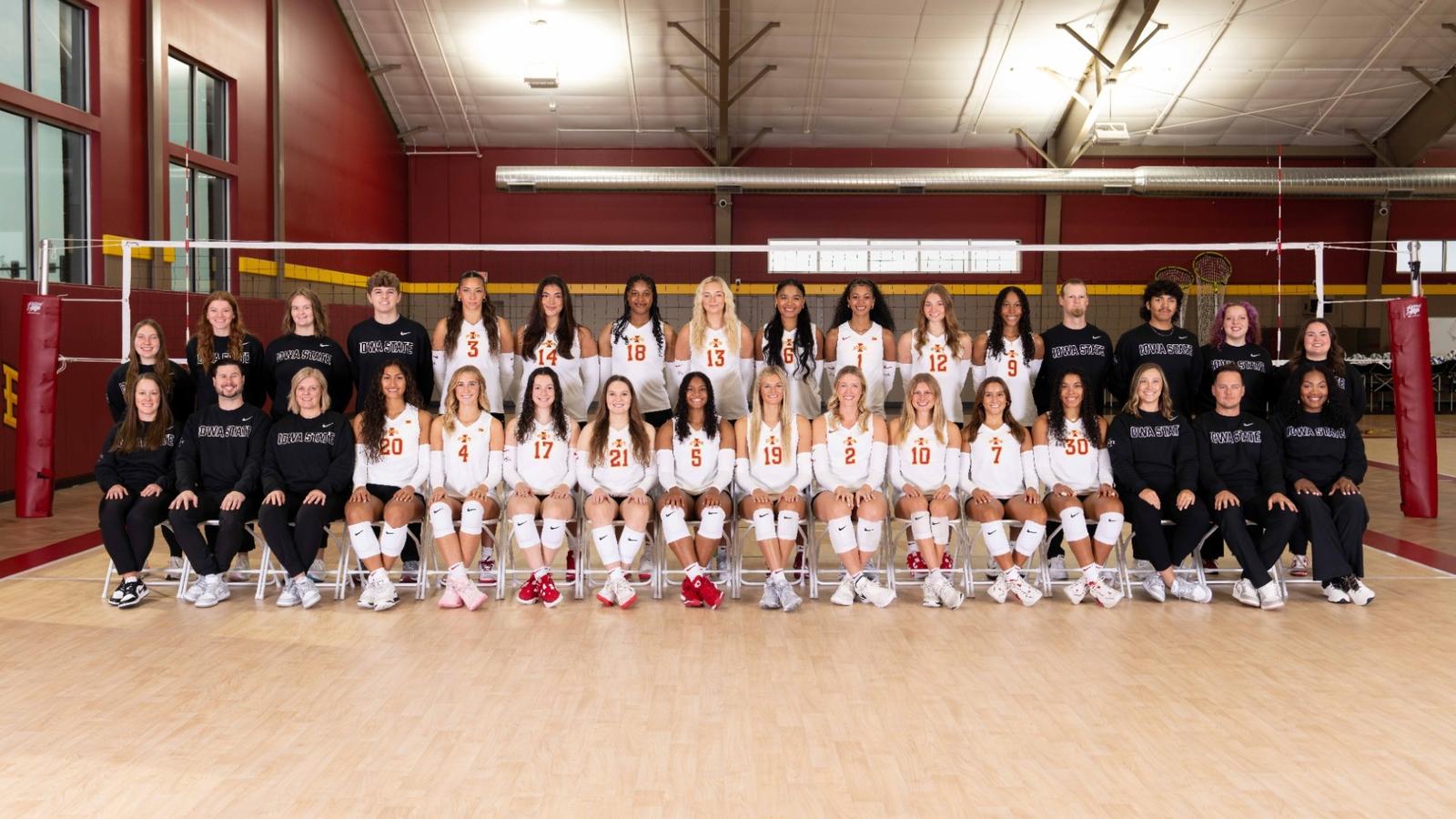
AMES, Iowa – Iowa State concludes 2025 with a 23-8 record, showing tremendous turnaround after going 10-18 last season. It is the highest win total since 2011, while ISU also went 12-6 in Big 12 play to finish tied for third after being chosen ninth in the preseason poll.
Cyclones wrapped the season earning national and conference awards including AVCA Libero of the Year, AVCA Second Team All-America, Big 12 Libero of the Year and Big 12 Setter of the Year.
Iowa State is ranked in the final AVCA Coaches Poll for the first time since 2017 earning the rank of T-No. 22. It’s the highest final ranking in 13 seasons (2012, No. 14). The Cyclones capped the season in the second round of the NCAA Championship, ISU’s 18th trip to the tournament.
Rachel Van Gorp, National Libero of the Year
Van Gorp showed the nation she is the best of the best becoming the inaugural AVCA Libero of the Year. The true sophomore, in her first full season at the position, compiled a list of awards also including AVCA Second Team All-America, AVCA First Team All-Region, Big 12 Libero of the Year, First Team All-Big 12 and two Big 12 Defensive Player of the Week honors.
Iowa State took home Big 12 Libero and Setter of the Year, while five Cyclones were placed on All-Big 12 Teams. Van Gorp was the unanimous choice for Libero of the Year, while Morgan Brandt secured Setter of the Year. Both were First Team All-Big 12 selections, and Tierney Jackson was placed on season team. True freshmen Alea Goolsby and Reagan Hanfelt earned Big 12 All-Rookie Team.
Leading the Conference
ISU ends 2025 as the Big 12 leader in digs (15.12 per set) and kills (13.98 per set). The Cyclones ranked top 25 nationally in kills (No. 18) and assists (12.91 per set, No. 24), helping lead Iowa State to hit at .245 on the season. The efficiency is the fourth-highest single-season hitting percentage in program history.
2025 By the Numbers
4 – ISU had four ranked wins on the season, the most since 2012. The Cyclones were the only Big 12 team to take down Arizona State this season and ended No. 6 ASU’s 12-match win streak and 26-match Big 12 win streak.
4 – Morgan Brandt ends her Iowa State career ranking fourth in program history with 3,787 assists. The total led all 2025 Big 12 active players.
7 – The Cyclones hit over .300 in seven matches. ISU had a stretch of three straight hitting over .400, a program first, while two of those match efficiencies now rank in the program all-time top 10.
8 – Iowa State ended non-conference with a record of 10-1, the best mark in eight seasons.
10 – Maya Duckworth entered the ISU top 10 in career kills and concludes her career with 1,073. Duckworth was the 12th in program history to join the 1,000-kill club.
12 – Iowa State sealed 12 Big 12 wins for the first time since 2012.
15 – ISU opened the season at 5-0 without losing a set, one of the final three teams to begins with 15 set wins. It marked the first time in program history to open the season with a 15-0 set record.
400 – Christy Johnson-Lynch celebrated win No. 400 this season vs. No. 16 TCU. Johnson-Lynch now owns 11 20-win seasons and 48 top 25 wins, with 12 in the top 10.
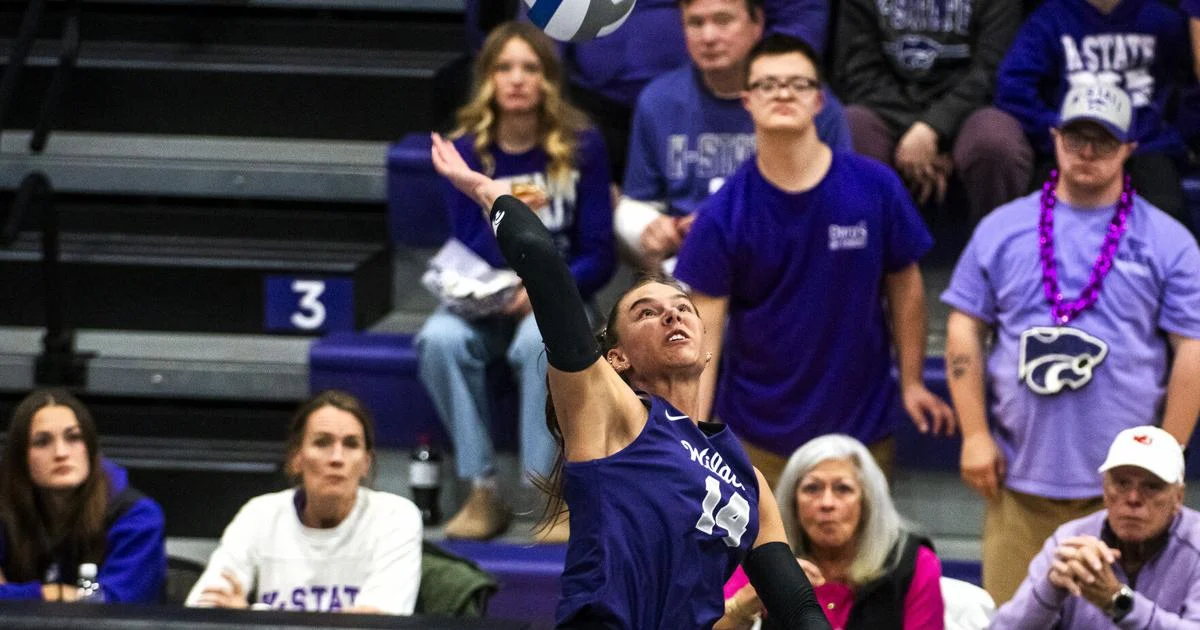
Kansas State volleyball All-American Shaylee Myers announced she is stepping away from the sport and will not pursue a professional career.
The Lincoln, Nebraska native was selected in the second round of last month’s Pro Volleyball Federation draft by the Atlanta Vibe, but has decided not to continue playing beyond her collegiate career.
Myers closed her time in Manhattan with one of the most decorated seasons the program has seen. She earned All-America Honorable Mention recognition from the American Volleyball Coaches Association (AVCA), becoming the 12th player in school history to receive the honor and the second under head coach Jason Mansfield, joining former Wildcat teammate Aliyah Carter.
Her All-America nod capped a historic senior campaign filled with accolades. Myers was named the program’s first-ever AVCA Region Player of the Year, earned AVCA First Team All-Region honors and was a unanimous First Team All-Big 12 selection. She also claimed three Big 12 Offensive Player of the Week awards during the season.
Statistically, Myers rewrote the K-State record book. She finished her senior year with 498 kills (4.70 per set) and 547.0 points (5.16 per set), setting the rally-scoring era single-season record for kills per set and tying for third-most total kills in that era. Her 34-kill performance against West Virginia on Oct. 1 marked the Big 12’s top single-match output of the season.
Myers reached another milestone during the NCAA Tournament, becoming just the 20th player in program history to surpass 1,000 career kills. She finished her career with 1,029 kills and 1,148.5 points, ranking among the program’s top 25 in multiple career categories.
K-State concluded the 2025 season at 18-10 overall and 10-8 in Big 12 play, earning an at-large bid to the NCAA Tournament — the program’s 19th postseason appearance and first under Mansfield.
Happy last day of 2025! We hope that, for you, it was a year to remember and not one to forget.
For the track and field community, this year left us with a lot to process. A quick search through the newsletter archives finds four uses of the word “change” in our subject lines this year, with phrases like “forecast,” “wide open,” “worth a try,” and “what?” sprinkled in as well. With one Olympic cycle firmly in the rearview and another just picking up steam, it makes sense: 2025 was, ultimately, a period of mass transition.
As the clock ticks to midnight tonight, we have a lot more questions than answers. Somewhere between “who will I kiss when the ball drops?” and “how hungover will I be tomorrow?”, you may start thinking instead about the bigger, more long-term unknowns looming for track and field in the year to come.
What do pro leagues look like next year?
Every professional sport evolves over time, but few go through as many evolutions and permutations as ours. That’s because we’ve never really had a dominant professional circuit.
Currently, we have the Diamond League, which seems to persist as “best of all the bad options.” One big improvement we got out of the 2025 season was the reclassification of the DL final to one last big event before the World Championships. The positioning, in essence, traded a little bit of star power for real stakes: a lot of the top stars opted to skip out on Zurich, but increased prize money and the promise of a wild-card entry to Worlds kept things interesting. Sure, the meets are still hard to watch (in the U.S.) and can feel repetitive mid-season, but it’s still the closest thing we have to a Premier League for track and field.
There was still enough of a perceived gap in the market, however, that several entities stepped up to try and fill the void. Grand Slam Track took the biggest swing at a legitimate Diamond League alternative, but unfortunately was also the biggest flop. All the public-facing messaging around the League’s bankruptcy filing insists that GST will return for a second season, but there’s a bit of a “fool me once, shame on you; fool me twice, shame on me” sentiment at this point in the game. It’s safe to say that, until GST is able to roll out a compelling argument for its own continued relevance, no one is taking for granted that it’ll be a genuine presence on the pro circuit moving forward.
At the other end of the spectrum, ATHLOS NYC’s second one-off exhibition meet was enough of a purported success that the event, organized by Reddit co-founder Alexis Ohanian, has announced it’s expanding into a multi-event league for the 2026 season with stars Sha’Carri Richardson, Gabby Thomas, and Tara Davis-Woodhall attached as “advisor-owners.” Much like GST, there are more questions than answers at this point in time: How does a women’s-only event map onto a landscape that prizes gender parity? Will keeping its events in the fall ever move ATHLOS out of novelty status to feel like a “real” part of the season? Does the limitation of events to sprints, middle-distance, and long jump continue? Unlike GST, however, they benefit (at least in public perception) from taking an approach that’s generally seen as safer: starting small and expanding, rather than swinging for the fences and coming up short.
And then there’s the 11th-hour announcement that, once again, USATF will by trying to tie its disparate offerings into a branded package. This time, it’s a “USATF Tour”, which unifies 17 meets scheduled from March to July under one calendar. It’s unclear how this will be different from these meets operating entirely independently; the landing page for the site includes the notation “TBD” no less than seven times. You’ll need at least three different streamers to watch all the meets, and there doesn’t seem to be any clearly-stated prize or other incentive for athletes to participate in multiple events. The number of events isn’t even clear: the website says “16 unique events” but lists 17, the LA Distance Classic and LA Grand Prix are listed as separate events despite occurring on back-to-back days in the same city, and there’s an unnamed “Grand Prix” event set to air on NBC that has a date but no location.
It would be great if there was a unified domestic circuit for professional track and field in the U.S. It would be great if there was a premiere showcase for the best of women’s sports with a hefty prize purse. And it would be great if we all agreed to prioritize one A-tier circuit that mattered throughout the regular season. But more than anything else, it would be great if we could build a little year-over-year momentum for any one of these initiatives rather than facing down a whole bunch of unknowns each December.
How does World Ultimate Champs shape the season?
One of the few positive side effects of a life-altering global pandemic was that we haven’t had a track season without a global championship since 2018. In 2026, we’ll see what a season looks like when the entire sport isn’t oriented toward a ten-day conclusion where gold medals drown out any other metric of success.
Or will we? World Athletics is rolling out its new “World Ultimate Championship,” which, despite its name, is a three-day track meet and not a frisbee tournament. On paper, it’s sort of an unholy hybrid of a true global championship and a beefed-up Diamond League final, with most, but not all, events slated for a one-round final with big prize money on the line.
How this slots into the global calendar, and how it is perceived, remain to be seen. For steeplechasers, it might be business as usual, given that the event is omitted entirely (same goes, at least this year, for a number of jumping and throwing events). Small fields of 16 athletes on the track and 8 in the field will mean that simply qualifying for the meet will be prohibitively difficult, if not impossible, for even most pros. Conversely, it relies a lot on the biggest names to lend their star power to the event—only a few passes or withdrawals from reigning World/Olympic champs could make this event feel too small in a hurry.
Adding a new championship-style event to a non-championship year is a great idea in theory, but it has to feel like a championship level of stakes and competition to be taken seriously.
Does 2026 become the year of the comeback?
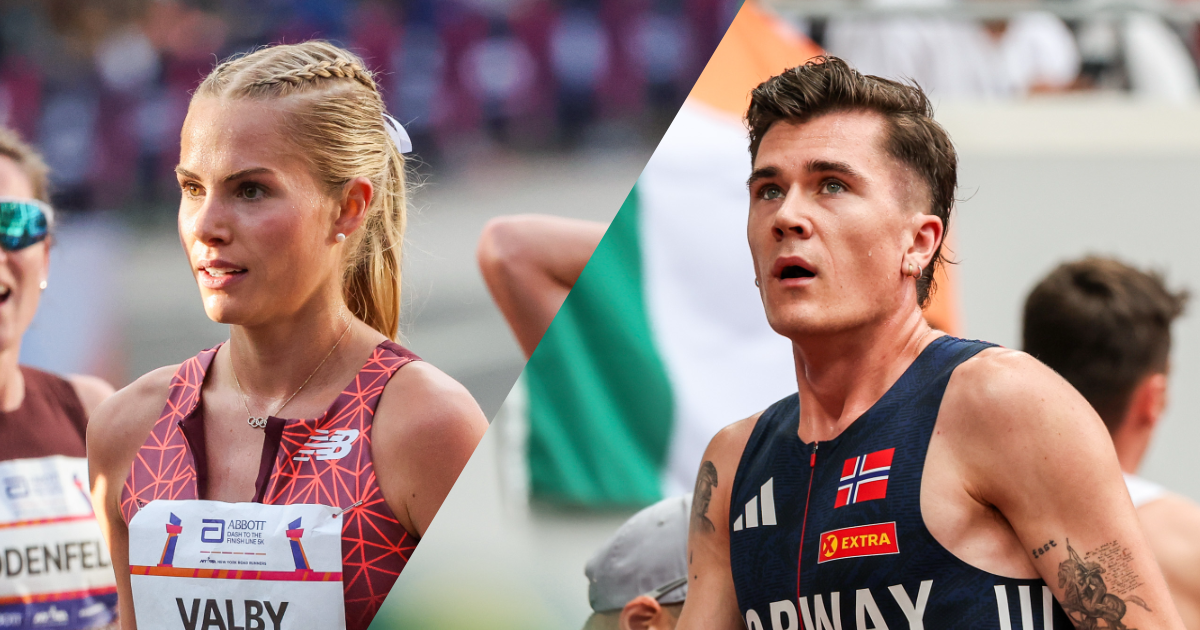
2025 was a year to forget for more than a few of the sport’s biggest stars. Olympic champs like Grant Holloway and Jakob Ingebrigtsen battled injuries and less-than-perfect returns, whereas domestic stars like Elle St. Pierre and Parker Valby returned late from long breaks. Some of the most dominant athletes of the last decade – like Yulimar Rojas, Shericka Jackson, and Soufiane El Bakkali—were not able to return to the top of podiums they’d once frequented.There’s a silver lining in each of these individual storm clouds, however: everybody loves a comeback story.
A year or two ago, athletes like Holloway and El Bakkali simply couldn’t seem to lose, and it was starting to get boring. Now, they get to head into 2026 with a chip on their shoulders rather than a target on their backs. Ingebrigtsen and Rojas are current world world record holders who remain squarely in their primes, at 25 and 30 years old, respectively. A few years of bad Achilles luck can’t possibly keep two of the sport’s biggest talents down for too much longer, right?
St. Pierre and Valby both returned to racing in November at the Abbott 5k in New York. St. Pierre was coming back from giving birth to her second son in May, and Valby was finally healthy again after an injury-plagued rookie season. Together, they represent two of the country’s biggest distance talents, but right now, we’re not quite sure where they fit into a broader pecking order where Nikki Hiltz and Sinclaire Johnson are dominating the middle distances and Shelby Houlihan has re-entered the chat.
Last, but certainly not least, there’s the crop of 30-something sprint stars who aren’t quite done. Shericka Jackson is just two years removed from her epic 21.41 200m gold in Budapest, and at 31, she’s still got the better part of a decade ahead of her if her countrywoman Shelly-Ann Fraser-Pryce is a model to follow. Trayvon Bromell already had a bit of a comeback season of his own, getting back atop the 100m ranks on the DL circuit but still falling short of the podium at USAs. And let’s not forget that both Tokyo Olympic champions, Elaine Thompson-Herah (33) and Lamont Marcell Jacobs (31) aren’t totally over the hill just yet, even if they’re a little farther removed from their best seasons and haven’t shown signs of life in a while. Ya never know.
Who tries a new event next?
2025 saw Sydney McLaughlin-Levrone forego the hurdles during her typically blistering trips around the oval. That foray into a new-ish-to-her event culminated in another gold medal, a 47.78 world-leading time, and a new American record. We already know that the closest thing to a rival SML has in the 400m hurdles—Femke Bol—will be experimenting with the 800m in 2026, and has already been spotted exploring fascinating training systems in her pursuit of half-mile glory. New events are in!
It’s pretty clear that if McLaughlin-Levrone gives the 400m her undivided attention for another season or two that she would have realistic ambitions to break the world record. She’s demonstrated world-class ability at this “off event” at every level of her competitive life. And what else does she have to prove in her primary event?
Male 400H World champ Rai Benjamin has also talked about wanting to take on the flat 400m or even the 200m in future seasons. Is there something about the hurdles that makes them get really boring over time? Regardless, it’ll be fun to see if Benjamin can improve on his PBs of 44.21 from 2023 or 19.99 from 2018. Heck, he even ran a wind-legal 10.03 in 2020 – is 2026 the year that births the first sub-10/sub-20/sub-44/sub-47 runner in history?
If there was ever a time for stars who’ve solidified their place atop one event to try another, it’s now. What’s to stop Faith Kipyegon from going even longer in distance, when she could always retreat to the safety of the 1500m if it doesn’t work out? Heck, even Jakob Ingebrigtsen has teased a return to the steeplechase. And simply typing out the words “Grant Fisher marathon debut” will trigger some sort of seismic activity as distance bros all over the world start to jump up and down with excitement all at once. And over in the infield, there’s one true wild card who could mix things up: Ryan Crouser.
Crouser is the best male shot putter in history, yes. But he still holds the American high school national record in the discus (72.40m) and secured World Youth Championship silver in that event back in 2009. During Crouser’s last complete outdoor season, 2024, his World ranking score in the shot was 1520. During 2025, the highest ranking attained by a discus thrower was 1476, belonging to Mykolas Alekna. Now those numbers should be taken with a grain of salt—comparing greatness across disciplines is tricky business—but if you’re Crouser, coming off an injury-shortened-ravaged campaign that still saw you win World gold in the shot, don’t you at least think about kicking the tires on a different event that you were historically great at as a teen, and that might tax your shot-put-worn body in different, career-extending ways?
Greater Akron stepped onto the national college scene with authority in a big way in 2025.
From national titles to being drafted at the professional level, area athletes shined.
Here’s our top 10 college moments involving local athletes:
1. Akron Zips men’s soccer returns to NCAA Tournament glory
Behind Big East Offensive Player of the Year Stefan Dobrijevic and conference goalkeeper of the year Mitch Budler, the University of Akron men’s soccer team reached the elite eight of the NCAA Tournament for the first time since 2018.
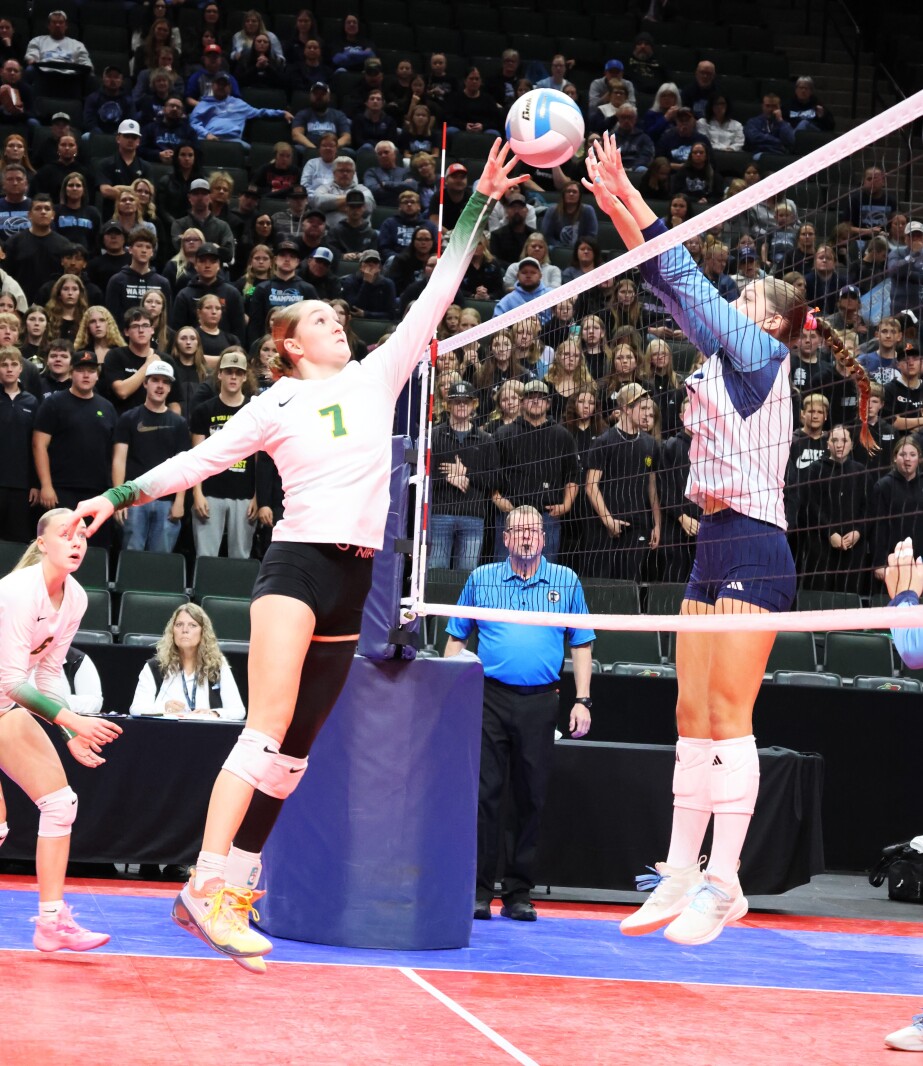
NEVIS – Karly Cobb couldn’t have asked for a better way to begin her reign as the new head coach of the Nevis volleyball team.
Not only did the Tigers go undefeated to capture the Northland Conference title, but they capped off the season by winning the Section 5A championship to qualify for the state Class A tournament. Nevis lost both matches at state to finish the season with a 24-9 record.
“My first season as head coach was incredible. I had the most supportive assistants, the most motivated team, and an incredible backing from the school and community. I am grateful to be a part of this community and am loving every minute of coaching for the Nevis Tigers,” said Cobb. “The team had their success this season due to their willingness to work hard and work together toward their common goal: getting to the state tournament.”
The Tigers won the Northland Conference title with a 7-0 record by defeating Clearbrook-Gonvick (25-20, 25-12, 25-17), Laporte (25-10, 29-27, 23-25, 25-13), Pine River-Backus (25-18, 25-15, 25-18), Cass Lake-Bena (25-12, 25-9, 25-15), Blackduck (25-17, 25-18 25-22), Northome-Kelliher (25-22, 25-17, 25-20) and Walker-Hackensack-Akeley (22-25, 25-19, 25-13, 25-8).
PR-B finished second in the conference with a 6-1 record as Blackduck (5-2), N-K (4-3), Laporte (3-4), W-H-A (2-5), C-G (1-6) and CL-B (0-7) rounded out the standings.
Nevis opened the season with wins over Park Rapids (25-23, 25-23, 25-27, 22-25, 15-10), Fosston (25-15, 18-25, 25-22, 18-25, 15-9) and Lake of the Woods (25-20, 25-12, 25-18). The Tigers went 4-1 at the Ada-Borup-West Invitational and 1-3 at the Duluth East Invitational. At Ada, Nevis defeated Thief River Falls (25-22, 25-12), Red Lake County Central (25-19, 25-21), Fosston (23-25, 25-11, 15-9) and A-B-W (25-19, 25-20) while losing to Kittson County Central (25-7, 25-23). In the Duluth tournament, the Tigers defeated Duluth Denfeld (25-17, 25-13) while losing to Cloquet (25-22, 22-25, 15-11), Superior (25-23, 25-17) and Brainerd (27-25, 15-25, 15-5).
To close out the regular season, the Tigers posted wins over Sebeka (25-16, 25-18, 22-25, 25-18), Browerville-Eagle Valley (25-16, 23-25, 25-16, 20-25, 15-9), Verndale (28-26, 25-18, 23-25, 25-23) and Menahga (24-26, 25-14, 25-17, 20-25, 15-6) before going 1-3 at the Pumpkin Classic in Moorhead. Nevis opened that tournament with losses to Moorhead (25-12, 25-8), Fargo North (28-26, 25-19) and Duluth East (25-22, 25-20) before closing with a win over Osseo (25-21, 25-22).
Senior Danika Anderson was named the Northland Conference’s Defensive Player of the Year. Anderson broke the school record with 52 digs in a match.
Contributed / Jodi Sandmeyer
For the Section 5A tournament, the Tigers received the No. 1 seed in the West and used wins over No. 9 B-EV (25-14, 25-17, 25-19), No. 4 Bertha-Hewitt (25-20, 25-21, 22-25, 25-21) and No. 3 Verndale (25-20, 23-25, 16-25, 25-16, 15-7) to reach the championship match. Nevis earned a trip to the state tournament with a 26-24, 20-25, 25-21, 29-27 win over Swanville, the No. 1 seed in the East, in the section title match.
In their fifth state tournament appearance, the No. 7-seeded Tigers lost to Russell-Tyler-Ruthton (25-20, 25-21, 25-21) and Fillmore Central (25-22, 25-13, 25-6). R-T-R, the No. 2 seed, lost to No. 1 Mayer Lutheran in the title match while Fillmore Central, the No. 3 seed, defeated No. 5 Cleveland for fifth place. Nevis also qualified for state in 2009, 2011, 2012 and 2013.
“I feel that the girls had a good state tournament appearance,” said Cobb. “They played very competitively with RTR, finishing only a few points behind them every set and RTR ended up getting second in the tournament. Of course the girls had to work through nerves since it was their first time playing at (state) for every girl on the team. We then played Fillmore Central, and although that game did not go as we hoped it would, our girls stuck together and still gave it their all.”
Leading the Tigers this season were seniors of Ava Forbes, Clair Isaacson, Brenna Lindow, Danika Anderson and Amber Pyburn. Freshman Mackenzie Lindow and junior Cassandra Bolster rounded out the starting lineup with junior Emma Wike; sophomores Mya Durgin, Evelyn Dierkhising and Kyleigh-Ann Smart; and freshmen Arianna Hamblin and Sage Chase playing key roles as reserves.
Brenna Lindow capped off her senior season by being named the Northland Conference’s Outstanding Setter. Lindow concluded her career with more than 1,000 set assists.
Contributed / Jodi Sandmeyer
Forbes, Isaacson, Brenna Lindow, and Anderson received all-conference honors with Forbes being named the conference MVP, Brenna Lindow being named the conference’s Outstanding Setter and Anderson earning the conference’s Defensive Player award. Pyburn and Mackenzie Lindow were all-conference honorable mention players.
In 26 of the 33 matches (statistics weren’t available for the Thief River Falls, Ada-Borup-West, Duluth Denfeld, Brainerd, Kelliher-Northome, Moorhead and Bertha-Hewitt matches), Forbes led the Tigers with 458 kills, 62 blocks and 44 ace serves while adding 231 digs. Isaacson was second with 315 digs, tied for second with 38 ace serves and had 113 kills and 22 blocks. Brenna Lindow led the way with 782 set assists while contributing 31 blocks, 27 kills and 22 ace serves. Anderson was the team leader with 402 digs while serving 15 aces. Pyburn chipped in 185 kills, 83 digs, 46 blocks and 19 ace serves. Mackenzie Lindow had 190 digs, 112 kills, 38 ace serves and 21 blocks. Bolster had 50 digs and 13 kills. Dierkhising had 24 kills and 17 digs, Durgin had 35 digs and 13 kills, Hamblin had 37 digs, and Chase had 15 digs.
Senior Clair Isaacson received Northland Conference honors this season.
Contributed / Jodi Sandmeyer
Anderson also broke a school record with 52 digs in a match against Verndale in the postseason. Ava Forbes surpassed 1,000 kills and Brenna Lindow surpassed 1,000 set assists.
The Tigers will have five starting spots to fill, but Cobb is counting on her team to put another competitive group on the floor next season.
“I want to give the seniors a ton of credit for leading our team. Amber, Danika, Clair, Ava and Brenna gave their heart, grit and determination this season. They led with grace and their faith. They showed the other girls in the program what it means to be a part of something bigger than themselves. They had the motto ‘no doubt in my mind’ and they proved that to everyone. There was no doubt that they were here this season to accomplish their goals and they did just that. It is always hard saying goodbye to seniors, but this year is extra hard because these five have all been a part of the program since they were third graders, and I have coached all of them since 8th/9th grade on the JV team. I hope they know what a mark they have made on the Nevis program and I know they will always look back and cherish the memories,” said Cobb. “We will have two returning starters next year in Mackenzie Lindow and Cassandra Bolster. We will also have a few players that came off the bench this year and helped us out in Evelyn Dierkhising, Mya Durgin, Sage Chase and Ari Hamblin. Of course, after graduating five seniors we know we have some building to do. The younger classmen are fired up and want to get back down to St. Paul. They have now experienced the state tournament and want to make it their goal again. Our girls plan to put in the work this offseason and be ready to start off the 2026-27 season strong.”