The Wyoming Valley Sanitary Authority faced a challenge rehabilitating a major interceptor line in Wilkes-Barre because it is beneath the Wyoming Valley Levee.
This aging reinforced concrete line, known as the authority’s East Side Interceptor, had to be addressed because it was installed in the 1960s and had reached the end of its service life. It carries wastewater from approximately 100,000 residents in 19 municipalities to the authority’s treatment plant in Hanover Township.
The traditional approach — excavating to remove and replace the line — would have cost an estimated $75 million or more and required extensive permitting and protective measures to ensure the flood control system along the Susquehanna River was not compromised, authority officials said.
Instead, the authority recently deployed a new engineering technology to restore the one-mile line for $14 million.
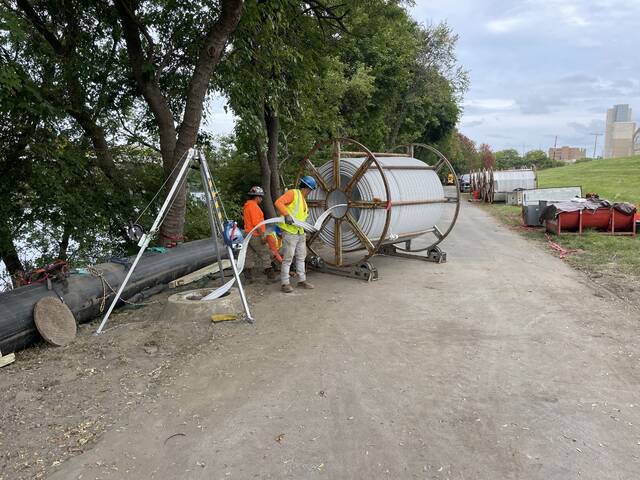
Authority Chief Technical Officer Samantha Albert said the solution involved steel-reinforced PVC that interlocks as it is fed through manholes into the pipe, creating a new standalone pipe within the existing line.
A machine was used to wind the large spools of PVC through the line, she said. The diameter of the line ranges from 4 to 6 feet, allowing crews to get inside during the installation, Albert said.
The authority could not use a different type of liner that requires a “curing” process with heat to dry and harden because the interceptor line would have to be completely dry for that option, Albert said.
The interceptor line could not be deactivated to dry because it handles a high volume of both wastewater and stormwater when it rains, she said.
“That was a huge advantage of the solution we chose because it still has to flow during the installation,” Albert said.
For the safety of crews, the contractor set up a temporary sewage bypass system — a large black pipe on the ground — to reduce the load passing through the line during installation, she said.
The section of line tackled in this project runs from the area of the Luzerne County Courthouse south to Riverside Drive, Albert said.
Albert said the line is “critical infrastructure” that must remain functioning to service residents and also protect the levee.
“We did not want this line to ever become compromised and impact the integrity of the levee,” Albert said. “It’s all about protecting the environment and the public.”
Georgia-based Ruby-Collins Inc. completed the project. The company has a specialized “trenchless division” to rehabilitate underground lines, its site says.
Luzerne County Council allocated $2 million of its federal American Rescue Plan Act funds toward the project. The authority also received a federal STAG Clean Water Community Project Funding Grant and secured a Pennsylvania Infrastructure Investment Authority, or PENNVEST, loan.
Albert said the authority will continue seeking grants to help fund work on other segments of the interceptor.
Christopher Belleman, executive director of the Luzerne County Flood Protection Authority that oversees the Wyoming Valley Levee, said his authority allowed access to land at the site to complete the project.
“They got us involved at the very start. They were a good partner,” Belleman said of the sanitary authority.
Belleman spoke favorably of the sanitary authority’s solution, saying the flood authority has used a lining to address damaged piping — an option available if the original pipe still has structural integrity.
“Fortunately, technology has advanced over the years so this type of work can be done in a way that saves costs without having to excavate,” Belleman said.
Approximately 170 pipes of varying dimensions run through the levee system, officials have said.
Belleman said the flood authority must inspect these pipes every five years in compliance with a U.S. Army Corps of Engineers mandate to keep the levee certified.
Reach Jennifer Learn-Andes at 570-991-6388 or on Twitter @TLJenLearnAndes.