Connect with us
https://yoursportsnation.com/wp-content/uploads/2025/07/call-to-1.png

Rec Sports

Coach Chris Conlin challenged, inspired his players –

Published

on


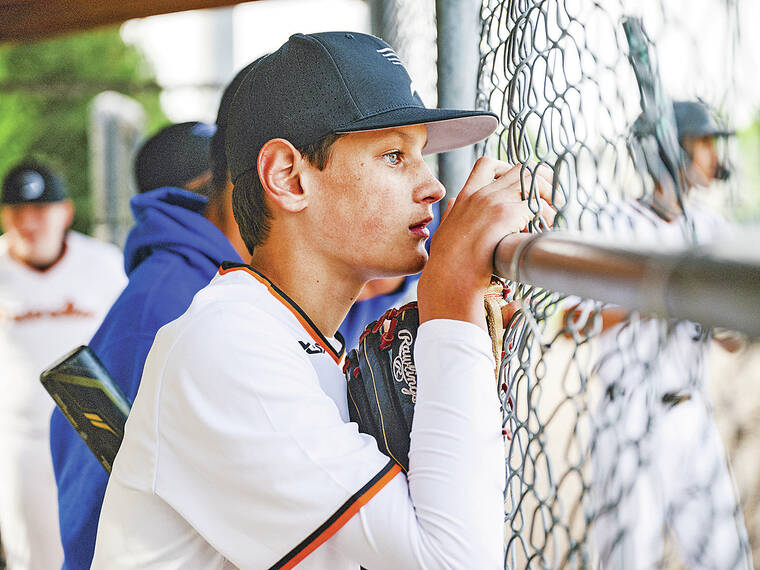
Eli Stokols attended the Celebration of Life for former coach Chris Conlin. (PHOTO: Tim Burt, OC Sports Zone).

Former University High School baseball standout Eli Stokols, who now covers the White House for Politico, has fond memories being coached by Chris Conlin, the long-time University High School coach who was honored during a celebration of life earlier this month.

There were plenty of life lessons, he said.

Conlin died on April 15, 2025 at the age of 71 after an illness surrounded by family friends.

“I was watching and listening to people and what Coach (Mike) Gerakos said about him with the red brick dust all over his feet I was thinking about this image of him on the field before practice, after practice, raking the dirt, watering the infield and the amount of time and care he put into just creating a place, a field, a program for not just me but for all these years and years and years of kids to come through and have a place to really grow but also to have just have fun,” Stokols said in an interview after the celebration at Friends Church in Yorba Linda.

“Being part of the Uni baseball program was the most important thing I did in high school, it’s the thing I remember the clearest, the friends I made and continue to be in touch with. It’s just a really special part of my life and my memories of growing up here and it was important to me. Coach, as people talked about, he was a pretty direct guy.

“As encouraging as he was he wouldn’t sugar coat things, so he was a big muscly guy and I came in at 14 years old and I was pretty spindly. I think he had a hard time seeing, ‘how is this guy going to develop and be anything in our program.’ I wasn’t the most athletic or the fastest and certainly not the biggest. And he would kind of let you know that you had a ways to go. And he was intimidating, especially coming in as a 14-year-old. He let you know, nothing was given and you had to earn it.

“It was really my first experience with that kind of situation and competition and being part of a program and having to work your way up to something. I can still remember some of our games our senior year in 1997, I can remember some of my better moments as a player and I can describe them to you very clearly. I think about the confidence I played with my senior year there and the way that team came together.

“You sort of appreciate it at the time but to go from a lot of self doubt and not being as good of a player but to being a better player and a more confident player on the field and being part of a group and all that confidence that I had on the field was because of the stuff that he and Coach (Paul) Serna and Coach Gerakos put me through and the challenge they laid down to you.

“High school baseball is sort of a singular experience but it does help you going forward whatever you do. To have someone who believed in you, but made you earn it, didn’t give you anything and let you know you were going to do it yourself and taught you how to be part of a team and a group, and we were really close.

“And it was also just fun. I think about all his little sayings and the ways he would kind of rib us. They had a good rapport and it was a really good environment and a good group and you feel all these years later lucky to be have been part of it.”

Celebrated league title

Stokols, who played two years with the varsity at University, remembers the 1997 season when the Trojans won the league title on the last day of the season.

“We all put a lot into it,” he said. “We won the league and we won our first CIF (playoff) game and then we had to play Mater Dei and we lost by one. I think Garrrett (Atkins) hit a ball that was caught on the warning track for the last out. I was on deck. It was sad when it ended, ends are tough, that was a really special group.”

Stokols then attended UC Berkley where he continued his baseball career and got his college education. He’s also a Columbia University School of Journalism graduate.

“I think maybe my confidence as a player going into a program that I really didn’t have any business playing in, a D-1 Pac-10 program as it was then, came from playing with Garrett and playing with this group and having a lot of success and being, ‘why not.’ I got to Cal and I thought these guys are really good, it was hard but I stuck with it and ending up traveling and pitching a little bit my senior year and earning a collegiate letter and I had times throughout college thought, ‘I don’t need to put the hours in, I don’t need to be a part of this program, it’s not my identity, I will go do something else,’” Stokols said.

“I stuck with it, in part because I had a lot of good friends in the program, as I did in high school, but I also probably stuck with it because of the experience I had in high school. You’re just building on the foundation you had already laid down, having people who push you and challenge you and support you.

“I got a (letterman) jacket that doesn’t fit me but it’s a nice symbol of my persistence in doing something that I probably had no business doing. I knew I wasn’t going to wind up in the Major Leagues but I’m glad I did it.”

Covered Little League

Besides baseball, Stokols also had an interest in journalism working during the summer for the Irvine World News and its sister paper in Mission Viejo at the age of 15. Stokols’ biggest story was covering South Mission Viejo Little League major all-stars, which wound up going to Williamsport for the Little League World Series.

“I do remember how much fun that summer was, taking the ride with those families all the way to the regional final in San Bernardino and being sad I had to go off to start college and couldn’t go with them to Williamsport,” he said.

“I can still remember a lot of the players from that team and the coach, Jim Gattis, was a lot of fun to get to know and talk to. When I told him I was going up to Cal to play baseball that fall, he invited me out to a team practice and tried to show me a few grips to play with to develop a cutter. Great baseball guy. 

“That team was the first story I ever got latched onto that was a running story, not a one-off piece. And I got fairly wrapped up in it. Maybe that’s a no-no in journalism even when you’re covering a Little League team. But being only a few years removed from my own Little League days, which I shared with my own dad, it felt very personal watching these kids and families have so much success and joy on this journey together.

“I remember being so impressed by their abilities at such a young age, by Gattis who gave them so much baseball knowledge and helped them succeed while remembering that they were all just kids, by the connections between the families in the stands; and the way all of them were so welcoming to me. I don’t cover many ‘feel good’ stories these days, but I’ll always remember that one.” 

White House reporter

Stokols path led him to work in Denver and then to Washington D.C where he has been covering politics for 10 years. He started at Politico, then the Wall Street Journal, the Los Angeles Times before returning to Politico about two and a half years ago. He’s also had guest television appearances on CNN and MSNBC.

Covering the White House and President Donald Trump has been demanding but fulfilling, he indicated.

“In some ways it’s easy because they make so much news you just try to catch up and there is always stuff to write about it but it’s challenging sussing out new information and finding out what’s going on as it is in any White House like that,” he said. “There’s a lot of people on the beat so it’s competitive. It feels like it’s important but it’s a grind. I would never say that I don’t appreciate the uniqueness of the opportunity to be in that building and to sit in the briefing room or to occasionally fly on Air Force One and to ask the president questions.

“But it’s a tough job and it’s a lot of work and there is a lot of competition. It is an intense beat. This president makes news at all hours of the day and sometimes you’re putting to kids to bed at 7:30 and your phone rings and your editor is on the line wanting to know why the hell you don’t have the story. You got to figure how to deal with that.

“I was lucky to come up with something when I was a teenager and sort of had a clear sense of what I wanted to do and to be able to go off and do it.”

Advice for others

Stokols also had advice for those wanting to enter the journalism field.

“Persistence, I guess. It’s not an easy time for the industry, people need journalism, they need to know what’s going on at the local level, I would say even more so than the national level, there are a lot of journalists in D.C. and New York talking about our federal government, he said. “There are not a lot of places who are still investigating local news and that’s hard.

“Don’t do it to get rich. But if you believe in it and you are good at it, we need people to come along who want to chase stories and find things out and shine a light on stuff and people who are good at that will always find that if you work hard, the information is still the commodity so the platforms are different and the business is different. But if you’re good at sussing out what is happening and telling a story, you will probably find somewhere to land and do that job.”

Stokols and his wife Elena have two boys Ryne, 2 (named after Stokols favorite players former Cub Ryne Sandberg) and Charlie, 4 and live in Washington, D.C.

“My parents are still in the same house I grew up in so a lot of ties there with them and their friends, trips are a little different now when you come out with two little ones, but they love running around going to the beach,” Stokols said.

Stokols acknowledged dealing with Coach Conlin’s death.

“This is obviously a sad occasion,” Stokols said. “You wish the circumstances were different but it’s been a while since I’ve seen a lot of these guys. Life takes you in different directions. It’s been nice the last day or so getting to catch up with guys you spend your entire high school years with, hour and hours at a time.”

—Tim Burt, OC Sports Zone; timburt@ocsportszone.com


Link

Continue Reading
Click to comment

Leave a Reply

Your email address will not be published. Required fields are marked *

Rec Sports

ECNL ANNOUNCES SPEAKERS FOR 2026 COACHING SYMPOSIUM, POWERED BY US CLUB SOCCER

Published

on


RICHMOND, Va. (December 31, 2025) – The ECNL is excited to announce that the ninth annual ECNL Coaching Symposium, powered by US Club Soccer, will take place February 3-4, 2026, at Circa Resort & Casino in Las Vegas, NV. Ten leaders from across the world will be sharing insights and expertise on a wide variety of topics during this incredible educational event.

The ECNL Coaching Symposium will feature experts with presentations addressing technical and tactical development, leadership and personal development, club and organizational development, and more. Attendees will have the opportunity to collaborate with fellow leaders and coaches, share ideas and best practices, and will return to their clubs with ideas to innovate and push the game forward. Get a sense of the size, scope and excitement of the event from last year!

Below is the fantastic lineup of speakers at this year’s event (listed alphabetically). 

Neil Bath – Former Academy Director, Chelsea Football Club

Neil Bath has spent the majority of his professional career at Chelsea FC, where he built a distinguished reputation in youth development and football operations. He began with eight years as an Academy Coach before moving into a 20-year tenure overseeing the club’s Youth Development Programme. In his final two years, he served as Director of Football Development and Training Ground Operations.

During Bath’s leadership, Chelsea’s academy grew into one of the most recognised and productive talent pathways in global football. The youth team secured seven FA Youth Cup titles, reached four UEFA Youth League finals—winning two—and achieved multiple additional honours. The academy also r0ose to No. 1 in England for player productivity, with numerous graduates progressing to Chelsea’s first team or generating significant value through transfers.

In July 2024, Bath chose to step away from the club, taking a year to reflect and learn from a range of clubs, sports, and business environments. He now works as a consultant, supporting organisations with leadership development, coach education, and high-performance talent systems.

Amie Bracken – Director Of Brand Services, ECNL

With more than 20 years of experience, Amie Bracken is an accomplished brand builder and organizational leader who excels at harnessing creative talent to solve complex business challenges. After consulting the ECNL from its inception in 2008 to the rebrand in 2018, she recently joined the organization to help steer the brand through its continued growth and expansion. 

As a brand and marketing strategist, she uses positioning, architecture and visual identity to build brands worth fighting for. She spent her career leading major initiatives across a wide variety of categories with companies like Cincinnati Children’s, Allergan, Smuckers, P&G, Bayer, and the Cincinnati Reds. 

Bracken is driven by a commitment to cultivating a culture of connection and co-creation. A dedicated advocate, she champions both the work and the people behind it, defining success through the growth of her teams and the measurable progress of the brands she nurtures. 

She holds a degree in Marketing and Communications from Georgetown College, is a three-time Boston Marathon qualifier, and a mediocre downhill skier. 

Ceri Bowley – Chief Soccer Officer, NC Courage (NWSL)

Ceri Bowley is the Chief Soccer Officer for the North Carolina Courage where he oversees all player and staff development.  Bowley worked as a first team assistant for Rangers FC in the Scottish Premier League and UEFA Champions League in 2023. Prior to that, he worked for many years for City Football Group (CFG) where he led the creation and implementation of the City Football Methodology, which remains in place at CFG clubs across the globe. Bowley holds a PhD in Sports Psychology and Coaching Science, and has worked with Barry Town, the English FA, Swansea City and Merthyr Town in various roles.

Thomas Christiansen – Men’s National Team Coach, Panama

Thomas Christiansen is the head coach of the Panama Men’s National Team. Since he took the reins of the Panama team in 2020, he has led the team to qualify for the 2026 World Cup and to two CONCACAF Gold Cups, finished as finalists in both the 2023 CONCACAF Gold Cup and the 2025 CONCACAF Nations League, and finished as quarterfinalists in the 2024 Copa America. Prior to coaching Panama, Christiansen was the manager at Belgium’s Union SG (2019-2020), England’s Leeds United (2017-2018), and Cypress clubs APOEL (2016-2017) and AEK Larnaca (2014-2016). He led AEK Larnaca to their best ever league finish in both seasons (2nd place), and led APOEL to the league title and Round of 16 of the Europa League. As a player, Christiansen had a 15-year career with clubs in Denmark, Spain and Germany, leading the Bundesliga in scoring for Bochum in 2002-2003, and earned two caps for the Spanish National Team.

Andrea Cortez – Director Of Creative Services, ECNL

Andrea Cortez is a seasoned creative strategist and communications professional with a 10+ year track record of driving digital engagement and brand development in competitive sports environments. She currently serves as Director of Creative Services for the Elite Clubs National League (ECNL), where she leads creative direction, social strategy, and digital content for one of the most visible and respected youth sports platforms in the country.

Her creative work and digital strategies have been featured by major national media outlets, including ESPN, ABC, and USA Today, and earned national honors from CoSIDA, SkullSparks, and others, underscoring her innovation, impact, and excellence in digital strategy and sports communications.

Before transforming youth sports marketing, Cortez spent over eight years in Division I athletics. She rebranded and elevated four university athletic departments, building creative infrastructure from the ground up and pioneering the long-form, athlete-driven content strategies now standard across collegiate and youth athletics.

A former Division I collegiate athlete, Cortez uniquely blends creative leadership, brand development, cross-platform storytelling, and media strategy. She holds a B.S. in Sports Management from North Carolina Central University and an M.S. in Leadership & Organizational Effectiveness from Troy University.

Russel Earnshaw – Former Premiership Rugby Player; Coach Educator

Since graduating from Cambridge in 1997 with a Masters in Economics and Mathematics, Russel Earnshaw has been involved in sport as a player and a coach. He played and coached in the World 7’s Series and in the Commonwealth Games, winning multiple events and finishing in 2013 with a silver medal in the 2013 7’s World Cup. He also coached the England U18’s and U20’s Men, U18’s Women and GB Students. 

In 2013, Earnshaw took a two-year sabbatical to teach Economics (the best CPD he ever did!) and now works cross-sport (with organizations including NZ Rugby, GB Hockey and the Premier League) and in business (including Google and Abbott) with a focus on developing people, leadership, coaching, working as effective teams and creative thinking. He currently works with coaches from International to Champions League to grass roots. There is nothing earnshaw loves more than being on the pitch with coaches. 

Brent Gleeson – CEO Exceler8; Former Navy SEAL

A Navy SEAL combat veteran, award-winning tech entrepreneur, three-time bestselling author, and Forbes leadership columnist, Brent Gleeson is a globally recognized expert and acclaimed speaker on topics ranging from resilience, mental toughness, leadership, and building high-performance teams to culture and organizational transformation.

Gleeson is the Founder and CEO of EXCELR8, an enterprise software and management consulting firm whose mission is to equip committed teams with the leadership tools and professional development necessary to navigate change and growth with accuracy and precision.

Gleeson holds degrees in finance and economics from Southern Methodist University, degrees in English Literature and Criminal Justice from Oxford University, and an MBA from the University of San Diego. He is the #1 bestselling author of Embrace the Suck: The Navy SEAL Way to an Extraordinary Life and TakingPoint: A Navy SEAL’s 10 Fail-Safe Principles for Leading Through Change. His third book, All In: The Pathway to Personal Growth and Professional Excellence, was released on December 2, 2025 and became an instant USA Today bestseller. Gleeson is married with four amazing children.

Doug Lemov – ECNL Coaching Methodology Advisor

Doug Lemov is the ECNL Coaching Methodology Advisor and an impactful educator of both teachers and coaches. He is the international best-selling author of the best-seller Teach Like a Champion and of the highly acclaimed The Coach’s Guide to Teaching. He is also the co-author of Practice Perfect, Reading Reconsidered, Teaching in the Online Classroom, and Reconnect. Lemov has been an instructor with the US Soccer Federation in their Pro License and other courses, and has consulted with coaches and sporting organizations around the world, including in MLB, the NBA, MLS, and more.

Stephen Torpey – Academy Director at Manchester United 

Stephen Torpey, appointed Academy Director of Manchester United in September, is widely regarded as one of the most influential and forward-thinking leaders in youth development in English football. His career spans elite roles at Liverpool FC, Manchester City, and Brentford, where he has consistently transformed coaching environments and accelerated player pathways.

At Manchester City, Torpey played a central role in creating one of Europe’s most successful academy models — delivering three consecutive PL2 titles, multiple U18 national titles, and helping produce a generation of players who progressed into top European leagues. At Brentford, he led the academy’s full strategic rebuild and delivered the unprecedented jump from Category 4 to Category 2, redefining the club’s long-term development structure.

A former FA National School scholar and Liverpool FC professional, Torpey is also a highly respected keynote speaker and coach educator, contributing to the FA’s highest-level coaching awards. His leadership is recognised for combining innovation, clarity of vision, and a relentless commitment to developing world-class talent.

Drew Watson – ECNL Medical Advisor

Drew Watson, MD, MS, is an Associate Professor in the Department of Orthopedics and Rehabilitation at the University of Wisconsin School of Medicine Public Health and board certified in pediatrics and sports medicine. He is a team physician for the University of Wisconsin and Forward Madison FC in USL League One and serves as the ECNL Chief Medical Advisor. He is the Director of both the ECNL Center for Athlete Health and Performance and the University of Wisconsin Human Performance Laboratory, conducting research in pediatric exercise physiology, injury prevention and the impacts of injuries on well-being and mental

The 2026 ECNL Coaching Symposium is part of the league’s club and coach development platform, a key component in the league’s mission to Raise The Game by providing unique coach and club development opportunities to youth soccer coaches and organizations. The event is open to coaches regardless of league affiliation.

###

About the ECNL:

The ECNL is the nation’s leading youth soccer development platform for America’s top soccer players. The ECNL mission to provide the best youth sports experience in the world drives constant innovations in competitions and experiences for players, parents, families, coaches, referees, and partners. The ECNL has questioned convention and challenged the status quo of youth sport since 2009, pushing boundaries and striving for unmatched excellence. Together with its clubs and club leaders, the ECNL creates unforgettable memories and supports the development of youth players into college stars, professionals, world champions, and leaders.

www.TheECNL.com 

ECNL FB: @TheECNL  |  ECNL IG: @TheECNL  | ECNL X: @TheECNL 



Link

Continue Reading

Rec Sports

New youth sports complex planned for Big Bend area | Waukesha Co. News

Published

on


BIG BEND — A large, multiple-sport youth athletic complex is being proposed for farmland near the intersection of Big Bend Road, Town Line Road and Skyline Drive, a development that backers say would become one of the largest youth sports facilities in the region.

The project would transform agricultural land into a regional destination for youth baseball, softball, soccer and lacrosse tournaments. Eric Weishaar, owner, presented the proposal for Breck Athletic Complex during the Nov. 20 Big Bend Plan Commission meeting.

The Big Bend Village Board and Plan Commission will hold a joint public hearing at 6 p.m. on Jan. 29 at the Village Hall to hear comments on a request by Claire Roth, agent, and Weishaar to amend the Village of Big Bend Comprehensive Plan — Future Land Use Map. The proposed amendment would change approximately 42 acres from the Medium Density Residential to Commercial land use plan designation. The amendment is associated with related rezoning and conditional use requests for a proposed indoor/outdoor sports complex.


From playrooms to movie nights: Top ways families are transforming their basements

“This is going to be the first, really of its kind in the area. It’s going to be the biggest in the area, probably almost in the state,” said Weishaar.

“The development will include six turf baseball fields, a championship baseball field with plaza and seating, seven fullsize soccer fields, three futsal fields, four lacrosse fields, and an indoor turf facility totaling 155,000 square feet for year-round baseball, soccer, and lacrosse training. Supporting amenities include concessions, restrooms, playgrounds, fitness trails, and plazas. Complementary uses such as a craft bar/restaurant, banquet hall, hotel, gas station, and future retail spaces will provide services for visitors and residents,” according to project documents.

The project will be developed in a series of eight stages.

Weishaar said national tournament operators are already committed to long-term leases of 25 to 30 years.

“These are going to be long-term leases that they’re going to enter into. … So they are going to be here for a long time,” he said.

One of those partners would be SC Wave, a huge Milwaukee Wave–affiliated soccer club. According to the developers, the club is seeking a permanent home for its growing programs.

“They rent places, spaces from all over the place, and they really want to consolidate. They’re actually pretty anxious to announce in their club, hey everybody, we’re going to have a permanent home,” Weishaar said.

Project designers emphasized that the complex is intended to be visually appealing and compatible with surrounding areas.

He said he doesn’t want it to look cheap or industrial. He said they want something families can come to, not a concert venue or nightlife type of option. Tournaments are typically over by 10 p.m. or 11 p.m.

“This is not something that is going on all night,” he said.

Always know what your neighbor knows with a subscription to The Waukesha Freeman.

Lighting was also discussed as a key concern, particularly given nearby residential areas. The developers said modern LED field lighting would be used to reduce light spill.

“The lighting design will respect adjacent land uses, including nearby residential areas. Where appropriate fixtures will utilize dark sky-compliant standards, directional optics, and shielding as needed to limit glare, light spill, and sky glow onto adjacent properties. Lighting placement, orientation, and performance will be evaluated to ensure compatibility with surrounding uses and compliance with applicable regulations,” documents said.

Weishaar said these aren’t the old-style lights you see at some facilities. The lights would be very focused, very controlled.

Construction would be completed in phases, beginning with the soccer fields, which developers said could be operational relatively quickly.

“If we can break ground, you know, this coming spring,” Weishaar said, “I’m anticipating that we can have those working for them, even if it’s just the fields and the parking lot.”

Baseball and softball fields would follow, with a targeted opening in spring 2027 to allow tournament operators time to schedule events.

“They start advertising their tournaments usually six months or more,” Weishaar said.

Developers said the complex would draw families who stay locally for entire weekends, creating demand for hotels, restaurants and retail.

“We’re going to be attracting not only the local clubs and teams, but we’re going to be bringing in a lot of out-of-state clubs and teams that are going to be coming here all summer long, every weekend for the next couple of decades,” Weishaar said.

Plans also include potential outlot development along Highway 164 for food, lodging and other services tied to the complex.

The project will require zoning and site plan approvals before construction can begin. Developers have asked local officials whether the review process can be expedited to meet club timelines.

Weishaar added they want to work with the community and do this the right way.


Link

Continue Reading

Rec Sports

Families weigh costs and benefits as year-round youth sports industry grows in Wisconsin | WTAQ News Talk | 97.5 FM · 1360 AM

Published

on


Heat is rising off the turf at Kaukauna High School’s football field. With the heat index more than 100 degrees many local school districts made changes to high school and middle school sports practice and game schedules and times.

PC: Fox 11 Online

FOX VALLEY, WI (WTAQ-WLUK) — Youth sports have become a year-round reality for many families, as more and more indoor sports facilities are being built in Wisconsin.

“I try to fill that gap for some of the boys,” said Rick Cavaiani, owner/founder of Cavaiani Baseball Training in Little Chute.

Training starts as young as eight years old

Teams of 10-year-olds and 11-year-olds scrimmaged while off of school for Christmas break Monday afternoon. Cavaiani serves players from ages eight to 18, providing structured training beginning in November.

“I feel a lot more prepared than normal teams would, because they don’t practice in the winter,” said Garrett Reukauf, who plays for Cavaiani’s 11-and-under team.

Reukauf hopes to become the next Alex Breckheimer of Chilton or Ethan Cole of Fond du Lac, going from Northeast Wisconsin to professional baseball.

“When I first started playing travel baseball, my facility was an old glass-blowing company,” said Cole, who was drafted by the Colorado Rockies last year and played for 5 Star Wisconsin, based in Oshkosh. “It was a super small building — two cages, maybe a room for 90 feet.”

The current setup includes nearly a full infield and multiple batting cages, a weight room, high-tech devices to track his pitching and a small locker room. He doesn’t think he would have been drafted without the facilities or coaching at 5 Star — believing those to be necessities in Wisconsin.

“We’re inside the majority of the year,” said Evan Wick, the co-owner of 5 Star Wisconsin, when asked about the disadvantage Midwest baseball players have. “Kids down south get to see the real ball fly at their own real field every single day.”

The indoor training is producing results.

“When I graduated in 2002, there were four of us in the state of Wisconsin, including myself, that eventually played Division I baseball,” said Cavaiani. “I think this past year, there were almost 50.”

Concerns about longevity, injuries and cost

There are certainly concerns about year-round sports.

  1. It costs thousands of dollars per player, as youth sports has become a $30-40 billion industry
  2. Sports injury has become the second leading cause of emergency room visits for youth
  3. Burnout is on the rise

It’s for the parent to decide whether the risk is worth the reward. But from November to April — for some players once a week, and others three-to-four times — you may find a 10-year-old or a college student playing baseball in Northeast Wisconsin.


Link

Continue Reading

Rec Sports

View from the Sideline: Lessons from the playing field | Sports

Published

on


Link

Continue Reading

Rec Sports

Winter Competition Brings Energy to Gyms, Rinks, and Fields Across the Region

Published

on


As winter settles in across the Finger Lakes, local sports programs are heating up, bringing packed gyms, competitive matchups, and a renewed sense of community pride. From high school basketball rivalries to college hockey action and grassroots youth leagues, the Finger Lakes sports scene continues to thrive during the heart of the winter season.

High School Basketball Takes Center Stage

High school basketball has become the focal point of winter sports across the region, with boys and girls teams settling into league play. Schools in the Wayne Finger Lakes, Finger Lakes East, and Finger Lakes West divisions are already seeing early separation in the standings, while several traditional rivalries have delivered close, physical contests.

On the boys side, teams have emphasized disciplined defense and balanced scoring. Programs with experienced upperclassmen are using depth to maintain pressure throughout four quarters, while younger squads are relying on athleticism and tempo to stay competitive. Several games this month have been decided in the final minutes, a sign that league play may remain tight well into February.

Girls basketball has been equally competitive, with multiple teams leaning on strong guard play and full-court pressure. Coaches across the region have noted improved outside shooting compared to recent seasons, leading to higher-scoring games and faster pace. Crowds have responded in kind, with student sections growing as teams push toward midseason tournaments and postseason positioning.

Wrestling Programs Show Strength and Depth

Wrestling continues to be a point of pride for many Finger Lakes schools, particularly those with long-established programs. Early-season dual meets and invitational tournaments have highlighted the depth of talent across multiple weight classes.

Several schools have already seen multiple wrestlers qualify for podium finishes at weekend tournaments, while younger athletes are gaining valuable experience against strong competition. Coaches have praised the work ethic shown in practice rooms, noting that offseason training and youth wrestling programs are paying dividends at the varsity level.

With sectional competition still weeks away, teams are focused on consistency and conditioning, knowing that late-season stamina often determines postseason success.

College Athletics Provide Regional Spotlight

At the collegiate level, Finger Lakes Community College continues to be a hub for regional athletics. The men’s and women’s basketball programs have shown steady improvement, with several conference wins highlighting disciplined execution and strong rebounding.

FLCC’s teams have leaned heavily on team chemistry, using ball movement and defensive rotations to stay competitive against larger programs. Coaches have emphasized development and resilience, particularly in close games where late possessions have made the difference.

Local colleges and SUNY schools across the broader Finger Lakes region are also contributing to the area’s sports identity, with athletes often drawing support from nearby hometowns when competing in conference matchups.

Hockey Keeps Winter Traditions Alive

Hockey has been making a lot of headlines in the Finger Lakes, with many recent game day photos covering the local newspapers. Local rinks have been busy hosting league games, youth tournaments, and community skating events.

WFL teams have displayed strong goaltending and structured defensive play early in the season, keeping games competitive even against traditionally strong opponents. Coaches have pointed to improved puck movement and discipline as key factors in early success.

Youth hockey programs continue to grow, providing a pipeline for future high school teams and reinforcing the region’s long-standing hockey culture.

Bowling, Indoor Track, and Swimming Gain Momentum

While basketball and wrestling often dominate headlines, several winter sports continue to build momentum behind the scenes.

Bowling teams across the region have started their seasons with impressive individual performances, including multiple high series and consistent team scores. Indoor track athletes are preparing for invitational meets, focusing on speed development and technical events during the colder months.

Swimming programs have also begun conference competition, with relay teams and distance swimmers standing out in early meets. Coaches emphasize the importance of depth, as dual meet success often depends on contributions across every event.

Community and Youth Sports Remain Strong

Beyond school athletics, community sports leagues remain a vital part of life in the Finger Lakes. Youth basketball, travel hockey, and recreational leagues continue to see strong participation, providing opportunities for skill development and community engagement.

Local gyms, community centers, and recreation departments have worked to expand programming, ensuring that young athletes have access to structured competition throughout the winter. These programs not only develop future varsity athletes but also strengthen the bonds between towns and school districts.

Looking Ahead

As winter sports move toward the midpoint of their seasons, the Finger Lakes region is poised for an exciting stretch of competition. League races are tightening, rivalries are intensifying, and athletes across all levels are finding their rhythm.

With tournaments, sectional qualifiers, and postseason play on the horizon, the coming weeks promise meaningful games and memorable moments. For communities across the Finger Lakes, sports continue to serve as a unifying force, bringing people together to cheer, compete, and celebrate local talent.


Link

Continue Reading

Rec Sports

As youth sports professionalize, kids are burning out fast

Published

on


ESCONDIDO, Calif. — Like many mothers in Southern California, Paula Gartin put her twin son and daughter, Mikey and Maddy, into youth sports leagues as soon as they were old enough. For years, they loved playing soccer, baseball and other sports, getting exercise and making friends.

But by their early teens, the competition got stiffer, the coaches became more demanding, injuries intervened and their travel teams demanded that they focus on only one sport. Shuttling to weekend tournaments turned into a chore. Sports became less enjoyable.

Maddy dropped soccer because she didn’t like the coach and took up volleyball. Mikey played club soccer and baseball as a youngster, then chose baseball before he suffered a knee injury in his first football practice during the baseball offseason. By 15, he had stopped playing team sports. Both are now in college and more focused on academics.

“I feel like there is so much judgment around youth sports. If you’re not participating in sports, you’re not doing what you’re supposed to be doing as a kid,” Gartin said. “There’s this expectation you should be involved, that it’s something you should be doing. You feel you have to push your kids. There’s pressure on them.”

Youth sports can have a positive effect on children’s self-esteem and confidence and teach them discipline and social skills. But a growing body of recent research has shown how coaches and parents can heap pressure on children, how heavy workloads can lead to burnout and fractured relationships with family members and friends, and how overuse injuries can stem from playing single sports.

A report published by the American Academy of Pediatrics in 2024 showed how overuse injuries and overtraining can lead to burnout in young athletes. The report cited pressure by parents and coaches as additional risk factors. Another study, in the Journal of Sport &Social Issues, highlighted how giving priority to a win-at-all-costs culture can stunt a young athlete’s personal development and well-being. Researchers at the University of Hawaii found that abusive and intrusive behavior by parents can add to stress on athletes.

Mental health is a vast topic, from clinical issues like depression and suicidal thoughts to anxiety and psychological abuse. There is now a broad movement to increase training for coaches so they can identify signs and symptoms of mental health conditions, said Vince Minjares, a program manager in the Aspen Institute’s Sports &Society Program. Since 2020, seven states have begun requiring coaches to receive mental health training, he said.

Domineering coaches and parents have been around for generations. But their pressure has been amplified by the professionalization of youth sports. A growing number of sports leagues are being run as profit-driven businesses to meet demand from parents who urge their children to play at earlier ages to try to improve their chances of playing college or pro sports. According to a survey by the Aspen Institute, 11.4% of parents believe that their children can play professionally.

“There’s this push to specialize earlier and earlier,” said Meredith Whitley, a professor at Adelphi University who studies youth sports. “But at what cost? For those young people, you’re seeing burnout happen earlier because of injuries, overuse and mental fatigue.”

The additional stress is one reason more children are dropping out. The share of school-age children playing sports fell to 53.8% in 2022, from 58.4% in 2017, according to the National Survey of Children’s Health. While more than 60 million adolescents play sports, up to 70% of them drop out by age 13.

While groups like the Aspen Institute focus on long-standing issues of access and cost in youth sports, combating mental health problems in young athletes is an emerging area. In recent years, professional athletes like Naomi Osaka and Michael Phelps have shined a light on the issue. But parents who want to teach their children the positive parts of playing sports are finding that some of the worst aspects of being a young athlete are hard to avoid.

That was apparent to the parents who took their sons to hear Travis Snider speak at Driveline Academy in Kent, Washington, one Sunday last spring. Snider was a baseball phenom growing up near Seattle and was taken by the Toronto Blue Jays in the first round of the 2006 MLB draft.

But he finished eight unremarkable seasons as an outfielder and played his last major league game at 27. While attempting a comeback in the minor leagues, he worked with a life coach to help him make sense of why his early promise fizzled. He unearthed childhood traumas and unrealistic expectations on the field.

In a playoff game as an 11-year-old, he had had a panic attack on the mound and was removed from the game.

Though he reached the highest level of his sport, Snider felt as if distorted priorities turned baseball into a burden, something he wanted to help others avoid.

Last year, he started a company, 3A Athletics, to help children, parents and coaches develop healthier approaches to sports that include separating professional aspirations from the reality that most young athletes just want to get some exercise and make friends.

“We as a culture really blended the two into the same experience, which is really toxic for kids as they’re going through the early stages of identity formation,” Snider said. “You have a lot of parents who are sports fans that want to watch youth sports the same way they watch pro sports without recognizing, ‘Hey, the thing I love the most is out there running around on the field.’”

He added, “We’ve got to take a step back and detach from what has become normalized and what kind of vortex we get sucked into.”

Driveline Academy, an elite training facility filled with batting cages, speed guns, sensors and framed jerseys of pro players, might be the kind of vortex Snider would want people to avoid. But Deven Morgan, director of youth baseball at Driveline, hired 3A Athletics to help parents and young athletes put their sport in context.

“It’s part of a stack of tools we can deploy to our families and kids to help them understand that there is a structural way that you can understand this stuff and relate to your kid,” he said.

“We are going to get more out of this entire endeavor if we approach this thing from a lens of positivity.”

During his one-hour seminar, Snider and his partner, Seth Taylor, told the six sets of parents and sons how to navigate the mental roadblocks that come from competitive sports. Snider showed the group a journal he kept during the 2014 season that helped him overcome some of his fears, and encouraged the ballplayers to do the same.

“It’s not just about writing the bad stuff,” he said. “The whole goal is to start to open up about this stuff.”

Taylor took the group through a series of mental exercises, including visualization and relaxation techniques, to help players confront their fears and parents to understand their role as a support system.

His message seemed to get through to Amy Worrell-Kneller, who had brought her 14-year-old son, Wyatt, to the session.

“Generally, there’s always a few parents who are the ones who seem to be hanging on too tight, and the kids take that on,” she said. “At this age, they’re social creatures, but it starts with the parents.”

Coaches play a role, too. The Catholic Youth Organization in the Diocese of Cleveland has been trying to ratchet down the pressure on young athletes. At a training session in August, about 120 football, soccer, volleyball and cross-country coaches met for three hours to learn how to create “safe spaces” for children.

“Kids start to drop out by 12, 13 because it’s not fun and parents can make it not fun,” said Drew Vilinsky, the trainer. “Kids are tired and distracted before they get to practice, and have a limited amount of time, so don’t let it get stale.”

Coaches were told, among other things, to let children lead stretches and other tasks to promote confidence. Track coaches should use whistles, not starting guns, and withhold times from young runners during races.

“We’re trying not to overwhelm a kid with anxiety,” said Lisa Ryder, a track and cross-country coach for runners through eighth grade. “CYO is not going to get your kid to be LeBron.”

© 2025 The New York Times Company


Link

Continue Reading
Motorsports3 weeks ago

SoundGear Named Entitlement Sponsor of Spears CARS Tour Southwest Opener

Motorsports3 weeks ago

Donny Schatz finds new home for 2026, inks full-time deal with CJB Motorsports – InForum

Rec Sports4 weeks ago

Black Bear Revises Recording Policies After Rulebook Language Surfaces via Lever

Sports4 weeks ago

Men’s and Women’s Track and Field Release 2026 Indoor Schedule with Opener Slated for December 6 at Home

Rec Sports3 weeks ago

David Blitzer, Harris Blitzer Sports & Entertainment

Rec Sports4 weeks ago

How Donald Trump became FIFA’s ‘soccer president’ long before World Cup draw

NIL3 weeks ago

DeSantis Talks College Football, Calls for Reforms to NIL and Transfer Portal · The Floridian

Sports3 weeks ago

Elliot and Thuotte Highlight Men’s Indoor Track and Field Season Opener

Motorsports3 weeks ago

Rick Ware Racing switching to Chevrolet for 2026

Motorsports4 weeks ago

JR Motorsports Confirms Death Of NASCAR Veteran Michael Annett At Age 39

Sports3 weeks ago

#11 Volleyball Practices, Then Meets Media Prior to #2 Kentucky Match

Technology4 weeks ago

23 عاما من الفضائح السياسية والجنسية منذ انقلاب حمد بن خليفة.. استغلال الفتيات الصغيرات في الدعارة.. ضبط ابنة رئيس وزراء قطر خلال ممارستها لجنس الجماعي.. ملامح الحكم تتخبط بين المنفي وتدخلات النساء

NIL4 weeks ago

Colleges ponying up in support of football coaches, programs

Motorsports3 weeks ago

Nascar legal saga ends as 23XI, Front Row secure settlement

Sports4 weeks ago

Temple Begins Indoor Track & Field Season at UPenn This Weekend

Most Viewed Posts

Trending