
Connect with us
https://yoursportsnation.com/wp-content/uploads/2025/07/call-to-1.png

Rec Sports

AREA SPORTS BRIEFS: Local 155 teams up with Peninsula Bottling Co.

Published

on


PORT ANGELES — The Olympic Junior Babe Ruth baseball League in Port Angeles is off to a shining start this season thanks to a unique fundraising initiative and the support of local beverage distributor Peninsula Bottling Company.

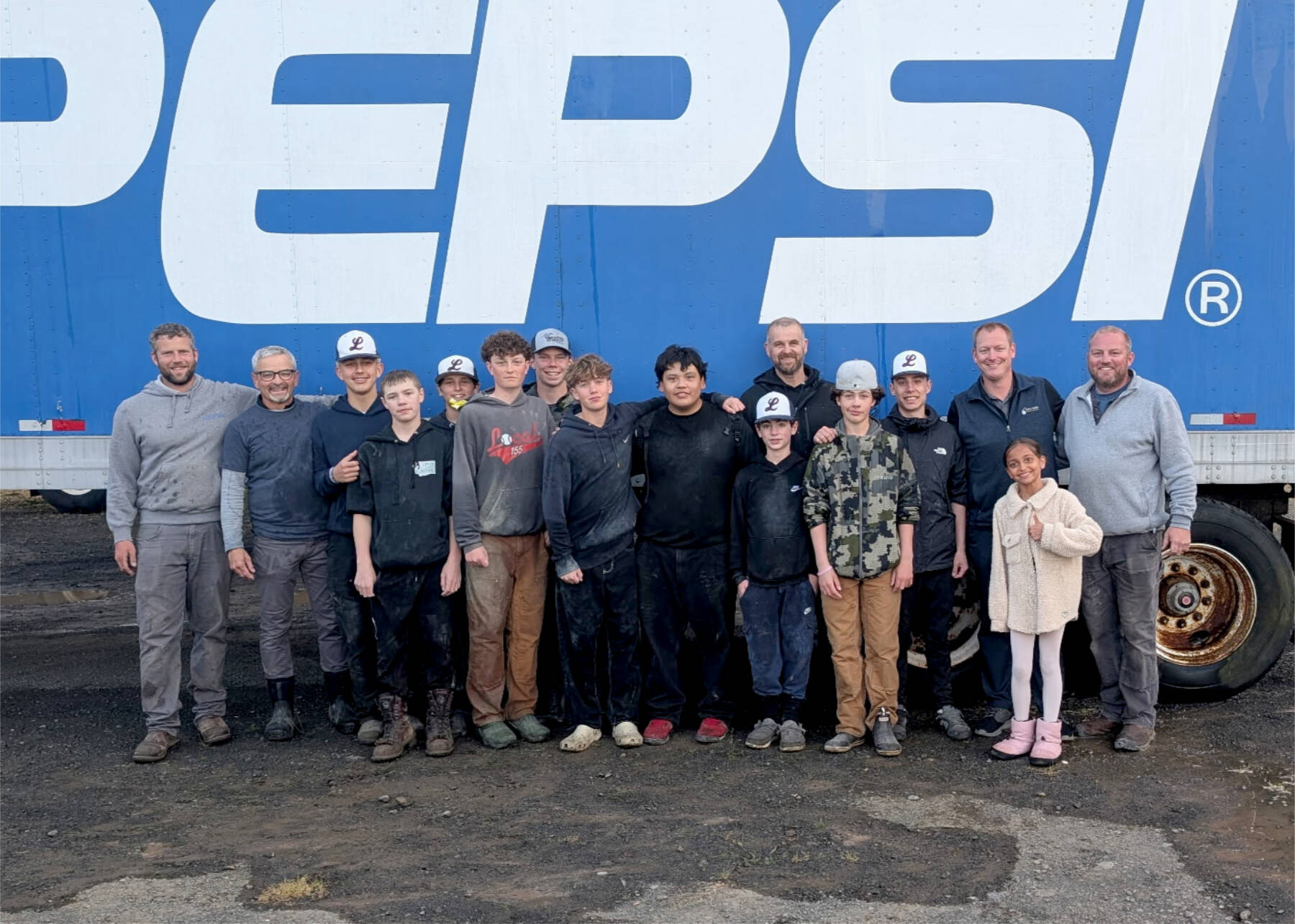
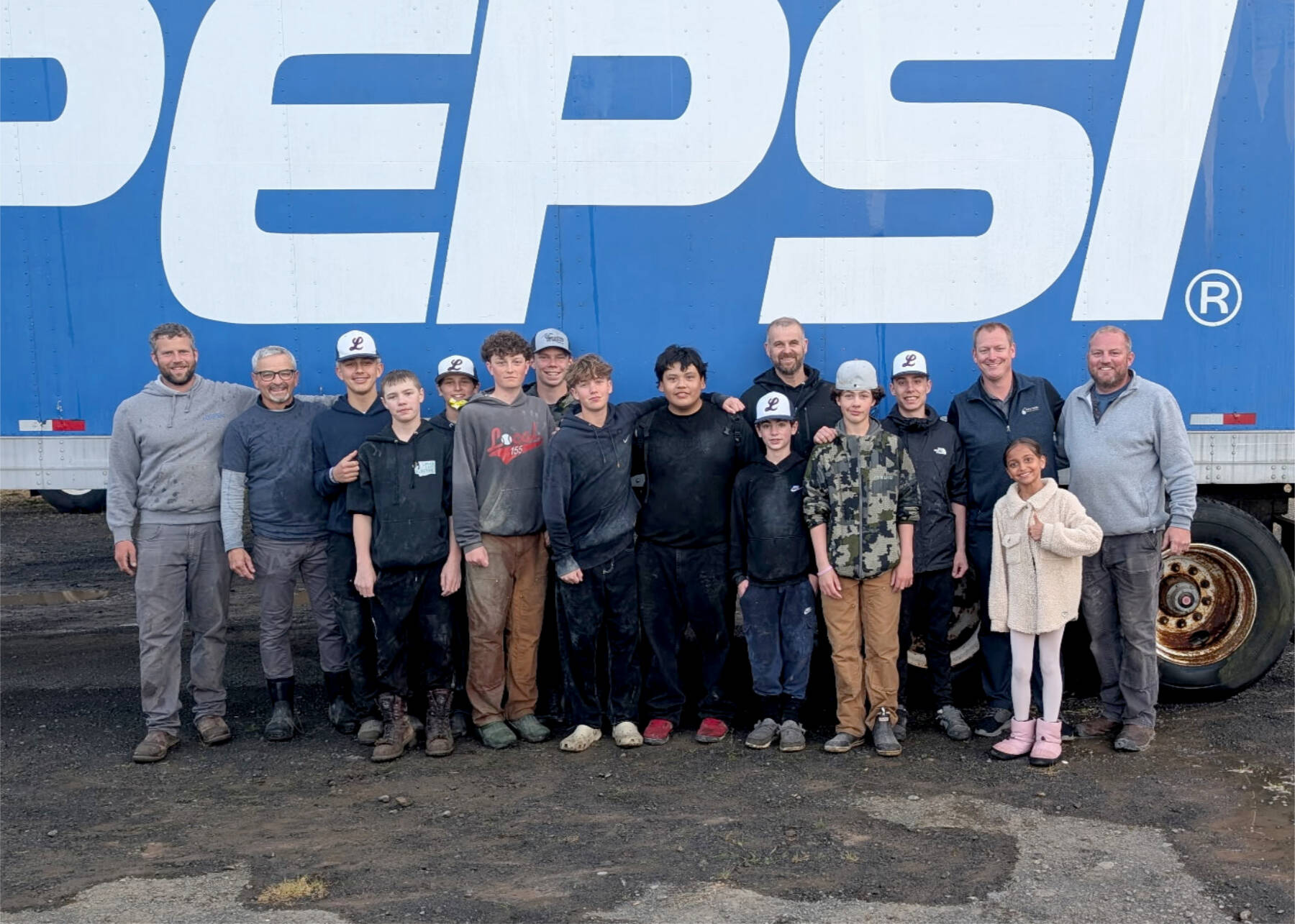
Youth athletes recently traded their bats and gloves for brushes and hoses, taking on the task of washing Peninsula Bottling’s fleet of semi-trailers, an effort that netted them a significant donation from the beverage company.

The partnership highlights a creative approach to youth sports fundraising and underscores Peninsula Bottling’s commitment to the community. By offering their elbow grease to clean the large vehicles, the Junior Babe Ruth players not only earned funds for their league but also gained valuable experience in teamwork and community engagement.

“First of all, I want to thank [Peninsula Bottling owner] Harry Hinds for the generous opportunity to help our Olympic Junior Babe Ruth baseball league earn money. I’m very proud of our Local 155 team and the great job they did. It was a valuable lesson in giving back to the community and working together toward a common goal. In addition, thank you Coach Tyler Wickersham, Riley Shea and John Underwood,” Local 155 coach Mike Mudd.

“Supporting the youth in our community is incredibly important to us,” Hinds said. “The Junior Babe Ruth team approached us with a fantastic idea, and we were more than happy to contribute. It’s great to see these young athletes take the initiative and work together to achieve their goals.”

Father’s Day event

PORT ANGELES — The YMCA of Port Angeles invites families to celebrate Father’s Day in active, joyful style with a free community Father’s Day Field Day on June 16, at the YMCA at 302 S. Francis St. in Port Angeles.

Dads and kids can team up for classic games like basketball, pickleball, cornhole and three-legged races. After the games, families are encouraged to head across the street to Erickson Park for more fun and a “bring your own” picnic.

“This event is about strengthening family bonds and bringing our community together,” says Cort Mao, event coordinator at the YMCA of Port Angeles. “We want dads and kids to leave with smiles, a little sweat, and stories to tell.”

The event from noon to 2 p.m. is free and open to the community, but registration is required. To register, people can go online at www.tinyurl.com/FathersDayPA.

High belt testing

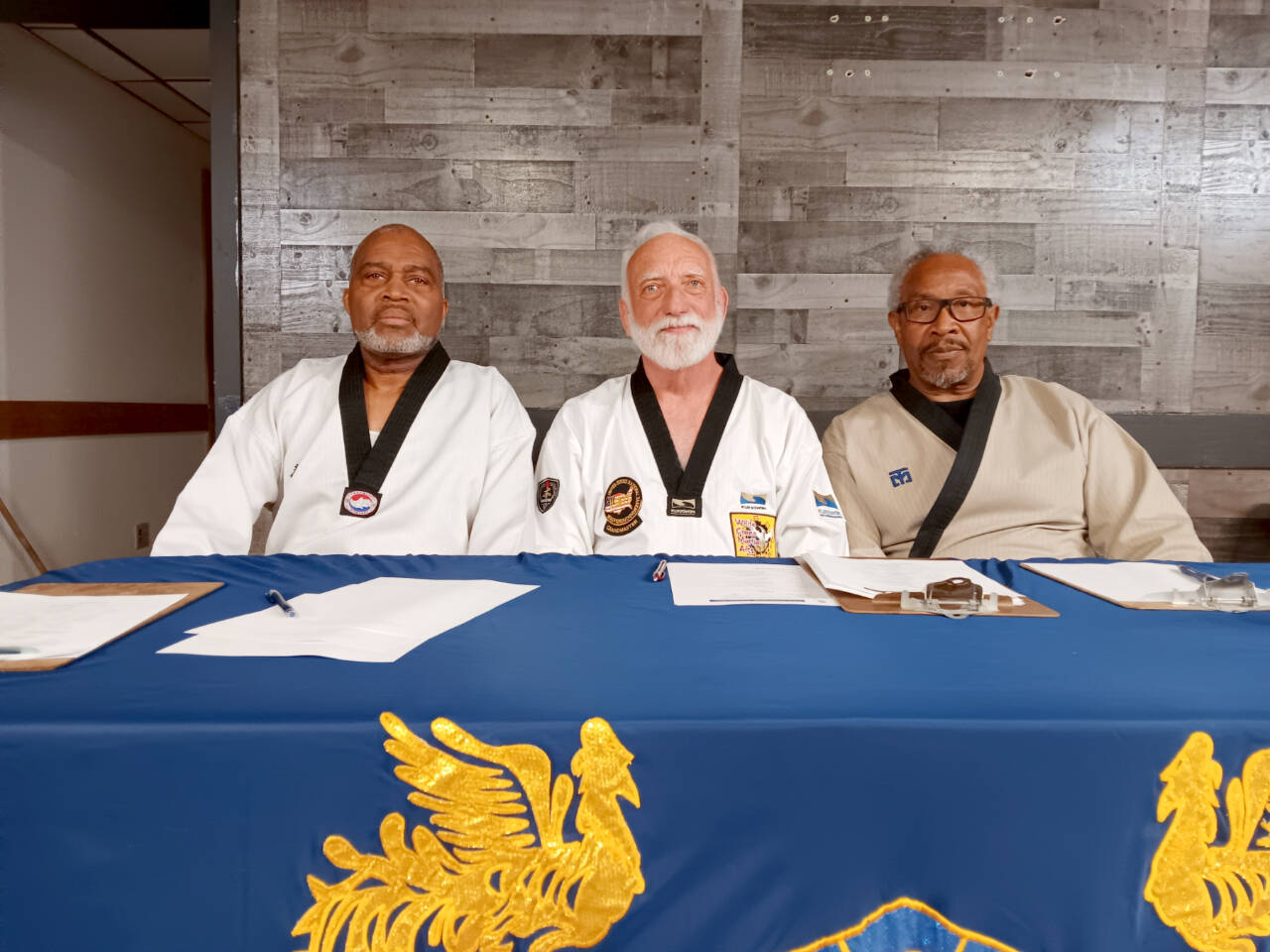
COLORADO SPRINGS, Colo. — On Saturday and Sunday, White Crane Martial Arts Grandmaster Robert Nicholls of Port Angeles conducted high belt testing and instruction seminars at the Mountain Region headquarters in Colorado Springs, Colo.

The host of the event, Grandmaster Sterling Chase and Grandmaster Harris of Las Vegas, Nev., tested eight black belt candidates, with several black belts improving their level and one master, Ashon Britton, testing for seventh dan, becoming a certified Grandmaster. Also testing were a group of adaptive students who train despite various disabilities.

Peninsula Daily News

Members of the Local 155 Babe Ruth team helped raised money for the team by washing a fleet of trucks belonging to Peninsula Bottling Company in Port Angeles.Members of the Local 155 Babe Ruth team helped raised money for the team by washing a fleet of trucks belonging to Peninsula Bottling Company in Port Angeles.
Members of the Local 155 Junior Babe Ruth team helped raised money for the team by washing a fleet of trucks belonging to Peninsula Bottling Company in Port Angeles.Members of the Local 155 Junior Babe Ruth team helped raised money for the team by washing a fleet of trucks belonging to Peninsula Bottling Company in Port Angeles.

Members of the Local 155 Junior Babe Ruth team helped raised money for the team by washing a fleet of trucks belonging to Peninsula Bottling Company in Port Angeles.


Link

Continue Reading
Click to comment

Leave a Reply

Your email address will not be published. Required fields are marked *

Rec Sports

On 50th Anniversary, Lay Park Playground Faces Possible Changes — Grady Newsource

Published

on


Views: 52

City officials and residents are split over a redevelopment plan of 295 E. Dougherty Street, where supporters expressed excitement for new parking, student housing and urbanization while others warned the project may disrupt community services, limit access to Lay Park Community Center and overlook housing needs.

Lay Park Community Center has given the downtown Athens community a place to learn and play, since opening in 1975. Today, the center supports children through programs including summer camp, youth sports and holiday events. 

Stephanie Johnson, District 6 Commissioner, expressed her concerns about the transparency and effectiveness of the new development in a Mayor and Commission meeting held on Nov. 4, 2025.

Johnson questioned the transparency of the development process by asking whether the developers ever met with the mayor and or county staff after submitting their initial plan to discuss expanding the project. Athens-Clarke County Mayor Kelly Girtz said they did not. 

Following the response, she then referenced an alleged conversation with a developer who said his group had been invited into an Athens-Clarke County official office to present plans, raising further questions about whether some discussions occurred outside public view.

Johnson also criticized the county’s progress on affordable housing and where its priorities should lie.

“And when it comes to housing, affordable housing, we don’t have anything appreciable to show for it,” Johnson said. “So yes, we need housing, but there are poor people that live in Athens too,” she added.

Officials Acknowledge Benefits Despite Challenges

The surrounding area of Lay Park Community Center is set for redevelopment if approved by the mayor and commission of Athens in the coming weeks. According to the plans, the development will provide new housing for 1,400 university students, with the addition of a parking deck built to ease downtown parking overflow. 

According to the development agreement, Core must “relocate or replace the playground on the ACC Property to a location approved by the Unified Government at Core’s expense.” As of today, Core will provide $275,000 to ACCGov, which will not fully cover Leisure Services’ plans to integrate an upgraded playground. The current estimated cost of the new playground will cost “at least twice the provided $275,000,” according to the development agreement. 

The development agreement would remove the existing playground, with the private contractor, CS Acquisitions Vehicle, LLC, aka Core, supplementing in a smaller playground in its development. 

Athens-Clarke County Mayor Kelly Girtz said that even with potential negatives of the project, the positives would outweigh them.

“Certainly it’s true that when people have gotten accustomed to a certain aesthetic views and something is going to be different … That’s just difficult for members of the public at times,” Girtz said. 

Alex Bond, assistant director of Athens-Clarke County government, spoke about how the effects of construction will impact the community center and its visitors.

“Construction will be impactful for sure,” Bond said.

Bond said during the year and a half of construction, they plan to rebuild the park and parking for the center. However, during that period of time the park will be less accessible as it currently is for guests. He included that the greatest impact will be the ability for guests to to play at the park, pull up to the front of the center for carpool and park across the street.

He said the 1,400 new residents will have an impact on how many visitors come to use the facilities, including the pickleball and basketball courts.

A benefit of the redevelopment will be the new location of the park.

“The playground will be more nested into Lay Park,” Bond said. “Moving the playground will benefit the users of the park.”

Temporary Playground Loss and Traffic Changes at Lay Park

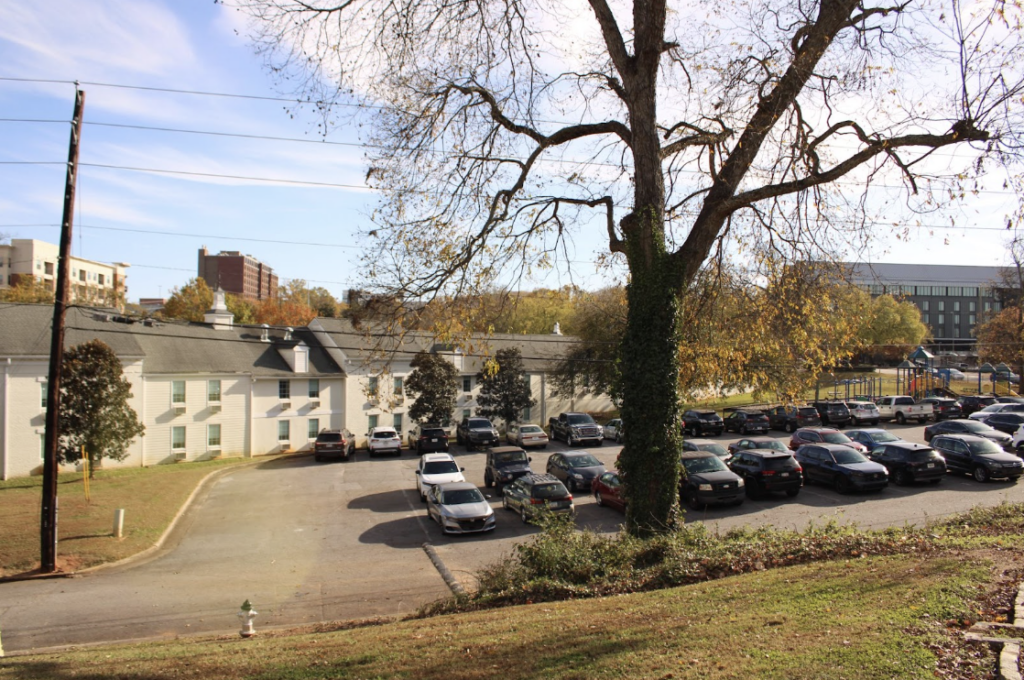
Cars park outside of the Lay Park Community Center, where patrons play on the playground and use the community facilities on Nov. 13, 2025. The lot is home to 54 free parking spots for park-goers and leisure services’ staff. (Photo/Ziggy Moon)

For Kelly Thomas, the facility supervisor at Lay Park Community Center, the redevelopment raises practical concerns about daily operations and access for families who rely on the center’s programs. 

Thomas said losing the current playground will limit daily activities and the center will be without a playground for an unknown amount of time. He also said parking access will shrink, adding that the plan guarantees roughly 50 spots in the new parking structure, which is less than the current parking situation.

Resident raises concerns about loss of community space

Normaltown resident Jordan Croy said the redevelopment threatens one of the neighborhood’s few accessible gathering spaces. He said the Lay Park playground plays an important social role for families, including his 6-month-old daughter.

He said his daughter already benefits from the park due to her constantly meeting new kids on the playground. 

“I don’t know, close by, there’s a few areas near Normaltown, but it’s, you know, it’s kind of fun to meet people from different walks of life because different people show up to different parks,” Croy said when discussing the park’s diversity.

“So, spaces like this are super valuable,” Croy said. “If you don’t have enough of them close by, you can feel really isolated.”

He added that the park carries racial relevance. 

“The families that I’ve seen here tend to be Black,” Croy said. “And I don’t know, it’s hard to ignore the like, sort of the racial component of the story.”

The redevelopment has not yet been approved by Athens-Clarke County officials, and it remains unclear when the project will move forward.

Ziggy Moon, Laney Spevacek and Skylar Smith are journalism majors in the Grady College of Journalism and Mass Communication at the University of Georgia.


Link

Continue Reading

Rec Sports

Utah tribe’s resort plan with developer draws criticism over transparency

Published

on


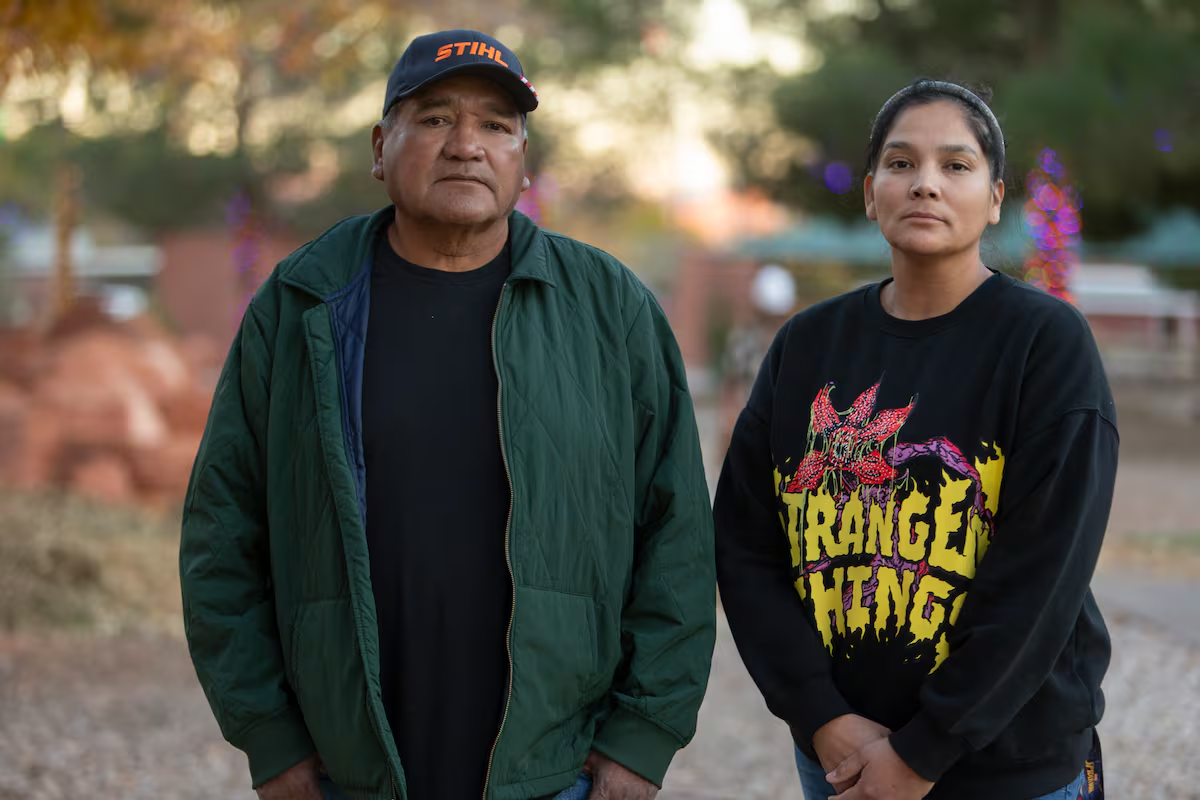
Ivins • Whenever Lawrence Snow rounds a bend on eastbound Highway 91 and the Red Mountains and the reservation that has been his lifelong home come into view, he knows he is on sacred ground, and has a duty to protect it.

“It feels spiritual and does something to one’s soul to see all those red colors and that magnificent Red Mountain,” Snow said. “When I was young, everyone on the reservation was taught you don’t go to the base of Red Mountain without permission because it is a spiritual place and that’s where the spirits go.”

Snow, who is land resource manager for the Shivwits Band of Paiutes Reservation, and others are now seeing red over a planned joint venture between the band and Black Desert Resort to build a massive sports, tourism and retail complex on 1,250 acres of tribal land west of St. George.

As announced in an October news release, Shivwits and resort officials will manage the enterprise that will include golf courses, a youth sports complex, a cultural museum, shopping, dining and a hotel and create 135 jobs. But tribal leaders have been reticent about revealing specifics about what the resort will include and the financial arrangement between the two groups.

Angered by what they say is a lack of transparency and the prospect of hordes of tourists descending on the Red Mountain land and desecrating graves and other sacred sites, Snow and some other Shivwits have banded together to try and inform the public — and if possible, kill the deal.

Among other allegations, members of the group accuse Shivwits elected officials of acting too hastily, keeping band members in the dark about the resort and the partnership and neglecting their responsibility to be wise stewards of the land.

“I think members of the [Shivwits] Band Council are not very business-savvy, and Black Desert is a big corporation with all these lawyers and is taking advantage of them,” Snow told The Tribune.

Growing opposition

(Robert Bolar) A drone shot of the area on the Shivwits Band of Paiutes Reservation west of St. George where a 1,250-acre resort is proposed.

Mary Snow, Lawrence’s daughter, said most Shivwits are opposed to what she called a “back-door deal,” adding that the band is now divided because tribal leaders are putting out a false narrative about group members and trying to sully their reputation.

“They stopped giving us services, answering the phone and are putting out to people that we oppose the resort because we don’t like them,” Mary Snow said.

Tina Gonzales, chair of the Shivwits Band Council, disputed the allegations, saying the joint venture came after a thorough 18-month review process that involved “community meetings, open dialogue with members and a band-wide survey outlining the proposed concept.”

“This was not a rushed decision,” Gonzales said in a statement to The Tribune. “It was a thoughtful process grounded in governance, transparency, and community consensus. This collaboration supports our goal of creating long-term ventures and is built on mutual respect and a shared vision. We are excited to be a co-steward in this project, ensuring that our heritage and values are woven into every aspect of the development.”

While the partners are not providing specific details about the resort, an internal document that was placed on the band’s website earlier this year said the resort could include as many as four golf courses, and an airfield in addition to the museum. All told, according to the document, the venture could provide the 322 members of the federally recognized tribe up to $149 million, much of which would come from leasing land and water rights to Black Desert for the resort.

The Snows said some of those details were in a power point presentation Black Desert shared with tribal members last April at the reservation’s community center, a meeting they said was adjourned early when it became clear that most band members present were opposed to a resort. Much has changed since that meeting, they noted.

Even now, the Snows said, band members still don’t know if a contract has been signed, what the financial terms are if one exists, or what projects have been agreed to.

“Every time we have asked what’s in the contract, they say, ‘We are not done yet’ and ‘changes are being made,’” Mary Snow said, adding most of what they learn they hear second hand from workers who live in St. George and have been hired to do projects on the reservation.

Lawrence Snow said he is worried that the band’s plan to lease the land and water for the resort for an extended period —potentially over 90 years, he said — is equivalent to selling out future generations.

Cultural concerns

(Chris Caldwell | Special to The Tribune) Joel Bushhead speaks to The Salt Lake Tribune in Santa Clara, Thursday, Dec. 11, 2025. Members of the Shivwits band of Paiutes near St. George discuss the impact proposed golf course developments would have on their tribal lands.

Gonzales argues otherwise, saying the partnership will strengthen the band’s ability to control development on the land and help support current and future generations.

“This land had been previously designated by the band for economic development projects, long before the current partnership discussions began,” she said in the statement. “The council’s decision reflects a balance of cultural stewardship and future community opportunity.”

Black Desert managing partner Patrick Manning also defended the partnership.

“We are committed to preserving and celebrating their rich heritage, and this entire project will stand as a model of responsible development,” he said in a statement. “We’re building a shared future that provides lasting economic and cultural benefits to the entire community. That includes job creation, workforce development, increased revenue for community services, and opportunities to reinvest in education, healthcare, housing, and cultural preservation.”

Joel Bushhead said he sees little evidence of that from the workers he sees riding around in the ATVs and putting in survey stakes. He said he has had to rebury pottery and a body part unearthed by the workers.

“They are desecrating the graves of the dead people who are buried there,” Bushhead said. “I can’t really do nothing because I’m an old man, and they won’t listen to me.”

Sabrina Redfoot, another member of the tribe, said Paiute artifacts in the ground belong where they are, not in the proposed museum. She and other resort opponents say they want to rally public opposition and ensure members of the Paiute Indian Tribe of Utah’s five bands — Cedar, Indian Peaks, Kanosh, Koosharem, and Shivwits — know about the resort.

“We’ll continue to grow Red Mountain resistance and get out there with picket signs and protest this,” Mary Snow said. “Even if it is too late, we want our voices to be heard.”

Gonzales and Manning pledge to continue engaging with band members and plan to conduct a detailed and rigorous environmental review and cultural study of the site, according to a joint statement.


Link

Continue Reading

Rec Sports

Shenandoah District girls basketball youth movement in 2025-26 season

Published

on


Updated Dec. 17, 2025, 7:39 a.m. ET

SWOOPE — When Buffalo Gap played Riverheads in girls basketball Dec. 12, there was one senior on both teams combined. They were the youngest (Gap) and third youngest (Riverheads) teams in the Shenandoah District, but youth is more the rule, not the exception, in girls basketball this year.

More than half of the players in the district are sophomores or freshmen.


Link

Continue Reading

Rec Sports

Bob Asmussen | Full speed ahead for youth wheelchair-basketball program | Columns

Published

on


12152025   rolling heat 2

Canaan Shaffer tries to shoot over defender Kylie Ritz during practice Monday for the Rolling Heat, the Stephens Family YMCA wheelchair basketball program for children ages 6-13, in the gym at the facility in southwest Champaign.


To subscribe, click here.

Want to purchase today’s print edition? Here’s a map of single-copy locations.

Sign up for our daily newsletter here

CHAMPAIGN — Kylie Ritz was new to wheelchair basketball in 2024 when she participated in her first game.

Her Rolling Heat team was playing at a tournament in Madison, Wis.

“The ball was tossed in the air for the tip off,” Kylie said. “We got it, we dribbled down the court and I made my first basket. I was just so excited.”

Kylie, who has played softball and standup basketball in the past, had found her sport … and long-term goal: to someday compete on the U.S. Paralympic team. After, of course, playing for the University of Illinois wheelchair team.

A 12-year-old sixth-grader at Jefferson Middle School, Kylie is a star player for the Rolling Heat, the team started in 2022 by Larkin’s Place Director Alyssa Anderson — who also serves as team director.


12152025   rolling heat 10

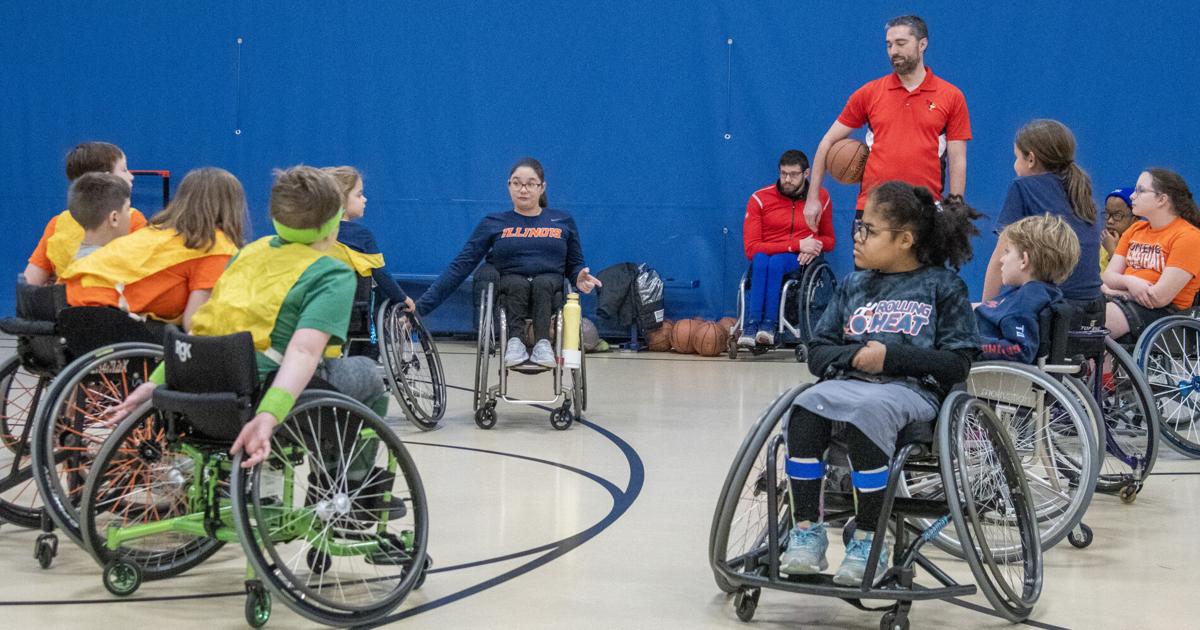
Assistant Coach Stefan Ritz, standing, talks to the team during practice for the Rolling Heat, the Stephens Family YMCA wheelchair basketball program for ages 6-13. At the YMCA in Champaign on Monday, Dec. 8, 2025.


From humble beginnings of three players in its first year, the Stephens Family YMCA program has expanded to its current 20. And they’re looking for more.

“We’re all over,” Anderson said. “We have kids driving in from Peoria, Argenta, Sullivan, Wapella, all within an hour and a half of here.”

Practices are held on Mondays at the Stephens Family Y.

What does Kylie remember about her first practice?

“I was kind of nervous, kind of excited,” she said. “I wasn’t sure if I was going to like it.”

She did. And does.

The team just returned from a tournament in the Madison area, where it went 2-2.

If you go to a game, you will notice Kylie — for both her skill and on-court personality.

“I am very aggressive, very talkative, very loud,” she said.

Her teammates look to Kylie for leadership.

Ask Kylie about her strength as a player, and the answer isn’t shooting or passing.

“The most important qualities of a basketball player are being coachable and being a team player,” Kylie said. “Without your team, you can’t play. And if you’re not coachable, you’re never going to learn anything new.”

Kylie’s parents, Stefan and Monica, are all for her time with the Rolling Heat.

“She has found something she is extremely passionate about,” Stefan said. “She has put a ton of work into this.”

This year, Stefan is helping coach the team. Kylie’s sister Rosie, 7, is also in the program. Sisters Ella, 8, and Evie, 5, were on the trip to Madison.

The Ritz family is sold on the program.

“I think it’s a great opportunity for a lot of these athletes to go out there and get all the good things that sports offers,” said Stefan, who is a teacher at Rantoul Township High School. “A lot of our athletes don’t have a ton of options like this. There is a need for more good, adaptive sports. I think this is a great opportunity for all of them to get the same benefits that any other young athlete can get from playing a sport.”


12152025   rolling heat 4

Coach Kaitlyn Eaton gives instruction during practice for the Rolling Heat, the Stephens Family YMCA’s wheelchair-basketball program for youths ages 6-13.


The right leader

When Anderson got the go-ahead to start the program, one of the first orders of business was finding a coach.

She turned to former UI wheelchair standout Kaitlyn Eaton, a two-time Paralympian.

The Houston native played on the UI wheelchair team from 2012-17. After graduation, she remained in C-U and was an assistant on the UI team from 2017-20.

She played in Paralympic Games at Tokyo in 2020 and Paris in 2024, winning bronze and silver medals.

How did she react when asked to coach the Rolling Heat?

“Obviously, I was excited,” Eaton said. “The Champaign-Urbana community has done so much for people with disabilities. The UI has done a lot for people with disabilities.

“I think all of the athletes that have come through here and played for the UI have known this community needed something like this.”


12152025   rolling heat 1

Dexter Campbell smiles after successfully passing to Rowan Smith. A gallery from Monday’s Rolling Heat practice is available at news-gazette.com.


The Rolling Heat created an opportunity that doesn’t exist in the rest of downstate Illinois.

“I was excited they were willing to start up a program.” Eaton said. “They had great backing with the YMCA, so that’s awesome.”

Eaton said she wasn’t sure “how good of a coach I would be with young kids.”

“It was something new for me,” she said. “I didn’t know really what to do or what to expect.”

Three years in, it’s going well.

“It’s been fun,” Eaton said. “I’ve learned a lot as a coach and I’ve learned how to talk to the kids and teach them in the best way I know how.”

The difference in the team’s skill level now compared to the beginning is “night and day,” she said.

“I think it’s cool. We’ve seen a lot of growth with the kids,” Eaton said. “They are starting to understand concepts now.”

A year ago at the same tournament, one of the players, Carter, froze every time he got the ball.

Afterward, Eaton sat in the hallway with him and taught him how to dribble and push at the same time.

“Now, Carter is one of our top scorers,” Kaitlyn said.

There are many other stories of players showing improvement.

“It’s one of those things in wheelchair basketball it is waiting for the light bulb to go off,” Eaton said. “We’re seeing the light bulbs go off pretty consistently right now.

“They get so excited. The smiles on their face when they win a tough game or when one of their teammates does something incredible is awesome.”

Winning is fun. But it’s not the driving force.

“At the end of the day, the best part about wheelchair basketball is the community it provides,” Eaton said. “They get to make friends and be with other kids that have disabilities too.”

The players are big fans of Eaton.

“She is very helpful,” Kylie said. “She’s taught us a lot of defensive strategies.”

Eaton challenges the players — in a good way.

“We’re fortunate that we have really good kids on our team,” she said. “They’re really kind, they’re really incredible about accepting new people. They make it a really welcoming environment.”


12152025   rolling heat 7

Zeke Arnold, right, and Victor Rafferty take a break during practice for the Rolling Heat, the Stephens Family YMCA wheelchair basketball program for ages 6-13. At the YMCA in Champaign on Monday, Dec. 8, 2025. Zele’s father said they had just returned from a weekend of playing sled hockey in Chicago.


Making it work

There had been other attempts in the past to start a wheelchair program in C-U. None took, until now.

“We’re building something incredible here in Champaign,” Eaton said. “The YMCA really did take a gamble. There wasn’t a lot to show that this would work. A lot of credit to them and a lot of credit to our director Alyssa. She has put a lot on the back end to make this happen by getting sponsorships and finding kids, finding parents, really persuading them to show up.”

When she started at Larkin’s Place, Anderson identified a need for adaptive sports opportunities for kids with physical disabilities.

She went to her bosses at the Y, Jeff Scott and Jeff Dobrik, and asked to start a youth wheelchair-basketball team.

“They said, ‘Great,’” Anderson said.

She suggested it might take a while to get it going. They said, “Let’s start now.”

She turned to the UI Division of Rehabilitation Services, which put her in touch with Eaton.

At first, none of the players had ever been in a sports chair.

In order to grow, Anderson knew the Rolling Heat needed sponsorships. A sports chair costs about $5,000.

“This was a huge investment, and not something we necessarily had in the budget,” Anderson said.

She contacted the C-U Elks, which administers a trust. The organization provided $35,000 — enough to buy six sports chairs, a trailer and jerseys.

The Rolling Heat registered with the National Wheelchair Basketball Association as a prep team. There are 65 teams across the country.


12152025   rolling heat 5

Paralympic athlete Daniel Romanchuk, 2-time World Champion/World Record Holder and 4-time Paralympic Medallist, left, chats with Aria Panika during practice for the Rolling Heat, the Stephens Family YMCA wheelchair basketball program for ages 6-13. At the YMCA in Champaign on Monday, Dec. 8, 2025.


Playing at the prep level (middle school and younger), the team competed in four tournaments last season, none of them in Illinois. The Rolling Heat have six tournaments this season, which extends into March.

“This wouldn’t be here without the kids,” Anderson said. “They are such an amazing group of kids. It is such a cool experience for this community to be together,”

There are four teams in Illinois, with the closest in New Lenox, near Joliet.

Tournaments this season are scheduled in Wisconsin, Missouri, Illinois and Indiana.

“Some of these parents are committing to eight-hour round trips,” Anderson said.

She was motivated in part by her daughter Millie, almost 5, who has spina bifida. Millie is planning to play for the Rolling Heat.


12152025   rolling heat 3

Head Coach Kaitlyn Eaton, center in Illinois shirt, and Assistant Coach Stefan Ritz, standing, talk to the team during practice for the Rolling Heat, the Stephens Family YMCA wheelchair basketball program for ages 6-13. At the YMCA in Champaign on Monday, Dec. 8, 2025.


Going all in

Emma Six, 11, is one of the original five players for the Rolling Heat. Her family travels to practices from their home in Decatur.

Emma is in her fourth year as a player.

“We were looking for something for her to try that was adaptive,” said her mom, Courtney. “They were very, very new. It was nice to go in and everyone was at the same level.”

Emma’s interest in the game was immediate.

“She looked forward to waking up on those days of practice,” Courtney said.

She can’t wait to play.

“I get excited,” Emma said.

One of her strengths is shooting. She made three baskets during one of the weekend games. The scores are generally in the upper 20s.

Like Kylie, Emma wants to play for Team USA — like their coach.

Emma said she has made many friends, both on her own team and among her opponents.


12152025   rolling heat 6

ABOVE: Victor Rafferty, left, and Rowan Smith go for the ball on the floor during practice for the Rolling Heat. BELOW: Four-time Paralympic medalist Daniel Romanchuk chats with Rolling Heat participant Aria Panika during practice.


“We joke that we have to drive three to five hours to hang out with some of our friends,” Courtney said. “I like the camaraderie of it all. All of us walking different paths in life and these kids have a wide range of different disabilities. It’s really cool to see them find their place on the team.”

Emma’s dad, Cody, was equally enthusiastic.

“I think it’s neat because of the wide age gap of the kids, seeing them develop at different speeds and grow together,” he said.

The families have to pay for their own travel and will spend $4,000 to $5,000 in expenses.

“It’s a big commitment for these families,” said Courtney, who is a paraprofessional aid for Argenta-Oreana Elementary. Cody is a shift supervisor at Primient in Decatur.

Emma is a sixth-grader at Argenta.


Link

Continue Reading

Rec Sports

Fire department budgets have a private equity problem

Published

on


Private equity money has flowed into so many parts of this economy — skilled trades like plumbing, restaurant chains, even youth sports. And now, companies backed by private equity are making acquisitions in software used by fire departments, according to New York Times investigative correspondent Mike Baker.

In Norfolk, Connecticut, the volunteer fire department has a budget of $132,000 a year, Baker said. They were paying $795 a year for their software until it was bought up by a private equity-backed company, which planned to shut it down and offered another software for $5,000.

“They go looking around for an alternative,” Baker said. “And then that same company backed by private equity comes along and buys up that second software provider. They really feel kind of trapped and have eventually now found a solution that wasn’t up to $5,000 a year but was still a lot more than they were paying before.”

Baker spoke with “Marketplace” host Kai Ryssdal about his reporting. Use the audio player above to hear their conversation.

Related Topics


Link

Continue Reading

Rec Sports

Youth Sports Hits Record Participation, But 46% Cost Surge and Widening Income Gap Threaten Growth

Published

on


Key Takeaways

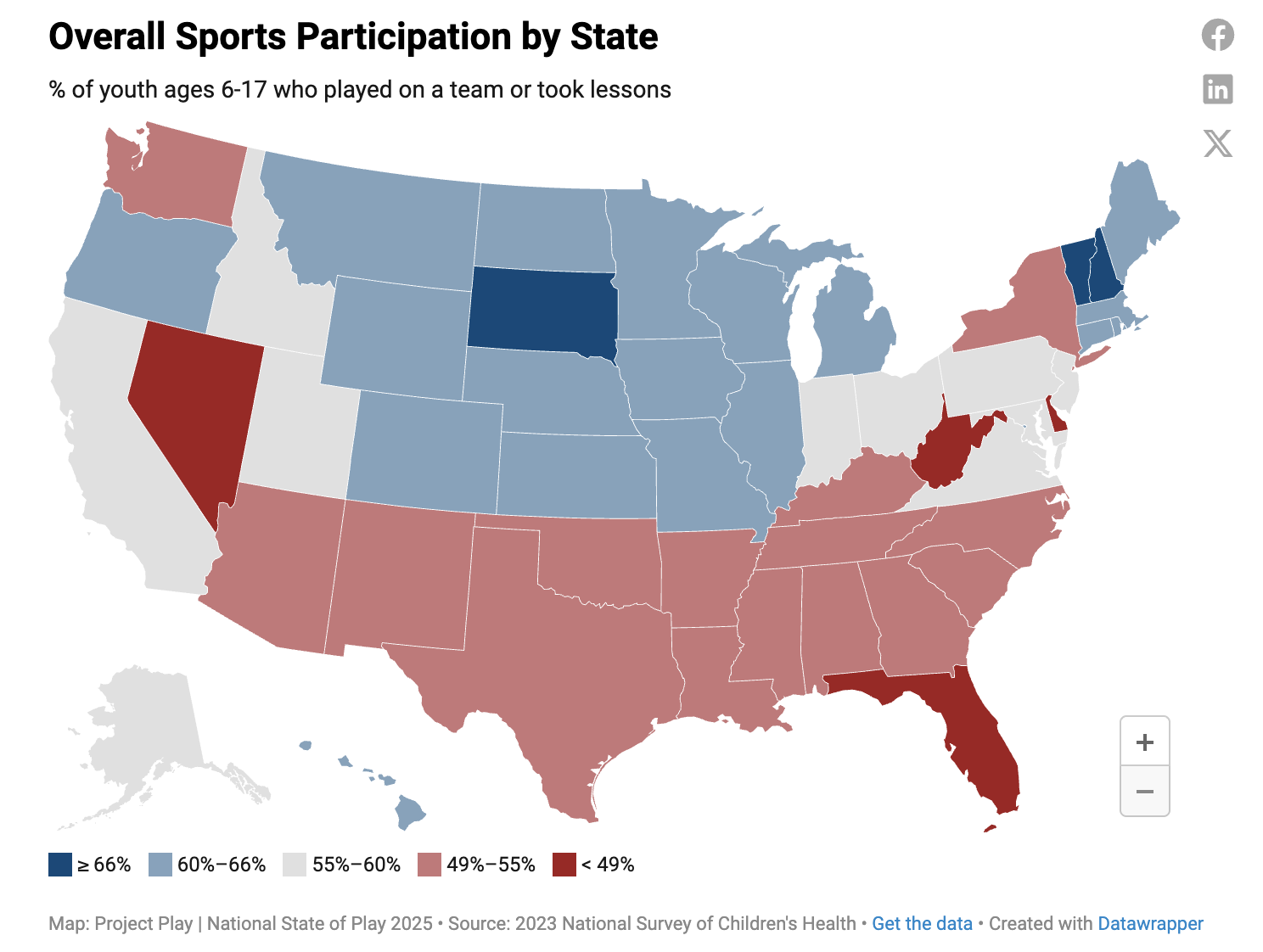
  • Youth sports participation recovered to 55.4% in 2023, the highest rate since before COVID, with 65% of kids trying sports at least once in 2024.
  • Average family spending jumped 46% since 2019 to $1,016 annually, twice the rate of overall U.S. inflation during the same period.
  • The participation gap between low-income and high-income households widened from 13.6 percentage points in 2012 to 20.2 points in 2024.
  • Flag football grew 14% in regular youth participation from 2019 to 2024, the only team sport tracked to show growth during that period.
  • Fourteen states reached the federal government’s 63% participation target, with Vermont leading at 72% and Nevada trailing at 43%.

The Aspen Institute’s State of Play 2025 report delivers a clear message: youth sports bounced back from the pandemic, but the rebound masks growing fractures in access, affordability, and equity across the $54 billion industry.

Released annually by the Sports & Society Program’s Project Play initiative, the report draws from federal data, industry surveys, and parent research to analyze how well children are being served by the adults building youth sports programs. The 2025 findings reveal an ecosystem experiencing record participation alongside record costs, with implications that will shape the market through 2030 and beyond.

Post-Pandemic Rebound Defies Historical Precedent

According to the National Survey of Children’s Health, 55.4% of youth ages 6-17 played organized sports in 2023, up from 53.8% in 2022. Industry data from the Sports & Fitness Industry Association shows even stronger momentum in 2024, with 65% of kids trying sports at least once during the year.

The recovery matters because it didn’t have to happen. After the 2009 recession, participation rates fell and never returned to pre-recession levels. Municipal budgets got cut, local recreation programs suffered, and private sport providers flourished while leaving many kids behind.

This time, casual participation surged. Sixty-five percent of youth ages 6-17 tried sports at least once in 2024, up from 59% in 2021 and the highest rate recorded by SFIA since at least 2012. The shift reflects how pro leagues and operators adapted post-COVID to offer more informal, lower-commitment options. The NFL’s investment in flag football through RCX Sports exemplifies this trend.

“The rebound in participation since the pandemic is a credit to all who have innovated to improve access to quality sport programs,” said Tom Farrey, executive director of the Sports & Society Program. “But we’re going to need leadership to ensure that as more money flows into the space, the needs of children, all children, are prioritized.”

The Cost Crisis Intensifies

The average U.S. sports family spent $1,016 on their child’s primary sport in 2024, a 46% increase since 2019. That’s twice the rate of price inflation in the broader economy during the same period.

Higher team registration fees, travel costs for non-local competition, and spending on camps and private instruction all contributed to the increase. Baseball emerged as the most expensive of the three most popular sports, costing more on average than soccer or basketball.

The timing adds complexity. The report’s data came before President Trump’s tariffs and the federal government shutdown, both of which could further impact family budgets. In 2024, $6.27 billion worth of sporting goods imported into the U.S. came from China, accounting for 61% of these imports.

After the 2017 tariffs, physical inactivity rates for households earning less than $25,000 jumped from 45% to 47% in one year, according to SFIA. The organization’s CEO, Todd Smith, told ESPN that the increase was directly related to tariffs. “We, as an industry, sports and fitness offer a free remedy to try and minimize healthcare costs,” Smith said, “so why would we create more barriers to accessibility and entry into activities?”

Children are noticing the burden too. Project Play’s community surveys show more kids citing “too expensive” as what they dislike most about sports. One student told The New York Times his family paid $500 to $700 per month for his team. “A lot of time I would feel pressure to make sure I do well because it costs so much money and if I played badly my parents would be disappointed.”

Participation Gap Widens Along Income Lines

In 2012, 35.5% of kids ages 6-17 from homes earning under $25,000 regularly played sports compared to 49.1% from homes earning $100,000 or more, a difference of 13.6 percentage points. By 2024, that gap had widened to 20.2 percentage points.

Federal data tells a similar story. Children from the lowest-income homes played sports in 2023 at half the rate of those from the highest-income group.

The Aspen Institute’s parent survey found that children from the wealthiest households play their primary sport more frequently than their peers across community settings, schools, travel teams, and independent training. Kids from homes earning $100,000 or more are two times more likely to play travel sports than those from homes making under $50,000.

The one exception is free play, where the pattern reverses. Children from the lowest-income homes and those in urban environments engage in unstructured play more than the wealthiest children and those living in the suburbs.

Flag Football Outpaces All Team Sports

From 2019 to 2024, flag football was the only team sport tracked by SFIA that experienced growth in regular participation among kids ages 6-17. Flag grew 14% while baseball dropped 19%, tackle football fell 7%, soccer declined 3%, and basketball slipped 2%.

Among kids ages 6-12, flag surpassed tackle as the most commonly played form of football in 2017. The gap continues to widen, with 4% playing flag in 2024 versus 2.7% playing tackle. Among teenagers 13-17, tackle (6.4%) still significantly outpaces flag (2.8%).

NFL FLAG now serves more than 620,000 youth ages 4-17 across 50 states. Twenty-eight states either sanction girls’ high school flag football or are running pilot programs. In October, the NFL announced plans to launch professional women’s and men’s flag leagues ahead of the sport’s debut at the 2028 Los Angeles Olympics.

The sport’s rise is affecting soccer participation. In 2012, soccer exceeded flag by 6.4 percentage points among kids ages 6-12. By 2024, soccer’s advantage had shrunk to 3.5 percentage points, a shift that has some soccer leaders concerned about losing would-be players to flag.

Latino Youth Drive Fastest Demographic Growth

For years, Latino youth played sports at lower rates than their peers. That changed recently based on SFIA data. In 2024, 65% of Latino youth ages 6-17 tried sports at least once, a higher rate than Black and White youth.

Participation among Latina girls rose from 39.5% in 2019 to 48.4% in 2024, outpacing the growth of their non-Latina peers, according to McKinsey Institute research. The increase is attributed to greater representation of Latinas in college and pro sports, along with targeted programs from organizations like ELLA Sports Foundation, Girls on the Run, Sports 4 Life, and the Women’s Sports Foundation.

“When young girls feel represented, they are empowered to dream and to succeed in life,” said Patty Godoy, co-founder of ELLA Sports Foundation. “This representation is inspiring and motivating for young Latinas to play sports and stay in sports.”

Challenges remain. Latino parents cite scheduling conflicts more than non-Latinos as a barrier. Research by McKinsey and U.S. Soccer Federation found that Latino and Black children are three times more likely than White children to stop playing soccer because they feel unwelcome.

The report also documents impacts from immigration enforcement. A Stanford University study found that recent raids in California’s Central Valley coincided with a 22% increase in daily student absences. Media accounts from 2025 describe decreased attendance across summer sports programs in parts of Los Angeles after raids, and the Oregon Youth Soccer Association reported that as many as 16 teams withdrew from Portland competition after people reported ICE activity in community parks.

Coaching Training Reaches One Million

The Million Coaches Challenge reached a milestone in 2025 when its cohort of partners trained one million youth coaches across the U.S. in evidence-based youth development practices. Research shows that 93% of coaches trained by the program feel more confident in their ability to support youth, and their athletes report more joy, stronger relationships, and higher likelihood to continue playing.

The U.S. Tennis Association introduced a comprehensive coaching platform in 2025 that offers four membership tiers ranging from free to $249 annually. Benefits include equipment discounts from 20% to 50%, liability insurance, telehealth access, career counseling, and flexible education modules that coaches can complete in 20-minute sessions.

“Research shows that people aren’t attracted to coaching as a career anymore, and we need to change that,” said Craig Morris, USTA Coaching CEO. “We need to work with facility owners and operators to put value on coaches who are educated and have a growth mindset.”

Strategic Implications for Operators

The report identifies several trends that will define the youth sports landscape through 2026 and beyond. NIL deals are trickling down to middle school athletes, with one eighth-grader in Washington D.C. signing sponsorship deals and hiring an agent. AI-powered analytics platforms are reaching younger age groups, with some organizations offering video analysis and performance tracking for 8- and 9-year-olds at costs around $300 annually.

Fourteen states reached the federal government’s 63% participation target in 2023. Achieving that goal nationwide by 2030 could save the U.S. $80 billion in direct medical costs and productivity losses while delivering over 1.8 million more quality years of life to Americans, according to a study published in the American Journal of Preventive Medicine.

Illinois created the nation’s first statewide youth sports commission in 2025, focused on quality, access, and equity. California is studying whether to establish a Department of Youth Sports. The Children’s Bill of Rights in Sports gained endorsements from the U.S. Conference of Mayors, National League of Cities, and National Recreation and Park Association.

The data shows an industry at a crossroads. Participation is up, but so are costs and inequities. How operators, municipalities, brands, and policymakers respond to these tensions will determine whether youth sports becomes more accessible or more exclusive in the years ahead.


YSBR provides this content on an “as is” basis without any warranties, express or implied. We do not assume responsibility for the accuracy, completeness, legality, reliability, or use of the information, including any images, videos, or licenses associated with this article. For any concerns, including copyright issues or complaints, please contact YSBR directly.


About Youth Sports Business Report

Youth Sports Business Report is the largest and most trusted source for youth sports industry news, insights, and analysis covering the $54 billion youth sports market. Trusted by over 50,000 followers including industry executives, investors, youth sports parents and sports business professionals, we are the premier destination for comprehensive youth sports business intelligence.

Our core mission: Make Youth Sports Better. As the leading authority in youth sports business reporting, we deliver unparalleled coverage of sports business trendsyouth athletics, and emerging opportunities across the youth sports ecosystem.

Our expert editorial team provides authoritative, in-depth reporting on key youth sports industry verticals including:

  • Sports sponsorship and institutional capital (Private Equity, Venture Capital)
  • Youth Sports events and tournament management
  • NIL (Name, Image, Likeness) developments and compliance
  • Youth sports coaching and sports recruitment strategies
  • Sports technology and data analytics innovation
  • Youth sports facilities development and management
  • Sports content creation and digital media monetization

Whether you’re a sports industry executive, institutional investor, youth sports parent, coach, or sports business enthusiast, Youth Sports Business Report is your most reliable source for the actionable sports business insights you need to stay ahead of youth athletics trends and make informed decisions in the rapidly evolving youth sports landscape.

Join our growing community of 50,000+ industry leaders who depend on our trusted youth sports business analysis to drive success in the youth sports industry.

Stay connected with the pulse of the youth sports business – where industry expertise meets actionable intelligence.

Sign up for the biggest newsletter in Youth Sports – Youth Sports HQ – The best youth sports newsletter in the industry 

Follow us on LinkedIn

Follow Youth Sports Business Report Founder Cameron Korab on LinkedIn


Are you a brand looking to tap into the world’s most passionate fanbase… youth sports?

Introducing Play Up Partners, a leading youth sports marketing agency connecting brands with the power of youth sports. We specialize in youth sports sponsorships, partnerships, and activations that drive measurable results.

About Play Up Partners

Play Up Partners is a leading youth sports marketing agency connecting brands with the power of youth sports. We specialize in youth sports sponsorships, partnerships, and activations that drive measurable results.

Why Sponsor Youth Sports?

Youth sports represents one of the most engaged and passionate audiences in sports marketing. With over 70 million young athletes and their families participating annually, the youth sports industry offers brands unparalleled access to motivated communities with strong purchasing power and loyalty.

What Does Play Up Partners Do?

We’ve done the heavy lifting to untangle the complex youth sports landscape so our brand partners can engage with clarity, confidence, and impact. Our vetted network of accredited youth sports organizations (from local leagues to national tournaments and operators) allows us to create flexible, scalable programs that evolve with the market.

Our Approach

Every partnership we build is rooted in authenticity and value creation. We don’t just broker deals. We craft youth sports marketing strategies that:

  • Deliver measurable ROI for brand partners
  • Create meaningful experiences for athletes and families
  • Elevate the youth sports ecosystem

Our Vision

We’re positioning youth sports as the most desirable and effective platform in sports marketing. Our mission is simple: MAKE YOUTH SPORTS BETTER for athletes, families, organizations, and brand partners.


Common Questions About Youth Sports Marketing

Where can I sponsor youth sports? How do I activate in youth sports? What is the ROI of youth sports marketing? How much does youth sports sponsorship cost?

We have answers. Reach out to info@playuppartners.com to learn how Play Up Partners can help your brand navigate the youth sports landscape.

Youth sports organizations: Interested in partnership opportunities? Reach out to learn about our accreditation process.


Link

Continue Reading

Most Viewed Posts

Trending