Connect with us
https://yoursportsnation.com/wp-content/uploads/2025/07/call-to-1.png

Rec Sports

Arizona youth sports’ cost rises steadily for parents | Sports

Published

on


As the cost of youth sports continues to rise, families across Arizona are being priced out of participation.

From local clubs to travel teams, the expenses add up with equipment, uniforms, tournament fees and more totaling thousands of dollars annually, putting pressure on families and widening the gap between those who can afford to play and those who can’t.

The financial strain is reshaping who gets to participate, raising concerns among researchers, nonprofits and parents about long-term access and equity.

According to a 2023 study by the Aspen Institute’s Project Play, Arizona ranked second to last in the country for youth ages 6-17 who played on a team or took lessons. 

Less than half of high school students reported playing on one or more sports teams during the past 12 months according to research done by the Arizona Department of Health Services Bureau of Nutrition and Physical Activity.

“Costs are rising and as a result of that we are seeing lower rates of participation, particularly in under-resourced, traditionally underrepresented communities,” said Eric Legg, assistant professor in Arizona State University’s School of Community Resources & Development. 

“It’s a wrecked relationship,” he said. “Costs go up, participation goes down, and it most impacts underrepresented communities.”

Youth sports play a crucial role in children’s development, allowing for positive social, emotional and physical growth.

The U.S. Anti-Doping Agency (USADA) found that physical activity enhances self-perceptions of body, competence and self-worth and that playing a sport can even protect against suicide risk in youth.

At the Boys & Girls Club of the Valley (BGCAZ), the importance of youth development is embedded in their subsidized sports, fitness and recreation programs.

“Unfortunately, as kids have started to specialize in sports, they’re dropping out of sport at a younger and younger age,” said Josh Stine, BGCAZ vice president of external affairs. 

“Our goal is to keep [them] playing sports longer. We want you to play for the health benefits, for the social recreation, for the communication skills you build.”


cost2.jpg

In the past year, the average amount AZ families spent on all their children’s sports programs was just short of $1500.


Rising costs for both families and organizations like BGCAZ affect equipment, staffing and facility rentals.

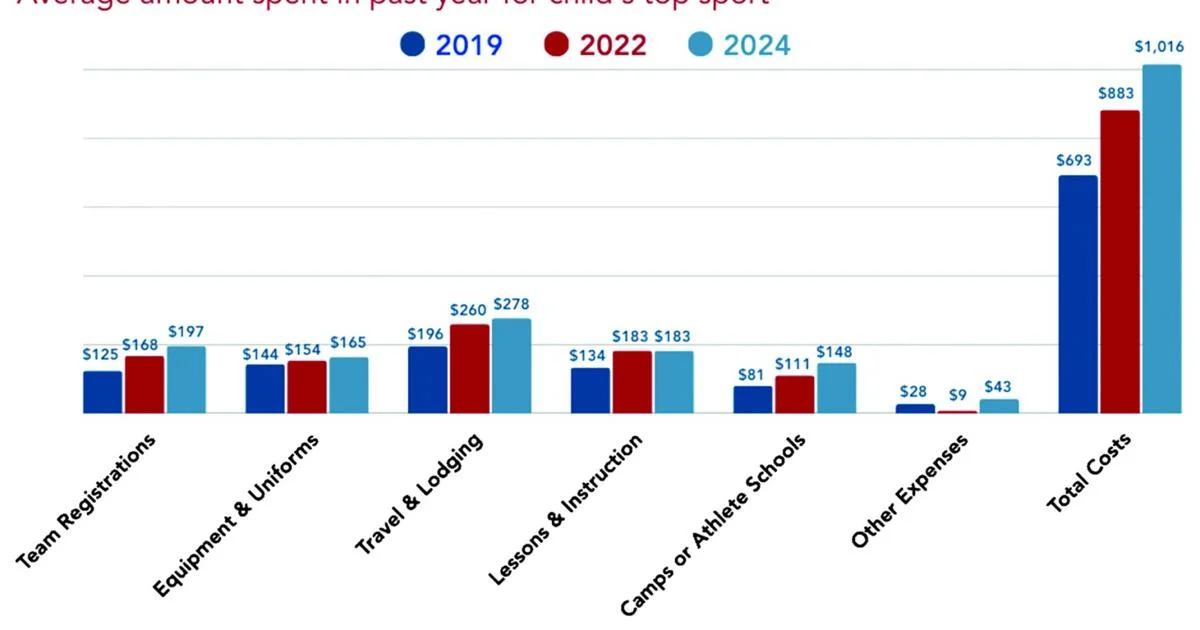
Project Play found that the average U.S. sports family spent $1,016 on a child’s primary sport in 2024. This is a 46% increase from 2019, twice the rate of price inflation in the U.S. economy during the same period.

Some companies and organizations are trying to fill the financial gaps for these families.

“Our corporate partners and our community partners are able to provide access to equipment and uniforms at a lower cost or donated so kids have access,” Stine said. “We don’t want a kid not playing or not signing up because they don’t have the proper shoes or the glove. 

“It’s really trying to lean into our partners where we can to help cover the costs that were traditionally passed on to our students or players.”

Local government has been an option, but Legg said a major issue is the massive reduction in how much local governments invest in youth sports.

Legg said that youth sports programs were at one point primarily subsidized by tax dollars and community support. This practice has shifted as the more commonly used funding model is the “pay to play” model, where the program is supported by participant fees.

“Youth sports create healthy youth, healthy youth create healthy communities,” Legg said. “It’s actually a cost saver in the long term and investing more in those communities through tax dollar support.”

The “pay to play” model is just one of the effects of the rapid commercialization of youth sports. This commercialization is prominent in the increase in club sports, programs that are run by private associations and often have much higher fees than traditional school or nonprofit youth sports programs.

For many families, cost is often the most important factor when considering youth sports programs.

Nick Girard, father of two and current president of Recreation Association of Madison Meadows & Simis (RAMMS), said cost is something he and many other parents weigh thoroughly.

“From the parents’ standpoint, I see that [rising cost] when I pay the registration fees, in RAMMS recreational sports and club sports,” Girard said. “I have kids who do club sports so I see all aspects of this.”


cost3.jpg

Not surprisingly, the money parents pay for a child to participate in a primary sport and other sports along the way in one year varies with the child’s age. 


RAMMS is a parent-run, volunteer-led nonprofit that provides recreational youth sports for children in North Central Phoenix. Like BGCAZ and similar nonprofits, it relies on registration fees and sponsorships to fund venues, uniforms, equipment and improvements to local schools.

RAMMS was created to provide recreational sport options for families who may be priced out of club or travel teams. 

Another factor that often deters parents from club sports involves the number of costs involved. Unlike recreational sport programs that charge one upfront fee, club and travel teams come with add-ons parents may not have accounted for.

 “In club sports, you’re typically paying a monthly fee for the club, you’re paying per event fees, you’re paying admission fees to get into those sports, you’re paying for the cost of uniforms separately oftentimes,” Girard said. :There’s a lot of different add-on pieces that add up.”

Even with the higher costs, parents often feel pressure to turn to club programs for many reasons, most notably when their child specializes in one sport.

Project Play found that the most common justifications for parents to enroll their children in club sports and specialize in one sport are that their child wants to play in high school, college or professionally. 

The study also found that one in four parents felt societal pressure to have their child stick to one sport while parents of older children feel the most pressure from their child and school coaches to specialize.

Girard, who’s been involved in youth sports for over eight years, said he’s noticed more younger children being pushed into club sports out of fear of being left behind.

But the great fear these days may be one of being left out by costs.

“What worries me the most about where youth sports are headed is kids leaving,” Girard said. “If it’s too expensive to play and families can’t sign up then kids stop participating.”  



Link

Continue Reading
Click to comment

Leave a Reply

Your email address will not be published. Required fields are marked *

Rec Sports

Car Thief Crashes Into Oakland Youth Boxing Club and Flees the Scene, Damaging Historic Ring

Published

on


The driver of a stolen car crashed into Lightning’s Boxing Club in Oakland early New Year’s Day after colliding with another car — sending two people to the hospital — then fleeing on foot. The estimated repair costs are between $50,000 and $1000,000.

As KTVU reports, a boxing ring used by heavyweight champion George Foreman in the 1980s sustained extensive damage after a car thief crashed into Lightning’s Boxing Club on 5845 MacArthur Boulevard in Oakland at some point in the early hours Thursday morning. Kris Lopez, who co-owns the gym with his wife Denise Lopez, said the impact of the crash was forceful.

“It’s like an earthquake,” Kris Lopez told KTVU. “The force knocked over the ring stairs and pushed the ring out of place.”

Per KRON4, the Lopezes are raising funds for the repairs and staff payroll through GoFundMe, which was close to $10,000 Sunday morning. According to the fundraiser’s page, the boxing ring will need to be replaced.

Per KTVU, the gym has played a crucial role in supporting underserved youth in the community, some of whom have become professional boxers.

“Dear Oakland Community, we have given our all to this city for the better good—mentoring youth, creating positive members of society, and even producing the occasional boxing champion,” the fundraiser’s page states. “Your donation will help us continue this important work and keep our doors open for the next generation. Please give what you can so we can get back to saving the community and inspiring our youth through the sport of boxing!”

Per NBC Bay Area, the boxing club is temporarily relocating to Geoffrey’s Inner Circle, a local nightclub and event space in Oakland’s Black Arts and Business District, but the Lopezes hope to reopen as soon as possible.

“I just want to keep the boxers going,” Kris Lopez told NBC Bay Area. “We have a nationally ranked amateur boxer, and of course my son and all the other kids who need this place to participate in something positive.”

“I’ve had so many people tell me, your husband changed my life,” Denise Lopez told KTVU. “That makes it worth doing.”

Authorities are still searching for the suspect in the crash.

Image: GoFundMe


Link

Continue Reading

Rec Sports

Fargo Youth Initiative finds new home with Fargo Public Schools – InForum

Published

on


FARGO — A move to take a youth initiative out of the purview of the city of Fargo is expected to expand student civic engagement, the city said.

The City Commission voted Monday, Dec. 22, to give Fargo Public Schools oversight of the Fargo Youth Initiative, an advisory body made up of local high school students.

Commissioners have been discussing over recent weeks whether certain boards are effective or viable. The city’s Planning Department previously coordinated Fargo Youth Initiative events.

“It really did take a village to find a new home for this, but I think it’s the next iteration of greatness,” Commissioner Denise Kolpack said at the meeting.

Isabella Meyer, chair of FYI and a senior at Fargo North High School, told commissioners many decisions are made for youth without involving them.

“The Fargo Youth Initiative has been a great way for us to be able to share our voice and our opinions on what actually works and what we actually need,” Meyer said.

The youth advisory group will now be housed within Fargo Public Schools and will include liaison representatives from the Fargo City Commission, the FPS Board of Education and the Fargo Park Board, with potential for expansion.

The group will meet at and receive administrative support from the Boys & Girls Clubs of the Red River Valley.

Fargo school board vice president Robin Nelson recommends to the board to keep the name Horace Mann for the Northside Elementary School on Tuesday, Nov. 25, 2025, at the Fargo Public School District No. 1.

Fargo School Board vice president Robin Nelson speaks during a meeting on Tuesday, Nov. 25, 2025.

Chris Flynn / The Forum

Robin Nelson, Boys & Girls Clubs CEO and Fargo School Board vice president, became involved in the Fargo Youth Initiative as it was created in 2013.

She said connecting the high school students with School Board, Park Board and city representatives will provide for even better opportunities.

“Now that they’ve got some more direction, it’s really ignited their excitement,” Nelson said.

Liaisons are expected to be Kolpack from the City Commission, Kristin Nelson from the Fargo School Board and Zoë Absey from the Park Board.

Proposed areas of focus for the Fargo Youth Initiative include education relating to North Dakota Century Code, open meeting regulations and local governance and policies.

Advocacy opportunities include raising the profile of youth public health issues and youth homelessness and speaking out on city, parks and school policies and initiatives.

Community impact ideas could include organizing student-led events or service projects, and regularly attending and participating in local government meetings.

“Youth are a big percentage of our population, so the more they can learn about how our city governments work and serve as a conduit and voice for youth so they are heard at those elected levels, is beneficial,” Robin Nelson said.

A goal is to achieve a total of 15 members on the Fargo Youth Initiative, which plans to continue to meet monthly.

Robin Huebner

Huebner is a 35+ year veteran of broadcast and print journalism in Fargo-Moorhead.


Link

Continue Reading

Rec Sports

Young athletes compete in Northwest Ohio Elks Hoop Shoot | Allen County

Published

on


LIMA, Ohio (WLIO) — Young athletes showed they could perform under pressure as they competed in the Elks Hoop Shoot competition.

The Northwest Ohio District brought winners from 10 different Elks lodge Hoop Shoot competitions to Ohio State Lima for the next step in the national contest.

The Elks have hosted the Hoop Shoot program for 52 years. Boys and girls ages 8 through 13 were divided into three age groups to see who could sink the most baskets.

While organizers hope the event is fun for the participants, they also emphasize the importance of developing skills through practice.

“They’re our future, and you don’t know who’s going to be able to benefit from all the practice that they put in, and further their careers in basketball, not only in the high school level, but in college and perhaps the professionals. We want them to increase their skill level and also show the sportsmanship and the camaraderie with the other shooters and enjoy the time that they have with this program,” says Jean Zink, Northwest Ohio District Elks Hoop Shoot Competition.

The top boys and girls from each age group in the Northwest Ohio District will advance to the state competition in February.

Copyright 2025 by Lima Communications Corporation. All rights reserved.


Link

Continue Reading

Rec Sports

Jake Kielb Hockey foundation launches effort to expand youth sports access in Las Vegas

Published

on


Alexa Belcastro

Since the Vegas Golden Knights arrived in 2017, youth hockey participation in Southern Nevada has more than doubled, according to USA Hockey and local youth programs. While that growth has created new opportunities, it has also strained existing facilities.

Usufzy said programs like learn-to-skate and youth leagues are reaching capacity, and without additional infrastructure, families may be forced to look elsewhere for competitive opportunities.

“We’ve seen incredible growth, but without places to support it, that growth can stall,” she said. “We want kids to be able to play and develop right here in Las Vegas.”

To meet that demand, the foundation has launched a capital campaign to build the Las Vegas Community Sports Complex, the first nonprofit community ice rink and multi-sport facility of its kind in Southern Nevada.

The proposed complex would feature two NHL-sized ice rinks and a versatile indoor turf field designed for sports like soccer and lacrosse, . The goal is to create affordable programming and expand scholarship opportunities for families across the valley.

The Jake Kielb Hockey Foundation’s capital campaign is entirely community-driven. Those interested in learning more or supporting the project can find additional information at HelpVegasPlay.com.

Usufzy hopes the project will ultimately give every child — regardless of background a place to play, grow, and belong.


Link

Continue Reading

Rec Sports

NBC5 In Depth: Nordic skiing gaining traction

Published

on


The organization that governs Nordic ski events in New England said it is seeing considerable growth in interest in the sport. The executive director of NENSA, the New England Nordic Ski Association, was a guest on this week’s episode of NBC5 In Depth.”The sport of cross-country skiing is much younger than alpine skiing in America, I think it’s fair to say,” said Heidi Lange of NENSA. “But we are seeing incredible growth and success at all levels.”On the Jan. 4 episode of NBC5 In Depth, Lange said the fame and success of Jessie Diggins, who won three Olympic medals in cross-country skiing and an array of other championships, has helped attract young athletes to the sport.”We see a lot of glitter at our races,” Lange said, referring to how Diggins popularized wearing glitter on her face during competitions. “We see kids embracing that joy and the sportsmanship that she emulates. And it goes deeper than that, of course. Jessie is an incredible mentor and role model in so many ways. She’s so willing to be open and vulnerable and very transparent about her journey, not just celebrating the successes, but sharing what she’s experiencing through challenges and struggles. And I think that has had a very powerful influence on skiers as they’re developing and navigating what are hopefully long journeys in the sport.”Lange told NBC5 In Depth that over the past two Olympic cycles, 50% of U.S. Olympic team members in Nordic skiing had an affiliation with a New England program. She went on to say that a closer examination of the numbers revealed that 30% of that population grew up in NENSA’s youth and junior programming in New England. “We’re incredibly proud of that,” Lange said. “It’s early to say yet for this year, but trends are tracking in a similar fashion.”Lange provided other encouraging signs for the future of the sport in the NBC5 In Depth interview. She also discussed advancements in snowmaking technology for Nordic ski areas, and offered recommendations of what fans of the Olympics should watch for in the Nordic competitions at the upcoming Winter Games.The video atop this article has the full interview with NENSA’s Heidi Lange that aired on the Jan. 4 episode of NBC5 In Depth.Previous coverage: Olympic gold medalist Jessie Diggins discusses climate activism

The organization that governs Nordic ski events in New England said it is seeing considerable growth in interest in the sport. The executive director of NENSA, the New England Nordic Ski Association, was a guest on this week’s episode of NBC5 In Depth.

“The sport of cross-country skiing is much younger than alpine skiing in America, I think it’s fair to say,” said Heidi Lange of NENSA. “But we are seeing incredible growth and success at all levels.”

On the Jan. 4 episode of NBC5 In Depth, Lange said the fame and success of Jessie Diggins, who won three Olympic medals in cross-country skiing and an array of other championships, has helped attract young athletes to the sport.

“We see a lot of glitter at our races,” Lange said, referring to how Diggins popularized wearing glitter on her face during competitions. “We see kids embracing that joy and the sportsmanship that she emulates. And it goes deeper than that, of course. Jessie is an incredible mentor and role model in so many ways. She’s so willing to be open and vulnerable and very transparent about her journey, not just celebrating the successes, but sharing what she’s experiencing through challenges and struggles. And I think that has had a very powerful influence on skiers as they’re developing and navigating what are hopefully long journeys in the sport.”

Lange told NBC5 In Depth that over the past two Olympic cycles, 50% of U.S. Olympic team members in Nordic skiing had an affiliation with a New England program. She went on to say that a closer examination of the numbers revealed that 30% of that population grew up in NENSA’s youth and junior programming in New England.

“We’re incredibly proud of that,” Lange said. “It’s early to say yet for this year, but trends are tracking in a similar fashion.”

Lange provided other encouraging signs for the future of the sport in the NBC5 In Depth interview. She also discussed advancements in snowmaking technology for Nordic ski areas, and offered recommendations of what fans of the Olympics should watch for in the Nordic competitions at the upcoming Winter Games.

The video atop this article has the full interview with NENSA’s Heidi Lange that aired on the Jan. 4 episode of NBC5 In Depth.

Previous coverage: Olympic gold medalist Jessie Diggins discusses climate activism


Link

Continue Reading

Rec Sports

Burbank Boys Basketball Wallops Upland 73-33

Published

on


Burbank defeated Upland 73-33 in a nonleague game. (Photo by Rick Assad)

By Rick Assad

Employing a smothering defense and a smoldering shooting display proved a perfect recipe for the Burbank High boys’ basketball team on Saturday night.

Facing a good Upland team that had height and length but was short on shooting played into the hosts’ favor as the Bulldogs routed the Highlanders 73-33 in a nonleague game.

Burbank scored 20 points or more in the second and third periods and nailed 19 of 28 shots for 67.8 percent in those two frames.

Burbank drained 10 three-pointers with six treys coming in the second half.

Three players scored in double figures and were paced by junior shooting guard Avo Papikyan with a game-high 20 points and was followed by senior point guard Cris Ong with 13 points and junior point guard Jon Ong with 12.

Burbank sank 29 of 52 from the field for 55.2 percent during the game while holding Upland to 11 of 61 for 18 percent.

The Bulldogs made 14 of 28 for 50 percent in the first half and led 36-17 and the Highlanders shot 25 percent after converting six of 24.

Burbank dashed in front 16-9 after the first period and then were off to the races.

Steve Eshleman is Burbank’s head coach and believes this was his team’s finest hour to date.

“That might be our best offensive game that we have had all year and we shot the ball really well, but really what spurred us was our defensive strength that we had throughout the game,” he said.

Eshleman also liked another important aspect of the game.

“We rebounded and got the ball out and when we ran, and then created offense to our defense and getting the ball out and going tonight was probably our best 32 minutes that we put together and that’s great for the kids,” he stated.

The Bulldogs (10-4) outrebounded Upland (8-9) 44-33 including 19-13 in the second half.

Imani Smith-Young, a junior small forward, scored all of his seven points in the opening period.

Papikyan tallied 12 points in the second quarter and that included three of his four from three-point range.

Cris Ong, after scoring five points that included a trey in the opening frame, added six points in the second period as the Bulldogs converted eight of 14 for 57.1 percent from the floor.

Ong’s basket with 5:15 remaining in the second period made it 22-9, Papikyan’s three-pointer increased the cushion to 25-9 with 4:52 on the clock and Ong’s bucket saw the Bulldogs pull ahead 29-9 with 3:25 left.

Senior small forward Anthony Jawiche found his range in the third quarter with nine points and also drilled a three-pointer as Burbank dashed ahead 62-29 heading to the fourth period.

Jon Ong dropped eight points in the same quarter, Papikyan added five points and Ong’s hoop with 6:35 left saw the Bulldogs march ahead 43-17.

In the fourth period, Blake Finnigan, a senior wing, scored five of his seven points and added a three-pointer.

Junior wing Jason Campos canned a three-pointer in the fourth quarter and senior small forward Giordan Lewis dropped two points in the second period for the Bulldogs.

Senior wing Collin Heard paced the Highlanders with nine points and they all came on three-pointers and Cooper Omness, a senior wing for Upland scored five points.

Assistant coach Tighe Eshelman is in agreement with his father’s assessment of the team.

“We’ve been lacking a full 32-minute effort so far this year. We’ve had good wins by getting ahead of people and holding on for dear life,” he said. “Tonight, we really executed the game plan throughout four quarters, which is a great step for us leading back into [Pacific] League play.”

Providence Saint Joseph Medical Center


Link

Continue Reading

Most Viewed Posts

Trending