The 2025 college football season is more than two months away from officially kicking off. But that just means Ranking Season is in full swing, and Athlon Sports came bearing gifts with its annual preseason magazine.
As part of its 2025 edition, Athlon Sports predicted the ACC’s order of finish for the upcoming season, with some serious similarities to how 2024 played out. That includes reigning ACC champion Clemson once again lifting the conference trophy after knocking off Miami in Charlotte.
Beyond that, Athlon expects a considerable bounceback effort for FSU, which suffered through a miserable 2-win campaign in 2024, but isn’t nearly as high on some of the other ACC teams that could find themselves looking for a new head football coach before the end of the regular season.
CLICK HERE to buy Athlon’s 2025 magazine online.
Check out Athlon Sports‘ ACC projected order of finish for the 2025 season (2024 record) below:
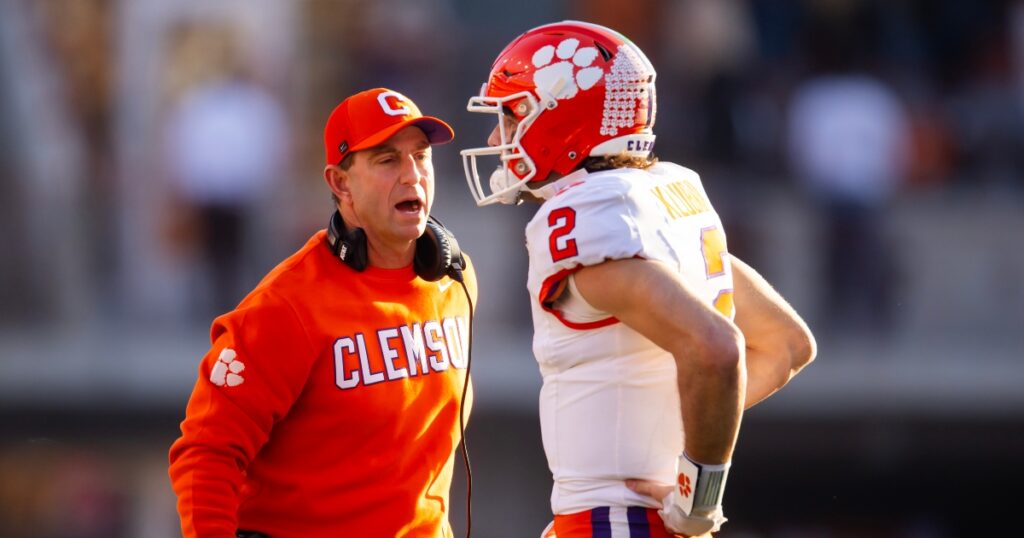
Dabo Swinney, Cade Klubnik (Mark J. Rebilas-Imagn Images)
Clemson is back, and Athlon Sports believes it will ultimately reign supreme atop the ACC once again in 2025 after claiming its eighth ACC championship in the last 10 years last season. Athlon predicts the Tigers will win its ninth conference title since 2015 with a championship game win over the Hurricanes.
Dabo Swinney returns a ton of talent, led by three-year starting QB Cade Klubnik, and finally dipped into the NCAA Transfer Portal to reload defensively. That included adding former Purdue pass rusher Will Heldt to work under new defensive coordinator Tom Allen, the former Indiana head coach who comes over after a one-year stint as Penn State‘s DC.
After a transformative 2024 season with ex-transfer QB Cam Ward at the helm, ‘Canes head coach Mario Cristobal doubled down and added former Georgia starting QB Carson Beck, a two-year starter, out of the portal this offseason. And Athlon clearly expects Beck to be a great fit in Miami, projecting a run to the ACC title game.
Despite a disappointing 2024, which ended prematurely with a UCL elbow injury to this throwing arm in the SEC Championship game, Beck is primed for a bounce-back season in Coral Gables and will have plenty of help in 2025, especially behind a loaded offensive line — which was clearly lacking last season in Athens. If Beck follows in Ward’s footsteps, he could cement his place as the next No. 1 overall draft pick.
The Mustangs were the surprise of the 2024 season, rolling through the ACC undefeated in their first season in the league before falling to Clemson in the ACC championship game. Still, that conference run was more than enough to secure a spot in the 2024 College Football Playoff, and Athlon clearly doesn’t expect much of a dropoff in 2025.
SMU head coach Rhett Lashlee returns much of same roster that helped spearhead last season’s success, including returning starting QB Kevin Jennings, who has gone a bit overlooked as one of college football’s elite returning QBs. If Jennings and company can turn that perceived slight into motivation, the Mustangs will once again be a serious ACC contender in 2025 with another potential Playoff spot on the line.
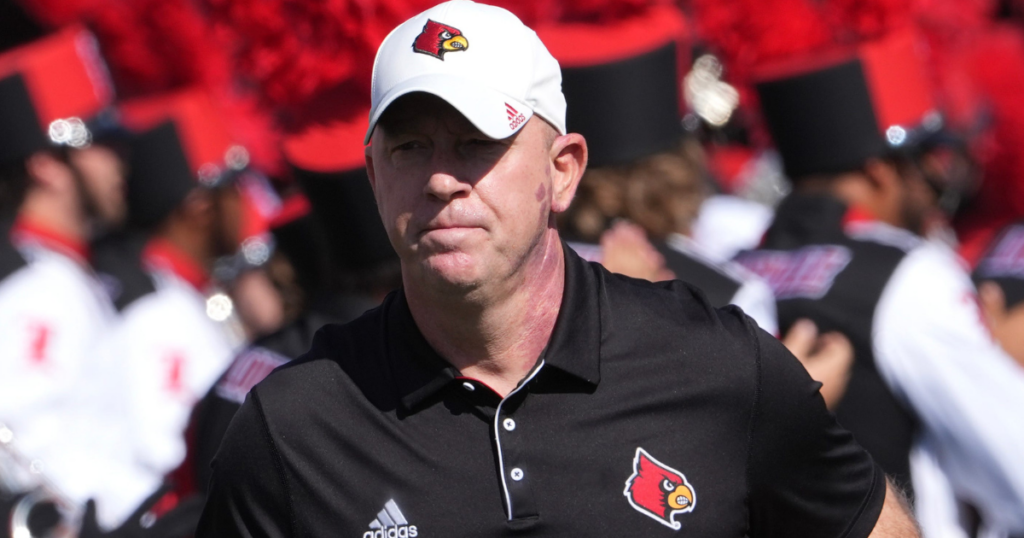
Jeff Brohm (Scott Utterback-Courier Journal/USA TODAY NETWORK via Imagn Images)
Much like it did a year ago, Cardinals head coach Jeff Brohm put all his chips behind a former transfer QB leading the way after landing Miller Moss out of USC this offseason. Much like last year’s QB1, Tyler Shough, Moss is hitting reset on his career under Brohm’s tutelage and could be primed for a breakout season in 2025.
But Moss isn’t coming alone. Brohm and Louisville also added talented WRs TreyShun Hurry (San Jose State) and Dacari Collins (NC State), while also reloading defensively with the addition of LB Clev Lubin (Coastal Carolina), among others. If Brohm can get Moss and the new transfers to play up to their potential, Athlon believes the Cardinals will be in the mix for the ACC title in 2025.
Entering Year 3 at the helm of his alma mater, Yellow Jackets head coach Brent Key clearly has Georgia Tech headed in the right direction and Athlon expects more of the same in 2025. Tech returns talented dual-threat QB Haynes King to lead a mostly-intact offense that lost its 2024 leading receiver (Auburn transfer Eric Singleton Jr.) but returns nearly everyone else.
Given the wealth of experience, the Yellow Jackets could be primed for a surprise breakout season in 2025, especially if Key can continue to push the right buttons. Still, Georgia Tech isn’t without its question marks, including in the trenches, where Key overhauled its offensive and defensive fronts through the transfer portal this offseason.
Manny Diaz‘s first season in Durham was certainly a success after transforming the Blue Devils into legit ACC contenders in short order. And Athlon clearly has high hopes for another strong push in 2025 after Diaz landed uber-talented QB Darian Mensah (Tulane) out of the transfer portal.
Of course, that will require Diaz and the Blue Devils getting the most out of their newest portal additions, especially after losing plenty of talent at key skill positions this offseason. If Mensah can build upon last season’s success, Duke will undoubtedly make itself a factor in the ACC in 2025.
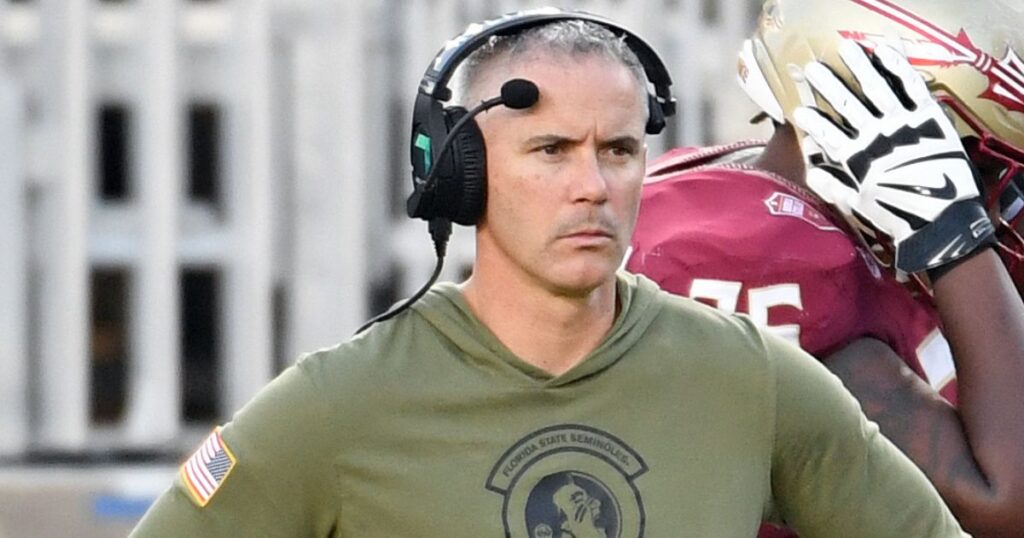
Mike Norvell (Robert Myers-Imagn Images)
Suffice it to say, 2024 was an utter disappointment for FSU and head coach Mike Norvell. That led to a complete offseason overhaul, including former UCF and Auburn head coach Gus Malzahn as the new offensive coordinator and former Nebraska DC Tony White taking over the same position in Tallahasse.
Norvell also went heavy into the transfer portal in landing new dual-threat QB1 Tommy Castellanos (Boston College) and elite receivers Duce Robinson (USC) and Squirrel White (Tennessee). While Athlon doesn’t expect back-to-back disappointments for FSU, they clearly aren’t yet believers the Seminoles will return to its ACC-leading ways in 2025.
The Panthers were a roller coaster in 2025 and Athlon doesn’t expect much to change in 2025, especially after losing a litany of talent to the NFL and the transfer portal this offseason.
Still, Pitt returns talented QB1 Eli Holstein and RB Desmon Reid and managed to rebuild its offensive line through the portal, which could mean big things for the Panthers in 2025.
North Carolina dominated the college football offseason headlines following the surprise hiring of six-time Super Bowl champion head coach Bill Belichick, even if it wasn’t always for the right reasons.
Still, the Tar Heels are all-in on Belichick and believe a coach of his NFL caliber will ultimately pay major dividends at North Carolina. A lot will rest on the shoulders of new transfer QB Gio Lopez (South Alabama), who is one of two dozen new additions that will be counted on in 2025.
Dave Doeren (Zachary Taft-Imagn Images)
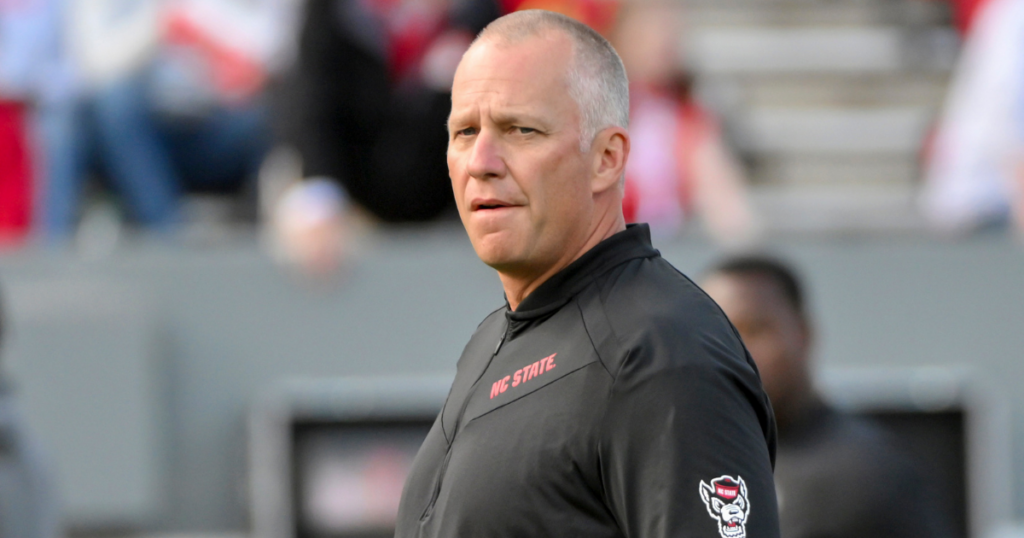
The Wolfpack underwent quite the offseason overhaul after last season. Longtime head coach Dave Doeren replaced both coodinators as well as a multitude of premium talent to the portal.
Still, NC State isn’t without some talented returners, including QB CJ Bailey and playmakers Hollywood Smothers, Noah Rogers and Wesley Grimes. But given those losses, especially on defense, it’s clear Athlon expects another up-and-down season for the ‘Pack.
Hokies head coach Brent Pry faces arguably the most pivotal season of his tenure ahead of Year 4 in Blacksburg. And Athlon Sports isn’t betting on a turnaround in 2025.
Pry added former Tulsa head coach Philip Montgomery as his offensive coordinator in hopes of turning things around for talented dual-threat QB1 Kyron Drones. If that happens in 2025, Virginia Tech could be primed for a breakout season. If not, Pry could find himself on the hot seat before the end of the year.
Year 1 under head coach Bill O’Brien was an overall success after making a bowl game, but BC has much higher hopes in 2025.
Part of that rests on O’Brien getting the most out of the QB position in Year 2 with Grayson James, who replaced Castellanos as QB1 midway through last season. Still, Athlon Sports doesn’t have the same expectations and expects a repeat of last year’s rollercoaster season in 2025.
Fran Brown (Rich Barnes-Imagn Images)
The ‘Cuse were another ACC surprise behind new head coach Fran Brown, who rode the strong arm of former Ohio State transfer QB Kyle McCord in what amounted to a breakout 2024 season.
But McCord is now in the NFL, and Brown must decide between a pair of transfer QBs in Steve Angeli (Notre Dame) and Rickie Collins (LSU) to lead the way this Fall. Based on this projection, Athlon isn’t quite sold on either QB repeating McCord’s success and expects a fall back to Earth for the Orange.
Much like his in-state rival, veteran Virginia head coach Tony Elliott could find himself on the hot season if the Cavaliers struggle once again in Year 4.
Still, Elliott went all-out in the transfer portal to avoid such a fate, including adding transfer QB Chandler Morris (North Texas) and WR Jahmal Edrine (Purdue) on offense as well as S Devin Neal (Louisville) and LB Mitchell Melton (Ohio State) on defense.
The Golden Bears faced quite the uphill climb in their first season apart of the ACC, and Athlon Sports sees much of the same happening in 2025.
And outside of a considerable turnaround, Cal head coach Justin Wilcox is another ACC coach that could find himself on the hot seat before the end of the season, especially if new transfer QB Devin Brown (Ohio State) doesn’t produce a McCord-like effort in 2025.
Jake Dickert (Jim Dedmon-Imagn Images)
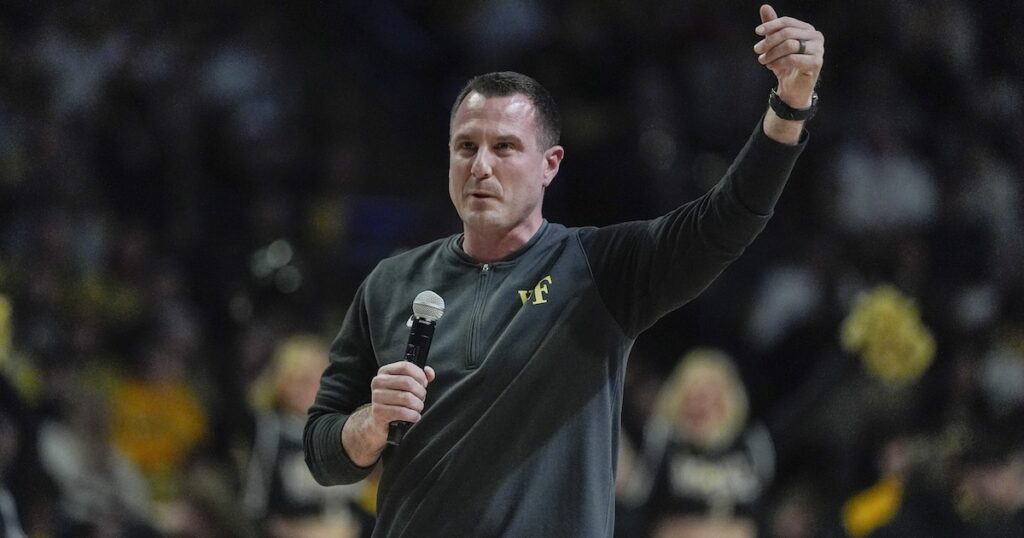
The Demon Deacons enter Year 1 under head coach Jake Dickert with as many questions as answers, especially given the complete offseason overhaul that generally comes with a change at the top.
Dickert did manage to replenish some talent through the portal, especially in the trenches, but any 2025 success will undoubtedly depend on hitting a home run with one of its multi-time transfer QB additions in Robby Ashford (South Carolina) and Deshawn Purdie (Charlotte).
Last and but hardly least in Athlon’s projection is Stanford, which was dealt a shocking offseason overhaul with the March dismissal of former coach Troy Taylor and the hiring of former NFL coach Frank Reich.
New Cardinal general manager Andrew Luck brings some hope for the once-proud Pac-12 leader, but the coaching change added to widespread roster turnover doesn’t bode well for a return to form in 2025.
A
transfer portal
spiraling out of control prompted the new regulatory body for college sports to issue a memo to athletic directors Friday night saying it has “serious concerns” about some of the multimillion-dollar contracts being offered to players.
The “reminder” from the College Sports Commission came out about an hour before kickoff of the semifinal between
Indiana and Oregon in a College Football Playoff
that has shared headlines with news of players signing seven-figure deals to move or, in some cases, stay where they are.
The CSC reminded the ADs that, according to the rules, third-party deals to use players’ name, image and likeness “are evaluated at the time of entry in NIL Go, not before, and each deal is evaluated on its own merits.”
“Without prejudging any particular deal, the CSC has serious concerns about some of the deal terms being contemplated and the consequences of those deals for the parties involved,” the memo said.
Under terms of the House settlement that dictated the rules for NIL payments, schools can share revenue with their players directly from a pool of $20.5 million. Third-party deals, often arranged by businesses created to back the schools, are being used as workarounds this so-called salary cap.
The CSC, through its NIL Go portal, is supposed to evaluate those deals to make sure they are for a valid business purpose and fall within a fair range of compensation for the services being provided.
The CSC did not list examples of unapproved contracts, but college football has seen its share of seven-figure deals luring players to new schools since the transfer portal opened on Jan. 2.
One high-profile case involved
Washington quarterback Demond Williams Jr.,
who initially sought to enter the transfer portal and turn his back on a reported deal worth $4 million with the Huskies. Legal threats ensued and Williams changed course and stayed at Washington.
“Making promises of third-party NIL money now and figuring out how to honor those promises later leaves student-athletes vulnerable to deals not being cleared, promises not being able to be kept, and eligibility being placed at risk,” the CSC letter said.
The commission listed two rules about contracts it evaluates, some of which have been termed “agency agreement” or “services agreement” in what look like attempts to bypass the rules.
—”The label on the contract does not change the analysis; if an entity is agreeing to pay a student-athlete for their NIL, the agreement must be reported to NIL Go within the reporting deadline.”
—”An NIL agreement or payment with an associated entity or individual … must include direct activation of the student-athlete’s NIL rights.” This is a reference to the practice of “warehousing” NIL rights by paying first, then deciding how to use them later.
___
Get poll alerts and updates on the AP Top 25 throughout the season. Sign up
here
and
here
(AP News mobile app). AP college football:
https://apnews.com/hub/ap-top-25-college-football-poll
and
https://apnews.com/hub/college-football
A transfer portal spiraling out of control prompted the new regulatory body for college sports to issue a memo to athletic directors saying it has “serious concerns” about some of the multimillion-dollar contracts being offered to players.
By EDDIE PELLSAP National Writer
A transfer portal spiraling out of control prompted the new regulatory body for college sports to issue a memo to athletic directors Friday night saying it has “serious concerns” about some of the multimillion-dollar contracts being offered to players.
The “reminder” from the College Sports Commission came out about an hour before kickoff of the semifinal between Indiana and Oregon in a College Football Playoff that has shared headlines with news of players signing seven-figure deals to move or, in some cases, stay where they are.
The CSC reminded the ADs that, according to the rules, third-party deals to use players’ name, image and likeness “are evaluated at the time of entry in NIL Go, not before, and each deal is evaluated on its own merits.”
“Without prejudging any particular deal, the CSC has serious concerns about some of the deal terms being contemplated and the consequences of those deals for the parties involved,” the memo said.
Under terms of the House settlement that dictated the rules for NIL payments, schools can share revenue with their players directly from a pool of $20.5 million. Third-party deals, often arranged by businesses created to back the schools, are being used as workarounds this so-called salary cap.
The CSC, through its NIL Go portal, is supposed to evaluate those deals to make sure they are for a valid business purpose and fall within a fair range of compensation for the services being provided.
The CSC did not list examples of unapproved contracts, but college football has seen its share of seven-figure deals luring players to new schools since the transfer portal opened on Jan. 2.
One high-profile case involved Washington quarterback Demond Williams Jr., who initially sought to enter the transfer portal and turn his back on a reported deal worth $4 million with the Huskies. Legal threats ensued and Williams changed course and stayed at Washington.
“Making promises of third-party NIL money now and figuring out how to honor those promises later leaves student-athletes vulnerable to deals not being cleared, promises not being able to be kept, and eligibility being placed at risk,” the CSC letter said.
The commission listed two rules about contracts it evaluates, some of which have been termed “agency agreement” or “services agreement” in what look like attempts to bypass the rules.
—”The label on the contract does not change the analysis; if an entity is agreeing to pay a student-athlete for their NIL, the agreement must be reported to NIL Go within the reporting deadline.”
—”An NIL agreement or payment with an associated entity or individual … must include direct activation of the student-athlete’s NIL rights.” This is a reference to the practice of “warehousing” NIL rights by paying first, then deciding how to use them later.
Copyright 2026 The Associated Press. All rights reserved. This material may not be published, broadcast, rewritten or redistributed without permission.
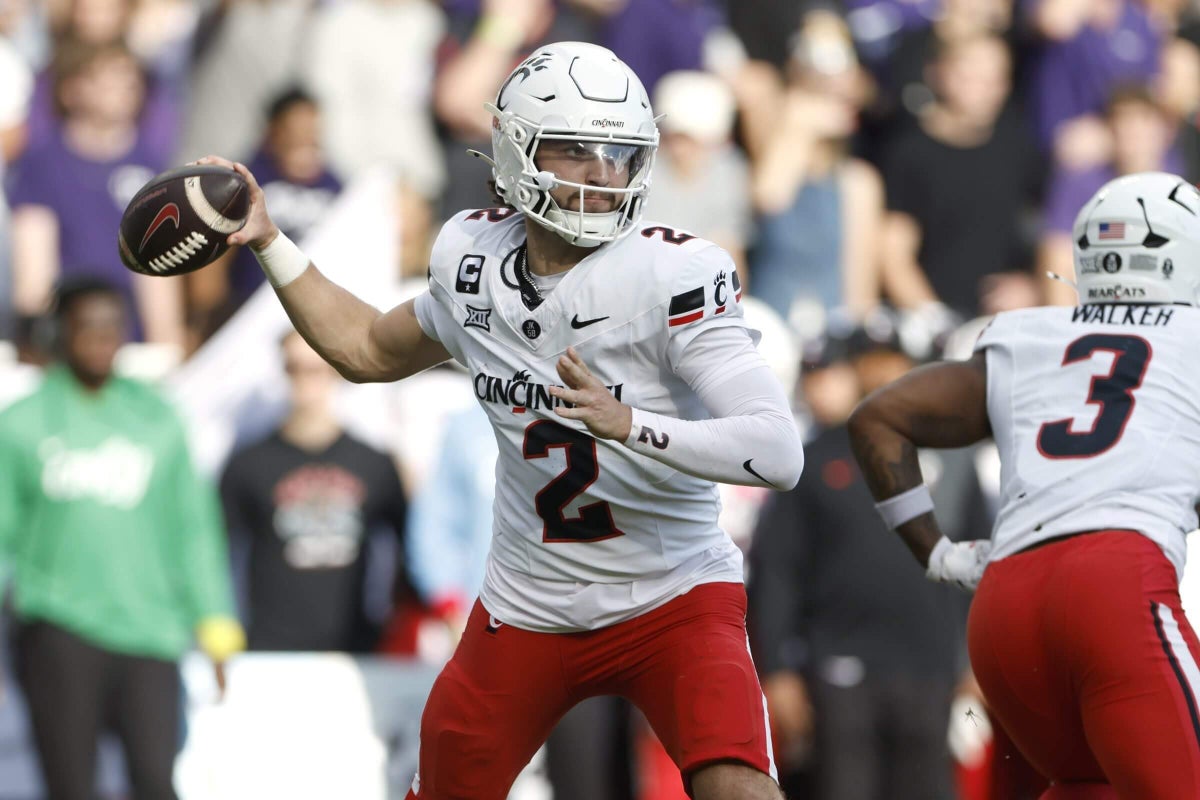
Brendan Sorsby, ranked No. 1 in The Athletic’s transfer quarterback rankings, transferred to Texas Tech earlier this week with one season remaining on a multi-year revenue sharing agreement with Cincinnati that includes a $1 million buyout clause, multiple people briefed on the deal told The Athletic. They were granted anonymity because they were not authorized to speak publicly about the terms of the deal.
The buyout payment is due to Cincinnati within 30 days of Sorsby’s transfer. It is not immediately clear how Sorsby’s buyout will be resolved.
Texas Tech was aware of Sorsby’s buyout, according to sources briefed on the transfer process, and factored it into his recruitment, as well as Tech’s own revenue sharing budget.
Ron Slavin, Sorsby’s agent with Lift Sports Management, declined comment.
Spokespersons for both Texas Tech and Cincinnati declined comment.
There have been questions about how revenue sharing contract terms might hold up under legal scrutiny, in part because college athletes are not employees and their rev share contracts are not typical employment agreements.
The full details of Sorsby’s agreement with the Red Raiders are not public, but the one-year deal is expected to pay him more than $4 million, according to people briefed on the terms. His signing was officially announced Tuesday by Texas Tech.
A redshirt junior with one year of eligibility remaining, Sorsby elected to enter the transfer portal and ultimately sign with Texas Tech rather than declare for the 2026 NFL Draft, where he is projected as a potential Day 2 pick.
Sorsby’s buyout is indicative of the new era of direct revenue sharing between schools and athletes under the House v. NCAA settlement, which was instituted last summer. Many schools have included buyout clauses in their rev share agreements that obligate athletes to redeem money to their previous school if they leave before the end of the agreement.
According to enforcement guidelines from the College Sports Commission, the organization that oversees revenue sharing, Sorsby’s $1 million buyout must be accounted for by Texas Tech within the school’s $20.5 million revenue sharing cap for fiscal year 2025-26. Texas Tech is not required to directly pay Cincinnati to cover the buyout costs.
Multiple power conference general managers told The Athletic they have either signed players who had buyouts with their previous schools or lost players with buyouts to other teams. The player or their representative will often handle paying the buyout to the previous institution, whether in full or at a negotiated rate.
“(Player buyouts are) happening this year. It’s not prevalent, but it’s happening,” said Darren Heitner, who specializes in sports law. “Typically there is a negotiation where a school starts at a specific number and then negotiates down, if the player has good counsel.”
Sorsby initially transferred from Indiana to Cincinnati as a redshirt sophomore, ahead of the 2024 season, signing an NIL agreement before revenue sharing began in July 2025. Last offseason, Sorsby signed a new two-year deal with Cincinnati’s NIL collective, a third-party group affiliated with the school, that later transitioned to a rev share contract with the university. The $1 million buyout was agreed to in both the multi-year collective deal and revenue sharing agreements. Sorsby earned roughly $1.5 million in 2025 from Cincinnati, according to people briefed on the previous terms.
There have been relatively few public disputes of NIL or rev share contracts between players, schools or third parties since college athletes could begin earning NIL compensation in 2021.
Earlier this week, Washington quarterback Demond Williams Jr. announced intentions to enter the transfer portal just days after signing a new contract with the Huskies that’s expected to pay him more than $4 million. The buyout would have likely factored into any protracted legal battle between player and school, but Williams never actually entered the portal and announced on Thursday that he will remain with Washington.
Late last year, the University of Georgia took former defensive end Damon Wilson II to court, with Georgia seeking arbitration and $390,000 in damages after the university claimed Wilson broke an agreement with Georgia’s NIL collective by entering the transfer portal in January 2025, prior to the onset of revenue sharing. Wilson, who transferred to Missouri for the 2025 season, later sued Georgia’s athletic association seeking his own damages for what the suit described as a “civil conspiracy” to interfere with Wilson’s business endeavors. It’s believed to be the first time a player and school have taken each other to court over an NIL dispute. Both proceedings are still ongoing. Wilson recently re-entered the portal.
Last summer, the University of Wisconsin and its NIL collective filed a lawsuit against the University of Miami for tampering with defensive back Xavier Lucas, who Wisconsin claimed had an agreement with their NIL collective and another “binding agreement” with the university that was contingent on revenue sharing being approved. The next hearing in this case is scheduled for March 2026.
In April 2025, a contract holdout by former Tennessee quarterback Nico Iamaleava ended with Iamaleava transferring to UCLA, but no legal action was taken.
Former Florida signee Jaden Rashada has a pending lawsuit filed against various parties, including former Gators coach Billy Napier, that stems from a 2022 NIL deal.
One Power 4 coach who spoke on the condition of anonymity, said that in some instances, unfulfilled buyout terms or the player attached might not be worth the time and effort to spark a legal battle, and some universities might be hesitant to pursue litigation against a college athlete.
“It’s less of a legal challenge and more of an optics challenge for institutions at this point,” said lawyer Paia LaPalombara, a former college athletics administrator who advises colleges, conferences and athletes on revenue sharing.
A 6-foot-3, 235-pound dual-threat quarterback, Sorsby averaged better than 2,800 yards passing and 500 rushing yards in his two seasons with the Bearcats, including 36 combined touchdowns passing and rushing in 2025, third-most in the FBS, with only five interceptions. He led Cincinnati to a 7-5 regular season record in 2025 and a spot in the Liberty Bowl, the program’s first bowl bid since 2022.
Sorsby opted out of the bowl game, announcing on Dec. 15 that he planned to enter the transfer portal. The native of Denton, Texas, was quickly linked to Texas Tech as a potential destination. He made recruiting visits to Tech and LSU.
The Red Raiders recently completed a 12-2 season in 2025, winning the Big 12 championship and earning a first-round bye in the College Football Playoff, where they lost to Oregon 23-0 in the quarterfinals on New Year’s Day. Starting quarterback Behren Morton has exhausted his college eligibility, and sophomore backup Will Hammond suffered an ACL injury in October. After making headlines for its portal additions last offseason, Tech has again been active early in this year’s transfer window.
A transfer climate spiraling out of control prompted the new regulatory body for college sports to issue a memo to athletic directors Friday night saying it has “serious concerns” about some of the multimillion-dollar contracts being offered to players.
The “reminder” from the College Sports Commission came out about an hour before kickoff of the Peach Bowl semifinal between Indiana and Oregon in a College Football Playoff that has shared headlines with news of players signing seven-figure deals to move or, in some cases, stay where they are.
The CSC reminded the athletic directors that, according to the rules, third-party deals to use players’ name, image and likeness “are evaluated at the time of entry in NIL Go, not before, and each deal is evaluated on its own merits.”
“Without prejudging any particular deal, the CSC has serious concerns about some of the deal terms being contemplated and the consequences of those deals for the parties involved,” the memo read.
Under terms of the House v. NCAA antitrust lawsuit settlement that dictated the rules for NIL payments, schools can share revenue with their players directly from a pool of $20.5 million. Third-party deals, often arranged by businesses created to back the schools, are being used as workarounds to this de facto salary cap.
The CSC, through its NIL Go portal, is supposed to evaluate those deals to make sure they are for a valid business purpose and fall within a fair range of compensation for the services being provided.
The CSC did not list examples of unapproved contracts, but college football has experienced its share of seven-figure deals luring players to new schools since the NCAA transfer portal opened on Jan. 2.
One high-profile case involved Washington quarterback Demond Williams Jr., who initially sought to enter the portal and turn his back on a reported deal worth $4 million with the Huskies. Legal threats ensued, and Williams changed course and stayed at Washington, a decision the quarterback announced Thursday night.
“Making promises of third-party NIL money now and figuring out how to honor those promises later leaves student-athletes vulnerable to deals not being cleared, promises not being able to be kept, and eligibility being placed at risk,” the CSC letter read.
The commission listed two rules about contracts it evaluates, some of which have been termed “agency agreement” or “services agreement” in what look like attempts to bypass the rules.
First, “The label on the contract does not change the analysis; if an entity is agreeing to pay a student-athlete for their NIL, the agreement must be reported to NIL Go within the reporting deadline.”
Second, “An NIL agreement or payment with an associated entity or individual … must include direct activation of the student-athlete’s NIL rights.” This is a reference to the practice of “warehousing” NIL rights by paying first, then deciding how to use them later.
A transfer portal spiraling out of control prompted the new regulatory body for college sports to issue a memo to athletic directors saying it has “serious…
A transfer portal spiraling out of control prompted the new regulatory body for college sports to issue a memo to athletic directors Friday night saying it has “serious concerns” about some of the multimillion-dollar contracts being offered to players.
The “reminder” from the College Sports Commission came out about an hour before kickoff of the semifinal between Indiana and Oregon in a College Football Playoff that has shared headlines with news of players signing seven-figure deals to move or, in some cases, stay where they are.
The CSC reminded the ADs that, according to the rules, third-party deals to use players’ name, image and likeness “are evaluated at the time of entry in NIL Go, not before, and each deal is evaluated on its own merits.”
“Without prejudging any particular deal, the CSC has serious concerns about some of the deal terms being contemplated and the consequences of those deals for the parties involved,” the memo said.
Under terms of the House settlement that dictated the rules for NIL payments, schools can share revenue with their players directly from a pool of $20.5 million. Third-party deals, often arranged by businesses created to back the schools, are being used as workarounds this so-called salary cap.
The CSC, through its NIL Go portal, is supposed to evaluate those deals to make sure they are for a valid business purpose and fall within a fair range of compensation for the services being provided.
The CSC did not list examples of unapproved contracts, but college football has seen its share of seven-figure deals luring players to new schools since the transfer portal opened on Jan. 2.
One high-profile case involved Washington quarterback Demond Williams Jr., who initially sought to enter the transfer portal and turn his back on a reported deal worth $4 million with the Huskies. Legal threats ensued and Williams changed course and stayed at Washington.
“Making promises of third-party NIL money now and figuring out how to honor those promises later leaves student-athletes vulnerable to deals not being cleared, promises not being able to be kept, and eligibility being placed at risk,” the CSC letter said.
The commission listed two rules about contracts it evaluates, some of which have been termed “agency agreement” or “services agreement” in what look like attempts to bypass the rules.
—”The label on the contract does not change the analysis; if an entity is agreeing to pay a student-athlete for their NIL, the agreement must be reported to NIL Go within the reporting deadline.”
—”An NIL agreement or payment with an associated entity or individual … must include direct activation of the student-athlete’s NIL rights.” This is a reference to the practice of “warehousing” NIL rights by paying first, then deciding how to use them later.
Get poll alerts and updates on the AP Top 25 throughout the season. Sign up here and here (AP News mobile app). AP college football: https://apnews.com/hub/ap-top-25-college-football-poll and https://apnews.com/hub/college-football
The first step toward addressing a problem, as the saying goes, is admitting you have one. Good news for concerned SEC football fans: It does seem the conference admits it has a problem.
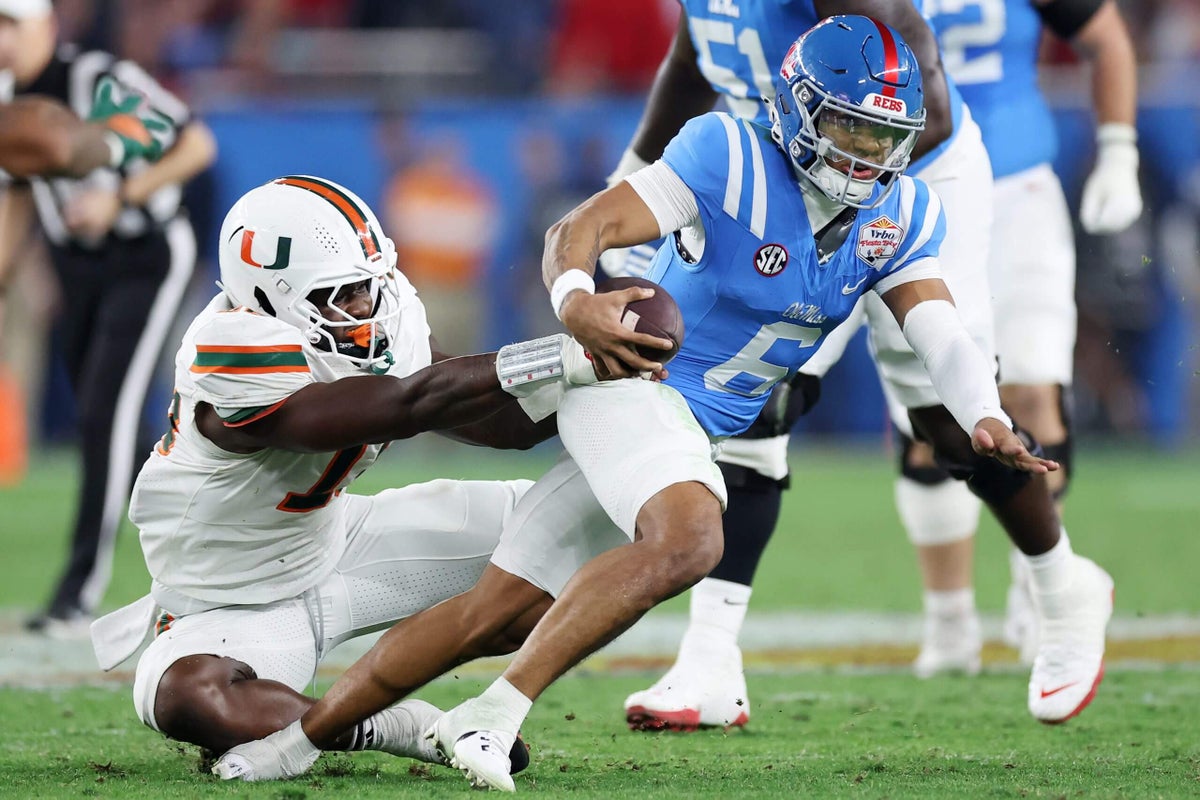
That was true even before Ole Miss lost to Miami on Thursday night, meaning the SEC was shut out of the national championship game for a third straight year. Ole Miss acquitted itself well, played a great game and almost got there. It deserves its flowers.
In fact, Ole Miss being the last SEC team standing was perfect symbolism. The rest of the conference should take heed.
As it is, the reality of the SEC’s situation set in this week among the conference’s defenders and within the league itself.
There was Paul Finebaum, voice of the SEC Network and basically the SEC, saying there was no defense for the conference’s 2-7 bowl record, including Alabama’s loss to Indiana in the College Football Playoff.
“There’s no way to defend the SEC. It’s been terrible,” Finebaum said on ESPN’s “First Take” on Tuesday.
There was Steve Spurrier, legendary former coach of Florida and South Carolina, not quite calling out his conference but also not downplaying things: “We got slapped in the face during the bowl season.”
And in my own conversations with people around the league, granted anonymity in order to be candid, there was none of the “everything is fine” meme.
“There’s no getting around the bowl results,” one conference source said, noting that SEC teams lost games they were favored to win. As elite teams faltered in the CFP, the SEC’s argument has been that it was still a deeper conference; Missouri losing to Virginia, Tennessee losing to Illinois, Vanderbilt losing to Iowa … not good.
Another SEC official maintained that the SEC is still the best league — as the NFL Draft has shown for years — but acknowledged that parity is here.
So will the SEC shrug and accept that? We all know the answer lies in a four-word slogan. The only question now is what the conference collectively will do about it.
To quote another saying: The answer to all your questions is money.
And a humbled SEC may become a desperate but smarter SEC. Because if the conference is going to get its mojo back, it will just need to mean more again. As in more money towards players.
Normally you could say the SEC was just due for a dip, this was cyclical, nothing to waste a column on. But the dip coincides with the other changes in the sport. The world is flat now, and too many SEC teams were slow to react.
Alabama and Georgia have been operating the past few years as if they got a discount because of their status. And that is the case for some recruits. But it isn’t for others, and that’s been enough to knock their talent down a notch.
Kirby Smart spent the early years of his tenure working donors for facility money, and it worked. When collectives became the focus, Smart did some lobbying, but perhaps with some restraint on the assumption they’d get that NFL Draft discount. Now that the difference appears to be third-party NIL deals, Smart may need to ratchet it up: There are big-money people working all around the Southeast who are Georgia fans and can probably arrange deals that will be approved by the authorities.
Or if not … well, anyway.
Georgia actually looks like it should be very good next year. Texas may be too. Alabama, on the other hand, has questions. Other teams are in transition, and then you have Ole Miss, the SEC program that most took advantage of the new rules. (Or lack of rules.) The other was Texas A&M a few years ago, but that was geared around traditional recruiting, not the portal. The programs that otherwise were the face of the era — programs desperate to win and willing to pay big to do it — tended to be outside the conference: Texas Tech, Miami and Ohio State.
That’s not to say SEC programs weren’t spending too; they were, which was part of the problem. SEC teams were picking off each other, whether it was top teams like Texas poaching Georgia and Alabama players or teams in the middle like Missouri. The SEC has been eating itself.
At the high school level, the SEC has still dominated recruiting:
• Last year, SEC teams signed 55 of the top 100 players, per the 247Sports Composite, including a remarkable 16 of the top 25.
• This year, it was only nine of the top 25, but still 53 of the top 100.
But while in the past it was the Georgias, Alabamas and LSUs signing most of those players, it’s now much more widely dispersed:
• Last year, 11 different SEC teams signed at least one top 100 player, and seven signed at least one top 25 player.
• This year, 13 different SEC teams signed at least one top 100 player, and five different teams signed at least one top 25 player. Vanderbilt, of all teams, swooped in and flipped the top-ranked recruit, quarterback Jared Curtis, from Georgia.
In the last year of the pre-NIL era, the 2021 recruiting cycle, teams that are now in the SEC signed a combined 18 of the top 35 players, but Alabama and Georgia signed 11 of them.
And of course, once you get players on campus, it’s harder to hoard the talent. Unlimited transfers provide a way for players to leave for immediate playing time rather than be stowed away on the bench, as Saban and Kirby Smart could do in the old days.
The world is flat. Parity is here. And throw in the CFP, which appears to be college sports joining the rest of the sports world with a postseason that’s a crapshoot. The best team doesn’t always win.
That is, if the SEC has the best team. Which it’s hard to say it has lately.
There can’t be any dismissing of the past: The SEC deserved the accolades it got for more than a decade leading up to 2023. The conference did win 13 national championships in 17 seasons, did have both teams in the national championship game three times in 12 years, did whip the Big Ten and other conferences in head-to-head matchups.
The SEC dominance was not a media creation.
But for the SEC industrial complex — media, administrators, whoever — to ignore the reality of the last three years would be foolish.
LSU is acting like a desperate program, committing the GDP of a small country not only to lure Lane Kiffin but to give him the resources to recruit. Texas, after a disappointing season, is also acting seriously about making amends. Even on the lower rung, Kentucky decided to pay coach Mark Stoops’ buyout, showing it wasn’t resigned to staying on that lower rung.
The signs are indeed there the SEC gets it. There’s a sense of urgency now. That doesn’t mean the old days will return: They’re probably gone, with super teams giving way to parity. That’s the new world.