
Sports
Baseball fans can now add little


JTA — For the first time in decades, a long-forgotten major league baseball player has been posthumously identified as Jewish.
Monte Pfeiffer, who played a single game for the Philadelphia Athletics some 112 years ago, had vanished into baseball obscurity — until a sharp-eyed Yankees fan uncovered a surprising truth written in Hebrew. The discovery, rooted in dusty box scores, old newspaper articles and genealogical detective work, adds Pfeiffer to the rarest of rosters: Jewish major leaguers.
“It’s really like fishing: You throw out your line, and nothing, nothing, nothing,” said Zak Kranc, a 27-year-old lawyer from Connecticut. “Then when you get a hit, you start reeling.”
Such finds are rare. Only about 200 of the more than 23,000 men to play major league baseball since 1871 have been conclusively identified as Jews. It’s a surprisingly tiny fraternity, given the outsized number of honors they have earned over the years, including Rookie of the Year, Most Valuable Player, Cy Young Award and Gold Glove.
Journalist and author David Spaner did most of the detective work in the 1990s. He spent a year sifting through records at the Baseball Hall of Fame in Cooperstown, phoning players and their relatives, and assembling family trees, all in an effort to find unknown Jews. The Vancouver native went on to reveal dozens of newly discovered Jews in “Total Baseball,” a scholarly series edited in part by a baseball historian born to Holocaust survivors.
“There was a form the Hall of Fame sent to family members of the deceased,” Spaner said in an interview. “One of the questions concerned nationality, and a number of players put ‘Jewish’ on it.” He also scrutinized players of unknown heritage who had Jewish-sounding names, and that, too, yielded discoveries. But Pfeiffer, a German name often associated with Jews, somehow escaped detection.
Thanks to Kranc (pronounced “Krantz”), Pfeiffer is unknown no more.
Montefiore “Monte” Pfeiffer, also known as Moshe ben Shmuel Yosef, was born in New York City in 1890 to Yiddish-speaking Jews from Eastern Europe: Fanny Pfeiffer and husband Samuel, a seller of women’s hats. He began playing baseball for money in 1911, at age 19, for the Haverhill (Massachusetts) Hustlers.
Statistically speaking, Pfeiffer was a middling hitter and error-prone fielder. But he thrilled fans with his speed and jaw-dropping plays. Reporters, too, were dazzled by his exploits, comparing the 5-foot-4-inch infielder to legends like future Hall of Fame inductee Honus Wagner. The Wilkes-Barre (Pennsylvania) Record called Pfeiffer a “sawed off giant” who carried “a lot of hitting power in his broad shoulders,” according to writer Darren Gibson.
The 1913 season saw breakthroughs for Pfeiffer, as well as a breakdown. Playing for Joe McCarthy, the Wilkes-Barre Coal Barons manager who later led the New York Yankees to seven World Series titles, Pfeiffer attracted major-league scouts — but not before vowing to quit baseball and return to his Bronx pool hall over an alleged antisemitic incident.
According to contemporary news reports, a teammate allegedly told a young woman Pfeiffer fancied that the player was “a Jew and a tightwad who never spent a nickel” — an insult that enraged the shortstop and nearly drove him to quit baseball. Despite McCarthy initially claiming to be “through with ball players that fall in love,” he convinced Pfeiffer to return.
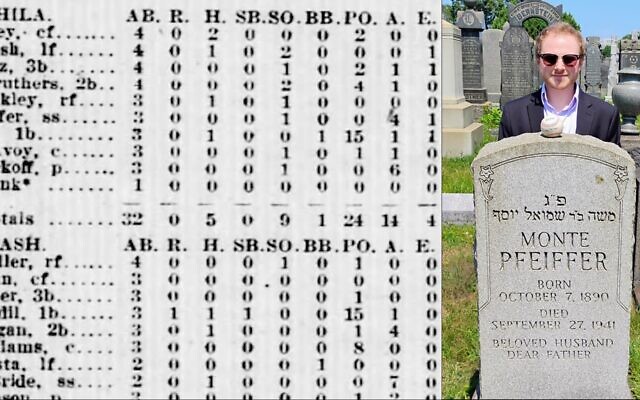
The box score of Monte Pfeiffer’s lone Major League ball game. At right, Zak Kranc poses at Pfeiffer’s grave in Acacia Cemetery, a Jewish cemetery in Queens, New York. (Courtesy Kranc via JTA)
Lucky for Pfeiffer. He wasn’t back on the diamond for long before Connie Mack, legendary manager of the Philadelphia Athletics, chose to rest his “$100,000 infield” for the 1913 World Series and yank three young men, including Pfeiffer, out of regional obscurity to temporarily replace them. The Philadelphia Inquirer cheekily dubbed the trio the “Kindergarten Brood.”
Pfeiffer made his debut in enemy territory: Griffith Stadium, home of the Washington Senators. An estimated 15,000 fans, far above the team’s 4,000 average, would crowd the stands on September 29, 1913, to celebrate George McBride Day, in honor of the Senators’ team captain and shortstop. US vice president Thomas Marshall would make an on-field presentation.
Observers predicted the three rookies would hit nothing but air against fearsome pitcher Walter Johnson, who arrived that day with a 35-7 record and an ERA hovering just above 1.00. Even Detroit Tigers legend Ty Cobb — a cutthroat Hall of Fame centerfielder who ended the major-league career of another Jewish ballplayer, Jesse “Tiny” Baker, by brutally spiking him with his cleats — was terrified the first time he faced Johnson. “Something went past me that made me flinch,” he said, according to Ken Burns’ documentary “Baseball.” “The thing just hissed with danger.”
Although the Senators wound up blanking Philadelphia 1-0, Pfeiffer never buckled, even after Johnson grazed his sleeve with a pitch. The Washington Times Herald said the 23-year-old “played a smashing good game at short” despite flubbing a grounder. The Washington Post said the “stocky little shortfielder…made several sensational stops” and was “robbed” of a sure hit off Johnson in the 6th inning.
Gibson, who has profiled more than 60 one-game players for the Society of American Baseball Research, sees Pfeiffer as a hard-luck case. “I found it wildly unfortunate that in his one major-league game, Pfeiffer had to square off against Johnson,” he said in an email.
The story of how Kranc discovered Pfeiffer is remarkable in its own right.
The antitrust attorney’s first exposure to Jewish ballplayers came at his bar mitzvah, when he received a framed collection of baseball cards. “It was just a cool thing,” he said. “And I kind of put it to the side.”
Years later, when COVID hit, Kranc thought about the collection. “Everyone was hunkered down and just looking for something to do, looking for an escape from all of the isolation and difficulties,” he said. “And I was like, hey, you know, I like being Jewish. I love baseball, right? I’m going to take this up a level.” He began to hunt for more Jewish baseball cards and autographs — and to search for an undiscovered player.
Several months ago, Kranc was casually scrolling through the website Baseball Reference when he spied a feature called “Cup of Coffee Players”— a nod to those whose big-league careers lasted just one game. Paging through the bios of hundreds of men, he stumbled upon a player listed as “Monte Pfeffer” who had been buried in Acacia Cemetery, a Jewish cemetery in Queens. A few clicks of the mouse took him to Find a Grave, where he located a tombstone he surmised was Pfeiffer’s.
“I saw the Hebrew writing, and I said to myself, ‘Okay, I think we have something here,’” Kranc recalled. He continues to be awed by his unlikely discovery. “I would venture to say the odds of this particular event happening are lower than a perfect game, a triple play, or almost anything else we might find on the field.”
Like Spaner and others before him, Kranc took a disciplined approach to confirming Pfeiffer’s Jewishness. He gathered photos, inspected family trees, read obituaries, and hunted down cemetery records. He also found a descendant, the Honorable Louis “Lou” Meisinger.
Meisinger, a retired California judge and entertainment lawyer, never met his great-uncle Monte Pfeiffer, but they shared an important connection: Meisinger’s late mother, Eleanor, was raised with Pfeiffer’s daughter, Frances. Meisinger also briefly owned Pfeiffer’s mitt, though he didn’t understand its significance at the time. “My mother gave me the glove, which she said was given to her by her Uncle Izzy, presumably Monte’s brother,” he said in an interview. “I used the glove in Little League and, unfortunately, discarded it when I graduated to better equipment. It was not in good shape.”
Like many other Jewish sports fans, Meisinger enjoys reading about Jewish athletes. But “there was no family lore about [Pfeiffer], other than that he once played in the major leagues. Nobody provided any details.”
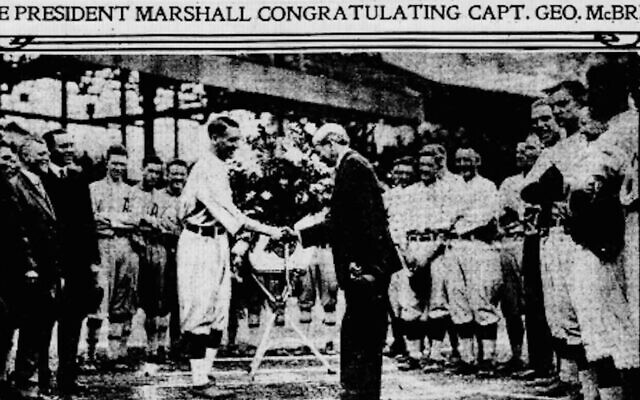
A newspaper article about Monte Pfeiffer’s lone major league baseball game as it appeared on Sept. 14, 1913. The Washington Senators honored their captain, George McBride, shown shaking hands with Vice President Thomas Marshall. (Courtesy Zak Kranc via JTA)
Alas, Pfeiffer’s major league tenure was as scant as the details. When the Athletics returned to Griffith Stadium a day after losing to Johnson’s Nationals, Pfeiffer’s two cohorts were in the lineup, but he had been cut loose. The Wilkes-Barre Record reported that the rookie was “struck on the head by a batted ball and rendered unconscious.”
Pfeiffer’s career swiftly nosedived. In true journeyman fashion, he began the 1914 season with the Kansas City (Missouri) Blues of the American Association, traveled north to join the Marinette-Menominee (Wisconsin) Twins of the Wisconsin-Illinois League, and signed with the Topeka (Kansas) Jayhawks of the Western League. The following year, in 1915, Pfeiffer wrapped up his baseball sojourn in Manitoba, Canada with the St. Boniface Bonnies of the Northern League. His best batting average over the two seasons was a dismal .176.
Pfeiffer also suffered misfortune at home. Things briefly had looked up in late 1914 when he married 18-year-old Rose Schechter, a Jewish native of New York City who soon became pregnant. But two weeks after giving birth to their daughter, Schechter died. Pfeiffer, presumably bereft and unprepared to raise the infant, asked his older sister Mamie to do so. He went on to work as a signal or subway repairman — public records are unclear — and briefly enlist in the military during World War I. As far as we know, the widower never remarried. He was just 49 years old when he died of heart disease in 1941.
Today, Monte Pfeiffer’s great-great-grandnephew Aric Berg pitches for Fordham University — a reminder that, more than a century after his lone appearance, Pfeiffer’s story is still being written.


Texas outside hitter Whitney Lauenstein announced her commitment to Penn State women’s volleyball out of the transfer portal on Wednesday. Lauenstein posted her decision to transfer to Happy Valley on her Instagram.
As a redshirt senior this past season, Lauenstein logged 33 kills, 11 digs, and 14 total blocks across 20 sets for the Longhorns.
Lauenstein began her NCAA journey with two seasons at Nebraska. As a sophomore, she led the Cornhuskers in total points, earning AVCA All-Region Team and Academic All-Big Ten honors.
After the 2022 season, the Waverly, Nebraska, native stepped away from the team to focus on her family. Lauenstein then transferred to Texas in December of 2023, where she spent the last two seasons.
Lauenstein now joins setter Alexis Stucky and middle blocker Ryla Jones as transfer players who have committed to the Nittany Lions this cycle.
Please choose an option below.
OR

Updated Dec. 24, 2025, 10:22 a.m. CT
- Marquette volleyball All-American Natalie Ring is transferring to Texas A&M for her final season.
- Ring, a third-team All-American, ranked 25th in the nation with 497 kills this past season.
- She is the second key player to leave Marquette, following freshman setter Isabela Haggard’s transfer to Baylor.
- Marquette has added Ball State’s Carson Tyler, the Mid-American Conference player of the year.
A Marquette volleyball All-American is joining the national champions.
The Golden Eagles’ Natalie Ring announced on social media on Dec. 23 that she will use her final season of NCAA eligibility at Texas A&M.
Ring, a former Madison Edgewood High School standout, was a third-team All-American this season. She ranked 25th in the nation in kills with 497. Ring has 754 kills in her career.
“We are excited to add Natalie to our Aggie family here in Aggieland,” Texas A&M coach Jamie Morrison said in a statement. “She brings a wealth of experience as a well-rounded outside hitter and is a relentless competitor who consistently raised her level against the best competition.”
Ring helped lead the Golden Eagles to the second round of the NCAA tournament under first-year coach Tom Mendoza. MU lost in five sets to host Louisville.
Texas A&M went on a magical run to the national title as a No. 3 seed, beating three of the tournament’s No. 1 seeds, culminating in a sweep of Kentucky in the title game.
Ring is the second key player to leave MU’s team. Freshman setter Isabela Haggard announced a transfer to Baylor after recording 997 assists and 257 digs.
Mendoza has added Ball State’s Carson Tyler, the Mid-American Conference player of the year who will have two seasons of eligibility. She registered 506 kills, which was 18th in the country.

Updated Dec. 24, 2025, 12:56 p.m. ET
Pitt volleyball’s fifth consecutive trip to the NCAA Tournament national semifinals ended with another heartbreak following an upset loss to the eventual champions, the Texas A&M Aggies. But the Panthers have reloaded for next season with one of the biggest names in the transfer portal.
The Panthers announced the signing of former Penn State setter Izzy Starck on Tuesday, pairing the 2024 AVCA National Freshman of the Year with Olivia Babcock, the two-time AVCA National Player of the Year.
“I’m so excited I cannot wait for next season to start,” Babcock wrote on Instagram. “WOOOOHHOOOO.”
Starck had a breakout freshman campaign at Penn State, recording 1,483 assists (10.89 per set), 342 digs, 112 kills and 99 blocks. The Big Ten Freshman of the Year led the Nittany Lions to a 35-2 overall record under head coach Katie Schumacher-Cawley and the program’s eighth national championship.
The 6-foot-1 setter appeared in four games for Penn State before stepping away for the season to prioritize her mental health. Starck said her hiatus wasn’t a “goodbye forever,” but her time at Penn State officially came to an end when she entered the transfer portal earlier this month.
“I am very excited to announce that I will be entering the transfer portal this December. I look forward to finding a new home where I can grow in the next chapter of my career,” said Starck, who has three years of eligibility remaining after redshirting her sophomore season. “I am beyond grateful for the endless support I’ve received over the past months.”
Starck joins a championship contender looking to finally get over the national semifinal hump. Pitt advanced to the 2025 NCAA volleyball Final Four for the fifth consecutive year, but the No. 1 seed Panthers were swept 29-27, 25-21, 25-20 by No. 3 seed Texas A&M. It marked the first time Pitt had been swept all year and the Panthers’ fifth straight time falling short of a national championship berth.
Pitt is in search of its first national championship appearance and first national title.

The USA TODAY app gets you to the heart of the news — fast. Download for award-winning coverage, crosswords, audio storytelling, the eNewspaper and more.
Dec. 24, 2025, 10:30 a.m. CT
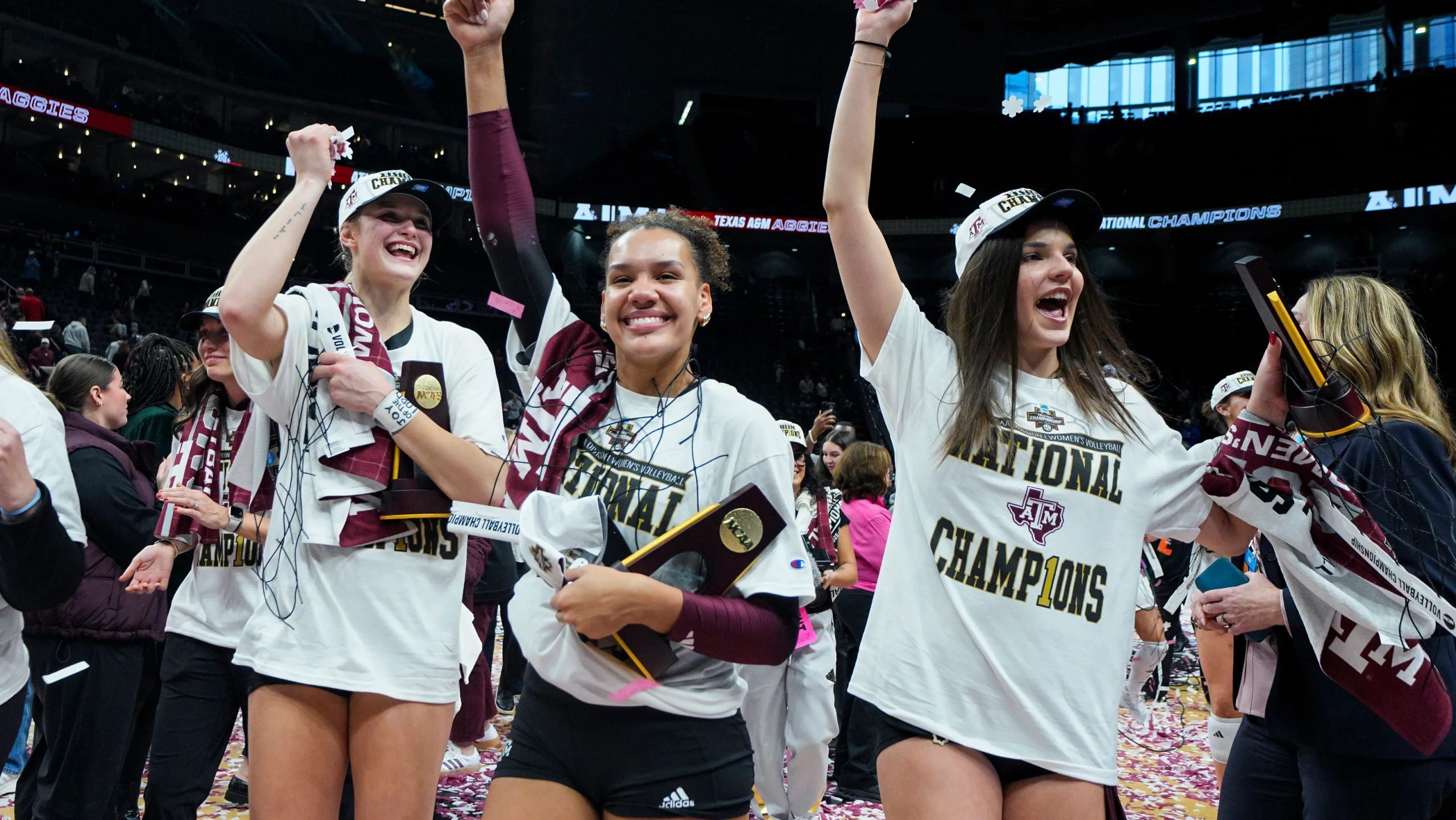
Texas A&M’s first-ever NCAA Championship win over the Kentucky Wildcats on Sunday was one of the most-watched title games in college volleyball history.
The 2025 campaign has featured many first-time achievements for Jamie Morrison’s squad in just his third year as head coach in Bryan-College Station, Texas, including a victory in the No. 2-most-watched NCAA title game ever. Texas A&M’s match against Kentucky attracted a peak of 1.7 million viewers, as part of the most-consumed NCAA Women’s Volleyball Tournament in the history of the sport.
The Aggies have much to be proud of following their historic run on the court this season. Still, the Maroon and White faithful have also played their own crucial roles in supporting the program as it ventured to some of the most hostile road environments in volleyball. One of those rowdy atmospheres occurred in the Lincoln Regional, where Morrison’s squad dethroned No. 1 seed Nebraska in an instant classic that advanced the Aggies to their first-ever appearance in the Final Four.
Texas A&M’s outstanding season, capped off by a sweep of the Wildcats in the NCAA Championship, played a massive role in etching their name into the viewership history books.
The wheels never stop turning, however. Morrison went straight to work and immediately made a splash in the transfer portal by landing commitments from Ohio State middle blocker Kaia Castle and Marquette outside hitter Natalie Ring. While it hasn’t even been one week since Texas A&M brought the national title to College Station, Morrison and company are already turning their heads to focus on building another stacked roster eager to make more history in 2026.
That approach to recruiting and rebuilding is a massive reason for the Aggies’ recent success on the court under Morrison’s watchful eye. The talented athletes like Logan Lednicky, Ifenna Cos-Okpalla and the NCAA MVP Kyndal Stowers have molded this winning culture, which the stars of the future in the Maroon and White will look to build upon and surpass moving forward.
Contact/Follow us @AggiesWire on X (formerly Twitter) and like our page on Facebook to follow ongoing coverage of Texas A&M news, notes and opinions. Follow Dylan on X: @dylanmflippo.
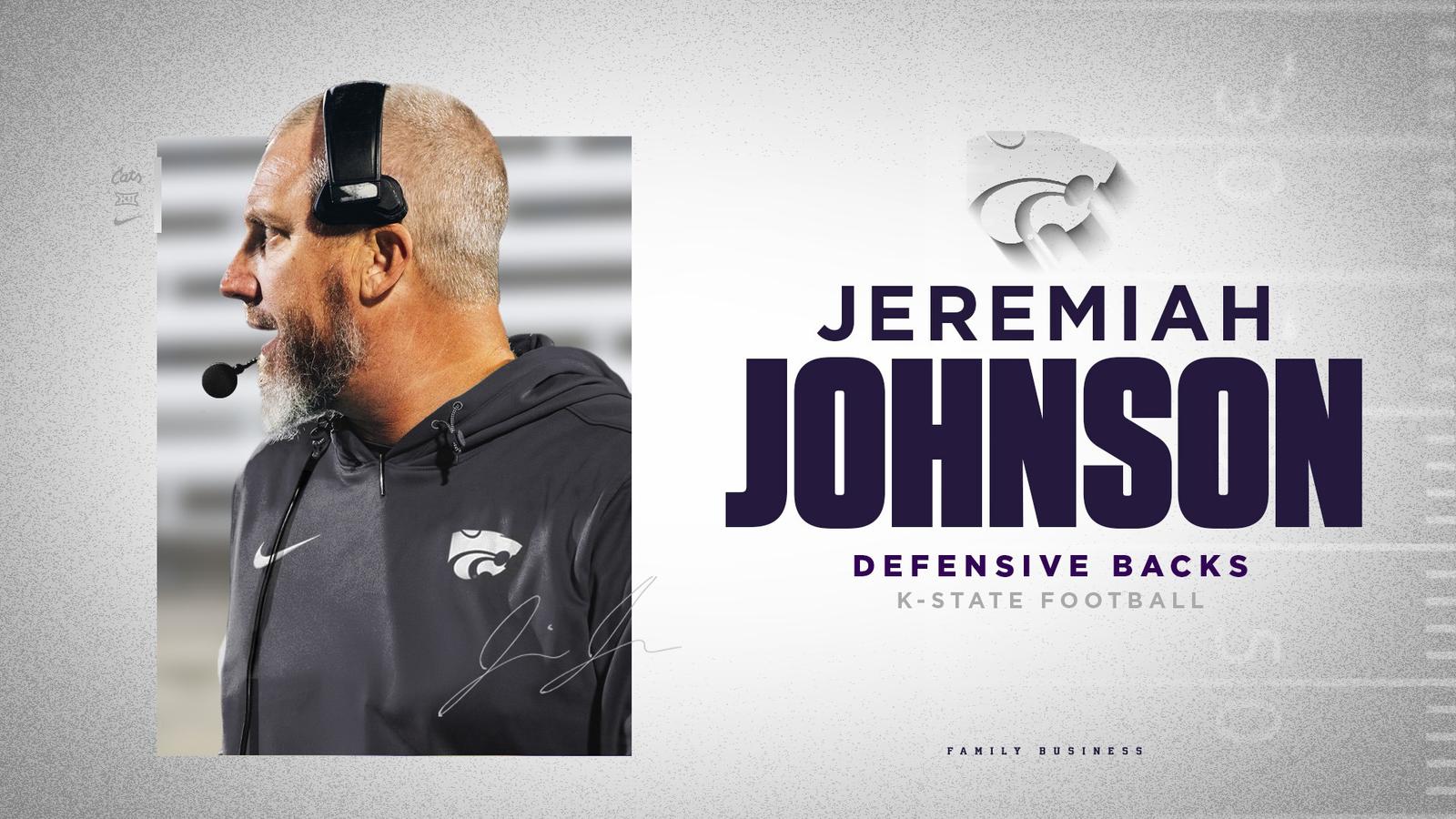
Johnson comes to Manhattan after serving one season as the defensive coordinator at Coastal Carolina in addition to being the Chanticleers’ interim head coach for the Independence Bowl against Louisiana Tech, which will be played next Tuesday.
“When Coach Klein called about joining his staff, it was a no brainer,” said Johnson, who worked with Klein during the 2016 season at Northern Iowa. “Having the opportunity to help him execute his vision for this program is exciting, and I am humbled and honored to work alongside one of the best coaches, leaders and humans in this business. It’s an added bonus that I am able to return to my home state. Nicki, Lane, Drew and I are so grateful to Collin and Shalin for bringing us on their journey and making us a part of their Wildcat Family. Team Johnson is fired up to get to Manhattan and get to work. Go Cats!”
Johnson has also served as a defensive coordinator at Northern Iowa (2014-2021, 2023), Kent State (2022) and Louisiana Tech (2024).
“Jeremiah is one of the best teachers of the game of football I have been around,” said Klein. “He is a relentless recruiter and a program builder. I am very excited to have him on our staff.”
This season, Johnson has helped Coastal advance to its sixth-straight bowl game as the Chanticleers rank 16th nationally and second in the Sun Belt in fourth down defense (40.0%) and 31st in fumble recoveries (8). He has helped Xamarion Gordon to a No. 2 national ranking in fumble recoveries (3) and a No. 5 ranking in the conference in interceptions (3). Myles Woods also had three interceptions on the year, while Johnson has coached Ezekiel Durham-Campbell to a No. 7 ranking in the conference in sacks (0.46 per game).
The Johnson-led Louisiana Tech defense in 2024 ranked 12th nationally in total defense, surrendering only 308.4 yards per game. It was a 98-spot improvement over where the Bulldogs finished in 2023, while his unit also produced a 91-place improvement in scoring defense (21.0 points per game) as they finished at No. 26. Additionally, Johnson led La Tech to an 88-place bump in rushing defense (135.5 yards per game) to rank 44th.
Outside of a one-year hiatus in which he served the 2022 season as Kent State’s defensive coordinator, Johnson coached for 16 seasons at Northern Iowa, spending the 2007 through 2021 seasons – in addition to the 2023 campaign – in Cedar Falls. While at UNI, Johnson coached Panther defenders to a combined 32 All-Missouri Valley Football Conference (MVFC) First Team honors, five MVFC Defensive Players of the Year, one Buck Buchanan Award winner, 15 Associated Press FCS All-America honors and seven American Football Coaches Association (AFCA) All-American accolades.
In 11 seasons as the UNI defensive coordinator, Johnson’s defenses ranked in the top 10 nationally in statistical categories 29 times, which included turnovers gained on six occasions (highest ranking of No. 2 in 2019 with 34), defensive touchdowns four times (highest ranking of No. 5 in 2016 and 2019 with 4) and scoring defense three times (best ranking of No. 6 at 15.3 points per game in the Spring of 2021). During his first run as defensive coordinator from 2014 through 2021, UNI ranked sixth in the FCS by allowing 19.9 points per game over a 99-game span. He was also named a finalist for the 2019 FootballScoop FCS Defensive Coordinator of the Year award.
The Panthers won four conference championships during Johnson’s time at UNI. Additionally, they made 10 FCS Playoff appearances and advanced past the first round in eight of 10 seasons, which included a semifinal showing in 2008 and quarterfinal appearances in 2015 and 2019.
Before being promoted to coordinator, Johnson coached the Northern Iowa defensive backs and served as the recruiting coordinator from 2009 through 2012. In 2007 and 2008, he was the video coordinator and assistant defensive backs coach.
Johnson went to UNI after working the 2003 through 2006 seasons at Loras College, serving on the same staff as former K-State head coach Chris Klieman. Johnson worked with the Duhawk defensive backs in 2003, 2004 and 2006, while he coached the wide receivers in 2005. Prior to his time at Loras, he was a graduate assistant and video coordinator at Wyoming in 2002.
A native of Scandia, Kansas, Johnson obtained his undergraduate degree in sports science from Kansas in 2000, while he earned a master’s degree in athletic administration from Loras in 2005.
Johnson and his five, Nicki, have a son, Lane, and a daughter, Drew.
THE JEREMIAH JOHNSON FILE
Hometown: Scandia, Kansas
College: Kansas – Bachelor’s degree in sports science (2000); Loras College – Master’s degree in athletic administration (2005)
Family: Wife: Nicki; Children: Lane, Drew
JEREMIAH JOHNSON’S COACHING CAREER
2002, Wyoming (Graduate Assistant/Video Coordinator)
2003-04, Loras College (Defensive Backs)
2005, Loras College (Wide Receivers)
2006, Loras College (Defensive Backs)
2007-08, Northern Iowa (Video Coordinator/Assistant Defensive Backs Coach)
2009-12, Northern Iowa (Defensive Backs/Recruiting Coordinator)
2013-16, Northern Iowa (Defensive Coordinator/Linebackers)
2017-21, Northern Iowa (Defensive Coordinator/Defensive Backs)
2022, Kent State (Defensive Coordinator)
2023, Northern Iowa (Defensive Coordinator)
2024, Louisiana Tech (Defensive Coordinator)
2025, Coastal Carolina (Defensive Coordinator/Interim Head Coach)
2026, K-State (Defensive Backs)

Dec. 24, 2025, 5:40 p.m. CT
Winning championships is always the top goal for any athletic program. However, when you go deep into the postseason, especially in volleyball, it can interfere with the staff’s ability to recruit. That’s a good problem to have when you’re bringing home hardware, and Texas A&M head coach Jamie Morrison is already getting work done in the NCAA transfer portal.
Needing to reload a roster that’s losing nine seniors, including four All-Americans and two future professional players, Coach Morrison received some major news on Tuesday. It was announced that former Boise State middle blocker Eliza Sharp has committed to Texas A&M. This gives A&M another young talent to develop and brings some elite production.
Originally, Coach Morrison had a five-year plan to reach a national title, which meant he understood that the roster he had now would be a crucial part of turning the Aggie volleyball program into a national powerhouse. With him now ahead of schedule by two years, it gives him a significant advantage in recruiting and positions Texas A&M for a quick turnaround to make another championship run in the near future.
Below is key information on the third commit joining the 2026 Texas A&M volleyball team.
Eliza Sharp – Middle Blocker
- Former School: Boise State
- Class: RS Freshman
- Eligibility: Three years remaining
- Stats: 250 career kills, 2.21 kills per set, .323 hitting percentage, 140 career blocks, 1.2 blocks per set, Mountain West Freshman of the Year, All-Mountain West
Contact/Follow us @AggiesWire on X and like our page on Facebook to follow ongoing coverage of Texas A&M news, notes, and opinions. Follow Jarrett Johnson on X: @whosnextsports1.

Surprising List Of USC Trojans’ Biggest NIL Valuations

Aleia Fenburg wins again as local wrestlers compete in Warrior Classic

Child care funding methods ‘unsustainable’ for YSS | News, Sports, Jobs

College football program loses 22 players to transfer portal

Valley Boys: The U12 team redefining the “win” for a 4-year-old fighter | News

Monroe residents help throw a Christmas bash for children in Bridgeport’s East End

3 young kids killed in house fire; 4-year-old, parents and grandmother seriously injured

Ocean View’s Maury Young made mark by breaking 39-year-old record

Miami NIL financial commitment in 2026

Early 2026 Daytona 500 favorite slides as NASCAR season nears

Kyle Larson Addresses Possibility of Racing Rolex 24 Again

New ‘Community Playbook Academy’ to revolutionize youth sports leagues in the U.S.

Texas Outside Hitter Whitney Lauenstein Transfers To Penn State Women’s Volleyball

FIA greenlights pure genius Mercedes 2026 F1 engine

College football: Four key Gophers coming back in unique NIL campaign

Fargo girl, 13, dies after collapsing during school basketball game – Grand Forks Herald

CPG Brands Like Allegra Are Betting on F1 for the First Time

Sycamores unveil 2026 track and field schedule

Two Pro Volleyball Leagues Serve Up Plans for Minnesota Teams

Utah State Announces 2025-26 Indoor Track & Field Schedule

SoundGear Named Entitlement Sponsor of Spears CARS Tour Southwest Opener

Jo Shimoda Undergoes Back Surgery

Redemption Means First Pro Stock World Championship for Dallas Glenn

Bowl Projections: ESPN predicts 12-team College Football Playoff bracket, full bowl slate after Week 14

Black Bear Revises Recording Policies After Rulebook Language Surfaces via Lever

Texas volleyball vs Kentucky game score: Live SEC tournament updates

Robert “Bobby” Lewis Hardin, 56

Donny Schatz finds new home for 2026, inks full-time deal with CJB Motorsports – InForum

How this startup (and a KC sports icon) turned young players into card-carrying legends overnight

How Donald Trump became FIFA’s ‘soccer president’ long before World Cup draw





-
 Motorsports2 weeks ago
SoundGear Named Entitlement Sponsor of Spears CARS Tour Southwest Opener
-
 Motorsports2 weeks ago
Donny Schatz finds new home for 2026, inks full-time deal with CJB Motorsports – InForum
-
 Rec Sports3 weeks ago
How Donald Trump became FIFA’s ‘soccer president’ long before World Cup draw
-
 Rec Sports2 weeks ago
David Blitzer, Harris Blitzer Sports & Entertainment
-

 Motorsports3 weeks ago
JR Motorsports Confirms Death Of NASCAR Veteran Michael Annett At Age 39
-
Sports3 weeks ago
Elliot and Thuotte Highlight Men’s Indoor Track and Field Season Opener
-
Sports3 weeks ago
West Fargo volleyball coach Kelsey Titus resigns after four seasons – InForum
-

 Motorsports2 weeks ago
Rick Ware Racing switching to Chevrolet for 2026
-

 NIL2 weeks ago
DeSantis Talks College Football, Calls for Reforms to NIL and Transfer Portal · The Floridian
-
 Sports2 weeks ago
#11 Volleyball Practices, Then Meets Media Prior to #2 Kentucky Match