Jack Sawyer #33 of Ohio State scores a touchdown after recovering a fumble in the fourth quarter against Texas during the Goodyear Cotton Bowl. (Photo by Alex Slitz/Getty Images)


 Michael Cohen College Football and College Basketball Writer
In the immediate aftermath of Jack Sawyer’s stunning scoop and score during the national semifinals of last year’s College Football Playoff, as half the crowd at AT&T Stadium screamed loudly enough to shake the television cameras and the other half stood frozen in disbelief, mouths collectively agape, it was difficult to parse through all the layers of deeper-seated meaning crammed into one unforgettable play.
Jack Sawyer #33 of Ohio State scores a touchdown after recovering a fumble in the fourth quarter against Texas during the Goodyear Cotton Bowl. (Photo by Alex Slitz/Getty Images)
On the surface, Sawyer had single-handedly manufactured the clinching touchdown in an enthralling victory over Texas that propelled Ohio State to the national championship game. His 83-yard fumble return extended the Buckeyes’ lead to double digits with 2:29 remaining at a juncture when the Longhorns were deep in the red zone and threatening to level the score.
But there was so much more to that sequence, and to that game, that would help contextualize the enormity of such a high-stakes moment between Ohio State and Texas — two programs that are unquestionably among the sport’s biggest, richest and most recognizable brands, even though they’d combined to capture just a single national title in the preceding 20 years.
ADVERTISEMENT
For the Longhorns to maintain their blue-blood status despite only winning one championship since 1970 — thanks, Vince Young — speaks to how enmeshed Texas really is in the double helix of college football lore. The Buckeyes, meanwhile, could at least claim two national titles in the 21st century going into that January evening, but none since 2014.
“We’ve been close,” Texas head coach Steve Sarkisian said at SEC Media Days this summer. “We’ve been there. We’ve been knocking on the door [for] the last two years. But to go do that [and win it all], we need to take it one step at a time as we embark on the summit that we’re looking for. And that’s going to take great discipline.”
Texas’ quarterback that fateful night against Ohio State was none other than Quinn Ewers, a former No. 1 overall recruit in the country who began his career with the Buckeyes before transferring back home, swiftly elevating the Longhorns to consecutive CFP appearances for the first time in school history. Sawyer, meanwhile, was a former five-star prospect in his own right and a player who, on Feb. 3, 2019, became the first high schooler to commit to newly promoted head coach Ryan Day, igniting an otherworldly recruiting run for the Buckeyes that has since produced six consecutive classes ranked among the top five nationally. That Ewers and Sawyer had previously been roommates at Ohio State, albeit relatively briefly, offered yet another delicious plot twist.
For Texas and Ohio State to have met with so much pomp and circumstance and talent seven months ago only to climb atop the rankings again in 2025, when they are Nos. 1 and 3, respectively, in the preseason AP poll and Nos. 1 and 2, respectively, in the coaches poll, only reinforces the hypothesis that these two schools, perhaps more than any others, are uniquely positioned for long-term success in this new era of college football. An argument can be made that Saturday’s mouthwatering season opener at Ohio Stadium, where the Buckeyes will host the Longhorns in the premier game of Week 1 (noon ET on FOX and the FOX Sports app), is a matchup between the sport’s current and future preeminent powers.
“If you look at last year’s game,” Sarkisian said at a news conference earlier this week, “26 players got drafted off the two teams into the NFL. If you include free agents, 32 players that were playing in that game a year ago are now playing in the NFL. And the fact that both teams are coming back as 1 and 2 in the country [in the coaches poll], I think speaks volumes to the quality of programs that both of us have, quite frankly.”
Once perennial contenders in the Big 12, a conference Texas seemingly co-chaired with rival Oklahoma, the Longhorns stormed the SEC last fall with a dream-like debut that flashed enough coaching guile, spending power and depth to send shock waves of staying power across the league. And the Buckeyes, long considered the class of the Big Ten on the shoulders of coaching icons like Jim Tressel, Urban Meyer and now Day, each of whom won a national title, swiftly responded to archrival Michigan’s championship ascension in 2023 by mobilizing with the kind of multi-comma fundraising and ruthless roster construction necessary to reach the pinnacle one year later, fortifying the program’s infrastructure along the way.
All of which serves as the necessary preamble for a game that is rather historic: It’s the first time since 1988 that the defending national champion will open against the preseason No. 1 team in the country. It’s just the second time in the history of the AP poll, which dates to 1950, that two teams ranked among the top three nationally will face each other in Week 1. And there are no teams in college football with better odds of winning this year’s national championship than the two that will face each other in Columbus on Saturday afternoon, according to DraftKings Sportsbook.
“I think it’s great for college football playing a game like this opening weekend,” Day said at a news conference earlier this week. “And we’re excited to play these guys. It’s rare that you would kind of play someone like this toward the end of the season [in 2024] and then start the regular season with them [in 2025], but here we are. And I think it’s going to give us a great barometer coming out of the first game.”
Though each team’s barometer will be subject to short-term change in the aftermath of Week 1 — with the winner likely anointed by the national media as the true national championship favorite — the long-ranging prospectuses for both could hardly be more encouraging, be that over the course of the 2025 marathon or in future seasons to come. There are plenty of reasons why the Wall Street Journal labeled Ohio State ($1.957 billion) and Texas ($1.897 billion) the two most valuable college football programs in the country earlier this year.
Beyond Ohio State’s perch as the defending national champion, its claim to be considered the strongest program in the sport begins with an incredible record of player acquisition and the capital needed to both procure and retain such talent year over year. When it comes to recruiting, where Day has entrenched himself as the only Big Ten coach capable of competing with traditional SEC powers on an annual basis, the Buckeyes enter 2025 ranked third behind Alabama and Georgia in the 247Sports Team Talent Composite, a metric that assesses the overall quality of each roster. And when it comes to the transfer portal, which provided Ohio State with a handful of high-level contributors ahead of its title-winning season last fall, the Buckeyes have ranked sixth, first and fifth in the country for average prospect score over the previous three years.
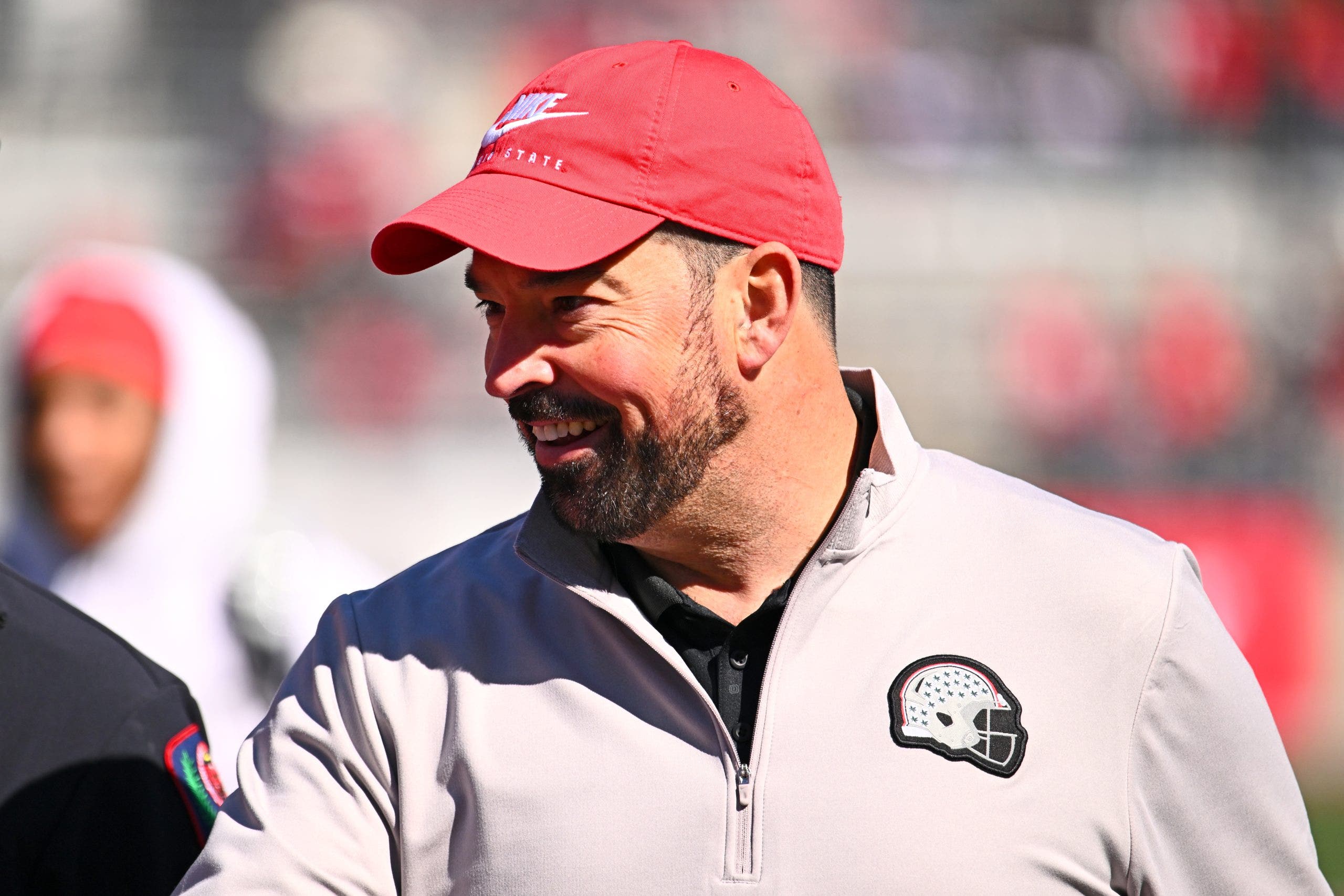
Head coach Ryan Day of the Ohio State Buckeyes enters Ohio Stadium prior to the Ohio State Spring Game. (Photo by Ben Jackson/Getty Images)
In the NIL and revenue-sharing world, stringing together those kinds of high school and transfer classes requires supreme organization between Ohio State’s personnel department and the financial arm of its athletic department, the blending of which can be largely credited to football general manager Mark Pantoni and athletic director Ross Bjork. Together, they were two of the leading figures behind last year’s aggressive financial packages that simultaneously retained the core of Day’s senior class and augmented it with an elite transfer portal haul that included quarterbacks Will Howard and Julian Sayin, center Seth McLaughlin, running back Quinshon Judkins and safety Caleb Downs, among others — all at the lofty price of “around $20 million,” as Bjork later acknowledged.
“I think it was four years ago that I was here when I said, ‘I think in about five years we won’t recognize what college football looks like,’” Day said earlier this summer at Big Ten Media Days. “I think that I was right off the field. I think I was wrong on the field. I think the product is as good as it’s ever been. I think the athletes are better than they’ve ever been.
“But off the field it’s just very, very different. It’s constantly changing. And so that’s where great alignment will be very, very important. I think we’re very well-positioned here at Ohio State moving forward.”
The same is certainly true for Sarkisian’s outfit, which has increased its win total every year since he took over in 2021. Not only is Texas the only FBS team to make the CFP each of the last two years — it lost in the national semifinals both times — but the Longhorns are also coming off the winningest two-year stretch in school history, matching the 25 victories amassed by former coach Mack Brown in 2008-09. Yet not even Brown, who previously brought home a national title with Young in 2005, could guide Texas to No. 1 in the preseason AP poll, something the Longhorns had never experienced until this summer. Now, Sarkisian just needs a title of his own.
To get this close to the summit, Sarkisian has authored a recruiting heater of his own that underwrote the program’s relatively seamless transition from the Big 12 to the SEC, even with an obvious jump in the level of competition. His last four recruiting classes have ranked fifth nationally in 2022, third in 2023, sixth in 2024 and first in 2025 to land at No. 4 overall in the Team Talent Composite. The current Longhorns’ roster is tied with Alabama for the most former five-star prospects in the country with 14, which is three more than Ohio State and nine more than any other Big Ten program. One of those recruits, former No. 1 overall prospect Arch Manning, makes his highly anticipated debut as the team’s starting quarterback this weekend.
Assembling such a group was anything but cheap. In April, a report from The Houston Chronicle said Texas was going to spend “between $35 million and $40 million” on its 2025 roster alone, widening eyes and loosening the jaws of college football fans across the country. And even though Sarkisian later rebuffed that number — he called it “irresponsible reporting” during an appearance on SiriusXM — nobody is questioning the depths of the Longhorns’ coffers relative to their competitors. Especially when Sarkisian’s weekly news conference is broadcast on the Longhorn Network, the school’s own television channel and streaming service, because everything is bigger in Texas.
So, while there could certainly be viable cases for Georgia and Alabama as the preeminent powers in college football — after all, those two schools have combined to win eight of the last 16 national championships — it’s beginning to feel more and more like Texas’ moment in time, especially if Manning lives up to the hype. And there waiting for him and Sarkisian at the apex of college football are the Buckeyes of Ohio State.
“Pretty epic matchup when you think about No. 1 versus No. 2 — in at least one of the two major polls — for the first game of the season,” Sarkisian said. “As much as I’m going to talk about, ‘the rankings don’t matter’ — [and] I believe that — but I think for college football, the fanfare, the excitement around this game, I think is great for our sport.”
Michael Cohen covers college football and college basketball for FOX Sports. Follow him at @Michael_Cohen13.
Want great stories delivered right to your inbox? Create or log in to your FOX Sports account, follow leagues, teams and players to receive a personalized newsletter daily!
What did you think of this story?
recommended

Get more from the College Football Follow your favorites to get information about games, news and more

Is this the new normal? The new Bloomington? The new Big Ten?
Good afternoon, and happy Monday. Three-quarters of the MNW household are struggling with some form or residuals of the flu, and the other one is me. That, of course, has led to no resentment of the fact that I am healthy other than a little cough, no sir.
Indiana feels inevitable at this point, do they not? The Hoosiers have, through Curt Cignetti’s shrewd use of the transfer portal and quality coaching, turned college football completely on its ear.
Well, a deep-pocketed donor by any other name is…a deep-pocketed donor, still. Add to that Mark Cuban’s money for 2026? We might be dealing with the Hoosiers until Curt Cignetti gets bored.
Of course, there have been flashes in the pan before: the wisconsin Rose Bowls, the Peak Weather Machine years of Michigan State, that one time Minnesota won ten games or whatever—but it’s undeniable that none of those programs ever made a national championship and that none of them did it in the style that Indiana is doing it right now.
Watching Indiana do it—or, indeed, the entire SEC going belly-up in the postseason—is certainly cathartic. It’s better than the usual suspects doing it over and over again, and it’s at least more above-board than the standard SEC model of used car dealers buying themselves a championship. I take little solace in knowing that there’s less program-building, less connection to a campus, less-anything that feels “authentically” college football, but it’s incredibly possible that my feelings of “authenticity” always relied on a lie—the lie that it was possible to square “belonging” or “identity” of a college campus with athletes being fairly treated.
Congratulations, of course, to Indiana on their seemingly inevitable championship. It is truly exciting for the Hoosiers and their fans, as well as those coming back to football to join the thousand or so of their long-suffering brethren. Glad you’ve finally left the tailgate lots and headed in. Enjoy Miami.
Of course, you might have questions or comments about completely different things—basketball, wrestling, the best episode of Magic School Bus, the worst way to cook cod. We in the OTE Hive were recently discussing our careers as Quiz Bowl contestants (MNW, AlmaOtter, LPW), speech wannabes (LPW, Kind of…, Dead Read), or speech titans (BRT, Jesse, et al). Ask us what you’d like, and we’ll answer how we’d like.
This is a Mailbag call, and I hope you’ll treat it as such.

Elite running back Hollywood Smothers flipped from Alabama to Texas in the 2026 college football transfer portal on Sunday, signaling deeper issues within the Crimson Tide program.
On the field, Alabama has fallen short of sustaining the elite standard set by Nick Saban, losing as many games in two seasons under Kalen DeBoer (eight) as it did across the previous five seasons under the seven-time national championship-winning coach.
Coaching deserves its fair share of blame for Alabama’s slight fall from grace, but deeper issues may lie within the Crimson Tide’s NIL operation, which has lagged behind many of its peers this cycle.
Alabama has lost six players ranked inside Cooper Petagna‘s top 100 of the college football transfer portal rankings this offseason, while adding just one: defensive lineman Devan Thompkins.
National college football and transfer portal analyst Chris Hummer went inside Alabama’s NIL struggles, offering insights into what’s gone wrong in Tuscaloosa and what the future may hold for one of college football’s most storied programs.
“A decade ago, Alabama could land everyone they wanted,” Hummer said on CBS Sports HQ. “They could be like a dragon sitting on a chest of gold. There’s nothing you could do about it.

Rutgers football legend Leonte Carroo is suing Rutgers University over the use of his Name, Image, and Likeness from when he was playing in college, according to an article written by Brian Fonseca of Nj.com/NJAdvancedMedia. Carroo’s lawsuit claims that he is entitled to back payments for the money he generated for the university throughout his college career. The lawsuit values those figures between 2.8 and 3 million dollars.
Carroo and his team originally filed the lawsuit in October. In December, Rutgers countered and tried to have the lawsuit dismissed, arguing that the statute of limitations had long passed and that several courts from around the country had already unanimously denied the type of NIL claim that Carroo’s team is making. On January 9th, Carroo’s legal team filed a brief meant to argue that the university’s dismissal should be denied.
According to the article by Fonseca, Carroo’s team gave Rutgers a formal demand letter in June seeking compensation for the unauthorized use of his NIL. The university did not provide such compensation, which led to the lawsuit.
The House vs. NCAA settlement granted back payment to college athletes who were in school between June 2016 and 2024. Carroo’s playing at Rutgers career falls just outside that, as he played from 2012-2015. Carroo’s legal team is arguing that just because he falls outside the period given, it does not take away from the fact that Rutgers unjustly profited from his time as a player.
Carroo was one of the most well-known players at Rutgers while he was playing. He currently holds the receiving touchdowns record in school history by a wide margin, and he was one of the faces of the team when they first entered the Big Ten. Carroo and his legal team argue that some sort of compensation is in order for his level of stardom.
If the courts side with Carroo in this case, it has the potential to open up a whole can of worms across college athletics. It would lay the groundwork and encourage other former athletes from other schools to sue their own school for the same reason. Similar cases to this, including players from other college programs, have been dismissed or denied already across the board. It remains to be seen what will come of this lawsuit in particular.
A link to the original article by Fonseca can be found here.

The great debate regarding which conference — the Big Ten or the SEC — reigns over college football might not be much of a debate anymore. Especially given the SEC’s dismal 4-10 bowl record this offseason.
That bowl record looks even worse in games between the SEC and other Power Four teams, with the Southeastern Conference finishing the 2025-26 bowl season a combined 1-8 versus the ACC, Big Ten and Big 12. That includes a winless 0-4 mark against the ACC and a 1-3 record vs. the Big Ten, which has won the last two CFP national championships and will play for a third when No. 1 Indiana takes on No. 10 Miami in next Monday’s College Football Playoff national title game.
In fact, following No. 6 Ole Miss‘ 31-27 loss to the Hurricanes in last Thursday’s Fiesta Bowl CFP semifinal, the SEC — winners of 13 national titles in 17 years between 2006-22 — was shut out of playing for a third consecutive national championship game, something it hasn’t experienced since 2000-02.
Those struggles have led college football fans and pundits alike to effectively dance on the grave of the once-dominant conference. College football analyst Josh Pate joined the fray on Sunday’s episode of Josh Pate’s College Football Show, making it clear he’s been off the SEC gravy train for awhile now.
“The SEC is lagging behind the Big Ten, at the top, (and) I would even venture to suggest the middle-tier now is at least comparable if not slightly lagging behind,” Pate said Sunday night. “That’s probably where my perception has changed of late, moreso than at the top. So I’m not beating that drum.”
Pate then preceeded to break down all the ways the SEC ultimately lost its crown as King of College Football to the Big Ten, including his perception Big Ten “culture” is just more focused on football, as opposed to SEC’s perceived focus on the pomp and circumstance of the sport.
“Maybe the average Big Ten player is wired a little bit differently, maybe they focus a little more on the football aspect, the mean-and-potatoes aspect of football, instead of the more highlight-ish, branding aspect of football,” Pate added. “I think there’s something to that.”
From there, Pate addressed how the advent of NIL and the NCAA Transfer Portal has leveled the playing field from a talent perspective. In fact, Pate suggested the SEC became so spoiled by its multi-decade talent advantage, effectively drunk off its own supply, that it didn’t do what was necessary to maintain it. That ultimately resulted in what Pate described as “lazy practices” like prioritizing recruiting over coaching and player development, including a tendency to fill out their football staffs based on the agency they were associated with rather than the most-qualified candidates.
“If you think that’s ridiculous, it’s because it is,” Pate concluded. “But that’s been standard practice in the SEC for awhile. And I don’t find it to be the case in the Big Ten.”
And while the SEC could certainly return to glory by this time next year, at least for forseable future, college football fans in the South will suffer through more gloating from their neighbors to the North.

Indiana (No. 1) crushed No. 5 Oregon 56–22 in the Peach Bowl semifinal, forcing multiple first-half turnovers, dominating in all three phases, and improving to 15–0.
Miami (No. 10) survived a 31–27 Fiesta Bowl win over No. 6 Ole Miss, with quarterback Carson Beck’s late 3-yard scramble sealing the outcome after earlier College Football Playoff victories over Texas A&M and defending national champion Ohio State.
Miami’s College Football Playoff berth carried nearly as much drama as its postseason run.
Both the Hurricanes and Notre Dame finished the regular season 10–2, but despite ranking ahead of Miami for much of the year, the Irish were left out of the field, in large part because of Miami’s head-to-head win earlier in the season.
The decision sparked national debate about CFP criteria and the weight of head-to-head results.
Since then, Miami has done nothing but validate the committee’s call, advancing to the national title game, now just one win away.
The CFP national championship is set for January 19 at Hard Rock Stadium in Miami Gardens, pitting Indiana against Miami.
On Monday’s episode of “The Triple Option” podcast, former head coach Urban Meyer praised Indiana’s coaching, offensive line, and efficiency on film, ultimately picking the Hoosiers to win the title.
“I think Indiana wins by 9,” Meyer said. “I think Vegas is right on the point spread, but I think Miami plays their [expletive] off at home.”

Indiana powered an unblemished run under second-year head coach Curt Cignetti, transforming a 3–9 program into Big Ten champions.
The Hoosiers stacked signature road wins over Iowa, Oregon, and Penn State, dismantled Alabama 38–3 in the quarterfinals, and overwhelmed the Ducks again in the Peach Bowl semifinal.
Heisman-winning quarterback Fernando Mendoza has driven a balanced, physical attack that has dominated all season, throwing for 3,349 yards and 41 touchdowns while adding 284 rushing yards, six scores, and a 73% completion rate across 15 games.
Miami’s path has been far different, as the No. 10 seed fought through adversity to reach 13–2, upsetting Ohio State, beating Texas A&M, and edging Ole Miss 31–27 behind an elite scoring defense allowing just 14.0 points per game, the fifth-fewest nationally.
Indiana enters as the consensus favorite, listed by most sportsbooks as 8.5-point favorites with a 48.5-point total.
With Indiana’s balanced attack facing Miami’s opportunistic defense, the matchup likely hinges on tempo: the Hoosiers aim to dictate the pace while the Hurricanes seek pressure and takeaways.
Game odds refresh periodically and are subject to change. If you or someone you know has a gambling problem and wants help, call 1-800-GAMBLER.


 NBA Legend Michael Jordan to Join NBC Sports as Special Contributor
 Why a rising mid-major power with an NCAA Tournament team opted out of revenue-sharing — and advertised it
 Trackhouse to pair Chastain with McSwain
 Volleyball Falls to SEMO – Tennessee State University
 Kennewick School Board backs changes to gender inclusion in sports | News
Five Youth Sports Trends We’re Watching in 2026
Kentucky VB adds an All-American honorable mention, loses Brooke Bultema to portal


BangShift.com IHRA Acquires Historic Memphis Motorsports Park In Millington Tennessee. Big Race Weekend’s Planned For 2026!
Fifty years after IU’s undefeated champs … a Rose Bowl


H.S. INDOOR TRACK & FIELD: GLOW region athletes face off at Nazareth University | Sports

Colorado volleyball poised to repeat success

2025 Volleyball Player of the Year: Witherow makes big impact on Central program | Nvdaily


NJ Motorsports Park Announces 2026 Event Schedule


Texas A&M volleyball’s sweep of Kentucky attracts record viewership

NIL Funds Are at Top of Arizona State’s Christmas Wishlist