Rec Sports
BMX Bikes Market | Global Market Analysis Report

BMX Bikes Market Size and Share Forecast Outlook 2025 to 2035
The BMX Bikes Market is estimated to be valued at USD 380.6 million in 2025 and is projected to reach USD 681.5 million by 2035, registering a compound annual growth rate (CAGR) of 6.0% over the forecast period. This growth, supported by a CAGR of 6%, is driven by the increasing popularity of BMX biking in youth sports, recreational cycling, and competitive events. In the first five-year phase (2025–2030), the market is expected to grow from USD 380.6 million to USD 507.9 million, adding USD 127.3 million, which accounts for 42.3% of the total incremental growth, driven by growing urbanization, cycling infrastructure, and youth engagement in extreme sports.
The second phase (2030–2035) will contribute USD 173.6 million, representing 57.7% of the total growth, driven by stronger momentum from higher consumer adoption and improved marketing strategies by leading brands. Annual increments will rise from USD 25 million in early years to USD 35 million by 2035, signaling accelerated growth due to increasing awareness of cycling benefits, expanding competitive events, and product innovations. Manufacturers focusing on lightweight, durable, and performance-enhancing features will capture the largest share of this USD 300.9 million opportunity.
Quick Stats for BMX Bikes Market
- BMX Bikes Market Value (2025): USD 380.6 million
- BMX Bikes Market Forecast Value (2035): USD 681.5 million
- BMX Bikes Market Forecast CAGR: 6.0%
- Leading Segment in BMX Bikes Market in 2025: Freestyle BMX Bikes (38.6%)
- Key Growth Regions in BMX Bikes Market: North America, Asia-Pacific, Europe
- Top Key Players in the BMX Bikes Market: Cult Crew, GT Bicycles, Haro Bikes, Mongoose, Sunday, Redline Bicycles, Fit Bike Co.
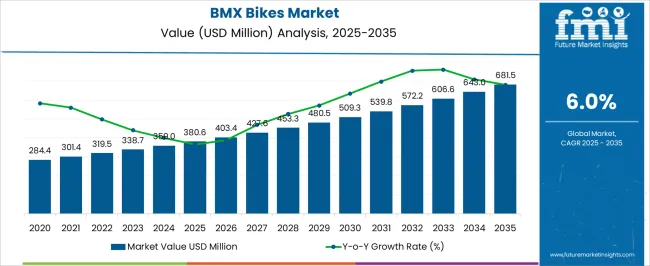

BMX Bikes Market Key Takeaways
| Metric | Value |
|---|---|
| BMX Bikes Market Estimated Value in (2025 E) | USD 380.6 million |
| BMX Bikes Market Forecast Value in (2035 F) | USD 681.5 million |
| Forecast CAGR (2025 to 2035) | 6.0% |
Why is the BMX Bikes Market Growing?
The BMX Bikes market is witnessing sustained momentum as youth-focused recreational activities and extreme sports culture continue to gain global traction. A growing emphasis on urban mobility, individual expression, and stunt-based cycling has increased the demand for high-performance BMX bikes with customizable configurations. The market is benefiting from a combination of factors including media exposure through competitive events, growth in skate and bike parks, and a shift toward fitness-oriented lifestyles.
Advancements in frame engineering and component manufacturing have enabled the production of lighter yet stronger BMX models, appealing to both amateur and professional riders. The market has also seen a rise in brand collaborations and sponsorship deals aimed at boosting visibility and authenticity among niche cycling communities.
With increasing investments in sports infrastructure and a visible push toward action sports in international competitions, the outlook for BMX bike adoption remains positive Product innovation, retail channel expansion, and localized marketing strategies are expected to further enhance market penetration across developed and emerging regions.
Segmental Analysis
The BMX bikes market is segmented by bike type, frame material, distribution channel, application, and geographic regions. By bike type, the BMX bikes market is divided into Freestyle BMX Bikes, Race BMX Bikes, Dirt BMX Bikes, and Street/Park BMX Bikes. In terms of frame material, the BMX bikes market is classified into Chromoly, Hi-ten steel, Aluminum, and Carbon fiber. Based on distribution channel, the BMX bikes market is segmented into Specialty BMX bike shops, Online sales, Sporting goods stores, and Mass merchandisers. By application, the BMX bikes market is segmented into Freestyle/Stunt, Racing/Competition, and Recreation/Casual riding. Regionally, the BMX bikes industry is classified into North America, Latin America, Western Europe, Eastern Europe, Balkan & Baltic Countries, Russia & Belarus, Central Asia, East Asia, South Asia & Pacific, and the Middle East & Africa.
Insights into the Freestyle BMX Bikes Segment
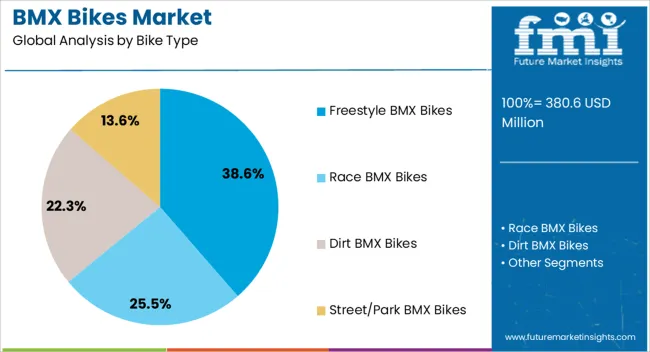
Freestyle BMX bikes are projected to hold 38.6% of the total revenue share in the BMX Bikes market in 2025, making it the leading bike type segment. This segment’s dominance is driven by increasing interest in trick riding, park cycling, and street-style performances among youth. Freestyle BMX bikes are engineered with reinforced frames and pegs to support aggressive stunts, which has made them especially popular among competitive and recreational riders.
Their structural versatility and design customization allow riders to adapt to various terrains and riding styles, adding to their wide appeal. The rise in organized freestyle BMX competitions and the inclusion of freestyle events in global sporting platforms have contributed significantly to the popularity of this bike type.
Additionally, social media platforms have amplified the visibility of freestyle cycling content, further accelerating youth engagement. Continuous improvements in frame geometry, component integration, and aftermarket customization options have strengthened the demand for freestyle BMX models across both amateur and expert user segments.
Insights into the Chromoly Frame Material Segment
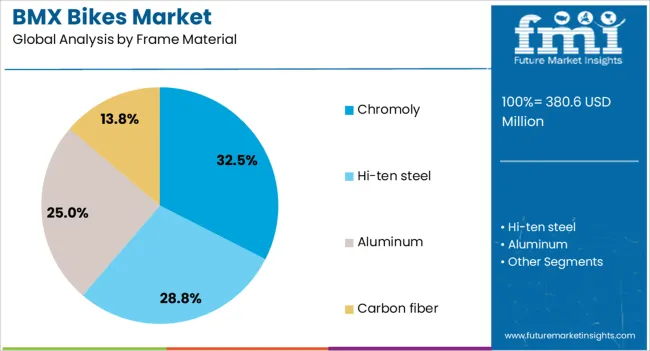

Chromoly frame bikes are expected to account for 32.5% of the revenue share in the BMX Bikes market in 2025. This segment’s growth is influenced by the superior strength-to-weight ratio offered by chromoly alloys, which enhances performance without compromising durability. Riders prefer chromoly frames for their flexibility, fatigue resistance, and ability to withstand high-impact landings typical in BMX stunts and jumps.
The material’s structural advantages support longer lifecycles and better responsiveness, making it a trusted choice for both street and park riders. Manufacturers have increasingly adopted chromoly to meet the expectations of professional BMX athletes seeking high-performance builds.
Additionally, chromoly’s welding compatibility and clean finishing properties allow for precision frame construction, enabling brands to differentiate through design while maintaining structural integrity The segment’s appeal is further enhanced by the balance between cost efficiency and professional-grade reliability, positioning chromoly frames as a leading choice across intermediate and expert rider segments.
Insights into the Specialty BMX Bike Shops Segment
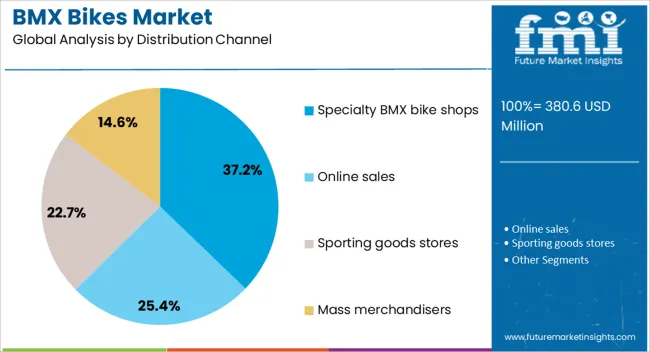

Specialty BMX bike shops are projected to contribute 37.2% of the total revenue share in the BMX Bikes market in 2025, positioning them as the dominant distribution channel. The prominence of this segment is attributed to the highly tailored customer experience and technical expertise offered by dedicated BMX retailers. These shops serve as niche hubs for enthusiasts and competitive riders seeking specialized advice, product customization, and premium components unavailable through mass-market channels.
Specialty retailers often cultivate deep brand relationships and offer curated inventories that reflect the latest trends and technological advancements in BMX riding. Their role in community engagement through sponsorships, events, and rider meetups further enhances customer loyalty and repeat business.
As BMX consumers place a high value on authenticity, product knowledge, and post-purchase support, specialty bike shops have become essential touchpoints in the consumer journey. Their contribution to brand discovery, fitment accuracy, and long-term product service reinforces their leadership in channel-based sales within the BMX Bikes market.
What are the Drivers, Restraints, and Key Trends of the BMX Bikes Market?
The BMX bikes market is driven by the popularity of BMX racing and rising participation in action sports. Emerging opportunities are seen in global expansion, particularly in Asia-Pacific and Latin America. Trends toward customization and lightweight materials are reshaping the market. However, challenges such as price sensitivity and fierce competition persist. By 2025, addressing these challenges while capitalizing on emerging markets and customization trends will be key to driving sustained growth in the BMX bikes market.
Growing Popularity of BMX Racing Drives Market Demand
The BMX bikes market is witnessing significant growth driven by the increasing popularity of BMX racing events and competitive sports. With more youth and amateur athletes participating in BMX racing, the demand for high-performance bikes continues to rise. This trend is especially prevalent in regions like North America and Europe, where BMX events are a mainstream activity. As interest in action sports rises, it is expected that the BMX bikes market will continue to experience steady growth through 2025, with an increasing focus on bike innovation and performance enhancements.
Opportunities in Expanding Global BMX Bike Communities
Expanding global BMX bike communities present significant opportunities for market growth, especially in emerging regions like Asia-Pacific and Latin America. With increasing interest in cycling sports and urban biking, new riders are entering the market, driving demand for entry-level as well as high-end BMX bikes. The rise in BMX-related activities such as freestyle events, dirt jumping, and street racing is also opening up new revenue streams for bike manufacturers. By 2025, these opportunities in emerging regions are expected to significantly boost market expansion.
Emerging Trends in Customization and Lightweight BMX Bikes
Customization and lightweight BMX bikes are emerging as key trends in the market. Consumers, particularly enthusiasts, are increasingly seeking bikes that are tailored to their specific needs, from frame material choices to design preferences. Lighter materials, such as aluminum and carbon fiber, are being incorporated to enhance bike performance, particularly in freestyle and racing events. By 2025, these trends are expected to dominate, as BMX riders prioritize not just the aesthetic appeal but also the technical performance of their bikes.
Challenges from High Competition and Price Sensitivity
The BMX bikes market faces challenges from intense competition and price sensitivity, particularly in the mid-range and entry-level segments. As more brands enter the market with competitive pricing and innovative designs, established brands must differentiate themselves through superior quality and performance. Moreover, with many consumers being price-sensitive, especially in emerging markets, offering affordable yet durable bikes is essential. By 2025, manufacturers will need to navigate these challenges by balancing quality, price, and performance to maintain a competitive edge.
Analysis of BMX Bikes Market By Key Countries
| Countries | CAGR |
|---|---|
| China | 8.1% |
| India | 7.5% |
| Germany | 6.9% |
| France | 6.3% |
| UK | 5.7% |
| USA | 5.1% |
| Brazil | 4.5% |
The global BMX bikes market is projected to grow at a 6% CAGR from 2025 to 2035. China leads with a growth rate of 8.1%, followed by India at 7.5%, and Germany at 6.9%. The United Kingdom records a growth rate of 5.7%, while the United States shows the slowest growth at 5.1%. These varying growth rates are driven by increasing demand for BMX bikes in sports, recreational activities, and urban transportation. Emerging markets like China and India are experiencing higher growth due to rising disposable incomes, increasing participation in extreme sports, and growing interest in cycling as a fitness activity. More mature markets like the USA and the UK see steady growth driven by advancements in BMX bike design, technological innovations, and the popularity of cycling in urban environments. This report includes insights on 40+ countries; the top markets are shown here for reference.
Sales Outlook for BMX Bikes Market in China
The BMX bikes market in China is growing rapidly, with a projected CAGR of 8.1%. China’s expanding middle class, increasing interest in recreational cycling, and growing participation in sports like BMX racing and freestyle cycling are key drivers of market growth. The country’s rising disposable incomes, coupled with government policies promoting sports participation and physical fitness, further contribute to the increasing demand for BMX bikes. Additionally, China’s growing urban infrastructure, including cycling lanes and sports facilities, continues to accelerate the adoption of BMX bikes in cities across the country. The growing popularity of BMX events and sports festivals also supports market expansion.
- Expanding middle class and increasing interest in recreational cycling drive market growth in China.
- Government policies promoting sports participation and physical fitness contribute to the growing demand for BMX bikes.
- Rising urban infrastructure, including cycling lanes and sports facilities, accelerates the adoption of BMX bikes in cities.
Demand Analysis for BMX Bikes Market in India
The BMX bikes market in India is projected to grow at a CAGR of 7.5%. India’s increasing participation in extreme sports, coupled with a growing interest in cycling as a recreational and fitness activity, continues to drive the demand for BMX bikes. The country’s rising disposable incomes, increasing awareness about the health benefits of cycling, and expanding urban infrastructure contribute to market growth. Additionally, the growing popularity of sports events and cycling festivals, combined with a shift towards sustainable transportation, further accelerates the adoption of BMX bikes in India. The rise in demand for affordable, high-quality bikes and increasing investments in sports infrastructure support the market’s expansion.
- Increasing participation in extreme sports and growing interest in cycling as a fitness activity drive market growth in India.
- Rising disposable incomes and growing awareness about the health benefits of cycling contribute to the demand for BMX bikes.
- Expanding urban infrastructure and growing popularity of cycling events and festivals accelerate adoption in India.
Growth Outlook for BMX Bikes Market in Germany
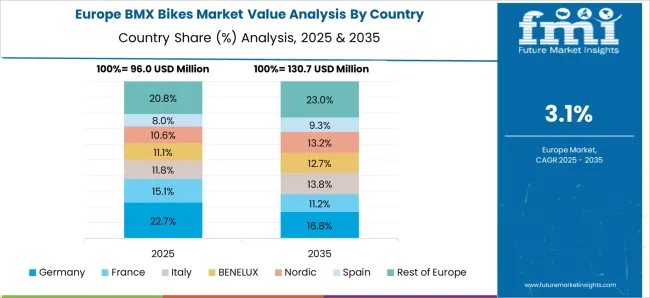
The BMX bikes market in Germany is projected to grow at a CAGR of 6.9%. Germany’s strong cycling culture, combined with rising interest in BMX sports, continues to drive steady demand for BMX bikes. The country’s emphasis on fitness and outdoor recreational activities, coupled with its extensive network of cycling lanes and sports facilities, supports market growth. Additionally, Germany’s growing focus on sustainable transportation solutions and environmentally friendly modes of transport further fuels the adoption of BMX bikes. The increasing popularity of BMX competitions, as well as advancements in bike design and technology, continue to contribute to the market’s expansion.
- Strong cycling culture and growing interest in BMX sports contribute to steady market growth in Germany.
- Focus on fitness and outdoor recreational activities accelerates the demand for BMX bikes in Germany.
- Emphasis on sustainable transportation and growing popularity of BMX competitions contribute to market expansion.
Future Analysis for BMX Bikes Market in the United Kingdom
The BMX bikes market in the United Kingdom is projected to grow at a CAGR of 5.7%. The UK’s growing interest in extreme sports, along with increasing participation in recreational cycling and BMX competitions, continues to support steady market growth. The country’s focus on promoting outdoor activities, physical fitness, and environmental sustainability contributes to the increasing demand for BMX bikes. The rise in urban cycling infrastructure, such as dedicated cycling lanes and BMX parks, accelerates market adoption. Additionally, the growing popularity of BMX racing events and freestyle cycling further boosts the market in the UK
- Increasing participation in extreme sports and recreational cycling drives steady market growth in the UK
- Focus on outdoor activities, fitness, and sustainability contributes to the growing demand for BMX bikes.
- Expansion of urban cycling infrastructure and rising popularity of BMX events and freestyle cycling accelerate market adoption.
Opportunity Analysis for BMX Bikes Market in the United States
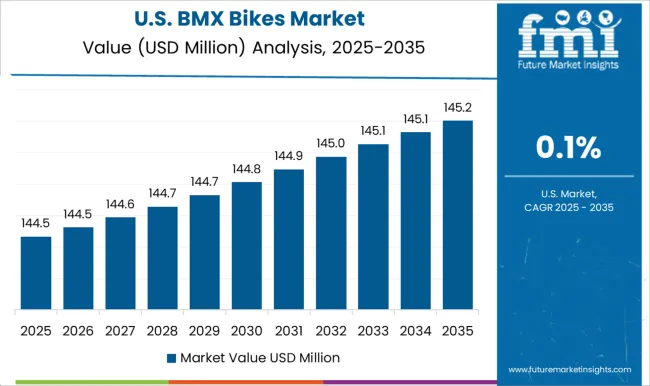

The BMX bikes market in the United States is expected to grow at a CAGR of 5.1%. The USA market is driven by the increasing popularity of BMX racing, freestyle biking, and recreational cycling. The growing focus on fitness, outdoor sports, and sustainable transportation solutions contributes to the demand for BMX bikes. Additionally, the USA market benefits from a strong culture of cycling, increasing investments in cycling infrastructure, and the rising popularity of extreme sports events. The adoption of BMX bikes is further supported by advancements in bike design, technology, and innovations that make them more accessible and performance-driven for riders.
- Popularity of BMX racing and freestyle biking ensures steady market growth in the USA
- Focus on fitness, outdoor sports, and sustainable transportation solutions drives the adoption of BMX bikes.
- Strong cycling culture, growing investments in cycling infrastructure, and advancements in bike design contribute to market expansion in the USA
Competitive Landscape of BMX Bikes Market
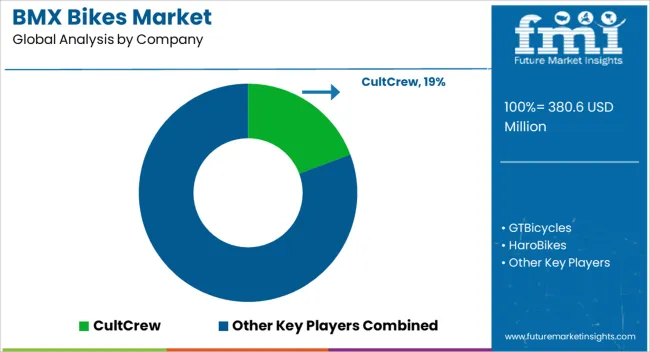
The BMX bikes market is dominated by GT Bicycles, which leads with its high-performance BMX bike models designed for both casual riders and professional athletes. GT’s dominance is supported by its strong brand reputation, innovative designs, and commitment to providing durable and stylish BMX bikes that cater to various disciplines, including freestyle and racing. Key players such as Haro Bikes, Mongoose, and Redline Bicycles maintain significant market shares by offering a wide range of BMX bikes known for their performance, durability, and customization options. These companies focus on improving bike geometry, enhancing strength, and providing riders with a variety of options to suit different riding styles.
Emerging players like Sunday, Fit Bike Co., and Cult Crew are expanding their market presence by offering specialized BMX bikes tailored for niche applications, such as street riding, park, and dirt jumping. Their strategies include focusing on product innovation, collaborating with professional riders, and offering limited-edition models to attract younger consumers. Market growth is driven by increasing participation in BMX sports, the rising popularity of freestyle cycling, and the growing demand for high-quality, customizable bikes. Innovations in frame materials, enhanced suspension systems, and lightweight designs are expected to continue shaping competitive dynamics and fuel further growth in the global BMX bikes market.
Scope of the Report
| Item | Value |
|---|---|
| Quantitative Units | USD 380.6 Million |
| Bike Type | Freestyle BMX Bikes, Race BMX Bikes, Dirt BMX Bikes, and Street/Park BMX Bikes |
| Frame Material | Chromoly, Hi-ten steel, Aluminum, and Carbon fiber |
| Distribution Channel | Specialty BMX bike shops, Online sales, Sporting goods stores, and Mass merchandisers |
| Application | Freestyle/Stunt, Racing/Competition, and Recreation/Casual riding |
| Regions Covered | North America, Europe, Asia-Pacific, Latin America, Middle East & Africa |
| Country Covered | United States, Canada, Germany, France, United Kingdom, China, Japan, India, Brazil, South Africa |
| Key Companies Profiled | CultCrew, GTBicycles, HaroBikes, Mongoose, Sunday, RedlineBicycles, and FitBikeCo. |
| Additional Attributes | Dollar sales by bike type and application, demand dynamics across recreational, competitive, and professional sectors, regional trends in BMX bike adoption, innovation in lightweight and high-performance materials, impact of regulatory standards on safety and durability, and emerging use cases in electric BMX bikes and smart biking technologies. |