
Despite new NCAA track and field roster limits that cap teams at 45 athletes per gender, UNC Charlotte will continue to field upwards of 100 track athletes—for now.
The new roster limits stem from the landmark House vs. NCAA settlement, which ruled that universities must pay any Division I athletes who have played since 2016, introduced revenue sharing among athletes and universities and added roster limits.
The settlement included a clause allowing athletes to be designated as Designated Student Athletes (DSAs). This status exempts athletes who were on rosters in the 2024-2025 season and recruits who were promised a spot on rosters in the 2025-2026 season from counting against a school’s new roster limit for their sport and from potentially losing their roster spot.
Without the DSA status, Charlotte would have needed to cut roughly 15 athletes from both the men’s and women’s track teams, as they’ll field 119 in the upcoming season.
As DSA athletes graduate, Charlotte’s roster will gradually shrink to 90. Still, for the upcoming season, it’s a fortunate break for a track and field program accustomed to success with larger rosters.
Winning with depth
Charlotte’s 2025 outdoor track and field season marked the eighth straight season in which one of either the men’s or women’s teams won a conference championship. Since 2015, the program has taken home 16 conference championships across both men’s and women’s teams and indoor and outdoor programs. In that span, the program has fielded an average of 120 athletes per year.
The women’s team has not ended an academic year without an indoor or outdoor conference championship since 2021. This season, they will field 60 athletes; last season, they fielded 55.
Depth on both teams has allowed Charlotte to build competitive groups in each event that score at conference championships. At the 2025 outdoor conference championships, Charlotte’s women’s team scored in 11 events, including the heptathlon, shot put and 5,000-meter race.
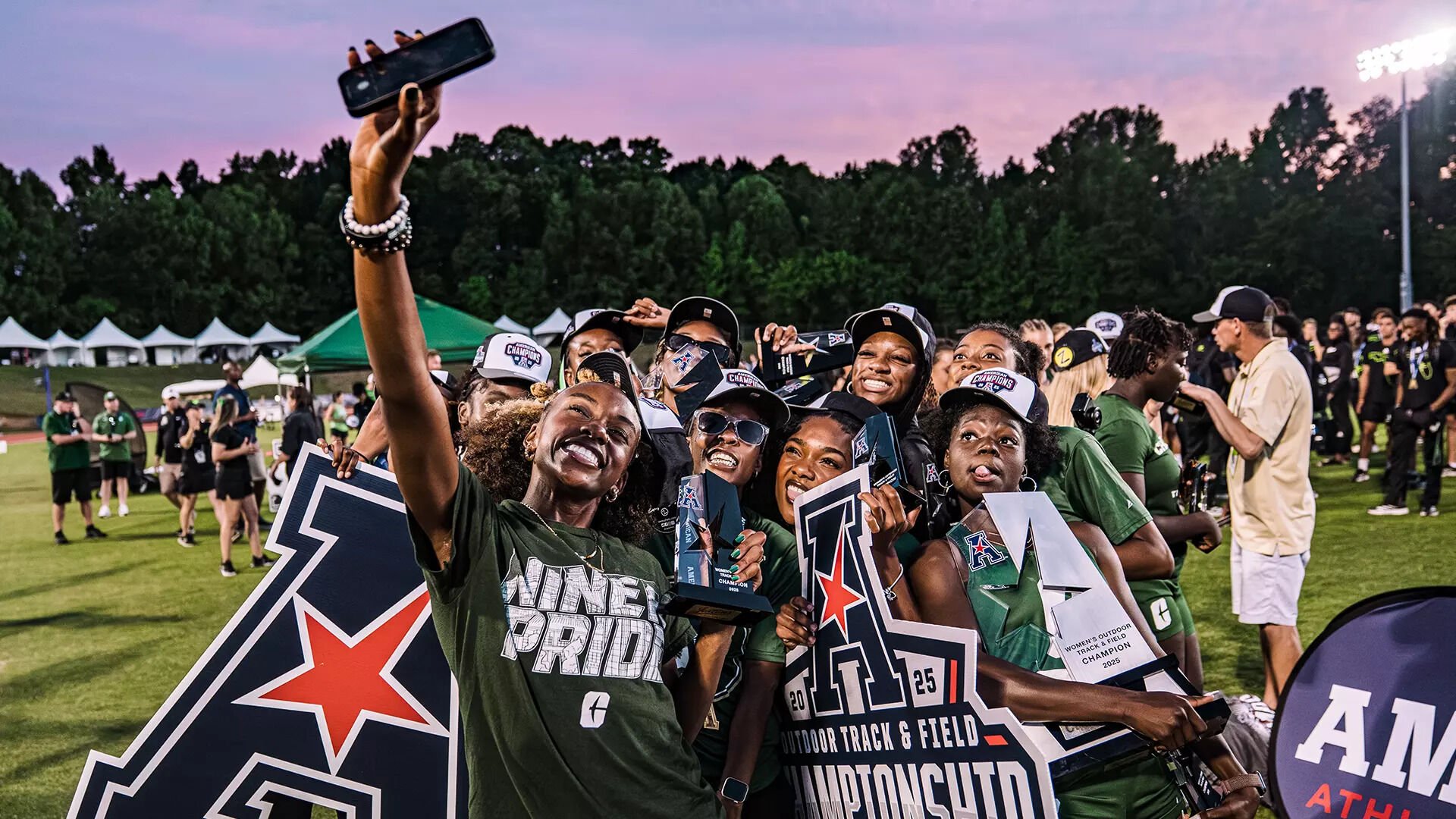
Charlotte’s women’s track team following their 2025 outdoor track and field conference championship meet victory.
Change in roster construction
For Bob Olesen, Charlotte’s head track and field coach, slimming down the roster would mean a change in roster-building philosophy away from his current balanced approach.
“In our conference, if South Florida is focusing on sprints and hurdles, and Tulsa and Tulane are focusing on distance, we might be really well balanced, but not good enough to score enough points to win a championship,” Olesen said.
As for what that exact philosophy change may be, Olesen says the coaching staff will, “cross that bridge when we come to it.” If Olesen’s track record as head coach is any indication of how the philosophy might shape the team, Charlotte should be just fine.
Since his hiring in 1988, Olesen has guided his 49ers to over 40 conference championships and has adapted to change, already after switching conferences in 2013 and then again in 2023.
In the American Conference, where all of Charlotte’s 19 Division I teams compete, the median track and field roster size among programs that field both men’s and women’s teams is 88. In the 2025-2026 season, Charlotte has the fourth-largest team.
The conference’s larger rosters are an outlier in the college landscape. Last year’s women’s track and field national champions, the University of Georgia, had just 36 athletes on their roster.
Recruiting adjustments
In catching up with the Georgias of the world and getting ahead of the roster limits, Olesen said his staff has already changed how they recruit and adjusted last offseason before the lawsuit had even settled.
“We definitely had to kind of hedge our best with recruiting a little bit,” Olesen said. “We wanted to identify some really and focus really on the high-value prospects that even if we were in a restricted situation, we would still want in our program.”
“It definitely cooled some of our conversations with some athletes that might be considered a little bit more developmental.”
Losing the ability to add athletes who are more developmental may come at a cost to Charlotte’s program. Having mixed recruiting classes in the past has allowed Charlotte to grab athletes like senior sprinter Joyasia Smith, who competed in a smaller high school division and did not have top times, but has competed in Olympic trials as a 49er.
Although the limits cause for a change he’d rather not make, Olesen is at peace with his soon-to-be shrinking roster.
“It’s above my pay grade. I mean, it is what it is,” Olesen said. “I understand the dynamic of it, and it’s just one more hurdle to clear.”
The season ahead
With his focus on what’s immediate, Olesen says Charlotte’s women’s team will again be one to watch. They’ll compete for what he calls the “triple crown”: a chance to win cross-country, indoor and outdoor track and field championships. Charlotte’s men’s team earned a triple crown of its own in 2022 when its roster was 67 deep.
As the weather gets colder, indoor track season is just a month away, with Charlotte’s first meet taking place on Dec. 5 at the Liberty Kickoff.