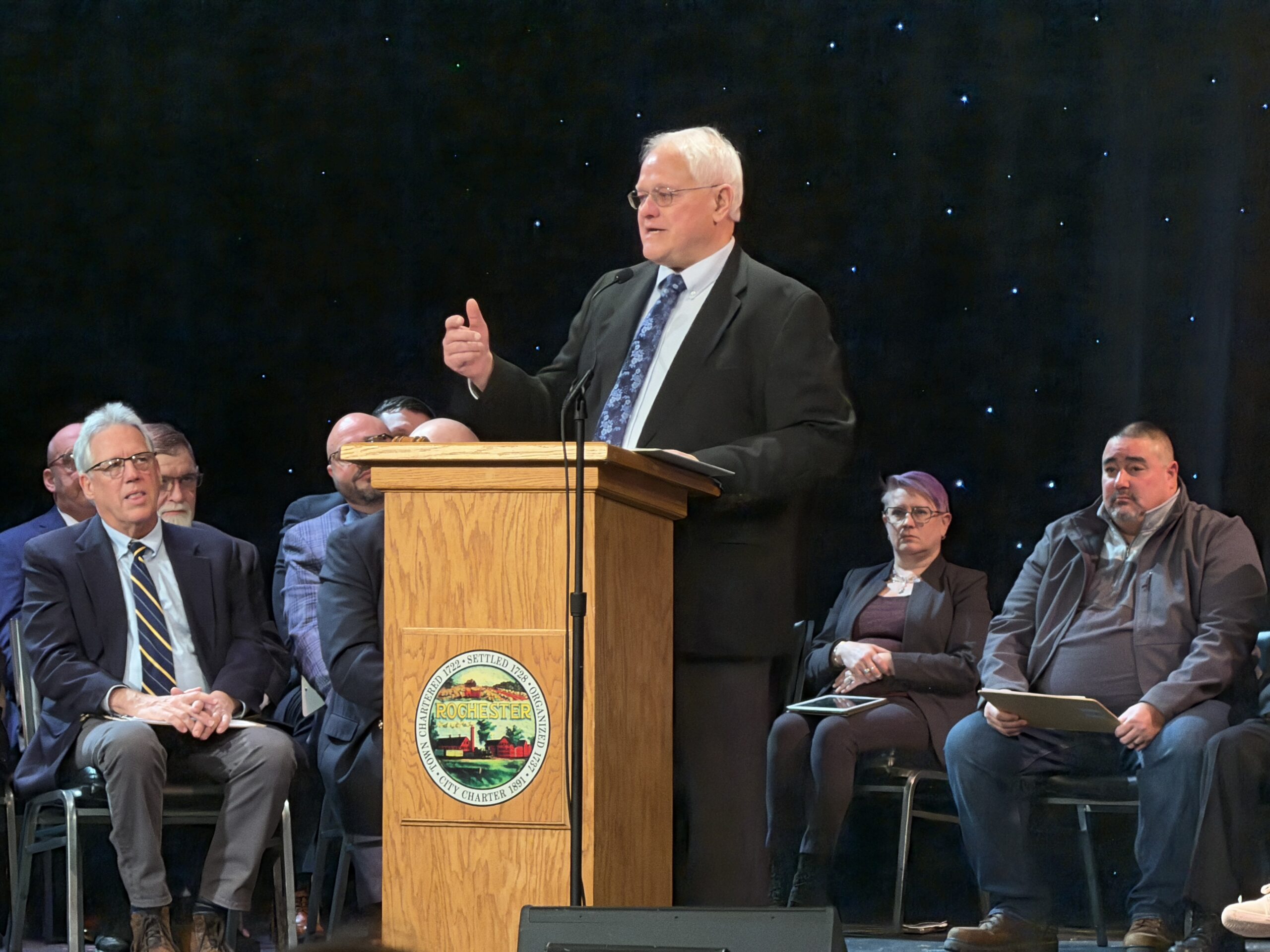
On Tuesday, January 6, 2026, the City of Rochester celebrated the inauguration of the Mayor, City Council, School Board, Police Commission, and Election Officials. Following the swearing-in of elected officials, Councilor David E. Walker (Ward 4/Seat A) was unanimously chosen to serve as Deputy Mayor.
Click here to watch online.
Mayor Chuck Grassie delivered the following address:
Thank you all for coming.
I want to thank Mayor Callaghan for his service to our city. I also want to thank everyone who has stood up to serve our community—our election workers, school board members, and city council members.
As we reflect on the history of our city, it becomes clear that we have experienced numerous changes over the years. Many of these changes have been met with applause and approval, while others have faced criticism and debate. The impact of these transformations has shaped our community in profound ways—some for the better, others perhaps less so, depending on one’s perspective. Regardless of whether these changes were welcomed or opposed, we now find ourselves on the threshold of an uncertain future, moving forward together as a community.
Recent assessments have resulted in significant tax increases for many working families and seniors. Given ongoing funding uncertainties at the federal level and reductions at the state level, developing sustainable school and municipal budgets will be increasingly challenging. Your mayor and city council recognize the difficulties facing our community and are committed to addressing the city’s needs with fiscal responsibility. We will pursue public-private partnerships where appropriate and explore innovative and cost-effective solutions to meet these challenges.
We also need to make sure our state representative delegation understands that actions taken at the state level can have dramatic effects on our local property taxes. I will be asking the city council to speak out when state actions cause increased costs for our property taxpayers.
Governance and Civic Responsibility
During the last election, some tried to bring political parties into our city’s government. By choosing the Council-Manager system without political affiliation, we moved away from party rule and toward elected councilors and school board members who serve Rochester’s voters—not political interests.
Personal opinions outside City Hall are your responsibility, but remember: partisanship has no place in City Hall. We represent the citizens of Rochester, not outside political powers.
As a city councilor, your responsibility is to actively listen to those you represent. Make time for regular ward meetings where you can hear their concerns and viewpoints. If you need assistance organizing a meeting, reach out and we will support you. I encourage you to ask questions and thoughtfully examine any issues that arise. You serve as the voice of your constituents, representing everyone in your wards. Bring forward their ideas—no suggestion is too unusual if it could help make Rochester better for all. As mayor, I promise that I will never silence your perspective.
As a citizen, it is your responsibility to reach out to your elected representatives and let them know how you feel about issues. Don’t be afraid. These councilors and school board members are your neighbors—you elected them to be your voice. We cannot represent you if we never hear from you.
Looking Ahead
Now let’s look forward. (The next two years are going to be tough.)
When I speak to many new citizens who move here, one of the first things they talk about is the number of people who volunteer. Whether it be youth sports, city beautification, faith-based activities, community festivals, or arts and culture, many work to make Rochester a special place to raise a family or retire.
But now we need to get even more involved.
If you have children in school, join your PTA or PTO and help make your school the best it can be. Volunteer in a classroom. Read to kids in a classroom. If you’re a businessperson—either large or small—join the Chamber of Commerce. If you’re a downtown business, join Main Street. If you attend church or are active with any other faith-based group, find out what programs they may have to help those less fortunate.
If you have kids, volunteer to coach or help with a youth sports or scouting program. Find a local cleanup or gardening group. Find a soup kitchen and lend your cooking skills to help feed those in need. Join the Rotary, Elks, Lions, Moose, or other groups that help our community in different ways. Volunteer at the Opera House or the Historical Society and help promote the arts, culture, and history of our city.
Encourage your children to get involved with extracurricular sports, music, theater, or community activities in the schools, because teaching them to get involved will ensure our future. Every hour you volunteer strengthens our community.
Issues Facing Rochester
1. Homelessness
One of the major issues I heard most from voters was homelessness. On any given night, Rochester has conservatively over 150 individuals sleeping outside under the sky—most not by choice, but by circumstance. A recent comment from our superintendent of schools stated that there were almost 100 students who were housing insecure.
Last year, 2025, our welfare department placed 68 households in motels as emergency housing. Most of those were families with children and some people with medical conditions that would not be appropriate for traditional shelters. This year, 2026, we have assisted 23 households with emergency housing in motels. The problem is getting worse, not better, and we need to find ways to solve it by working with the state and county.
People living in the woods, in tents, in cars, under tarps, in boxes—this is not a solution; it’s the problem. No one deserves to live in conditions less than an animal. Whether the cause is drugs, mental health challenges, poverty, physical disability, or job loss, we can and should do better.
I will be asking the school board to work with us to form a special committee to address youth homelessness. This committee will include community homelessness and housing advocates, members of the faith-based community, and city, county, and state elected officials.
Homelessness is not a problem Rochester can solve on its own. I have been—and will continue to—work with the mayors of Dover and Somersworth, as well as Strafford County and state officials, to find solutions to homelessness, drug and mental health treatment, and transitional and affordable housing.
2. Affordability of Housing
High housing costs in New Hampshire have forced many children and grandchildren to leave Rochester for affordable options elsewhere. It is troubling that new families moving here for jobs struggle to find affordable homes, and this situation must improve.
We need to review our zoning and building codes to see where we might reduce the cost of housing. Smaller “starter” homes used to be the norm but are now unpopular due to lower profit margins. There is a company right here in Rochester that I have been speaking with that uses innovative building techniques to 3D-print homes.
Small-footprint “cottage” homes need to be considered. Tiny home developments, such as one in Dover, need to be replicated here in Rochester. Concepts such as pattern zoning, accessory dwelling units, and workforce housing within commercial and industrial developments need to be expanded. What’s old may be new again, as companies are successfully developing workforce housing within their projects.
3. Education
I will be working closely with the chair of the school board to understand how we can help improve our schools. Most parents love their children’s teachers and their schools, and we need to support the efforts that have been successful in helping our children succeed.
With cutbacks at the state and federal levels, our schools struggle to make improvements. Our teachers work hard every day to help our children succeed but are constantly seeing reductions in special education supports and a lack of tools to do their jobs. Adolescent mental healthcare needs to be addressed, and I have reached out to mental healthcare professionals to see where we can help.
I will be asking both boards to hold regular meetings between our finance committees so issues, opportunities, and challenges are not surprises to either body. I will also be asking to meet monthly with the school board chair to keep us both informed on the common issues we face. The success of our schools will determine the success of our city.
4. Arts, Culture, History, and Community
The vibrancy of a community—and its ability to attract young families and new businesses—is rooted in its ability to provide arts and culture to its citizens. We have had many successful festivals in Rochester, but we can and should do more.
I will be reaching out to all community groups to find new and more innovative ideas to bring excitement to Rochester. Working with the Rochester Fair Association, Main Street, the Rochester Chamber, the Rochester Opera House, and other arts and cultural organizations, we will bring more energy to our city.
But most importantly, we should never forget the history that makes Rochester, Rochester. The stories that built our community need to be preserved and repeated. Our schoolchildren need to hear how Rochester became what it is today.
My father’s family came to the United States in the mid-1800s from Italy and settled here in Rochester. We were the first Italian family to settle here. Many more families followed from other countries to work in the woolen mills, shoe factories, and box shops.
I’ve heard it said that Portsmouth always wanted to be Boston, Dover always wanted to be Portsmouth, but Rochester just wanted to be Rochester—a working-class community where everyone could claim a piece of the American Dream, raise their children, work a good job, and retire with dignity.
Closing
I’ve only addressed four issues I’d like the city to focus on over the next two years. There are many more. It will not be easy, but I can tell you this: I will not be discouraged, nor will I accept the name “Rottenchester” any longer.
We will work with any group that has an idea or a desire to make our community better. I ask you—the people who make Rochester what it is—to help your city council and school board face the future.
One thing I can promise: no matter how hard it gets, we will have fun walking into the fight.
BEDFORD TOWNSHIP, Mich. — In an update related to the dozens of animals found at a Bedford Township property Wednesday, the Battle Creek Police Department (BCPD) announced Friday that some dead animals were also found on the property.
Several dogs and one cat were found dead in addition to the 29 dogs, 15 cats, and two horses that had been removed from the Woodside Drive property that day, according to BCPD.
Police said the residence was operating as animal rescue but received a tip that raised concerns about animal care.
The dogs and cats are now in the care of the Calhoun County Animal Shelter and partner facilities, where staff are continuing medical and behavioral evaluations.
Shelter Executive Director Jackie Martens told News Channel 3 on Thursday many of the dogs are showing positive signs, but not all animals were up to date on rabies vaccinations.
Records for the cats have not yet been provided, meaning the shelter may need to re-vaccinate and spay or neuter them as a precaution.
Veterinarians are continuing medical evaluations. The horses were taken to a secure location that officials are not disclosing due to the ongoing investigation.
BE THE FIRST TO COMMENT
The owner was not home when authorities searched the property and no arrests have been made, according to BCPD. As detectives continue to investigate, the department said they will likely submit the case to the Calhoun County Prosecutor’s Office for review of potential criminal charges.
As the U.S. Supreme Court prepares to hear two high-profile cases involving transgender student athletes, LGBTQ+ advocates are urging the justices to consider not only constitutional questions, but the real-world consequences facing trans youth across the country.
On Jan. 13, the court will hear oral arguments in West Virginia v. B.P.J. and Little v. Hecox, cases that challenge state laws barring transgender girls from participating on school sports teams that align with their gender identity. While the cases focus on athletics, advocates say the broader implications reach far beyond the playing field.
What’s at Stake for Trans Youth
The challenged laws in West Virginia and Idaho are part of a growing wave of state-level restrictions that target transgender participation in school sports. Supporters of the bans often frame them as necessary for fairness or safety. Critics argue they rely on assumptions rather than evidence and impose blanket exclusions that fail to account for differences in age, sport, or level of competition.
The Trevor Project, the nation’s leading suicide prevention organization for LGBTQ+ young people, has taken a firm stance against the bans. In a statement released ahead of the hearings, CEO Jaymes Black urged the Supreme Court to reject what he described as discriminatory policies.
“Like all young people in this country, transgender youth deserve the opportunity to play sports at school, if they want to,” Black said, emphasizing that exclusion sends a damaging message about belonging.
Mental Health Impacts Backed by Data
The Trevor Project points to a growing body of research linking anti-transgender legislation to negative mental health outcomes. According to the organization, transgender and nonbinary youth living in states where restrictive laws were enacted reported up to a 72% increase in suicide attempts compared to peers in states without such policies.
Their 2024 U.S. National Survey on the Mental Health of LGBTQ+ Young People found that 46% of transgender and nonbinary respondents seriously considered suicide in the past year. Political debates and legislation were cited as a major source of distress, with 90% of LGBTQ+ youth saying recent politics harmed their well-being.
Sports participation, meanwhile, appears to have protective effects. LGBTQ+ youth who reported playing sports showed nearly 20% lower rates of depressive symptoms than those who did not. Still, fewer than one in three LGBTQ+ young people participate in athletics, often citing discrimination or fear of mistreatment as barriers.
Beyond Fairness Arguments
Black also criticized the laws for applying broad restrictions without nuance. “These one-size-fits-all bans treat every sport, age group, and level of competition the same,” he said, adding that they are rooted in misinformation rather than evidence.
While acknowledging the need for thoughtful discussion around safety and competition, Black drew a clear line between regulation and exclusion. “Banning an entire group of young people from any participation whatsoever is discrimination, plain and simple,” he said.
Polling from The Trevor Project suggests the emotional toll is immediate. Among transgender and nonbinary youth surveyed, debates around sports bans triggered feelings of anger, sadness, stress, and fear, underscoring how public discourse alone can impact mental health.
Looking Ahead
The Supreme Court’s decisions in these cases could shape how states approach transgender inclusion in schools for years to come. Regardless of the outcome, The Trevor Project says its mission remains unchanged.
“No matter what they decide,” Black said, “we will continue fighting for a world where transgender and nonbinary youth feel safe, seen, and accepted exactly as they are.”
The city of Tracy will take suggestions for naming the Tracy Sports Complex on 11th Street, for one more week, with Thursday, Jan. 15, the deadline for submitting names.
The Tracy City Council, at its Dec. 2 meeting, updated its naming policy for city facilities, giving the council the ability to name certain parts of a public building or parks and recreation facility for a city dignitary or member of the community.
The result was the naming of the baseball fields at Legacy Fields for former Mayor and current San Joaquin County Supervisor Robert Rickman, the soccer fields at Legacy Fields for late Tracy Youth Soccer League leader Shirley Thompson, and the lobby at Tracy City Hall for the most recent former Mayor Nancy Young.
During the discussion the council also considered naming the softball fields at Tracy Sports Complex for former Mayor Brent Ives, Tracy’s mayor from 2006 to 2014, and a city council member when the sports complex was planned, developed and then dedicated in 2002.
Instead, the council agreed that it wanted to name the full complex for Ives, but under the policy for naming public buildings and parks and recreation facilities, reviewed and updated that night, choosing to rename the Tracy Sports Complex requires the city to go through the full naming process.
The city opened the process on Dec. 15, allowing people to make nominations, and following the Thursday deadline for nominations, the naming recommendations will go to the Parks and Community Services Commission. The commission meets on the first Thursday of every month, with the next meeting scheduled for Feb. 5. The commission then picks three names, listed in order of preference, and forwards its recommendation to the City Council.
Applications for naming of public buildings and parks and recreation facilities are at www.cityoftracy.org/our-city/departments/parks-recreation-department/park-naming-nomination. They can be mailed or brought in person to Tracy City Hall, 333 Civic Center Drive, Tracy, CA 95376, or emailed to parks@cityoftracy.org, with the subject line “Naming Public Buildings, Parks & Facilities.”
• Contact the Tracy Press at tpnews@tracypress.com or (209) 835-3030.
Want to learn about the variety of exciting sports available to Cambridge girls in Kindergarten – 5th grade? Join us at Cambridge Girls in Sports Night on Tuesday, January 20 at the War Memorial Field House (1640 Cambridge St., Door 15) from 5 –7 p.m.!
Research shows that girls who play sports are more likely to get better grades; have higher levels of confidence and self-esteem; develop critical skills necessary for success in the workplace; and build a larger community of friends.
At Cambridge Girls in Sports Night, attendees can:
Explore new sports and discover local Cambridge teams
Meet representatives from hockey, ultimate frisbee, lacrosse, soccer, flag football, cheerleading, softball, and more!
Participate in hands-on demonstrations
Sign up on the spot for athletic leagues
Enjoy games, pizza, and more!
The event, presented by the Cambridge Women’s Commission and Cambridge Recreation, is open to anyone in grades K – 5 who identifies as a girl or with girlhood.
Registration is required to attend. Register Here!
After the event, stay to cheer on the CRLS Girls Varsity Basketball Team at 7 p.m.! (Attending the game is free!)
Questions? Contact Adam Corbeil, Director of Cambridge Recreation, at acorbeil@cambridgema.gov.
In the summer of 2024, you couldn’t pin Khloe Ison down. But her parents, Akilah Crowner and Keemie Ison, did the best they could to keep up.
While Baltimore basketball prodigy Ison was traveling with Team Durant — NBA star Kevin Durant’s Nike-sponsored Elite Youth Basketball League team — her parents were paying and coordinating their own way to get to her games and tournaments.
First were the round-trip rental car trips to Albany, New York, for a warmup tournament and Hampton, Virginia, for the first EYBL event, arriving on Thursdays and back home on Sundays. Then it was a round-trip flight to Iowa for the next EYBL long weekend, followed by a quick run down the road for another three-day tournament in Philly.
Next up was Winston-Salem, North Carolina, for a Team USA event. The third stop on the Nike tour was Lexington, Kentucky. With the EYBL finals in Chicago that very next week, they chose to stay in Lexington a few extra days before flying to the Windy City on a Thursday and heading back to Baltimore on Sunday at the end of July.
The next weekend was the Blue Star Camp in Indianapolis, an invite-only affair for the country’s best seventh and eighth graders.
It was an exhausting — and expensive — schedule.
The average American household, according to a recent Aspen Institute study, spends $1,016 per year on their child’s primary sport. But that number pales in comparison to what’s spent on the most elite kids who have realistic dreams of college and pro stardom.
Over the past two years alone, Ison’s parents conservatively estimate they’ve spent over $20,000 on their daughter’s basketball pursuits, factoring in line items such as gas and car repairs from running up and down the road for practices and games, healthier grocery shopping lists, rental car fees, airline tickets, individual training sessions, massages, cryotherapy, and dining out on the road, among other expenses.
Because of her stature as a top national prospect, all of Ison’s airfare, lodging, equipment, shoes, apparel, meal stipends, and tournament entry fees are bankrolled by Team Durant’s Nike sponsorship.
But even with Nike’s largesse, which also covers Crowner and Keemie’s hotel fees when the team plays out of town, they’re on their own for airfare, ground transportation, meals, and other ancillary expenses to occupy their other kids while on the road.
Those numbers add up quickly.
Factoring in everything over the last six years starting from that very first travel tournament, way before that Nike EYBL money kicked in, they’re looking at a tab that easily runs into six figures.
“Vacations?” said Crowner, a technology systems engineer. “We’ll do something while we’re on the road to make it feel like a vacation.”
And for the tens of thousands of other kids that are not in that elite Nike EYBL stratosphere, playing on a plethora of less heralded youth teams and circuits all over the country hoping against the greatest of odds to be noticed by a college coach, all of those fees come out of their parents’ own pockets.
“We’ve sacrificed and put everything to the side,” said Keemie, who teaches physical education at Collington Square Elementary. “Her mom goes to all of the tournaments. And if she can’t go, I go.”
But it’s worth it. For Ison, the St. Frances Academy freshman phenom, it’s the path to greatness. In the prep basketball world, the preternaturally gifted point guard is among the country’s top ranked players in the Class of 2029.
Khloe Ison in the St. Francis basketball court. Credit: Faith Spicer
When she was finally back home after the summer season, it was time to rest. But Ison was still working out with trainers and refining her skills. About to enter eighth grade, she was already facing a dizzying array of high school tours and recruitment visits throughout Maryland, DC, and Northern Virginia.
And the recruiting wasn’t simply limited to the prep level. That summer, a full year before graduating from middle school, she received full scholarship offers from the University of Wisconsin, University of Maryland, and George Mason. Georgetown, Providence, and other colleges have since been added to that list, which will likely grow exponentially over the next few years.
As her family weighed their options on where she’d attend high school, their trip to IMG Academy, the private Florida boarding school where Maria Sharapova, Carlos Alcaraz, and Serena and Venus Williams honed their adolescent tennis skills, was especially memorable.
The scenery was tempting, with a lushly manicured 600-acre campus, practice facilities that put some NBA franchises to shame, and a promise that Ison would start on the varsity squad as an eighth grader. But her parents couldn’t quite fathom heading back to Maryland without their 13-year-old daughter.
“The visit was amazing, but she was just too young for us to consider leaving her there to attend IMG in the eighth grade,” said Crowner. “Then the tropical storm hit. Every flight out from Sunday to Tuesday was cancelled. We had to pay to stay three extra days. I couldn’t take another night sitting in that hotel room, we had to get out of there.”
So Crowner and Keemie rented a car, during Hurricane Debby, and drove 14 hours back to Maryland.
They eventually settled on attending St. Frances, the country’s oldest continually operating predominantly African-American Catholic high school, which has produced two of the greatest players ever from Baltimore: Angel McCoughtry and Angel Reese.
The transition has been seamless.
“Khloe’s personality reminds me of Angel Reese, who I coached here for four years. She will challenge anyone, including the coaches, going over every play and wanting to know what she can do better. She’s a natural born leader,” said St. Frances Associate head coach and Dean of Student Engagement Nyteria Burrell.
“It’s great to have a boisterous point guard that will not back down to anyone, no matter how young she is. We’re not asking her to come in and find her way, we’re asking her to take over, ”
And Ison has proven up to the task thus far.
“She’s calling me at 6:00 a.m. to open the gym for her, and she’s bringing her teammates with her,” Burrell continued. “She’s the best player on our team right now, her talent is unmatched. Last year, the bus rides were quiet. Now they’re laughing, singing, dancing and being playful. Sometimes I have to say, ‘Chill out! Be quiet!’”
That exuberance and joy was evident from the earliest days of Ison’s sports journey, which started with dance and gymnastics at age four. And from the outset, she was conspicuously different.
“She would watch the older kids for a few minutes, then replicate everything they were doing without any practice,” said Crowner. “We’d be watching her like, ‘Wait, did you just see that?’”
Her hoops journey began similarly. Without any prior training other than shooting around for fun, she tore up a local co-ed basketball league as if she’d been playing for years.
Two-year-old Khloe working on her handle. Credit: Keemie Ison
“She was six years old, playing with boys and scoring whenever she wanted to,” said Keemie.
“Her instincts were different from the other kids,” said Crowner. “It was weird. She already had this advanced basketball IQ. I’d be asking myself, ‘How did she know how to do that?’ Her father and I agreed that we needed to figure out what to do with her.”
As a fourth grader playing against top-rated sixth-grade boys, she stood out. The summer prior to starting fifth grade, at the Battle of the Bull youth tournament in Indian Trail, North Carolina, she and Keemie bopped into the expansive Carolina Courts complex when an unfamiliar man walked past them, stopped dead in his tracks, and yelled, “Khloe!”
Keemie was taken aback. He eyed the stranger skeptically and asked, “How do you know my daughter?”
“I was coaching a boys team in Maryland two years ago and she absolutely killed us,” Caesar Harris, the founder of Triple Threat, a boys team in Howard County, explained. “I’ve been looking for her ever since!”
Harris told Keemie about a new girls squad he was putting together called Lady Threat.
“I’d never seen a kid that young, male or female, who played with that level of skills, intensity, and energy from start to finish,” Harris said, recalling his first glimpse of Ison as a third grader. “I couldn’t stop thinking about her. She was living in my brain.”
The inner hunger is natural, latent in Ison’s DNA. It’s an heirloom of sorts, passed down from the difficult circumstances her parents endured.
Keemie was raised in West Baltimore’s Garrison Boulevard corridor, nurtured by a grandmother who held it down while his father was incarcerated and his mother struggled to maintain her footing. He showed promise as a raw, athletic player at Douglass High School. But he was more interested in the drug game at the time.
From 2000-2001, he resided in the city jail, which ironically sits ominously across the street from where Ison now attends school at St. Frances. Locked in his cell 22 hours a day, he had the dual gifts of desperation and time.
Upon his release, he worked days sweeping streets for the Downtown Partnership. But on nights and weekends, he was putting in real work against some of the city’s top ballers at the rugged, legendary playground on Dukeland Street known as The Cage. He was offered an invitation to play junior college ball in Kansas solely based on his playground exploits and eventually earned a Division I scholarship to Robert Morris University.
“Getting that scholarship, I had tears in my eyes,” said Keemie. “I was in a place where I didn’t have to watch my back in college. As I was getting a new chance at life, my boys back home were getting murdered. I had to run back and forth for at least five funerals.”
After one year at Robert Morris, he transferred to play his final college season at Hawaii Pacific University in idyllic Honolulu. Prior to leaving for Hawaii, the debonair college man was at a lounge on Guilford Street when he met a beauty who’d recently graduated from Morgan State. Her friends called her Kiki.
Akilah Crowner also grew up on the west side, with her own hardscrabble story. Her family dynamics fractured when she was nine and placed in foster care. Yet she thrived in school, dedicating her time equally between academics, the xylophone and flute, winning oratorical contests, and excelling in sports.
“I lived in 14 foster homes, seven group homes, and one homeless shelter before I eventually found a foster family in high school that I consider a real mother and father who put their whole soul into me,” said Crowner.
A volleyball, basketball, and track star at Milford Mill High School, Crowner played hoops as a freshman at Essex Community College before transferring to Morgan. The demands of being a teenage mom along with majoring in engineering dashed her college sports dream. She worked full-time as a database engineer to pay for school while also juggling a full undergraduate course load.
Starting her career in the Information Technology field while Keemie went back to school, the two stayed in touch and connected again a few years later. Ison was born in 2011.
Ison’s parents drive her ambition — when she was a sixth grader playing against high school freshmen, Ison and her father would often be seen doing sunrise conditioning at Lake Montebello, running hills and doing ab work, lunges, push-ups, plyometrics, and calisthenics.
Khloe Ison sitting down on bleachers in the St. Francis basketball court. Credit: Faith Spicer
“Even as the competition got better, she was always one of the best players out there,” said Keemie. “You could see she was special.”
Despite her accolades and burgeoning national profile, Ison is still a young girl, adjusting to the realities of life on the road and away from her family.
When her mom informed her that she wouldn’t be in attendance to watch her national high school debut in Las Vegas in early October, Ison stood momentarily frozen.
“I told her I was going to her brother’s final homecoming football game at Merrimack College in Massachusetts,” Crowner said. “Khloe didn’t know how to respond.”
The initial shock turned to disbelief. Then denial.
“Wait, what? Nobody’s coming?” Ison asked through soft sobs.
“I just assumed my mom was going,” Ison later said. “I was upset. Then I thought about my brother, and realized my mom couldn’t be in two places at once. But for the longest time, I guess I thought she could.”
When Akilah called Keemie, they shared a laugh about their daughter’s mini-meltdown.
“The funny thing is, when we go to her tournaments, she pays us absolutely no mind, like we’re not even there,” said Keemie.
St. Frances went undefeated in Las Vegas at the Border League in early October. Ison played well despite struggling with a cold, locking down on defense, distributing the ball, and attacking the hoop when a crucial bucket was needed.
She got over the initial shock of not having her parents physically present, FaceTiming them throughout.
“Sometimes you have to remind yourself that she’s still a young kid who’s gonna do freshman stuff,” said Burrell. “She was missing her parents, being a little clingy, falling asleep in my room before waking up and going back to her own room.”
“She obviously still has a lot to work on but if she continues on this path, she’ll eventually be the #1 player in the country before her high school career is over.”
Ison’s thinking extends slightly further ahead.
“When I’m finished here, I want to be in the St. Frances Hall of Fame, make an impact on my school and my community, and be the next one to come out of Baltimore and make it far.”
Lindsey Rector added up the costs as she waited for her son to finish his baseball lesson.
That was $60 a week right there. A new bat: $500. His club baseball team in Boynton Beach, Florida, and its three practices a week were $3,000 a year. Out-of-town tournaments cost extra. Last summer, the team traveled to Pigeon Forge, Tennessee. This summer, it will be Cooperstown, New York. She figures she spends at least $8,000 a year on baseball for her 12-year-old son, Cruz Thorpe.
She knows he loves the game. She’s less certain she can afford it.
“You’re just trying to do everything you can to make these dreams come true for your child,” Rector said. “But it’s just so money-driven.”
She even tried a GoFundMe campaign to raise some of the $4,000 she’ll need to reach Cooperstown Dreams Park, where preteen baseball teams from across the country flock each summer for weekly tournaments. A single mom working for an online education platform, she felt a little guilty asking for help. But she’s not alone: GoFundMe said “competition travel” was the top sports fundraising cause in 2025.
Youth sports has transformed over the past two decades, shifting from low-cost grassroots programs run mostly by local groups toward a high-priced industry filled with club teams, specialized training and travel tournaments staged at gleaming youth sports complexes – changes fueled, in part, by private equity and venture capital investment.
It’s a supercharged “pay to play” model that promises better opportunities and college recruitment, with little evidence to support it. But parents find it hard to resist, despite the sticker shock.
Many parents are struggling to keep up, according to a survey conducted by the Aspen Institute’s Sports and Society Program in partnership with Utah State University and Louisiana Tech University. Family spending on youth sports jumped 46 percent from 2019 to 2024, the survey found, reaching an estimated $40 billion a year. That’s more than the annual revenues of the NFL and NBA combined.
The impact on a family’s pocketbook varies, with costs rising for older kids and those participating in activities such as ice hockey or gymnastics. The Aspen Institute found families spent an average of $1,016 a year for one child’s primary sport, while other surveys have reported that the average youth club activity costs $3,000 to $5,000 a year.
A New York Life survey in 2025 found 20 percent of parents said money worries had led them to reduce or drop their child’s participation in youth sports, and nearly 60 percent of parents in a 2022 Lending Tree survey described youth sports as a financial strain. A 2019 Harris poll for TD Ameritrade showed that even wealthier parents – those with more than $25,000 to invest – who had kids in a club sport were stressed, with 1 in 3 taking fewer vacations and 1 in 5 finding a second job to afford it.
“Nobody is all that happy with the current system,” said Tom Farrey, executive director of the Aspen Institute sports program. “It’s broken at best.”
The costs of youth sports go far beyond paying for teams. Parents now have to pay fees for their kids just to try out for teams – $50 is not unusual – or even to watch them play.
“BIGGEST SCAM EVER,” said a mother online about being charged an admission fee to a club volleyball tournament she was already paying for her child to play in.
Some youth sports companies have been sued over the sky-high fees they charge, with the competitive cheerleading company Varsity Brands reaching a $82.5 million settlement in 2024 after a group of parents alleged it used anticompetitive tactics to raise costs for its competitions, camps and apparel.
And parents sometimes are banned from live-streaming their own child’s matches because the game rights have been sold.
That’s what happened last year to Sen. Chris Murphy, a Democrat from Connecticut, who was told to stop using his phone to live-stream his youngest son’s ice hockey game or “my kid’s team will be penalized and lose a place in the standings,” he recalled during a speech on corporate concentration that was noted in a report by online news site the Lever.
“You can’t videotape your child’s hockey game to show to their grandparents!” Murphy said.
Black Bear Sports Group, the nation’s largest owner-operator of hockey rinks, said in a statement its policy applies only to parents broadcasting games on their phones, which it calls a “significant safety risk” without the consent of the other players. Its streaming service charges $14.99 to watch a single hockey game.
While “pay to play” has been a concern in youth sports since at least the early 1990s, it has taken on new dimensions in recent years.
“It’s wildly out of control,” said Jeremi Duru, an American University law professor who directs the school’s Sport and Society Initiative. “It’s sad. I feel like the joy of youth sports has been corroded.”
John Engh, executive director of the National Alliance for Youth Sports, a nonprofit focused on recreational sports, said youth sports has flipped from being run mostly by local rec programs to being dominated by club teams.
Farrey of the Aspen Institute said club sports start to peel off players from low-cost community teams in the second grade. By the fifth grade, he said, parents often feel they have no choice but to make the switch, too, as their child’s friends leave and the number of players dwindles.
Katherine Van Dyck, a senior legal fellow at the left-leaning American Economic Liberties Project, told House members during a recent hearing on the cost of youth sports that local and state parks and recreation budgets were slashed after the 2008 financial crisis. She said private equity investors, which tend to be driven by profit, filled the void by bankrolling club teams and travel tournaments.
A market report from business consultants Red Chalk Group in April said youth sports has become “a magnet for investment activity” as firms look “to capitalize on this growing demand.”
Outside the hearing, Farrey said many of the problems with youth sports existed before private equity, “but it’s gotten a lot worse since then.”
Rector grew up in an era when sports mostly meant local rec teams with volunteer coaches.
She recalled playing low-stakes softball and basketball as a child. It cost something like $80 a season, and she just had to turn up on Saturdays. She also did competitive cheerleading, which required some fundraising and travel to regional tournaments. But the scale was different: She and her friends got by with car washes and “canning” – standing in the street and asking drivers for spare change.
“It just wasn’t as intensive,” she said.
Investors have poured money into youth sports leagues as well as megaplexes where teams can compete on the road.
Washington Commanders owner Josh Harris and his private-equity business partner David Blitzer in 2024 launched Unrivaled Sports, buying nearly 200 youth flag football leagues, along with the baseball tournament operations of Cooperstown All Star Village and Ripken Baseball. Unrivaled declined to comment. The company does not share revenue numbers, but Dick’s Sporting Goods paid $120 million for a minority stake in Unrivaled in May.
Another private equity-backed firm, 3STEP Sports, has rolled up more than 1,000 youth sports clubs and leagues across the country in recent years. The company, which is also private and does not publicly disclose its revenues, did not respond to a request for comment.
Later this year, a youth sports megaplex is set to open in Springfield, Illinois, boasting the world’s largest air-supported dome, with room for more than 12 volleyball courts, six basketball courts and two softball fields.
“I don’t know of one community that isn’t thinking about optimizing their parks and recreation assets,” said Jason Clement, CEO of the Sports Facilities Companies, which operates roughly 50 properties focused on youth sports tourism. Those facilities can host tournaments 50 weekends a year – a big boost to local sales tax and hotel tax revenue.
But it’s not clear that these pricey new options make kids into better athletes, especially since club sports often come with year-round commitments requiring a focus on a single sport from an early age. Experts say that can backfire, citing studies that show specialization, especially before the teenage years, hurts performance in most cases.
“There’s a huge industry that sells parents on the idea of what develops kids and gets them ready to be elite athletes, but it doesn’t bear out in the evidence,” said Eric Post, manager of sports medicine research at the U.S. Olympic & Paralympic Committee.
Joseph Guettler, an orthopedic sports surgeon in Bingham Farms, Michigan, who treats kids with overuse injuries, said even he “drank the Kool-Aid” and started his four kids in club sports early.
Parents want the best for their kids, he said, “but maybe we’re not pushing them necessarily in the best way.”