July 16 was a big night for members of the Cloverdale Livestock Club as they gathered at the Moss Ranch for showmanship trials. This is essentially a dress rehearsal for the event for all the marbles — the Deschutes County Fair & Rodeo, July 30-August 3. At the fair some hundreds of 4-H youth will compete in five categories – beef, sheep, goat, swine, and poultry.
4-H has been around for 123 years, and for 77 of those, 4-H has thrived in Sisters Country as Cloverdale Livestock Club. 4-H is the nation’s largest youth development organization surpassing Scouting. The 4‑H idea is simple: help young people and their families gain the skills needed to be proactive forces in their communities and develop ideas for a more innovative economy.
Today, 4‑H serves youth in rural, urban, and suburban communities in all 50 states. 4‑H participants are tackling the nation’s top issues, from global food security, climate change, and sustainable energy to childhood obesity and food safety.
Photo by Bill Bartlett
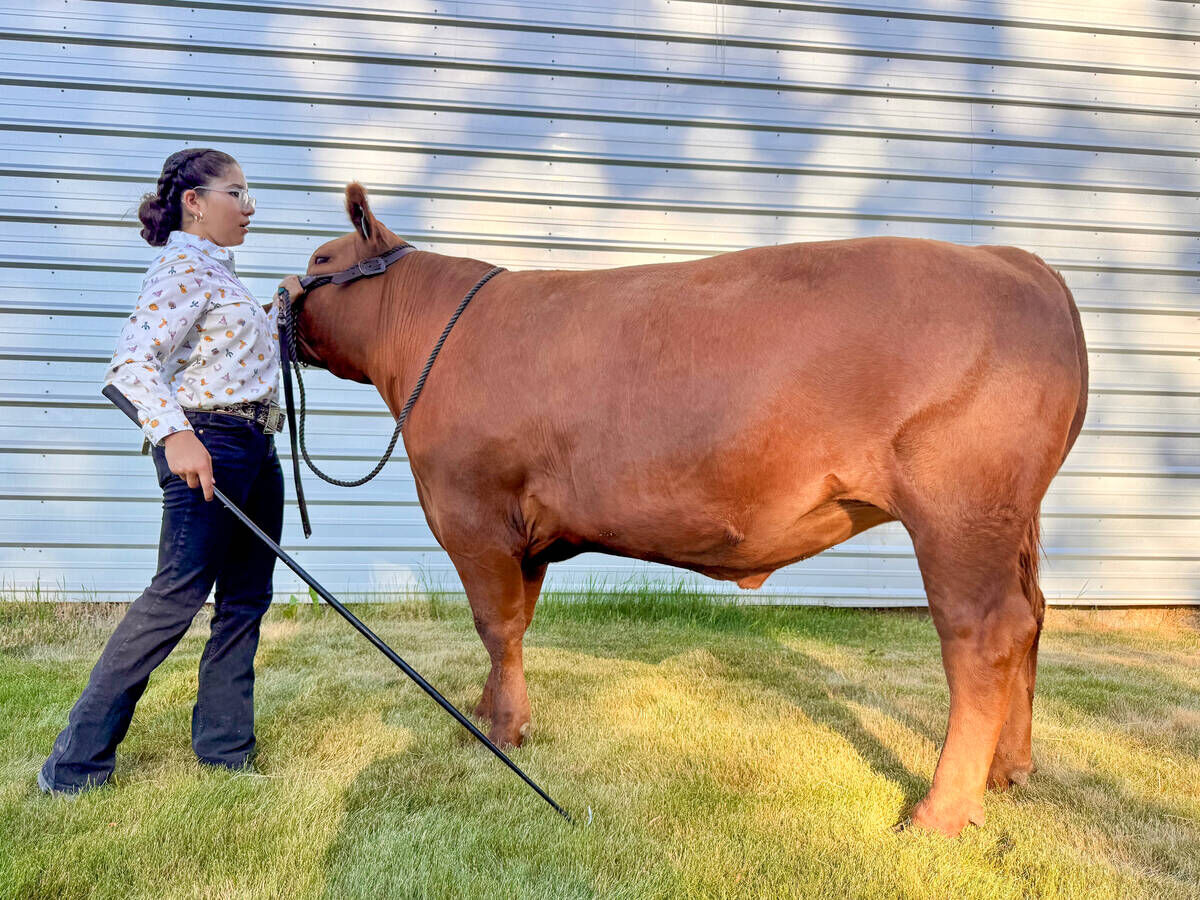
Yesenia Ortiz’ steer is about 15 times her size – but she shows that steer who’s boss.
4‑H out-of-school programming, in-school enrichment programs, clubs and camps also offer a wide variety of STEM opportunities — from agricultural and animal sciences to rocketry, robotics, environmental protection, and computer science — to improve the nation’s ability to compete in key scientific fields and take on the leading challenges of the 21st century.
Dressed in their show attire, with their animals groomed to perfection, each of the 55 members aged 9 to 18 patiently waited their turn to enter the pen and be judged under the same rules and conditions as would be typical at the Fair. The Cloverdale club boasts eight “Cloverbuds.” They are under age 9, the starting age for 4-H.
Their animals, on the other hand, were not always so nonchalant, eyeing the lush green grass abundant at the Moss family property or otherwise eager to get the show over.
Five managed their chickens, a relatively easy task. Three were showing their goats, a still relatively manageable chore. Twenty-seven handling sheep had to use some muscle as in many cases the animal weighed twice as much as the kid. The five showing swine used brain over brawn to out-clever and wrangle them.
The 11 kids keeping their cows in line were a master class in leverage. Yesenia Ortiz let her 1,500 pound steer — about 15 times her size — know who the boss is.
Show day at the Fair is the “moment of truth.” What youth and teens have learned, how they have managed their animal, and how well they control their animal are all tested.
Showmanship contests are evaluated based on preparation of animals for show, the apparent training, and the appearance and behavior of the exhibitor. An animal’s conformation should not be considered except as it may affect the way an animal should have been fitted or shown. Basic skills and both grooming and showing should not be confused with current fads and trends.
Show rings come in many different sizes. Regardless of the shape or the size of the ring, a good showman will utilize all the space available. Animals on the move should be held towards the outer edge of the ring to provide adequate room for evaluation.
A big percentage of showmanship is how well an animal handles, cleanliness, and cooperation between the animal and the handler.
Exhibitors must pay attention to the straightness of lines when bringing their animal to a stop in side-by-side or head-to-tail alignments.
The Nugget asked Issac Vanaken (12), showing for his second year, what he valued most about the Club.
“Seeing how other people work and handle, what I can learn from them,” he answered.
In typical modest fashion, a characteristic of 4-H kids, Vanaken said “he hoped to do well at the fair, improve on last year.”
His steer Rex weighed in at 1,530 pounds. However, he was like a poodle under Vanaken’s deft steering.
Evelyn Webb (11) is a third year Club member. She let her steer Colt, also 1,530 pounds, know who was in charge as we asked her to change positions for photos when he preferred to stay right where he was.
“What’s best about 4-H is working on your project. It keeps you really busy and it’s challenging,” she said. She hopes to do well at the Fair where last year she won a blue ribbon.
The last day of the fair can be bittersweet, and for some downright heart-wrenching. Auction day is when many 4-H kids must say goodbye after a year of training, feeding, and caring for an animal.
But their parents and Club leaders have prepared them well for the eventual good-bye, and living with the outcome. 4-H kids, many from farming and ranching families, beyond demonstrating showmanship, display a sound understanding of “the circle of life.”