
NIL
College Football Playoff: CBS Sports projects 12-team field, full bowl slate after Week 14

The 2025 regular season has concluded, and conference championship week is nearly upon us. In turn, bowl matchups and College Football Playoff seeds are soon to be set in stone.
Some of the notable outcomes from Week 14 included Texas A&M dropping its first game of the season to Texas and Alabama outlasted Auburn in the Iron Bowl. Miami and Vanderbilt are both looking to make the CFP and earned statement wins over ranked opponents as well.
In turn, CBS Sports has shaken up their predictions for the College Football Playoff after the regular season. Here are the updated projections, along with a projection list of every bowl game:
No. 12 North Texas vs. No. 5 Texas A&M
Texas A&M didn’t finish the regular season undefeated and will miss out on the SEC title game as a result. They’re likely on outside looking in when it comes to the top four seeds in the CFP, however.
North Texas will face Tulane in the American Championship next week. The winner of that game will most likely represent the Group of Six in the playoffs. UNT’s Eric Morris will be headed to Oklahoma State after their season is over, while Jon Sumrall of Tulane is going to be the next Florida coach.
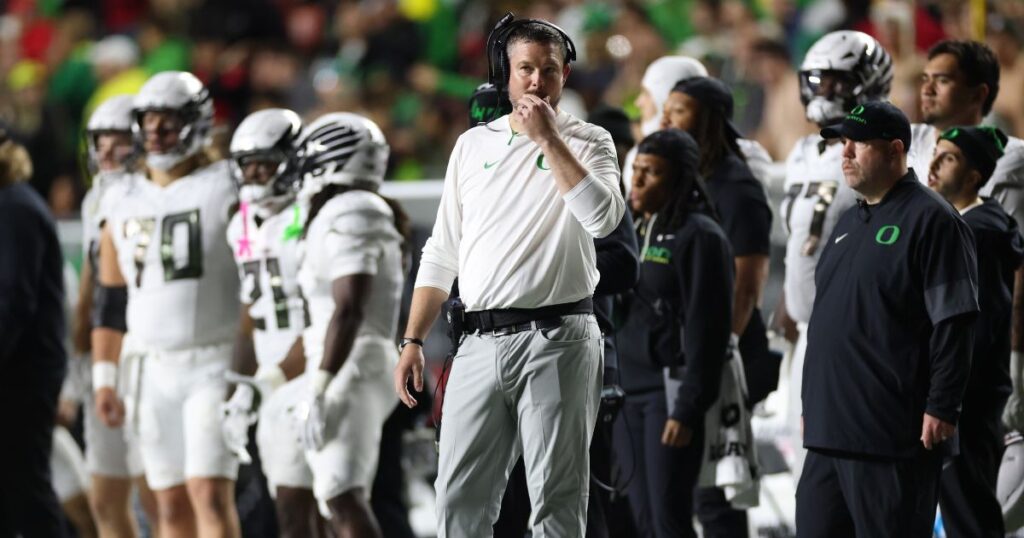
No. 11 Virginia vs. No. 6 Oregon
Oregon will not have a chance to defend its Big Ten Championship this season. The Ducks lost to Indiana in October and remains the lone blemish on Oregon’s record. They’re 11-1 and likely hosting a first-round game heading into the CFP.
The Cavaliers are in this spot as the expected ACC Champion. They’ll take on Duke next weekend, but come into conference title week with a 10-2 record after beginning the season with an 8-1 record.
No. 10 Alabama at No. 7 Ole Miss
This would be one of the more interesting matchups in the playoffs. CBS predicts Ole Miss to host this matchup — but it’s unclear what that Rebels team will look like at the moment.
Aside from that, these two SEC teams did not match up against one another during the regular season. Both programs finished the regular season with a 7-1 mark in conference play.
No. 9 Notre Dame at No. 8 Oklahoma
Oklahoma beat Tennessee and Alabama on the road in consecutive weeks to begin November and followed that up with wins at home vs. a ranked Missouri team and LSU. In turn, the Sooners have won their last four games and finished the regular season with a perfect 4-0 record on the road.
Notre Dame had to win all 10 of its remaining games after losing the first two games of its regular season to make the playoffs, and they did. However, CBS Sports predicts the Irish to be an 9-seed — one seed shy of hosting a first-round playoff game.
CFP Quarterfinal at the Rose Bowl
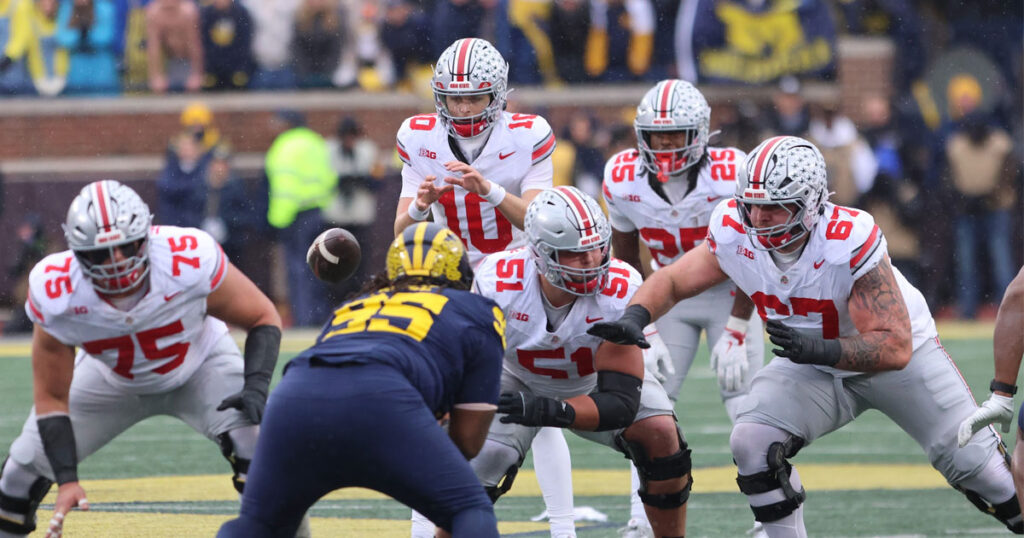
No. 1 Ohio State vs. TBD
Ohio State beat Michigan for the first time in over half a decade on Saturday. In turn, the Buckeyes are 12-0 heading into the Big Ten Championship game vs. Indiana.
They’ll most likely be the No. 1 overall seed if they can best the Hoosiers. This would put Ohio State in position for a second national championship run in as many seasons once the conference title is decided.
CFP Quarterfinal at the Sugar Bowl
No. 2 Georgia vs. TBD
Georgia will face a familiar foe in Alabama next week during the SEC Championship game. The Bulldogs are 11-1 this season, and the Crimson Tide are that lone blemish.
In September, Alabama defeated Georgia in Athens 24-21. The Bulldogs have won their last eight games since that loss.
CFP Quarterfinal at the Orange Bowl
No. 3 Indiana vs. TBD
Indiana is 12-0 for the first time in school history and now set their sights on their matchup vs. Ohio State in the Big Ten Championship game next weekend. The Hoosiers continue to win under head coach Curt Cignetti, and has a chance to solidify itself among the nation’s elite with a win vs. the Buckeyes.
That’s easier said that done, of course. But CBS Sports predicts the loser of this matchup to still receive a first-round bye in the College Football Playoff.
CFP Quarterfinal at the Cotton Bowl
No. 4 Texas Tech vs. TBD
Texas Tech was among the biggest spenders in the transfer portal and recruiting cycle last offseason, and it has paid off — literally. The Red Raiders are the team to beat in the Big 12 Conference, and are set to face BYU in the conference title game next weekend.
The Big 12 title game marks the second time these two programs will face each other this season. Texas Tech won the first meeting 29-7 on Nov. 8.
CBS Bowl Projections after Week 14
Saturday, Dec. 13
LA Bowl
SoFi Stadium (Inglewood, California)
9 p.m., ESPN
San Diego State vs. Arizona
Tuesday, Dec. 16
IS4S Salute to Veterans Bowl
Cramton Bowl (Montgomery, Alabama)
9 p.m., ESPN
Central Michigan vs. Troy
Wednesday, Dec. 17
StaffDNA Cure Bowl
Camping World Stadium (Orlando, Florida)
5 p.m., ESPN
Jacksonville State vs. Georgia Southern
68 Ventures Bowl
Hancock Whitney Stadium (Mobile, Alabama)
8:30 p.m., ESPN
Louisiana Tech vs. Coastal Carolina
Friday, Dec. 19
Myrtle Beach Bowl
Brooks Stadium (Conway, South Carolina)
Noon, ESPN
Southern Miss vs. Delaware
Union Home Mortgage Gasparilla Bowl
Raymond James Stadium (Tampa, Florida)
3:30 p.m., ESPN
USF vs. Clemson
Monday, Dec. 22
Famous Idaho Potato Bowl
Albertsons Stadium (Boise, Idaho)
2 p.m., ESPN
Toledo vs. UNLV
Tuesday, Dec. 23
Boca Raton Bowl
Flagler Credit Union Stadium (Boca Raton, Florida)
2 p.m., ESPN
FIU vs. Louisiana
New Orleans Bowl
Caesars Superdome (New Orleans)
5:30 p.m., ESPN
Western Kentucky vs. Old Dominion
Scooter’s Coffee Frisco Bowl
Frisco, Texas
9 p.m., ESPN
Boise State vs. James Madison
Wednesday, Dec. 24
Sheraton Hawaii Bowl
Clarence T.C. Ching Athletics Complex (Honolulu)
8 p.m., ESPN
Hawaii vs. Cal
Friday, Dec. 26
GameAbove Sports Bowl
Ford Field (Detroit)
1 p.m., ESPN
Ohio vs. Penn State
Rate Bowl
Chase Field (Phoenix)
4:30 p.m., ESPN
Cincinnati vs. Northwestern
SERVPRO First Responder Bowl
Gerald J. Ford Stadium (Dallas)
8 p.m., ESPN
Texas State vs. Missouri State
Saturday, Dec. 27
Go Bowling Military Bowl
Navy-Marine Corps Memorial Stadium (Annapolis, Maryland)
11 a.m., ESPN
Army vs. Duke
Bad Boy Mowers Pinstripe Bowl
Yankee Stadium (Bronx, New York)
Noon, ABC
Minnesota vs. Georgia Tech
Wasabi Fenway Bowl
Fenway Park (Boston)
2:15 p.m., ESPN
Louisville vs. East Carolina
Pop-Tarts Bowl
Camping World Stadium (Orlando, Florida)
3:30 p.m., ABC
BYU vs. SMU
Snoop Dogg Arizona Bowl
Arizona Stadium (Tucson, Arizona)
4:30 p.m., CW Network
Fresno State vs. Miami (OH)
Isleta New Mexico Bowl
University Stadium (Albuquerque, New Mexico)
5:45 p.m., ESPN
New Mexico vs. Washington State
TaxSlayer Gator Bowl
EverBank Stadium (Jacksonville, Florida)
7:30 p.m. ABC
Miami vs. Texas
Kinder’s Texas Bowl
NRG Stadium (Houston)
9:15 p.m., ESPN
Iowa State vs. Missouri
Monday, Dec. 29
Birmingham Bowl
Protective Stadium (Birmingham, Alabama)
2 p.m., ESPN
Memphis vs. Arkansas State
Tuesday, Dec. 30
Radiance Technologies Independence Bowl
Independence Stadium (Shreveport, Louisiana)
2 p.m., ESPN
Utah State vs. Kennesaw State
Music City Bowl
Nissan Stadium (Nashville, Tennessee)
5:30 p.m., ESPN
Nebraska vs. LSU
Valero Alamo Bowl
Alamodome (San Antonio)
9 p.m., ESPN
USC vs. Houston
Wednesday, Dec. 31
ReliaQuest Bowl
Raymond James Stadium (Tampa, Florida)
Noon, ESPN
Illinois vs. Tennessee
Tony the Tiger Sun Bowl
Sun Bowl Stadium (El Paso, Texas)
2 p.m., CBS
Wake Forest vs. Arizona State
Cheez-It Citrus Bowl
Camping World Stadium (Orlando, Florida)
3 p.m., ABC
Vanderbilt vs. Michigan
SRS Distribution Las Vegas Bowl
Allegiant Stadium (Las Vegas)
3:30 p.m., ESPN
Iowa vs. Utah
Friday, Jan. 2
Lockheed Martin Armed Forces Bowl
Amon G. Carter Stadium (Fort Worth, Texas)
1 p.m., ESPN
Navy vs. Kansas State
AutoZone Liberty Bowl
Simmons Bank Liberty Stadium (Memphis, Tennessee)
4:30 p.m., ESPN
Tulane vs. TCU
Duke’s Mayo Bowl
Bank of America Stadium (Charlotte, North Carolina)
8 p.m., ESPN
NC State vs. UConn
Holiday Bowl
Snapdragon Stadium (San Diego)
8 p.m., Fox
Pitt vs. Washington

Continue Reading
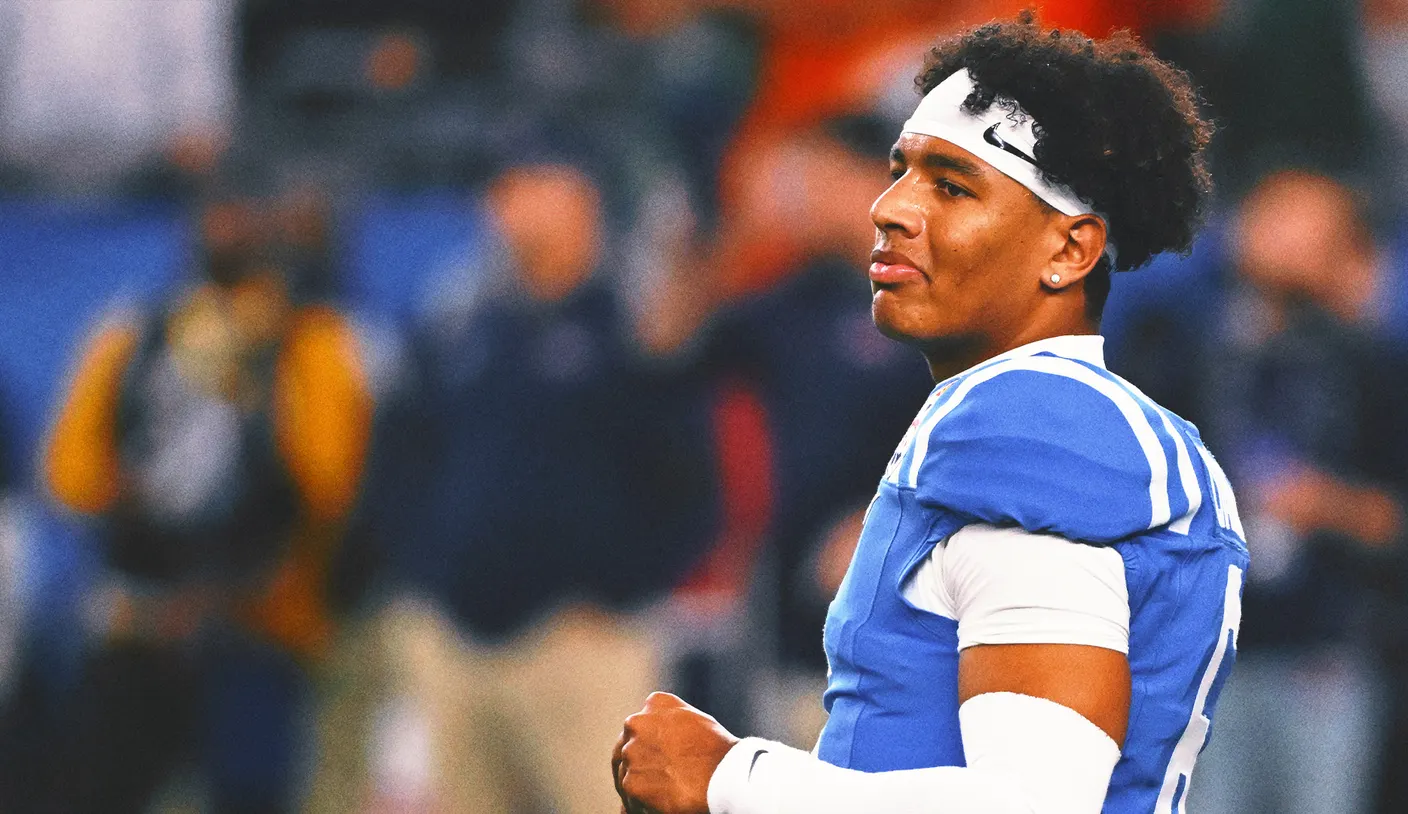
Ole Miss quarterback Trinidad Chambliss saw his season end on Thursday night, and on Friday, potentially his college career. The NCAA formally rejected a request for a sixth year of eligibility, with which he would have been able to return to the Rebels as their starting QB once more.
Instead, Chambliss has two options in front of him. Ole Miss can still appeal the NCAA’s ruling in an attempt to retain Chambliss and have him play out the deal he had agreed to for 2026 that was pending NCAA granting additional eligibility, or Chambliss can enter the NFL Draft to continue his football career in the pros, instead. Given the NCAA’s reasoning for their refusal to grant the additional year of eligibility, an appeal doesn’t guarantee any kind of success.
Ole Miss athletic director Keith Carter said his school will appeal the ruling.
“We are disappointed with today’s announcement by the NCAA and plan to appeal the decision to the Committee level,” Carter said in a social media post, in which he included the flag of Trinidad and Tobago. “Additionally, we will continue to work in conjunction with Trinidad’s representatives in other avenues of support.”
Tom Mars, who is an attorney for Chambliss, said he was disappointed but not surprised by the NCAA’s decision. “The last time I checked, however, the only score that matters is the one at the end of the fourth quarter,” Mars said.
“I understand that Ole Miss will file an appeal with the NCAA. However, there’s now an opportunity to move this case to a level playing field where Trinidad’s rights will be determined by the Mississippi judiciary instead of some bureaucrats in Indianapolis who couldn’t care less about the law or doing the right thing,” Mars said. “Whether to pursue that course of action is a decision only Trinidad and his parents can make.”
[Beck? Kiffin? 4 Takeaways From Miami’s CFP Semifinal Win Over Ole Miss]
In its own statement, the NCAA explained the reason for the rejection by giving background to how the process works in general, how it worked for Chambliss and what was lacking for the decision to go in his and Ole Miss’ favor.
“In November, Ole Miss filed a waiver request for football student-athlete Trinidad Chambliss, seeking to extend his five-year Division I eligibility clock, citing an incapacitating illness or injury. Approval requires schools to submit medical documentation provided by a treating physician at the time of a student’s incapacitating injury or illness, which was not provided. The documents provided by Ole Miss and the student’s prior school include a physician’s note from a December 2022 visit, which stated the student-athlete was “doing very well” since he was seen in August 2022. Additionally, the student-athlete’s prior school indicated it had no documentation on medical treatment, injury reports or medical conditions involving the student-athlete during that time frame and cited “developmental needs and our team’s competitive circumstances” as its reason the student-athlete did not play in the 2022-23 season. The waiver request was denied.”
The “prior school” mentioned by the NCAA is Division II Ferris State, at which Chambliss was a redshirt freshman in 2021 before moving into a backup role and then becoming a national champion as its starter in 2024.
The NCAA elaborated that, “To receive a clock extension, a student-athlete must have been denied two seasons of competition for reasons beyond the student’s or school’s control, and a “redshirt” year can be used only once. One of the rules being cited publicly (Bylaw 12.6.4.2.2) is not the correct rule for the type of waiver requested by the school. Ole Miss applied for the waiver in November, and the NCAA first provided a verbal denial Dec. 8.”
Chambliss led the SEC in passing yards in 2025 with 3,937 while throwing 22 touchdowns against just 3 interceptions. He finished eighth in the Heisman voting overall and fifth among quarterbacks, behind Georgia’s Gunner Stockton, Ohio State’s Julian Sayin, Vanderbilt’s Diego Pavia and the winner of the 2025 Heisman, Indiana’s Fernando Mendoza. Chambliss led Ole Miss to the College Football Player for the first time, and the Rebels’ 13 wins are a school record.
The Associated Press contributed to this report.
Want great stories delivered right to your inbox? Create or log in to your FOX Sports account, and follow leagues, teams and players to receive a personalized newsletter daily!
FOLLOW Follow your favorites to personalize your FOX Sports experience
NIL
College enforcement group voices ‘serious concerns’ with spiraling transfer portal – Las Vegas Sun News

Published Friday, Jan. 9, 2026 | 4:39 p.m.
Updated Friday, Jan. 9, 2026 | 4:39 p.m.
A
transfer portal
spiraling out of control prompted the new regulatory body for college sports to issue a memo to athletic directors Friday night saying it has “serious concerns” about some of the multimillion-dollar contracts being offered to players.
The “reminder” from the College Sports Commission came out about an hour before kickoff of the semifinal between
Indiana and Oregon in a College Football Playoff
that has shared headlines with news of players signing seven-figure deals to move or, in some cases, stay where they are.
The CSC reminded the ADs that, according to the rules, third-party deals to use players’ name, image and likeness “are evaluated at the time of entry in NIL Go, not before, and each deal is evaluated on its own merits.”
“Without prejudging any particular deal, the CSC has serious concerns about some of the deal terms being contemplated and the consequences of those deals for the parties involved,” the memo said.
Under terms of the House settlement that dictated the rules for NIL payments, schools can share revenue with their players directly from a pool of $20.5 million. Third-party deals, often arranged by businesses created to back the schools, are being used as workarounds this so-called salary cap.
The CSC, through its NIL Go portal, is supposed to evaluate those deals to make sure they are for a valid business purpose and fall within a fair range of compensation for the services being provided.
The CSC did not list examples of unapproved contracts, but college football has seen its share of seven-figure deals luring players to new schools since the transfer portal opened on Jan. 2.
One high-profile case involved
Washington quarterback Demond Williams Jr.,
who initially sought to enter the transfer portal and turn his back on a reported deal worth $4 million with the Huskies. Legal threats ensued and Williams changed course and stayed at Washington.
“Making promises of third-party NIL money now and figuring out how to honor those promises later leaves student-athletes vulnerable to deals not being cleared, promises not being able to be kept, and eligibility being placed at risk,” the CSC letter said.
The commission listed two rules about contracts it evaluates, some of which have been termed “agency agreement” or “services agreement” in what look like attempts to bypass the rules.
—”The label on the contract does not change the analysis; if an entity is agreeing to pay a student-athlete for their NIL, the agreement must be reported to NIL Go within the reporting deadline.”
—”An NIL agreement or payment with an associated entity or individual … must include direct activation of the student-athlete’s NIL rights.” This is a reference to the practice of “warehousing” NIL rights by paying first, then deciding how to use them later.
___
Get poll alerts and updates on the AP Top 25 throughout the season. Sign up
here
and
here
(AP News mobile app). AP college football:
https://apnews.com/hub/ap-top-25-college-football-poll
and
https://apnews.com/hub/college-football

News – AP-National
A transfer portal spiraling out of control prompted the new regulatory body for college sports to issue a memo to athletic directors saying it has “serious concerns” about some of the multimillion-dollar contracts being offered to players.
By EDDIE PELLSAP National Writer
A transfer portal spiraling out of control prompted the new regulatory body for college sports to issue a memo to athletic directors Friday night saying it has “serious concerns” about some of the multimillion-dollar contracts being offered to players.
The “reminder” from the College Sports Commission came out about an hour before kickoff of the semifinal between Indiana and Oregon in a College Football Playoff that has shared headlines with news of players signing seven-figure deals to move or, in some cases, stay where they are.
The CSC reminded the ADs that, according to the rules, third-party deals to use players’ name, image and likeness “are evaluated at the time of entry in NIL Go, not before, and each deal is evaluated on its own merits.”
“Without prejudging any particular deal, the CSC has serious concerns about some of the deal terms being contemplated and the consequences of those deals for the parties involved,” the memo said.
Under terms of the House settlement that dictated the rules for NIL payments, schools can share revenue with their players directly from a pool of $20.5 million. Third-party deals, often arranged by businesses created to back the schools, are being used as workarounds this so-called salary cap.
The CSC, through its NIL Go portal, is supposed to evaluate those deals to make sure they are for a valid business purpose and fall within a fair range of compensation for the services being provided.
The CSC did not list examples of unapproved contracts, but college football has seen its share of seven-figure deals luring players to new schools since the transfer portal opened on Jan. 2.
One high-profile case involved Washington quarterback Demond Williams Jr., who initially sought to enter the transfer portal and turn his back on a reported deal worth $4 million with the Huskies. Legal threats ensued and Williams changed course and stayed at Washington.
“Making promises of third-party NIL money now and figuring out how to honor those promises later leaves student-athletes vulnerable to deals not being cleared, promises not being able to be kept, and eligibility being placed at risk,” the CSC letter said.
The commission listed two rules about contracts it evaluates, some of which have been termed “agency agreement” or “services agreement” in what look like attempts to bypass the rules.
—”The label on the contract does not change the analysis; if an entity is agreeing to pay a student-athlete for their NIL, the agreement must be reported to NIL Go within the reporting deadline.”
—”An NIL agreement or payment with an associated entity or individual … must include direct activation of the student-athlete’s NIL rights.” This is a reference to the practice of “warehousing” NIL rights by paying first, then deciding how to use them later.
Copyright 2026 The Associated Press. All rights reserved. This material may not be published, broadcast, rewritten or redistributed without permission.
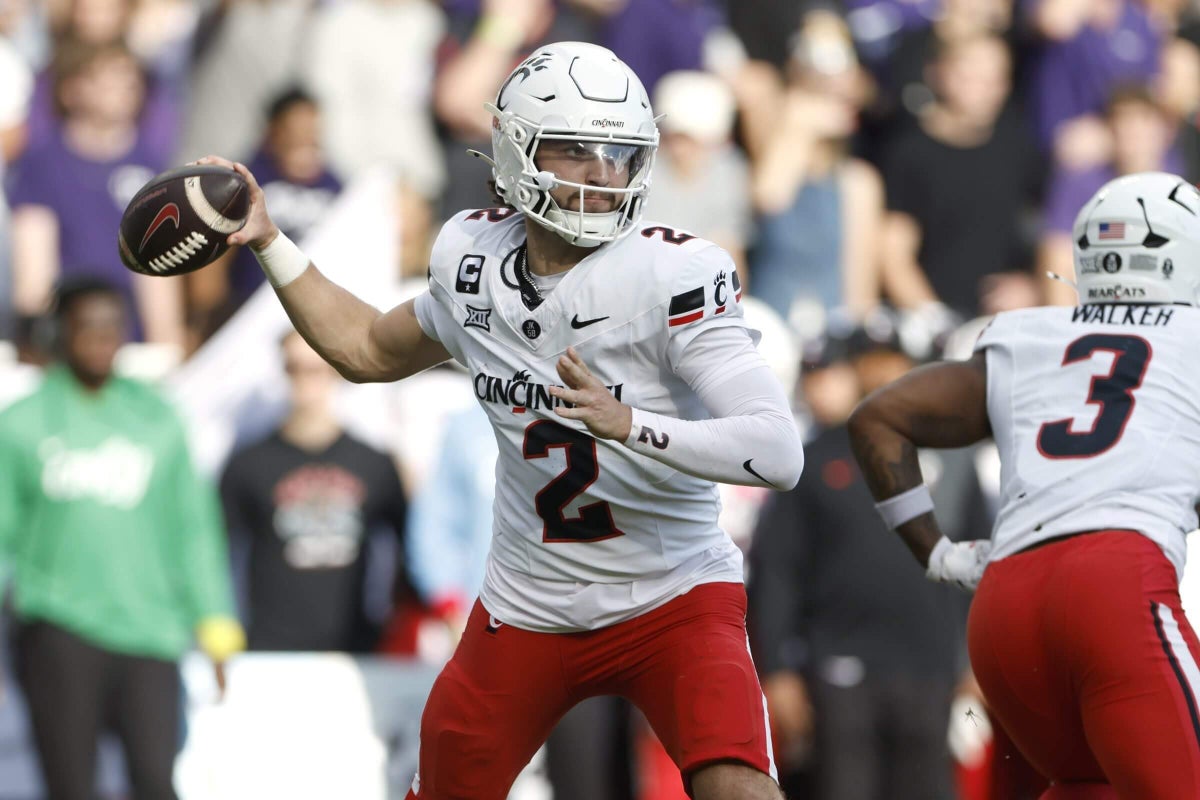
Brendan Sorsby, ranked No. 1 in The Athletic’s transfer quarterback rankings, transferred to Texas Tech earlier this week with one season remaining on a multi-year revenue sharing agreement with Cincinnati that includes a $1 million buyout clause, multiple people briefed on the deal told The Athletic. They were granted anonymity because they were not authorized to speak publicly about the terms of the deal.
The buyout payment is due to Cincinnati within 30 days of Sorsby’s transfer. It is not immediately clear how Sorsby’s buyout will be resolved.
Texas Tech was aware of Sorsby’s buyout, according to sources briefed on the transfer process, and factored it into his recruitment, as well as Tech’s own revenue sharing budget.
Ron Slavin, Sorsby’s agent with Lift Sports Management, declined comment.
Spokespersons for both Texas Tech and Cincinnati declined comment.
There have been questions about how revenue sharing contract terms might hold up under legal scrutiny, in part because college athletes are not employees and their rev share contracts are not typical employment agreements.
The full details of Sorsby’s agreement with the Red Raiders are not public, but the one-year deal is expected to pay him more than $4 million, according to people briefed on the terms. His signing was officially announced Tuesday by Texas Tech.
A redshirt junior with one year of eligibility remaining, Sorsby elected to enter the transfer portal and ultimately sign with Texas Tech rather than declare for the 2026 NFL Draft, where he is projected as a potential Day 2 pick.
Brendan Sorsby is officially a Red Raider.#WreckEm pic.twitter.com/EGE4Xn1OIL
— Texas Tech Football (@TexasTechFB) January 6, 2026
Sorsby’s buyout is indicative of the new era of direct revenue sharing between schools and athletes under the House v. NCAA settlement, which was instituted last summer. Many schools have included buyout clauses in their rev share agreements that obligate athletes to redeem money to their previous school if they leave before the end of the agreement.
According to enforcement guidelines from the College Sports Commission, the organization that oversees revenue sharing, Sorsby’s $1 million buyout must be accounted for by Texas Tech within the school’s $20.5 million revenue sharing cap for fiscal year 2025-26. Texas Tech is not required to directly pay Cincinnati to cover the buyout costs.
Multiple power conference general managers told The Athletic they have either signed players who had buyouts with their previous schools or lost players with buyouts to other teams. The player or their representative will often handle paying the buyout to the previous institution, whether in full or at a negotiated rate.
“(Player buyouts are) happening this year. It’s not prevalent, but it’s happening,” said Darren Heitner, who specializes in sports law. “Typically there is a negotiation where a school starts at a specific number and then negotiates down, if the player has good counsel.”
Sorsby initially transferred from Indiana to Cincinnati as a redshirt sophomore, ahead of the 2024 season, signing an NIL agreement before revenue sharing began in July 2025. Last offseason, Sorsby signed a new two-year deal with Cincinnati’s NIL collective, a third-party group affiliated with the school, that later transitioned to a rev share contract with the university. The $1 million buyout was agreed to in both the multi-year collective deal and revenue sharing agreements. Sorsby earned roughly $1.5 million in 2025 from Cincinnati, according to people briefed on the previous terms.
There have been relatively few public disputes of NIL or rev share contracts between players, schools or third parties since college athletes could begin earning NIL compensation in 2021.
Earlier this week, Washington quarterback Demond Williams Jr. announced intentions to enter the transfer portal just days after signing a new contract with the Huskies that’s expected to pay him more than $4 million. The buyout would have likely factored into any protracted legal battle between player and school, but Williams never actually entered the portal and announced on Thursday that he will remain with Washington.
Late last year, the University of Georgia took former defensive end Damon Wilson II to court, with Georgia seeking arbitration and $390,000 in damages after the university claimed Wilson broke an agreement with Georgia’s NIL collective by entering the transfer portal in January 2025, prior to the onset of revenue sharing. Wilson, who transferred to Missouri for the 2025 season, later sued Georgia’s athletic association seeking his own damages for what the suit described as a “civil conspiracy” to interfere with Wilson’s business endeavors. It’s believed to be the first time a player and school have taken each other to court over an NIL dispute. Both proceedings are still ongoing. Wilson recently re-entered the portal.
Last summer, the University of Wisconsin and its NIL collective filed a lawsuit against the University of Miami for tampering with defensive back Xavier Lucas, who Wisconsin claimed had an agreement with their NIL collective and another “binding agreement” with the university that was contingent on revenue sharing being approved. The next hearing in this case is scheduled for March 2026.
In April 2025, a contract holdout by former Tennessee quarterback Nico Iamaleava ended with Iamaleava transferring to UCLA, but no legal action was taken.
Former Florida signee Jaden Rashada has a pending lawsuit filed against various parties, including former Gators coach Billy Napier, that stems from a 2022 NIL deal.
One Power 4 coach who spoke on the condition of anonymity, said that in some instances, unfulfilled buyout terms or the player attached might not be worth the time and effort to spark a legal battle, and some universities might be hesitant to pursue litigation against a college athlete.
“It’s less of a legal challenge and more of an optics challenge for institutions at this point,” said lawyer Paia LaPalombara, a former college athletics administrator who advises colleges, conferences and athletes on revenue sharing.
A 6-foot-3, 235-pound dual-threat quarterback, Sorsby averaged better than 2,800 yards passing and 500 rushing yards in his two seasons with the Bearcats, including 36 combined touchdowns passing and rushing in 2025, third-most in the FBS, with only five interceptions. He led Cincinnati to a 7-5 regular season record in 2025 and a spot in the Liberty Bowl, the program’s first bowl bid since 2022.
Sorsby opted out of the bowl game, announcing on Dec. 15 that he planned to enter the transfer portal. The native of Denton, Texas, was quickly linked to Texas Tech as a potential destination. He made recruiting visits to Tech and LSU.
The Red Raiders recently completed a 12-2 season in 2025, winning the Big 12 championship and earning a first-round bye in the College Football Playoff, where they lost to Oregon 23-0 in the quarterfinals on New Year’s Day. Starting quarterback Behren Morton has exhausted his college eligibility, and sophomore backup Will Hammond suffered an ACL injury in October. After making headlines for its portal additions last offseason, Tech has again been active early in this year’s transfer window.

A transfer climate spiraling out of control prompted the new regulatory body for college sports to issue a memo to athletic directors Friday night saying it has “serious concerns” about some of the multimillion-dollar contracts being offered to players.
The “reminder” from the College Sports Commission came out about an hour before kickoff of the Peach Bowl semifinal between Indiana and Oregon in a College Football Playoff that has shared headlines with news of players signing seven-figure deals to move or, in some cases, stay where they are.
The CSC reminded the athletic directors that, according to the rules, third-party deals to use players’ name, image and likeness “are evaluated at the time of entry in NIL Go, not before, and each deal is evaluated on its own merits.”
“Without prejudging any particular deal, the CSC has serious concerns about some of the deal terms being contemplated and the consequences of those deals for the parties involved,” the memo read.
Under terms of the House v. NCAA antitrust lawsuit settlement that dictated the rules for NIL payments, schools can share revenue with their players directly from a pool of $20.5 million. Third-party deals, often arranged by businesses created to back the schools, are being used as workarounds to this de facto salary cap.
The CSC, through its NIL Go portal, is supposed to evaluate those deals to make sure they are for a valid business purpose and fall within a fair range of compensation for the services being provided.
The CSC did not list examples of unapproved contracts, but college football has experienced its share of seven-figure deals luring players to new schools since the NCAA transfer portal opened on Jan. 2.
One high-profile case involved Washington quarterback Demond Williams Jr., who initially sought to enter the portal and turn his back on a reported deal worth $4 million with the Huskies. Legal threats ensued, and Williams changed course and stayed at Washington, a decision the quarterback announced Thursday night.
“Making promises of third-party NIL money now and figuring out how to honor those promises later leaves student-athletes vulnerable to deals not being cleared, promises not being able to be kept, and eligibility being placed at risk,” the CSC letter read.
The commission listed two rules about contracts it evaluates, some of which have been termed “agency agreement” or “services agreement” in what look like attempts to bypass the rules.
First, “The label on the contract does not change the analysis; if an entity is agreeing to pay a student-athlete for their NIL, the agreement must be reported to NIL Go within the reporting deadline.”
Second, “An NIL agreement or payment with an associated entity or individual … must include direct activation of the student-athlete’s NIL rights.” This is a reference to the practice of “warehousing” NIL rights by paying first, then deciding how to use them later.

A transfer portal spiraling out of control prompted the new regulatory body for college sports to issue a memo to athletic directors saying it has “serious…
A transfer portal spiraling out of control prompted the new regulatory body for college sports to issue a memo to athletic directors Friday night saying it has “serious concerns” about some of the multimillion-dollar contracts being offered to players.
The “reminder” from the College Sports Commission came out about an hour before kickoff of the semifinal between Indiana and Oregon in a College Football Playoff that has shared headlines with news of players signing seven-figure deals to move or, in some cases, stay where they are.
The CSC reminded the ADs that, according to the rules, third-party deals to use players’ name, image and likeness “are evaluated at the time of entry in NIL Go, not before, and each deal is evaluated on its own merits.”
“Without prejudging any particular deal, the CSC has serious concerns about some of the deal terms being contemplated and the consequences of those deals for the parties involved,” the memo said.
Under terms of the House settlement that dictated the rules for NIL payments, schools can share revenue with their players directly from a pool of $20.5 million. Third-party deals, often arranged by businesses created to back the schools, are being used as workarounds this so-called salary cap.
The CSC, through its NIL Go portal, is supposed to evaluate those deals to make sure they are for a valid business purpose and fall within a fair range of compensation for the services being provided.
The CSC did not list examples of unapproved contracts, but college football has seen its share of seven-figure deals luring players to new schools since the transfer portal opened on Jan. 2.
One high-profile case involved Washington quarterback Demond Williams Jr., who initially sought to enter the transfer portal and turn his back on a reported deal worth $4 million with the Huskies. Legal threats ensued and Williams changed course and stayed at Washington.
“Making promises of third-party NIL money now and figuring out how to honor those promises later leaves student-athletes vulnerable to deals not being cleared, promises not being able to be kept, and eligibility being placed at risk,” the CSC letter said.
The commission listed two rules about contracts it evaluates, some of which have been termed “agency agreement” or “services agreement” in what look like attempts to bypass the rules.
—”The label on the contract does not change the analysis; if an entity is agreeing to pay a student-athlete for their NIL, the agreement must be reported to NIL Go within the reporting deadline.”
—”An NIL agreement or payment with an associated entity or individual … must include direct activation of the student-athlete’s NIL rights.” This is a reference to the practice of “warehousing” NIL rights by paying first, then deciding how to use them later.
Get poll alerts and updates on the AP Top 25 throughout the season. Sign up here and here (AP News mobile app). AP college football: https://apnews.com/hub/ap-top-25-college-football-poll and https://apnews.com/hub/college-football

NIL7 minutes ago
NCAA Denies Ole Miss QB Trinidad Chambliss a 6th Year of Eligibility

Sports14 minutes ago
Men’s Volleyball Sweeps St. Thomas Aquinas to Begin 2026 Campaign

Sports30 minutes ago
Men’s Volleyball Falls In Season Opener At #3 Long Beach State

Sports46 minutes ago
Men’s Volleyball Drops Rematch With Loyola Chicago In Four Sets

Rec Sports50 minutes ago
Oregon’s Kenyon Sadiq thrives during challenging journey from small-town Idaho to tight end stardom

Rec Sports59 minutes ago
Youth Athlete Protection Act aims to safeguard young athletes in Alabama
NIL1 hour ago
College enforcement group voices ‘serious concerns’ with spiraling transfer portal – Las Vegas Sun News

Rec Sports1 hour ago
Portola girls basketball team aiming for another memorable CIF post-season run –

Rec Sports1 hour ago
What are we teaching Maine’s young athletes?

Sports2 hours ago
From Clemson Clinics to Friday Night Lights

Sports2 hours ago
Hoosiers Close Day One From Rod McCravy
NIL2 hours ago
College enforcement group voices ‘serious concerns’ with spiraling transfer portal

Sports2 hours ago
Track & Field Opens Strong at Day One of Rod McCravy Memorial – Ole Miss Athletics

Sports2 hours ago
T&F Set To Start At Clemson Invitational

Sports3 hours ago
Track and Field Kicks Off Calendar Year at St. Thomas Aquinas Invitational

Sports4 weeks ago
#11 Volleyball Practices, Then Meets Media Prior to #2 Kentucky Match

Rec Sports4 weeks ago
Stempien to seek opening for Branch County Circuit Court Judge | WTVB | 1590 AM · 95.5 FM

Motorsports3 weeks ago
Ross Brawn to receive Autosport Gold Medal Award at 2026 Autosport Awards, Honouring a Lifetime Shaping Modern F1

Motorsports4 weeks ago
Nascar legal saga ends as 23XI, Front Row secure settlement

Rec Sports3 weeks ago
Princeton Area Community Foundation awards more than $1.3 million to 40 local nonprofits ⋆ Princeton, NJ local news %

Sports4 weeks ago
Maine wraps up Fall Semester with a win in Black Bear Invitational

NIL3 weeks ago
Downtown Athletic Club of Hawaiʻi gives $300K to Boost the ’Bows NIL fund

Motorsports4 weeks ago
Sunoco to sponsor No. 8 Ganassi Honda IndyCar in multi-year deal
Motorsports4 weeks ago
NASCAR, 23XI Racing, Front Row Motorsports announce settlement of US monopoly suit | MLex

Rec Sports4 weeks ago
WNBA’s Caitlin Clark, Angel Reese and Paige Bueckers in NC, making debut for national team at USA camp at Duke

Sports4 weeks ago
Hope College Tops MIAA Commissioner’s Cup Fall Update

NIL4 weeks ago
Nike Signs 10 LSU Athletes to NIL deals

Sports2 weeks ago
Badgers news: Wisconsin lands 2nd commitment from transfer portal

Sports3 weeks ago
Three Clarkson Volleyball Players Named to CSC Academic All-District List

Rec Sports1 week ago
Five Youth Sports Trends We’re Watching in 2026





-
 Sports2 weeks ago
Badgers news: Wisconsin lands 2nd commitment from transfer portal
-
 Rec Sports1 week ago
Five Youth Sports Trends We’re Watching in 2026
-

 Sports3 weeks ago
Is women’s volleyball the SEC’s next big sport? How Kentucky, Texas A&M broke through
-
 Sports2 weeks ago
Kentucky VB adds an All-American honorable mention, loses Brooke Bultema to portal
-

 Motorsports3 weeks ago
Dr. Patrick Staropoli Lands Full-Time O’Reilly Ride with Big Machine Racing
-

 Rec Sports3 weeks ago
NBA, Global Basketball Community Unite for World Basketball Day Celebration
-

 Motorsports3 weeks ago
BigRock Motorsports Retains Its Championship Title At ISRL Season 2 Grand Finale In Calicut
-

 Motorsports3 weeks ago
NASCAR, IndyCar, and F1 Share These Race Days in 2026
-
 Sports2 weeks ago
Colorado volleyball poised to repeat success
-

 Motorsports2 weeks ago
BangShift.com IHRA Acquires Historic Memphis Motorsports Park In Millington Tennessee. Big Race Weekend’s Planned For 2026!