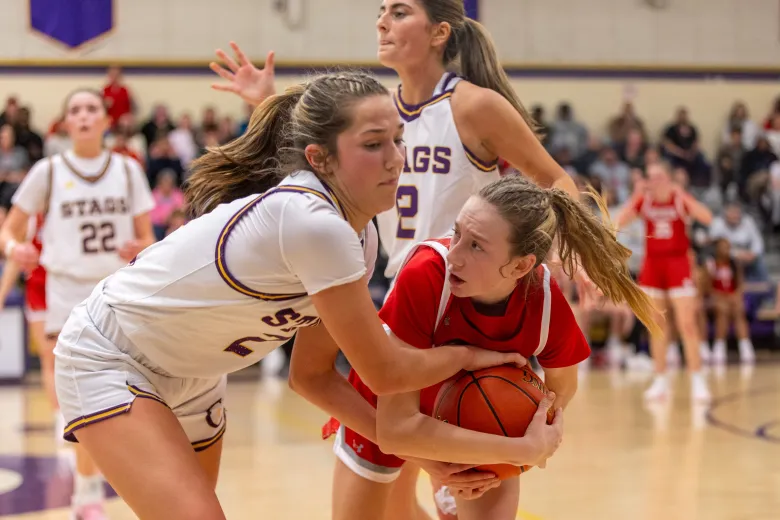
Colonie Youth Court celebrates 32 years and graduates
COLONIE — With certificates in hand and a deeper grasp of how justice works, nearly two dozen Colonie teens graduated Nov. 13 from one of the nation’s premier peer-run youth court educational programs.
The 23 graduates of Colonie Youth Court were joined at the 32nd annual ceremony by 43 returning first-, second- and third-year students who took on the various roles of a court system received certificates.
Youth Court is a nationwide peer-run restorative justice program operated through town police departments giving young people the opportunity to play a direct role in the local justice system while also offering those who are juvenile offenders a constructive alternative to traditional court proceedings.
Founded and organized in 1993, Colonie Youth Court functions entirely as a sentencing court, expecting all young offenders who participate to first acknowledge responsibility for their actions.
Cases are then heard and decided by trained local students who serve as prosecutors, defenders, judges, clerks, victim advocates and jury forepersons.
Graduating as a fully trained Colonie Youth Court member, high school freshman Sophia Mann said she was surprised by the range of roles involved.
Colonie Youth Court held its graduation ceremony Nov. 13 at Colonie High.
“At first I thought it was just the judge and the offender and the victim, but I didn’t know there were so many different aspects to it,” said Mann, who hopes to become a lawyer. “This is going to help.”
Fellow graduate Kyiah Holmes said the experience made her feel like she might “want to go into something law-related” and agreed with Mann that the experience helped her understand more about the roles of the justice system.
In the opening remarks at the ceremony, held at Colonie High School, town Supervisor Peter Crummey said the “Colonie Youth Court program is an extraordinary initiative made possible by the diligence and hard work of so many.”
Crummey told the graduates and returning students that every time they listen to their peers’ perspectives within the court, they strengthen both themselves and the justice system.
“Our justice system can only be as good as those who administer it,” he added.
Keynote speaker Mike Elmendorf, a Colonie native and co-founder of Colonie Youth Court, provided an in-depth history of the program’s origins, and said the court has been extremely successful in educating teens and creating opportunities for accountability.
According to town officials, more than 1,650 Colonie teens have completed the program since its inception, compiling more than 62,800 hours of community service.
The recidivism rate of juvenile offenders who have participated in Colonie Youth Court stands at 7% — far below national averages.
As the graduates reflected on how the program reshaped their understanding of justice, Elmendorf closed the night by reminding them why their work matters.
“The future is bright for our community, for our country, and it’s because of young people like you,” Elmendorf saids. “Don’t believe any of that nonsense that things aren’t looking up for us. We have a very bright future, and you guys are Exhibit A.”
Youth sports has long been lauded as one way to instill a sense of belonging, responsibility, patience and accountability in young people. Sports, particularly team sports, pushes youth to think beyond the “me” and toward the “we.”
“Sportsmanship is as important as winning,” we say. We should be good humans as we strive to be good athletes. In the last few weeks, I have had the misfortune of witnessing behavior very out of line with these tenets.
My daughter plays basketball on the eighth grade team of King Middle School in Portland. The team is composed of four (maybe five) players who have played this game before. The other 11 players have never played. Not only is most of the team new, the coaches are also new. They are dedicated King staff filling an unexpected gap, have no experience coaching and limited basketball experience in general.
But the players and coaches are learning, they are showing up, they are trying their best, they are helping each other out on the court — often to understand the basic rules of the game.
As you may have guessed, the King team is not in the middle of a winning season. We have lost every game, often by a pretty good margin. During most of these games, the other teams exhibit behavior you’d expect. The coaches pull the best players after the first half, they don’t press or try too hard to steal the ball from kids obviously still learning to control the ball, they don’t shoot three-pointer after three-pointer. Basic sportsmanship.
In two of our recent home games, however, we have had teams come in missing that bit of sportsmanship that the other teams exhibited. Windham won the game 73 to our 6. Falmouth won 64 to our 19. During both of these games, the coaches kept their best players in, they stole the ball constantly, they smirked.
Windham celebrated when they hit 67 points (6-7!) while King still had just 6 points. And they continued to score. Their coaches encouraged this. They laughed. They argued with the refs. Falmouth did the same. During the last two minutes of the Falmouth game, the coaches and the players were engaging in “operation 6-7” and had all the players shooting three-pointers for the last few minutes just so they could laugh. The King players kept up their efforts. They did not give up and Falmouth was denied that extra bit of mocking celebration, thank goodness.
You cannot ignore the underlying context that shines a harsher light on this. Windham and Falmouth are both well-resourced schools. King is not. Our gym has a court that is smaller than regulation, and we do not have bleachers. The King staff line up metal chairs along the wall before each game. When you sit, your toes can touch the sideline.
Many of the King players are in families here (legally) to seek asylum from countries to which they cannot return. The current environment adds a level of stress to all families in our community, and especially those who live in fear of having their parents taken during school drop-offs. For these and other reasons, few King parents can attend the games.
However, the political climate and socioeconomic disparities are not the responsibility of the student athlete to fully understand. It should be the responsibility of the coaches to help them understand. What are we teaching our youth when we allow players to engage with the world this way?
Each team could have won handily and handled it with grace. They chose not to. These players are watching and learning how to behave on the court. This is not a “participation trophy” argument. The better teams should win and, in an evenly matched game, the better players should play more than the players still learning.
Please do not confuse a plea for sportsmanship with anything other than that. These teams took on the role of every antagonist in an underdog sports movie. During this holiday season, I hope that these coaches and others who have lost sight of the real goal of youth sports reflect on whether they are focusing enough on helping student athletes be good humans as they become — no doubt — exceptional athletes.
BEDFORD TOWNSHIP, Mich. — In an update related to the dozens of animals found at a Bedford Township property Wednesday, the Battle Creek Police Department (BCPD) announced Friday that some dead animals were also found on the property.
Several dogs and one cat were found dead in addition to the 29 dogs, 15 cats, and two horses that had been removed from the Woodside Drive property that day, according to BCPD.
Police said the residence was operating as animal rescue but received a tip that raised concerns about animal care.
The dogs and cats are now in the care of the Calhoun County Animal Shelter and partner facilities, where staff are continuing medical and behavioral evaluations.
Shelter Executive Director Jackie Martens told News Channel 3 on Thursday many of the dogs are showing positive signs, but not all animals were up to date on rabies vaccinations.
Records for the cats have not yet been provided, meaning the shelter may need to re-vaccinate and spay or neuter them as a precaution.
Veterinarians are continuing medical evaluations. The horses were taken to a secure location that officials are not disclosing due to the ongoing investigation.
BE THE FIRST TO COMMENT
The owner was not home when authorities searched the property and no arrests have been made, according to BCPD. As detectives continue to investigate, the department said they will likely submit the case to the Calhoun County Prosecutor’s Office for review of potential criminal charges.
As the U.S. Supreme Court prepares to hear two high-profile cases involving transgender student athletes, LGBTQ+ advocates are urging the justices to consider not only constitutional questions, but the real-world consequences facing trans youth across the country.
On Jan. 13, the court will hear oral arguments in West Virginia v. B.P.J. and Little v. Hecox, cases that challenge state laws barring transgender girls from participating on school sports teams that align with their gender identity. While the cases focus on athletics, advocates say the broader implications reach far beyond the playing field.
What’s at Stake for Trans Youth
The challenged laws in West Virginia and Idaho are part of a growing wave of state-level restrictions that target transgender participation in school sports. Supporters of the bans often frame them as necessary for fairness or safety. Critics argue they rely on assumptions rather than evidence and impose blanket exclusions that fail to account for differences in age, sport, or level of competition.
The Trevor Project, the nation’s leading suicide prevention organization for LGBTQ+ young people, has taken a firm stance against the bans. In a statement released ahead of the hearings, CEO Jaymes Black urged the Supreme Court to reject what he described as discriminatory policies.
“Like all young people in this country, transgender youth deserve the opportunity to play sports at school, if they want to,” Black said, emphasizing that exclusion sends a damaging message about belonging.
Mental Health Impacts Backed by Data
The Trevor Project points to a growing body of research linking anti-transgender legislation to negative mental health outcomes. According to the organization, transgender and nonbinary youth living in states where restrictive laws were enacted reported up to a 72% increase in suicide attempts compared to peers in states without such policies.
Their 2024 U.S. National Survey on the Mental Health of LGBTQ+ Young People found that 46% of transgender and nonbinary respondents seriously considered suicide in the past year. Political debates and legislation were cited as a major source of distress, with 90% of LGBTQ+ youth saying recent politics harmed their well-being.
Sports participation, meanwhile, appears to have protective effects. LGBTQ+ youth who reported playing sports showed nearly 20% lower rates of depressive symptoms than those who did not. Still, fewer than one in three LGBTQ+ young people participate in athletics, often citing discrimination or fear of mistreatment as barriers.
Beyond Fairness Arguments
Black also criticized the laws for applying broad restrictions without nuance. “These one-size-fits-all bans treat every sport, age group, and level of competition the same,” he said, adding that they are rooted in misinformation rather than evidence.
While acknowledging the need for thoughtful discussion around safety and competition, Black drew a clear line between regulation and exclusion. “Banning an entire group of young people from any participation whatsoever is discrimination, plain and simple,” he said.
Polling from The Trevor Project suggests the emotional toll is immediate. Among transgender and nonbinary youth surveyed, debates around sports bans triggered feelings of anger, sadness, stress, and fear, underscoring how public discourse alone can impact mental health.
Looking Ahead
The Supreme Court’s decisions in these cases could shape how states approach transgender inclusion in schools for years to come. Regardless of the outcome, The Trevor Project says its mission remains unchanged.
“No matter what they decide,” Black said, “we will continue fighting for a world where transgender and nonbinary youth feel safe, seen, and accepted exactly as they are.”
The city of Tracy will take suggestions for naming the Tracy Sports Complex on 11th Street, for one more week, with Thursday, Jan. 15, the deadline for submitting names.
The Tracy City Council, at its Dec. 2 meeting, updated its naming policy for city facilities, giving the council the ability to name certain parts of a public building or parks and recreation facility for a city dignitary or member of the community.
The result was the naming of the baseball fields at Legacy Fields for former Mayor and current San Joaquin County Supervisor Robert Rickman, the soccer fields at Legacy Fields for late Tracy Youth Soccer League leader Shirley Thompson, and the lobby at Tracy City Hall for the most recent former Mayor Nancy Young.
During the discussion the council also considered naming the softball fields at Tracy Sports Complex for former Mayor Brent Ives, Tracy’s mayor from 2006 to 2014, and a city council member when the sports complex was planned, developed and then dedicated in 2002.
Instead, the council agreed that it wanted to name the full complex for Ives, but under the policy for naming public buildings and parks and recreation facilities, reviewed and updated that night, choosing to rename the Tracy Sports Complex requires the city to go through the full naming process.
The city opened the process on Dec. 15, allowing people to make nominations, and following the Thursday deadline for nominations, the naming recommendations will go to the Parks and Community Services Commission. The commission meets on the first Thursday of every month, with the next meeting scheduled for Feb. 5. The commission then picks three names, listed in order of preference, and forwards its recommendation to the City Council.
Applications for naming of public buildings and parks and recreation facilities are at www.cityoftracy.org/our-city/departments/parks-recreation-department/park-naming-nomination. They can be mailed or brought in person to Tracy City Hall, 333 Civic Center Drive, Tracy, CA 95376, or emailed to parks@cityoftracy.org, with the subject line “Naming Public Buildings, Parks & Facilities.”
• Contact the Tracy Press at tpnews@tracypress.com or (209) 835-3030.
Want to learn about the variety of exciting sports available to Cambridge girls in Kindergarten – 5th grade? Join us at Cambridge Girls in Sports Night on Tuesday, January 20 at the War Memorial Field House (1640 Cambridge St., Door 15) from 5 –7 p.m.!
Research shows that girls who play sports are more likely to get better grades; have higher levels of confidence and self-esteem; develop critical skills necessary for success in the workplace; and build a larger community of friends.
At Cambridge Girls in Sports Night, attendees can:
Explore new sports and discover local Cambridge teams
Meet representatives from hockey, ultimate frisbee, lacrosse, soccer, flag football, cheerleading, softball, and more!
Participate in hands-on demonstrations
Sign up on the spot for athletic leagues
Enjoy games, pizza, and more!
The event, presented by the Cambridge Women’s Commission and Cambridge Recreation, is open to anyone in grades K – 5 who identifies as a girl or with girlhood.
Registration is required to attend. Register Here!
After the event, stay to cheer on the CRLS Girls Varsity Basketball Team at 7 p.m.! (Attending the game is free!)
Questions? Contact Adam Corbeil, Director of Cambridge Recreation, at acorbeil@cambridgema.gov.
In the summer of 2024, you couldn’t pin Khloe Ison down. But her parents, Akilah Crowner and Keemie Ison, did the best they could to keep up.
While Baltimore basketball prodigy Ison was traveling with Team Durant — NBA star Kevin Durant’s Nike-sponsored Elite Youth Basketball League team — her parents were paying and coordinating their own way to get to her games and tournaments.
First were the round-trip rental car trips to Albany, New York, for a warmup tournament and Hampton, Virginia, for the first EYBL event, arriving on Thursdays and back home on Sundays. Then it was a round-trip flight to Iowa for the next EYBL long weekend, followed by a quick run down the road for another three-day tournament in Philly.
Next up was Winston-Salem, North Carolina, for a Team USA event. The third stop on the Nike tour was Lexington, Kentucky. With the EYBL finals in Chicago that very next week, they chose to stay in Lexington a few extra days before flying to the Windy City on a Thursday and heading back to Baltimore on Sunday at the end of July.
The next weekend was the Blue Star Camp in Indianapolis, an invite-only affair for the country’s best seventh and eighth graders.
It was an exhausting — and expensive — schedule.
The average American household, according to a recent Aspen Institute study, spends $1,016 per year on their child’s primary sport. But that number pales in comparison to what’s spent on the most elite kids who have realistic dreams of college and pro stardom.
Over the past two years alone, Ison’s parents conservatively estimate they’ve spent over $20,000 on their daughter’s basketball pursuits, factoring in line items such as gas and car repairs from running up and down the road for practices and games, healthier grocery shopping lists, rental car fees, airline tickets, individual training sessions, massages, cryotherapy, and dining out on the road, among other expenses.
Because of her stature as a top national prospect, all of Ison’s airfare, lodging, equipment, shoes, apparel, meal stipends, and tournament entry fees are bankrolled by Team Durant’s Nike sponsorship.
But even with Nike’s largesse, which also covers Crowner and Keemie’s hotel fees when the team plays out of town, they’re on their own for airfare, ground transportation, meals, and other ancillary expenses to occupy their other kids while on the road.
Those numbers add up quickly.
Factoring in everything over the last six years starting from that very first travel tournament, way before that Nike EYBL money kicked in, they’re looking at a tab that easily runs into six figures.
“Vacations?” said Crowner, a technology systems engineer. “We’ll do something while we’re on the road to make it feel like a vacation.”
And for the tens of thousands of other kids that are not in that elite Nike EYBL stratosphere, playing on a plethora of less heralded youth teams and circuits all over the country hoping against the greatest of odds to be noticed by a college coach, all of those fees come out of their parents’ own pockets.
“We’ve sacrificed and put everything to the side,” said Keemie, who teaches physical education at Collington Square Elementary. “Her mom goes to all of the tournaments. And if she can’t go, I go.”
But it’s worth it. For Ison, the St. Frances Academy freshman phenom, it’s the path to greatness. In the prep basketball world, the preternaturally gifted point guard is among the country’s top ranked players in the Class of 2029.
Khloe Ison in the St. Francis basketball court. Credit: Faith Spicer
When she was finally back home after the summer season, it was time to rest. But Ison was still working out with trainers and refining her skills. About to enter eighth grade, she was already facing a dizzying array of high school tours and recruitment visits throughout Maryland, DC, and Northern Virginia.
And the recruiting wasn’t simply limited to the prep level. That summer, a full year before graduating from middle school, she received full scholarship offers from the University of Wisconsin, University of Maryland, and George Mason. Georgetown, Providence, and other colleges have since been added to that list, which will likely grow exponentially over the next few years.
As her family weighed their options on where she’d attend high school, their trip to IMG Academy, the private Florida boarding school where Maria Sharapova, Carlos Alcaraz, and Serena and Venus Williams honed their adolescent tennis skills, was especially memorable.
The scenery was tempting, with a lushly manicured 600-acre campus, practice facilities that put some NBA franchises to shame, and a promise that Ison would start on the varsity squad as an eighth grader. But her parents couldn’t quite fathom heading back to Maryland without their 13-year-old daughter.
“The visit was amazing, but she was just too young for us to consider leaving her there to attend IMG in the eighth grade,” said Crowner. “Then the tropical storm hit. Every flight out from Sunday to Tuesday was cancelled. We had to pay to stay three extra days. I couldn’t take another night sitting in that hotel room, we had to get out of there.”
So Crowner and Keemie rented a car, during Hurricane Debby, and drove 14 hours back to Maryland.
They eventually settled on attending St. Frances, the country’s oldest continually operating predominantly African-American Catholic high school, which has produced two of the greatest players ever from Baltimore: Angel McCoughtry and Angel Reese.
The transition has been seamless.
“Khloe’s personality reminds me of Angel Reese, who I coached here for four years. She will challenge anyone, including the coaches, going over every play and wanting to know what she can do better. She’s a natural born leader,” said St. Frances Associate head coach and Dean of Student Engagement Nyteria Burrell.
“It’s great to have a boisterous point guard that will not back down to anyone, no matter how young she is. We’re not asking her to come in and find her way, we’re asking her to take over, ”
And Ison has proven up to the task thus far.
“She’s calling me at 6:00 a.m. to open the gym for her, and she’s bringing her teammates with her,” Burrell continued. “She’s the best player on our team right now, her talent is unmatched. Last year, the bus rides were quiet. Now they’re laughing, singing, dancing and being playful. Sometimes I have to say, ‘Chill out! Be quiet!’”
That exuberance and joy was evident from the earliest days of Ison’s sports journey, which started with dance and gymnastics at age four. And from the outset, she was conspicuously different.
“She would watch the older kids for a few minutes, then replicate everything they were doing without any practice,” said Crowner. “We’d be watching her like, ‘Wait, did you just see that?’”
Her hoops journey began similarly. Without any prior training other than shooting around for fun, she tore up a local co-ed basketball league as if she’d been playing for years.
Two-year-old Khloe working on her handle. Credit: Keemie Ison
“She was six years old, playing with boys and scoring whenever she wanted to,” said Keemie.
“Her instincts were different from the other kids,” said Crowner. “It was weird. She already had this advanced basketball IQ. I’d be asking myself, ‘How did she know how to do that?’ Her father and I agreed that we needed to figure out what to do with her.”
As a fourth grader playing against top-rated sixth-grade boys, she stood out. The summer prior to starting fifth grade, at the Battle of the Bull youth tournament in Indian Trail, North Carolina, she and Keemie bopped into the expansive Carolina Courts complex when an unfamiliar man walked past them, stopped dead in his tracks, and yelled, “Khloe!”
Keemie was taken aback. He eyed the stranger skeptically and asked, “How do you know my daughter?”
“I was coaching a boys team in Maryland two years ago and she absolutely killed us,” Caesar Harris, the founder of Triple Threat, a boys team in Howard County, explained. “I’ve been looking for her ever since!”
Harris told Keemie about a new girls squad he was putting together called Lady Threat.
“I’d never seen a kid that young, male or female, who played with that level of skills, intensity, and energy from start to finish,” Harris said, recalling his first glimpse of Ison as a third grader. “I couldn’t stop thinking about her. She was living in my brain.”
The inner hunger is natural, latent in Ison’s DNA. It’s an heirloom of sorts, passed down from the difficult circumstances her parents endured.
Keemie was raised in West Baltimore’s Garrison Boulevard corridor, nurtured by a grandmother who held it down while his father was incarcerated and his mother struggled to maintain her footing. He showed promise as a raw, athletic player at Douglass High School. But he was more interested in the drug game at the time.
From 2000-2001, he resided in the city jail, which ironically sits ominously across the street from where Ison now attends school at St. Frances. Locked in his cell 22 hours a day, he had the dual gifts of desperation and time.
Upon his release, he worked days sweeping streets for the Downtown Partnership. But on nights and weekends, he was putting in real work against some of the city’s top ballers at the rugged, legendary playground on Dukeland Street known as The Cage. He was offered an invitation to play junior college ball in Kansas solely based on his playground exploits and eventually earned a Division I scholarship to Robert Morris University.
“Getting that scholarship, I had tears in my eyes,” said Keemie. “I was in a place where I didn’t have to watch my back in college. As I was getting a new chance at life, my boys back home were getting murdered. I had to run back and forth for at least five funerals.”
After one year at Robert Morris, he transferred to play his final college season at Hawaii Pacific University in idyllic Honolulu. Prior to leaving for Hawaii, the debonair college man was at a lounge on Guilford Street when he met a beauty who’d recently graduated from Morgan State. Her friends called her Kiki.
Akilah Crowner also grew up on the west side, with her own hardscrabble story. Her family dynamics fractured when she was nine and placed in foster care. Yet she thrived in school, dedicating her time equally between academics, the xylophone and flute, winning oratorical contests, and excelling in sports.
“I lived in 14 foster homes, seven group homes, and one homeless shelter before I eventually found a foster family in high school that I consider a real mother and father who put their whole soul into me,” said Crowner.
A volleyball, basketball, and track star at Milford Mill High School, Crowner played hoops as a freshman at Essex Community College before transferring to Morgan. The demands of being a teenage mom along with majoring in engineering dashed her college sports dream. She worked full-time as a database engineer to pay for school while also juggling a full undergraduate course load.
Starting her career in the Information Technology field while Keemie went back to school, the two stayed in touch and connected again a few years later. Ison was born in 2011.
Ison’s parents drive her ambition — when she was a sixth grader playing against high school freshmen, Ison and her father would often be seen doing sunrise conditioning at Lake Montebello, running hills and doing ab work, lunges, push-ups, plyometrics, and calisthenics.
Khloe Ison sitting down on bleachers in the St. Francis basketball court. Credit: Faith Spicer
“Even as the competition got better, she was always one of the best players out there,” said Keemie. “You could see she was special.”
Despite her accolades and burgeoning national profile, Ison is still a young girl, adjusting to the realities of life on the road and away from her family.
When her mom informed her that she wouldn’t be in attendance to watch her national high school debut in Las Vegas in early October, Ison stood momentarily frozen.
“I told her I was going to her brother’s final homecoming football game at Merrimack College in Massachusetts,” Crowner said. “Khloe didn’t know how to respond.”
The initial shock turned to disbelief. Then denial.
“Wait, what? Nobody’s coming?” Ison asked through soft sobs.
“I just assumed my mom was going,” Ison later said. “I was upset. Then I thought about my brother, and realized my mom couldn’t be in two places at once. But for the longest time, I guess I thought she could.”
When Akilah called Keemie, they shared a laugh about their daughter’s mini-meltdown.
“The funny thing is, when we go to her tournaments, she pays us absolutely no mind, like we’re not even there,” said Keemie.
St. Frances went undefeated in Las Vegas at the Border League in early October. Ison played well despite struggling with a cold, locking down on defense, distributing the ball, and attacking the hoop when a crucial bucket was needed.
She got over the initial shock of not having her parents physically present, FaceTiming them throughout.
“Sometimes you have to remind yourself that she’s still a young kid who’s gonna do freshman stuff,” said Burrell. “She was missing her parents, being a little clingy, falling asleep in my room before waking up and going back to her own room.”
“She obviously still has a lot to work on but if she continues on this path, she’ll eventually be the #1 player in the country before her high school career is over.”
Ison’s thinking extends slightly further ahead.
“When I’m finished here, I want to be in the St. Frances Hall of Fame, make an impact on my school and my community, and be the next one to come out of Baltimore and make it far.”