
NIL
Cowboy Baseball Falls To Duke

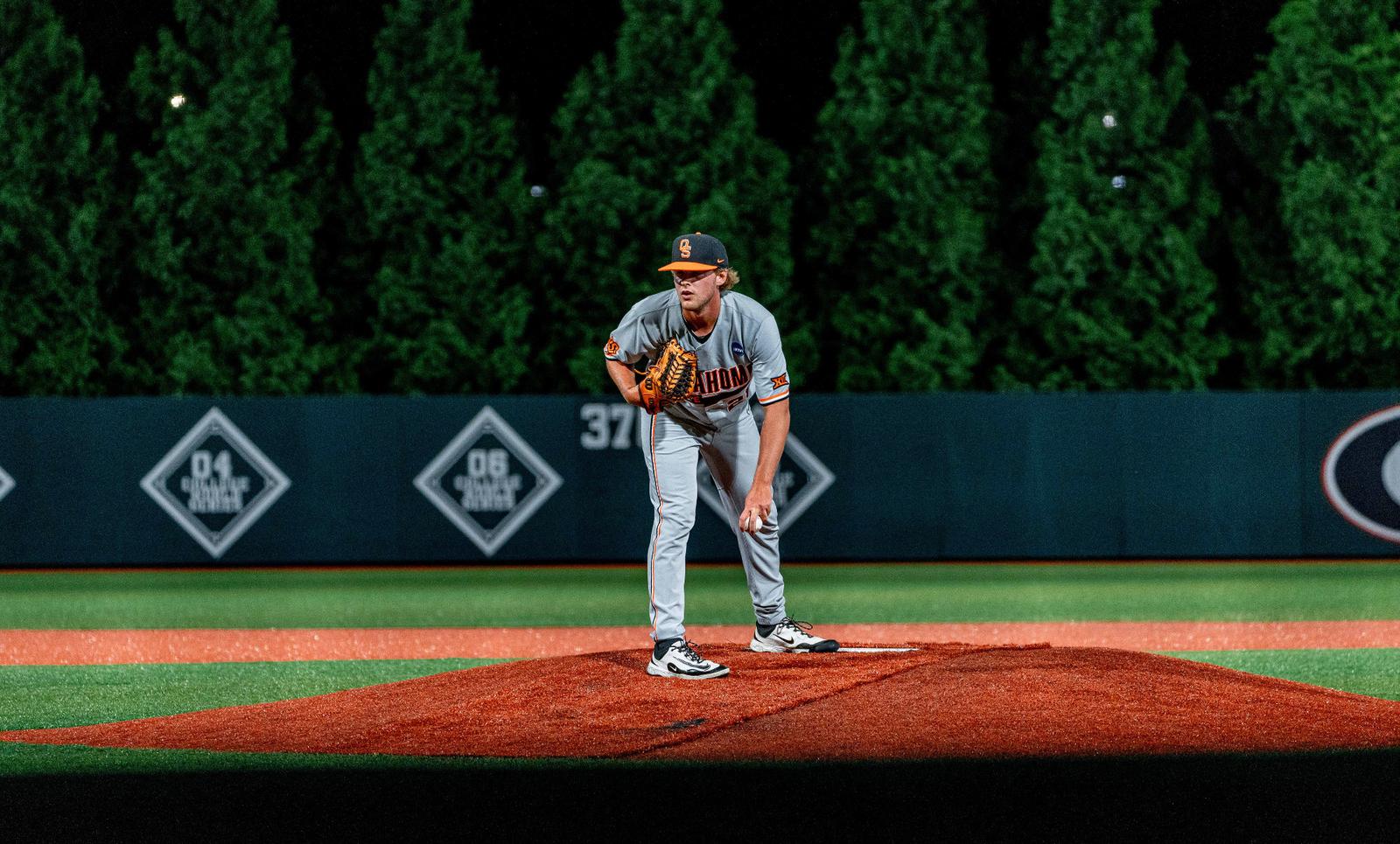
With the loss, the third-seeded Cowboys fell to 28-24, while No. 2 seed Duke is now 38-19. OSU will face fourth-seeded Binghamton in an elimination game Saturday at 11 a.m. (CDT).
The Cowboys smacked four home runs in the loss, with Kollin Ritchie, Garrett Shull, Ian Daugherty and Brock Thompson all going deep, but left nine runners on base in the game.
Mario Pesca took the loss on the mound to fall to 7-3 on the season. The right-hander worked three innings, allowing nine runs on nine hits with two walks and a pair of strikeouts.
Brennan Phillips was strong out of the bullpen, finishing the final five innings on the mound and racking up a career-high eight strikeouts while allowing three runs.
Duke jumped out to a 3-0 lead in the second inning. Following a single and a hit by pitch, a double by Sam Harris brought both runners home. Later in the frame, a two-out single plated the Blue Devils’ third run.
The Blue Devils rallied for six runs in the third to extend their lead. Ben Miller got things started with a solo home run to lead off the inning, and Duke tallied five more hits, including a pair of two-run homers, to take a 9-0 advantage.
OSU got on the scoreboard in the fifth as Ritchie delivered his 11th homer of the season, a no-doubter to right field, and added its second run in the sixth when Shull went deep for the third time this year.
The Cowboys plated three runs in the eighth, cutting their deficit to 12-5, as Daugherty delivered a solo homer and Thompson smacked a two-run blast over the wall in right field.


FORT LAUDERDALE, Fla. – Dan Lanning made a feeble attempt to match Joey McGuire on the humility meter this week at the Orange Bowl by noting both had started out as high school coaches, but he was in over his head. Lanning once drove 13 hours to talk Todd Graham into rescuing him from his high school job. He went on to work for Mike Norvell, Nick Saban and Kirby Smart, a pretty good start on this century’s Mount Rushmore of coaches.
The coach McGuire cited this week as his mentor? Robert Woods, who hired him at Crowley. He credited Gina Farmer, athletic director much of his two decades at Cedar Hill, where he won three state titles, with teaching him to keep the kids first.
Then he slipped this in near the end of Wednesday’s final presser before the biggest football game in Texas Tech history on New Year’s Day:
“For Joey McGuire,” he said, “an ol’ high school coach, to be able to coach in this game and bring the Red Raiders in the College Football Playoff, it’s pretty cool.”
Perfect.
Now all he has to do is beat Oregon and advance to next week’s semis in Atlanta, because there’s no going back from here.
The storylines of both Tech and McGuire dovetail nicely. Both got a late start on this CFP thing. The Red Raiders filled the Big 12 vacuum left by Texas and Oklahoma and looked every part the best team in the state in the process.
Tech earned the fourth seed with a defense that gave up only 10.9 points a game. Beating BYU twice was good, too.
But let’s face it: This wasn’t the high-flying Big 12 of years past. A nice league, but it’s not the SEC or Big Ten. Or at least that’s the consensus.
Don’t get me wrong, the Red Raiders deserved their bye into the quarterfinals. But now they’ve stepped up in competition. This is their chance to prove they didn’t take advantage of a lesser league.
Beating Oregon, a Big Ten power with a considerable CFP history, would make a good case that these aren’t the same old Red Raiders in a different dress.
Right, Shiel Wood?
“Every team that’s left in the College Football Playoff,” Tech’s defensive coordinator said, “is an outstanding team with outstanding coaches and outstanding players. Oregon’s got a great outfit. It’ll be a really good, stiff test for us.
“But it’s a tremendous opportunity for our players and our university on a national stage, and we’re excited about it.”
McGuire gets it, too, in case you were wondering. He was reminded in cards, letters and emails from long-suffering Tech boosters, alumni and former players after they won their first outright conference title since 1955. They’ve been waiting a long time out on the High Plains for a moment such as this. McGuire acknowledged Wednesday that he carries that with him into the game. If that message hadn’t already been delivered by the Tech faithful, Brett Yormark, the Big 12 commissioner, hammered it home in several calls over the last few weeks.
“It’s going to mean a lot,” McGuire conceded, “but we have focused every single week on being in the moment and being where our feet are.
“This is a game that’s a huge game, but our guys know what’s at stake.”
This is where McGuire probably doesn’t get enough credit. Twenty-five million buys a nice roster these days. Twenty-two Red Raiders were voted one Big 12 award or another, but the league’s coaches voted BYU’s Kalani Sitake Coach of the Year. Not saying he didn’t deserve it, but managing Tech’s roster, one with so many new parts, not to mention amid such high expectations, is no small feat. McGuire first demonstrated that ability at Cedar Hill, and it serves him well in the NIL era.
If you ask me, the Orange Bowl comes down to how well Behren Morton plays. Tech’s defense is at least as good as Oregon’s, which gave up 34 points to James Madison. Morton isn’t a hundred percent, but he probably hasn’t been that since high school. He’s as healthy as he’s been all season. If he can move, Tech stands a good chance to win.
Beat Oregon, and Tech will go at least as far as Texas did last year; where Oklahoma hasn’t gone in five years; where Texas A&M hasn’t been in the CFP era. The Red Raiders made a statement in winning their first Big 12 title. They can make a bigger one Thursday.
Do that, and McGuire may have to retire his “ol’ high school coach” bit. No need for him or Tech to try to sandbag anyone if they get past the quarterfinals. They’d better. You can’t be the poster school for the new NIL era if you can’t prove winning pays, too.
Twitter/X: @KSherringtonDMN
Find more Texas Tech coverage from The Dallas Morning News here.
The NCAA transfer portal officially opens for college football players on Friday. The portal will be open for a two-week period ending on Jan. 16, 2026.
Multiple starting quarterbacks across college football have entered the transfer portal in the weeks following the 2025 regular season. Dylan Raiola, Rocco Becht, Drew Mestemaker, DJ Lagway and Brendan Sorsby will be among the thousands of college football players searching for new destinations in 2026.
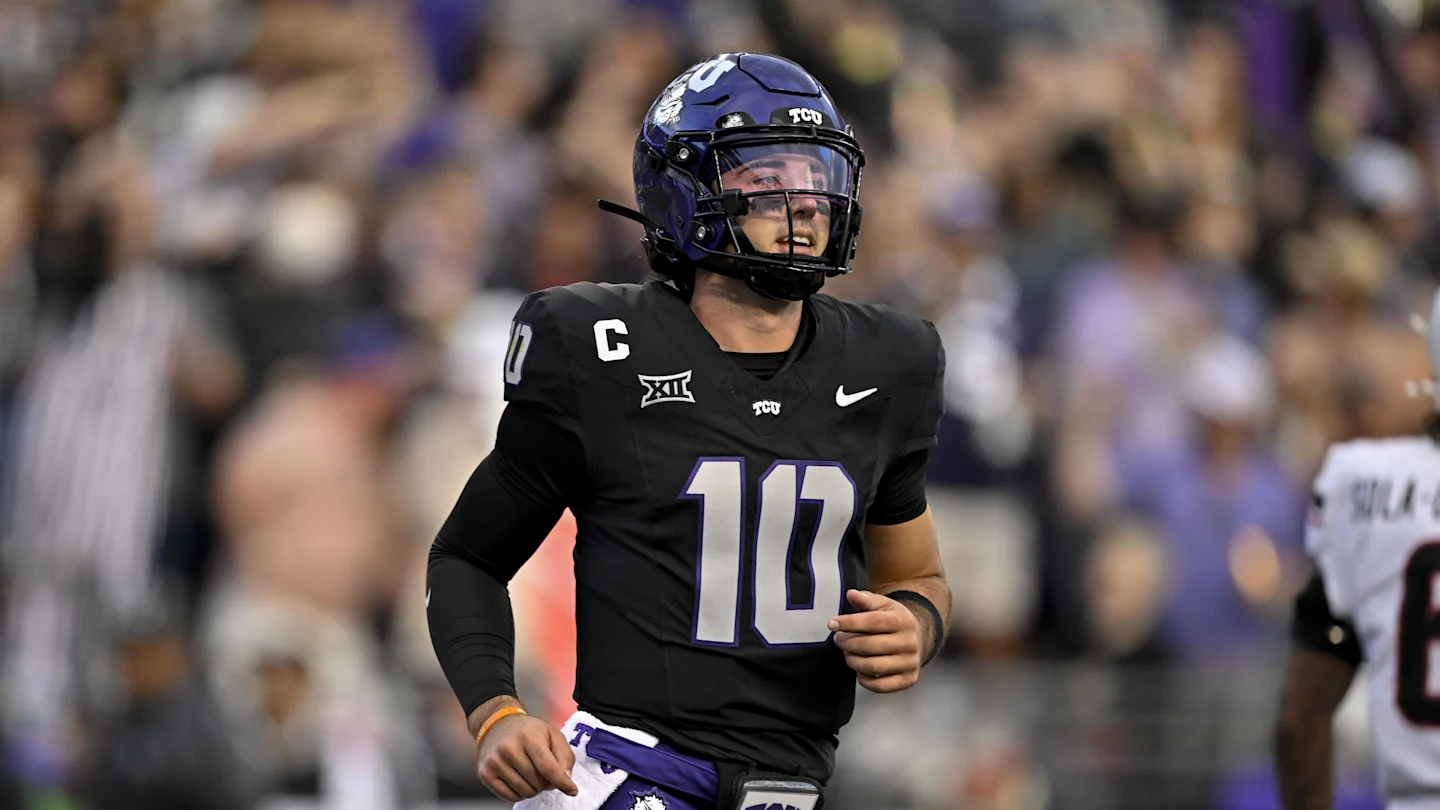
Another significant portal entrant in the 2026 offseason is TCU quarterback Josh Hoover. He will have one season of eligibility remaining at his second college football program.
Some of the quarterbacks in the portal such as Mestemaker and Becht have clear linkages with schools out of the portal. As for quarterbacks like Hoover, the options remain more open than some.
One fascinating link to Hoover from the transfer portal is Alabama. While it may seem puzzling, Hoover was heavily recruited by Crimson Tide offensive coordinator Nick Sheridan while DeBoer was at Indiana.

Mike Golic Jr. called attention to this connection between Alabama and Hoover during a recent edition of Bleacher Report’s “College Football Show.” Golic mentioned the fluidity of Ty Simpson’s NFL draft status when using the rationale for Hoover’s linkage to Alabama.
“A bit of connective tissue: his primary contact when he was being recruited by Indiana was Nick Sheridan, who is the co-offensive coordinator for Kalen DeBoer at Alabama,” Golic said. “That’s an offense that has really been one-dimensional, so they need a quarterback that can sling it all over the yard the way we watched Hoover do it a lot of the season at TCU.”
While quarterbacks transferring from one school to another in the Power Four ranks is nothing new, it would mark a significant moment in the brief history of the NCAA transfer portal. While Alabama has won a national championship with a transfer quarterback, Jake Coker, it has not started a transfer quarterback in the portal era, which began in the 2019 offseason.
As Golic mentioned, Simpson’s decision to stay or declare for the NFL draft could impact a potential pursuit of Hoover. Alabama also has coveted prospects on its roster behind Simpson in Keelon Russell and Austin Mack.
Hoover is leaving TCU as the third all-time leading passer for the Horned Frogs with 9,629 for his career, only behind Trevone Boykin and Andy Dalton. He threw 71 touchdown passes and 33 interceptions in his career with the Horned Frogs.
NIL
Carson Beck college transfer timeline: Why Miami QB left Georgia with NIL money, NFL Draft in mind

Carson Beck college transfer timeline: Why Miami QB left Georgia with NIL money, NFL Draft in mind originally appeared on The Sporting News. Add The Sporting News as a Preferred Source by clicking here.
The Miami Hurricanes have advanced to the second round of the College Football Playoff after defeating Texas A&M in the first round.
Advertisement
A big reason for the Canes’ success this season is the play of quarterback Carson Beck. Beck, a senior out of Jacksonville, Fla., transferred to Miami after spending the first three seasons of his career at Georgia.
So why did Beck transfer from Georgia to Miami? Let’s break down his college career and his decision to forgo the NFL draft and spend his last season of eligibility with the Canes.
MORE:Ranking the 19 greatest Miami players in history
Where did Carson Beck play last year?
Carson Beck played his 2024 season at Georgia, helping lead the Dawgs to the SEC Championship game against Texas. Georgia finished the season 11-3 during Beck’s last season in Athens.
Advertisement
Where has Carson Beck played?
Carson Beck has played at just two schools in his college career, first at Georgia from 2021-2024 and then Miami for the 2025 season.
MORE:Why The Group of 5 still belongs in CFP
Carson Beck colleges timeline

Georgia: 2021-2024
Coming out of high school, Carson Beck was a 4-star quarterback prospect out of Jacksonville, Fla. Rated as the No. 9 pro-style quarterback and No. 34 overall prospect out of the state of Florida, Beck had offers from the likes of Alabama, Penn State and Arkansas, among several others. He committed to Georgia in March of 2019 and signed with the Dawgs that December.
Advertisement
He spent two seasons in Athens backing up Bulldogs starters Stetson Bennett in 2021 and 2022, part of the Dawgs’ national title winning teams those years as a back-up.
He was named Georgia’s starting quarterback for the 2023 season and had his best season, statistically speaking, of his career that year. He threw for 3,491 yards with 24 touchdowns and six interceptions, adding 116 yards with four scores on the ground. The Dawgs finished 13-1 that season, losing to Alabama in the SEC Championship game, which knocked the Dawgs out of the College Football Playoff.
His 2024 season wasn’t nearly as successful. He threw for 3,175 yards with 26 touchdowns and 10 interceptions — a number that led the SEC. He had three interceptions in losses to Alabama, including another three vs. Texas and Florida. His 10th interception of the year came on the road against Ole Miss, handing the Bulldogs their second loss of the season.
Although he rebounded with a win over Tennessee to send Georgia to the SEC title game, his season was unfortunately cut short against Texas in that game. Right before halftime, Beck was tackled and ruled out with an elbow injury. He ultimately suffered a UCL tear on his throwing arm, which ended his season early. He briefly declared for the 2025 NFL Draft but ultimately transferred to Miami instead.
Advertisement
MORE:Georgia football timeline of trouble under Kirby Smart
Miami: 2025
At Miami, Beck has put up similar numbers to what he did at Georgia, throwing for 3,175 yards with 26 touchdowns on the year. Although he has thrown 10 interceptions on the year, four of those came during Miami’s loss to Louisville earlier in the season. In fact, Beck hasn’t thrown an interception since Miami’s Nov. 1 loss to SMU.
While Miami relies heavily on its dominant rushing attack, Beck’s performances have been good enough to help the Canes win 11 games. Against Texas A&M in Miami’s first-round victory, Beck went 14-of-20, throwing for 103 yards with a touchdown.
Advertisement
MORE:Revisiting Lee Corso’s greatest ‘College GameDay’ moments
Why did Carson Beck leave Georgia?
At the end of the 2024 season, Gunner Stockton had played adequately in Carson Beck’s absence. After his disappointing finish to the season, it was clear Beck needed a fresh start, either in the NFL or elsewhere.
At Miami, Beck was drawn to how he fit within its system as a quarterback.
“Yeah, I think the biggest thing for me, obviously, was the offensive fit,” Beck said via UGA Wire. “As a quarterback, the OC, the scheme, the talent and guys that you’re going to have around you is huge to the success and ultimately the future of a quarterback.”
Advertisement
He added that the decision to leave Georgia was still a “very difficult” one.
“This is my future, and I think this is one of the better decisions I’ve made,” Beck continued. “And since I’ve been here in January, developing the relationships and building the chemistry between me, the wide receivers, the running backs, the tight ends, the O-line, and just trying to develop those relationships and that camaraderie, it’s just reinforced my decision in a positive way.”
MORE:College football’s 30 highest-paid players
Carson Beck NIL money
According to CBS Sports, Carson Beck’s NIL deal is around $4 million for the 2025 season.
Advertisement
Carson Beck NFL Draft projection
Carson Beck’s current draft stock appears to be closer to a Day 2 or 3 pick, but that could change if he leads Miami on a deep CFP run.
ESPN’s Matt Miller lists Beck as a second-round pick, whereas NFL Mock Draft Database has him as a fourth-rounder. But with plenty of time between now and the NFL Draft process, there is plenty of time for that to change.
MORE:History of Miami QBs in the NFL, from Jim Kelly to Cam Ward
Has Carson Beck won a championship?
Only as a backup. Carson Beck was part of two national championships with Georgia in 2021 and 2023, and Georgia defeated Texas 22-19 to win the SEC Championship game against Texas after Beck got injured. His backup, current Dawgs starter Gunner Stockton, came off the bench for Beck and helped Georgia win that game.
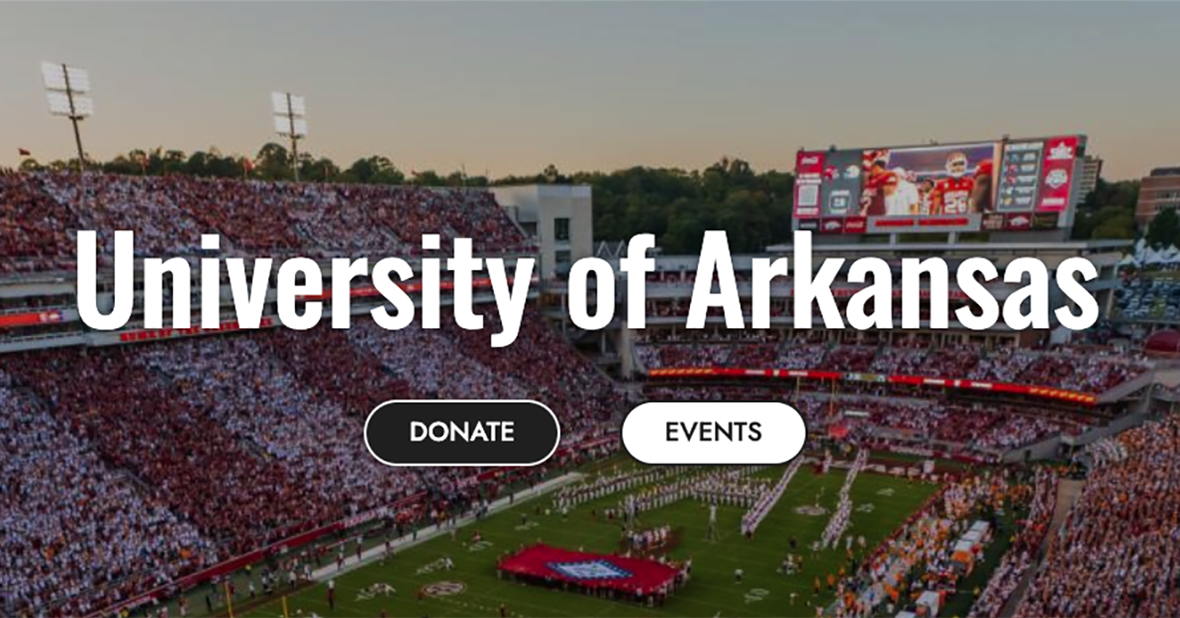
On Tuesday, the University of Arkansas announced a new partnership with TheLinkU to expand name, image and likeness opportunities for Razorback student-athletes. Since then, I have taken some time to explore the website and hit all the buttons to see what all it entails. My early opinion? It’s actually pretty good.
First the backstory… Arkansas has gone through two failed platforms that attempted to enhance and streamline the NIL experience for its student-athletes in ONEArkansas and Arkansas Edge. ONEArkansas focused largely on non-profits and charitable works, while Edge was managed by Blueprint Sports in what turned out to be — at least from Arkansas’ perspective — a failed effort to connect fans, businesses and athletes.
First, before you read my opinion, I must acknowledge that I opened this website with a little prayer of hope for a new age and without the skepticism I have been dragging with me the last few years… I am trying to put that behind me as we move forward to 2026 and the Ryan Silverfield era. So understand my mental state on this New Years Eve is one of hope.
So, I am pleased with what I am seeing with regard to the layout and structure at TheLinkU. Backed by a little hope and faith for a new era, I think there is a lot of promise here.
It is overdue, no doubt, but there is finally a clean and easy way for every Razorback fan to donate directly to the sport they want to support, from $10 to an infinite amount.
And, while Arkansas athletes are not individually integrated just yet, soon there will be opportunities for fans to directly connect with them.
So not only will fans be able to support the particular sport(s) they want, there are also ways to support an individual player if they choose.
HOW TO DONATE TO SPORTS
The donation page to support certain sports is pretty simple to access. Just click here: Donate to University of Arkansas NIL
Or from the homepage on desktop, click here (TheLinkU.com), hover over ‘SCHOOLS’ and scroll down to ‘University of Arkansas.’ The ‘U’ in University is alphabetical, not the ‘A’ in Arkansas. It’s right under ‘University of Alabama.’ I’d like this to change and just read ‘Arkansas.’
On mobile, it’s the same link, click here (TheLinkU.com). You will see three lines at the top right. Tap that. Select Schools, scroll to University of Arkansas.
There, you will see two options. ‘Donate’ and ‘Events.’ There are no events just yet. Click or tap ‘Donate,’ or just scroll down and you’ll see several options. Each option allows you to select the sport of your choice for which you would like to donate.
There’s the option to make a one-time donation to a particular sport, or you may sign up for monthly donations that come with perks, like a 10%, 15% or 20% discount to the NIL shop (where you can buy team merchandise), a monthly newsletter, gift boxes or ‘shout outs.’ More on the ‘shout outs’ below.
HOW TO CONNECT WITH ATHLETES
As stated, you can also connect directly to the athletes. Just click here: The Athlete Shop
Or, go to the homepage by clicking here (TheLinkU.com), select ‘FANS,’ in the middle of the screen on both desktop and mobile, select ‘ATHLETE SHOP.’ There, you are able to search by school. Again, not the ‘A’ in Arkansas but the ‘U’ in University… so you’ll need to scroll down… or you can type in ‘Arkansas’ and it’ll bring up all Arkansas schools.
As noted, Arkansas players are not yet integrated into the system, so as of now this is not an option.
But it will be soon, and when it’s ready, fans will be able to select the athlete and choose ways to engage with them.
I selected Houston senior defensive back Blake Thompson just to see what my options are. I can select an ‘Autograph,’ a video ‘Shout-out’ that is labeled as ‘most popular,’ a ‘Post’ and a ‘Meet.’
Selecting Autograph, I can have Blake sign a sport specific item for $55, a university T-shirt for $40 and a photograph for $35. As I pay, I can include ‘additional information regarding your request’ to provide Blake details of what I want more specifically.
Blake charges $300 to do a video shout-out, which I found to be quite expensive for a defensive back based on others I saw. But he’ll roast my buddy if I want, he’ll give advice, give me a pep talk, offer a birthday wish or do just about anything. Think of this like Cameo.
Most shoutout costs I saw were in the $50 range. Amare Thomas, who had 972 receiving yards and 12 touchdowns this past season for the Cougars, is only charging $50 for a shout-out, so Blake definitely is on the higher end.
Niccolo Moretti, a basketball player from Florida Atlantic, only charges $20 for one of these shoutouts. But the autograph prices are the same for all athletes as far as I could tell.
Now if I want to meet one of these athletes, I can make a monetary bid and provide details about what I want, and they’ll “do their best” to respond to my bid in 24 hours. In my head, I live in town, so maybe I’d like to pay a star athlete $500 to come to my kid’s birthday or something?
It’s the same way for a ‘post,’ which I assume means a social media post from the athlete.
MERCHANDISE & UNKNOWN
I can also visit the NIL shop and buy player jerseys or university merchandise. Houston basketball jerseys for specific players run $95. Other team-oriented clothing and gear is about what you’d expect, $35ish for a cap or a t-shirt, $70 for a hoodie.
I am not sure what percentage of these purchases go to fund NIL opportunities, but I do know that a portion of those purchases do.
I am also unsure what percentage TheLinkU takes from the donations to support NIL, if it’s a direct payment from Arkansas to run things or what, but obviously they have to make money to operate.
As I reported in October, Blueprint Sports took 15% of Arkansas Edge NIL donations, which would have been considered reasonable had the partnership been fruitful.
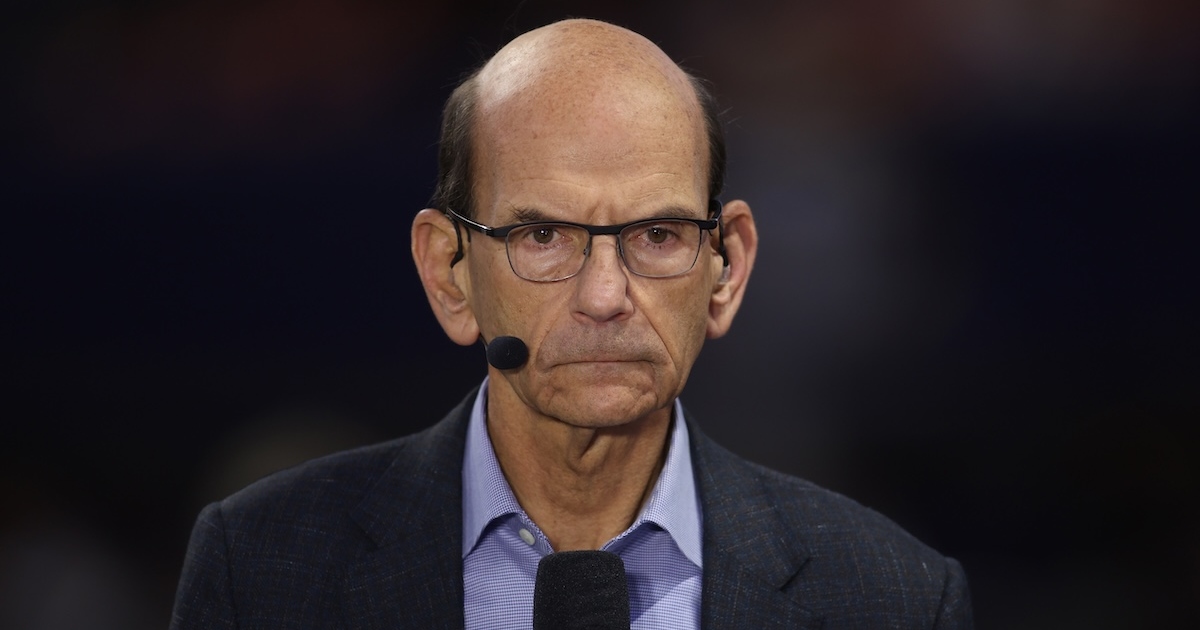
ESPN’s Paul Finebaum called the current layout of college football bowl games “a serious problem” these days. There are plenty of bowl games, so it’s hard to miss them.
But the problem, as Finebaum described, is that the postseason is pretty much all about the College Football Playoff. So even the bigger bowl games are reduced, while the smaller ones that come around once a year to smaller communities are diminished.
“Well, I think the playoff decision will be made quickly, and I think there is momentum to expand it for next year,” Finebaum said on McElroy and Cubelic. “The bowl situation is really a serious problem. Cole, you’ve done some games … and will do some more. And I mean, I flipped on the TV early this morning, and this is not a shot at Birmingham, but I mean, I wasn’t really that aware that the game was going on, because things are different.
“Way before you guys were even around, you knew about that bowl game six weeks out, because it was, it was such a sense of pride in the community, whether in Birmingham or Shreveport or Nashville or wherever. And because of the complexities of college football, that has gone away when a lot of people, you walk into a mall today, they couldn’t tell you who was playing downtown.”
So if you caught a bowl game over the last couple of days, that’s normal. The buzz is simply different these days.
“And it’s hard, because these are essentially television events,” Finebaum said. “They’re great television events Saturday, if you didn’t have anything to do and wanted to watch about eight or nine football games on multiple screens. You could see it, but they’re just not important anymore. The community influence is gone and they’re essentially something to put on between the end of football or at the end of the regular season and the championship game, and they fill in the gaps at weird times of the day, weird matchups that make very little sense.
“And it’s not completely going away. But every time the playoff expands, what used to be a good or great or average bowl game becomes even less important.”
If you’re looking at the bowl schedule for New Year’s Eve, it’s highlighted by Miami and Ohio State in the CFP quarterfinals at the Cotton Bowl. But there are some good games! That includes Iowa–Vanderbilt and Michigan–Texas.
What do they mean in the grand scheme of things? Perhaps less and less as time rolls on.

Getty
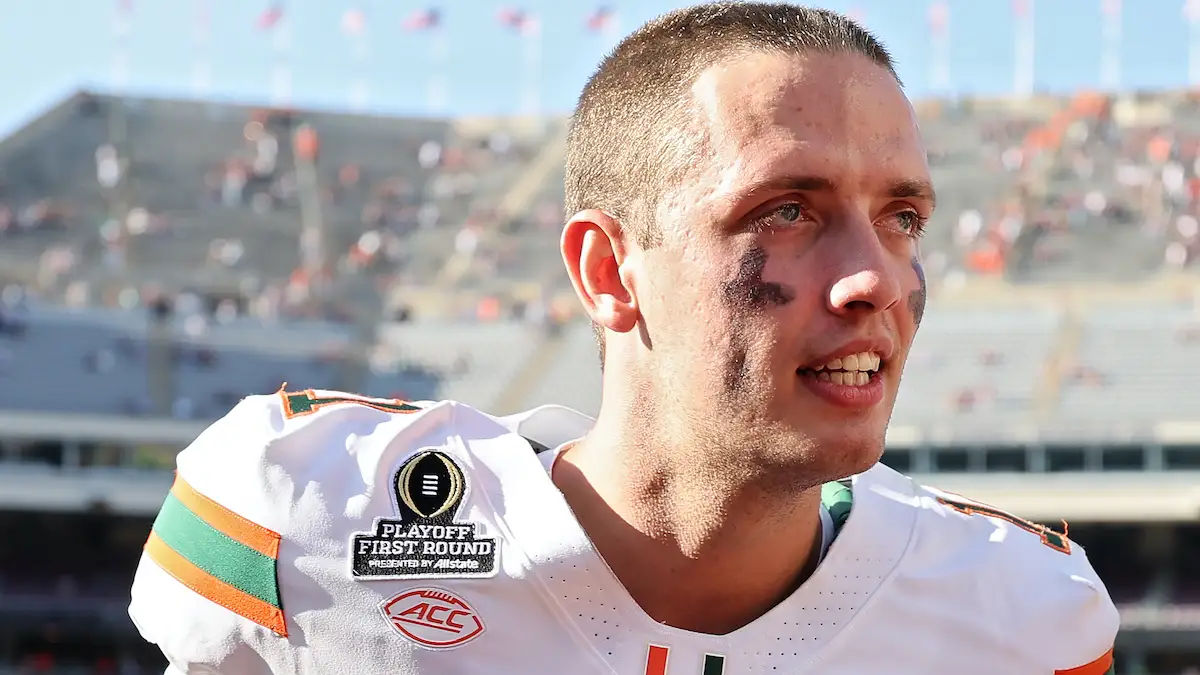
Carson Beck of the Miami Hurricanes.
Miami Hurricanes quarterback Carson Beck faces what will likely be the most significant challenge of his six-year college football career on New Year’s Eve, when his team faces the defending national champion Ohio State Buckeyes in the Goodyear Cotton Bowl Classic at AT&T Stadium in Arlington, Texas.
The game is a quarterfinal matchup in the College Football Playoffs, so by getting to this point Miami can say it got its money’s worth when it induced Beck to transfer from Georgia, where he spent the first five years of his college career. But how much money does Beck receive?

What is NIL Money?
Until 2021, college football players, like all undergraduate athletes, were supposed to be amateurs. Taking money in any way related to their status as athletes was strictly forbidden under NCAA rules. But a United States Supreme Court decision that June ruled that those restrictions violated federal antitrust laws — opening the door to college athletes receiving monetary compensation for their efforts on the field.
The resulting system allows athletes to be paid for use of their “Name, Image and Likeness,” or NIL. By supposedly limiting pay to an athlete’s personal business activities, the NCAA allowed itself to pretend that its athletes were still “amateurs.”
And Beck is one of the highest-paid “amateurs” in all of collegiate sports.

Miami QB Estimated as 3rd-Highest Paid
According to Pro Football Network’s college quarterback statistical rankings, Beck ranks an unimpressive 36th in the nation in the impact he has made on his team’s ability to win.
But according to the sports financial site On3, as of December 31 Beck owned the third-highest NIL valuation in college football, with a package estimated at $3.1 million.
At No. 1, according to the site, is Texas Longhorns quarterback Arch Manning, whose NIL deal is estimated at $5.3 million. Behind Manning, in the second slot, is the Buckeyes’ sophomore wide receiver Jeremiah Smith, who raked in $4.2 million this season.
In all of college sports, according to the On3 NIL 100 rankings, Beck’s $3.1 million NIL package places him fourth. The 18-year-old Brigham Young University freshman forward AJ Dybantsa, the No. 1 high school basketball recruit in this year’s class, places second, ahead of both Beck and Smith, with an estimated $4.4 million in NIL cash.

Beck Rumored to Receive Much More
Beck’s current $3.1 million estimate, however, is considerably lower than various rumors had him receiving earlier this year, when he transferred from Georgia for his final year of college eligibility. Those initial reports put his NIL compensation in the $4 million range, with some estimates ranging as high as $6 million due to various incentives.
But even back in January those rumors seemed inflated, and reporters Bruce Feldman and Manny Navarro of The Athletic revealed a more realistic figure of “a little over $3 million,” which of course fits with the $3.1 million the 23-year-old is estimated to receive by On3.
According to the Athletic reporting team, however, Beck’s deal was still nearly double the reported $1.6 million received by Beck’s predecessor at Miami, Cam Ward.
Ward became the No. 1 overall NFL draft pick this year. Beck is currently projected by the NFL Mock Draft Database to be selected in the fourth round in 2026.

Jonathan Vankin JONATHAN VANKIN is an award-winning journalist and writer who now covers baseball and other sports for Heavy.com. He twice won New England Press Association awards for sports feature writing. He was a sports editor and writer at The Daily Yomiuri in Tokyo, Japan, covering Japan Pro Baseball, boxing, sumo and other sports. More about Jonathan Vankin
More Heavy on Miami
Loading more stories

Joey McGuire plays ol’ high school coach as Texas Tech faces pivotal moment vs. Oregon

Fantin’s Late Goal Lifts No. 4 Nittany Lions over No. 10 Cornell – Penn State

2025 All Mountain Volleyball | Sports

KU signee Stanley set for All-America Game

Major college football program among candidates to land $1.4 million QB

St. Cloud State Athletics Names Wolters Kluwer Athletes of the Month for December

Three Husker Newcomers Set for Under Armour Next All-America Match – University of Nebraska

2025 All-Westbank Volleyball Team – Crescent City Sports

Carson Beck college transfer timeline: Why Miami QB left Georgia with NIL money, NFL Draft in mind

Ross Chastain Credits Kevin Harvick’s Retirement for Opening Door to Iconic Sponsor

NHL program to host youth hockey clinics in Big Sky
Tacoma Light Trail

Kyle Larson 2025 season in review: No. 5 team wins second Cup Series championship

Historic NASCAR track Richard Petty loves has new owner – Motorsport – Sports
Parents of motocross star Aidan Zingg file wrongful death lawsuit

SoundGear Named Entitlement Sponsor of Spears CARS Tour Southwest Opener

Donny Schatz finds new home for 2026, inks full-time deal with CJB Motorsports – InForum

Black Bear Revises Recording Policies After Rulebook Language Surfaces via Lever

How Donald Trump became FIFA’s ‘soccer president’ long before World Cup draw

David Blitzer, Harris Blitzer Sports & Entertainment

DeSantis Talks College Football, Calls for Reforms to NIL and Transfer Portal · The Floridian
Elliot and Thuotte Highlight Men’s Indoor Track and Field Season Opener

JR Motorsports Confirms Death Of NASCAR Veteran Michael Annett At Age 39

Rick Ware Racing switching to Chevrolet for 2026

#11 Volleyball Practices, Then Meets Media Prior to #2 Kentucky Match

23 عاما من الفضائح السياسية والجنسية منذ انقلاب حمد بن خليفة.. استغلال الفتيات الصغيرات في الدعارة.. ضبط ابنة رئيس وزراء قطر خلال ممارستها لجنس الجماعي.. ملامح الحكم تتخبط بين المنفي وتدخلات النساء

Colleges ponying up in support of football coaches, programs

Nascar legal saga ends as 23XI, Front Row secure settlement
West Fargo volleyball coach Kelsey Titus resigns after four seasons – InForum

23 عاما من الفضائح السياسية والجنسية منذ انقلاب حمد بن خليفة.. استغلال الفتيات الصغيرات في الدعارة.. ضبط ابنة رئيس وزراء قطر خلال ممارستها لجنس الجماعي.. ملامح الحكم تتخبط بين المنفي وتدخلات النساء





-
 Sports3 weeks ago
#11 Volleyball Practices, Then Meets Media Prior to #2 Kentucky Match
-
 Motorsports3 weeks ago
Nascar legal saga ends as 23XI, Front Row secure settlement
-
 Motorsports3 weeks ago
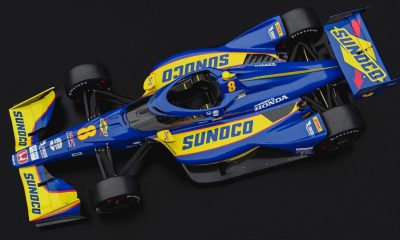
Sunoco to sponsor No. 8 Ganassi Honda IndyCar in multi-year deal
-
 Sports3 weeks ago
Maine wraps up Fall Semester with a win in Black Bear Invitational
-
 Motorsports2 weeks ago
Ross Brawn to receive Autosport Gold Medal Award at 2026 Autosport Awards, Honouring a Lifetime Shaping Modern F1
-
 Rec Sports3 weeks ago
WNBA’s Caitlin Clark, Angel Reese and Paige Bueckers in NC, making debut for national team at USA camp at Duke
-
 Motorsports3 weeks ago
Rick Hendrick comments after the NASCAR lawsuit settlement
-
 Sports3 weeks ago
Creating a Legacy: Maddie Scheier
-

 NIL3 weeks ago
Nike Signs 10 LSU Athletes to NIL deals
-
Sports3 weeks ago
Wisconsin defeats Stanford in NCAA regional semifinals: Updates, recap