Inside the athletics department’s decision and the impact this new era is having on women’s and Olympic sports.
Video: One-on-one interview with Louisville volleyball coach Dan Meske
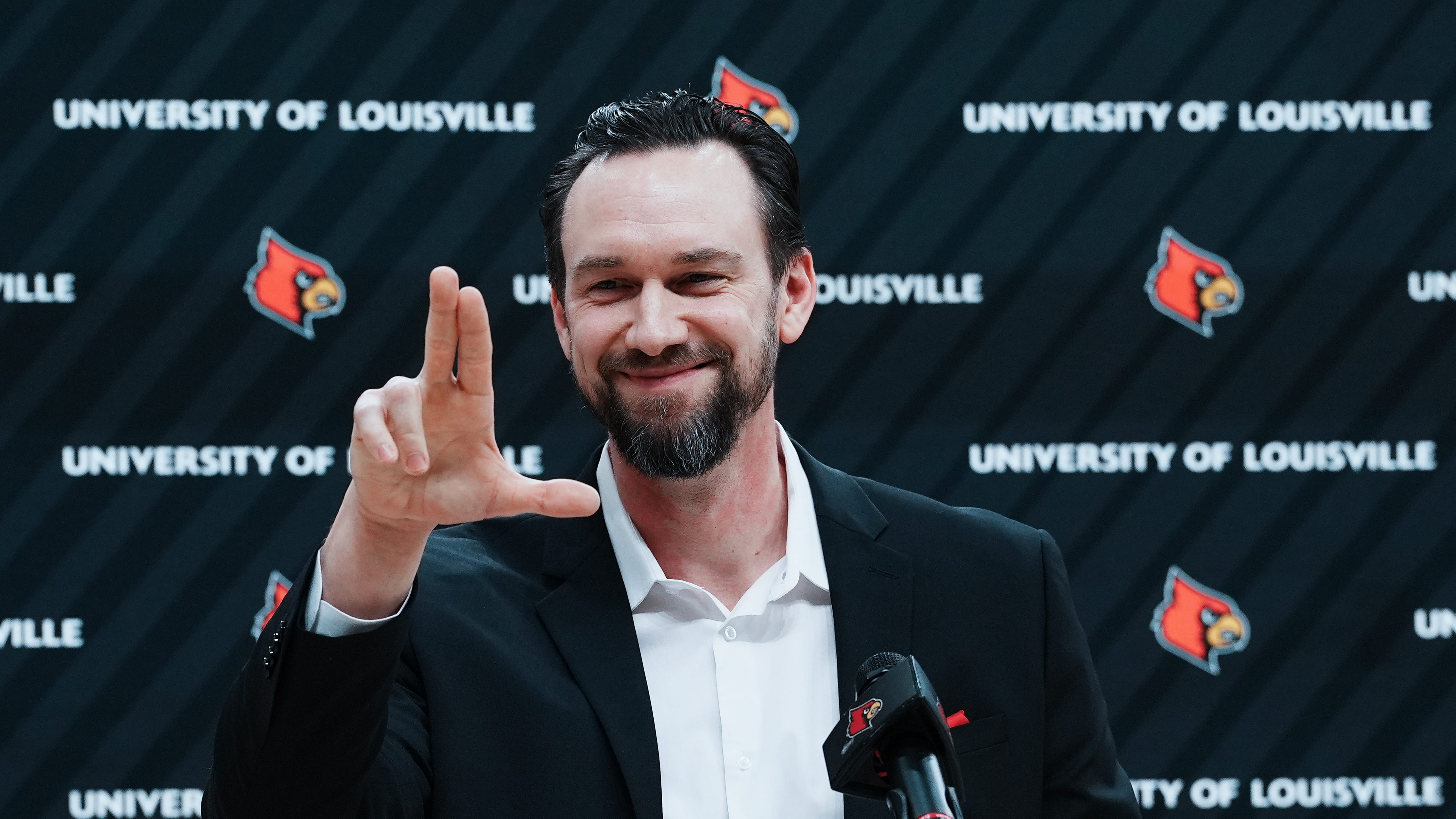
Louisville Cardinals volleyball coach Dan Meske sits down with The Courier Journal to discuss his career and vision for the future of the program.
- Athletics director Josh Heird told The Courier Journal that U of L will invest in the following five sports: football, men’s basketball, women’s basketball, baseball and volleyball.
- Nine schools, including U of L, expressly told the CJ they are investing revenue-sharing money into women’s volleyball.
The Dan Meske era of Louisville volleyball officially begins Friday versus Auburn as part of the Cardinal Classic at L&N Arena.
Friday also marks U of L’s first game of the revenue-sharing era, in which schools are allowed to pay athletes directly with a per-institution cap of $20.5 million (a number set to increase annually by 4%). While most schools will likely put the bulk of their $20.5 million into programs that turn a profit, athletics director Josh Heird told The Courier Journal that U of L will invest in the following five sports: football, men’s basketball, women’s basketball, baseball and volleyball.
“I think if you asked anybody around the country,” Heird said, “‘Are you giving rev share to football, men’s basketball, women’s basketball?’ There’s probably not a school that’s going to say we’re not at least giving something to those three. I think volleyball is a unique one.”
The Courier Journal asked 26 athletics departments (including Louisville’s) that sponsor college volleyball’s top programs whether they’re allocating revenue-sharing money to those athletes. Four of those 26 never responded to the inquiry. Thirteen either declined to answer or did not answer in their responses. And nine confirmed volleyball would receive a cut but did not share specific percentage breakdowns when asked to.
The following schools expressly told The Courier Journal they are investing revenue-sharing money into women’s volleyball:
Louisville’s logic as far as which programs to invest revenue-sharing money into came down to three factors: return on investment; external impact of on-field/on-court success, or good PR; and coaching staffs with proven track records.
Volleyball doesn’t bring in units like both NCAA basketball tournaments or TV money like football. But the program’s consistent top-ranked status shines a positive light on U of L’s overall brand, more so than a top-25 team finish at the NCAA outdoor track & field championship, as both Louisville’s men’s and women’s squads achieved this summer. For example, the 2024 volleyball national championship between Louisville and Penn State drew 1.3 million viewers, peaking at 1.9 million, according to ESPN. Viewership and visibility are valuable, if not easily convertible to exact dollar amounts.
While 2025 will be Meske’s first as head coach of Louisville volleyball, he served as Dani Busboom Kelly’s associate head coach from 2017-2024, helping lead the Cards to two national championship appearances and three Final Fours. So, from Louisville’s perspective, Meske has a proven track record of success. To maintain that success, and to finally snag an NCAA title, will require investment.
Especially knowing that other top volleyball programs will invest, too.
“Volleyball, they’ve had success, and we’ve invested in it,” Heird said. “So, it’s like, ‘Hey, we’re committed here with volleyball, and if we don’t do some things from a rev-share standpoint, then we should probably reduce everything that we’re doing from a volleyball standpoint. Because we’re not going to have the success that we want to have.’ And I think that was one of the biggest questions for us in making these decisions. Like, do we just do a little here, a little there, here? It was like, no … where can we have the most success?”
It’s an imperfect calculation. And many athletics departments are keeping the details to themselves, citing the need to maintain a competitive advantage, despite the fact that all schools are working with the same salary cap. And despite questions from fans who’ve donated to their NIL efforts and local taxpayers whose money is helping fund institutional support in the form of loans from universities to athletics departments claiming aid to stay afloat.
Earlier this year, Heird told The Courier Journal that Louisville had no plans to cut any of its 23 sports teams to help offset revenue-sharing costs. But that is a widespread, national concern among proponents of Title IX and Olympic sports.
Under the Biden administration, the Department of Education’s Office for Civil Rights issued a guidance saying NIL money should be treated the same as financial aid (like scholarships), i.e. subject to Title IX. Title IX is a 53-year-old antidiscrimination law requiring schools to issue financial assistance in proportion to the number of men and women who play varsity sports. The law also requires schools to provide opportunities for men and women to play sports that are proportionate with the student body’s gender makeup.
However, the Trump administration rescinded this guidance, meaning schools can manage their revenue-sharing budgets however they see fit without any risk of violating Title IX. Many schools have chosen to dump an overwhelming percentage into revenue-generating sports like football and men’s basketball.
Stephen F. Austin State University in Texas just lost a Title IX lawsuit filed by current athletes seeking to protect women’s bowling, women’s golf and beach volleyball after the school announced the elimination of those programs (plus men’s golf) “based on sustained departmental budget deficits and the anticipated financial impact of upcoming revenue-sharing requirements with Division I athletes.” SFA filed a notice of appeal Aug. 7, according to online court records.
“The funding of those revenue-sharing payments for football players and men’s basketball absolutely cannot come at the expense of women’s sports,” plaintiff attorney John Clune told USA TODAY. “So this is a huge message to schools across the country. Whatever you have to do to figure out how you’re going to fund your revenue-sharing payments, it’s not going to come at the expense of women’s opportunities to participate in sports. That’s a big deal.”
While President Donald Trump issued an executive order this summer stating that “all college sports should be preserved and, where possible, expanded,” including women’s and other non-revenue-generating sports, the word “should” is key. His anti-DEI executive orders used the threats like litigation and revocation of federal funding as enforcement. The “Saving College Sports” EO is effectively toothless until and unless Trump’s Cabinet members come up with policies to actually implement what he outlined in July.
That’s why many leaders in college sports — including Heird — are looking to Congress. Before he became an administrator, Heird spent five years in Washington, D.C., working for Rep. Mike Simpson of Idaho and Sen. Wayne Allard of Colorado. Those five years are proving very useful nowadays, as he lobbies Kentucky representatives to support federal regulation of college athletics.
“Congress doesn’t get involved in anything, for the most part, until they feel like they need to,” Heird said. “And I do believe that we’re at that point. … In a perfect world, free market society, none of that takes place. But that’s just the fundamentals of government. Like, ‘Hey, this isn’t working by itself. We need to step in and raise guardrails, rules, laws, so that it works better for everybody.’
“And the other piece of it, too, is this idea that college athletics is uniquely American. Nowhere else in the world do we have something like college athletics that supports opportunities for student athletes from all different backgrounds, supports women’s sports, supports Olympic sports, all these different things. If you look at why we are so good at the Olympics, I would contend it’s because of the college athletics model for all intents and purposes. And so I absolutely think college athletics needs to be protected for those reasons.”
Speaking of legislation, the U.S. Olympic & Paralympic Committee sent a letter to lawmakers expressing concern with the House’s SCORE Act (Student Compensation and Opportunity through Rights and Endorsements), a bipartisan bill with the aim of establishing national standards around collegiate athlete compensation.
“Without careful calibration,” the letter read, “proposed legislative reforms could result in potential for widespread program cuts, or material reductions in the investment level, that could dismantle decades of progress in sport diversity and opportunity.
“We encourage Congress to consider a model that ensures proportionate investment in operating costs and scholarships across sports programs.”
When asked how Louisville is working proactively to preserve Olympic sports and abide by Title IX during an era of constant flux within the industry, Heird said:
“For me, it’s, ‘Can we do a really good job of taking care of all of our 23 sports?’ I think we have a great track record investing in all of them. Obviously there’s always been some push and pull there relative to investment, but there’s more now. But if football and basketball for us aren’t successful, then everybody’s resources are going to get reduced.
“And I think that’s what you’re really trying to reconcile, is, ‘How do we make sure that we can provide the most resources to all of our programs?’”
Reach college sports enterprise reporter Payton Titus at ptitus@gannett.com and follow her on X @petitus25.