
NIL
Deadline, expedited College Sports Commission roll out, worries non-Power Conferences

Dan Butterly sat inside a large conference room inside Orlando’s World Center Marriott Resort and listened as Ohio State athletic director Ross Bjork and select members of the Settlement Implementation Committee explained how the newly-approved House v. NCAA settlement would change college athletics as we know it during the first panel of last week’s National Association of Collegiate Directors of Athletics (NACDA) convention.
Bjork is part of a 10-person working group made up of two ADs from each of the five defendant – known colloquially as the “Power” – conferences that have been developing ways to implement the terms of the House v. NCAA class-action settlement approved late June 6 by California district court judge Claudia Wilken.
And while the NACDA panel was certainly educational, especially for ADs and administrators from the more than 300 Division I schools that weren’t defendants in the groundbreaking House case, which combined three separate lawsuits against the NCAA, it left many in the room with more questions than answers.
“In some ways it felt like they were trying to educate us, but at the same time talking down in some ways,” Butterly, the Big West Conference commissioner, told On3 after emerging from that panel Tuesday morning, “just because of the lack of information that’s available to the rest of us in the room.”
A week after Wilken’s approval, the NCAA and defendant conferences jointly released a 36-page question-and-answer document late Friday that provided some clarity on an array of questions provided to the NCAA over the last year. But there still remain several key issues that have non-defendant Division I conferences and schools raising concerns about the expedited pace at which these groups are being asked to opt-in to the new world order, even after the original June 15 deadline was extended to June 30.
Butterly described it as creating “frustration and confusion” for schools from outside the defendant/Power conferences – i.e. the ACC, Big Ten, Big 12, and SEC.
“Now we know where the goalposts stand, and rather than being in a defensive stance and not know which way the ball is going to go, now we know where the ball is going and you have to adjust to it,” Butterly said. “But we just don’t know the playing rules yet, and it’s really about trying to get clarification beyond the stuff we see posted (in the media).”
NEW WORLD ORDER
The new House settlement formally ends the NCAA’s long-standing “amateurism” model in favor of revenue-sharing that allows Division I schools to provide direct financial payments to student-athletes beginning July 1. At least for the 2025-26 academic year, Division I programs are able to share up to $20.5 million, or 22-percent of the Autonomy/Power conferences’ aggregate revenue from media rights, ticket sales, and sponsorships.
There is also nearly $2.8 billion in back damages to be paid out over a 10-year period to former NCAA student-athletes who competed between 2016-24 that were either fully or partially unable to take advantage of NIL or rev-sharing. A significant portion – more than 85-percent – is expected to go toward athletes who participated in the highest revenue-generating sports: football and men’s basketball. Before Wednesday’s Title IX appeal was filed, putting back damages on pause during the appeal process, the first back payments were set to be paid within 45 days of the settlement’s finalization – July 21.
The House settlement also facilitated the creation of the College Sports Commission, a new enforcement entity that will implement the settlement’s rules around revenue-sharing, NIL and roster limits, as well as Deloitte’s “NIL Go” clearinghouse, which will regulate and approve third-party NIL deals above $600 between athletes and non-institutional entities based on an algorithm that determines an athlete’s fair-market-value within an established “range of compensation” based on similar NIL deals.
As NCAA president Charlie Baker explained at a May 20 panel set up by the Knight Commission, the College Sports Commission and NIL Go will serve as “the vehicle through which most of the so-called ‘money issues’ get addressed.”
But while all those new innovations are generally seen as welcomed changes across what had become an almost unchecked marketplace in college athletics, it’s the general lack of transparency about what the next stage will look like, including yet-to-be-finalized specifics – including legal contract language – about the College Sports Commission and NIL Go.
“It was very alarming and frankly discouraging that institutions that had a choice of whether to opt-in or not felt an urgency to make that decision, and there was a huge vacuum of information about how the terms will be implemented and what the impacts could be,” Knight Commission CEO Amy Perko told On3. “This plane is being built while it’s in the air.”
According to Butterly, the non-defendant conferences have yet to receive any indication whether they’ll be required to sign the same “participation agreements” the Power Five programs must sign with the College Sports Commission that not only codifies the settlement terms but binds all parties against taking legal action to settle disagreements.
Michael Cross, the Southern Conference commissioner, also raised similar concerns about a yet-to-be-revealed financial charge associated with joining the CSC – much like there’s a cost to be a part of the NCAA – or to utilize Deloitte’s NIL Go clearinghouse.
“None of those entities are doing their work for free, but there’s been no suggestion or clarity about where and how the costs and expenses to run these entities are going to be assigned,” Cross told On3.
And given the lack of transparency with those outside the defendant conferences, there is concern those legally-binding agreements could be forced on institutions just prior to the new June 30 deadline, not allowing time for each institution to best evaluate the full legal scope of the agreement.
“That’s the $20.5 million question,” Butterly said. “Once this information is released, … if they require as part of the opting in … that you have to agree to this contract as an opt-in institution, that takes some time. You can’t just as an AD or commissioner sign off on behalf of your membership or institution. That has to go through a legal process.”
Added Cross: “Nobody would run a business this way, nobody would say: ‘Oh yeah, we’ll write you a blank check and send me the bill later.’”
MONEY MATTERS
While most of the defendant/Power conference institutions are expected to take full advantage of the new rev-sharing cap, which allows programs to dish out up to the $20.5 million annually to student-athletes as they see fit, that figure is simply unreasonable for many institutions outside the Power Five conferences.
Not that it’s stopping them from opting in. All 11 Big West programs, which includes Hawaii for all non-football sports until the Rainbow Warriors officially join the Mountain West in 2026, already opted into the House settlement. But that doesn’t mean those Big West programs will be able to take full advantage of all the same financial benefits as their Power conference peers.
“We’re not going to be at the $20.5 million level, I’m just being blunt,” Butterly said of the Big West, a non-football conference. “One of my institution’s athletic directors said, ‘Our budget is $20.5 million and we’re not going to be able to double our budget to pay student athletes.”
Facing similar financial limitations, the Southern Conference (SoCon) is split 50-50, with five of its 10 schools opting in to the House settlement and five opting out for the first year while the dust settles, preferring to take a wait-and-see approach before reevaluating their options prior to the 2026-27 academic year.
“At our level, I don’t have anybody that’s going to go to $20.5 million, and that’s OK,” Cross said. “It doesn’t prevent us from meeting on the playing field, it doesn’t prevent us from meeting on the basketball court.”
Even at a Power program like Alabama, which produced an annual revenue of nearly $235 million but posted a roughly $28 million overall deficit in FY 2023-24, money remains a concern. Especially when, like most other Division I programs, its two revenue-generating sports – football and men’s basketball – often help to subsidize its 19 other non-revenue-generating sports.
“Our smallest net financial losers – from a financial standpoint, they’re all important programs – are men’s and women’s tennis, each lose about $1 million, and everybody else is more than that. … And from a financial standpoint, we’re in a pretty good position compared to most schools out there,” Byrne said on Tuesday’s episode of McElroy and Cubelic in the Morning with Greg McElroy and Cole Cubelic. “But it’s still challenging the new model because now we have a $20.5 million line item from a rev-share standpoint, which I think is the right thing to do, we’re going to fully fund it, but we’ve got to have that money come from somewhere. So, it’s a bit of a tight rope you’re walking right now.”
In addition to rev-sharing restrictions, all 32 Division I conferences are responsible to sharing in the $2.8 billion in back damages paid out over the next decade. The Big West is responsible for approximately $31.5 million – “a significant impact,” Butterly said – with the NCAA expected to withhold more than $3 million annually from the conference’s annual revenue distribution figure.
“That’s a direct impact on what we can do for conference championships and what we can do for our student-athletes at an institutional level,” Butterly said.
While he declined to provide a specific number, Cross indicated the SoCon’s financial responsibility for back damages is “millions of dollars annually, and at our level, those are real dollars.” In an effort to better manage their finances, at least in this first year, the SoCon ruled it will not expand scholarship limits beyond the previous NCAA standards prior to the House settlement ruling, even though the settlement allows for increased scholarship opportunities.
“All of our schools want to be competitive, they want to be competitive at the highest level, and they all operate within budgets,” Cross said, “but the order of magnitude is different and understanding what those costs might be is a real factor in the decision-making.”
And while the Power conferences are pushing to expand the College Football Playoff even further to add additional games – and revenue opportunities – to help offset the cost associated with paying both back damages and future revenue-sharing, the non-defendant conferences don’t currently have that option to generate new revenue.
“Those dynamics haven’t changed (for non-defendant schools), the pie hasn’t grown, and we’re going to spend a lot more money for our slice of pie,” Cross said. “And it isn’t going to look a whole lot different in size.”
WHAT’S NEXT WITH COLLEGE SPORTS COMMISSION, NIL GO
While the College Sports Commission and NIL Go are effectively taking over enforcement and regulation of the monetary side of college athletics, the NCAA will continue to manage other aspects such as academic eligibility and performance, as well as working to continue to govern rules around recruiting, sports betting, and other fraud and safety violations.
Within that vein, the NCAA plans to overhaul its own governance model to better align with the terms and conditions of House settlement and College Sports Commission. That includes deleting more than 150 previous bylaws and rules, many of which restricted direct payment to student-athletes – which is now legal, of course.
But what’s more concerning to the non-defendant conferences is a move to grant the Power conferences as much as 65-percent weighted voting authority in future committees, thus giving the four most powerful leagues even greater influence to reshape collegiate sports as they see fit.
“The CFP (Power) Four will have 59 institutions (between) four conferences with potentially 65-percent of the weighted vote in Division I governance moving forward,” Butterly said, “and many of us may not even have a representative in the room where it’s going to happen.”
Of course, that’s not sitting well with the 28 other conferences and more than 300 Division I institutions that are not a part of the Autonomy/Power Four leagues.
“That’s just not a way we should be governing a 370-member Division I governance group moving forward,” Butterly said.
The Division I Board of Directors will vote on that proposal in their June 23 meeting, which is just a week before the newly extended June 30 opt-in deadline.
In the meantime, as non-Power conference programs continue to weigh their options on whether or not to fully embrace the new post-House world of college athletics, the majority simply want to be included in the conversation and then be afforded the necessary time to make informed decisions at an institutional and conference level.
“There are legitimate questions. Get us some answers, and then give us some time to digest it. Don’t say, hey, you’ve got two weeks,” Cross said. “I’m not saying we need six months, but geez, is 30 days with the Fourth of July intervening and everything else (going on) really that difficult? Is the world going to collapse if July 1 comes and goes and not everybody’s opted in yet? What’s the big deal? Nobody’s playing games until August.”


Fox Sports’ Joel Klatt called out ESPN for its College Football Playoff broadcast quality and relationship with one conference. Klatt said the networks should be evenly distributed throughout the postseason and not just dominated by ESPN.
As it stands for the CFP, every game is presented by ESPN, with licensing distributed to TNT for two of the first round games. Other networks that routinely broadcast college football, such as FOX and CBS, do not have any playoff games.
“They chose the wrong path when it comes to the presentation of this playoff,” Klatt said on his podcast. “There is no playoff that should be a single television partner. It just shouldn’t. Because the presentation is important, in particular, when you’re down to this point in the sport where you’re trying to showcase games …
“Let’s face it, it’d be better if every network was giving an A-level broadcast versus a single presenter, in particular when that single presenter has a deep relationship with just one conference within college football … That’s how you know this isn’t a Fox-ESPN thing for me, because I don’t think it would be great if we at Fox solely had the College Football Playoff. That wouldn’t be good for the sport, and it’s not good the way that it is right now. It just isn’t.”
If you look at the NFL, the games are distributed between FOX and CBS, with NBC, ESPN and Amazon Prime getting playoff games as well. Then, the Super Bowl is rotated between FOX, CBS and NBC with ESPN/ABC getting back into the rotation starting next year.
With Klatt, who broadcasts on FOX Sports and does the Big Noon game every Saturday with Gus Johnson, his point is that the CFP should have some variety. His argument is ESPN broadcasts primarily SEC games, sprinkled in with some other conferences such as the ACC.
But the Big Ten, which is the other “Big Two” of the Power Four, is done by FOX, CBS and NBC. Regardless if you think there is network bias towards a conference or vice versa, Klatt wants that perception eliminated.
But until the College Football Playoff itself, which has a weekly rankings reveal show on ESPN, distributes its content to other major player networks, the broadcast rights will remain with the four-letter-network. Other major spots split up the networks when it comes to their postseason, but the CFP has yet to get to that point.

LSU running back JT Lindsey plans to enter the NCAA transfer portal, On3’s Pete Nakos has learned. He played only one season with the Tigers and will have all four years of eligibility remaining after taking a redshirt as a true freshman.
Lindsey played high school football for Alexandria (LA), where he was a four-star prospect in the 2025 class. He ranked as the No. 132 overall player and No. 7 running back in the cycle according to the Rivals Industry Ranking, an equally weighted average that utilizes all three major recruiting services.
Unfortunately, Lindsey never got to play in a game as his college career began with a suspension. The running back was arrested in August shortly after he arrived on campus on two felony counts of accessory after the fact to second-degree murder.
According to WAFB in Baton Rouge, Lindsey turned himself in to campus police after harboring two murder suspects in his dorm room. The U.S. Marshals Service also arrested 17-year-old Shemell Jacobs and 18-year-old Keldrick Jordan, the two suspects who allegedly stayed in Lindsey’s on-campus apartment for nearly two weeks.
Lindsey claimed through his attorney not to have known that Jacobs and Jordan were wanted as murder suspects. Regardless, the situation put a stain on his LSU career before it even began and now it appears that he is ready to move on to a new start.
The transfer portal officially opened Jan. 2 and will last 15 days until Jan. 16, a shorter window than previous portal cycles. Lindsey can officially enter his name any time between then.
This story will be updated.

Indiana has an opportunity to remain strong in the wide receiver room in 2026.
Texas transfer wideout Parker Livingstone has been reported by multiple outlets to be a visitor this weekend at IU. He’s also reportedly visiting Oklahoma.
Indiana also had Michigan State transfer receiver Nick Marsh on campus this weekend.
A 6-foot-4 and 191-pound redshirt freshman, Livingstone played in 13 games this season and caught 29 passes for 516 yards and six touchdowns. He also threw a touchdown pass.
As a true freshman in 2024, he appeared in four games and did not record any statistics.
A product of Lovejoy H.S. in Lucas, Texas, Livingstone was a 4-star and the No. 270 overall player in the 2024 class based on the industry average. He also had offers from Georgia, Michigan, Texas A&M, Oregon and many other programs.
Livingstone was a roommate of Texas quarterback Arch Manning. In a Saturday social meeting post he hinted there were extenuating circumstances that led to him entering the transfer portal.
“Never in a million years did I think I would be going into the portal looking for a new home. Some things are out of my control. Such is the reality of the ever-changing landscape of college football. Emptied my tank every day for this great university, my teammates & all the good folks of Texas. Grateful,” Livingstone wrote.
Indiana will lost multiple key players at wide receiver this offseason, including Elijah Sarratt, E.J. Williams and Jonathan Brady.
More transfer portal information:
For complete coverage of IU football recruiting, GO HERE.
The Daily Hoosier –“Where Indiana fans assemble when they’re not at Assembly”
Related
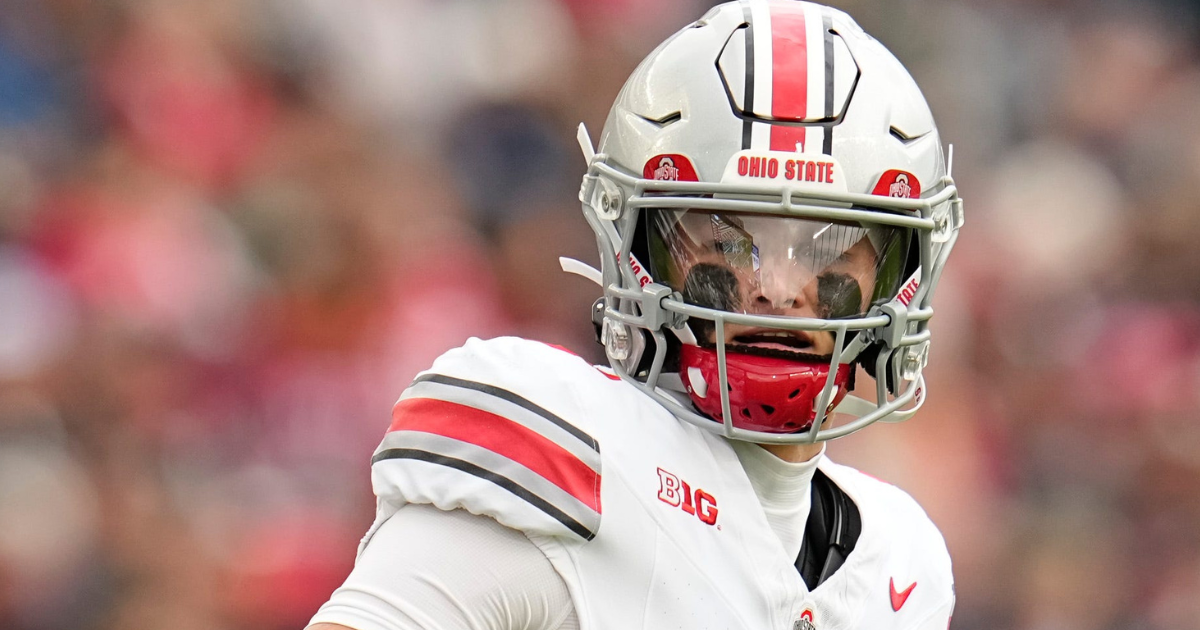
Ohio State quarterback Lincoln Kienholz is committing to Louisville out of the NCAA transfer portal, On3’s Hayes Fawcett has learned. He does so after spending three years with the Buckeyes.
Kienholz competed for the starting quarterback job heading into the 2025 season. He ultimately lost the gig to Alabama transfer Julian Sayin, who piloted the Buckeyes to a College Football Playoff berth.
The third-year player finished the 2025 season 10-of-14 passing for 139 yards and a score, while avoiding any interceptions. He also ran 11 times for 66 yards and two scores.
In three years at Ohio State, Lincoln Kienholz threw for 250 yards and a touchdown. He ran for 68 yards and two more scores. He has a career completion percentage of 58.3%, though it should be noted he was at 78.6% during the 2025 season.
Prior to enrolling at Ohio State, Lincoln Kienholz was ranked as a four-star prospect and the No. 205 overall recruit in his class, according to the Rivals Industry Ranking. He was also ranked as the No. 15 quarterback in his class and the No. 1 overall player in the state of South Dakota, hailing from Pierre (SD) T.F. Riggs.
Kienholz was decorated as a high school athlete. He was a multi-sport star.
In baseball, he batted .472 with six home runs, while also going 3-0 with a 1.24 ERA as a pitcher, according to his Ohio State biography. He also averaged 19.9 points, 7.3 rebounds and 2.8 assists per game on the hardwood as a junior.
On the football field, Lincoln Kienholz was superb in high school. He helped lead his team to three consecutive state championships, throwing for 3,422 yards and 46 touchdowns as a senior, while also rushing for 1,435 yards and 24 scores.
Louisville coach Jeff Brohm was clearly looking for a player with some upside, and he’s likely found it in Kienholz. It’ll be interesting to see what Kienholz can do with the opportunity in a new spot.
According to On3’s Hayes Fawcett, Cal Golden Bears linebacker Cade Uluave plans to enter the NCAA transfer portal. Uluave was one of the best players in college football this past season after being a tackling machine during the 2025 season. Now, the plan is to hit the open market and see what is out there moving forward.
Uluave played in 12 games this past season, recording exactly 100 tackles. Of those, 42 were solos, and the remaining 58 were assisted. No matter how you spin it, Uluave usually finds himself around the football and bringing people to the ground.
Elsewhere, 12 tackles for a loss and three sacks also pop up on the stat sheet. Uluave also recorded five quarterback hurries and five pass breakups when dropping into coverage. No interceptions came during the 2025 season but Uluave does have three throughout his career.
“Invaluable,” former Cal head coach Justin Wilcox said of Uluave preseason. “I mean, when you have a guy who’s got the character traits that Cade has, I mean, he is a solid guy. He’s the real deal human being. And then, I mean, that guy’s a baller. He is a baller. I’ve been around a little while now and seen defensive football players.
“He’s had a couple things that kept him out of games last year with some injuries. But when he’s healthy, like, I don’t know that there’s a lot of guys better than him as a defensive football player. He’s incredibly explosive. He’s got great instincts and he’s a great human being. So, yeah, I’m a big believer in Cade.”
In the end, Uluave is another example of Wilcox developing a quality defensive player. Uluave was just a three-star recruit coming out of Herriman (UT) Mountain Ridge. He finished as the No. 926 overall recruit in the 2023 cycle, according to the Rivals Industry Ranking, a weighted average that utilizes all four major recruiting media companies.
Cal’s official roster bio for Uluave listed him as a junior during the 2025 season. Wilcox continually used Uluave throughout his tenure in Berkley, meaning no redshirt was ever taken. One year of eligibility is expected to remain at whatever school the linebacker ends up at.
You have to imagine plenty of schools are going to be interested. Uluave might wind up having multiple options at his disposal, while new Cal head coach Tosh Lupoi will work hard to bring him back.
Most of the SEC didn’t get their return on rev-share investments over the past two seasons. “Pay-to-play” has been a boon for the Big Ten, which has won the last two College Football Playoff titles and has two teams remaining in this year’s field.
For the “It Just Means More” conference, though, it has evened the playing field in a way the SEC’s elite isn’t keeping up with.
ESPN LA’s Su’a Cravens, who played for the USC Trojans, owners of the No. 1 recruiting class in 2026, celebrated the sport’s massive changes and rubbed it in the SEC’s faces. Cravens did claim that five SEC schools would be able to compete “year in and year out,” though:
The Georgia Bulldogs, Texas A&M Aggies, LSU Tigers, Ole Miss Rebels, and Alabama Crimson Tide.
Cravens blamed it on NIL payments, which are a component of roster-building, but are not direct payments from schools; instead, they come from a third party.
“I absolutely love the correlation between NIL and the immediate parity in CFB! It’s hilarious to see the very theory we all knew was true come to fruition. The moment everybody could pay to play, the SEC’s dominance evaporated. And that doesn’t mean the SEC won’t have good teams, I never said that. I expect UGA, A&M, LSU, Ole Miss, and Bama to be able to compete year in and year out. But being able to compete vs juggernaut dynasties are a VAST DIFFERENCE to what the SEC is accustomed too… It’s almost like once the monopoly vanished, so did the chokehold on college football! I LOVE IT!! Justice has been served,” Cravens said.
Ole Miss, Alabama not guaranteed to be relevant in rev-share/NIL era
Truth be told, Ole Miss and Alabama’s inclusion here may be faulty. Those two programs are not flush with the kind of super-donor alums that the B1G has, and lacks the oil money that Texas A&M and the Texas Longhorns have.
Speaking of which, where is Texas on Cravens’ radar? If there’ a school that could compete when big money is being thrown around, it’s the Longhorns.
In the ever-competitive SEC, teams will shuffle in and out of relevance. Kirby Smart is likely to keep the Dawgs in the hunt, while Lane Kiffin will surely keep program-building his way deep into the CFP.
Other than those two, there are no guarantees for teams in that conference to be competitive year in and year out.
Which may have been the point of rev-share and NIL all along.

Joel Klatt calls out ESPN for CFP broadcast quality, relationship with one conference

Huntington’s Sebek makes Class 3A all-state volleyball third team | Sports

Braxon Vasconcellos Captures His First Career Golden Driller With K&B Motorsports Restricted – St. Louis Racing
Blue Bell/TSWA Class 2A All-State Volleyball – The Gilmer Mirror

Season Review: Union volleyball fought adversity in 2025 season | Sports

‘He’s not only a victim, he’s a hero’ – Metz youth player Tahirys Dos Santos risked his life to save his girlfriend in deadly Swiss nightclub fire

Men’s Ice Hockey Comes Up Short Against Arcadia

LSU RB JT Lindsey plans to enter NCAA transfer portal

Takeaways From Big 12 Opening Win At K-State

Mavericks Conclude Cactus Cup with 4-3 win over Yale – Minnesota State University

Check out the Baton Rouge-area All-Metro Volleyball team | High School Sports

NASCAR star’s top priority clear with unfinished business at Daytona – Motorsport – Sports

Kids bring hockey to the outdoors of Lexington

North Myrtle Beach basketball prepares for 2026 region play | Sports

STM’s Eleanor Guidry named All-Metro Volleyball MVP | High Schools

SoundGear Named Entitlement Sponsor of Spears CARS Tour Southwest Opener

Donny Schatz finds new home for 2026, inks full-time deal with CJB Motorsports – InForum

David Blitzer, Harris Blitzer Sports & Entertainment

DeSantis Talks College Football, Calls for Reforms to NIL and Transfer Portal · The Floridian

How Donald Trump became FIFA’s ‘soccer president’ long before World Cup draw
Elliot and Thuotte Highlight Men’s Indoor Track and Field Season Opener

JR Motorsports Confirms Death Of NASCAR Veteran Michael Annett At Age 39

#11 Volleyball Practices, Then Meets Media Prior to #2 Kentucky Match

Rick Ware Racing switching to Chevrolet for 2026

Colleges ponying up in support of football coaches, programs
West Fargo volleyball coach Kelsey Titus resigns after four seasons – InForum

Maine wraps up Fall Semester with a win in Black Bear Invitational

Nascar legal saga ends as 23XI, Front Row secure settlement

Ross Brawn to receive Autosport Gold Medal Award at 2026 Autosport Awards, Honouring a Lifetime Shaping Modern F1

Temple Begins Indoor Track & Field Season at UPenn This Weekend





-
 Motorsports3 weeks ago
Ross Brawn to receive Autosport Gold Medal Award at 2026 Autosport Awards, Honouring a Lifetime Shaping Modern F1
-

 Rec Sports3 weeks ago
Stempien to seek opening for Branch County Circuit Court Judge | WTVB | 1590 AM · 95.5 FM
-
 Rec Sports2 weeks ago
Princeton Area Community Foundation awards more than $1.3 million to 40 local nonprofits ⋆ Princeton, NJ local news %
-
 NIL3 weeks ago
Downtown Athletic Club of Hawaiʻi gives $300K to Boost the ’Bows NIL fund
-
 NIL3 weeks ago
Kentucky AD explains NIL, JMI partnership and cap rules
-

 Rec Sports3 weeks ago
Teesside youth discovers more than a sport
-

 Sports3 weeks ago
Young People Are Driving a Surge in Triathlon Sign-Ups
-

 Motorsports3 weeks ago
PRI Show revs through Indy, sets tone for 2026 racing season
-

 Sports3 weeks ago
Central’s Meyer earns weekly USTFCCCA national honor
-
 Sports3 weeks ago
Three Clarkson Volleyball Players Named to CSC Academic All-District List