The 2025-2026 college football postseason has exposed a glaring truth that should lead to major changes throughout the sport: other conferences have caught up with or surpassed the SEC.
For years, the SEC was the dominant force in the sport, thanks mostly to the success of Nick Saban’s Alabama Crimson Tide teams in the 2010’s, and Kirby Smart’s Georgia. But their performance in bowl games and the College Football Playoff the past two seasons has dealt a permanent blow to that reputation. Even if the conference’s fans, media partners, and boosters won’t acknowledge it.
Vanderbilt quarterback Diego Pavia said about staying in the SEC for 2025, “You want to play with the best — you don’t want to play with the Big Ten.” He wasn’t done, adding, “…the SEC, it’s like week after week. You’re going to get beat on. The Big Ten, you’re not gonna get beat on with the Purdue, Nebraskas.”
Then, before the ReliaQuest Bowl, he said it would only take “7 points” to beat the Iowa Hawkeyes. He lost 34-27. Whoops.
Illinois beat the Tennessee Volunteers in the Music City Bowl, marking the second consecutive season the Illini beat an SEC team in a bowl game. Virginia held Missouri to just seven points, winning 13-7. Houston, literally Houston, beat LSU 38-35. “You want to play with the best,” indeed.
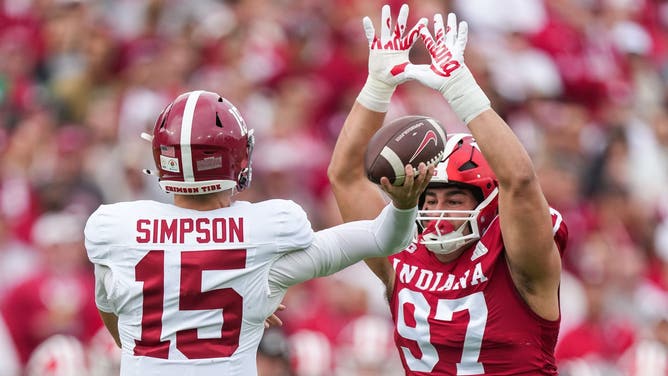
Texas A&M, a team that went 7-1 in the SEC and was hailed by Lane Kiffin in November as the No. 1 team in the country because of their conference success, scored just three points at home against Miami. Then, the pièce de resistance: the Rose Bowl. The Indiana Hoosiers humiliated Alabama in a 38-3 defeat, which undersells just how thoroughly they dominated.
RELATED: Alabama Never Should Have Been In The Playoff; Rose Bowl Loss Hurts ESPN, SEC’s Reputation
Oh, and for good measure, Mississippi State lost to Wake Forest. Nothing like the week in, week out gauntlet of the SEC. All these examples drive home an obvious point: the SEC’s advantage over competitive conferences has evaporated. And a new report may explain how and why.
Alabama Crimson Tide quarterback Ty Simpson throws the ball against Indiana Hoosiers defensive lineman Mario Landino. (© Grace Hollars/IndyStar / USA TODAY NETWORK via Imagn Images)
Has NIL Changed SEC’s Advantages?
The Athletic’s Bruce Feldman is out this week with a new story, talking to opposing coaches about the SEC’s dismal postseason performance. Right away, one Power 4 offensive coordinator highlighted how the narrative about conference superiority needs to change. And quickly.
“Ultimately,” the coach said, “and this is y’all’s job, not my job, but there needs to be an evaluation of this narrative of the SEC is these big, bad m————, because they’re getting their asses whipped in these games.”
The SEC team in bowl and playoff games is 2-7 against other conferences. One of those wins was Texas over Michigan, a team that saw head coach Sherrone Moore fired in shocking, spectacular fashion just a few weeks ago. The SEC team was the favorite in seven of those nine games.
That same offensive coordinator he quoted earlier said that the explanation for this dramatic about face is that NIL has leveled the playing field, paving the way for other teams to, shall we say, provide financial incentives for players.
“The reality is this, there were some very famous, very successful coaches that were having a lot of success when the NIL was illegal,” he added. “Well, now NIL is legal. I saw what (former LSU head coach Ed) Orgeron said about how now you can walk through the front door with the money. Well, now the players are going everywhere.”
Another Big Ten assistant coach told Feldman over the weekend, “Hard to ignore the fact that when everyone got to pay players, it leveled the playing field immediately. They can deny all they want, but that’s a fact.”
While some defend the SEC by repeating the same “gauntlet” argument, one Group of 5 head coach agreed that the legality of NIL has shifted the balance of power, saying “There’s some truth to that too, I think that’s accurate.”
And there’s more to it than that.
Quality Depth Has Evaporated Thanks To NIL
It’s clear that many top SEC programs were providing some sort of financial benefits to players before NIL. Though that was almost certainly happening at other top programs in different conferences across the country. But it’s not just that the top players were choosing to go where they could benefit the most, it’s the second and third tier players going elsewhere that’s changed the competitive balance.
Now, instead of say, going to be the second string guy for Nick Saban at Alabama because of the likelihood of winning a championship and reaching the NFL eventually, that same recruit from Florida or Texas might go play at Miami or Texas Tech or Indiana, because they can start, make more money, and still compete for a title and reach the NFL.
That’s hollowed out the depth of talent at SEC programs, in much the same way that USC’s ridiculous, monstrous penalty from the NCAA in the early 2010’s destroyed their depth. Now, when the inevitable injuries hit, teams like Bama or Georgia aren’t able to replace their starting players with high-level talent. Those players are starting at Oregon instead of sitting in Athens.
It’s obvious, taking more than a handful of seconds to analyze it, that this makes sense. Every top team was paying players before, but the SEC was better at it. Sitting at Alabama may have had more value than starting at Indiana just a few years ago. Now it doesn’t. Having the legacy and big brand name doesn’t matter much anymore, because the transfer portal has allowed any program to get established talent if they have the money.
What does this all mean? Well, the push to view the SEC differently than other conferences has to stop. Immediately. Allowing Greg Sankey and his ESPN promotional department to repeat the word “gauntlet” because Missouri and Tennessee are ranked despite not winning a single game over a team with a winning record is a farce. Acting as though one conference deserves preferential treatment, like, say, having its championship game be a meaningless exhibition, must end. The relentless demand for more SEC teams in the playoff needs to end.
And the worst part is, Sankey and the SEC booster club at ESPN are only going to get louder in 2026. Why? Because they’re now going to play nine conference games. While this change is, in a way, beneficial by forcing the SEC to finally have the same number of conference games as the Big Ten, it’s also going to make their demands even louder. Fewer opportunities to compare teams across conference. Marquee matchups across conferences have already been canceled. And the insistence on never punishing losses in the SEC will only grow. “How can we leave out four loss Alabama,” the argument will go, “when they played the SEC gauntlet?!”
Those arguments, those boosters, the ESPN propaganda campaigns, all of it…is based on a past that no longer exists. The future is here, and with it, the end of acting as though one league gets a pass because its teams were good a decade ago.